In this article
TL;DR
Traditional agency qualitative research runs for 6 to 12 weeks, so findings usually arrive after the launch brief, retail calendar, and shade range are already locked in.
Surveys are fast but can't capture the hesitation, contradiction, or exact phrasing behind a preference score.
AI-moderated video interviews close that gap, running in parallel across markets and returning clip-backed, timestamped findings that provide actionable insights while the decision is still open.
Defensible beauty research depends on behavioral segmentation, episodic recall, and displacement probing. Demographic profiles and "sounds good" reactions leave findings exposed in review.
Governance risk in beauty research centers on participant authenticity, GDPR/CCPA compliance when handling sensitive personal data, and the leakage of stimuli for unlaunched concepts.
Beauty market research findings that cannot be traced to a real participant rarely survive a stakeholder review. A persona without a supporting clip, a positioning claim without a verbatim quote, a pack hierarchy without a recorded hesitation: these get challenged in the room, and the team presenting them has nothing to stand behind. The data analysis is usually sound. The problem is timing: the evidence arrives too late to be usable.
Traditional qualitative beauty consumer research runs 6 to 12 weeks through agencies. By the time synthesis lands, the launch brief is written, the retail calendar is locked, and the shade range across multiple beauty categories has been signed off. The research confirms what the team suspected, or contradicts a decision that cannot be reversed. Either way, it does not change anything.
Surveys move faster but hit a different wall. Cosmetics market research based on closed-ended survey data shows that 62% of shoppers say convenience outranks price. It cannot capture the pause before that answer, the contradiction two questions later, or the exact phrase a participant uses when she explains why the packaging feels wrong for the occasion. That texture is where positioning actually comes from.
AI-moderated video interviews change the sequence. Sessions run in parallel across time zones, with adaptive probing that follows what participants actually say. Findings arrive backed by clips, verbatim quotes, and timestamped recordings, providing valuable insights while the decision is still open.
Why beauty market research fails to inform launch decisions
Three failure modes show up again and again, and they compound each other:
Unsupported personas. Workshop-built traits like "values authenticity" or invented scales like "7/10 tech-savvy" fail stakeholder reviews for one reason: no participant ever said them, and no evidence ties them to real consumer expectations.
Timeline lag. Qualitative research in the beauty industry typically runs for 6 to 12 weeks through agencies, so launch decisions and retail calendar commitments are already locked in by the time the findings arrive. Teams end up defending personas built on assumption rather than evidence.
Staleness. Emerging trends now spread across social platforms faster than annual or biannual refresh cycles can keep up with, so personas that were directionally accurate during fieldwork are often out of date by the time they reach the briefing room.
Demographic splits make it worse. Segmenting by age, income, or region tells a team who their shopper is, but leaves unanswered why she chose one skincare brand over another among competing beauty brands, or why a packaging claim fell flat at the fixture in retailers like Ulta Beauty and Sally Beauty. Surveys close part of the gap: a survey can report that 62% of participants prefer convenience over price, a data point that quantifies consumer preferences but strips away the reasoning behind them. The result is predictable: teams either launch without the evidence they need, or wait for research that arrives too late to identify areas the concept needs to change before shelf date.
How AI-moderated interviews deliver traceable beauty consumer insights
Beauty consumer insights programs run on retail calendars set by beauty retailers and internal launch teams, rather than waiting for 10-week agency timelines. AI-moderated video interviews close that gap by running asynchronously and in parallel across every market at once. Instead of sequencing a US wave, then a UK wave, then Germany, then Japan over months, a global skincare brand can field reformulation-sensitive repurchaser interviews across all four markets simultaneously, delivering clip-backed findings in days rather than months.
The traceability mechanism is what makes those findings defensible beyond the insights team. Conveo's AI moderator captures voice, tone, and video throughout every session, then ties each theme to timestamped clips. When a stakeholder asks, "Where did this come from?" the answer is a specific moment in a specific conversation, delivering nuanced insights rather than a synthesized summary with no visible source.
Industry experts increasingly note that beauty trends now shift within a single quarter. K-beauty routines and ingredient-led product ideas illustrate how quickly a promising concept can move from niche to mainstream.
Beyond traceability, three further advantages compound:
Multi-market reach. AI-moderated interviews in 50+ languages produce comparable reads worldwide within days.
Compounding knowledge. Every study feeds a searchable insight library, so clips, themes, and quotes from a reformulation study remain retrievable when the next concept test surfaces a related question.
Procurement-ready compliance. SOC 2 Type II certification, GDPR compliance, and EU hosting (Belgium) remove a common procurement blocker before legal review begins.
Comparison table: Beauty market research methods
| Agency-led qualitative | Survey platforms | AI-moderated interviews | |
|---|---|---|---|
| Timeline | 6 to 12 weeks | Days to weeks | Typically days |
| Traceability | Summary decks, no clips | Aggregate scores, no verbatim context | Timestamped video clips tied to every theme |
| Multi-market capability | Sequential, localization delays | Simultaneous but no cultural nuance | Simultaneous in 50+ languages |
| Output format | Stakeholder-ready decks | Dashboards and crosstabs | Clip reels, quote-linked findings, searchable library |
| Cost structure | Higher per-study investment | Lower per-study investment | Contact for a quote |
| Best use case | Custom ethnographies, 6-month lead time | Quantified preference scores, 5,000+ participants | Concept testing, claims validation, persona refresh |
Compliance data reflects publicly available information as of August 2026. Verify directly with vendors.
Choosing the right beauty consumer research method for your study type
Most beauty companies default to two methods: commission an agency for deep qualitative work, or field a survey for fast quantification. Neither covers what modern product and innovation calendars actually require.
Agency-led research services deliver genuine expertise: custom discussion guide design, skilled moderation, stakeholder-ready decks. What they leave out is clip-level traceability, the ability to run across five markets simultaneously, and a timeline that fits a launch calendar. Timelines typically run 6 to 12 weeks from brief to debrief, so findings often arrive after the packaging brief has closed or the launch date has been set.
Survey platforms, built on structured survey data, solve the speed and scale problem, returning preference scores, market share estimates, and claimed purchase intent across price tiers. What they leave out is the hesitation before someone answers and the exact words a consumer uses when a serum's claims feel overpromised.
AI-moderated interviews deliver traceable, clip-backed findings in days, enabling concurrent conversations across multiple markets within a single study, whether the study is testing a serum claim or tracking a shift in lipstick sales tied to a new shade range. Use cases include concept testing, product testing, claims validation for skin care products, packaging evaluation, messaging hierarchy, persona refresh, and continuous discovery.
The decision heuristic: if the decision window is open and you need defensible participant evidence, use AI-moderated interviews. If you need quantified preference scores across a broader target market, use surveys. If you need a six-month ethnographic study or a broader competitive analysis, use an agency. Most beauty teams use all three to capture growth opportunities at every stage of the launch calendar.
Operational framework: Running beauty market research that produces defensible findings
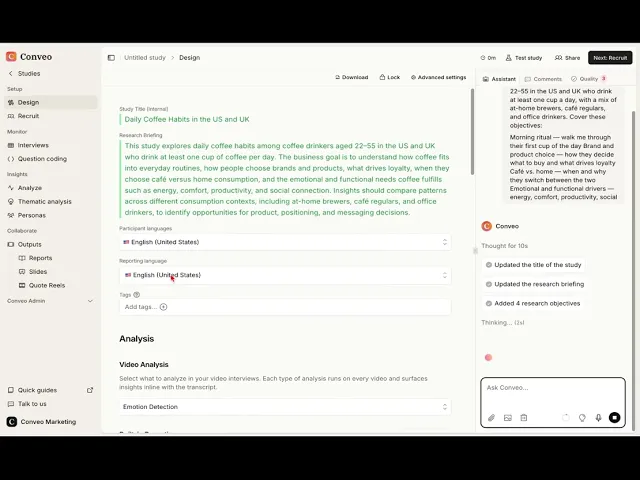
Most beauty concept and product testing programs fail because the recruiting is wrong, even when the questions are right. Here is the framework that prevents that.
Watch the walkthrough: Setting Up a Research Study in Conveo
1. Define behavioral segments before recruiting
Demographic profiles tell you almost nothing about why a shopper chooses one brand over another, or how she fits into a brand's broader target market. Define segments by behavior instead: what participants use now, what they've rejected, what triggered their last switch. A reformulation-sensitive repurchaser and a trial-driven switcher may look identical on paper but sit at opposite ends of the same customer base. Recruit 5 to 15 participants per segment, representative of the target audience, to reach saturation without incurring costs from redundant interviews.
2. Design the discussion guide around episodic recall
Scenario-based questions force participants to describe what actually happened in their daily routines rather than what they imagine they'd do. Establish baseline behavior before introducing any concept, so switching costs and real alternatives surface first.
3. Probe for displacement as well as appeal
When a participant says "interesting" or pauses, that signals a claim, a price tier, or a proof gap isn't landing. Adaptive probing helps identify the actual blocker; "what would you stop using to make room for this?" is the most revealing question you can ask.
4. Add a shelf-choice probe for packaging tests
Ask which pack a shopper would reach for next to a competitor's product at retailers like Ulta Beauty or Sally Beauty. This catches standout failures and claim-hierarchy mismatches before they reach production and affect sales at retail.
Output requirement: clip reels tied to specific quotes give brand, insights, and product teams the actionable insights they can align on, and make it easier to identify areas for the next study.
Governance and compliance considerations for beauty consumer research
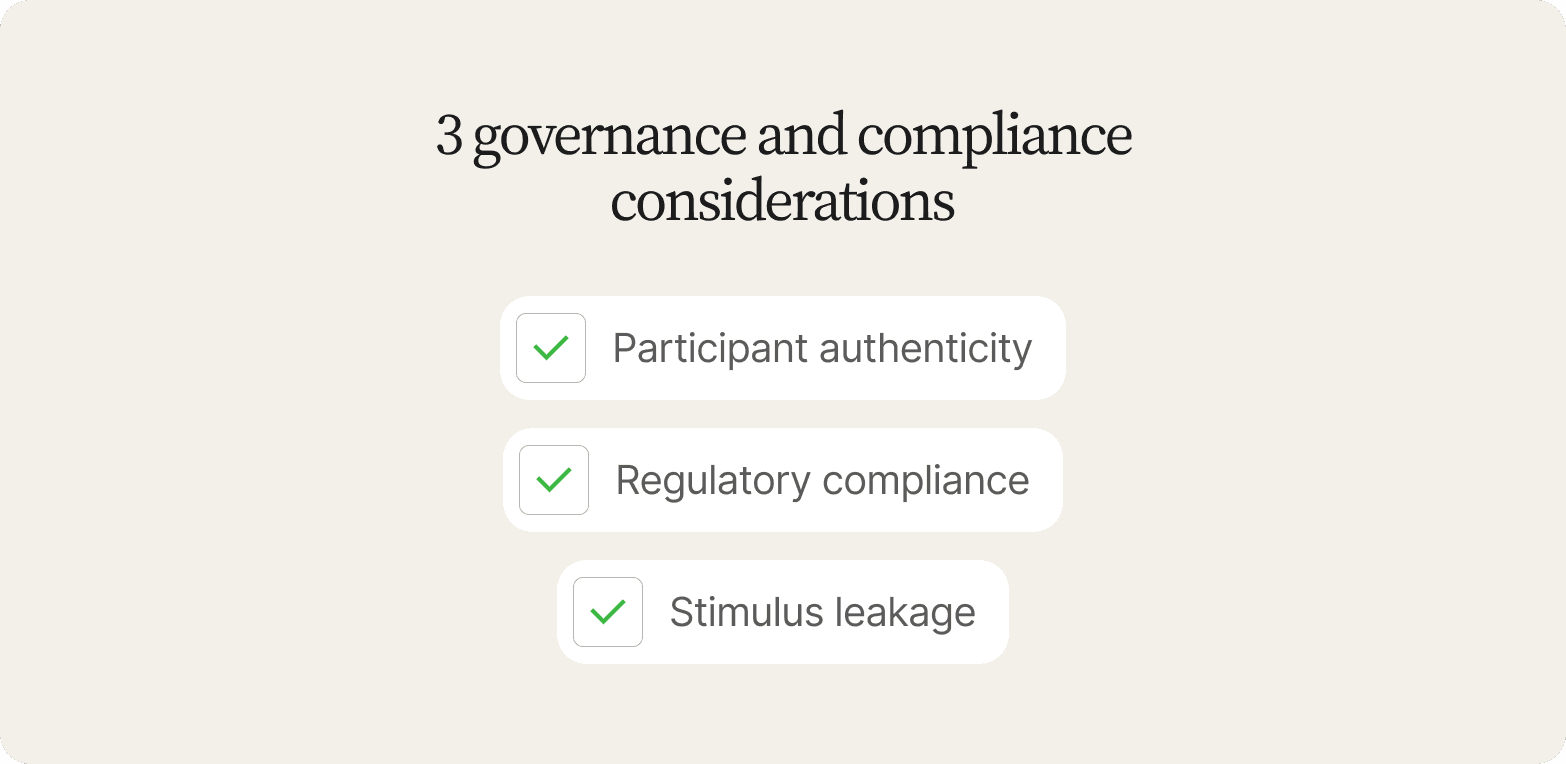
Beauty research carries three governance risks most platform evaluations underestimate:
Participant authenticity
Personal care consumer insights often involve sensitive subject matter, skin conditions, hair loss, and aging concerns, so screening for consumer needs rather than assumptions is a methodological requirement.
Regulatory compliance
Video and voice recordings constitute personal data under GDPR and trigger CCPA obligations at scale in the US. SOC 2 Type II certification, GDPR compliance, and EU hosting (Belgium) have moved from preference to table stakes.
Stimulus leakage
Concept decks and packaging mockups often contain proprietary formulation details, so participant access controls and NDA workflows are required, since a leaked claims deck can move lipstick sales before a brand is ready to talk about it.
Legal review is where vendor approvals most often stall. Platforms with documented compliance credentials move through review faster, giving beauty organizations a competitive edge in getting studies fielded sooner.
Why beauty and CMI teams choose Conveo for defensible research
For beauty companies running more studies than budget and headcount allow, the case for Conveo starts with always-on understanding, with speed as supporting proof. Teams use Conveo StoryLines, a wave-based, continuous research program, to hold consumer understanding between tracker waves, ensuring evidence is in place before the next launch decision and supporting growth across the beauty portfolio as demand shifts.
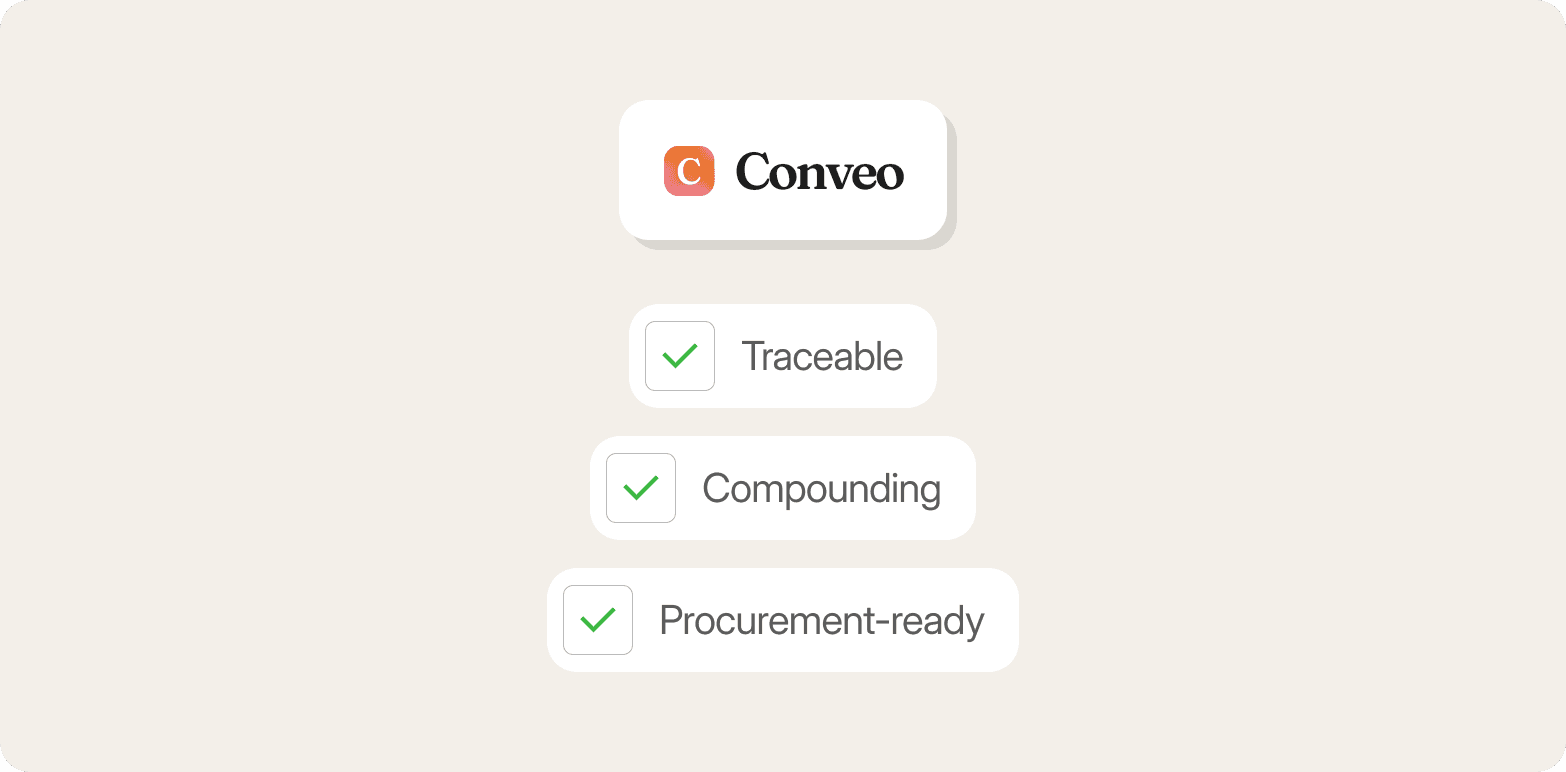
That understanding holds up under scrutiny:
Traceable. Every finding traces back to a real participant, a verbatim quote, and a video timestamp, so stakeholders can act on strategic recommendations grounded in evidence rather than opinion.
Compounding. Each study feeds a searchable insight library, and growth opportunities that surface in interviews often appear weeks before they show up in sales data.
Procurement-ready. SOC 2 Type II certified, GDPR compliant, EU hosting (Belgium) means sign-off doesn't stall the timeline, whether the company runs five studies a year or fifty.
Frequently Asked Questions
What is beauty market research?
The systematic study of consumer behavior and decision drivers across beauty categories, including skincare, cosmetics, haircare, fragrance, sun care, and personal hygiene. It spans qualitative methods (interviews, focus groups, ethnographies) and quantitative methods (surveys, conjoint analysis, brand trackers) to inform product development, claims validation, and messaging. The core challenge is timing: traditional research runs for 6 to 12 weeks through agencies, so findings often arrive after launch decisions are locked in.
What are the best methods for beauty consumer research?
It depends on the decision. For concept testing and claims validation, AI-moderated video interviews deliver traceable, clip-backed findings in days; participants are 68% more open than with a human moderator, delivering nuanced insights a survey score alone can't capture. For quantified preference scores across large samples, surveys and conjoint analysis provide statistical confidence about broad consumer expectations, but miss the contradiction between what participants say and how they react. For deep cultural immersion, agency-led ethnographies remain the richest option, though at the cost of a 6- to 12-week timeline.
How do you recruit participants for beauty and personal care research?
The most common failure is defining segments by demographics alone, without mapping them to the actual target audience. Define behavioral segments before recruiting, built on what the participant actually does. Typically, 5 to 15 participants per segment are enough to reach saturation without redundant interviews. Source through Conveo's integrated panel network with fraud screening, or bring your own lists via CSV, QR code, or WhatsApp.
What is the difference between beauty market research and cosmetics market research?
The terms are used interchangeably in most professional contexts. "Beauty market research" typically covers the broader category, skin care products, haircare, fragrance, sun care, personal hygiene, and color cosmetics, while "cosmetics market research" sometimes refers specifically to color cosmetics. The methods and operational frameworks are identical across both.
How long does beauty market research take?
Agency-led qualitative research runs 6 to 12 weeks from kickoff to final deliverable. Surveys are faster, days to a few weeks, but rarely answer the why behind a reaction. AI-moderated video interviews deliver traceable, clip-backed findings in days because async interviews run in parallel, allowing teams to cover multiple segments simultaneously rather than sequentially.
What are common mistakes in beauty consumer research?
Recruiting by demographics alone, producing audiences that look identical on paper but have different purchase drivers. Accepting "sounds good" responses instead of prompting episodic recall. Showing concepts before establishing baseline behavior, which hides real competitive alternatives. Delivering summary decks without clips or quotes, which makes findings indefensible when stakeholders push back.
About the author
Charlotte Morelli
Research Impact Lead
Charlotte studied economics, joined Opinium as a research analyst and left it as a research manager, with Charles among her clients. She partners with clients as a researcher and thought partner, runs several StoryLines programs, and was the first person in the New York office. Outside work she screen prints her own art onto shirts.
Meet Charlotte on film →Qualitative insights at the speed of your business.
Conveo runs AI-moderated video interviews and structures everything they say.