In this article
TL;DR
Best for: brand, marketing, and innovation teams who need consumer validation before a decision window closes.
Most concept testing questions fail on sequence: teams measure appeal before confirming comprehension, so even strong product ideas get scored against a misreading. Participants respond based on what they think the concept means, yielding scores that signal confidence without earning it.
The fix is a decision-first framework: map your question modules to your research objectives and the specific decision you need to make, whether that is a go/no-go call, a positioning choice, a feature tradeoff, a pricing range, or a creative route selection.
Below is a categorized, copy-paste concept testing question bank with guidance on what each answer actually means.
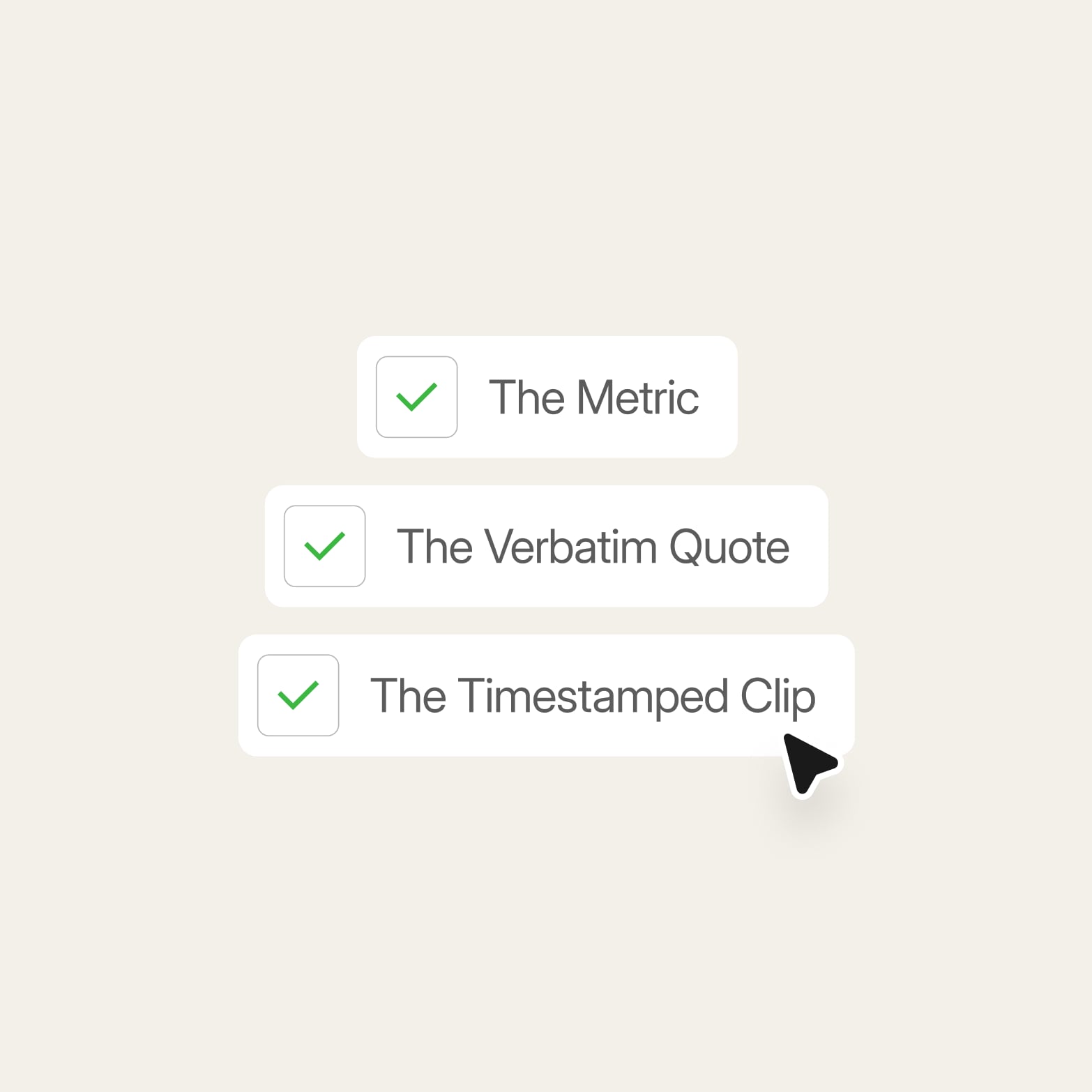
Findings are packaged as evidence combining a metric, a verbatim quote, and a clip reference, so the finding lands intact in rooms the researcher is not in.
When the brief is due Thursday, and the insights team is three projects deep, consumer input arrives after the call has already been made. You need concept testing questions that work. A generic concept testing survey template collects polite, inaccurate ratings.
The core problem with most concept question sets is sequence. Fixed surveys, and online surveys in particular, measure appeal before confirming what a participant understood the concept to be. A participant who misread your positioning still gives you a score. That score goes into a deck, the deck drives a decision, the concept fails in market, and nobody knows why.
This guide is for brand, marketing, and innovation teams conducting initial validation ahead of a full study, or briefing a market research partner on what to ask. It is built to sharpen your collaboration with your insights function.
Why most concept testing questions fail
Appeal scores and purchase-intent questions are only meaningful if the person scoring them understands the concept correctly, and that assumption fails more often than teams expect. A participant forms a rough mental model of the concept, then rates it against that model rather than the one the team intended. Survey respondents who misread the concept still produce a score. The survey records it, the team records a win, and neither party knows they were evaluating different things.
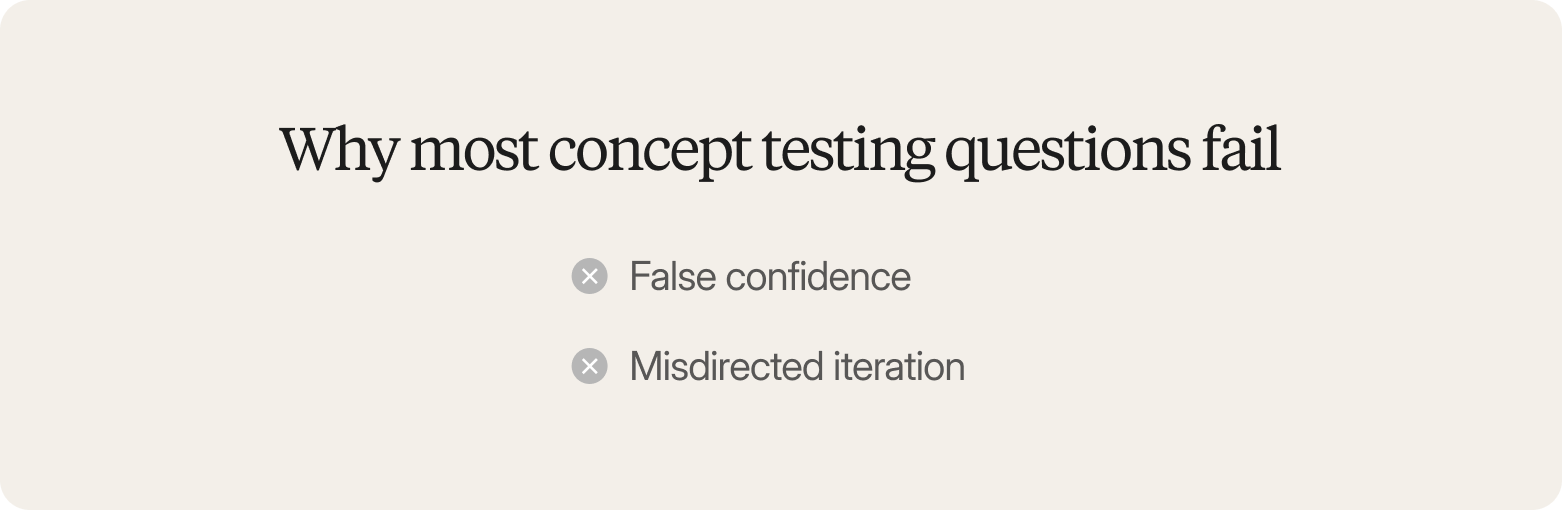
That produces two failure modes which look identical in the data:
False confidence. The concept scores well because it sounds broadly appealing, but the appeal is detached from the benefit the product actually delivers. Teams go into launch believing they have validated market demand, when they have validated a vague positive impression.
Misdirected iteration. The concept scores poorly, so the team changes the wrong element. The data cannot tell them whether the problem was the claim, the language, the format, or a comprehension failure upstream.
Both share a root cause: the order of questions. "In your own words, what does this do?" must precede "How likely are you to buy this?" This is where fixed surveys fall short compared with other available concept testing methods. A survey cannot adapt when a participant misunderstands.
The decision-first question framework
Most concept testing research guides list question types without connecting them to the research objectives or the decision to be made. The result is a discussion guide that covers everything and answers nothing.
Start by naming your decision type, then select the modules that serve it.
| Decision type | The call you are making | Primary signal | Method |
|---|---|---|---|
| Go/no-go | Does this concept merit moving forward? | Purchase intent | Monadic |
| Positioning choice | Which message frame resonates, and with whom? | Emotional fit and language match | Sequential monadic, 2 to 3 territories |
| Feature tradeoff | Which capability earns its place in the offer? | Relative importance | Monadic per feature set |
| Pricing range | What range avoids rejection and undervaluation? | Perceived value relative to cost | Monadic |
| Creative route | Which direction generates the response the campaign needs? | Emotional reaction and memorability | Sequential monadic, 2 routes |
Go/no-go
Comprehension check: one open-ended item confirming the new concept landed as intended
Overall appeal rating
Purchase intent questions on a scale
One open probe: what, if anything, would stop the participant from buying
Each participant sees one concept, evaluated without comparison pressure, which keeps the intent signal clean.
Positioning choice
First impression, open-ended and unprompted
Relevance to the participant's own situation
Distinctiveness versus what participants already know
Follow-up probe: which words would they use to describe this to someone else?
Recruit against your target market rather than a general population sample. Brand perception shifts sharply across segments, and an average read hides those shifts.
Feature tradeoff
Feature comprehension
A must-have versus nice-to-have sort that includes existing features as reference points
A qual probe on the use case each feature solves
MaxDiff ranks customer preferences and stops there. Conveo's MaxDiff module pairs the ranking with an open follow-up, so the preference order comes with the reasoning behind it.
Pricing range
Value-for-money rating
An open probe on perceived value and price sensitivity
Follow-up: what would the participant expect to give up at a lower price?
Read the result against the customer expectations the category has already set. Keep it monadic: price sensitivity is distorted when participants compare concepts side by side.
Creative route
First-word association, open-ended
Emotional response scale
A probe on what the concept makes the participant want to do next
This is the module that stops marketing campaigns from committing production budget to the weaker of two creative concepts.
Concept testing question bank: What to ask
Each module below pairs a scaled anchor question with a follow-up probe, because a number without a reason is a score without a story. The same logic applies whether you are writing survey questions or a moderated discussion guide.
| Question module | Sample question | What it tells you |
|---|---|---|
| Comprehension | "In your own words, what is this product and what does it do?" | Whether the concept communicates its core idea as intended, or generates misinterpretation that makes downstream scores meaningless |
| Differentiation | "Compared to what you currently use, how different is this?" (1 to 5 scale) + "What makes it feel different, or not?" | The competitive reference set participants hold, and whether the competitive advantage you believe you have is meaningful or cosmetic |
| Relevance | "Walk me through a situation where you would actually use this." + "How often do you encounter the problem it solves?" | Whether the use case is real and recurring, or aspirational. Participants who struggle to place the concept in a specific scenario are signaling a relevance problem |
| Believability | "How believable do you find the claims made here?" (1 to 5 scale) + "Is there anything that feels like an overstatement?" | Whether the value proposition lands as credible. Concepts can score high on appeal and low on believability at once, which is a messaging fix rather than a product fix |
| Barriers | "What, if anything, would stop you from choosing this?" + "What would have to be true for you to switch from what you use now?" | The real friction potential customers face: price, habit, trust, or distribution. This is where the most actionable findings live, and where a scaled question alone returns almost nothing |
| Pricing | "What price would make this feel like good value? What price would make you question the quality?" + "At [price point], what's your reaction?" | Price sensitivity range and the value anchor participants use. In an ad concept testing scenario, it also reveals whether the creative sets the right price expectation before the product page does |
The module structure maps directly to debrief decks: one slide per module, with the scaled score and the verbatim alongside it.
Why scaled questions alone are not enough
Most platforms frame qualitative concept testing as adding open-ended survey components to a rating scale. Scaled survey responses indicate that three of five participants rated the believability low. An adaptive follow-up probe tells you that two of those three were reacting to the efficacy claim in the second line. The price point you assumed was the problem barely came up. Those are different briefs for different teams, and the most valuable insights usually sit in that gap.
Teams using Conveo's AI research assistant get both in a single session. A participant rates differentiation as a three, and the follow-up comes immediately: "You mentioned it didn't feel that different. What are you comparing it to?" The answer is captured on video, timestamped, and surfaced as a clip in the qualitative analysis, where it is grouped with every other response naming the same reference frame.
That clip becomes the slide in the debrief. The brand director who wasn't in the session watches 90 seconds of a real consumer explaining the competitive reference frame in their own words, and the positioning conversation changes. The number and the reason arrive from the same person in the same session.
"You see them physically doing it. Testing the product for the first time, being probed right there. That unfiltered, in-the-moment reaction is possibly the most powerful thing you can see as a researcher."
Dafydd Jones, Associate Director, Ninth Seat
5 questions to avoid and why
Five question-design failures recur in concept testing surveys and moderated guides alike. Each traces back to the same root problem: if a participant hasn't understood the concept, every answer they give measures something other than what you think it does.
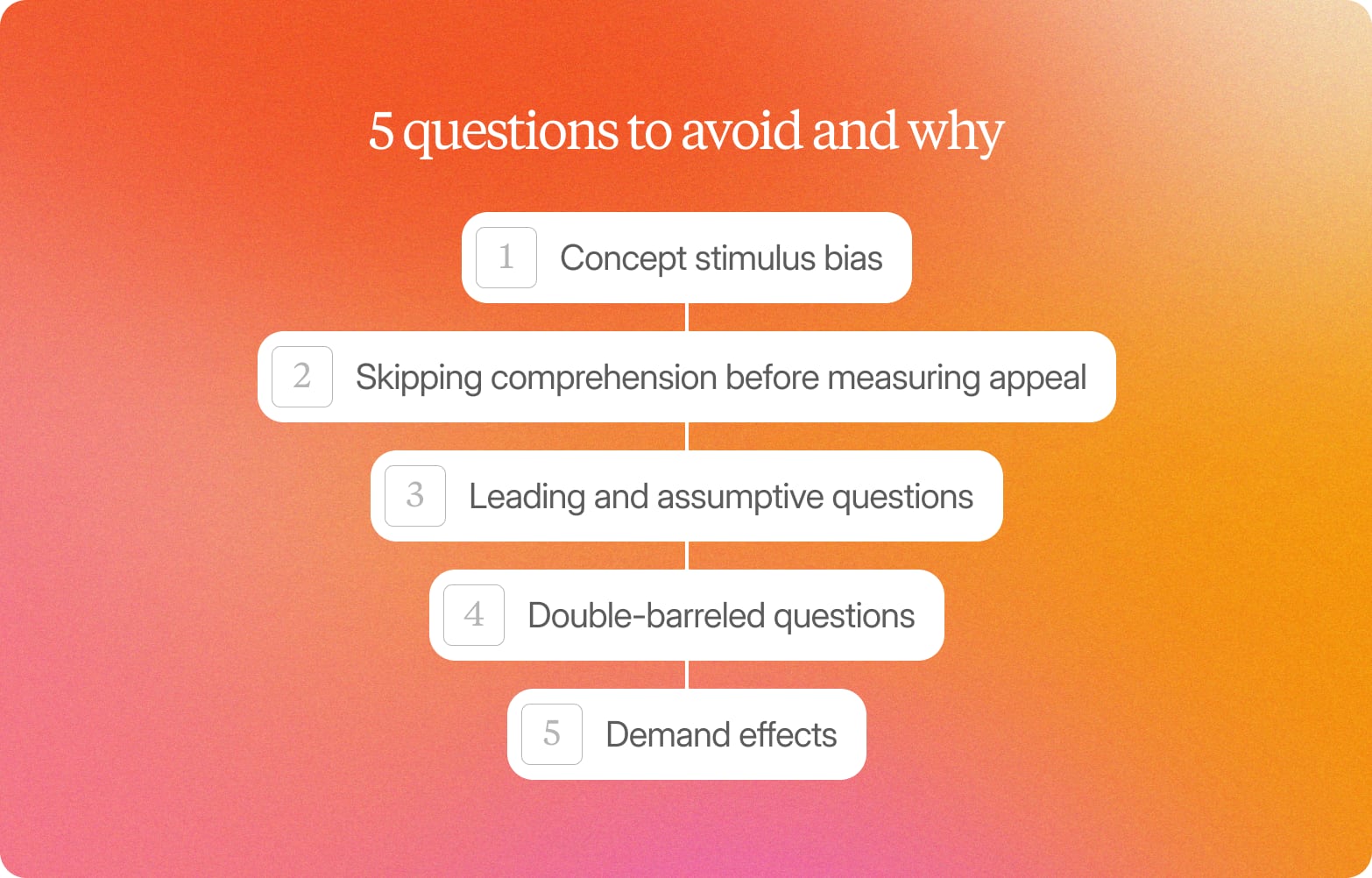
1. Concept stimulus bias
The way a concept is framed before a single question is asked already shapes the response. Premium packaging photography, a polished brand name, and an aspirational headline create a halo that inflates appeal scores before participants process the idea. Teams report that stripping stimulus back to a plain-text description, or testing it unbranded first and branded second, produces materially different appeal readings.
The test: if your stimulus could double as an ad, it's doing persuasion work, and that work inflates the comprehension read.
2. Skipping comprehension before measuring appeal
The most consequential sequencing error in concept testing. Ask "How appealing is this product to you?" before confirming what the participant thinks the product does. The appeal score reflects a mix of concept clarity, category familiarity, and stimulus quality. A participant who read the concept as a subscription service when it's a one-time purchase will rate appeal on the wrong product.
The fix: ask participants to describe the concept back in their own words first, then move to appeal. The full sequence is in the next section.
3. Leading and assumptive questions
Compare: "How much do you like the convenience this product offers?" versus "What, if anything, did you find convenient about this product?" The first assumes the product is convenient and asks only for degree. It produces inflated scores and no reliable feedback on whether participants perceived that benefit at all.
The fix: neutral and open. Teams defending study design in stakeholder reviews should be able to explain why their survey questions are neutral in direction as well as in wording.
4. Double-barreled questions
These collapse two evaluations into a single response slot, rendering the collected data uninterpretable. "How clear and appealing is this concept?" is the classic form. A participant who finds the concept crystal clear but completely unappealing has no honest answer available, and the muddled middle score reads as moderate performance on both dimensions.
The fix: one construct per question, always.
5. Demand effects
Participants often sense what a study is designed to validate and adjust accordingly. Social cues push even honest participants toward agreement. Questions framed around a named brand, or placed after earlier questions that have primed enthusiasm, systematically skew consumer responses higher.
AI-moderated interviews reduce this pressure. With nobody in the room to read, participants have less reason to manage the answer, and teams report that criticism surfaces more plainly where a concept has problems worth surfacing.
Sequencing comprehension before appeal
A purchase intent score attached to a misread concept measures noise and reports it with a confidence interval. Build the sequence in four steps:
Expose the concept without commentary. Let participants respond before a moderator frames what it should mean. First impressions, unanchored, are the closest proxy to a real-world encounter.
Capture the interpretation. Ask participants to describe the concept in their own words before any rating question appears. Participants who misread it stay in the study, flagged, and their responses form a separate stream that shows where the concept's communication breaks down.
Probe the interpretation. If a participant describes the concept differently from the intended positioning, that gap is the finding. A scripted survey moves on. In an AI-moderated interview, the participant gets asked directly: "You described it as X. What made you read it that way?"
Attach appeal scores to the interpretation that produced them. Without the comprehension record, a low appeal score could mean the concept was understood and rejected, or never understood at all.
Teams build this sequence into the discussion guide in Conveo: the AI research assistant asks participants to describe the concept before any appeal question, and probes any misread in the same session. Every score then arrives with its interpretive context, which is where teams gain deeper insights than a rating alone can carry. In a representative scenario, the useful output reads:
"Concept B was read as a premium product by 60% of participants and a budget option by 40%, and the two groups rated appeal in opposite directions."
The same split can diverge again across different demographic groups, which is the pattern a single average hides. Read splits like this as diagnostic patterns within a base of 20 to 30 participants; projectable incidence for the category needs a quantitative wave.
Running concept tests that fit decision timelines
The objection surfaces in almost every planning conversation: "We'd love consumer input, but we don't have time for qual." It's reasonable when traditional qualitative market research means weeks of recruitment, scheduling, moderation, and synthesis before a finding reaches anyone who can act on it.
Asynchronous AI moderation changes the arithmetic of gathering feedback. Instead of scheduling one-hour sessions with eight participants across two weeks, teams publish a study link and participants complete video interviews on their own schedule, in their own words. Because the study runs on Conveo, the follow-ups track the hesitation, skepticism, or enthusiasm in what that person actually said, across 50+ languages. Conversations run in parallel, and qualitative analysis completes as recordings arrive. Teams report reaching 100 interviews in 3 days.
That means teams can conduct concept testing against three common decision gates:
Before brief lock. A directional test with 20 to 30 participants identifies which territory resonates and what's missing. This is the cheapest point at which to validate ideas while the brief is still open.
Before creative route selection. Test two or three routes with target customers in your priority segment. AI-moderated interviews surface the emotional response and the reasoning behind it, alongside the preference score.
Before pricing or product launch decisions. Probe perceived value and price sensitivity in the same session where participants react to the concept.
The moment someone pauses at a price point or reframes a benefit in their own language gets captured in the conversation itself. That is what effective concept testing looks like on a compressed timeline.
Monadic vs sequential monadic: when rigor is worth the cost
Monadic and sequential monadic are the two concept testing methods most concept decisions come down to, and the choice between them turns on decision risk more than on research theory.
| Monadic | Sequential monadic | |
|---|---|---|
| How it works | Each participant sees one concept in isolation | Each participant sees multiple concepts, one at a time, in randomized order |
| Why it works | No reference point for comparison, so reactions come closer to the real world, where consumers encounter one product at a time | The practical way to compare multiple concepts with one group of participants |
| Sample | A separate cell per concept: testing four product concepts means recruiting four cells | Fewer participants overall, because every participant evaluates every concept |
| Main tradeoff | Cost and timeline scale directly with concept count | Bias risk: impressions from concept A carry into concept B, inflating or suppressing scores in ways that are hard to neutralize |
| Use it when | The decision is high-stakes and the concepts differ meaningfully, for example a final go/no-go call before significant investment | Concepts are variations on one idea, the budget cannot support multiple cells, or you are screening a larger set |
Practitioners treat monadic as the higher-rigor standard for that reason, and teams with a track record of launching successful products tend to spend monadic money on the calls that are hardest to reverse. Sequential monadic is comparative testing by another name, with the comparison happening inside the participant's head rather than across cells. It earns its place when the team has too many concepts in play and is screening a larger set of product ideas to find the most promising concept for deeper testing.
Neither design substitutes for usability tests, which ask whether people can operate a built product rather than whether they want the idea in the first place.
Turning findings into stakeholder-ready evidence
A concept test score without visible reasoning is an opinion with a number attached, and senior stakeholders push back accordingly. Think of each finding as an evidence panel built in three steps. The examples below are drawn from a representative scenario, not a specific Conveo study.
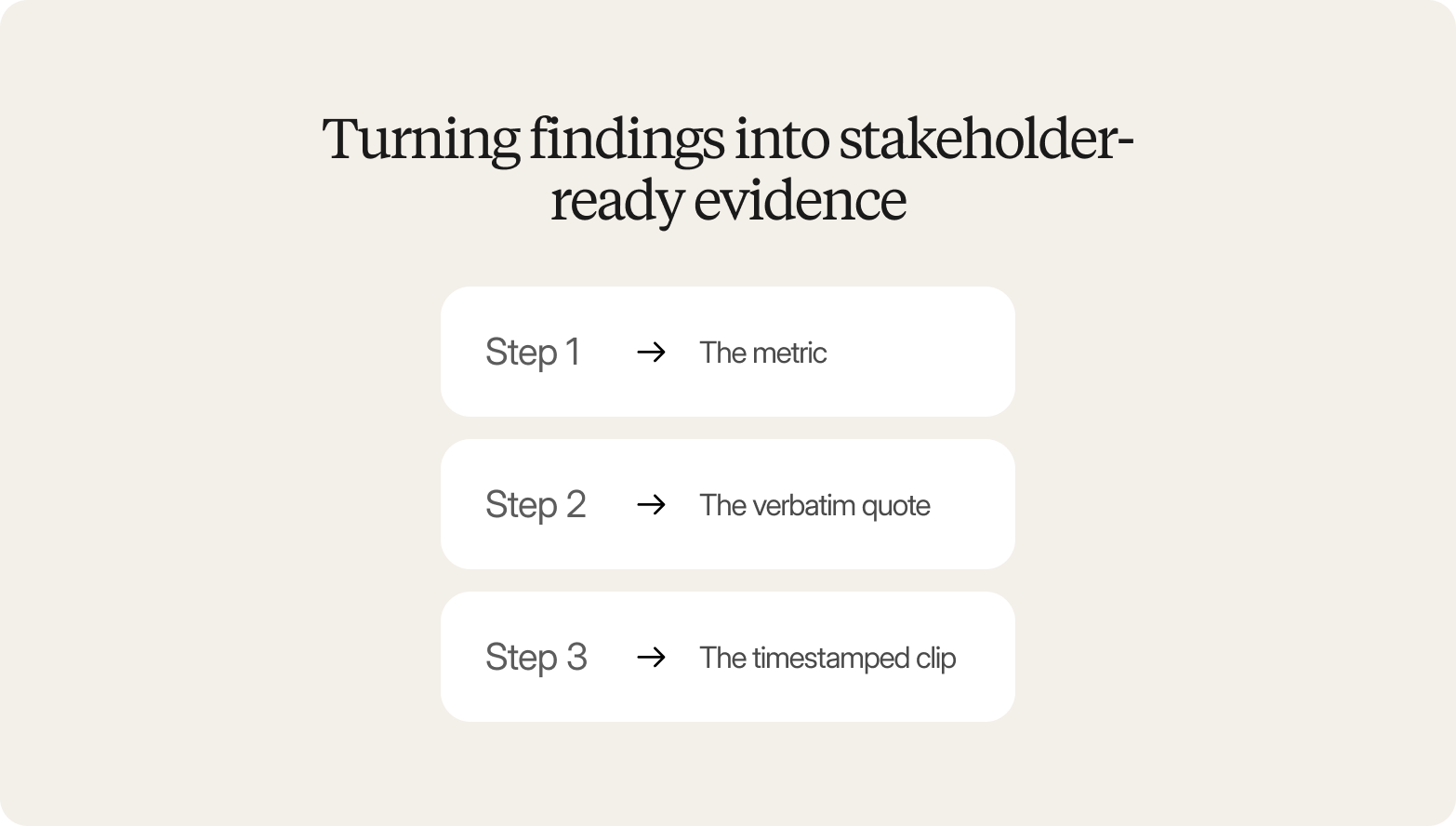
Step 1: the metric
A scoped claim naming the population, the question, and the outcome in one sentence: "68% understood the concept as a meal kit rather than a recipe app." Scoping is what turns a percentage into valuable data.
Step 2: the verbatim quote
The participant's exact words, unedited: "I thought this was going to teach me how to cook, not send me ingredients. That's a different thing entirely." Verbatim quotes preserve the participant's framing rather than the researcher's interpretation, which shows that the metric reflects something real.
Step 3: the timestamped clip
A pointer to the video moment behind the quote. Stakeholders who were not in the debrief navigate directly to the source, watch it, hear the tone, and see whether the hesitation is visible on screen. The finding travels without a 40-slide deck behind it.
That is what actionable feedback looks like by the time it reaches the people making decisions. The evidence holds up on its own, so the researcher spends the debrief on implications rather than defense.
Where Conveo fits in your concept testing workflow
Concept decisions don't arrive on a research calendar, so the input has to be available when the question comes up. Teams use Conveo to keep that capacity open: AI-moderated video interviews they can launch against a concept the same week the brief lands, in 50+ languages, without booking a fieldwork window. Comprehension is confirmed before appeal is measured, so every score carries the interpretation that produced it.
Because findings connect across projects in Conveo's searchable insight library, the second concept test builds on what the first established rather than starting from zero. Each wave deepens understanding of how your market responds to new ideas.
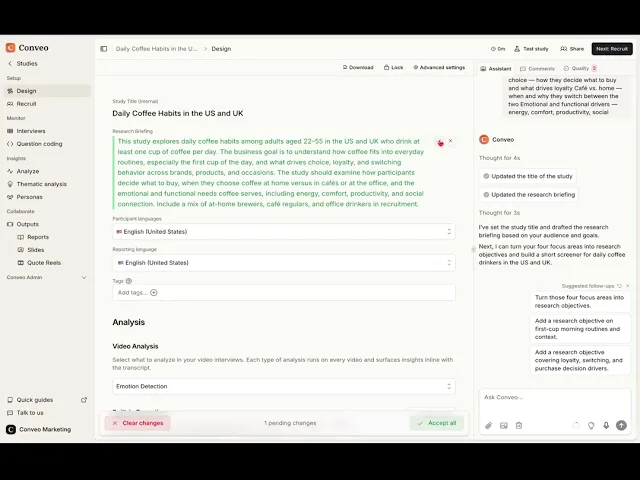
Watch the walkthrough: how to build and launch a study in Conveo, from brief to validated insight.
Frequently Asked Questions
What are some concept testing question examples?
Good concept testing questions are organized by what they're designed to reveal. Comprehension: "In your own words, what is this offering?" Differentiation: "How does this compare to what you currently use?" Relevance: "Walk me through a situation where you would actually use this." Believability: "How believable are the claims in this concept?" Barriers: "What, if anything, would stop you from trying this?" Pricing: "What would you expect to pay, and what would feel too expensive?" Each module needs follow-up probing to produce actionable feedback. A closed rating scale tells you a score. A follow-up question tells you what to fix.
What is a concept testing interview?
A concept testing interview is a moderated, open-ended conversation in which a participant reacts to a concept stimulus in real time, rather than completing a fixed-answer questionnaire. The key difference from survey research is adaptive probing: when a participant hesitates or misinterprets a claim, the moderator follows that thread rather than moving to the next scripted question. A survey records that someone rated believability 3 out of 5. An interview finds out which word triggered the doubt. Teams get the same dynamic asynchronously in AI-moderated video sessions on Conveo, where the AI research assistant follows what each participant actually said rather than running a fixed script.
How many participants do you need for a concept test?
For a directional concept test, 20 to 30 participants per concept cell. That is enough to see whether comprehension holds and where interpretations diverge. Sequential monadic designs need fewer participants overall, because every participant evaluates every concept. Monadic designs need a separate cell per concept, so sample scales with concept count. If the concept targets a specific segment, size each group rather than splitting one cell after the fact. Percentages from a qualitative concept test are diagnostic patterns within a small base and should always be shown with the base size attached. If the decision requires projectable numbers, use the concept test to decide what to measure, then size a quantitative wave accordingly.
When should concept testing happen in the product development process?
In the early stages, before significant resources are committed: after a concept is defined clearly enough to show a participant, but before creative, tooling, or go-to-market investment is locked. At this stage teams can still change the positioning, the claim, or the target audience at little cost. Testing after product launch is diagnostics; the validation window has closed. A concept test tells you how one idea lands with a defined audience. Market demand and category sizing are separate exercises calling for quantitative work.
What's the difference between concept testing and message testing?
Concept testing asks whether the idea itself is understood, relevant, and worth pursuing: the unit under evaluation is the offer, meaning what the product is, who it's for, and what problem it solves. Message testing assumes the concept is settled and asks how to express it: the unit is the language. Teams routinely run a message test and read the result as a verdict on the concept. If participants can't accurately describe the offer back to you, you have a comprehension problem that copy testing will not resolve. Confirm the concept lands first, then test how to say it.

About the author
Kavya Pillutla
Research Impact Lead
A qual researcher by nature, Kavya spent four and a half years on the Human Insight and Innovation team at PA Consulting, on brand strategy and concept testing. She joined Conveo for the pace of a startup without leaving research, and gets her energy from seeing a study turn into a product on a shelf or an ad on a billboard.
Meet Kavya on film →Qualitative insights at the speed of your business.
Conveo runs AI-moderated video interviews and structures everything they say.