In this article
TL;DR
Choose concept testing when:
The value proposition is uncertain, and you need to know if the early-stage idea is worth building
You're working before development begins, validating appeal, perceived value, or messaging fit with your target audience
You want to understand whether the right people would want this, not whether they can use it
You're choosing between multiple directions and need a directional signal before committing resources
Choose usability testing when:
The concept is validated, but execution carries risk: flows, labels, interactions
A prototype or working build exists, and you need to identify where users break down
You're measuring task completion, error rates, and comprehension of specific UI decisions
The question is "can they use it?" not "do they want it?"
Qualitative research can now do what it couldn't five years ago: run hundreds of in-depth conversations in parallel, surface structured themes in hours, and deliver stakeholder-ready evidence before a sprint ends. That shift changes how product teams approach two foundational research methods and makes getting the sequence right more consequential than ever.
Many product teams run usability testing on prototypes before confirming that anyone actually wants what they're building. The result is wasted build cycles, wasted research budget, and findings that answer the wrong question.
Both testing methods involve showing participants something and gathering user feedback. But the questions they answer are fundamentally different. Concept testing asks: Does this idea have value? Usability testing asks: Can people use this execution? The practical decision rule is straightforward: concept test when the value proposition is still uncertain, usability test when the core idea is validated, and execution risk is what needs to be reduced.
What is concept testing?
Concept testing answers: Should we build this, and for whom? Before a product ships, a campaign launches, or a feature gets scoped into a sprint, concept testing evaluates whether the core product concept resonates with the people it's meant to serve.
The purpose of concept testing is to validate early ideas before investing heavily in development. The range of what gets tested is broad:
Value propositions and messaging frames
Product concepts and feature ideas
Packaging designs and positioning statements
Campaign concepts and pricing structures
New concepts in adjacent markets
What they share is uncertainty. The team has a hypothesis about what customers want, but hasn't confirmed whether that hypothesis holds for their target audience.
Conducting concept testing means showing participants a concept description, a stimulus, or a mockup and asking them to respond openly:
What do they think this is?
What problem does it solve?
Who do they imagine it's for?
What appeals to them, and what concerns them?
Would they pay for it?
That last question points to the concepts that concept testing evaluates: emotional reactions, perceived value, usage scenarios, competitive positioning, and purchase intent. Effective concept testing doesn't just capture surface-level preferences. It surfaces the reasoning behind reactions, the user needs it meets or misses, and the segments most likely to respond. Concept testing ensures teams understand the product's viability before committing engineering resources to build it.
A subscription service concept might be shown as a landing page mockup. The research question isn't "Do you like this?" It's what problem they believe it solves, whether they see themselves as the intended user, and what would need to be true for them to subscribe.
This is where concept testing diverges from traditional surveys. A survey can tell you that 68% rated an idea "appealing." It cannot tell you what they found appealing, what they misunderstood, or which segment reacted differently and why. Concept testing requires open-ended probing to surface the reasoning behind reactions.
Effective concept testing also differs from preference testing, in which participants simply choose among options. Preference testing tells you which concept wins; concept testing tells you why, which is what teams need to act on the findings.
UX concept testing extends this logic into product design. Teams test ideas at the initial idea stage, long before a prototype exists, to validate that the direction is worth pursuing at all. The output is structured around themes:
What's driving appeal?
Where confusion exists
Which usage scenarios do participants describe?
How reactions differ by segment
What is usability testing?
Usability testing answers one specific question: Can people actually complete the tasks your product is designed for? Not whether they find the product concept appealing, but whether the execution holds up when a real user tries to use it.
As a UX method, usability testing is a core part of the design process. It applies to low-fidelity prototypes, live products, checkout flows, onboarding sequences, navigation structures, and any other workflow in which the concept is settled but execution quality remains uncertain.
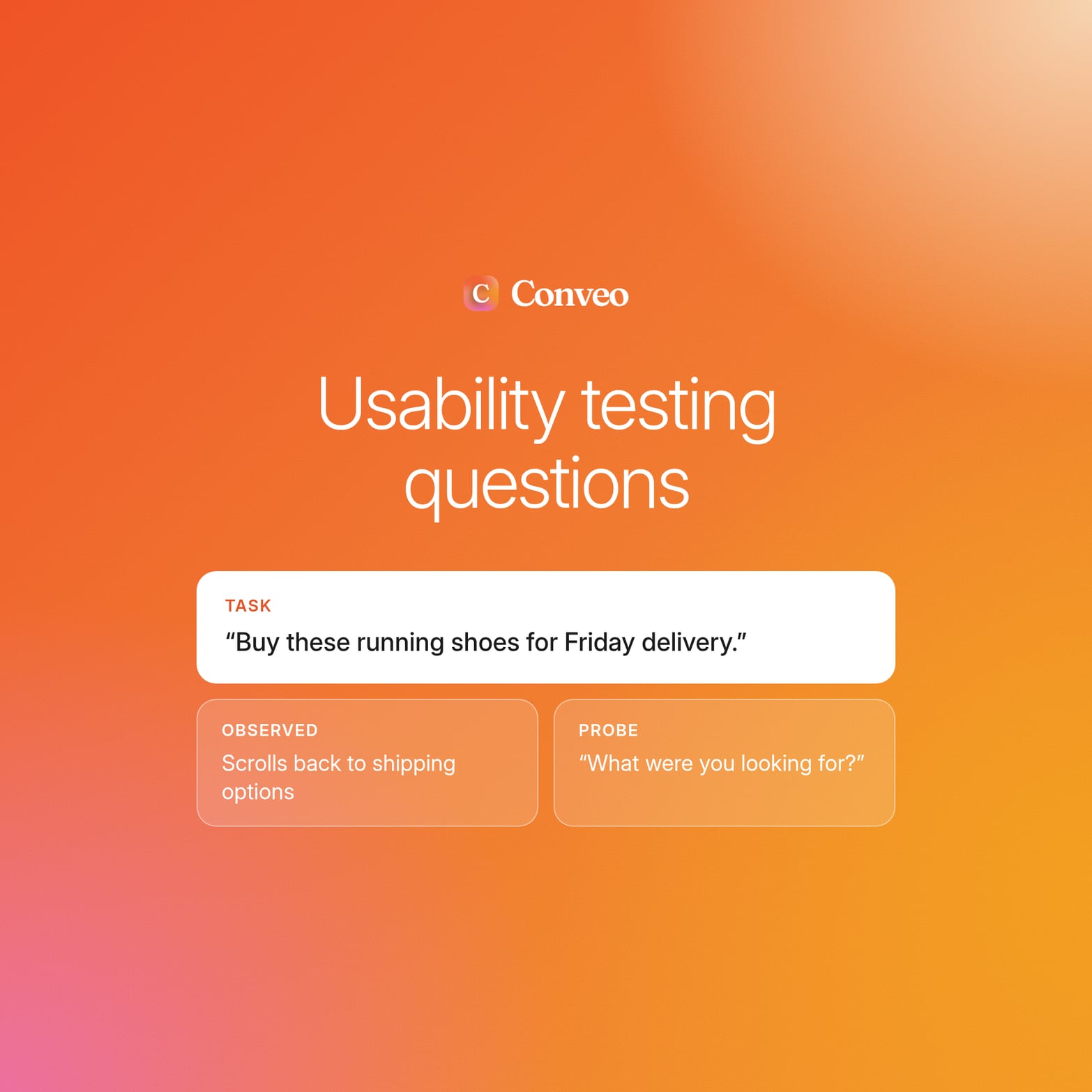
Usability testing focuses on behavior. Participants attempt realistic tasks while thinking aloud, and researchers observe without intervening. Typical tasks mirror actual user behavior: "Find and purchase a product," "Set up your account," "Locate your billing history." Researchers watch for moments where real users pause, misclick, backtrack, or abandon the attempt entirely. That friction is the primary data.
What usability testing evaluates is specific and behavioral: task completion rates, time on task, error frequency, navigation confusion, and usability issues. Usability testing shows, for example, that participants in an e-commerce checkout flow consistently abandon at the shipping address step because the form validation error is ambiguous. That's a finding that traditional surveys, focus groups, or post-purchase feedback forms would never surface.
One important distinction: usability testing assumes the user wants to complete the task. It doesn't ask whether the task is worth completing. That's a different question, one that concept testing is built to answer.
Identifying usability issues early is far cheaper to fix. A pain point discovered in a low-fidelity prototype costs an afternoon to correct; the same issue discovered after launch requires a redesign cycle. This is why UX research teams use usability testing as a continuous improvement mechanism across the design process, not just a one-time pre-launch check. UX design teams rely on these findings to address user pain points before shipping.
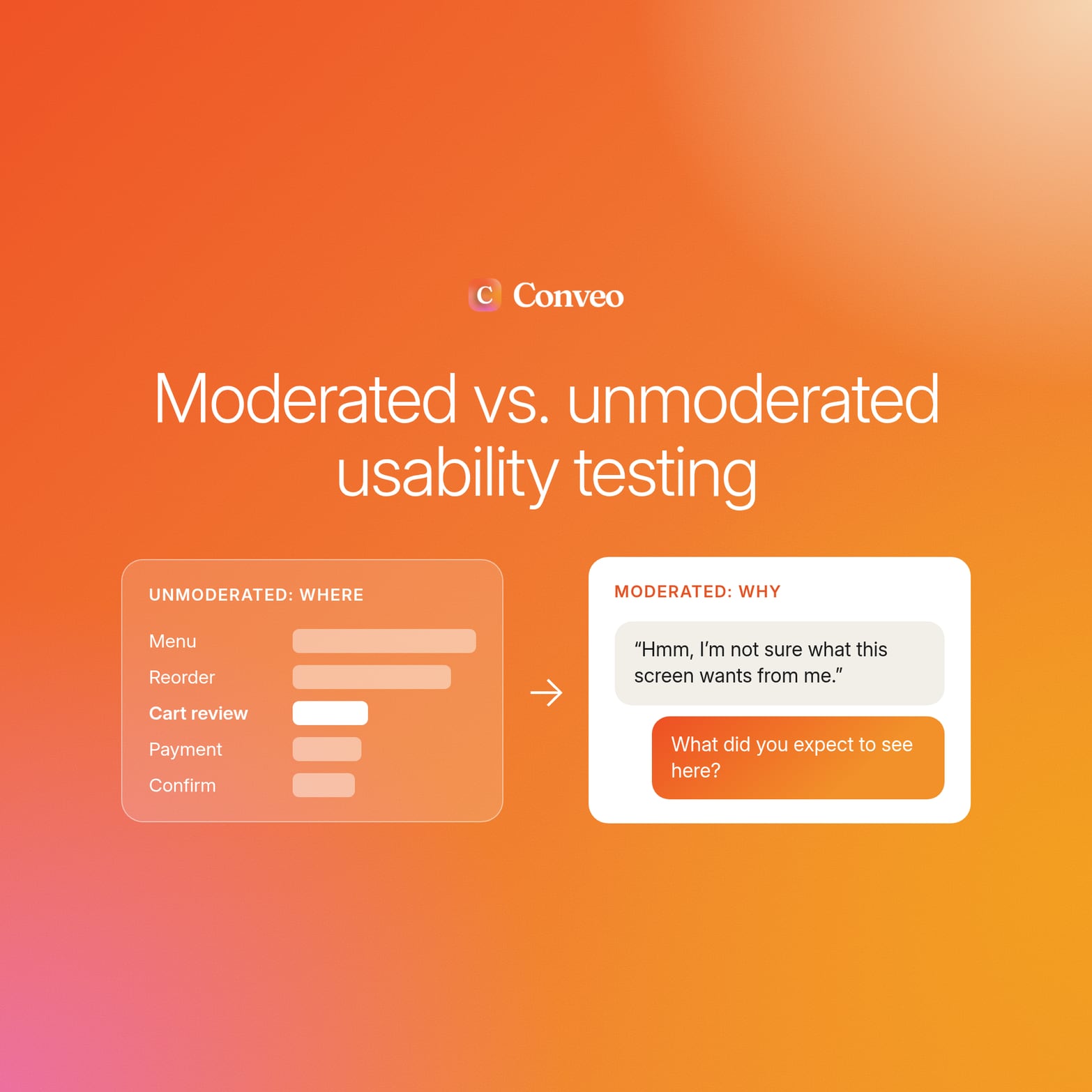
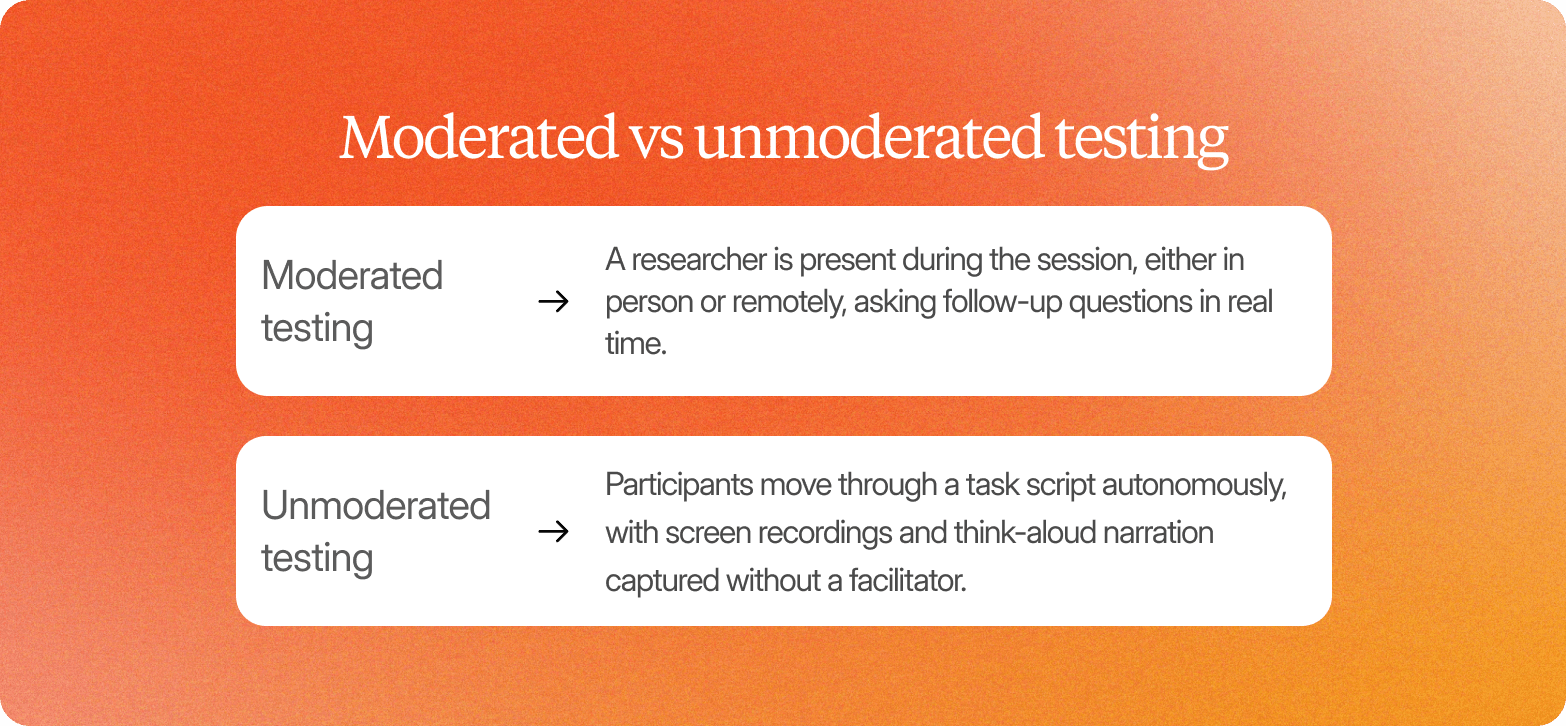
Usability testing can be moderated or unmoderated:
Moderated testing: A researcher is present during the session, either in person or remotely, asking follow-up questions in real time.
Unmoderated testing: Participants move through a task script autonomously, with screen recordings and think-aloud narration captured without a facilitator.
Both approaches identify usability issues; the choice depends on the depth of probing needed and the scale at which the team needs to gather feedback.
The output is a prioritized list of interaction breakdowns, navigation failures, and comprehension gaps, each rated by severity. Teams use this to systematically improve user satisfaction before and after launch.
Concept testing vs usability testing: The core difference
Teams confuse these distinct methods because both involve showing participants a product idea and gathering user feedback. But they answer opposite questions.
Concept testing asks "Should we build this?" Usability testing asks, "Can people use what we built?"
The timing difference matters as much as the question. Concept testing happens at the early stage, before development begins, to validate whether the idea meets user needs. Usability testing occurs after a prototype is created to validate its execution.
The participant's mindset is different, too. In concept testing, participants react to an initial idea: you measure appeal, relevance, and purchase intent. In usability testing, participants perform tasks: you measure behavior, error rates, and task completion.
The outputs reflect this split. Concept testing produces thematic findings around value perception. Usability testing produces a prioritized list of usability issues and interaction breakdowns.
Confusing the two creates predictable failures. Running usability tests before concept validation produces false negatives: rough prototypes with usability issues kill good concepts before they get a fair hearing. Skipping concept testing produces false positives: polished, usable products that solve problems no one valued enough to pay for.
Side-by-side comparison: Concept testing vs usability testing
The table below contrasts concept testing and usability testing across six dimensions to clarify when to use each testing method.
| Dimension | Concept testing | Usability testing |
|---|---|---|
| Research question answered | Should we build this, and for whom? | Can people complete key tasks? |
| Timing in the product lifecycle | Early stage, before development begins | After the prototype exists |
| Participant task type | React to the product concept, explain the appeal, and the concerns | Complete realistic tasks with real users, think aloud |
| Output format | Themes around appeal, value perception, and usage scenarios | Prioritized list of usability issues and interaction breakdowns |
| Common mistakes | Testing low-fidelity prototypes too early (false negatives) | Skipping concept validation (false positives) |
| When to use | Value proposition is uncertain; evaluating ideas before building | Concept is fixed, execution is risky |
Understanding this distinction prevents wasted research cycles and ensures teams test the right thing at the right time.
Key takeaways
Concept test when the value proposition is uncertain; usability test when the concept is fixed, and execution is risky.
The correct sequence is always concept testing first, then usability testing. Reversing this order can lead to false negatives or false positives.
Concept testing produces thematic findings around value perception; usability testing produces a prioritized list of usability issues.
Skipping either research method wastes build cycles: one by building something nobody wants, the other by shipping something nobody can use.
Research infrastructure determines whether teams actually run both. When results take weeks, teams skip steps. When results arrive in days, sequencing becomes practical.
When to use each method
The practical decision rule is to concept-test when the value proposition is uncertain and to usability-test when the concept is fixed, but execution is risky.
When to use concept testing
Reach for concept testing in these situations:
Before development begins, you need to validate demand before committing engineering resources to early-stage ideas
When evaluating ideas across multiple product directions, and internal opinion is standing in for customer evidence
When testing messaging or value propositions, to understand whether your framing lands with your target market before it ships
When stakeholders disagree on what customers want, and the team needs a credible, traceable answer
When entering a new market or customer segment, where assumptions from existing customers may not transfer
When marketing teams need to test campaign concepts or positioning statements, before committing to a full launch
Concept testing prevents building usable products that solve problems nobody cares about.
When to use usability testing
Usability testing belongs in your research plan when:
A prototype exists, and you need to validate execution quality before committing to production
Task completion rates or conversion rates are lower than expected, and you need to find the breakdown
A redesign or new feature is approaching launch, and you need evidence that interaction patterns work
An existing workflow needs optimization for user satisfaction and efficiency
UX design decisions need validation with real users before shipping
Usability testing prevents shipping products with interaction breakdowns that concept testing wouldn't catch.
Getting the sequence wrong means either validating execution before demand or skipping validation entirely in concept testing vs usability testing. Both waste build and research cycles.
4 Common mistakes teams make
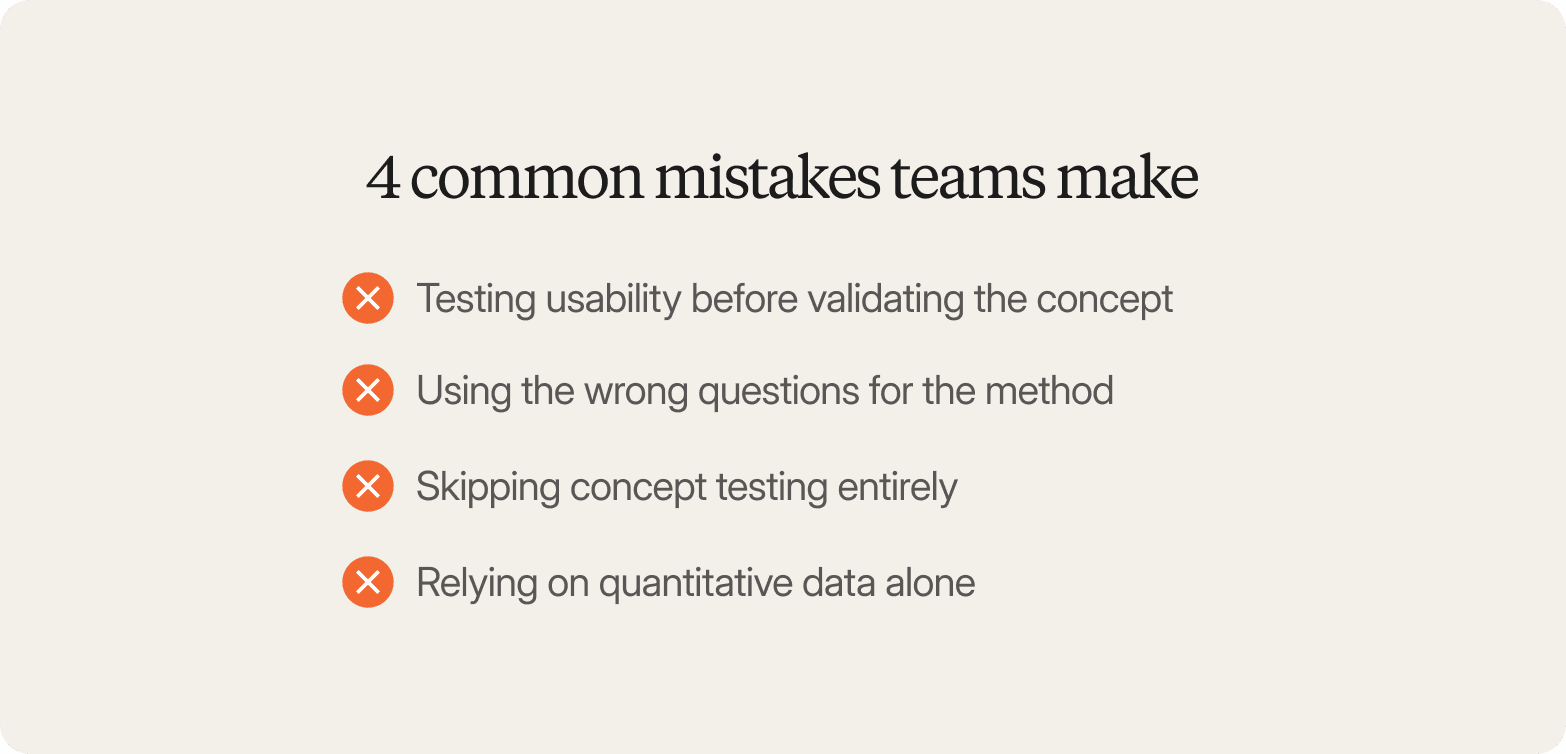
Testing usability before validating the concept
Teams run usability tests on rough prototypes before confirming the underlying product concept is worth building. Real users fixate on execution friction, and a concept with genuine appeal gets rejected for reasons unrelated to demand.
The fix: run concept testing first to validate demand, then use usability testing for refinement. Platforms like Conveo make this sequencing practical by delivering concept validation findings within hours, so teams don't have to choose which testing method the calendar allows.
Using the wrong questions for the method
The mistake: A concept testing session that asks participants to complete tasks is measuring interface behavior, not perceived value. The reverse happens too: usability testing participants asked "Would you buy this?" are reporting intent, not demonstrating behavior.
The fix: Concept testing questions should probe appeal, user needs, and value. Usability testing questions should focus on task completion and interaction clarity. Traditional surveys are often used instead of proper concept testing, but they lack the open-ended probing needed to understand the "why" behind user feedback.
Skipping concept testing entirely
Teams that skip the concept testing process move straight from an initial idea to building, then run usability testing once a prototype exists. Usability testing confirms whether something works, not whether anyone wanted it.
The fix: validate the product's viability before investing heavily in execution.
Relying on quantitative data alone
Quantitative analytics data can tell you that users are dropping off at a specific step. It cannot tell you why. Both testing methods require qualitative depth to surface users' pain points and the motivations behind their behavioral patterns. Product testing without qualitative insight leaves teams guessing at root causes.
These mistakes compound when teams lack a platform that supports both methods, forcing them to default to one or skip research entirely. The operational cost of switching between research vendors or waiting weeks for results makes it rational to skip a step, even when skipping is risky.
How Conveo makes concept-then-usability sequencing practical
The sequencing principle running through this article validates the concept first, then refines execution, and only works when teams can run both testing methods quickly enough to fit within real product timelines. That's where Conveo, the video-first AI research platform, closes the gap.
Conveo is one of the few concept testing platforms that also supports full usability research workflows in the same environment. Concept testing ux workflows, product concept validation, and task-based usability sessions all run through a single platform. Teams don't need separate vendors for each research method.
Conveo runs AI-moderated interviews asynchronously, enabling hundreds of parallel conversations with real users. For concept testing, the AI moderator probes on appeal, perceived value, and usage scenarios. For usability testing, it guides participants through tasks and probes on confusion points and usability issues. The same platform handles both without requiring a vendor switch or new research setup.
[Watch: How AI-moderated concept testing works in Conveo →] [Loom embed: V9: How to Run Concept and Messaging Tests Using AI-Moderated Video Interviews]
Speed makes sequencing viable. Conveo delivers actionable insights in days, not weeks, so teams can test new concepts before building and validate usability after building within the same sprint. A product team running a two-week sprint no longer has to choose between concept feedback and usability feedback based on which one the calendar allows.
"We ran a concept test for a new product line, and in one night, we had 200 interviews analyzed."
CMI Lead, Edgard & Cooper
Depth comes from adaptive probing. Conveo's AI moderator follows what participants actually say, not a rigid script, surfacing the "why" behind concept reactions and usability issues that traditional surveys and focus groups miss. Automatic theme clustering speeds synthesis without requiring manual transcript coding.
Credibility is built into the output. Every finding traces back to video clips and verbatim quotes, so when a stakeholder pushes back on a conclusion, the evidence is already there.
Across studies, learnings compound. Conveo builds a searchable insight library so concept and usability findings don't disappear into one-off decks. Each study adds to a research foundation that becomes more useful over time, supporting continuous improvement across the product development cycle.
Conveo supports AI moderation in 20+ languages, with built-in transcription and translation, and offers recruitment reach across 50+ markets. All research is conducted with real users via video, not synthetic profiles, and the platform is SOC 2-certified and GDPR/EU hosting-compliant for enterprise research governance.
Frequently Asked Questions
What is the difference between concept testing and usability testing?
Concept testing and usability testing are two distinct methods that answer fundamentally different questions at different stages of development. Concept testing answers "Should we build this and for whom?" by measuring appeal, perceived value, and intended use before a line of code is written. Usability testing answers "Can people complete key tasks?" by identifying usability issues in an existing interface or prototype. Timing separates them as much as method. Concept testing happens in the early stage, before development begins, to validate demand. Usability testing occurs after a prototype is created to validate execution quality. The decision rule: concept test when the value proposition is uncertain. Usability test when the concept is fixed, but execution is risky.
Can you conduct concept testing and usability testing simultaneously?
No. Concept testing and usability testing answer different questions and require different participant mindsets, so running them simultaneously produces shallow user feedback on both. The correct sequence: run concept testing first to validate demand, then usability testing to validate execution. If the concept isn't appealing, usability improvements won't move the needle. The one exception: when evaluating ideas across multiple concept directions, you can run concept testing in parallel across all directions, then move to usability testing only on the winning concept.
What is a concept testing example?
A SaaS company developing an AI-powered email assistant creates a landing page mockup describing the feature's value proposition. They show it to target users and ask: "What problem does this solve? Who is it for? Would you pay for this? What concerns do you have?" Participants reveal that the positioning is ambiguous. Some assume it's built for executives; others assume it's for customer support teams. Many raise concerns about AI accuracy and data privacy that the product team hadn't anticipated. The company refines its messaging and addresses the privacy concern before a single line of code is written. Concept testing prevented months of misdirected development by surfacing unclear positioning while it was still inexpensive to fix.
What questions should I ask in concept testing vs usability testing?
Concept testing questions focus on desirability and fit before anything is built: "What problem does this solve for you?" "Who do you picture using this?" "What would make you trust this enough to try it?" Usability testing questions focus on task completion and friction once something exists: "Walk me through how you'd accomplish X." "What would you expect to happen when you tap here?" "Where would you go next?" The practical split is intent vs. interaction. Concept testing surfaces whether the idea resonates with user needs; usability testing reveals where the execution breaks down.
How many participants do you need for concept testing vs usability testing?
Concept testing: 15 to 30 participants per segment typically provides enough thematic saturation to identify patterns in appeal, confusion, and purchase intent. When comparing multiple product concepts, monadic testing (in which each participant evaluates a single concept rather than all options at once) prevents carryover bias across stimuli. Sequential monadic testing, in which participants evaluate concepts one at a time, allows direct comparative testing while controlling for order effects. Plan for 15 to 30 participants per concept direction. Usability testing: 5 to 8 participants per round is the established standard for identifying most usability issues. Additional rounds after design iterations catch problems introduced by fixes. The participant count depends on what you're optimizing for. Concept testing needs enough diversity to surface segment-level differences. Usability testing requires sufficient observations to confirm that a friction point is systematic rather than idiosyncratic.
Can AI replace human moderators in concept testing?
AI moderation does not replace human researchers. It changes what they spend time on. AI-moderated interviews handle the conversation, adaptive follow-ups, and transcription at scale, freeing researchers to focus on analysis, synthesis, and strategic recommendations. AI moderation runs hundreds of interviews in parallel with consistent probing depth, which is especially valuable for concept testing ux research, where open-ended follow-ups are critical to surfacing the "why" behind participant reactions. Unlike unmoderated testing tools that rely on scripted tasks or focus groups that introduce group dynamics and social desirability bias, AI-moderated sessions deliver individual depth at scale. The research team designs the study, defines the probing logic, and interprets the findings. AI moderation scales the execution.

About the author
Dieter De Mesmaeker
Co-Founder & CEO
Dieter is CEO and co-founder of Conveo. Before starting the company, he founded DataCamp and scaled it into one of the leading edtech platforms in the world.
More by Dieter →Qualitative insights at the speed of your business.
Conveo runs AI-moderated video interviews and structures everything they say.