
TL;DR
Qualitative research is not one method. It's a family of approaches for exploring complex phenomena that statistics alone can't explain, each designed for a different business question.
Most teams run into trouble not because they chose qualitative over quantitative, but because they defaulted to a single format (usually interviews or focus groups) without asking whether it fit what they needed to learn.
By the end of this article, you'll understand four distinct layers of qualitative research:
Research designs and methodologies: the overall study structure (phenomenological, grounded theory, ethnographic, case studies, narrative research, action research)
Data collection methods: the different methods used to gather qualitative data from participants (in-depth interviews, focus groups, observation, diary studies, online communities)
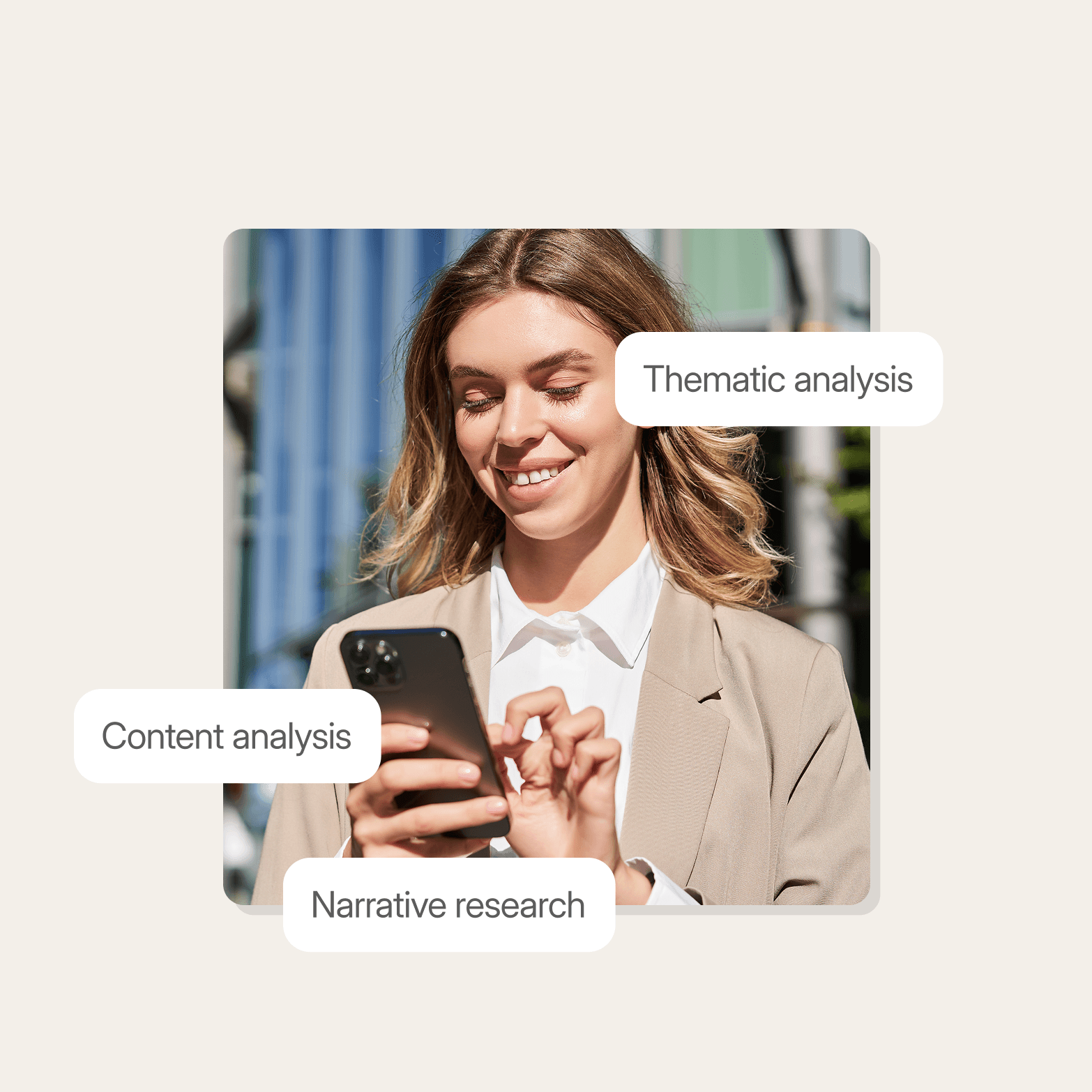
Analysis frameworks: how researchers make sense of what they collected (thematic analysis, content analysis, narrative analysis)
Sampling strategies: how participants are selected to produce credible, purposeful findings
Most teams searching for qualitative research methods aren't looking for a primer on methodology. They're standing at a business question that surveys can't answer: why customers stopped converting, what drives brand preference, and which message lands. Qualitative research turns non-numerical data (conversation, observation, behavior) into the explanations that numerical data can only describe.
This article maps the various qualitative research methods across four layers: research designs, data collection methods, analysis frameworks, and sampling strategies. Each layer gets its own treatment, so you can match research method to question, without conflating a research philosophy with a fieldwork technique. Most overviews mix phenomenology (a research design) with focus groups (a data collection method) and thematic coding (an analysis approach) as if they belong in the same list. Treating them as interchangeable is how teams end up using the wrong method for the right question, then wonder why the findings don't hold up in a stakeholder meeting.
Understanding the Qualitative Research Landscape
Qualitative research was developed to explain complex phenomena that statistics alone can't capture: the motivations, perceptions, and subjective experiences that surveys reduce to a rating scale. Academic traditions in the social sciences (sociology, anthropology, psychology) each brought different vocabulary, which is why qualitative research design looks so different depending on who's defining it. Ask a sociologist, and you'll get grounded theory. Ask an anthropologist, and you'll get ethnography. Ask a brand researcher at a CPG company, and you'll get in-depth interviews and focus groups. They're all describing types of qualitative research, drawing from different traditions for different purposes.
In academic settings, each qualitative research design has a distinct name: a phenomenological study explores subjective experiences from the inside out; historical research (sometimes structured as a historical study of how earlier conditions shaped the present) draws on archival data sources; action research uses the research process itself as an intervention; grounded theory builds explanatory frameworks from patterns that emerge across data. Together, these designs address social phenomena that no single methodology owns.
In business, most teams adapt these principles into faster, applied formats drawing from multiple sources (interviews, observations, documents) rather than committing rigidly to one school. The various qualitative research methods available are also shifting: platforms combining AI moderation with video capture are collapsing timelines that once entirely separated method choices.
7 Core Qualitative Data Collection Methods
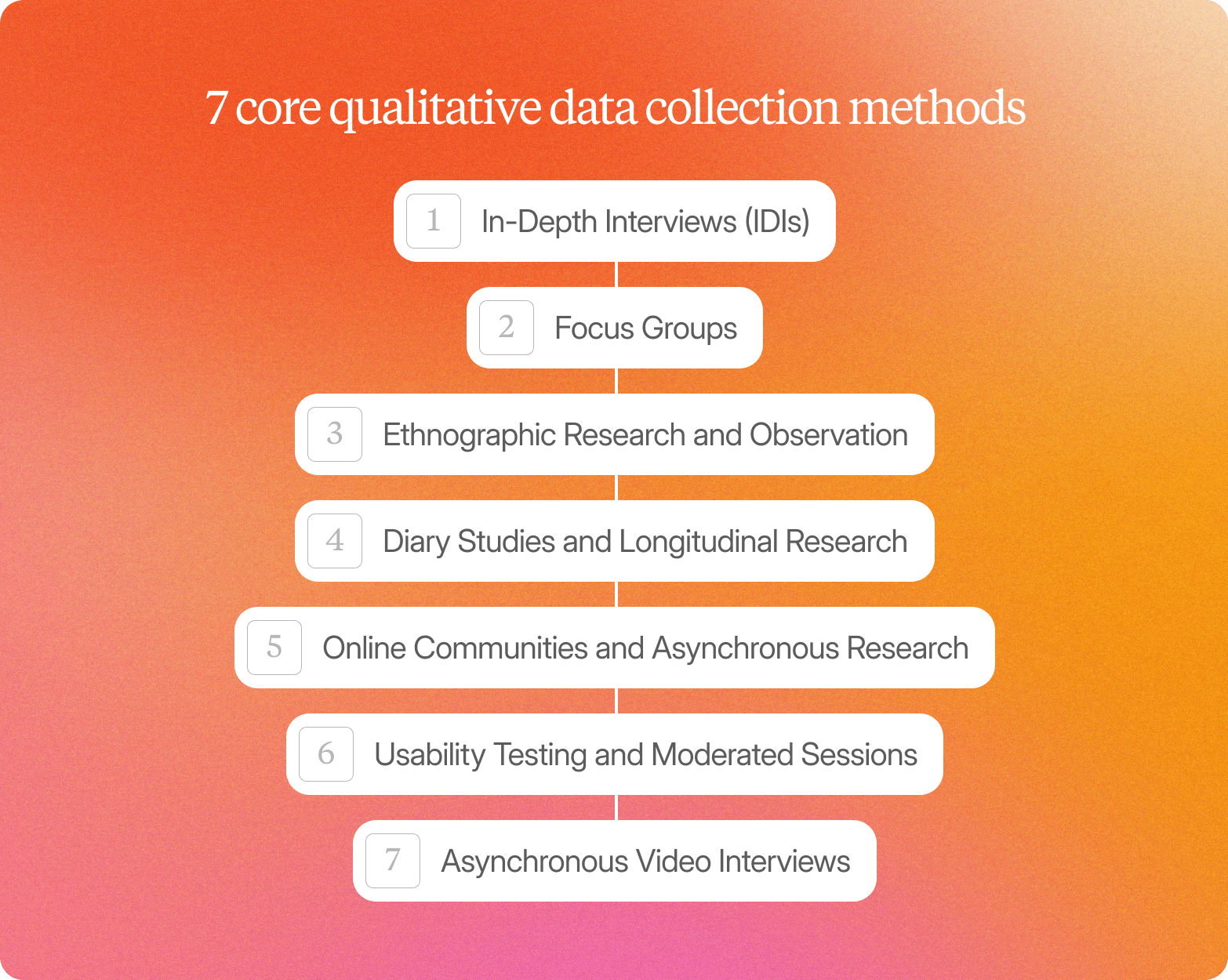
In-Depth Interviews (IDIs)
One-on-one conversations designed to probe individual beliefs, motivations, and mental models without social pressure. Conducting interviews in this format strips away the group dynamics that distort answers in collective settings, allowing researchers to gain an in-depth understanding of individual decision processes that common methods like surveys structurally can't reach.
The goal is detailed insights into exploring motivations, decision triggers, and subjective experiences: the kinds of qualitative data that a rating scale collapses into a single number. When a survey asks whether a product feels "natural," you get a yes or no. A one-on-one conversation reveals that "natural" means incompatible things to different people.
A CPG brand discovered this precisely: one segment prioritized ingredient lists, another trusted brand heritage, and a third required third-party certification. The survey showed strong overall appeal. The IDIs revealed three incompatible mental models beneath that number, each requiring a different messaging response. In-depth interviews yield deeper insights when individual decision-making matters.
IDIs are the right choice when individual decision-making processes matter more than shared reactions, and when you need the language customers actually use, not the answers they give in a group context.
Focus Groups
Moderated group discussions that surface how opinions form socially, including consensus, polarisation, and idea-building. Focus groups are built around social interactions: the back-and-forth between multiple participants that reveals how opinions actually form in public, allowing researchers to observe that process in motion. The key advantages of focus groups over IDIs include social texture and the ability to observe real-time opinion formation.
Unlike IDIs, focus groups are the right choice when you need to see how customers respond to one another's perspectives rather than to their isolated opinions. They are also useful for exploring social phenomena, such as how communities form shared views around a brand, a product, or an emerging trend in market research.
A financial services brand testing messaging found that "security" language resonated when customers evaluated it on its own. In a group, a single skeptical voice shifted the room, revealing how fragile that message was in the real world. Among the qualitative methods available to insights teams, focus groups are strongest when social dynamics shape perceptions.
The limitation is that they aren't statistically representative and can be dominated by vocal participants.
Ethnographic Research and Observation
Observing behavior in a natural environment to understand workarounds, environmental constraints, and the gap between what people say and what they do. Rather than conducting interviews in a studio, researchers immerse themselves in the participant's world through extended observation that captures patterns no single session reveals.
Ethnographic research provides a deeper understanding of how cultural context shapes user behavior than self-reported answers can supply. Complex phenomena that participants have normalized: the workaround they've stopped noticing, only surface when someone watches.
A medical device team studying emergency department nurses found that a "quick-access" feature was never used, not because nurses disliked it, but because it required two hands, which was rarely possible mid-procedure. That finding doesn't surface in an interview. It only appears when someone watches. This is the gap that ethnographic research closes across the different kinds of qualitative research methods available to teams working in physical or operational settings.
Diary Studies and Longitudinal Research
Participants document experiences over extended periods (days or weeks), capturing how behavior and sentiment actually shift across a journey that one-time sessions can't surface. The right choice when the research question spans onboarding, habit formation, complaint escalation, or product adoption.
These methods exist specifically to gain insights from the unexpected insights that surface between scheduled touchpoints: the friction that emerges on day three, not during onboarding. A product team tracking new app users found that the critical drop-off occurred on day three, well after onboarding was complete and long before any follow-up survey would have landed. The types of qualitative methods that track change over time consistently surface patterns that snapshots miss.
Online Communities and Asynchronous Research
Ongoing platforms where participants share experiences and respond to prompts over days or weeks, capturing the arc of an experience rather than a fixed moment. The most powerful insights emerge not from individual responses but from the back-and-forth between multiple participants: the meaningful narratives that build collectively over time, allowing researchers to observe how shared understanding develops.
A retail brand found through an asynchronous community study that customer frustration peaked not at the initial complaint but when the resolution process felt opaque, redirecting the CX team's priorities from faster response times to clearer status communication. Among the different types of qualitative research methods, online communities excel at tracking evolving narratives that surveys measure only in retrospect.
Usability Testing and Moderated Sessions
UX research teams use usability testing to observe user behavior directly, collecting data as participants interact with a product, prototype, or interface. Among qual research methods, it's the backbone of UX research: surfacing concrete interface problems before launch, when post-launch analytics can only confirm what users have already abandoned.
Teams test participants in practical scenarios that mirror real-world task completion, uncovering user preferences and friction points that other methods miss entirely. Data capture during usability sessions (screen recordings, verbal think-aloud protocols, observer notes) provides a richer picture of user behavior than any quantitative method. Post-launch usage data tells you what changed; usability testing tells you why.
A SaaS company found users couldn't locate the export feature, not because it was buried, but because they scanned for "download" and ignored the button labeled "export." One terminology finding changed the label before it reached production.
Asynchronous Video Interviews
Participants record responses to prompts on their own schedules, allowing teams to gather data from hundreds of people in parallel across markets without coordinating live sessions. This makes async video one of the most scalable ways to collect data at enterprise scale.
What async video produces that surveys can't is the full register of human communication (tone, hesitation, facial expression), preserved alongside the words, to surface deeper insights than text alone can. A global CPG brand ran concept testing across 12 markets in five days, with each cultural context revealing different interpretations of the same "premium" concept in ways that text responses would have stripped away entirely.
The tradeoff is adaptive probing. Without a live moderator, follow-up questions must be pre-scripted. Conveo's AI moderator closes this gap: it listens to each participant's response and probes based on what was actually said, bringing the depth of live moderation to async scale.
"Conveo's video-first approach is a real differentiating methodological advantage. The ability to distill insights from reactions and not just hear answers adds context you simply can't get from transcript-only tools, or any other tool in the market for that matter."
— Senior Marketing Research & Insights Manager, Google
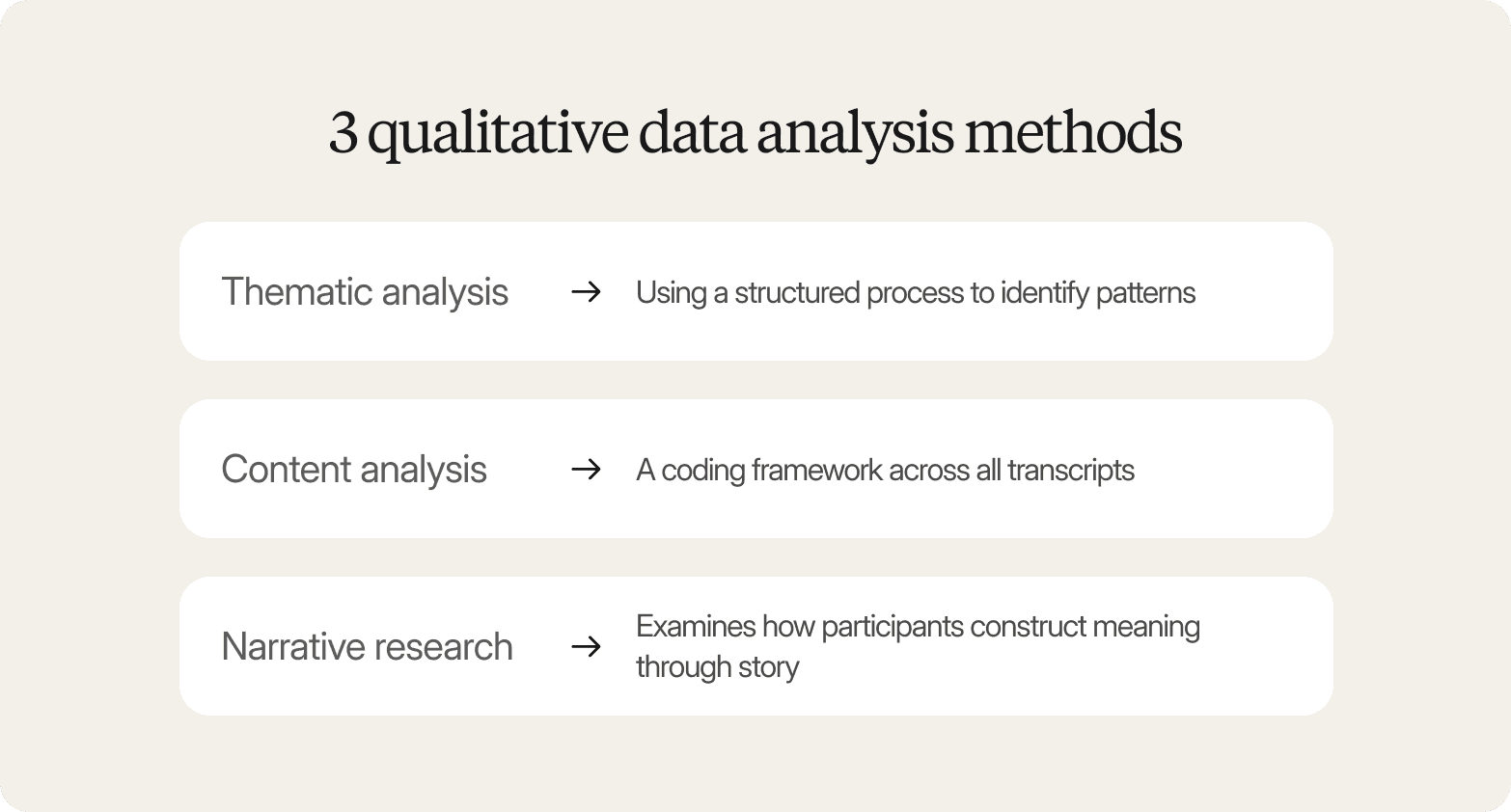
3 Qualitative Data Analysis Methods
Data collection is half the qualitative research workflow. Analysis is where raw conversations become findings that a leadership team can act on, and the real bottleneck. The goal is to gain insights that translate into decisions, not just observations that accumulate in a report.
Thematic analysis
The default for most business research. It works by using a structured process to identify patterns: researchers read through the qualitative data, label meaningful segments with codes, group codes into recurring themes, and validate that those themes reflect what participants said. The key stages (familiarisation, coding, theme development, and validation) make it both rigorous and practical. Insights emerge from patterns that repeat across different participants and data sources, from interview transcripts to session recordings to written participant responses.
Content analysis
Applies a defined coding framework consistently across all transcripts. Most useful when tracking specific constructs (brand perceptions, feature mentions, complaint categories) rather than exploring open territory, it also extends naturally to document analysis: reviewing existing materials like support tickets or customer reviews for recurring themes across qualitative studies.
Narrative research
Examines how participants construct meaning through story: what they emphasize, how they sequence events, and where emotion enters the account. Valuable for understanding purchase decisions or brand relationships where the "why" is embedded in context rather than stated directly.
Across qualitative studies, the shared constraint is time. Manual coding across 30–40 transcripts can take two to three weeks, long enough for the decision the research was meant to inform to have already been made.
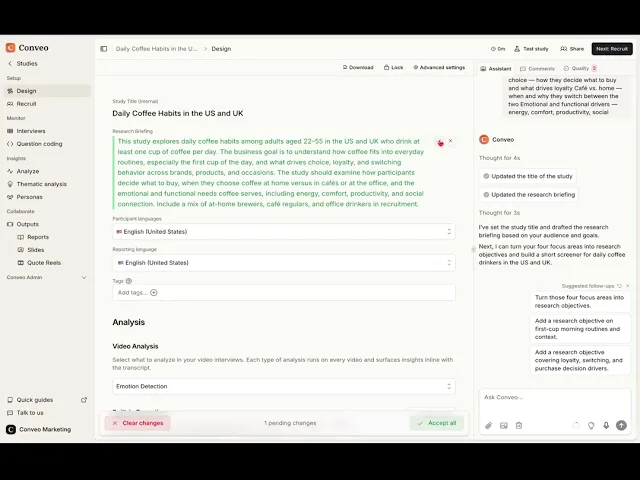
Conveo accelerates coding and theme identification through AI-assisted analysis, surfacing valuable insights while maintaining traceability: every theme links back to verbatim quotes and timestamped video clips. Researchers retain interpretive control; the platform removes the manual overhead that makes synthesis the slowest part of qualitative practice.
Discover how to build and launch a study in Conveo:
Sampling Strategies in Qualitative Research
Unlike quantitative research, which aims to represent a broader population statistically, qualitative research doesn't aim for statistical representativeness. It aims for depth, diversity, and theoretical saturation: the point at which new conversations no longer produce new insight.
The three kinds of sampling that appear most commonly across qualitative studies each serve a different purpose.
Purposive sampling (one of the most common methods of participant selection) selects participants who meet specific criteria and is the most common starting point.
Theoretical sampling recruits new participants to test or challenge emerging hypotheses as analysis progresses, iterative by design.
Maximum variation sampling deliberately captures the widest range of perspectives, drawing from multiple sources to surface tensions and edge cases that a tighter sample would miss.
Execution is where studies succeed or fail. A weak screener lets the wrong participants through. A poorly vetted panel produces responses that look real but aren't. Even the strongest discussion guide cannot recover findings built on a compromised sample.
Conveo's vetted global panel spans 50+ markets and includes built-in fraud filtering, so teams recruiting across regions can source high-quality participants in days rather than weeks without compromising sample integrity.
How to Choose the Right Qualitative Method
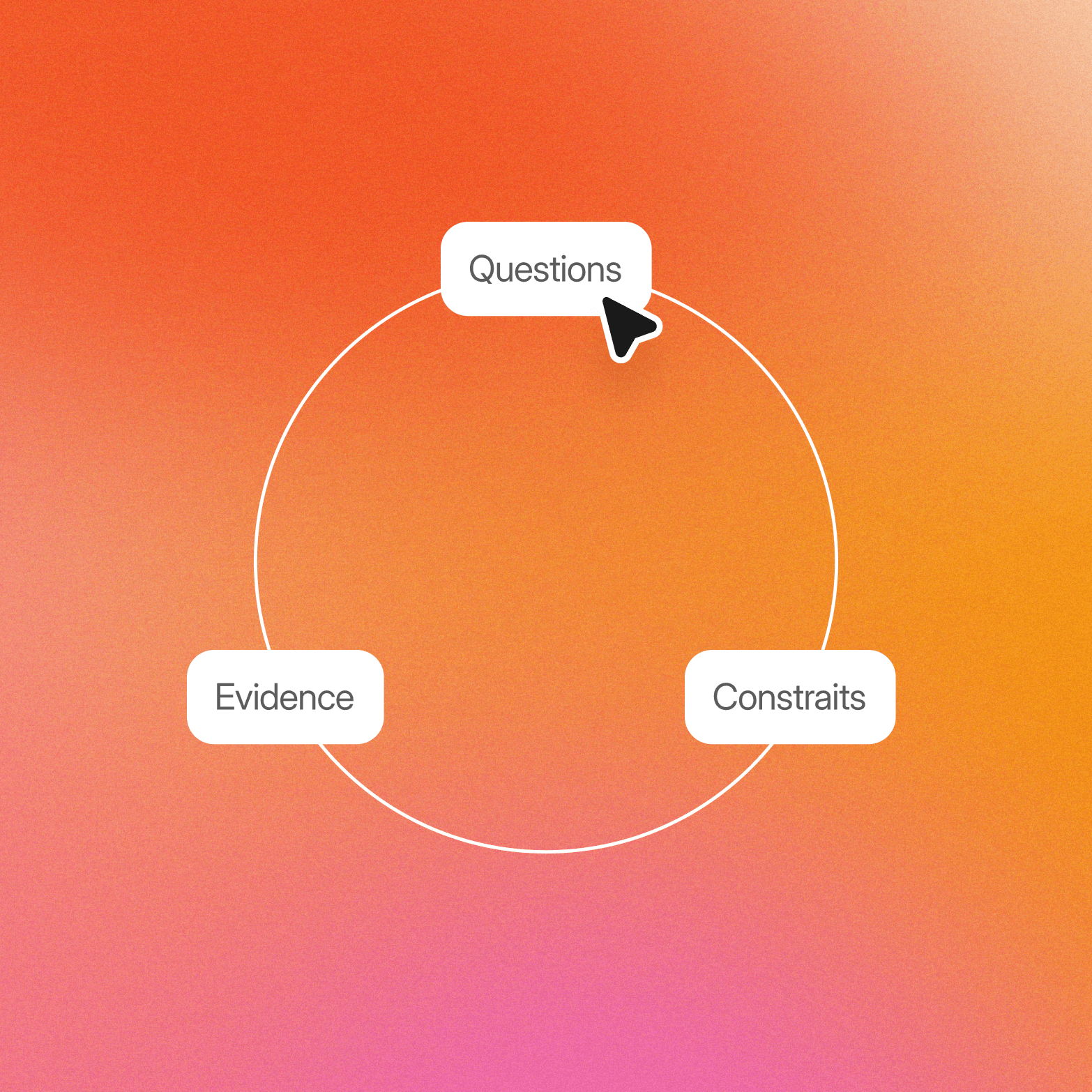
The most common design mistake is selecting a method before the research question is fully formed. Teams reach for interviews out of habit, or focus groups because a stakeholder requested them, without asking whether the research method fits what they need to learn. A structured research process prevents this, applying four filters in sequence before a single participant is recruited.
The key differences between methods often come down to four practical dimensions: the business question (what specifically do you need to understand?); the decision window (how soon do findings need to land?); credibility requirements (does this need to hold up in a board presentation, or is directional insight enough?); and operational constraints (participant access, languages, budget).
Business Question | Recommended Method | Timeline | Participants |
Why are customers churning after onboarding? | Diary study or IDIs | 1–2 weeks | 15–25 |
How do customers react to this new messaging? | Focus groups or async video interviews | 3–7 days | 30–50 |
What workarounds do users invent to complete this task? | Ethnography or usability testing | 2–4 weeks | 8–12 |
What's driving a shift in market trends or consumer sentiment? | Online communities or diary studies | 2–4 weeks | 30–60 |
The table covers common practical scenarios, but the logic applies equally to UX research, market research, and brand and concept testing, wherever numerical data and statistical analysis alone can't provide insight into the why. Other practical scenarios, including tracking sentiment shifts and evaluating new concepts across markets, follow the same four-filter framework.
Understanding the various qualitative research methods available also clarifies when qual is the right tool. Where quantitative research methods measure prevalence, qualitative methods explore meaning. Non-numerical data (the words, observations, and behaviors) explain what quantitative data can only describe. Most programs need both, sequenced correctly: qual generates hypotheses, quant validates them at scale across a broader population. The common failure mode runs in reverse: teams survey first, get shallow answers, then commission qual to interpret data that should have shaped the survey design.
How Conveo Supports the Full Qualitative Workflow
Choosing the right research method is half the challenge. Executing it within a decision window is the other half.
Conveo is a video-first AI research platform that collapses the timeline between research design and stakeholder-ready evidence:
AI-moderated video interviews at scale: run hundreds of one-on-one conversations in parallel across markets and languages, with an AI moderator that adapts its probing to each participant's actual responses
Automated analysis with traceability: themes and patterns surface across the full transcript set in hours, with every finding linking back to timestamped video clips and verbatim quotes
Vetted global panel: 50+ markets with built-in fraud filtering, so sample quality is a research advantage, not an operational risk
Whether you're running IDIs, diary studies, or async video interviews, the question is no longer which method fits. It's how quickly you can move from question to evidence.
"Within days, we had insights that would've taken a traditional agency a month."
— Head of Customer Insights, JDE Peet’s
Frequently Asked Questions
What are the main kinds of qualitative research methods?
What is the difference between qualitative and quantitative research?
How do I choose the right qualitative method for my project?
When should I use focus groups instead of interviews?