In this article
TL;DR
Consumer intelligence research closes the gap between knowing what customers do and understanding why they do it: combining behavioral data, consumer surveys, and qualitative depth.
Traditional qualitative research runs 6 to 12 weeks through agencies, creating a structural mismatch with decision cycles that move in days.
AI-moderated video interviews compress timelines from weeks to days while preserving conversational depth and traceability.
Video-first methodology gives stakeholders auditable evidence (timestamped clips and verbatim quotes) rather than black-box summaries.
Building a searchable insight library turns research from periodic events into compounding institutional knowledge.
Multi-market programs that once required months of sequential fieldwork can now run in parallel across regions and languages.
Most market intelligence teams track two things at once: what competitors are doing and what customers actually want. The gap between those signals is where decisions go wrong. Consumer intelligence research exists to close that gap. But for most teams, the data arrives too late to change anything.
The challenge isn't access to information. Teams have more sources than ever: consumer surveys, social media, CRM data, news sources, and third-party panels. The problem is capturing the "why" behind what the numbers show, at a pace that matches how quickly decisions need to be made. Behavioral data tells you what customers did. Consumer intelligence research tells you what drove that behavior and what's likely to change it: the kind of actionable insights that sharpen marketing strategies, inform product decisions, and fuel business growth.
The competitive stakes are significant. Companies that understand consumer motivations (not just consumer actions) can position products more precisely, respond to competitor moves faster, and build loyalty with customers who feel genuinely understood. Companies that rely solely on behavioral signals and surveys make decisions based on what customers did in the past, not what they're likely to do next.
Traditional qualitative research runs 6 to 12 weeks from brief to findings. For teams that need recurring consumer input, that pace makes continuous intelligence practically impossible. This guide covers the core methods, the use cases where each delivers the most value, and how teams are compressing timelines without trading away depth.
What Is Consumer Intelligence Research?
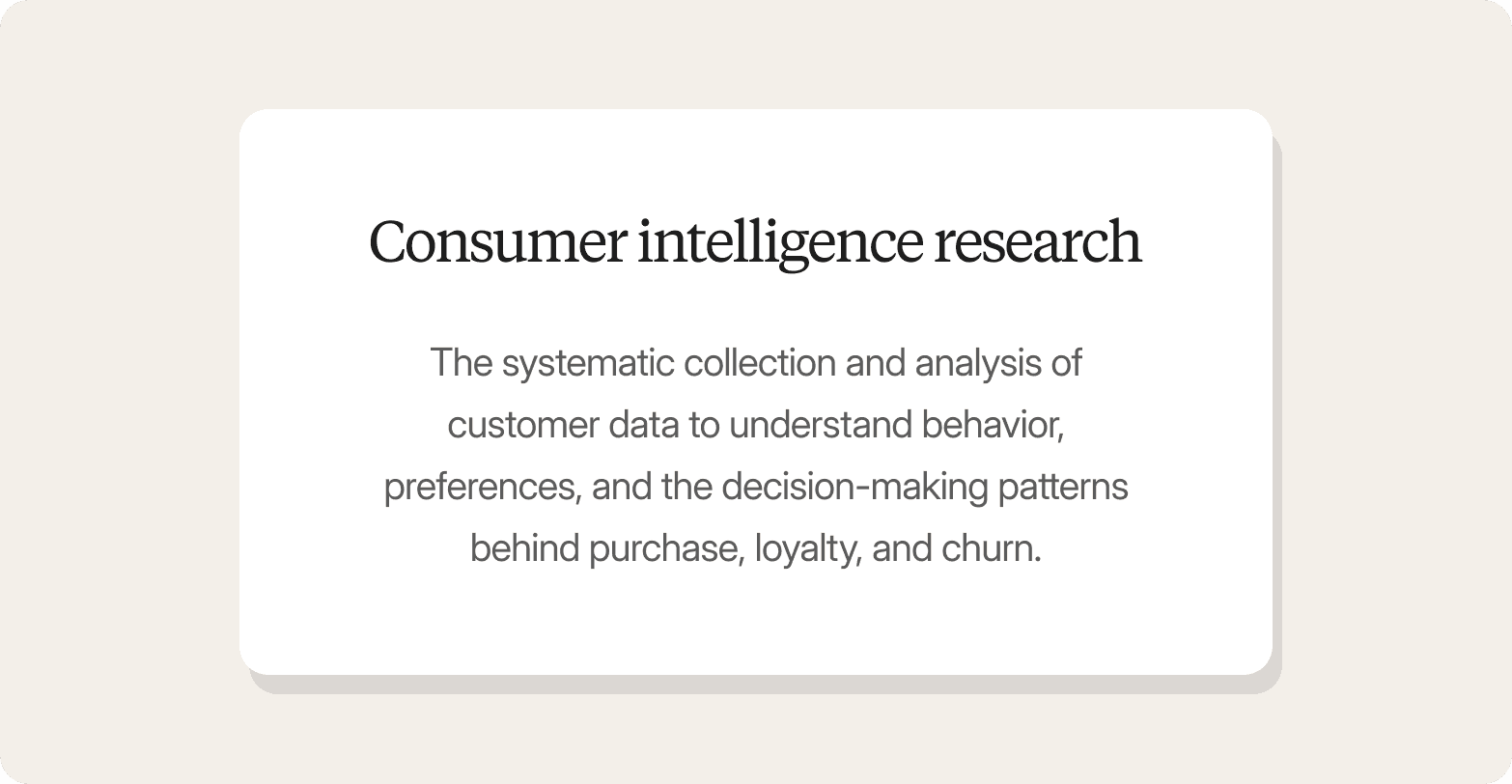
Consumer intelligence research is the systematic collection and analysis of customer data to understand behavior, preferences, and the decision-making patterns behind purchase, loyalty, and churn. Where market research maps the landscape: covering market size, competitive positioning, and category trends, consumer intelligence research centers on the customer intelligence question: why they choose one option over another, what makes them stay, and what causes them to leave.
Effective programs draw on three data sources:
Behavioral data: usage patterns, purchase history, media consumption, and feature engagement. Tracks purchasing behavior at scale, but tells you what happened without explaining the reasoning behind it.
Consumer surveys: scaled feedback across larger populations. Useful for quantifying preferences, but the raw data collected rarely explains the motivations behind responses.
Qualitative research: interviews, focus groups, ethnographic observation. Surfaces the language customers use, the emotions attached to decisions, and the context that explains behavior rather than just recording it.
Systematic data collection across all three sources is what separates a genuine consumer intelligence program from a fragmented set of one-off studies. In practice, most teams over-index on behavioral and survey data because qualitative research has historically been time- and cost-intensive. A single agency-led qualitative study can run $15,000 to $50,000 and take 6 to 12 weeks to complete, making it impractical to run frequently. That imbalance creates a persistent depth gap: teams know what their customers are doing, but not reliably why. Closing that gap is where qualitative consumer intelligence becomes strategically valuable, and it's the problem that modern consumer intelligence platforms are built to solve.
Why Consumer Intelligence Research Matters for Market Intelligence Teams
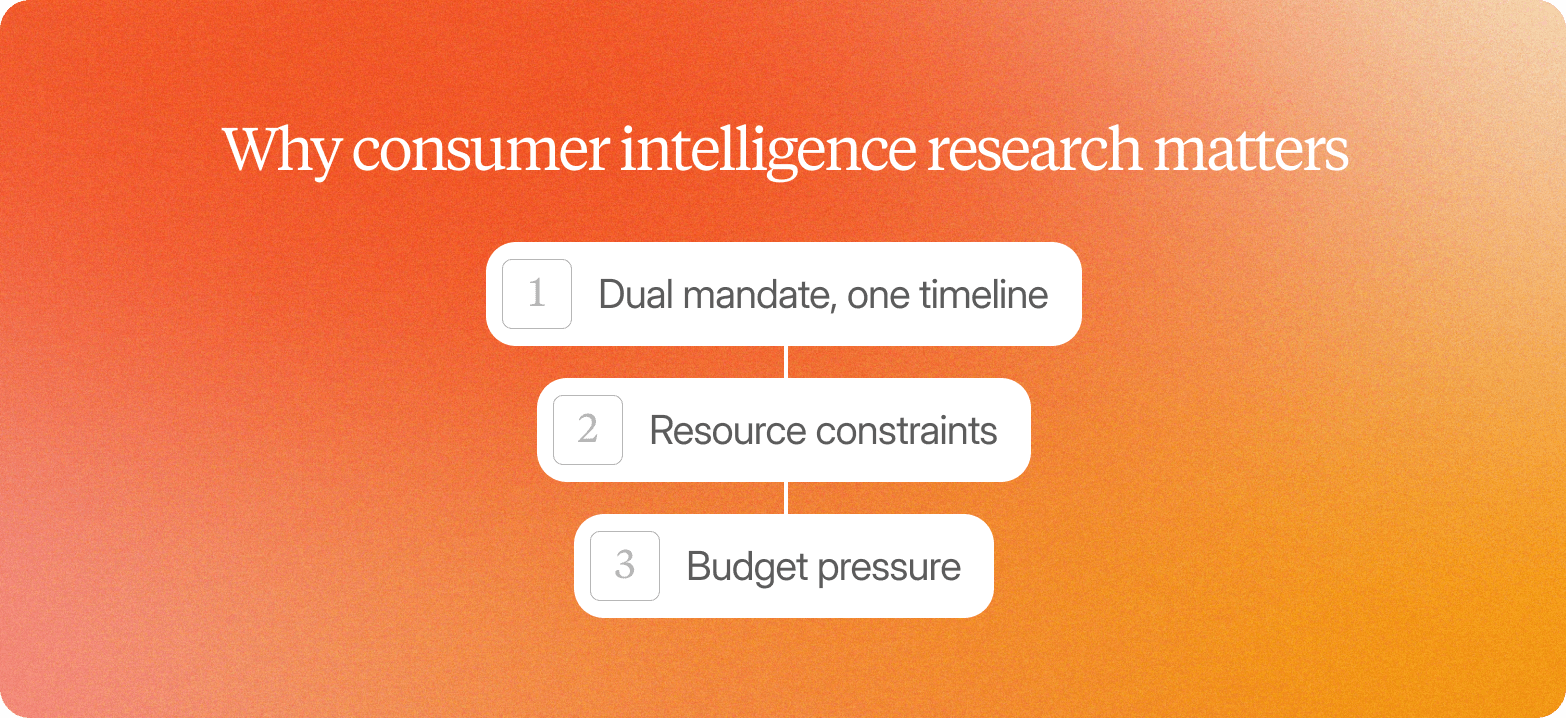
Consumer intelligence research informs product roadmaps, marketing strategies, pricing decisions, and competitive positioning, but only when insights arrive before the decision window closes.
The barriers are consistent across most insights teams:
Dual mandate, one timeline. Tracking competitor behavior and understanding consumer response to those moves aren't sequential tasks; they happen simultaneously. Manual synthesis adds weeks. By the time findings land, the decision is already locked.
Resource constraints. Most insights teams run 1 to 5 researchers serving a much larger internal organization. The backlog of unanswered consumer questions grows faster than any small team can address, and internal stakeholders (from product to sales to marketers) compete for limited research capacity.
Budget pressure. Agency-led qualitative studies run $15,000 to $50,000 each. Teams default to consumer surveys, not because surveys answer the right questions, but because they're the only format the budget can sustain at volume. The result is research that scales but doesn't deepen.
The net effect is a research function that runs on a lag, producing batch updates when teams need real-time insights. Consumer intelligence research only creates competitive advantage when it operates at the speed of decision-making, not the speed of traditional research procurement.
"Within days, we had insights that would've taken a traditional agency a month."
Head of Customer Insights, JDE Peet’s
Consumer intelligence research methods fall into three categories: quantitative, qualitative, and hybrid AI-augmented approaches, each with distinct strengths and tradeoffs.
| Method | What it delivers | Core limitation |
|---|---|---|
| Consumer surveys | Stated preferences at scale | Misses the reasoning behind responses |
| Behavioral analytics | Purchasing behavior and engagement patterns | No causal explanation |
| Social listening / social data | Sentiment analysis and real-time signals from social media, news sources, and review sites | Lacks conversational depth and context |
| 1:1 in-depth interviews | Motivation, emotion, decision language | 6-12 weeks via agencies |
| Focus groups | Shared reactions and vocabulary | Group dynamics can bias responses |
| Ethnography/diary studies | In-context behavior and in-the-moment experience | Time-intensive and costly |
| AI-moderated video interviews | Depth at scale, traceable evidence | Requires stakeholder trust in AI moderation |
Quantitative methods scale well but consistently miss the "why." Social intelligence tools are valuable for monitoring brand reputation and tracking what customers say across digital channels at volume, but they don't capture the reasoning behind those opinions. Qualitative methods capture nuance but have historically required 6 to 12 weeks through agencies, making recurring programs impractical for most teams.
AI-moderated video interviews change this. Hundreds of conversations run in parallel, asynchronously, with thematic synthesis and data analysis ready in days. Video-first platforms go further: every theme and pattern links back to a specific participant response, including the original clip. That traceability separates a fast output from a credible one; it determines whether findings actually move decisions.
The practical implication for consumer intelligence strategy is that method selection should be driven by the question type, not just the timeline or budget. Quantitative methods belong at the scale end: when you need to know how many customers feel a certain way, how purchase rates correlate with demographics, or which category trends are accelerating. Qualitative consumer intelligence belongs at the depth end: when you need to understand why customers switch, what emotional drivers underlie brand preference, or what pain points are invisible to analytics. The teams running the most effective consumer intelligence programs use both, with artificial intelligence powering the qualitative depth layer at speed.
5 Key Use Cases for Consumer Intelligence Research
Consumer intelligence research identifies five high-stakes decision contexts in which teams need both speed and depth.
Concept and messaging testing
Brand teams need consumer reaction before the budget gets committed, not after. By the time a traditional agency cycle delivers results, the brief has often already shipped. AI-moderated consumer intelligence research delivers validated feedback in days, while the concept is still shapeable. The AI moderator probes hesitation, unpacks emotional reactions, and surfaces the language real people use to describe what does and doesn't land, giving marketers the evidence they need to refine brand reputation and messaging before committing budget to product launches. For teams running multiple concept variants simultaneously, asynchronous interviews make parallel testing practical without multiplying cost or timelines.
Competitive response and market positioning
When a competitor makes a move across digital channels, consumer surveys confirm awareness. Consumer intelligence research reveals whether that move actually shifted purchasing behavior and why: the emotional and rational drivers that sit behind behavioral signals, not just the fact that switching occurred. Market intelligence teams can understand how consumers perceive changes in competitors' positioning and use that insight to sharpen their own marketing strategies. Qualitative consumer intelligence is particularly valuable here because it captures the reasoning and vocabulary consumers use: the raw material for positioning refinement that analytics cannot provide.
Product and feature prioritization
Consumer intelligence research creates ongoing feedback loops rather than point-in-time studies. Conveo's AI moderator probes based on what participants say in the moment, surfacing the pain points and unmet needs that a consumer survey or a single round of usability testing would miss. Product teams get real-time feedback on the customer journey, not a study that arrives after the roadmap is already locked. The difference between a "nice to have" and a "must have" often lives in a single follow-up question: one that a fixed survey script never reaches.
Customer satisfaction and retention
Behavioral data tells you a customer left; qualitative research explains why. Customer retention depends on understanding not just satisfaction scores but also the underlying drivers of the customer experience. Recurring consumer intelligence research lets CX teams identify dissatisfaction signals weeks before they show up in churn data, early enough to intervene before patterns accelerate. Understanding the language customers use to describe friction is what separates a meaningful product fix from a cosmetic one. It's also what makes the difference between a retention strategy built on assumptions and one built on evidence from real conversations.
Multi-market and global programs
Traditional multi-market qual stacks sequentially across markets, regularly stretching to three or four months. Coordinating recruitment, translation, and analysis across regions and industries compounds every delay. AI-moderated consumer intelligence research runs asynchronously in parallel across 50+ languages, with built-in audience segmentation from the start, compressing global timelines from months to days. For global brands tracking how consumer insights vary by region, this enables teams to compare findings across markets in a single reporting cycle, driving innovation and identifying where consumer needs diverge to increase sales opportunities.
How to Build a Continuous Consumer Intelligence Research Program
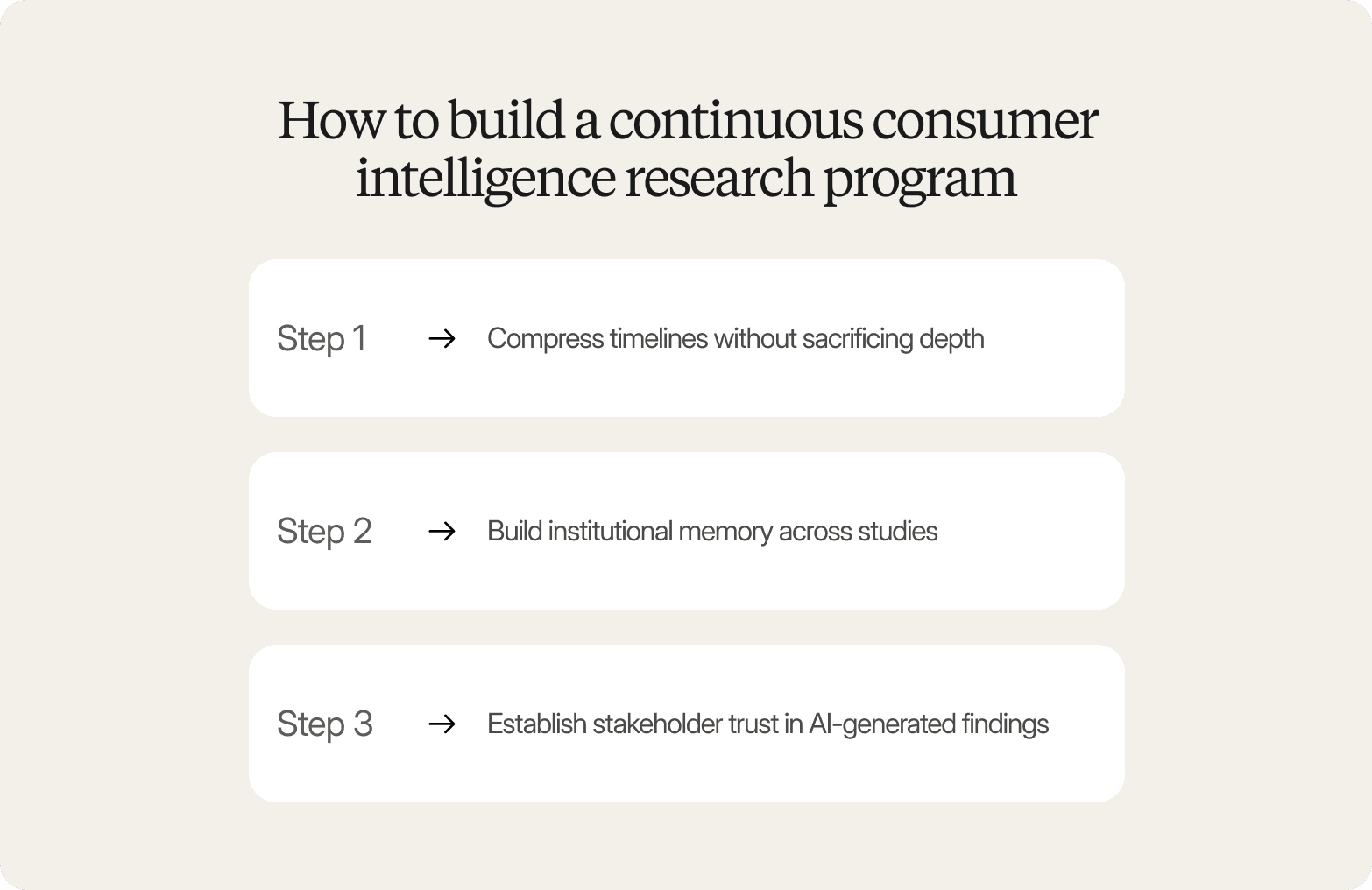
Most teams run consumer intelligence periodically: once per quarter or campaign. Competitive advantage requires continuous feedback loops. Three operational shifts make that possible.
Compress timelines without sacrificing depth
The time loss in traditional qualitative research isn't in the conversations; it's in every manual step around them: data collection, recruiting, scheduling, transcription, synthesis. Each step adds days. Across a full study cycle, those days become weeks. AI-moderated video interviews automate every stage, replacing manual processes with AI. A study that once required six weeks of coordination delivers structured findings in days. And because every session is video-backed, stakeholders can verify depth rather than take summaries on trust. The output isn't faster because it's shallower; it's faster because the manual overhead is gone.
Build institutional memory across studies
Findings trapped in decks don't compound. Each new study starts from scratch, re-asking questions that prior research already answered because those answers aren't accessible. When consumer insights flow into a searchable library, with every finding, clip, and coded theme connected across projects, researchers build on prior learning rather than duplicating it. Over time, this data science foundation enables predictive analytics: identifying patterns in how customer needs evolve before they surface as churn or switching. Conveo's insight library lets stakeholders query findings in plain language and trace every claim back to its source, making each new study more valuable than the last.
Establish stakeholder trust in AI-generated findings
Generic AI synthesis is fast but not grounded in real conversations: there's no clip to play, no verbatim quote to point to. Stakeholders distrust findings they cannot inspect, and that distrust often stops AI-generated research from driving decisions. Video-first consumer intelligence research addresses this by tying every insight to a timestamped clip and real participant context. Real-time insights need to be verifiable insights. That traceability changes the conversation from "can we trust this?" to "what do we do with it?" It's also what separates a customer intelligence platform built for decision-making from one built for content generation.
Consumer Intelligence Research vs. Traditional Market Research
Consumer intelligence research and traditional market research are often conflated, but serve different purposes and operate at different speeds.
| Consumer intelligence research | Traditional market research | |
|---|---|---|
| Focus | Individual customer behavior and decision-making | Market size, competitive landscape, trend analysis |
| Output | Proprietary consumer insights specific to your brand | Syndicated reports are often available to multiple buyers |
| Cadence | Must operate at the speed of decisions | Quarterly or annual cycles |
| Strategic role | Product, messaging, and customer experience decisions | Long-range planning and investment decisions |
| Competitive edge | Compounds over time (harder to replicate) | Available to any buyer |
Teams need both. Market research provides structural context: the size of the opportunity, the shape of the competitive field, and the direction of category trends. Consumer intelligence research provides the competitive edge: proprietary consumer data and insights specific to your customers that no competitor can buy from a syndicated report. The strategic difference is that consumer intelligence research is where you build knowledge that compounds; market research tells you where to point it.
3 Challenges in Scaling Consumer Intelligence Research
Most teams want to run consumer intelligence research continuously, but three operational barriers consistently prevent it from scaling.
| Challenge | The problem |
|---|---|
| Cost | Agency-led qualitative studies run $15K-$50K each. At that cost, most teams are limited to 3-4 studies per year, making research periodic rather than continuous. Budgets push teams toward consumer surveys even when they need the "why" behind purchasing behavior. |
| Speed | Traditional qualitative research takes 6 to 12 weeks. Most decisions operate on 2- to 4-week cycles, so insights routinely arrive after the decision is already made, informing the next campaign, not the current one. |
| Credibility | Stakeholders can't trace AI-generated outputs to real conversations. Without a clip to play or a verbatim quote to point to, findings get questioned before they get acted on. Every insight needs to be auditable and tied to real human responses: whether for a product decision, a brand reputation issue, or crisis management. |
The cost and speed barriers are connected: because each study is expensive and slow, teams run fewer of them, which means consumer data arrives in batches rather than continuously. That batch cadence is what makes consumer intelligence a retrospective exercise rather than a forward-looking one. Credibility is a separate problem: one that emerges specifically as teams adopt data science and AI tools to compress timelines. Speed alone doesn't build trust; traceability does. Customer intelligence platforms that solve all three (cost, speed, and credibility) are the ones that enable genuinely continuous consumer intelligence programs.
How Conveo Powers Consumer Intelligence Research
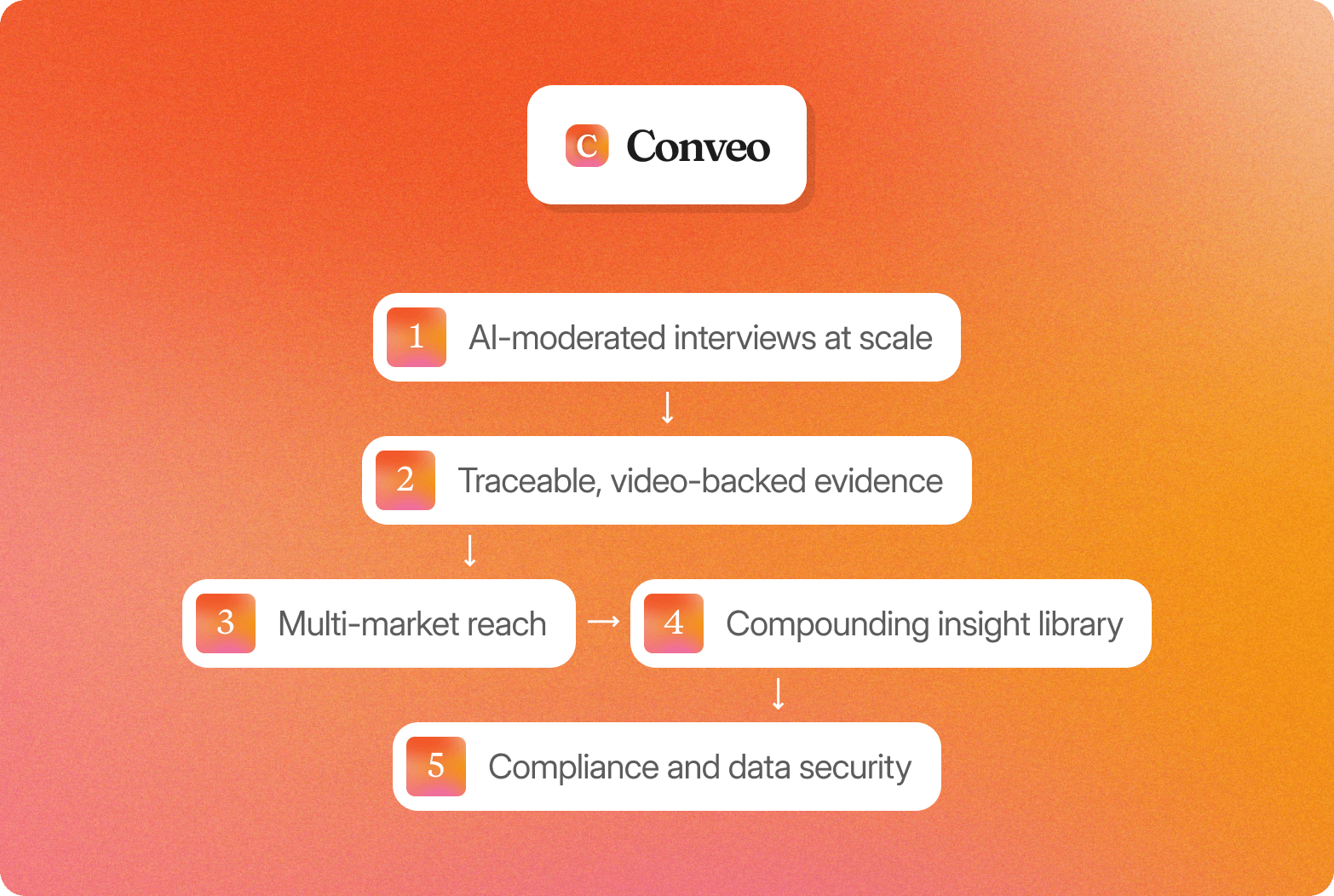
Consumer intelligence research delivers value when it operates at decision speed, with depth that stakeholders can verify and knowledge that compounds over time. Conveo, a video-first AI research platform, is built to make that operational reality achievable for consumer insights, brand, and product teams.
AI-moderated interviews at scale. Conveo's AI moderator conducts adaptive video conversations with real participants, probing hesitation, following unexpected threads, and capturing depth that consumer surveys miss. Hundreds of interviews run in parallel, asynchronously, across markets. This is the technology that makes always-on consumer intelligence viable for teams of any size.
See it in action: How an AI-Moderated Consumer Interview Actually Works →
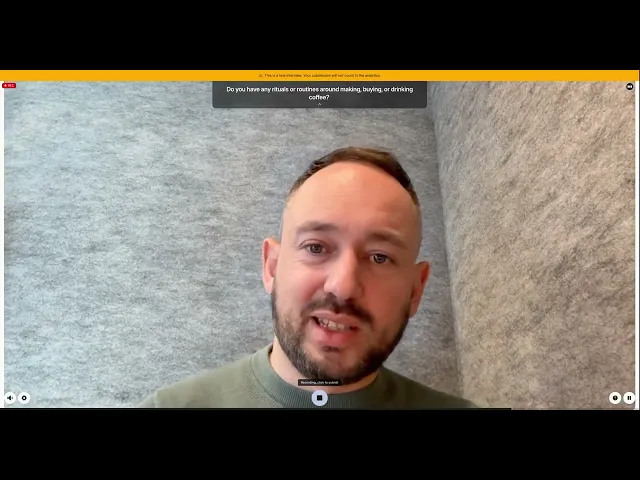
Traceable, video-backed evidence. Every insight links to a timestamped video clip, verbatim quote, and participant context. Stakeholders inspect the source, not a summary, which is what converts skepticism into action and drives business growth through confident decision-making.
Multi-market reach. AI-moderated consumer intelligence research runs in 50+ languages with recruitment across 50+ markets and industries through integrated panel partners or your own lists.
Compounding insight library. Consumer insights, clips, and coded themes flow into a searchable library that grows with every study, so each new project builds on what's already known rather than starting from scratch.
Compliance and data security. Conveo is SOC 2-certified, with GDPR-compliant data handling, built for enterprise procurement.
Frequently Asked Questions
What is consumer intelligence research?
Consumer intelligence research is the systematic study of consumer data: behavior, preferences, and decision-making patterns, to help brands understand their customers in depth. It differs from market research by centering on the individual customer rather than the market landscape, combining quantitative signals (what customers do) with qualitative depth (why they do it). Effective consumer intelligence research connects behavioral evidence to the reasoning behind it, closing the gap left by consumer surveys and analytics alone.
What are the main methods for consumer intelligence research?
Consumer intelligence research draws on three core approaches: quantitative (consumer surveys, behavioral analytics, social media, and review sites), qualitative (in-depth interviews, focus groups, and ethnography), and hybrid AI-augmented approaches. Quantitative methods and social intelligence tools scale well but miss the reasoning behind purchasing behavior. Qualitative methods capture nuance but traditionally take 6 to 12 weeks to run through agencies. AI-moderated video interviews compress that to days without sacrificing conversational depth, making recurring consumer intelligence programs operationally viable for marketers and insights teams alike.
How is consumer intelligence research different from market research?
Market research focuses on market sizing, competitive landscape, and trend identification. Consumer intelligence research focuses on individual customer behavior and decision-making, producing proprietary consumer insights that compound over time rather than syndicated snapshots that any competitor can buy. The key structural difference is cadence: market research operates on quarterly or annual cycles; consumer intelligence research must run at the speed of real-time feedback and business decisions to be useful.
What is a consumer intelligence research CIRP report?
CIRP (Consumer Intelligence Research Partners) publishes syndicated reports tracking consumer behavior in specific markets, including Apple device ownership and Amazon Prime adoption. These provide useful benchmarking snapshots for digital marketers and customer intelligence platforms, but follow a fixed publishing schedule and can't be customized to a specific brand's questions. Proprietary consumer intelligence research platforms let teams run their own moderated interviews, ask questions specific to their brand and competitive situation, and build institutional memory that compounds across studies rather than arriving on a fixed schedule.
What are consumer intelligence and research partners?
Consumer intelligence research partners are agencies, consultancies, and syndicated data providers that design and deliver consumer research on behalf of brands. Traditional partners typically take 6 to 12 weeks per study, making recurring consumer intelligence impractical for teams that need continuous feedback and actionable insights. Platforms like Conveo expand in-house capacity by supporting end-to-end workflows: study design, data collection, AI-moderated interviewing, analysis, and reporting, reducing dependence on external agencies for every study.
How do you build a continuous consumer intelligence research program?
Continuous consumer intelligence requires three operational shifts: compress timelines (AI-moderated interviews instead of agency cycles, cutting 6 to 12 weeks to days), build institutional memory (a searchable library connecting consumer insights across studies so prior consumer intelligence informs future research), and establish stakeholder trust (video evidence tying every insight to a real participant, not a synthetic summary). Start with one recurring study: monthly concept testing or quarterly brand tracking, and expand as the program proves its value across teams and industries.

About the author
Charles Allison
Insights Lead
Charles started agency side in London and spent eight years client side at Sky, Starbucks and Instacart, where he was Conveo's first tech client before he joined. He leads the Research Impact team and prototypes the platform features that serve researchers rather than the ones that only look clever.
Meet Charles on film →Qualitative insights at the speed of your business.
Conveo runs AI-moderated video interviews and structures everything they say.