In this article
TL;DR
Conveo is the video-first AI research platform built for enterprise teams that need real participant evidence, not survey summaries or synthetic data.
A customer research panel is a recruited group of panel members who have been screened for specific attributes and given ongoing access to a team's research program, available for repeated research projects across a team's insight agenda.
Panels decay fast when recruitment, screening, and engagement are managed across disconnected platforms: participant records fall out of sync, screener data sits in one system while interview recordings sit in another, and no one has a complete view of who has been contacted or when.
Panel recruitment through traditional methods typically costs more than social-based recruiting, which means poor targeting and duplicate outreach compound quickly into inflated cost per qualified participant.
Stakeholders challenge findings when there is no direct path from a reported insight back to the participant who said it: without traceable evidence, qualitative research findings get dismissed as anecdote rather than acted on as market insights.
Unified panel management software that consolidates recruitment, screening, interviewing, and incentive tracking within a single platform keeps customer research panels engaged, reduces dropout, and ensures every finding can be verified against the real conversation that produced it.
Qualitative research can now run continuously, at scale, with every finding traceable back to the person who said it. Customer research panels are how insights teams turn that potential into a standing capability, yet most panels lose active panel members faster than they can recruit them. The reason is usually structural, not motivational: recruitment, screening, interviewing, and incentive management each live on separate platforms with no unified participant record connecting them.
That disconnect shows up in a few predictable ways:
A participant completes a study in one system, and that signal never reaches the recruiting platform or the analysis layer.
Coordinators manually reconcile vendor lists, chase incentive confirmations, and guess at who has already been contacted this quarter.
For teams managing customer research panels across multiple markets or business units, over-contact becomes invisible until a stakeholder questions why response quality has dropped, or a participant complains about receiving three invitations in a week.
The result: every new study starts from near-zero.
This guide covers how to build and manage panels that stay engaged, stay auditable, and stay useful across research activities, without adding headcount or stitching together another vendor relationship.
What Is a Customer Research Panel?
A customer research panel is a pre-recruited group of participants who have agreed to take part in multiple studies over time. Unlike one-off recruitment, where teams start from scratch for every project, panels give research functions a standing pool of qualified panel members and ongoing access to their perspective whenever a question surfaces.
Two models dominate how organizations structure customer panel research: proprietary panels, built and managed in-house, and third-party panels, managed by an external market research firm or provider.
| Proprietary panels | Third-party panels | |
|---|---|---|
| Managed by | In-house team | External market research firm, market research company, or panel provider |
| Best for | High-frequency studies with consistent segments (e.g., enterprise CPG, financial services) | Fast access to large, diverse samples without building from scratch |
| Tradeoff | Tighter profile control and accumulated context per participant, more setup overhead | Faster reach, less accumulated context per participant |
Proprietary panels are common at enterprise CPG and financial services organizations that run high-frequency studies across consistent audience segments.
Many third-party providers also power online market research panels and online survey panels, running online surveys, structured surveys, and other online panel research for clients who need quantitative research at scale alongside qualitative work. Some also field phone surveys for demographics that are harder to reach online, or host online discussions where consumer panels weigh in on a topic together rather than one at a time.
The practical value of either model is clearest in recurring research programs. Concept testing, brand tracking, and product feedback cycles all benefit from a stable participant base: response times are shorter, screener drop-off is lower, and findings are easier to compare across waves because panel composition stays consistent. This is also where tracking studies and longitudinal studies depend most heavily on panel stability, since the same panel members need to answer comparable questions wave after wave.
The tradeoff is maintenance. Panels degrade without active management. Panel members become over-contacted, disengage, or drift outside the target audience over time. Without regular auditing, refreshed recruitment, and controls on contact frequency, even a well-built customer research panel introduces sample bias that quietly undermines the findings it was designed to support.
Why Customer Research Panels Decay and What It Costs You
Most customer research panel programs lose active panel members faster than they can recruit replacements. The reason is rarely a shortage of willing participants. It's the infrastructure holding the process together.
Fragmented workflows drive early dropout
When recruitment happens on one platform, screening on a second, and interviewing on a third, every handoff between systems creates friction. Panel members receive inconsistent communications, encounter broken links, or lose patience waiting for the next step. Each additional platform in the chain increases the probability that someone drops out before the session begins. Teams report that this structural friction, not disinterest, accounts for a significant share of incomplete studies and low survey response rates.
Invisible over-contact accelerates opt-outs
Without a unified participant record, different research teams within the same organization independently draw from the same online panels. Customer research panels that look healthy on paper can be quietly exhausted because no single system tracks how often a participant has been contacted, across which projects, or by which team. The result is burnout. Panel members who opted in for occasional engagement start receiving multiple invitations per month and disengage permanently.
Demographic screening doesn't catch behavioral mismatch
Panels filter well on age, location, and household income. They struggle with behavioral data: whether someone has purchased a specific product category in the last 30 days, has recently switched providers, or has direct purchase authority in a business-to-business context. In practice, this mismatch drives high disqualification rates when screening occurs after sourcing, and it's a major reason data quality measures matter as much as recruitment volume.
The cost compounds quickly. Panel recruitment typically costs more than social recruiting, so poor targeting inflates cost per qualified participant at scale. And when findings reach stakeholders, summaries without traceable participant evidence invite skepticism that no presentation can fully overcome, no matter how insightful the data looks on the surface.
The 3 Hidden Costs of Multi-Vendor Panel Management
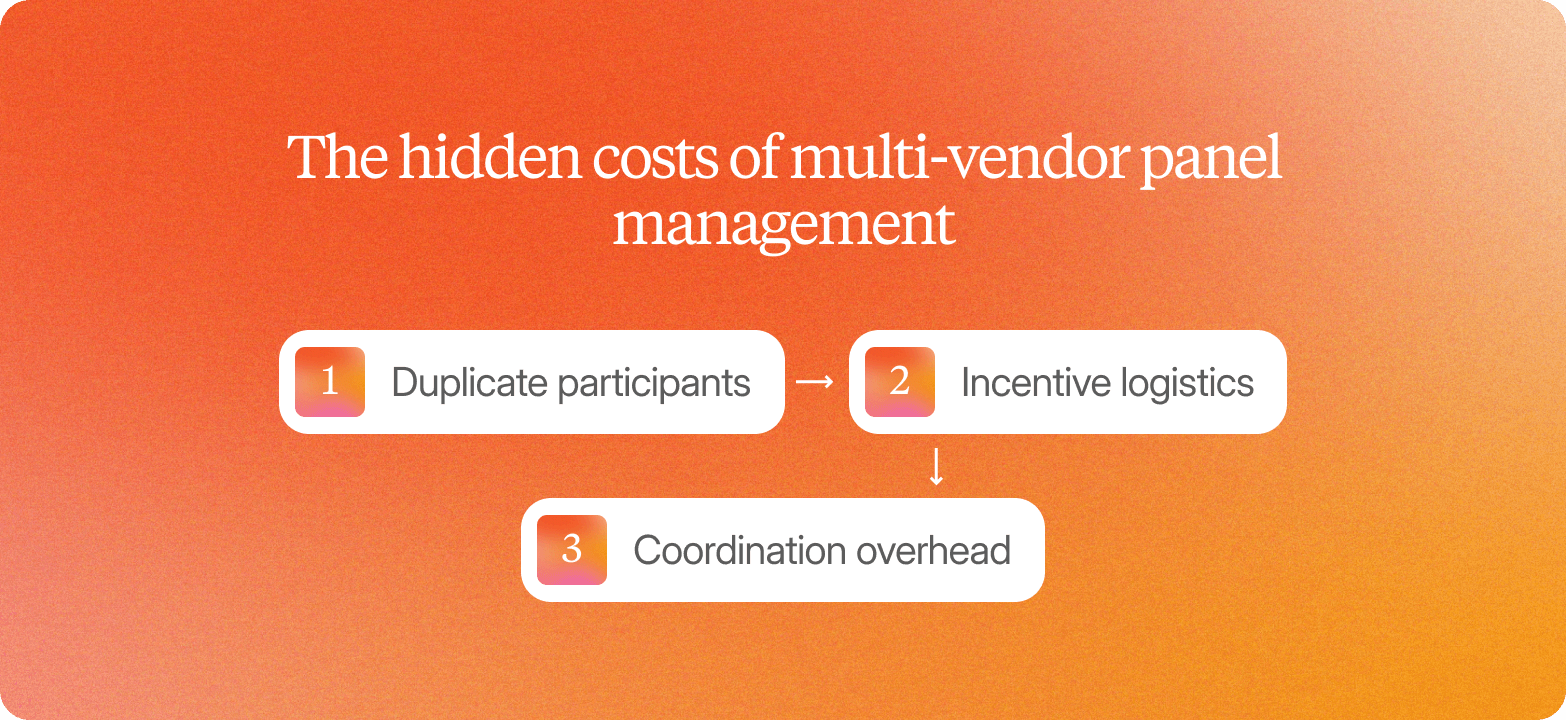
Most enterprise research teams add vendors incrementally: one source for recruitment, a separate screener platform, a third for hosting interviews, and a spreadsheet or finance ticket system for tracking incentive payments. Each addition feels rational in isolation. The cumulative cost is not.
Duplicate participants
Are the first problem to go unnoticed until they surface as a data quality issue. When teams source participants through social media ads alongside a custom market research panel, each source deduplicates only within its own database. A participant who completed a study through one channel last month can appear as a fresh recruit through another channel this month. There is no cross-source deduplication unless someone builds it manually, and in practice, most teams don't, which quietly erodes the reliable data the program depends on.
Incentive logistics
Are the second hidden cost, and the one most likely to become a compliance problem. Research shows that monetary incentives increase response rates by approximately 25% compared to no-incentive controls (systematic review and meta-analysis of 46 randomized controlled trials, PMC), making incentive strategy a material lever for panel participation rather than a line-item afterthought. For B2B participants, rates scale with seniority: individual contributors typically command $75 to $150 per hour, and senior roles, including healthcare professionals and other specialized profiles, considerably more (CleverX research participant incentive guide). Tracking those payments across disconnected systems, without a unified audit trail, creates reconciliation gaps that finance and compliance teams notice at the worst possible moments.
Coordination overhead
Is the third cost, and the most corrosive to turnaround time. Every new study requires manual handoffs between vendors: confirming screener criteria, sharing participant lists, aligning on scheduling windows, and chasing confirmations. Each handoff introduces lag, and lag introduces participant drop-off. Participants who agreed to join a study on Monday are harder to reach by Thursday.
The enterprise consequence compounds at scale. When teams need to localize recruiting across multiple markets, balance demographic quotas, and manage participation limits across disconnected systems, the coordination burden grows with every research project added to the program. What starts as a manageable workaround becomes a structural drag on research velocity and on the market researchers trying to keep the pipeline moving.
How to Build and Manage a Panel That Stays Engaged
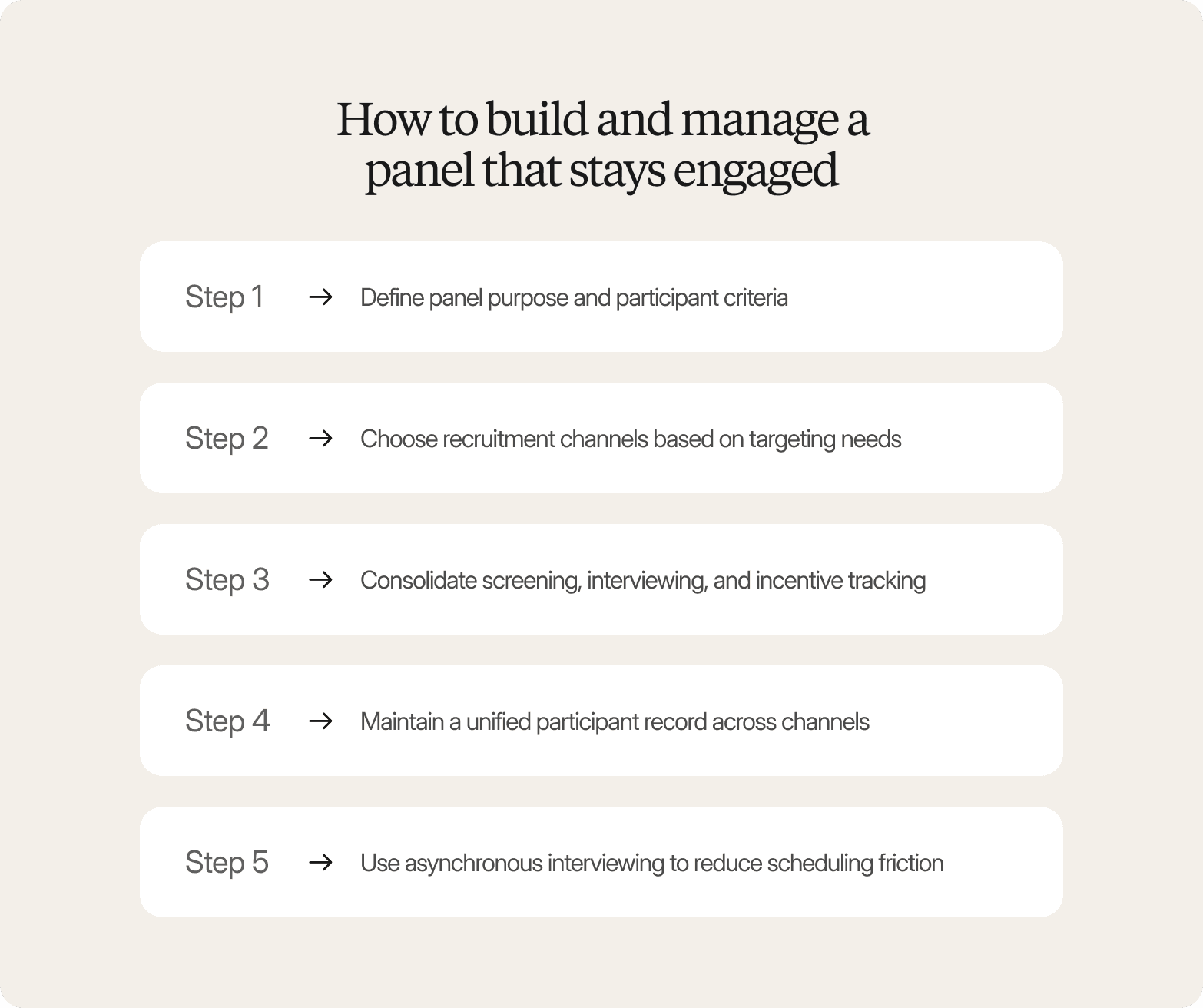
Step 1: Define Panel Purpose and Participant Criteria
Most panels fail before the first interview runs. The reason is almost always the same: the panel was defined by who participants are rather than what they do.
Start by identifying the specific research objectives this customer research insight panel needs to answer, whether the team plans to conduct surveys, run interviews, or both. The right participant profile and research goals shift depending on the use case:
Concept testing needs people who actively make purchase decisions in the category, not consumers who simply match a demographic bracket.
Brand tracking requires the same panel members across waves, so comparisons remain valid over time.
Product feedback needs current, active users of the product or category being evaluated.
Usage research needs participants segmented by real behavior, not self-reported interest.
Each is a different way to gather insights from the same underlying panel, which is why defining the objective first matters more than defining the audience first.
Behavioral screening criteria consistently outperform demographic filters. Product usage frequency, purchase recency, decision-making role, and category involvement predict response quality far better than age or location alone. Define these research needs before you recruit a single participant, and your panel will generate findings worth acting on.
Step 2: Choose Recruitment Channels Based on Targeting Needs
Recruitment channels aren't interchangeable, and matching the channel to the audience matters more than picking a default:
Social recruiting, including targeted social media ads, works well for broad consumer audiences: lower cost per recruit, faster reach, and reasonable demographic spread.
Panel providers give pre-screened access to hard-to-reach segments, including niche B2B buyers, healthcare professionals, or category-specific users, that social channels cannot reliably replicate.
Phone surveys still supplement digital channels for populations that are harder to reach online.
The trap most teams fall into is defaulting to their own CRM or customer list when building a custom research panel. That approach systematically overweights satisfied, active users. Lapsed customers, near-misses, and people who evaluated your category and chose someone else rarely appear in internal databases. If your sample skews toward your most engaged users, your findings will too, and the objections that actually block purchase decisions stay invisible.
Step 3: Consolidate Screening, Interviewing, and Incentive Tracking
Participant drop-off rarely happens because the research topic is uninteresting. It happens because the path from screener to completed interview involves too many handoffs, too many separate links, and too much friction between steps. When recruitment lives on one platform, screening on another, and incentive fulfillment on a third, participants encounter gaps that erode completion rates before the first real question is answered.
The operational cost is borne by the Research Ops team. Each vendor handoff is a potential failure point: a screener that doesn't pass participant data cleanly, an incentive that takes weeks to process, a confirmation email that never arrives. Multiply that across customer research panels spanning multiple markets and the coordination burden compounds quickly.
Conveo combines recruitment, screening, interviewing, analysis, and incentive management in one workflow, streamlining the research process end to end:
Participants receive a single link.
They move through screening and the AI-moderated interview without switching contexts.
They receive their incentive through the same system.
For Research Ops teams, that consolidation means fewer vendor contracts to manage, fewer handoff points to monitor, and completion rates that reflect genuine participant interest rather than attrition caused by process friction, which leaves more time for the relevant insights and valuable insights the research was meant to surface in the first place.
Watch the walkthrough: How Conveo Handles Participant Recruitment →]
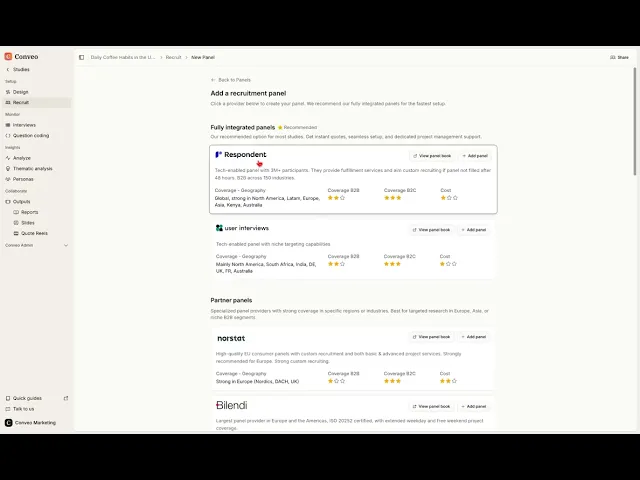
Step 4: Maintain a Unified Participant Record Across Channels
Fragmented panel management creates a specific, costly problem: the same participant completes a study twice, consuming two interview slots and introducing duplicate responses that distort your findings. The fix isn't manual cross-checking. It's architecture, and increasingly it's purpose-built panel management software rather than a shared spreadsheet.
A well-run custom online research panel tracks three things in one place:
Participation history across every study
Current consent status
Contact frequency per participant
When those records live in separate systems, over-contact becomes inevitable. Participants who have already completed a study on a given topic get re-invited, and consent lapses go unnoticed until they become a compliance issue.
Conveo maintains a unified participant record across channels to catch duplicates before they consume interview slots. Every session completed, every consent collected, and every contact event updates the same panel database. Before a participant enters a new study, the platform automatically checks eligibility against that history. No manual reconciliation, no spreadsheet audits. The result is a cleaner sample, fewer wasted sessions, and a customer research panel that stays compliant without requiring your team to police it manually.
Step 5: Use Asynchronous Interviewing to Reduce Scheduling Friction
Scheduling is the hidden tax on every live-moderated panel program. Coordinating availability across participants, moderators, and time zones adds days to a timeline before a single interview begins. For Research Ops teams managing high study volumes, that overhead compounds quickly, especially compared with traditional methods like focus groups or in-depth interviews, which depend on everyone being available at the same time.
Asynchronous video interviewing removes the coordination layer entirely. Participants receive a link and respond when it fits their schedule, whether that is Tuesday at noon or Saturday morning. The research team does not wait on calendar alignment to start collecting data.
For teams evaluating the best platforms for building customer research panels in 2026, throughput capacity is a practical differentiator worth examining closely. Conveo supports always-on panels by enabling repeated, asynchronous video interviews so participants can respond on their own schedule, running hundreds of conversations in parallel and removing the throughput ceiling of live-moderated sessions.
The operational result is a panel that continuously produces data rather than in scheduled waves, giving insights teams a standing source of customer intelligence and feedback rather than a periodic one.
5 Panel Quality Metrics You Should Monitor
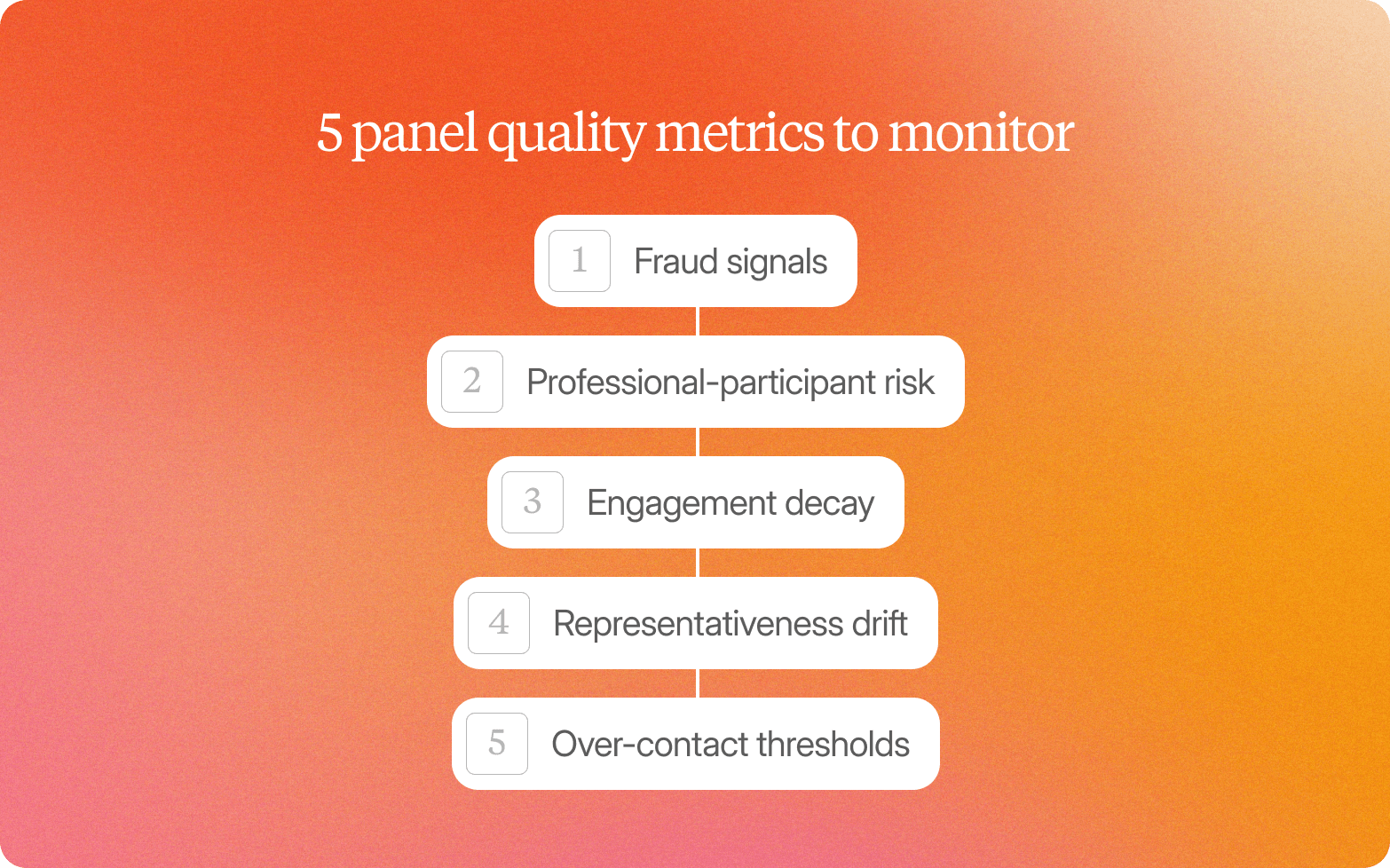
Panel health isn't self-maintaining. Left unmonitored, even a well-sourced customer research panel degrades in ways that only become visible when a stakeholder challenges the findings in a debrief meeting. Tracking five key factors consistently keeps that from happening and helps ensure data quality across every wave.
Fraud signals
Duplicate IP addresses, completion times that are statistically impossible given the study length, and patterned responses in which answers follow a mechanical sequence rather than genuine reflection all indicate that a participant is not engaging authentically. These flags should be reviewed before analysis begins, not after, as part of standard data quality standards.
Professional-participant risk
Participants who rotate across multiple panels and complete studies repeatedly tend to develop rehearsed answers that track what they believe researchers want to hear. In practice, this shows up as unusually polished responses that lack the specificity and contradiction that characterize real consumer behavior.
Engagement decay
Declining completion rates or rising mid-study drop-off over successive waves signal that participants are burning out or losing trust in the experience. Monitoring these rates across studies, rather than within a single wave, surfaces the pattern before it contaminates a full program and erodes data quality.
Representativeness drift
When certain participant types opt out faster than others, the customer research insights panel skews toward whoever remains most willing to engage. Panel composition, demographic and behavioral, should be tracked wave-over-wave rather than assumed stable.
Over-contact thresholds
Contacting the same participants too frequently within a short window increases the risk of fatigue-driven responses and inflated familiarity with study formats. Most research operations teams set a minimum re-contact interval per participant per month to protect data quality measures across the panel.
The reason monitoring matters is straightforward: stakeholders who weren't in the room will probe the findings. When claims can't be traced back to real participant evidence, credibility collapses. Conveo addresses this directly. Video-based participation means each session is recorded and linked to the participant who gave it. Themes in the analysis connect to verbatim quotes and video clips, so any finding can be traced back to a real person and a real conversation rather than to an aggregate number with no visible source, which is what turns raw data into genuinely reliable, high-quality data. Every metric above exists to protect the same outcome: high-quality data that stakeholders don't have to take on faith and insightful data that holds up under scrutiny.
"Trustworthy insights overnight, the researcher's holy grail"
CMI Lead, Edgard & Cooper
Multi-Market Panel Playbook
Running global customer research panels without a clear operational framework creates compounding complexity. Recruiting across multiple markets means managing varying incentive expectations, translating materials without losing meaning, coordinating asynchronous sessions across time zones, and accounting for cultural dynamics that shape participants' responses. Each of these variables is manageable in isolation. Together, they slow studies down and introduce inconsistencies that compromise cross-market comparability.
Four considerations help teams keep multi-market panels on track:
Incentives by region: Custom panel market research works best when incentive structures reflect local purchasing power and cultural norms. A gift card that motivates a participant in Germany may be far less compelling than a mobile credit transfer in Southeast Asia.
Translation vs. localization: Verbatim translation preserves literal meaning but often loses cultural resonance. Adapting questions to local idioms and reference points produces more natural, honest responses and more reliable feedback overall.
Timing windows: Asynchronous interviews reduce scheduling pressure, but the timing of study launch still matters. Account for regional holidays and typical daily rhythms to avoid low completion windows.
Cultural response bias: In some markets, participants tend toward socially desirable answers or avoid direct criticism of brands. Discussion guide design should create space for indirect expression and probe beneath initial positive responses.
Conveo supports 50+ languages with automated transcription and translation, keeping multi-market panels moving without localization delays. As recordings arrive from different markets, every session is transcribed, translated, and coded within a single workflow, so teams can focus on analyzing findings rather than managing logistics across vendors.
When to Use Panels vs. One-Off Recruitment
The right recruitment approach depends on what your team is trying to learn and how often you need to learn it.
| Use panels when... | Use one-off recruitment when... |
|---|---|
| Research is recurring (tracking, concept testing, ongoing product feedback) | Criteria are still undefined, and the research is exploratory |
| Target market is hard to reach (niche demographics, healthcare professionals) | You need a single deep dive: focus groups, in-depth interviews, one-time studies |
| Running longitudinal or tracking studies | Panel conditioning is a risk (rehearsed responses from repeat participants) |
When to use panels
Research is recurring: customer panel research programs like brand tracking, concept testing, and ongoing product feedback benefit from a consistent participant pool where baseline attitudes are already established and panel members provide ongoing access to the same perspective over time.
Your target market is hard to reach: niche demographics, low-incidence conditions, or specialized professional profiles like healthcare professionals are expensive to source from scratch each time.
You're running longitudinal studies or tracking studies: measuring how attitudes shift over weeks or months requires the same participants, not a rotating cast.
When to use one-off recruitment
Criteria are still undefined: exploratory research where you're not yet sure who the right participant is benefits from a broader, unconditioned pool.
You need a single deep dive: focus groups, in-depth interviews, or one-time studies on a new market, a competitive shift, or an emerging behavior call for fresh perspectives rather than participants who know your brand well.
Panel conditioning is a risk: participants who have completed multiple studies on similar topics can develop rehearsed responses that reduce the authenticity of findings.
The core tradeoff: customer research panels compress time-to-insight and reduce per-study recruitment overhead, but they require active management. Without periodic refreshes, panel quality degrades through attrition, over-surveying, and familiarity bias. One-off recruitment, whether structured surveys, phone surveys, or in-depth interviews, costs more per study but guarantees uncontaminated responses.
How Conveo Keeps Customer Research Panels Engaged and Auditable
The failure mode running through every section above is the same: disconnected platforms with no shared participant record. Conveo closes that gap by consolidating the full panel management software workflow into a single system, making panel health the default state rather than a maintenance burden.
One workflow, one link. Recruitment, behavioral screening, AI-moderated interviewing, analysis, and incentive tracking run in a single platform, so participants never switch contexts and completion rates reflect real interest, not process attrition.
A unified participant record. Participation history, consent status, and contact frequency update in the same panel database, catching duplicates and over-contact before they distort your sample or trigger a compliance issue.
Asynchronous video at scale. Repeated, on-demand video interviews run hundreds of conversations in parallel, turning a panel into a continuous source of market insights and gathered feedback rather than a periodic wave.
Traceable evidence. Because every session is recorded and linked to the participant who gave it, each theme connects back to verbatim quotes and video clips, so stakeholders can audit any finding to a real person and a real conversation and gain insights they can actually defend.
For Research Ops teams, that consolidation is what keeps a customer research panel engaged, representative, and defensible across research projects, without adding headcount or another vendor relationship. It's also what turns panel data into actionable insights and durable marketing strategies rather than one-off summaries that stakeholders forget by the next quarterly review, and it lays the groundwork for future research the team hasn't scoped yet.
Frequently Asked Questions
What Is a Customer Research Panel?
A customer research panel is a pre-recruited group of participants who have agreed to take part in multiple studies over time. Because panelists are already screened and consented, teams can field new studies without rebuilding their participant pool from scratch, which makes panels especially valuable for tracking how attitudes or behaviors shift across product launches, campaigns, or market changes and for gathering employee insights alongside customer-facing research.
How Much Does It Cost to Build a Customer Research Panel?
Panel recruitment typically costs more than social recruiting, with costs driven by targeting complexity and the niche of participants. US incentive norms for research participation commonly run $75 to $150 per hour for B2B individual contributors, with senior roles commanding significantly higher rates. Poor behavioral screening further compounds costs: high disqualification rates inflate the cost per qualified participant. Custom research panel solutions with built-in screening and clear data quality standards help contain that waste.
How Do I Prevent My Customer Research Panel from Decaying?
Panel decay accelerates when participants face friction at every touchpoint. Three tactics help: consolidate recruitment, screening, and interviewing into a single workflow to reduce drop-off; maintain a unified participant record to prevent over-contact across studies; and use asynchronous interviewing to remove scheduling as a barrier. Conveo consolidates recruitment, screening, asynchronous video interviewing, and incentive tracking into a single workflow, keeping your customer research panel engaged and auditable across studies.
What Are the Best Platforms for Building Customer Research Panels in 2026?
The best platforms for building customer research panels in 2026 consolidate recruitment, screening, interviewing, and incentive management in one place rather than splitting those steps across separate market research firms or vendors. Look for platforms that apply behavioral screening criteria before interviews run, not after sourcing. Panels that screen late typically see high disqualification rates. Conveo applies behavioral screening upfront, reducing that waste and maintaining a unified participant record across studies.
How Do I Manage Incentives for a Customer Research Panel?
Tracking incentive payments across separate recruitment, moderation, and finance systems creates audit gaps that become a compliance problem at scale. Research consistently shows that monetary incentives increase response rates, making incentive strategy a material lever for panel participation in any customer research insight panel. The practical recommendation: consolidate incentive tracking into the same platform that handles recruitment and interviewing. A unified system maintains a clear payment audit trail and removes the manual reconciliation step that breaks down across fragmented vendor stacks.
Can I Use My CRM or Customer List as a Research Panel?
You can, and CRM lists have real advantages: they're already segmented and free to access. The risk is sample bias. Customers and highly engaged users tend to skew positive, which means you'll miss objections from lapsed users and non-customers entirely. For most studies, custom research panels that blend your CRM with external recruitment give you a more complete and representative picture and a better foundation for the deep insights stakeholders need to act on.
About the author
Ivayana Abdi
Research Impact Lead
Ivayana has worked in market research since 2017, most recently as group manager of research operations and logistics at Culturati, and trained at RIVA and the Burke Institute. She joined Conveo for the hybrid researcher model: agile with new methods, fluent in the traditional ones, and able to combine the two for clients who want to try new things.
Meet Ivayana on film →Qualitative insights at the speed of your business.
Conveo runs AI-moderated video interviews and structures everything they say.