In this article
TL;DR
Define research goals tied to a specific business decision before writing a single question
Build interview guides around open-ended questions with room for adaptive probing
Recruit target users using behavioral screeners, not demographic filters alone
Moderate for depth: observe non-verbal cues, follow unexpected threads, and probe incomplete answers
Synthesize qualitative data with traceable, video-linked evidence that stakeholders can audit
Scale beyond manual moderation with async AI-moderated interviews that run hundreds of conversations in parallel
Qualitative research is entering a new era. AI-moderated interviews, multimodal signal capture, and compounding insight libraries mean that the depth qual has always promised is now achievable at a speed and scale that were structurally impossible five years ago. Well-executed user research provides valuable insights that numbers alone can't deliver: surface-level metrics tell you what happened, but user interviews reveal why.
Yet in practice, the user research process is still slow for most teams. Recruiting takes two weeks. Scheduling takes another. Moderation runs back-to-back across a single afternoon. Then the synthesis sits in a backlog while the product team ships without it.
This guide covers the full workflow for conducting user research interviews that actually influence decisions: planning a research study with a clear question, recruiting participants without burning a week on logistics, moderating conversations that surface real behavior, and analyzing qualitative data into structured output your team can act on. The sections on synthesis and scaling are where the operational reality gets hardest, and where most teams lose ground.
What are user interviews, and when should you use them?
User interviews are structured 1:1 conversations designed to understand user needs, motivations, and pain points. Unlike usability testing, focus groups, or surveys that collect scaled responses, interviews are built for depth. They follow where research participants lead, surface reasoning that observation misses, and help teams develop a deeper understanding of what drives user behavior.
Interviews are among the most powerful UX research methods because they reveal not just how users interact with a product but also why. Unlike quantitative methods that measure what happens, interviews explore why it happens, making them an essential complement to analytics and surveys. Among the full range of UX methods available to a research team, they are uniquely suited to surfacing user needs that don't appear in usage data.
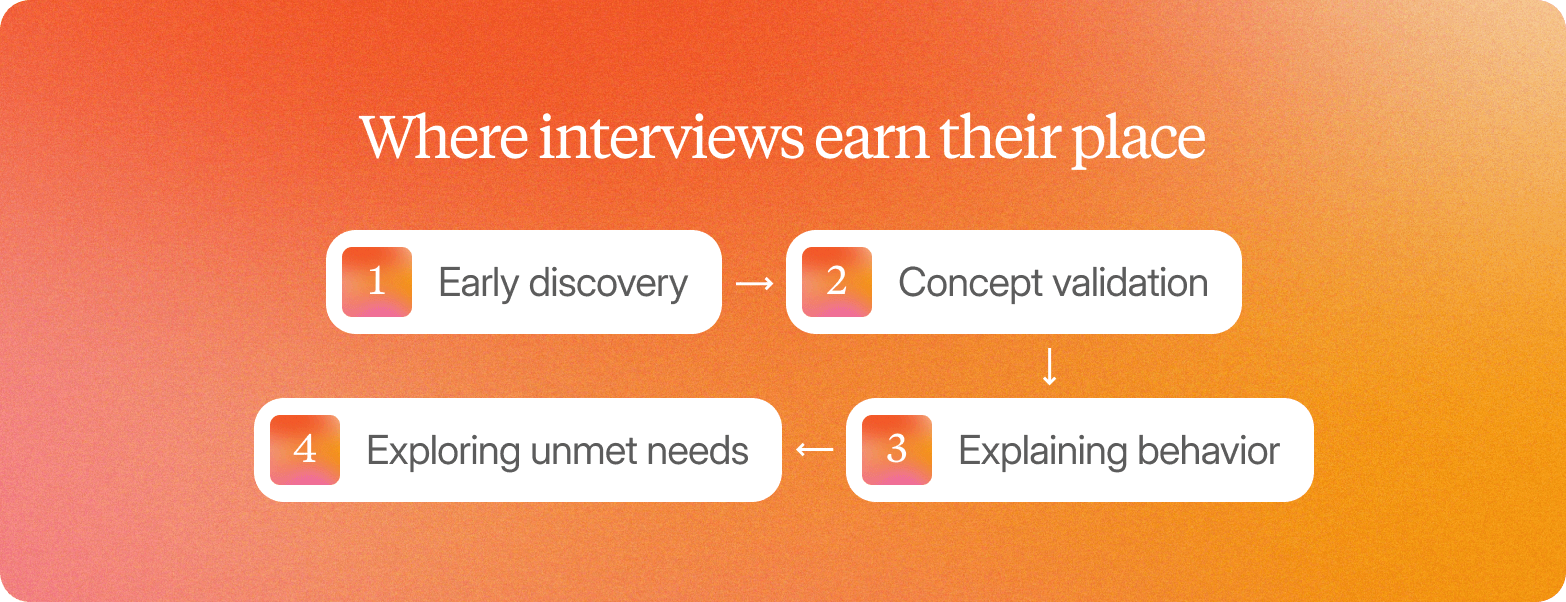
Knowing how to conduct user research well starts with choosing the right research method for the question. Interviews earn their place when:
Early discovery: You don't yet know what problem you're solving: generative interviews designed to generate ideas and surface unmet needs are the right starting point
Concept validation: You need to understand how users interpret an idea before committing to it
Explaining behavior: Quantitative data shows what is happening but not why; understanding how users behave in real workflows requires direct conversation
Exploring unmet needs: You're looking for gaps that don't appear in usage data
Use interviews to understand why users abandon a checkout flow. Use usability testing to watch where they get stuck. Contextual inquiry and contextual interviews go further, observing users in their own environment to understand how behavior plays out in context, rather than in a controlled session.
Interviews are not the right method when you need statistical significance, when you're measuring the prevalence of a behavior, or when you need to watch participants perform tasks under direct observation.
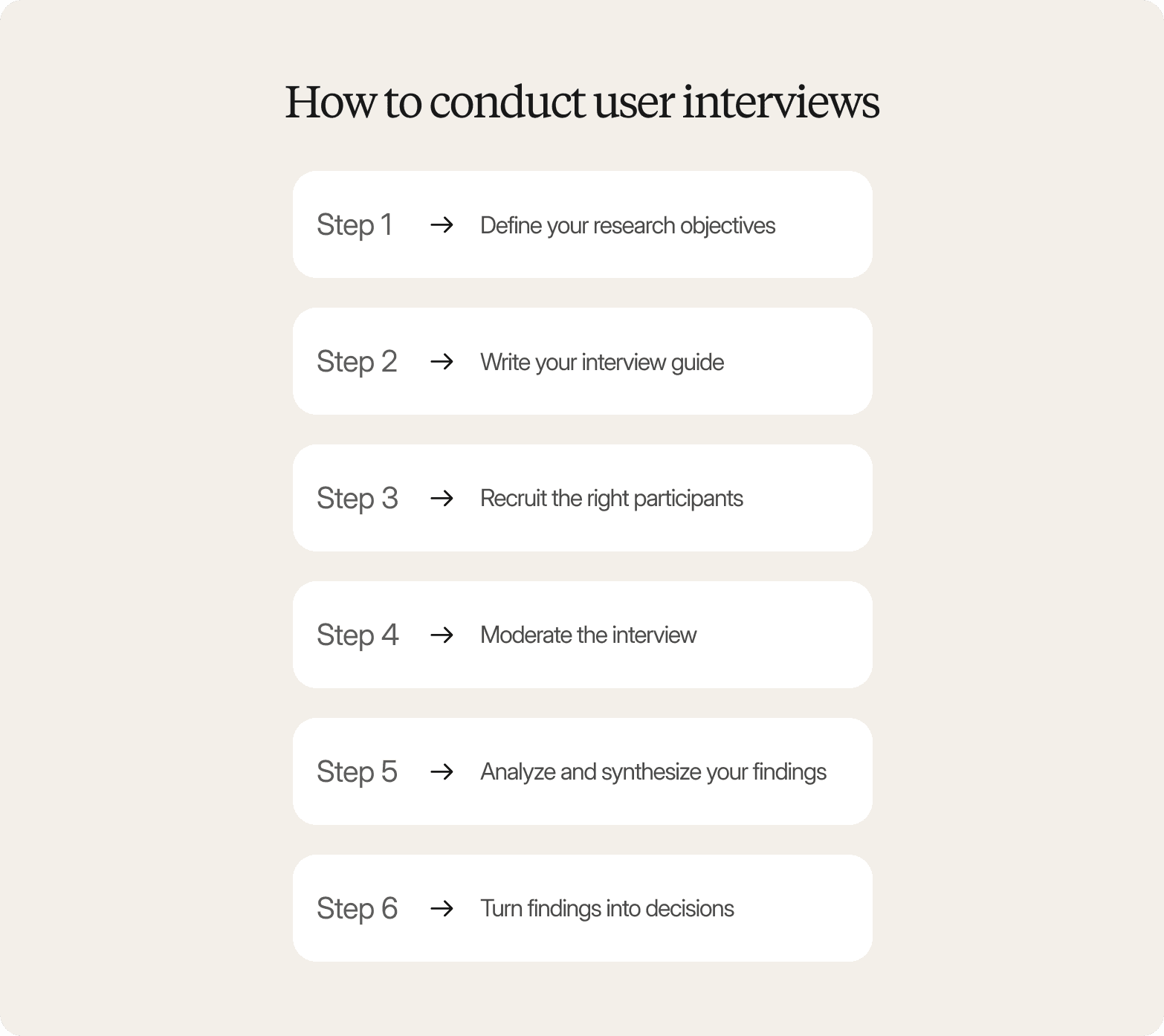
Step 1: Define your research objectives
An interview guide without clear objectives is a conversation looking for a direction. Sessions drift, participants follow tangents, and by the time you sit down to analyze, you have rich material that answers questions nobody actually asked. A skilled user researcher knows that conducting effective user research starts with research goals specific enough to drive question design.
A well-formed research objective has two components: the specific question the business needs answered, and the decision it's attached to. That second part is what most teams skip. "Understand our users better" is not an objective: it's a category. The moment you attach a decision to it, it becomes a behavioral research question worth asking.
| Context | Objective | Decision |
|---|---|---|
| Product discovery | What workarounds are power users building around our export feature? | Whether to prioritize a native export improvement |
| Feature validation | Do users trust the new dashboard summary enough to act on it without drilling down? | Whether to ship as designed or revise the information hierarchy |
| Onboarding friction | At what point in the first session do new users lose confidence? | Where to intervene in the onboarding sequence |
| Retention drivers | What keeps target users coming back after 30 days, and which factors are within our control? | Which retention levers to prioritize next quarter |
Objectives also determine question structure. Broad, exploratory objectives need open questions. Narrow, evaluative objectives need focused probing. Mixing both in a single guide produces sessions that feel unfocused and research data that is hard to code consistently.
Before launching a research study, write your objectives down. If a stakeholder can't immediately see what decision they support, rewrite it.
Step 2: Write your interview guide
A well-structured guide is the foundation of an ideal user interview, one that separates genuine behavioral insight from polished, surface-level answers. An ideal user interview involves open-ended questions, adaptive probing, and a moderator focused on understanding rather than validating.
Most effective user interviews follow a semi-structured interview format: a defined set of core questions with room to follow threads as they emerge. This is distinct from a scripted survey or a fully open conversation; the structure keeps sessions on track while preserving the flexibility that produces depth.
The four-part structure
| Section | Purpose |
|---|---|
| Rapport and orientation | Low-stakes opening questions establish context and candor. Remind participants there are no right or wrong answers: you're here to learn from their experience, not evaluate them. |
| Context and background | Understand the participant's broader workflow, current workarounds, and what they did before the product existed |
| Core exploration | Substantive open-ended questions focused on behavior, not opinion: use the example questions below |
| Closing | Space for participants' questions and anything they felt was missing, plus a clear explanation of how their input will be used |
Example questions by context
Discovery:
"Walk me through the last time you had to [do the relevant task]. What happened?"
"What's the hardest part of that process right now?"
"Why do you approach it that way rather than [alternative]?"
Validation:
"How does this compare to how you currently handle it?"
"What would have to be true for this to fit into your workflow?"
Usability:
"What's going through your mind as you look at this?"
"How would you expect this to work?"
Every question starts with "how," "what," or "why." Questions that can be answered with a yes or no end the conversation before it starts.
The leading question problem and one's own biases
Questions like "Did you find the onboarding confusing?" telegraph the answer. Participants respond to the assumption, not their actual experience. Be alert to your own biases when writing questions: the instinct to confirm a hypothesis rather than challenge it is one of the most common sources of weak interview data.
Reframe leading questions as open invitations: "What was your experience with onboarding?" The difference sounds small. The data difference is significant. Well-framed questions expose the mental models users carry into a product experience, which is where the most actionable insights live.
Why probing matters more than the question list
A static question list is a floor plan, not a conversation. The real insight lives in what participants say between the scripted questions: the hesitation, the digression, the offhand mention of a workaround. Knowing how to conduct user interviews, UX teams will trust means following those threads with strong follow-up questions rather than returning to the next list item.
This is where adaptive probing changes output quality. When Conveo's AI moderator senses hesitation or an incomplete answer, it follows up in real time: "Can you say more about that?" or "What made you decide to do it that way?" rather than moving on. That responsiveness is what turns a surface-level answer into a behavioral explanation, and helps teams collect data that genuinely reflects user experience.
Step 3: Recruit the right participants
Participant quality is the variable most teams underestimate. A rigorous discussion guide and a well-structured analysis plan can still yield unreliable findings if the wrong target users are included in the sessions.
Build screeners around behavior, not demographics
Age, job title, and company size are weak predictors of the behavior you want to study. A 38-year-old product manager could be a daily power user or someone who has logged in twice. What research participants have done is more predictive than who they are.
The problem with demographic-only screeners is that they surface self-reported data about identity, not behavior. Self-reported data has well-documented reliability limits: people describe themselves as they want to be seen, not necessarily as they act. Behavioral screeners ask about past actions instead: "Have you used [feature] in the last 30 days?" or "Describe the last time you ran into [problem]." A brief questionnaire of four to six screener questions, with one or two knowledge-verification items that only genuine users would know, protects your research data from the start.
Sample size by study type
Discovery: 5 to 8 interviews per user segment is typically enough to reach thematic saturation
Validation: 10 to 15 participants per segment, where you're pressure-testing a specific hypothesis
Going larger is rarely the answer when the quality of each conversation matters more than the count.
Where to find participants and how to protect quality
Common channels: your existing user base, vetted panel providers, product community forums, social media intercepts, and in-app recruitment. Each has its own trade-offs: your own user base skews toward engaged customers; open panels introduce fraud risk.
Before the initial interview in any large-scale research study, establish quality controls. Unvetted panels carry real risks: professional survey-takers, bot-generated completions, and misrepresented experience. At scale, even a 10% fraud rate can corrupt the data collected throughout your thematic analysis. Conveo integrates with vetted panel partners and adds a behavioral screening layer to filter for genuine experience rather than just demographic fit. Governance requirements (informed consent, recording permissions, regional data handling) should be built into your recruitment workflow from the start.
Step 4: Moderate the interview
Good moderation is one of the highest-leverage skills when interviewing users, and one of the hardest to scale. The moderator's job is not to run through a script. It is to build rapport, probe the moments that matter, and follow interesting threads even when they pull the session off-script.
The mechanics of good moderation
Use silence deliberately. Wait 3 to 5 seconds after a participant finishes. Most researchers move too fast. Silence creates space for the real answer to surface.
Probe without leading. "Tell me more about that" is neutral. "So you found it confusing?" is not.
Watch for non-verbal cues. In video sessions, hesitation, long pauses, and changed answers are signals worth following. These non-verbal cues reveal where real friction lives, often more reliably than what participants say directly.
Follow the thread, not the guide. Unexpected responses are often the most valuable signal. A rigid script leaves user errors, unexpected reactions, and emotional hesitations on the table.
Manage time without rushing. Know which questions are load-bearing and which can be cut.
Ask strong follow-up questions. Asking "What did you mean by that?" or "Can you walk me through a specific example?" keeps participants from giving surface-level responses rather than sharing their real experience.
Understanding how users behave in real contexts (not just how they self-report) requires a moderator who fosters a safe environment for honesty. Remind participants at the start that there are no wrong answers and that their candid experiences are exactly what's needed to develop a deeper understanding of user needs.
For teams learning to conduct user interviews as product managers, the most common error is validating rather than exploring: asking yes/no questions, restating participants' answers, and moving on without resolving ambiguity.
Where manual moderation hits its ceiling
A researcher can moderate 8 to 10 sessions a week before synthesis quality degrades. For a team of two or three serving multiple product squads, that ceiling arrives fast. Every session still needs to be scheduled, attended, transcribed, and coded before anyone learns anything.
Conveo's AI-moderated video interviews remove that ceiling. Sessions run asynchronously: hundreds of conversations in parallel, without adding a single hour of moderation time. The AI probes are based on what participants actually say, so the adaptive depth that makes moderation valuable is preserved at any volume.
Step 5: Analyze and synthesize your findings
Synthesis is where most qualitative research programs stall. Transforming raw conversations into meaningful insights and stakeholder-ready narratives takes longer than the fieldwork itself, and it's often the bottleneck in analyzing qualitative data.
The manual process: transcribe recordings, tag key moments, group tags into candidate themes, test whether each theme holds across multiple interviews, build an evidence hierarchy (theme → sub-themes → representative quotes → participant context), then write findings. For a research-focused team running 20 participants, this takes two to three weeks. Under sprint pressure, it often doesn't get done at all.
AI-assisted synthesis changes this concretely. Platforms like Conveo handle transcription, translation, and initial thematic coding as recordings arrive, not after fieldwork closes. Themes surface from actual coded content: from the qualitative data itself, not a user researcher's memory of what felt important. The researcher's role shifts from mechanical coding to reviewing, validating, and deepening the analysis where judgment matters most.
The video-first difference is significant. When every finding links back to a timestamped clip, research findings become auditable. A product manager who doubts a finding can watch the moment. That traceability separates structured, credible output from a summary that lives and dies in a slide deck. Generic LLM synthesis produces fluent output that is untethered: no source to inspect, no clip to share.
"The AI doesn't just summarize, it surfaces patterns I wouldn't have spotted reading transcripts."
CMI Lead, Edgard & Cooper
Step 6: Turn findings into decisions
The most common failure in research delivery isn't bad analysis. It's a good analysis buried in a format nobody reads. A 40-slide deck with methodology appendices and 12 themes of equal weight doesn't help a product manager solve problems before Thursday's sprint planning.
Structure research findings for how decisions actually get made:
Lead with the recommendation, then show the supporting evidence
Keep executive summaries to 3 to 5 findings, each tied to a specific product or design implication
Pair written findings with a video highlight reel: clips of participants describing their user journeys and reacting to prototypes landing in a way bullet points cannot
Every claim should link back to a specific participant quote or video timestamp to provide valuable insights that stakeholders can verify
The deeper problem is what happens after the presentation. Most of the data collected from interviews dies in presentation decks. Themes identified six months ago are rediscovered from scratch because there is no searchable record of what was already learned. Conveo's insight library is designed to address this: every finding, clip, and theme flows into a searchable repository, so organizational knowledge compounds over time rather than resetting with every study.
How to scale user interviews beyond one-off projects
The barrier to continuous user interviewing isn't willingness: it's operational. Each step in the user research process happens sequentially: recruit, schedule, moderate, transcribe, code, synthesize. Total cycle time routinely stretches to two or three weeks. For teams embedded in the design and development process (where insights need to arrive at the pace of sprint cycles, not agency timelines), this gap is felt most acutely.
Scaling requires shifting from a project mindset to an operating model: a repeatable research plan built into the team's rhythm: brief intake at sprint start, sampling from panels or your own participant list, rolling synthesis that builds on the previous round, and a searchable repository where findings accumulate. This approach embeds UX research into the design process rather than treating it as a project that precedes development.
When volume exceeds what one moderator can handle, parallel async interviewing changes the math entirely. Participants receive a link, respond on their own schedule, and complete an AI-moderated session that probes based on what they actually say. Ten conversations or a hundred run simultaneously. What previously took three weeks compresses to hours or days.
For cross-market work, knowing how to conduct cross-cultural user research traditionally means coordinating local recruiters, bilingual moderators, and translation vendors across multiple markets. Conveo's AI moderator supports 50+ languages, with built-in automated transcription and translation, no separate vendors per market, and no extra overhead for collecting data from research participants across time zones.
Manual vs. AI-moderated user interviews: A comparison
| Dimension | Manual moderation | AI-moderated async |
|---|---|---|
| Recruiting time | Weeks to recruit and schedule | Days from vetted global panels |
| Moderation capacity | Limited by moderator availability; typically 4 to 6 sessions/day | Unlimited parallel capacity |
| Synthesis speed | Manual transcription and coding; often days of analyst time | Automated transcription, translation, and thematic synthesis |
| Stakeholder traceability | Findings are summarized in decks; raw transcripts are rarely shared | Video clips, verbatim quotes, and source-linked themes |
| Timeline: launch to insight | 6+ weeks typical for traditional qual | Hours to days from study launch |
| Cost per interview at scale | Scales linearly with moderator and analyst time | Decreases significantly as volume increases |
Neither approach is universally right. Manual moderation brings irreplaceable human judgment: a skilled moderator can follow an unexpected thread, read hesitation in real time, and adapt in ways no protocol anticipates. That matters for sensitive topics and studies where the unexpected finding is the most important one.
AI moderation offers consistent adaptive probing at any volume: following hesitation, exploring stated frustrations, and probing different responses across every session, whether that's 20 interviews or 200. Most research programs benefit from both AI moderation for high-volume discovery and sprint-cycle behavioral research and human moderators for complex or sensitive exploratory work.
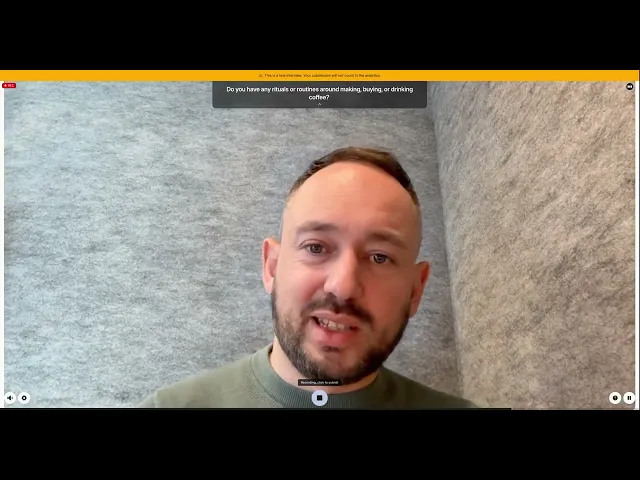
Watch: AI vs. Human Moderation: What's the Same, What's Different, and When It Matters
6 common user interview mistakes and how to avoid them
Most mistakes aren't skill failures: they're process failures that prevent research from reaching its potential to produce meaningful insights that influence the development process.
| Mistake | Fix |
|---|---|
| Vague research goals | Tie every interview to a specific decision. If you can't name it, the study isn't ready to launch. |
| Leading questions | Use open-ended questions that invite participants to narrate their own experience. Building prompts that open doors rather than confirm hypotheses is the key to conducting user research interviews well. |
| Weak probing | When a participant says something unexpected, follow up. The script is a floor, not a ceiling. |
| No synthesis plan before fieldwork | Design your analysis structure alongside your discussion guide. A task analysis of the questions you're asking will reveal gaps before fieldwork starts. |
| Findings that die in decks | Build a searchable, persistent insight repository: past findings should inform future interviews and prevent teams from rediscovering what they already know. |
| Treating interviews as one-off projects | A single research study produces a snapshot. A continuous interviewing cadence produces organizational understanding that compounds across user needs. |
How Conveo supports the full user interview workflow
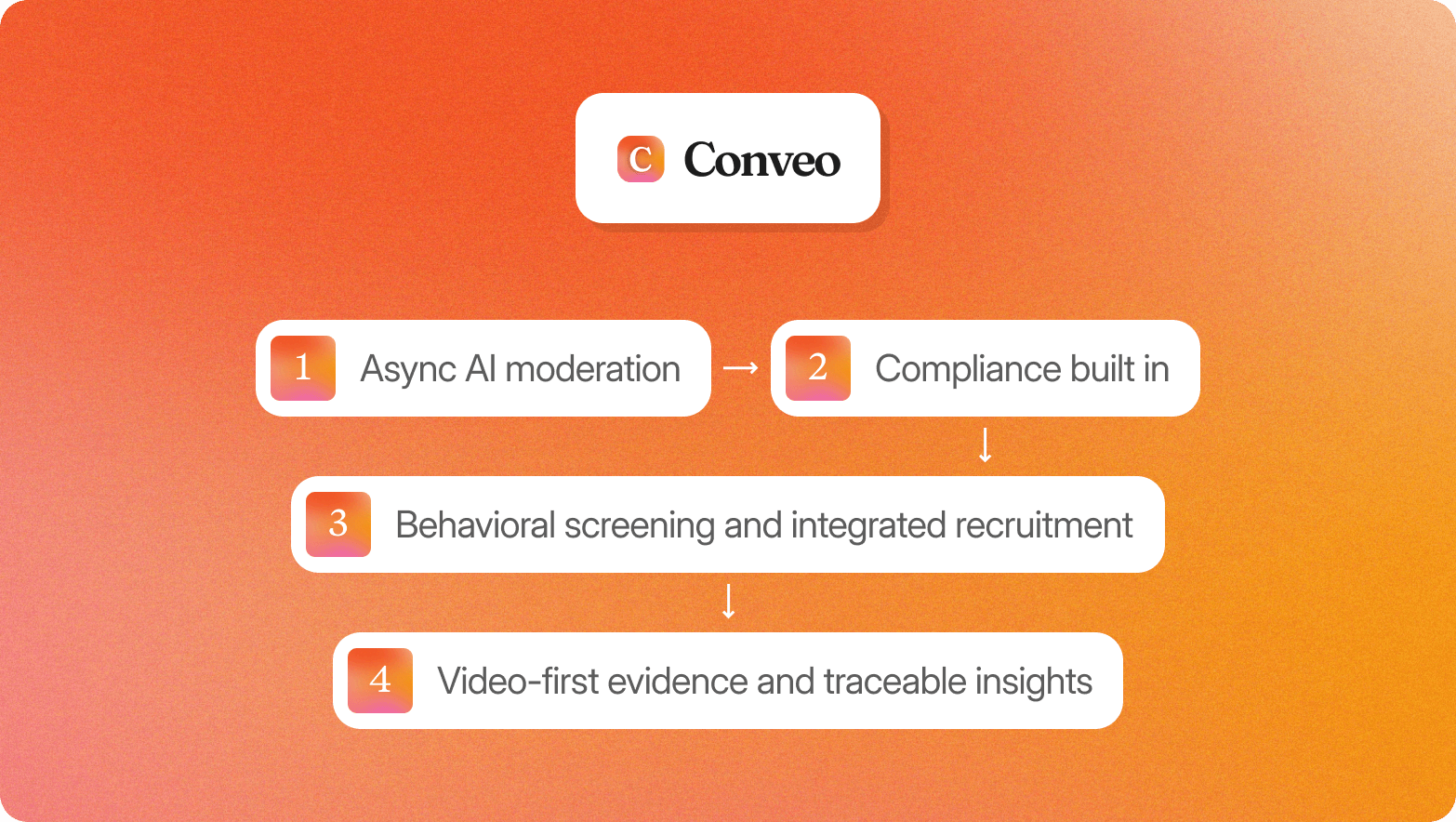
Conveo, the video-first AI research platform, is built to remove the operational ceiling most research-focused UX research teams hit, without sacrificing the depth that makes qualitative data valuable.
Async AI moderation. Conveo's AI moderator probes based on what each participant actually says, following hesitation and exploring stated frustrations across every session. Hundreds of conversations run in parallel, without a researcher moderating each one.
Behavioral screening and integrated recruitment. Source target users through Conveo's panel partners or recruit from your own list via CSV upload, QR codes, or WhatsApp. Behavioral screeners filter for genuine experience rather than self-reported data about who participants say they are.
Video-first evidence and traceable insights. Every finding links to a timestamped video clip. Stakeholders can watch the moment, hear the hesitation, and verify the claim.
Compliance built in. GDPR-compliant data handling and comprehensive participant consent management ensure that research governance scales with session volume.
If your team runs user interviews regularly and needs to move from weeks to days without sacrificing depth, Conveo is built for that workflow.
Frequently Asked Questions
What are good user interview questions?
Good questions invite stories, not verdicts. In an ideal user interview, question design determines whether you collect surface opinions or behavioral explanations. Questions that work: "Walk me through the last time you [did X]." "What made you decide to [take that action]?" "How do you currently handle [problem area]?" "What's the most frustrating part of [workflow]?" "What would have to be true for you to [change behavior]?" "What did you expect to happen when you [did X]?" "Who else is involved when you [make that decision]?" Questions to avoid: Yes/no questions close conversations before they open. Leading questions ("Did you find it confusing?") confirm assumptions rather than challenge them. Remind participants at the start of every session that there are no right or wrong answers: their honest experience is what you're there to learn from.
How many user interviews should I conduct?
For discovery, 5-8 per user segment is a practical starting point. For validation, 10 to 15 gives enough signal to identify patterns with confidence. The more meaningful measure is thematic saturation: the point at which new interviews no longer yield new themes. Async AI-moderated interviewing removes the capacity constraint, making it feasible to reach saturation rather than stop at an arbitrary number.
How long should a user interview last?
30 to 45 minutes works for most interviews. For complex topics such as user journeys, multi-step workflows, or concept evaluation with multiple stimuli, 60 minutes is reasonable. Under 20 minutes is too shallow to collect data that provides valuable insights; over 90 minutes sees a measurable drop-off in response quality. Async video interviews let participants respond on their own schedule, reducing no-shows and removing the scheduling friction that shortens live sessions.
What's the difference between user interviews and usability testing?
User interviews are conversations to understand behavior, motivations, and pain points. User testing is observational: research participants perform tasks on a product while you observe where they struggle. User testing identifies user errors and friction points through direct behavior observation: contextual interviews and contextual inquiry extend this further by taking observation into the user's environment. Task analysis then maps where participants consistently struggle with specific flows. Interviews answer "why" questions; usability tests answer "where" questions. Most strong research programs use both: task analysis to map friction, and interviews to understand the mental models and motivations behind those struggles.
How do I recruit participants for user interviews?
The four main channels are your existing user base, third-party panels, social media communities, and contextual intercepts. Regardless of channel, prioritize behavioral screeners over demographic filters: self-reported data about who someone is tells you far less than behavioral research data about what they've actually done. Vetted panels with built-in fraud detection and quality controls reduce the risk of contamination, especially at scale. The brief questionnaire you send each initial interview is your first line of quality control: four to six screener questions, with at least one knowledge-verification item that only genuine users would know.
How do I analyze user interview data?
Transcribe recordings, code for emerging themes, identify patterns, extract representative quotes, and write up research findings. Manual coding across 20 to 30 interviews takes days; under sprint pressure, that time rarely exists. AI-powered platforms handle transcription, initial coding, and thematic clustering, leaving researchers to review and refine. The critical requirement: every theme should link back to specific quotes or video moments. Video-first evidence makes research data auditable: stakeholders can watch the clip and see the reaction, not just read a summary slide. This is what transforms raw analysis into meaningful insights that actually influence the design process.

About the author
Abby Euyang
Research Impact Lead
Abby studied psychology, fell for research there, and spent four years on the UX research team at PayPal. She compared the AI-moderated platforms before choosing Conveo for the researchers it had gathered, and now sits in the sessions where researcher feedback becomes product changes the same day.
Meet Abby on film →Qualitative insights at the speed of your business.
Conveo runs AI-moderated video interviews and structures everything they say.