In this article
TL;DR
Customer insights research turns raw data and customer feedback into traceable, actionable insights that stakeholders trust and act on
The bottleneck is rarely data collection: it's the synthesis workflow between recorded conversations and stakeholder-ready evidence
Choosing the right method (surveys, customer interviews, diary studies, behavioral data) depends on the question, decision risk, and timeline
Credibility requires evidence traceability: every key insight linked to a real participant, a real quote, a real video clip
AI-moderated video interviews compress the analysis phase from weeks to hours without sacrificing rigor, enabling small teams to gather consumer insights at enterprise scale
Qualitative research is going through a structural shift. For the first time, teams can run real, in-depth customer conversations at scale, capture multimodal signals (voice, expression, hesitation), and deliver stakeholder-ready evidence in days rather than months. The richness that made qualitative research valuable has always been there. What's changed is the ability to synthesize it fast enough to matter.
Most enterprise insights teams haven't caught up. Surveys go out, customer interviews get recorded, review data gets exported, and then the synthesis work stalls in a spreadsheet or a transcript folder that no one has time to properly code. The problem is rarely a shortage of data. It's the absence of a repeatable workflow for moving from raw data to traceable, structured findings. Without consistent coding and thematic synthesis, patterns that should inform product decisions or campaign strategy stay buried. Stakeholders ask for evidence. Researchers know it exists somewhere in the data. The gap between those two realities is where credibility erodes.
For teams of one to five researchers fielding requests from marketing, product, innovation, and executive stakeholders simultaneously, that gap widens every quarter. Businesses understand the value of customer research in principle; building the operational infrastructure to run it continuously is where most fall short.
This article covers the methods, workflows, and credibility standards that make customer insights research something stakeholders trust and act on, not just read once and file away.
What Is Customer Insights Research?
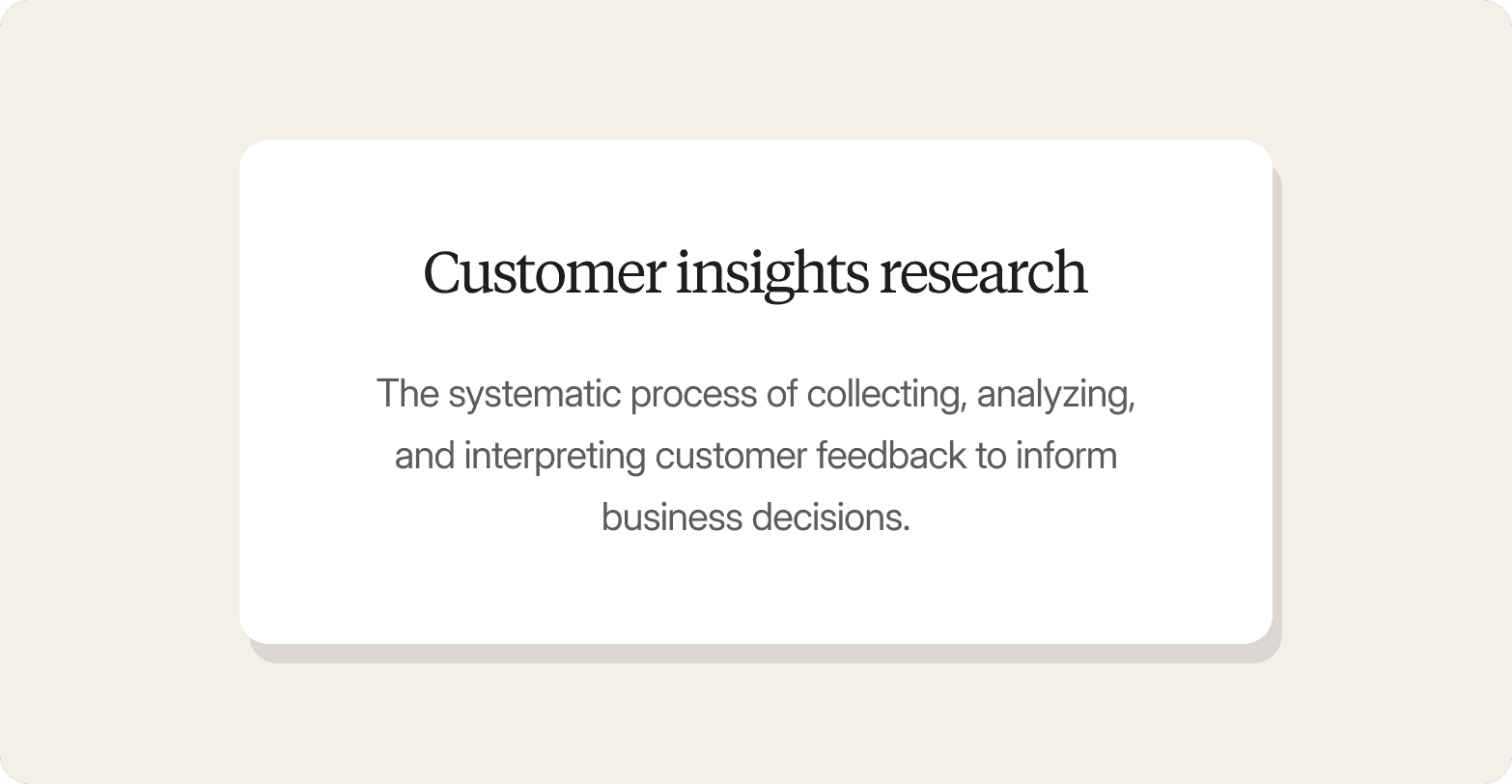
Customer insights research is the systematic process of collecting, analyzing, and interpreting customer feedback to inform business decisions. Where market research studies markets, categories, and competitive dynamics, customer insights research (sometimes called consumer insight research in broader market intelligence contexts) focuses inward: on the specific behaviors, motivations, and unmet needs of your actual customers.
The distinction matters because behavioral data tells you what happened. Customer insights research tells you why. That difference is where product, brand, and marketing decisions either sharpen or miss.
Getting to a deeper understanding of consumer behavior requires more than collecting customer data. It requires structuring how that data is gathered, coded, and interpreted so the output holds up to scrutiny. Consumer research that lacks a repeatable synthesis workflow produces findings that are hard to trace, hard to defend, and ultimately hard to act on.
Consider a CPG brand that reformulates a product and watches sales drop among a key demographic. Surveys confirm dissatisfaction but cannot explain it. Customer insights research surfaces the real issue: the new packaging obscured ingredient information that this segment actively used to make purchase decisions. The fix was not the formula. It was the label. That is the kind of directional clarity that behavioral data alone rarely delivers.
Why Customer Insights Research Matters for Business Decisions
Agency-led studies run six to twelve weeks from brief to delivery, which means findings routinely arrive after the campaign has launched, the product roadmap has been locked, or the CX fix has already shipped. The decision didn't wait for the research. The research confirmed what everyone had already guessed.
That guessing carries real costs across product, marketing, and customer experience teams:
Product teams ship features customers don't want because they optimized for stated preferences rather than the actual job customers were trying to do. Strategic decisions get made without the consumer insights needed to validate them.
Marketing teams launch marketing campaigns that miss the emotional drivers behind purchase decisions, reaching the right target audience with the wrong message. Marketing efforts suffer when messaging isn't grounded in what customers actually value across different audience segments.
CX teams reduce wait times while leaving confusing self-service flows untouched, treating friction points as isolated incidents rather than as symptoms of deeper failures in the customer experience. Improving the customer service process requires understanding root causes, not just visible symptoms. Customer satisfaction erodes when teams fix the wrong problem.
The downstream problem isn't just wasted spending. Its credibility. When findings can't be traced back to real customer conversations (complete with verbatims and video clips), stakeholders hesitate to act. Research that can't be inspected rarely changes a decision.
Customer retention, customer churn reduction, and improved customer satisfaction all depend on teams having access to credible, timely consumer insights. Consumer insights help organizations identify trends before they become crises, and understand the customer journey well enough to intervene at the right moment.
"Within days, we had insights that would've taken a traditional agency a month."
Head Customer Insights, JDE Peet’s
4 Common Methods for Customer Insights Research
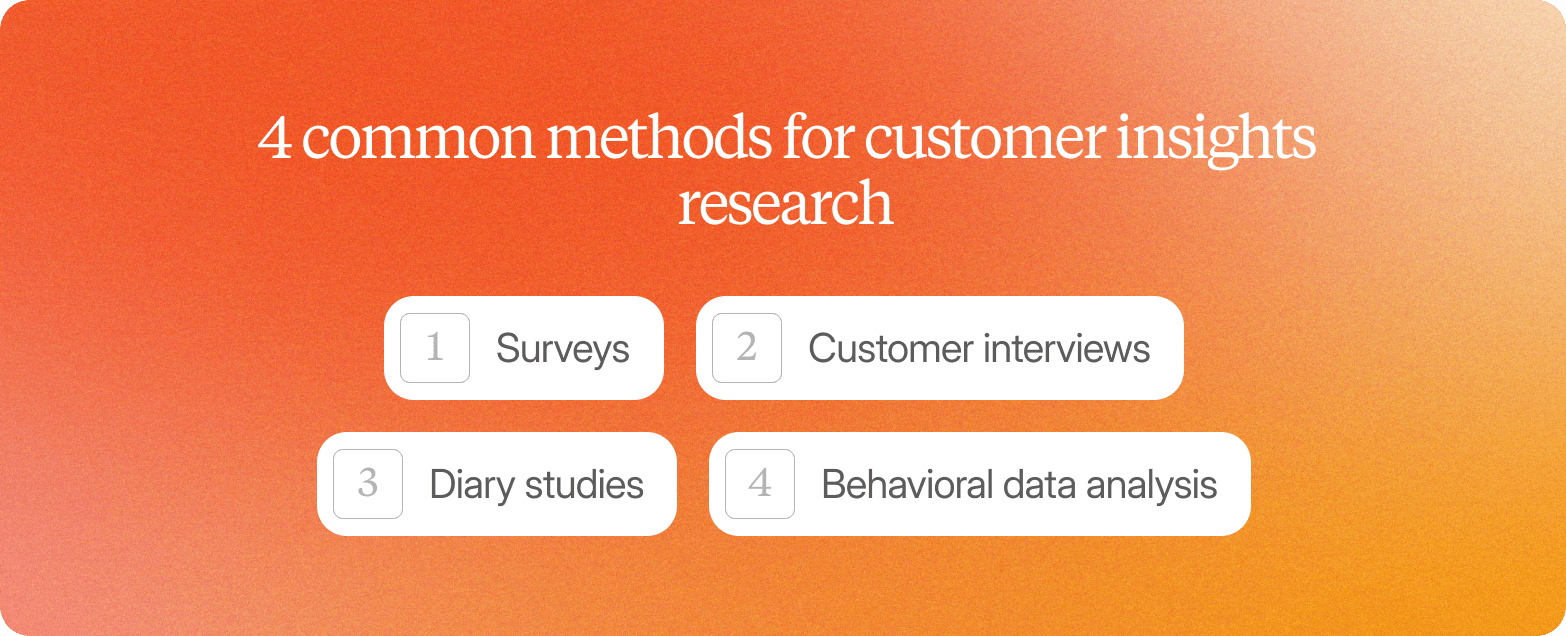
Choosing the right method depends on three variables: what question you're trying to answer, how much decision risk is involved, and how quickly you need findings.
| Method | What It Answers | When to Use It | Key Limitation |
|---|---|---|---|
| Surveys | What customers think or do at scale | Quantifying the prevalence of known behaviors across customer segments; tracking net promoter score and other satisfaction metrics | Misses the "why"; survey data and open-ended responses lack contextual depth |
| Customer Interviews (IDIs) | Why customers behave as they do: emotional and contextual drivers | Exploring motivations, consumer behavior, decision-making processes, or unmet needs | Traditional moderation runs 6 to 12 weeks with high per-study costs; AI-moderated video interviews compress this to days |
| Diary Studies | How consumer behavior unfolds over time in natural contexts | Understanding routines, habit formation, or longitudinal product usage | High participant drop-off; manual synthesis of unstructured entries |
| Behavioral Data Analysis | What customers actually do: clicks, purchases, churn | Validating stated preferences against observed behavior; analyzing how users interact with a product over time | Shows correlation, not causation; requires qualitative follow-up to explain the "why." |
No single method covers the full picture. Behavioral data and quantitative data identify patterns worth investigating. Customer interviews and qualitative data explain what those patterns actually mean. Surveys confirm whether a finding holds at scale. Diary studies capture the moments that happen between research sessions, when real decisions and habits form without anyone watching.
The most reliable customer insights research programs treat these methods as complementary rather than interchangeable. The question shapes the method, not the other way around. Consumer insights based on a single data source rarely give organizations the complete picture they need to act with confidence.
How to Conduct Customer Insights Research: A Step-by-Step Workflow
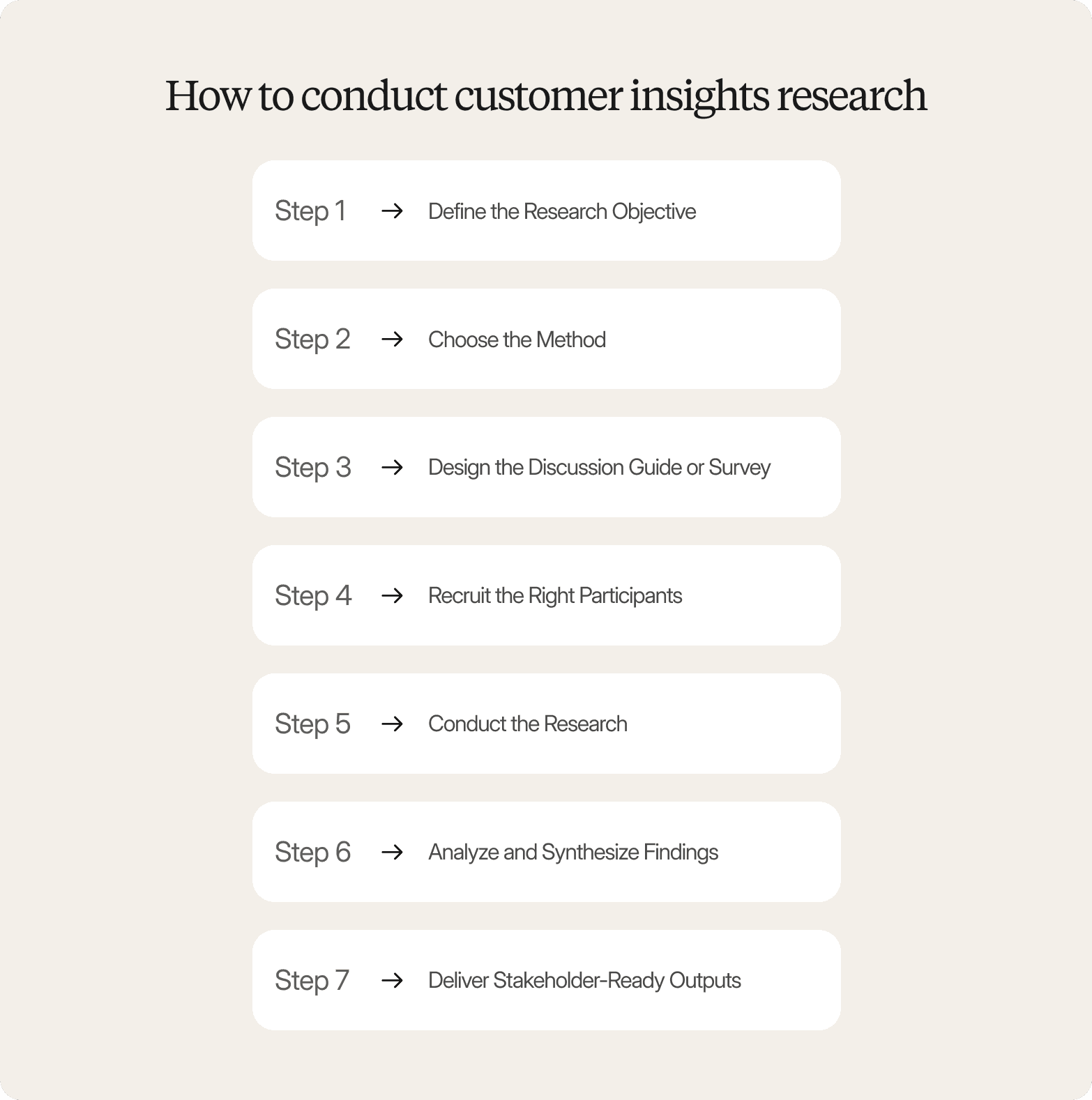
Step 1: Define the Research Objective
Start with the business decision at stake, then work backward to the question customer insights research must answer. "Should we add a premium tier?" is a business hypothesis. The research question is: "What unmet needs would justify paying 40% more?" That specificity shapes every downstream choice, from method to participant criteria to discussion guide.
Step 2: Choose the Method
Match the method to the question. Use surveys when you need to measure how many. Use customer interviews when you need to understand why. Use diary or journal studies when you need to track how consumer behavior unfolds over time. Choosing the wrong method at this stage yields accurate, technically correct data that is useless for the decision you are trying to make.
Step 3: Design the Discussion Guide or Survey
For customer interviews: write open-ended questions that invite stories, not yes/no answers. "Walk me through the last time you..." surfaces a richer context than "Do you ever...?" For surveys: limit to 8 to 10 questions and include at least two open-ended fields for direct feedback and direct input from respondents. Avoid leading questions that signal the answer you expect.
Step 4: Recruit the Right Participants
Define screening criteria based on the research objective: existing customers, prospective customers, lapsed users, or high-value customer segments. Use vetted panels or CRM lists. Convenience samples (whoever is easiest to reach) skew results and undermine credibility when findings are shared with stakeholders.
Understanding your target audience at this stage determines whether the insights you gather will accurately reflect the customers whose decisions matter most. Recruiting across the right audience segments is not a logistical detail; it is a validity condition.
Step 5: Conduct the Research
For customer interviews: probe adaptively based on what participants actually say, not just the next item on the guide. Capturing how customers feel about specific features, experiences, or decisions requires following the thread rather than the script. For surveys: pilot with 5-10 participants first to catch any confusing wording before the full launch.
Step 6: Analyze and Synthesize Findings
Code transcripts or open-ended responses into themes. Tie each theme to verbatim quotes or video clips so findings are traceable, not just asserted. State confidence levels and sample limitations. Overgeneralizing from 12 interviews is how research loses credibility with skeptical stakeholders.
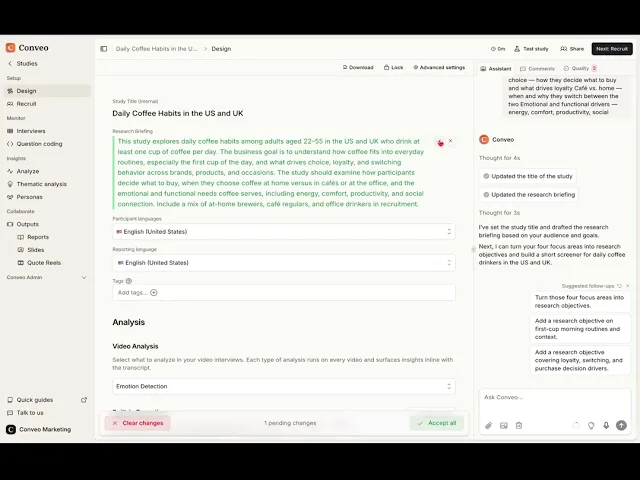
This is where most customer insights research timelines break down. Manually working through raw data (coding transcripts, synthesizing open-ended survey data, and identifying patterns across dozens of sessions) can take longer than the fieldwork itself. AI-moderated video platforms like Conveo handle transcription, coding, and thematic synthesis automatically as recordings land, compressing the time to analyze data from weeks to hours without sacrificing the rigor that makes findings credible.
Discover how you can build and launch a study in Conveo
Step 7: Deliver Stakeholder-Ready Outputs
Structure findings as: what we learned, why it matters, what to do next. Include direct quotes or video clips so stakeholders can inspect the evidence rather than accept the summary. Detailed insights that trace back to real customer conversations drive faster, more confident strategic decisions than summaries without a visible chain of evidence.
Standards for Credible Customer Insights Research
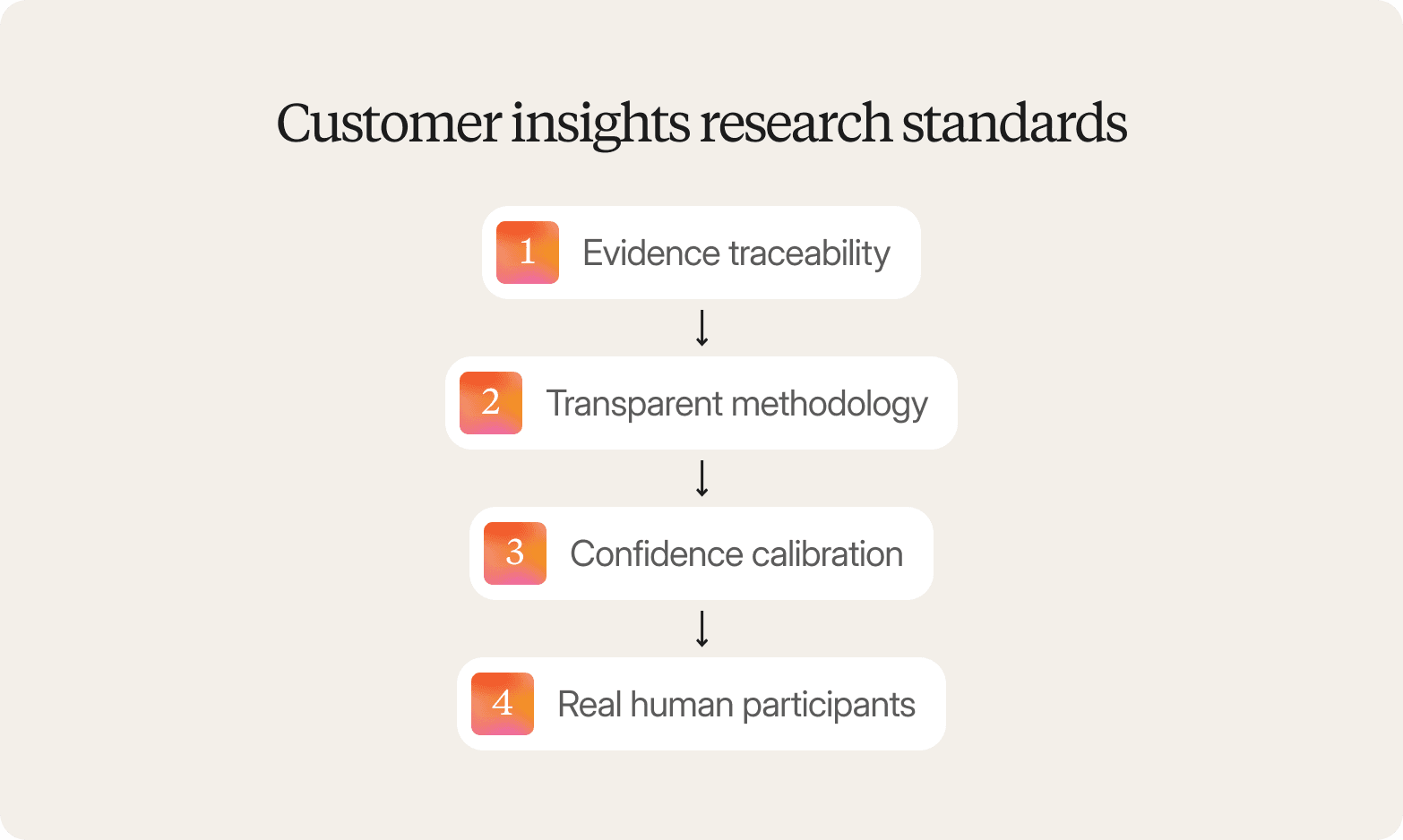
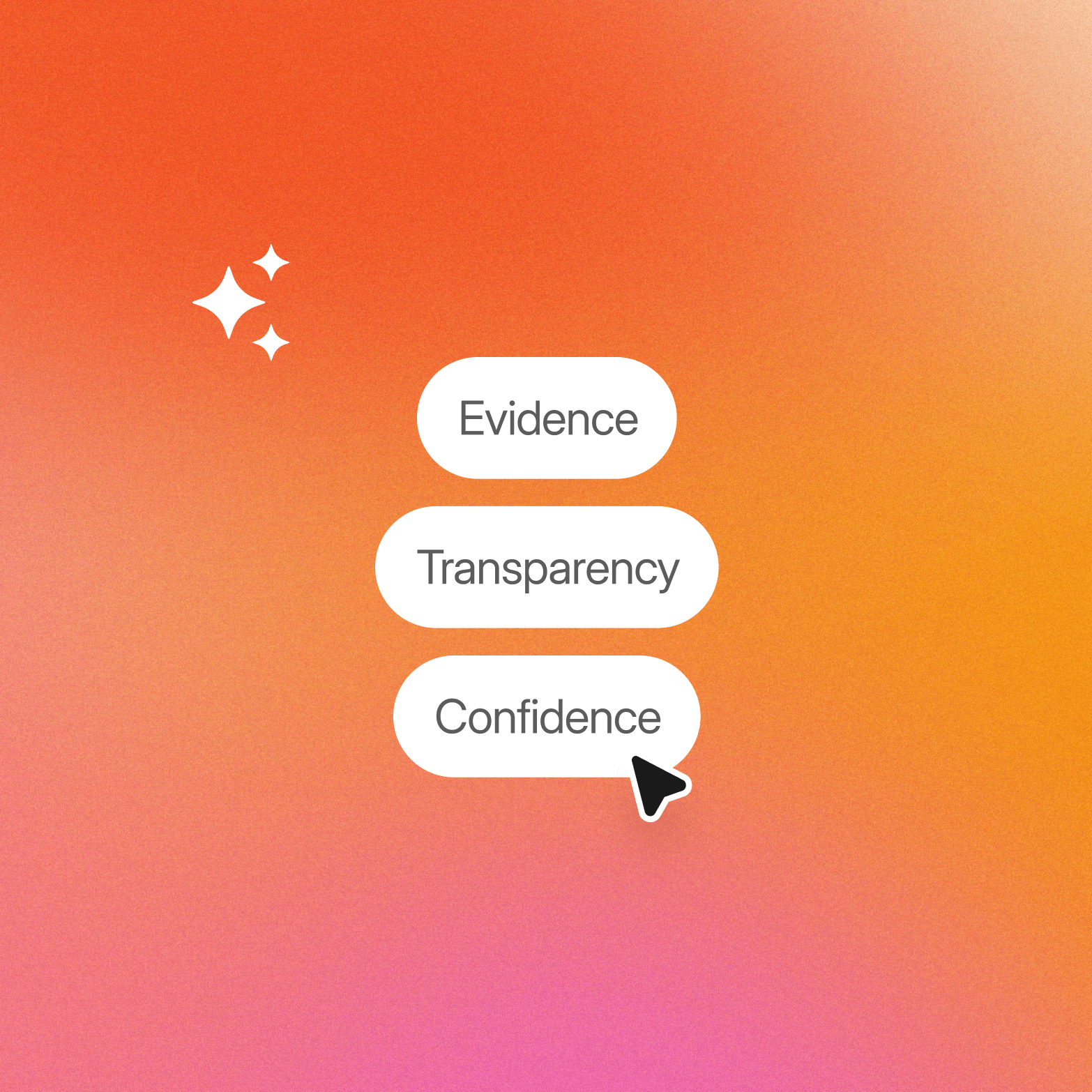
Stakeholders push back on research findings when they can't trace a claim back to a real customer conversation. A summary without a source is an opinion. Four standards separate credible customer insights research from outputs that stall in the review process.
Evidence Traceability
Every insight links to a specific quote, video clip, or customer data point. No finding stands on an unverified summary alone. Video-first research makes this tangible: stakeholders can watch the moment a participant explains their reasoning, not just read a paraphrased excerpt. Consumer insights based on traceable evidence are far more likely to inform strategic decisions than those built on aggregated summaries that no one can verify.
Transparent Methodology
Sample size, screening criteria, and question wording are documented. Stakeholders can assess what the research represents and where its boundaries are. Accurate data requires methodological transparency at every stage: from how customer information was collected to how themes were coded.
Confidence Calibration
Directional findings are labeled as directional. Definitive claims require the sample size to support them. Overstating certainty from small samples erodes trust faster than any methodology gap.
Real Human Participants
Real people in real conversations, verified by video. No avatars, no synthetic responses. The fabricated-output concern that follows AI-assisted research disappears when participants are visible and verifiable. This is a non-negotiable credibility standard, and one of the clearest lines separating research-grade platforms from customer insight tools that rely on synthetic or simulated data.
For enterprise teams, credibility also runs through procurement. SOC 2 certified platforms with GDPR compliance and EU regional data hosting remove the blockers that quietly kill vendor approvals before a study ever launches.
Operationalizing Customer Insights Research as a Continuous Program
Most research outputs die in the deck they were presented in. The next team with a similar question commissions a new study, waits six weeks, and arrives at a finding that already existed. Learning doesn't compound. Budgets erode. The same ground gets covered repeatedly.
The shift that changes this is structural: moving from periodic, agency-dependent projects to continuous in-house customer insights research loops that run at the pace of actual decisions. Consumer trends and market trends don't wait for quarterly research cycles. Teams that build a continuous research infrastructure gather consumer insights as the market moves, not after it has already shifted.
Four operational components make that shift durable:
Intake Process
Centralize research requests through a single intake form. Prioritize by business impact, not by who asked loudest. Internal data from CRM systems, customer support queues, and website traffic can flag emerging customer engagement issues worth fast-tracking into formal research. Social media platforms are another source worth monitoring for early signals; qualitative themes that surface there often warrant structured follow-up.
Cadence Planning
Replace quarterly mega-projects with smaller studies that run in three to five days. More questions get answered. Fewer decisions go uninformed. Continuous cadence also makes it easier to identify trends in consumer behavior over time rather than capturing a single snapshot. Advanced tools that support parallel async interviewing make this feasible for small teams without expanding headcount.
Insight Library
Store findings in a searchable repository. Teams check existing evidence before commissioning new work. Each study adds to a compounding knowledge base rather than expiring in a separate deck. Key insights from one quarter can directly inform how the next study is designed; teams stop paying to re-learn what they already know.
Cross-Study Intelligence
Tag themes across studies. When "pricing concerns" surfaces in three consecutive concept tests, that pattern becomes visible rather than buried across separate decks. Advanced analytics applied across a growing library of insights can surface macro trends in consumer behavior that no individual study would reveal on its own. Over time, this is how customer insights research moves from reactive to genuinely predictive, enabling teams to increase sales, improve customer satisfaction, and strengthen customer engagement through decisions backed by compounding evidence.
Parallel async interviewing supports hundreds of conversations simultaneously, clearing backlogs without adding moderators. Conveo's video-first AI research platform handles transcription, coding, and synthesis while preserving evidence traceability, enabling small teams to run continuous customer insights research at enterprise scale.
How Conveo Accelerates Customer Insights Research
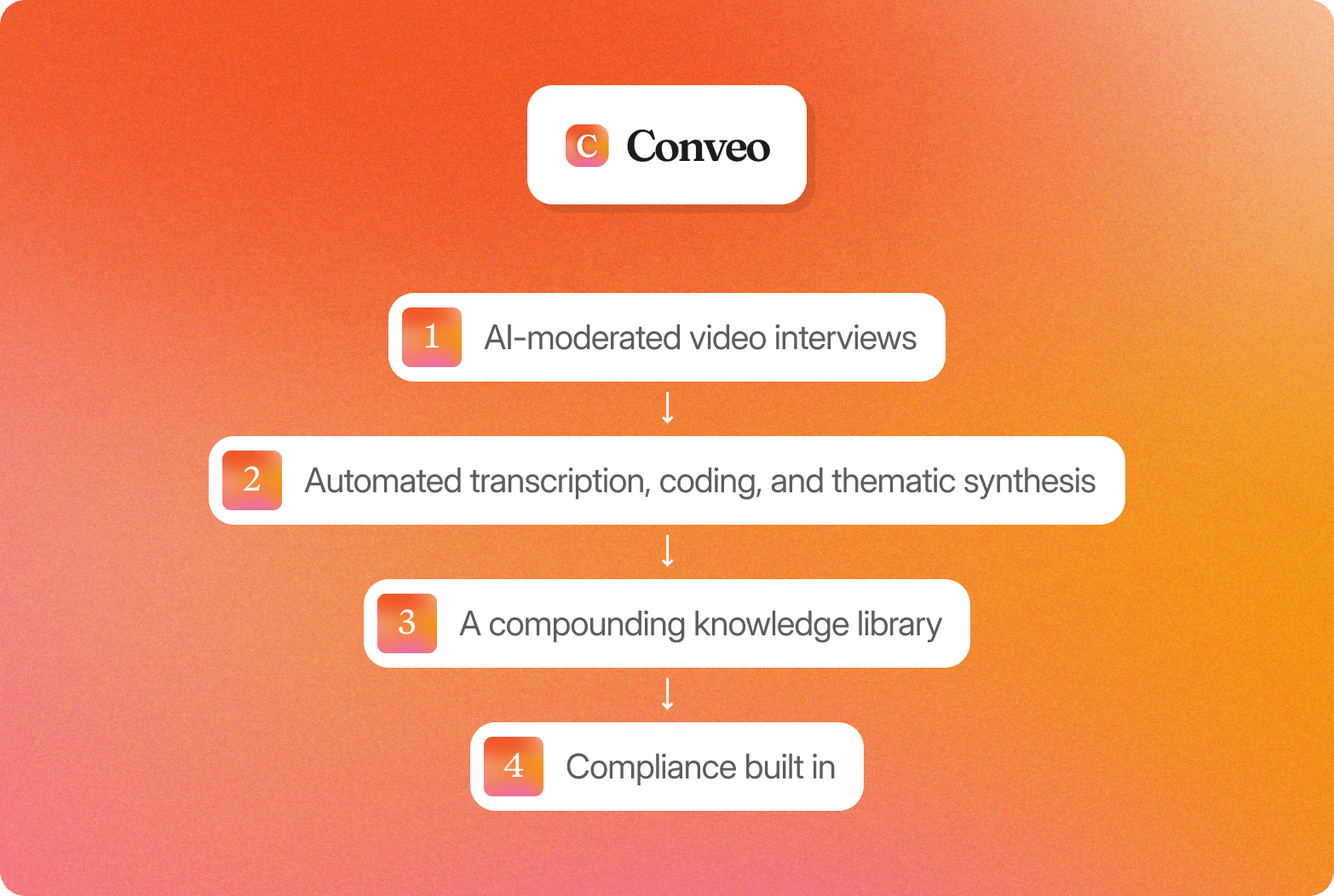
The methods and standards outlined above are only as useful as the workflow that connects them. Conveo's video-first AI research platform closes the gap between knowing what good customer insights research looks like and being able to run it continuously with a small team.
AI-moderated video interviews let participants respond in their own words, on camera, at a time that suits them. Conveo's AI moderator probes adaptively based on each participant's responses, capturing the depth of a traditional in-depth interview without the scheduling overhead or per-session moderator cost. The result is valuable feedback from real participants, direct input that reflects how customers actually think and feel, not how they respond to a fixed script. Understanding how users interact with products, services, and messaging at this level of depth is what separates genuine consumer insights from surface-level survey data.
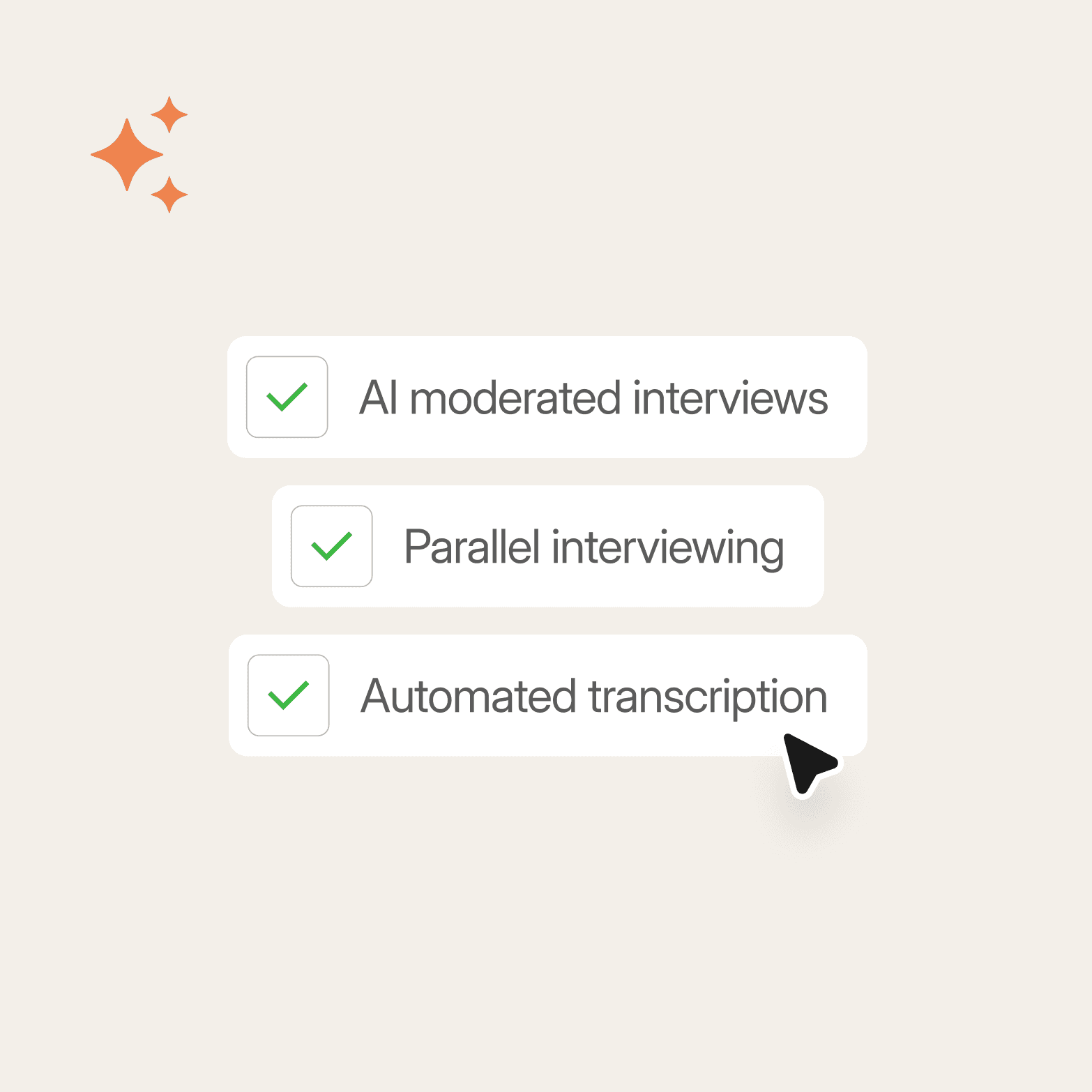
Automated transcription, coding, and thematic synthesis compress the analysis bottleneck from weeks to hours. Machine learning powers the analysis layer, identifying patterns across hundreds of conversations simultaneously. Every finding links back to the original video clip and verbatim quote, so stakeholders can inspect the evidence themselves.
A compounding knowledge library stores findings across studies in a searchable repository. Teams stop re-asking questions they've already answered. New customer data builds on prior conclusions instead of starting from scratch. Over time, the library becomes one of the most valuable customer insight tools in the organization, a living record of how customers interact with your products, categories, and competitors.
Compliance built in. SOC 2 certified with GDPR compliance and EU regional data hosting, Conveo clears procurement before a study launches, not after. Enterprise teams evaluating customer insights platforms and customer insights software can move faster, knowing the compliance work is already done.
Frequently Asked Questions
What is a customer insights research paper?
A customer insights research paper is a formal document that presents the study's objectives, methodology, findings, and recommendations. It gives stakeholders a structured record of what was learned, what customer information was gathered, and why conclusions were reached. The limitation is structural: traditional research papers are static. Once delivered, they don't update as new customer conversations happen. Each project resets the learning cycle rather than building on what came before. Continuous qualitative workflows change that dynamic. A searchable insight library connects findings across studies, so customer understanding accumulates over time instead of sitting in separate decks. New evidence can confirm, challenge, or extend prior conclusions rather than starting from scratch. Teams that move from static reports to continuous consumer research gain a meaningful advantage in how quickly they can act.
What are some customer insights research examples?
Customer insights research takes different forms depending on the business question. The following scenarios illustrate common use cases across product development, campaign validation, and CX improvement. Product development: A SaaS team wanted to know why users were abandoning their onboarding flow at step three. They ran in-depth customer interviews with 25 recent sign-ups. Participants revealed consistent anxiety around data privacy controls at that step, a pain point that survey data had flagged but couldn't explain. The team redesigned the screen to clarify those controls and saw abandonment drop by 40%. Campaign validation: A brand team needed to choose between two messaging angles: convenience versus quality. Concept testing with 50 target customers across both creative directions made concept reactions immediately clear: convenience was already assumed. Quality messaging created genuine differentiation. The campaign shifted accordingly before any marketing spend was committed. CX improvement: A product team facing recurring spikes in support tickets ran a diary study with 30 customers over two weeks. The research identified three features that consistently generated confusion, friction points that users interact with repeatedly without resolution. Adding in-app tooltips to those features reduced ticket volume by 25%. What separates these outcomes from survey-based findings is the depth that video interviews provide. Adaptive probing captures the specific language customers use, the hesitations they show on camera, and the reasoning behind their reactions, a context that basic analytics and closed-ended questions simply cannot surface.
How long does customer insights research take?
Customer insights research through a traditional agency typically runs 6 to 12 weeks from brief to findings, which means results arrive after the campaign has launched, the product decision has been made, or the CX change has already shipped. AI-moderated video platforms compress that timeline to days, not weeks, by handling transcription, coding, and thematic synthesis automatically as recordings land. The difference is not speed alone. Platforms that cover the full workflow (from study design and participant recruitment through fraud filtering, incentive management, interviewing, and stakeholder-ready reporting) remove the coordination overhead that accumulates when teams stitch together separate point tools. That end-to-end coverage is what makes the timeline compression real rather than theoretical.
What is the difference between customer insights research and market research?
Customer insights research focuses on understanding specific customer behaviors, motivations, and unmet needs. Market research, by contrast, studies broader market conditions: category size, competitive dynamics, and market trends. The scope difference is practical. Market research answers "How big is the opportunity?" Customer insights research answers "Why would customers choose us over anything else?" A market research study might assess the size of the plant-based protein category and identify relevant consumer trends. A customer insights research study explains why flexitarians reach for plant-based options on weekdays but revert to meat on weekends. Both questions matter, but they require different methods and produce different kinds of evidence. Consumer trends visible in market research data often only become explainable through the deeper behavioral context that qualitative customer research provides.
Can AI conduct customer insights research?
AI can conduct significant parts of customer insights research (including transcription, coding, and thematic synthesis across large interview sets), but it does not replace human judgment in study design, probing strategy, or stakeholder interpretation. The credibility concern most teams raise centers on fabricated outputs. That concern is legitimate for platforms that use synthetic or avatar-based responses. When AI moderation runs with real human participants captured on video, findings trace directly to verbatim quotes and timestamped clips, making every conclusion auditable rather than opaque. That traceability distinction matters in practice. Generic LLM synthesis produces summaries with no visible evidence chain. Research-grade AI moderation (powered by machine learning and built on real human conversations) produces key insights that stakeholders can inspect, challenge, and act on with confidence. Consumer insights gathered this way carry the same evidential weight as traditional research, at a fraction of the time and cost. Hundreds of enterprises (including Google, Reddit, and FOX) use AI-moderated video interviews to run customer insights research at scale without sacrificing the rigor their procurement and leadership teams require.
How do you ensure customer insights research is actionable?
Actionable customer insights research is structured to drive a specific decision, not just inform a general understanding. Three standards separate findings that move teams forward from findings that sit in decks: Tie each finding to a decision. Every output should answer a launch/kill question, justify a messaging pivot, or inform feature prioritization. Customer engagement data without a clear next action is context, not direction. Structure outputs as: What we learned, why it matters, what to do next. This format forces researchers to complete the interpretive work that stakeholders won't do themselves. Direct input from customer conversations only becomes valuable feedback when it's translated into clear strategic implications. Make insights searchable and reusable. When findings live in a shared library rather than separate project decks, customer understanding accumulates across studies instead of resetting with each new brief. Teams can gather customer insights from existing research before commissioning new work, reducing costs, speeding response times, and increasing the organizational return on every study conducted. Teams that build this infrastructure report fewer repeat studies and faster stakeholder alignment. A searchable insight library connects findings across quarters so the organization stops re-asking questions it has already answered.

About the author
Charles Allison
Insights Lead
Charles started agency side in London and spent eight years client side at Sky, Starbucks and Instacart, where he was Conveo's first tech client before he joined. He leads the Research Impact team and prototypes the platform features that serve researchers rather than the ones that only look clever.
Meet Charles on film →Qualitative insights at the speed of your business.
Conveo runs AI-moderated video interviews and structures everything they say.