In this article
TL;DR
A design research template is not a discussion guide. It connects research objectives, participant criteria, discussion guide, analysis plan, and output format into a single repeatable workflow, covering all the methodology decisions that determine whether a research project delivers actionable outcomes.
The six-week qualitative research bottleneck is structural, not motivational. Recruiting, scheduling, live moderation, and manual synthesis consume weeks regardless of template quality.
AI-moderated asynchronous video interviews dissolve the scheduling and moderation bottlenecks, delivering usable qualitative data in days, not weeks.
Templates should match the study type: broad and open for exploratory research, structured for evaluative studies, and lightweight and repeatable for continuous discovery.
Enterprise adoption requires traceability (theme to quote to video clip), governance (consent, retention, access controls), and auditability. Synthetic persona platforms cannot provide these.
Your product team needs user feedback this sprint. Your design research template is ready. But the process required to actually run the study takes six weeks.
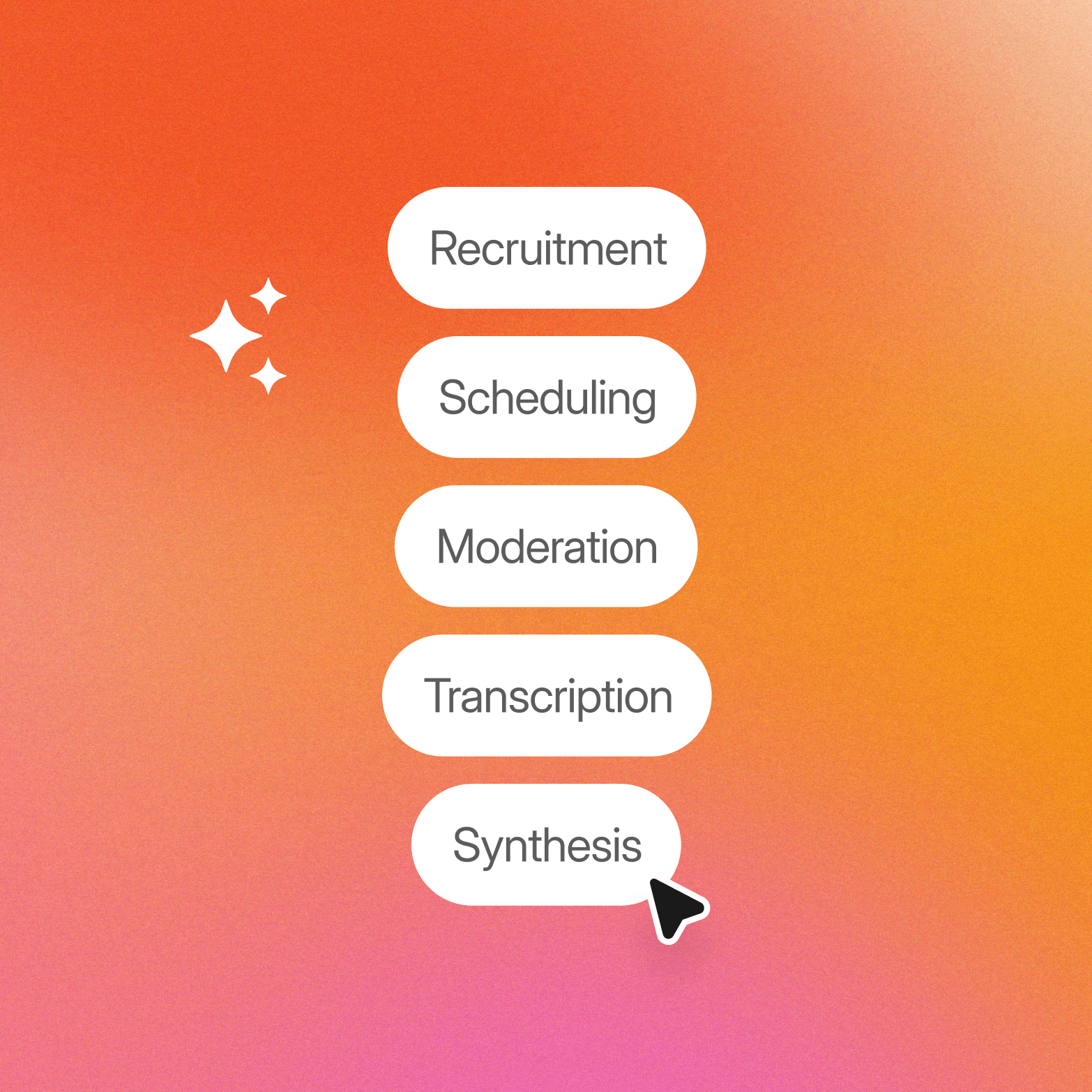
That gap is not a prioritization problem. It is a structural one. Every new research project carries the same operational weight: recruiting participants, coordinating schedules across time zones, conducting in-depth interviews one at a time, manually transcribing recordings, and synthesizing qualitative data under sprint pressure. Each of those steps requires real time and real attention. None of them compresses without creating a different problem: smaller samples, shallower probing, or findings that arrive after the decision was already made.
The structural bottleneck compounds when you consider the team behind the work. Most embedded research functions run one to five people serving multiple product squads simultaneously, and often supporting UX teams, marketing teams, and brand researchers at the same time. A single researcher might be fielding discovery requests from three product managers, conducting a usability study, and preparing a synthesis deck for a design review, all in the same two-week window. Discovery demand consistently outpaces research capacity, not because researchers are slow, but because the operational overhead of each study is fixed and non-negotiable under traditional research methodologies.
What changes the equation is not working faster. It is removing the steps that create the bottleneck in the first place. A design research template becomes genuinely repeatable when AI-moderated asynchronous interviews handle scheduling, run sessions in parallel, and produce structured synthesis outputs that fit within a sprint cycle. That is what makes a template worth developing: not the document itself, but the operational infrastructure it connects to.
This article walks through how to use the template, how to match it to your study type, and how to build the infrastructure that turns a static framework into a continuous discovery workflow.
Download: Design Research Plan Template
Skip the blank page. The template below provides a ready-to-fill framework that covers all five components of a research study: objectives, participant criteria, discussion guide, analysis plan, and output format.
What makes a design research template operationally effective
Most research templates fail before the first participant joins a session, not because the questions are wrong, but because the document stops at the discussion guide. A researcher opens a Word file, adapts last quarter's customer interview script, and calls it a plan. What's missing is everything that comes before and after the conversation itself: who gets recruited and why, how responses will be coded, and what the output needs to look like before a product manager will act on it.
A design research plan template is not a discussion guide with a title block. It is a structured framework that connects research questions to study design, participant criteria, moderation protocol, analytical approach, and stakeholder-ready outputs within a single, coherent workflow. When those components are documented together, the template becomes operational. When they exist in different sections of a shared drive (or not at all), each new research project gets reinvented from scratch.
The methodology section is the anchor. It does not need to be long, but it does need to be explicit: which research methods will be used, why those methods fit this study's scope, and how data collection will produce the type of evidence the analysis plan requires. Research methodologies borrowed from social sciences (ethnography, grounded theory, experimental research design) have always been applied in this discipline. Applied design research is no different. Without a clear methodology section, teams default to the methods they used last time rather than the methods that fit the current research question.
A research design template that actually works in practice includes five components:
Research objectives tied to specific product decisions. Not "understand user behavior," but "determine whether users can complete onboarding without support, to inform whether we ship the current flow or redesign the empty state."
Sampling and recruiting criteria. Who participates, what qualifies them, and what disqualifies them are documented before recruitment begins.
Discussion guide or interview protocol. Core interview questions, probing logic, and the conditions under which the moderator should follow a thread rather than return to the script.
Analysis plan. How responses will be coded, what thematic framework will be applied, and who is responsible for analyzing data and delivering the synthesis.
Output format. The specific deliverable (a findings deck, a highlight reel, a tagged clip library, or a final report) is defined before the first interview.
Without all five, a template is a starting point. With them, it becomes a repeatable research system.
The six-week research bottleneck (and why templates alone don't fix it)
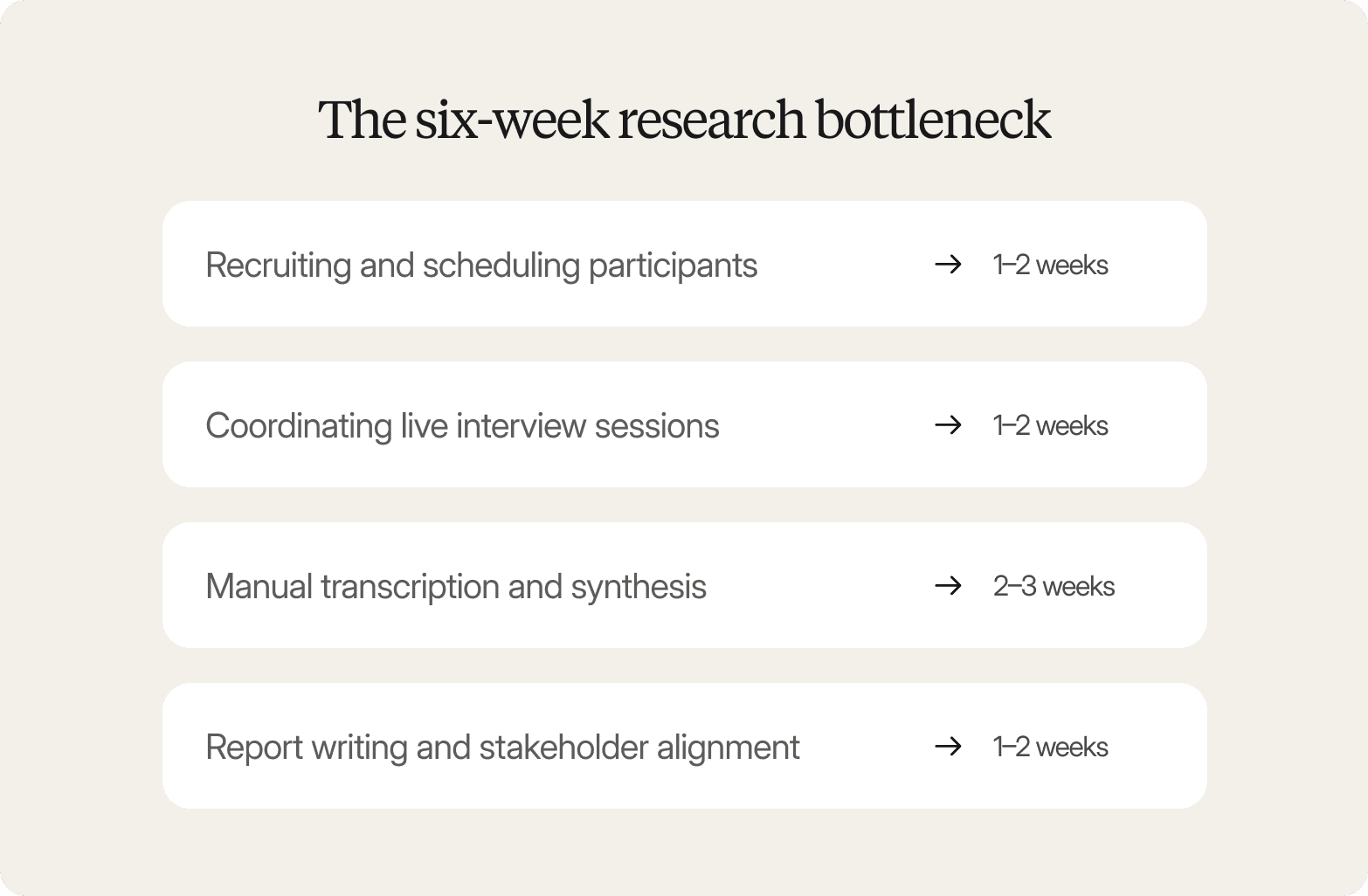
A conventional qualitative workflow takes six weeks to three months from brief to findings. By that point, the sprint has closed, the design decision has shipped, and the insight arrives too late to change anything.
The time loss is distributed across every phase:
| Phase | Elapsed Time |
|---|---|
| Recruiting and scheduling participants | 1–2 weeks |
| Coordinating live interview sessions | 1–2 weeks |
| Manual transcription and synthesis | 2–3 weeks |
| Report writing and stakeholder alignment | 1–2 weeks |
"Within days, we had insights that would've taken a traditional agency a month."
Head of Customer Insights, JDE Peet’s
Teams that feel this pressure often default to quantitative studies: surveys that are fast to field and straightforward to analyze within a sprint cycle. But quantitative methods answer a different question. A survey tells you what users chose or rated; it rarely tells you why a feature feels confusing, what mental model is driving the wrong behavior, or which unspoken assumption is blocking adoption. For those questions, you need qualitative data, which has historically required timelines that product teams cannot absorb.
The core tension is real: research methodologies that produce the depth of context required for good design decisions have always demanded the most time. AI-moderated, asynchronous video interviews dissolve the scheduling and live moderation bottlenecks that account for the majority of elapsed time. It is now possible to conduct hundreds of in-depth interviews in parallel, without calendar coordination, and deliver usable qualitative data in days. The research design template structure stays the same. The six-week wait does not.
How to use the design research plan template: A worked example
The template above is structured around the same five components described in the previous section. Here is how each one looks in practice.
Scenario: A SaaS product team needs to understand why trial users are not converting to paid plans, and needs findings before the next onboarding sprint kicks off.
Research objective: Identify pain points in the trial-to-paid conversion flow to inform an onboarding redesign. Specific questions: Where do users lose confidence in the product's value? Is pricing the barrier, or is onboarding itself the problem? What prior research exists on this topic, and what gaps remain, treating existing exit survey data as the equivalent of a literature review before fieldwork begins.
Participant criteria: 20 users who started a free trial in the past 30 days but did not upgrade. Mix of SMB and enterprise segments. Exclude users who churned within the first 48 hours, as their experience reflects acquisition misalignment rather than onboarding failure.
Discussion guide: Open with the trial experience overall before introducing product-specific topics. Probe on the moment the user first felt uncertain about continuing. Explore how they weighed perceived value against price and what alternatives they considered. Interview questions should surface the "why" behind the decision, not just the decision itself.
Analysis plan: Code responses by friction type across three categories: pricing clarity, feature gaps, and onboarding confusion. Identify patterns across segments by tagging all quotes by user type (SMB vs. enterprise) to determine whether barriers are consistent or segment-specific.
Output format: A thematic report with embedded video clips for the product team, plus a one-page final report for key stakeholders in product leadership. The summary leads with the top two pain points and a clear recommendation, not a list of themes.
Each component depends on the others. A sharply defined objective shapes who gets recruited. Participant criteria determine what the discussion guide needs to probe. The analysis plan only works if the guide surfaces codeable responses. And the output format should be decided before fieldwork begins, because it determines how much raw evidence needs to be captured alongside synthesized findings.
Choosing the right design research template by study type
Not all research situations call for the same structure. Different methods serve different questions, and the right research design templates depend on what you are trying to learn, how quickly you need findings, and what key stakeholders will accept as credible evidence.
| Study type | Sample size | Guide structure | Analysis approach | Timeline |
|---|---|---|---|---|
| Exploratory (early-stage discovery) | 10–15 | Open-ended, minimal laddering | Inductive, emergent themes | 2–3 weeks |
| Evaluative (concept or prototype testing) | 20–30 | Structured tasks and reactions | Predefined evaluation criteria | Under 1 week |
| Continuous discovery (ongoing feedback) | Rolling | Short, repeatable protocol | Consistent tracking across rounds | Days per round |
| Multi-market (global or regional studies) | Varies | Culturally adapted, not just translated | Pre-aligned codes for comparability | Varies |
Evaluative research and UX research share the closest template structure. Studies designed to surface usability issues, with a focus on evaluating a specific interface, prototype, or workflow, often produce outputs such as empathy maps and task completion analyses alongside traditional thematic findings. For UX research, the discussion guide shifts toward structured tasks with observation prompts, and the analysis plan incorporates usability-specific coding (friction points by screen, task failure modes, error patterns). The scope is tighter, but the evidence requirements are higher: key players in product and design typically need direct video evidence of where users struggle, not just a summary.
For continuous discovery studies, the template emphasizes repeatability and realistic expectations. Each round should be short enough to complete within a sprint, with interview questions sufficiently consistent to identify patterns across rounds. Service blueprints and journey maps are common outputs here: living documents that update as each round of customer interviews adds new qualitative data to the same project.
The market research design template for multi-market studies requires the most upfront structural investment: discussion guide adaptation, code alignment before fieldwork, and output formats designed for comparison across regions. Where different methods are needed to account for cultural context, this should be documented in the methodology section before recruiting begins.
How AI-moderated interviews transform design research template execution
Even with a well-designed template, the operational work between study launch and the production of usable findings is where weeks disappear. AI-moderated asynchronous video interviews change that workflow in four concrete ways:
Participants complete interviews on their own schedule. No calendar coordination, no no-show risk, no time zone juggling. This matters especially when conducting customer interviews across multiple markets or time zones.
The AI moderator adapts probing based on what each participant actually says. When a participant raises a pain point about a specific feature, the AI follows that thread rather than the next scripted question. This is what separates a well-executed design research template from a static survey.
Transcription, translation, and thematic coding happen automatically as sessions land. Analyzing data from 30 in-depth interviews no longer means a week of manual tagging; synthesis is available as fieldwork is completed.
Any number of interviews can run in parallel. The bottleneck is only the time participants need to complete their session, not the resources required to moderate each one individually.
Conveo, a video-first AI research platform, supports this workflow end-to-end, giving teams the qualitative depth of real conversations at a pace that matches the sprint cadence.
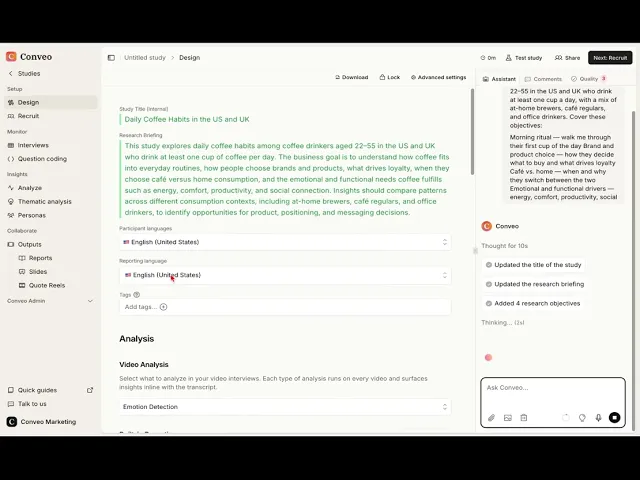
Watch the walkthrough: Setting Up a Research Study in Conveo
Enterprise-grade rigor: Traceability, governance, and stakeholder buy-in
The question key stakeholders ask most often when reviewing AI-generated findings is not "Is this interesting?" It is "Where did this come from?" A qualitative research design template built for enterprise use must treat traceability, governance, and auditability as structural requirements rather than afterthoughts.
Traceability means every theme links to the specific verbatim quotes and video clips that produced it. When a product manager pushes back on a finding, the researcher should be able to pull up the exact moment a participant said it, on video. Without that chain, findings are assertions. With it, they are evidence.
Governance covers consent management, data collection policies, and access controls. A template circulating across teams and markets needs to document how participant data is collected, stored, and deleted, as well as the conditions under which legal, IT, and compliance teams will approve org-wide use.
Auditability means key players outside the immediate research team can inspect the evidence behind any claim without requesting a separate debrief or waiting for a researcher to reconstruct the analysis.
Stakeholder buy-in is not just a communication challenge; it is a methodology challenge. When findings are traceable back to real video evidence, key stakeholders who were not in the room can develop their own context and confidence in the outcomes. A template that builds traceability and governance into the workflow from the start means the evidence speaks for itself; buy-in follows from the quality of the process rather than the persuasiveness of the presentation.
This is where the distinction between real participants and synthetic persona platforms becomes consequential. Synthetic tools generate ideas quickly, but they cannot produce a video clip of a real person saying something real. There is nothing to audit.
Conveo is built around this standard. Every insight links to video clips and verbatim quotes. SOC 2 certification, GDPR compliance, and EU regional data hosting reduce the procurement friction that typically slows org-wide adoption of a standardized research template.
How Conveo turns your design research template into a continuous discovery workflow
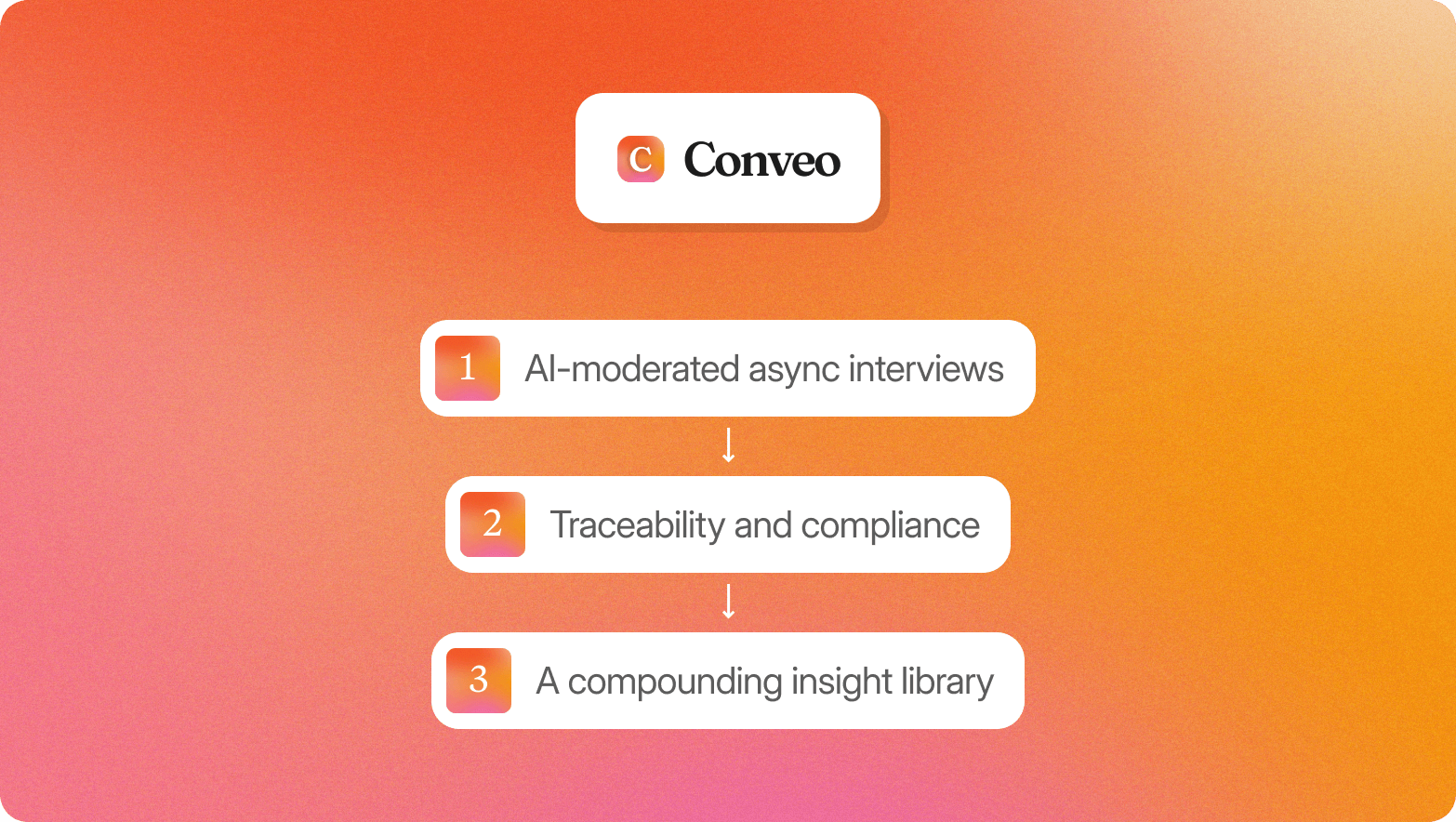
The framework in this article, and in the template above, gives your team structure. Conveo gives that structure an engine.
Every component of the design research template maps directly to Conveo's workflow:
AI-moderated async interviews compress the 6-week cycle to days, turning the template into a repeatable sprint-cadence workflow. Teams can conduct in-depth interviews with customers, UX participants, or market research audiences without the scheduling overhead that makes continuous discovery impractical with traditional methods.
Traceability and compliance (SOC 2, GDPR, real participants) earn stakeholder buy-in, so template outputs carry institutional credibility with key stakeholders across product, design, and marketing teams, as well as leadership.
A compounding insight library turns individual research projects into a living system in which each execution builds on what came before, and future research starts from a richer foundation.
Frequently Asked Questions
What is a design research template?
A design research template is a structured framework that connects research questions to participant criteria, a discussion guide, an analysis plan, and an output format within a single workflow. Research design refers to the structural choices that determine how data will be collected, which research methods will be used, and how qualitative data will be synthesized into actionable outcomes. The meaningful distinction today is between static templates (Word, PDF) and operational ones integrated directly into a research platform, where the guide, screener, and analysis framework are live and ready to conduct, not spread across different sections of a shared drive.
What should a design research plan template include?
A solid design research plan template covers five components: research objectives tied to specific product decisions; sampling and recruiting criteria; a discussion guide or interview protocol; an analysis plan that defines how you will analyze data and identify patterns; and a defined output format for stakeholder delivery. Without all five, teams collect responses but struggle to synthesize them, and the findings end up in a deck that no one returns to as a reference for future research.
How do I create a qualitative research design template?
A qualitative research design template gives your team a reusable structure that adapts without having to rebuild from scratch each time. Start with the product decision that the research will inform, then identify who you need to talk to and why. Draft interview questions that probe the "why" behind behaviors, plan how responses will be coded before data collection begins, and decide how findings will be delivered before the first session runs. Include a methodology section that documents the research methods you are using and why they fit the scope; this sets realistic expectations with key stakeholders before fieldwork begins.
Why do design research template Word documents create friction?
A design research template Word document introduces friction the moment more than one product squad touches the same research project. Version conflicts compound fast across different sections of the same file, and static Word documents cannot link to video clips, transcripts, or live participant responses. Findings land in a file, severed from the qualitative data that produced them. Integrated platforms resolve both problems: insights update as sessions complete, and every theme links directly to the source clip, giving key players across the organization context they can independently verify.
What's wrong with design research template PDF downloads?
A design research template PDF locks in interview questions before you know what participants will say. When a participant reveals a new pain point mid-session, the guide cannot follow up; the conversation stays on script, and the real insight gets left on the table. This is a particular problem for UX research and evaluative studies, where usability issues often emerge from unexpected behaviors. Video-first AI-moderated interviews solve both sides: adaptive probing follows what participants actually say, and every finding links back to the original video clip, so key stakeholders can verify the evidence.
Are free design research templates worth using?
A free design research template download solves the blank-page problem, and that starting point has real value, particularly for students or teams running their first research project with limited resources. But free templates do not recruit participants, conduct sessions, moderate interviews, transcribe recordings, or synthesize findings. Those steps are where weeks disappear. For teams trying to conduct research every sprint, operational infrastructure, not template format, is what determines whether the methodology section ever turns into actual outcomes.

About the author
Dieter De Mesmaeker
Co-Founder & CEO
Dieter is CEO and co-founder of Conveo. Before starting the company, he founded DataCamp and scaled it into one of the leading edtech platforms in the world.
More by Dieter →Qualitative insights at the speed of your business.
Conveo runs AI-moderated video interviews and structures everything they say.