In this article
TL;DR
Homogeneous panels produce research findings that fail when products reach broader markets, not because teams don't care about representation, but because the operational barriers to building a diverse participant pool are real.
Diversity in user research extends beyond demographics. Language, digital fluency, behavioral context, and access to technology all shape how people experience a product.
Panel defaults create invisible selection bias, skewing toward digitally literate, English-speaking, higher-income participants unless UX researchers and insights teams actively define requirements otherwise.
Defining diversity requirements per study, not per program, is the discipline that separates rigorous research from checkbox compliance.
Async, multilingual interviewing removes the structural barrier that makes recruiting diverse participants expensive and slow.
Most research teams know their panels are not representative. They recruit from the same vetted sources, run studies on the same timelines, and consistently hear from the same demographic clusters. The voices that are hardest to reach get cut first: older adults, non-English speakers, lower-income households, and people with disabilities. Decisions get made anyway, built on a partial picture, the team knows is partial.
The barriers that made diverse research impractical were never philosophical. They were logistical: limited panel sources, manual translation overhead, and 6–12 week timelines that force demographic cuts before decision windows close.
That ceiling is no longer fixed. The timeline, cost, and moderation overhead that made diverse sampling genuinely difficult have shifted enough that UX researchers and insights teams can now design for inclusion from the start, rather than retrofitting it after the fact.
Why Diversity in User Research Matters (Beyond the Ethical Case)
Homogeneous research samples don't just limit who gets heard. They produce research findings that fail when products reach broader markets, and the cost of that failure lands far later than it should.
Consider usability testing conducted primarily with native English speakers. The interaction flows well in the lab. The team ships with confidence. Then users with accented speech, non-standard phrasing, or regional dialects encounter consistent recognition failures, the research never surfaced: usability issues that a broader sample of potential customers would have caught before launch. Disabled users and users from diverse backgrounds with varying abilities and levels of digital fluency face the same dynamic. Industry estimates put late-stage design corrections at 10 to 100 times the cost of changes made during the design phase. Diversity in user research isn't a values question alone. It's a cost-of-rework question.
The ethical dimension is real: products serve diverse users from varied backgrounds, and research that ignores this reality yields findings that reflect a narrow slice of human experience. The principles of accessible design apply equally to research methodology. Digital services built on qualitative research that misrepresents user needs fail in the market, affect user satisfaction, and require expensive redesigns a broader sample would have prevented.
There's also a stakeholder trust problem that teams consistently underestimate. When findings reach a CMI director or cross-functional product review, someone will notice diverse perspectives are missing from the sample. Challenged findings don't drive decisions. They generate more rounds of research.
What Prevents Diversity in Practice (The Operational Reality)
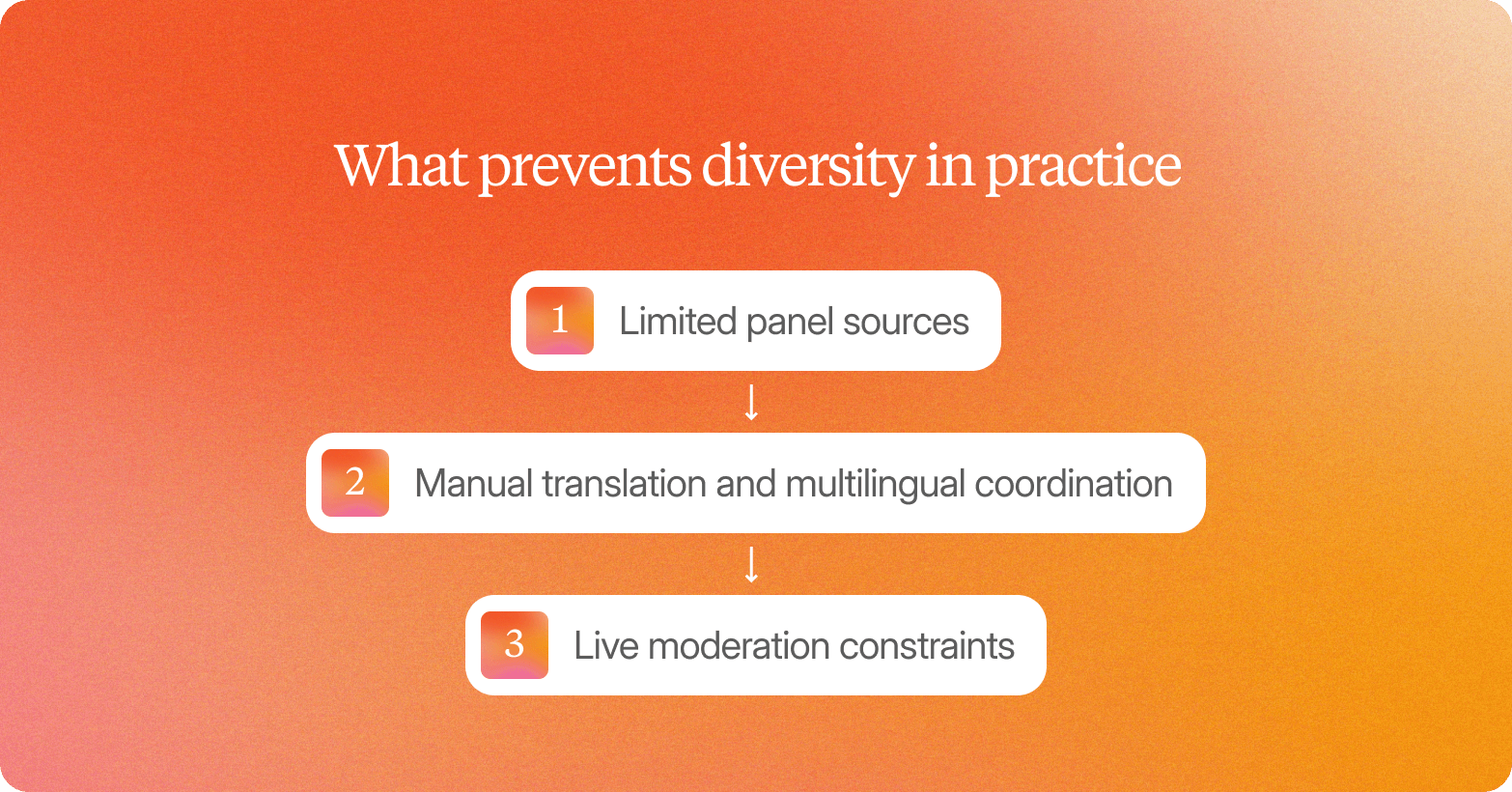
Most teams want representative samples. The gap between intent and execution is not a values problem. It is an operational one.
Diversity in user research breaks down at three specific points in the research process.
Limited panel sources
Most insights teams rely on two or three familiar panels because coordinating multiple vendors adds procurement overhead, separate contracts, and duplicated quality checks. Panel composition determines which segments appear in your data and which remain structurally invisible. A panel built around English-speaking, digitally fluent, mid-income adults will consistently return research findings that reflect that population, regardless of how carefully the discussion guide is written. Teams don't deliberately choose narrow samples. They inherit them from the path of least resistance.
Manual translation and multilingual coordination
Running research studies across multiple languages means hiring separate vendors for each market, translating discussion guides before fieldwork, and waiting for transcript translations before analysis can begin. This adds weeks to the timeline and a significant cost multiplier for each additional language. The consequence is predictable: teams cut languages and geographies before the decision window closes. Inclusive UX research requires reaching research participants in the language they think in, not the language the research team is comfortable working in.
Live moderation constraints
Scheduling human moderators across time zones and accessibility challenges creates a hard ceiling on how many participant profiles a small team can cover in a single research project. When each session requires a calendar slot, a trained moderator, and a debrief cycle, the practical sample size shrinks fast.
When qualitative research takes months and requires high agency fees for each new market or demographic slice, the operational cost of recruiting diverse participants is cut before the decision window closes.
Conveo's work with enterprise insights teams shows that most panel-based samples share three structural gaps: geography concentration, language monoculture, and experience-level skew. Teams rarely notice until research findings are challenged in a stakeholder review, at which point the study cannot be reopened.
One diagnostic: if your last three research projects used the same panel and the same language, you are likely missing segments that matter to your business.
4 Common Failure Modes (And How to Avoid Them)
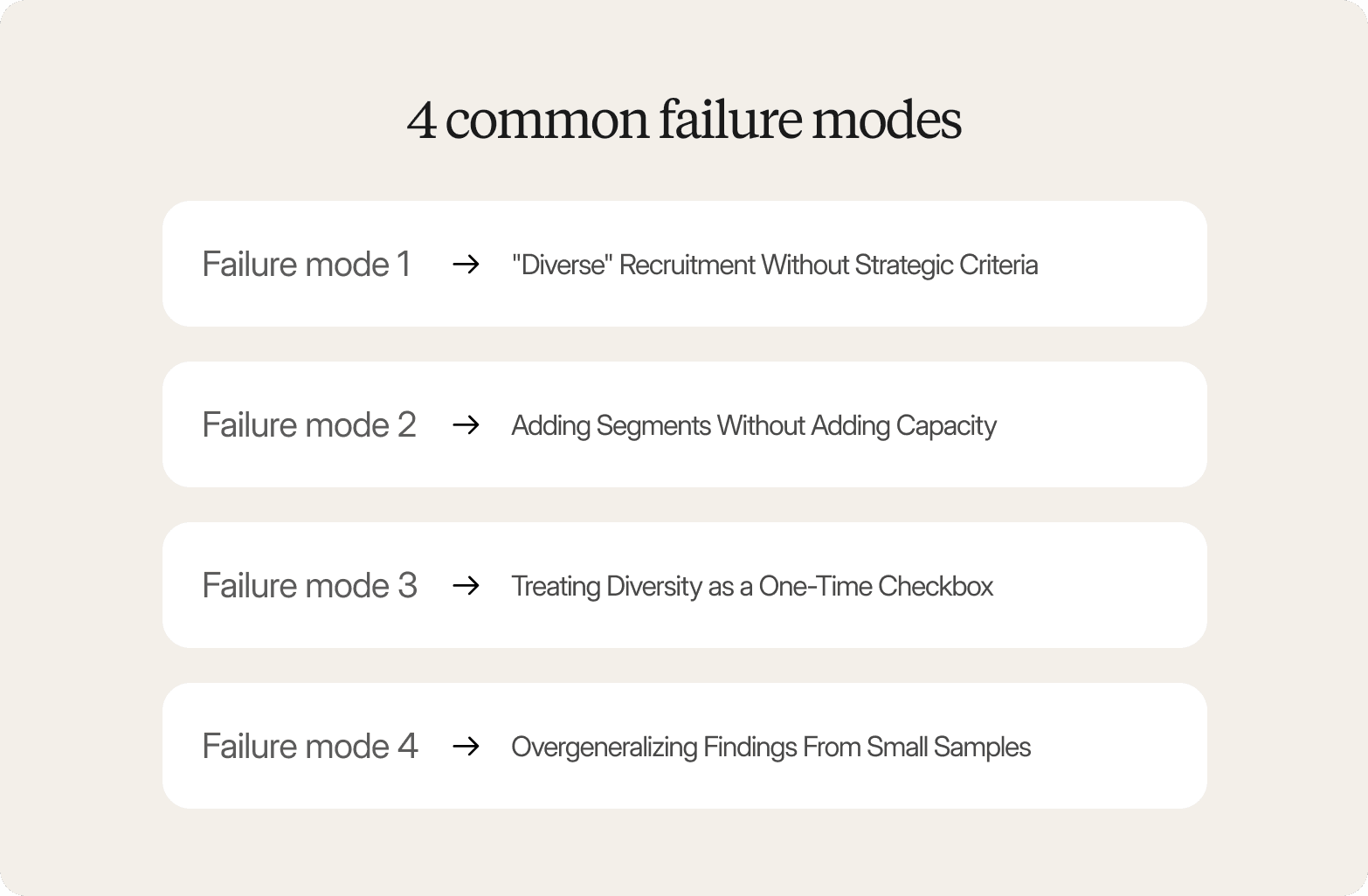
Knowing what prevents diversity is useful. Knowing how those barriers manifest as specific, recurring mistakes is actionable.
Failure Mode 1: "Diverse" Recruitment Without Strategic Criteria
Teams often spread participation across age groups, geographies, or income brackets without asking which of those dimensions actually explains the behavior under investigation. The result looks balanced on paper, but produces noise rather than signal. The corrective is to define diversity requirements from the decision outward: before building a screener, identify which participant characteristics would produce meaningfully different answers.
Failure Mode 2: Adding Segments Without Adding Capacity
When a team adds new regional segments or a second language to a study scoped for one, something has to give: the participant pool shrinks, depth gets cut, or synthesis gets rushed. Small insights teams cannot cover enough demographic and regional segments when manual moderation limits throughput. Async AI-moderated interviewing changes that arithmetic: hundreds of conversations across regions and languages run in parallel without extending timelines or adding headcount.
Failure Mode 3: Treating Diversity as a One-Time Checkbox
Teams run one inclusive study, share the report, then quietly revert to their familiar participant pool for the next research project. Inclusive research is an ongoing process, not a project milestone. When every interview, clip, and finding flows into a shared insight library that persists across research studies, comparing patterns across diverse audiences becomes less of a manual effort.
Failure Mode 4: Overgeneralizing Findings From Small Samples
Findings from 15 research participants are presented as universal truths with no acknowledgment of who those participants were or what the study was not designed to test. The corrective is documentation: state participant criteria alongside every finding, name what was excluded and why, and trace every claim back to a specific response or clip.
4 Steps to Define "Diversity Requirements" for Your Study
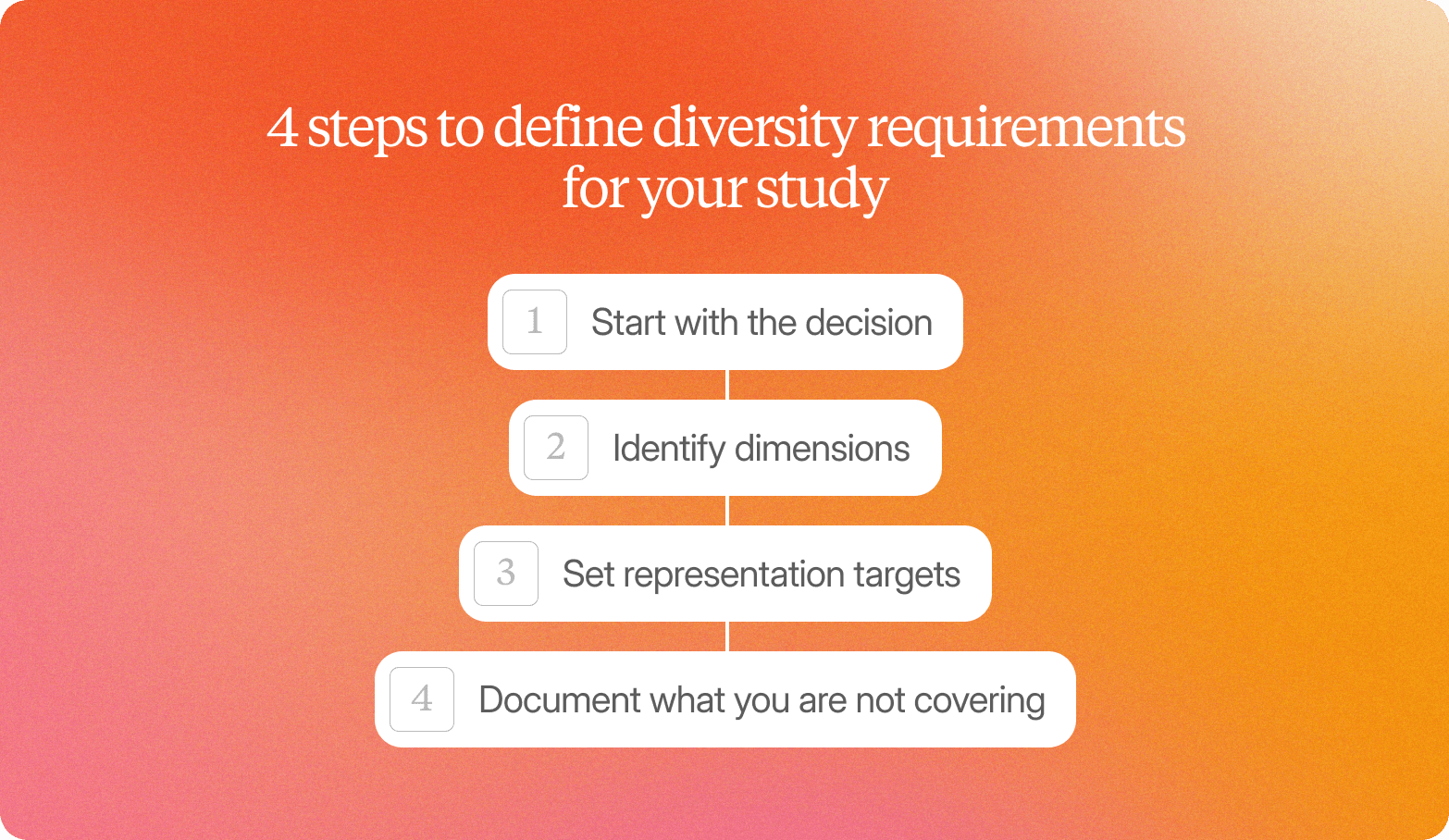
Diversity in user research means different things depending on what you are trying to learn. There is no universal checklist. The right participant mix follows from the research question, not from a general aspiration toward representation. The work begins in early brainstorming sessions, before a screener is written, where teams map which user groups actually matter for the decision at hand.
Step 1: Start with the decision that the research will inform
Write down the specific business decision this research project will support. Which user groups will interact with this product, feature, or message in the real world?
Step 2: Identify dimensions that affect the behavior being studied
Common dimensions include age, income, geography, language, accessibility criteria, cognitive disabilities, mobility challenges, visual disabilities, tech literacy, and prior product experience. For a given study, two or three may be critical and the rest irrelevant. Be specific about which dimensions affect user needs in the context of your research question.
Step 3: Set representation targets based on business exposure
If 40% of your market speaks Spanish, 40% of participants should too. If accessibility requirements are a documented friction point in your product, recruit diverse participants with relevant needs rather than treating inclusion as an optional add-on.
Step 4: Document what you are NOT covering and why
Scope limitations are methodological decisions that need to be stated clearly. This prevents overgeneralization and builds stakeholder trust.
What this looks like in practice
A checkout flow study for a US e-commerce site should include research participants across income levels, mobile and desktop users, and first-time and returning customers. Inclusive UX research here does not require multilingual coverage if the site operates exclusively in English: that is a scoped decision, documented transparently.
Inclusive Participant Recruitment
Recruiting participants from underrepresented groups starts earlier than most teams realize. Screeners and other research materials often unintentionally exclude the diverse participants teams most want to include.
5 Screener Questions for Inclusive Sampling
Use these to screen participants across key diversity dimensions without biasing responses.
Language and communication context
"What language do you primarily use when [using this product / completing this task]?" Captures linguistic diversity without flagging non-native speakers as disqualified.
Assistive technology use
"Do you use any assistive technologies when interacting with digital products? Common assistive technologies include screen readers, voice control, magnification software, and switch access." Knowing whether a potential participant is an assistive technology user (including screen reader users who rely on screen reader support and other assistive technologies) lets you confirm the platform's accessibility before the research session begins.
Accessibility features and needs
"Are there any accessibility features you rely on that we should accommodate for this study?" This catches accessibility issues before they become barriers, and signals to participants with different abilities that the study is genuinely open to them.
Behavior frequency
"How often do you [perform the behavior being studied] in a typical week?" Frequency captures relevant experience without demographic proxies.
Self-described identity
"How would you describe your gender identity?" [Free text, with "prefer not to answer" as the first option.] Open-ended questions reduce misclassification and capture nuance that binary checkboxes miss.
Quota Grid for Multi-Dimensional Representation
Grids become unwieldy when teams try to control every demographic dimension simultaneously. The practical approach: identify the two or three dimensions most relevant to the research question and grid those.
Sample grid: 20 participants, digital service study
| Segment | Age 25–40 | Age 41–60 | Total |
|---|---|---|---|
| High-tech literacy | 5 | 3 | 8 |
| Moderate tech literacy | 4 | 5 | 9 |
| Low tech literacy | 2 | 1 | 3 |
| Total | 11 | 9 | 20 |
The grid deliberately oversamples high-literacy younger participants because that segment drives the adoption behavior under investigation. Conveo's parallel async structure means a diverse participant pool like this can be fielded within days rather than weeks.
Outreach for Hard-to-Reach Audiences
Response rates drop sharply among potential participants with lower baseline trust in research institutions when invitations feel vague. The fix is transparency and plain language, not length. Example: "We're inviting people to share their experience with [topic] in a short video interview. It takes about 20 minutes, on your own schedule, and you'll receive [compensation] within [timeframe]. The interview is available in [languages] and in multiple formats. If you need accessibility support, let us know." Naming time, compensation, language options, and accessibility accommodations each removes a specific reason to decline.
Conveo supports multilingual research across 20+ languages, so the experience of being heard in your own words extends from the invitation through to the interview itself.
See how Conveo handles participant recruitment and screening
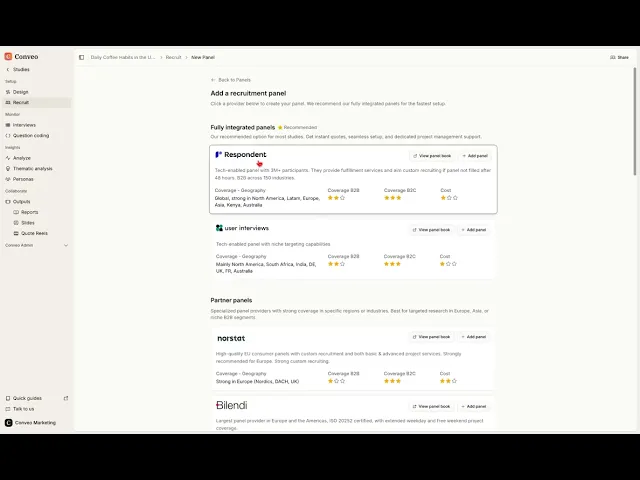
Running Inclusive Interviews Without Losing Depth
Live moderation allows real-time probing but creates scheduling, time-zone, and power-dynamic barriers that exclude the participants' teams that most want to reach. Three tactics shift that balance.
Asynchronous Interviewing to Remove Scheduling Barriers
Async user interviews allow research participants to respond on their schedule, removing time zone and caregiving constraints that make live coordination impractical at scale. Conveo runs asynchronous video interviews, allowing UX researchers to include more geographies and schedules without coordinating live sessions. Depth is maintained through adaptive AI probing: when a participant's response opens a new line of inquiry, the system follows up within the remote session without a researcher being present. Teams using async interviewing see 3–4x longer responses compared to text surveys, which means the format captures more of the user needs and nuance that make diverse perspectives valuable.
Reducing Power Dynamics in Remote Research
Video-first async interviews reduce moderator-participant power imbalance in ways live sessions cannot. Participants control their environment, can pause and resume, and are not performing live for an authority figure. This matters most when research touches sensitive topics, product critique, or lived experience tied to identity, particularly for disabled participants and others with different abilities, cognitive disabilities, or mobility challenges who may find live moderated sessions inaccessible or stressful.
Capturing Nonverbal Context Across Cultures
Research participants with visual disabilities or who rely on screen reader support interact with digital products in fundamentally different ways than sighted users, and accessibility testing conducted only with sighted participants misses that entirely. Cultural norms also shape how participants express agreement, confusion, or frustration. Treating accessibility testing as a standard component of every research project, rather than a specialist exercise, is what separates genuinely inclusive design from performative diversity. Video-first remote sessions preserve facial expression, hesitation, and vocal tone, signals that text surveys lose entirely.
Analysis and Synthesis Across Diverse Segments
Manual thematic analysis across 50 or more user interviews in multiple languages is one of the most common reasons for diversity in user research to be cut before a study launches. When synthesis takes weeks, UX researchers face a familiar tradeoff: run a tighter study with fewer segments, or hold the timeline and lose the decision window. Most teams cut the segments.
AI-assisted analysis changes the economics of that decision.
Automated transcription and translation eliminate the vendor-per-market overhead that has historically made multi-language research studies prohibitive. Adding a Spanish-speaking segment or a German market no longer requires separate translation cycles.
Parallel async interviewing allows hundreds of conversations to run simultaneously. Where traditional research methods cap a team at 20 user interviews across two segments, the same research project can now cover five or six groups within the same fieldwork window.
AI-assisted summaries, themes, and clips reduce the synthesis load across diverse segments. UX researchers can compare how a theme lands across diverse user groups or geographies without rebuilding the analysis for each cut. Every finding links back to its original video source, so teams can uncover insights across their full participant pool without losing traceability.
Generic LLM-based synthesis is fast but not traceable to real conversations. When a conclusion concerns underrepresented groups, stakeholders will ask to see the evidence. A summary without a source does not hold up. Conveo handles the infrastructure so teams can focus on interpretation, and a searchable insight library compounds learning across research studies, so findings about how a diverse group responds to one product decision inform the next project.
Measuring and Reporting Representation (Without Overstating Findings)
Stakeholders need to understand who was included, who was not, and what conclusions the sample actually supports.
Document Who Was Included (Participant Composition Table)
| Dimension | What to capture | Why it matters |
|---|---|---|
| Language | Primary language of each session | Confirms linguistic coverage matches target markets |
| Geography | Country or region | Shows whether the sample reflects the intended audience distribution |
| Age and demographics | Age range, gender, relevant household profile | Let stakeholders assess demographic fit against the target audience |
| Accessibility needs | Assistive technologies used, accessibility features relied on | Documents whether the research was accessible to disabled users |
| Experience level | Novice, regular, or expert user of the category | Flags whether research findings skew toward a particular usage segment |
| Recruitment source | Panel, CRM, screener criteria | Establishes how research participants were qualified and filtered |
A composition table lets stakeholders verify the sample themselves rather than accept it on faith. Transparency about who was included is not a caveat. It is evidence of methodological rigor.
State Limitations Explicitly
Findings mean what the data supports. State scope plainly: "This study included research participants across [dimensions covered]. It did not include [dimensions not covered], for example, disabled users, rural participants, or non-English-speaking markets, which may limit generalizability to those contexts." This matters particularly in inclusive UX research, where the temptation to present partial coverage as representative is highest.
Tie Findings to Evidence (Traceable Quotes and Clips)
Research findings about underrepresented groups are among the first to be questioned when stakeholders scrutinize methodology. Without direct evidence connecting each insight to the participant who expressed it, conclusions feel asserted rather than demonstrated.
Conveo links every finding to its source: the original video clip, verbatim quote, and participant context that produced it. Researchers can show the evidence rather than defend the conclusion. Conveo uses real participants with no avatars or synthetic responses, which matters when research touches identity, accessibility barriers, or lived experience.
How Conveo Removes Barriers to Inclusive Research
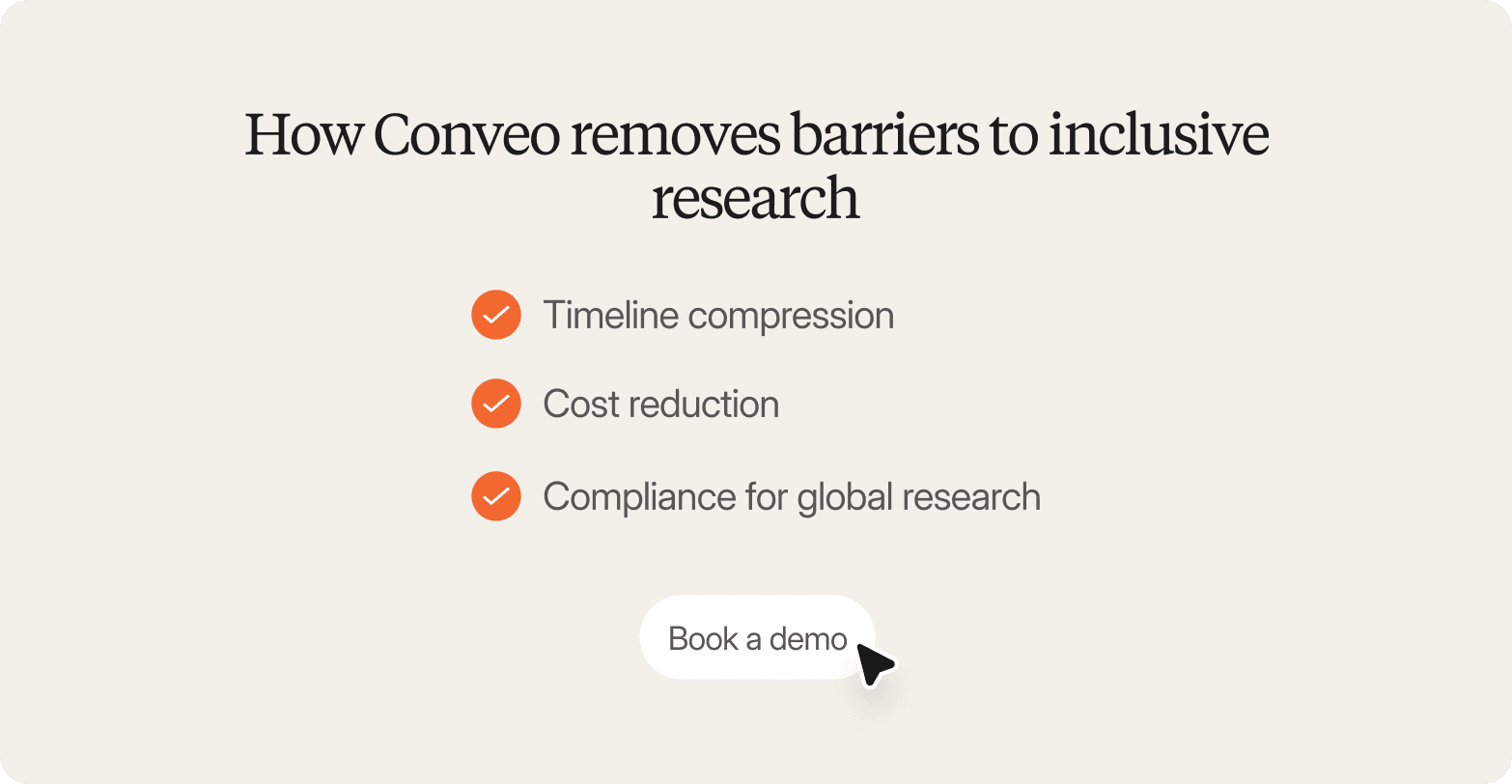
The tension this article has traced is consistent: teams understand that representative sampling produces better decisions, but diverse recruitment has historically been expensive, slow, and logistically difficult to sustain. That constraint is now operational, not structural.
Conveo enables multilingual, asynchronous voice and video interviews across 20+ languages in parallel, compressing the timeline and cost barriers that have prevented representative sampling. For teams building digital services that need to meet accessibility standards across global markets, that compression changes what is possible within a single research project.
Timeline compression
Teams report timelines shifting from weeks or months to hours or days, making demographic inclusion checks practical before launch rather than retrospective afterward.
"We pull richer insight in hours, not weeks."
Head of Customer Insights, JDE Peet’s
Cost reduction
In documented cases, teams report spending up to 50-80% less on research than with agency-delivered qualitative programs. That reduction frees budget to recruit harder-to-reach research participants: lower-income segments, rural participants, non-English speakers, disabled users, and communities that traditional panels consistently underrepresent.
Compliance for global research
SOC 2 certification, GDPR compliance, and EU data hosting support diverse global research programs where procurement and data handling are prerequisites.
Most teams don't skip inclusive research because they disagree with the principle. They skip it because the operational cost within a real project timeline is too high. Conveo addresses that at the infrastructure level, not the intent level.
Frequently Asked Questions
Why do our qual findings keep looking the same when we recruit from the same few panels?
Panel composition determines which customer segments appear in your research findings and which remain invisible. When UX researchers and insights teams consistently recruit from a small set of familiar panel sources, the result is selection bias that skews findings away from underrepresented groups. If your last three studies drew from the same participant pool in the same language, you are likely missing segments that matter to your business. Diversity in user research starts at the recruitment stage, not the analysis stage.
What are the most common ways limited panel sources bias user research results?
Three patterns appear consistently. Language and geography concentration: when the majority of research participants come from a single country or share one primary language, research findings reflect that context rather than broader market reality. Demographic homogeneity: when age, income, or education levels cluster narrowly, the research captures one segment's experience and misses how other user groups use the product. Experience-level skew: when all participants are heavy users, or all are first-timers, the findings describe one end of the user journey. When these biases go unnoticed, product and marketing decisions get made on an unrepresentative slice of the actual audience.
How do you recruit underrepresented participants without blowing your research budget?
The underlying cost driver is synchronous moderation. When every session requires a researcher to be present, each additional demographic slice adds researcher time. Traditional research methods make each new segment inherently expensive. Async video interviewing removes that constraint: sessions run on the participant's schedule, so 50 responses from three underrepresented segments can be fielded without blocking calendar time for each. Two practical adjustments make the biggest difference: review screener logic for unintentional exclusion, particularly around language, device access, and assumed context, and write outreach in plain language that clearly states time commitment, compensation, and accessibility options.
What does "inclusive UX research" mean in practice for an enterprise team?
Inclusive UX research means designing research studies so the participants who appear in findings actually represent the populations whose behavior the product depends on, not just whoever was easiest to recruit. In practice, that spans three dimensions: who gets recruited (a diverse participant pool built on purposeful screener design), how sessions run (remote sessions and async formats that remove accessibility barriers and scheduling constraints for disabled participants and others with different abilities), and how findings get reported (transparent about scope, sample composition, and limitations).
About the author
Ivayana Abdi
Research Impact Lead
Ivayana has worked in market research since 2017, most recently as group manager of research operations and logistics at Culturati, and trained at RIVA and the Burke Institute. She joined Conveo for the hybrid researcher model: agile with new methods, fluent in the traditional ones, and able to combine the two for clients who want to try new things.
Meet Ivayana on film →Qualitative insights at the speed of your business.
Conveo runs AI-moderated video interviews and structures everything they say.