In this article
TL;DR
Evaluative user research measures how well a product, feature, or concept meets defined success criteria, the discipline behind usability testing, concept validation, and task completion studies.
Evaluative research focuses on a systematic process that blends quantitative and qualitative methods, statistical analysis of task metrics alongside qualitative data from real conversations, to produce evidence-based insights instead of opinion.
The evaluation research process only creates value when findings reach the team before the decision is locked; manual moderation, transcription, and synthesis routinely stretch a research study to two to four weeks and miss that window.
Common evaluative research methods- usability testing, concept testing, A/B testing (also known as split testing), tree testing, and prototype validation- share one constraint: the time it takes to recruit, moderate, and synthesize.
Findings hold up only when success criteria are set upfront, and every conclusion traces back to a real participant moment on video, supporting informed decisions rather than guesswork.
Asynchronous, AI-moderated video interviews with adaptive probing compress the evaluation process from weeks to days while keeping that evidence auditable.
Most evaluative user research findings land on a product team's desk after the decision they were meant to inform has already been made. A usability study kicks off the week a feature enters development. By the time moderation wraps, transcripts come back, and synthesis produces a coherent set of themes, the sprint has closed. The finding is accurate. It is also irrelevant.
That gap is structural, not a prioritization failure. Manual moderation, transcription, and synthesis create a bottleneck that stretches evaluative studies beyond what should take days, extending timelines to two to four weeks and making rigorous evaluations hard to sustain alongside continuous discovery.
Evaluative user research is the practice of measuring how well a product, feature, or concept meets user needs against defined success criteria. It is why evaluative research is important for any team trying to conduct evaluation research with confidence: without a systematic approach, "does this work?" collapses into a debate of opinions. Where generative research explores what problems exist and why, evaluative research asks whether a solution actually works for the people it is built for. It is the discipline behind usability testing, concept validation, and task completion studies, and it typically relies on both qualitative and quantitative methods- the work that turns design assumptions into evidence.
This article covers the core evaluation research methods used in practice, when each method fits the research question, how teams are compressing the evaluation research process without sacrificing rigor, and what it takes to make findings sufficiently traceable to hold up under scrutiny.
What Is Evaluative User Research?
Evaluative research is the discipline of testing a specific thing against specific criteria. Where generative research opens questions, evaluative research closes them. You have something concrete, and you need to know whether it works before you commit to it.
That distinction matters more than most teams treat it. Generative and evaluative research are not interchangeable phases of the same process. They answer fundamentally different questions, and getting research evaluation wrong at this stage is why so many teams run the wrong study for their particular circumstances.
| Generative Research | Evaluative Research |
|---|---|
| What problems do users have? | Does this solution solve the problem? |
| What do users need that doesn't exist yet? | Does this meet the need we designed for? |
| Where are the gaps in the current experience? | Should we ship this version, or change it first? |
Evaluative research occurs at a specific moment in the product development process: after a concept, prototype, or feature exists and before a decision is locked in. That window is narrower than most teams realize; once engineering resources are committed or a campaign goes to production, the cost of acting on evaluative findings rises sharply.
Evaluative Research's Roots in Program Evaluation
The discipline has roots outside of product teams too. In the social science tradition, program evaluation applies the same underlying logic to judge program effectiveness and program outcomes for a specific program, whether that's a public health initiative or a new program at a nonprofit. The evaluation research process typically runs in stages: formative evaluation tests a concept before launch, process evaluation checks whether a program is being delivered as designed, and summative evaluation, also called outcome evaluation, measures whether a program has reached its intended goals. Product teams borrow this same structure, whether or not they use the label, and program managers face the same pressure product teams do: decide with evidence or with instinct.
Evaluative user research answers three core questions:
Does this work as intended?
Does it meet real user needs in a particular context?
Is this ready to ship, or does it need another iteration?
A good research study is not open-ended discovery. You are testing a hypothesis: that a specific solution solves a specific problem for a target audience in a particular circumstance and specific context. The output is a verdict with evidence, not a landscape of themes, which is exactly why evaluative research is important once real budget is on the line.
6 Common Evaluative Research Methods
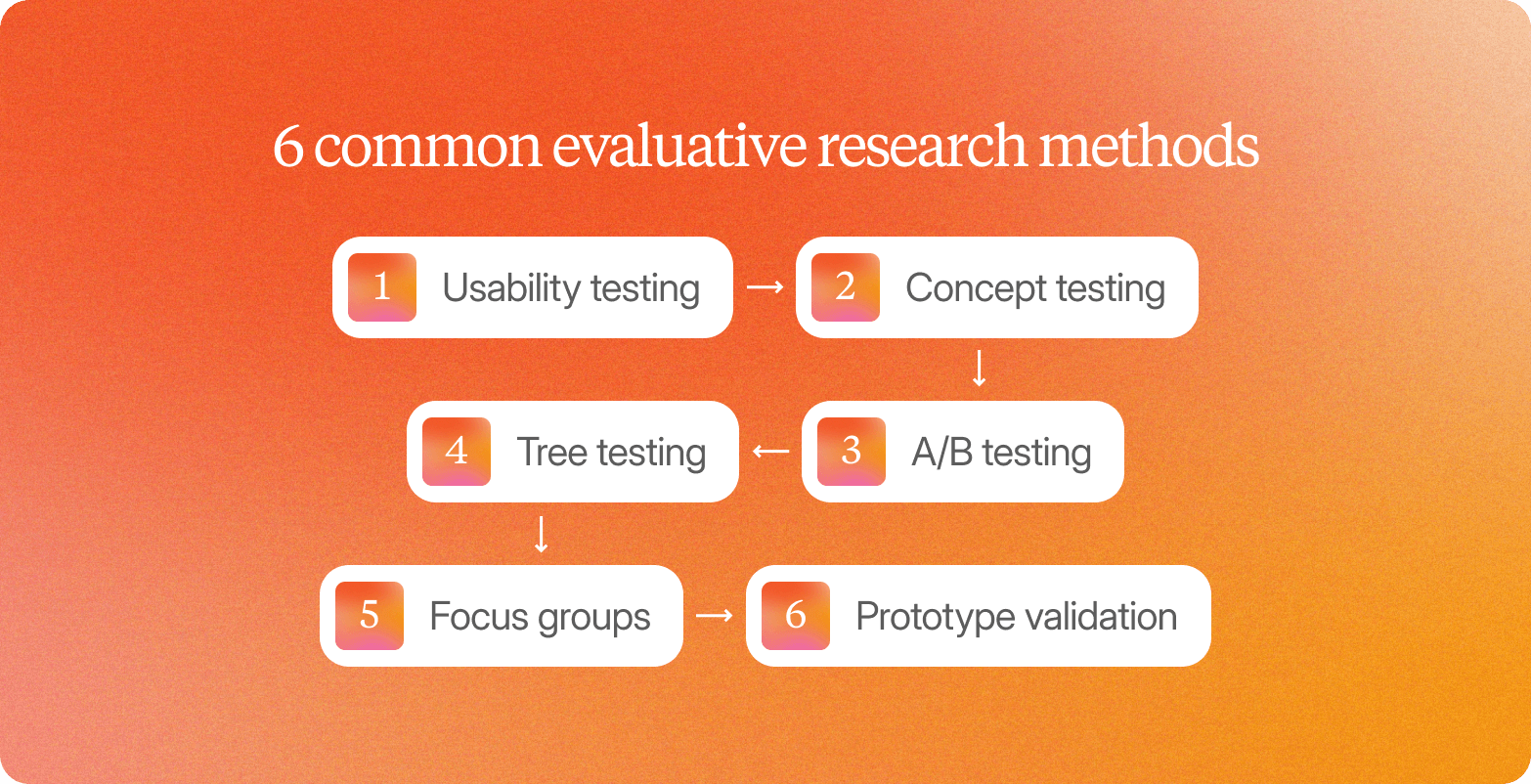
Each of these methods belongs to the same family of evaluation research methods: structured approaches that measure how real users respond to a specific design, concept, or decision. Some lean on quantitative data, some on qualitative data, and most rigorous studies gather both.
"Conveo gives us quant-level robustness and qual-style depth"
CMI Lead, Edgard & Cooper
| Method | What It Measures | When to Use It |
|---|---|---|
| Usability testing | Task completion, error rates, and friction points inside a workflow or interface, combining quantitative data like time-on-task with qualitative data like verbatim frustration | Before a feature ships, while changes are still cheap; feeds a prioritized friction list straight to the design process backlog |
| Concept testing | Appeal, comprehension, and purchase intent for a particular audience | Before committing to development, to catch misalignment between internal assumptions and real consumer language |
| A/B testing (split testing) | Preference and performance between two variants, using statistical analysis to declare a winner | When a team has two credible options (headlines, layouts, pricing) but no explanation of why one wins, so it's usually paired with a qualitative layer |
| Tree testing | Whether users can find what they're looking for inside a proposed information architecture, sorted into predefined categories | Early, to catch structural navigation problems before they get built into a live site |
| Focus groups | Concept-stage reactions, especially where hearing participants respond to one another surfaces objections a one-on-one session might miss | Weaker for behavioral evidence, so best paired with usability or prototype testing rather than used alone |
| Prototype validation | Whether a design solves the intended problem, combining behavioral observation with participant reasoning | Once a team has a working-fidelity prototype and needs to verify the solution before engineering investment scales |
The tradeoff these methods share is the same regardless of which one a team chooses: each requires recruiting participants, moderating sessions, and synthesizing the data collected into something stakeholders can act on, time most research teams don't have when product cycles move faster than traditional research timelines allow.
When Evaluative Research Fails
Evaluative research earns its credibility when it can be traced back to real user moments. When it can't, findings get dismissed as subjective, and the researcher defending them loses the room. The failure modes are consistent, and they're preventable.
Asking the Wrong Question
The most common way concept and usability evaluations go wrong is starting with the wrong prompt. "Would you use this?" sounds reasonable, but it produces optimistic, socially desirable answers that don't predict behavior. Participants say yes because the concept sounds appealing in the abstract, not because it would change how they actually work. The question that unlocks real signal is different: "What do you use now? What would this replace?" That framing grounds the evaluation in current user behavior and competing alternatives, where genuine adoption friction lives.
Missing the 'Why'
Surveys can quantify preferences at scale and gather quantitative and qualitative data at volume, but they miss the signals that explain the numbers. A participant who rates a feature 4 out of 5 might have paused for six seconds before answering, lowered their voice when describing the price, or smiled flatly at a prototype they called "interesting." Those moments carry more evaluative weight than the score. A survey response, especially one built around predefined categories, cannot capture the flat "I wouldn't pay that much" that comes with a particular tone and a glance away from the camera. This is why a video-first approach matters: the evidence is in the behavior, not the transcript.
Findings Without Evidence
Evaluative conclusions without traceable evidence don't survive stakeholder review. When a researcher presents a theme and a stakeholder pushes back, the debate becomes an opinion contest unless the researcher can point to the exact clip, quote, or transcript moment behind the claim. Without that, the loudest voice in the room wins.
The resolution is straightforward: evaluative research works when criteria are defined before fieldwork begins, evidence is traceable to specific moments with participants, and findings reach the team while the decision is still open. Each of the three practices below satisfies one of those conditions.
Replace Live Moderation with Asynchronous Video Interviews
Scheduling is where evaluative research loses its first week. Coordinating 20 live sessions across time zones and calendars turns a focused concept validation into a three-week logistics exercise before a single question gets asked.
Asynchronous, AI-moderated video interviews remove that constraint. Participants receive a link and complete the session on their own schedule. Conveo, a video-first AI research platform, uses an AI moderator that greets participants naturally, follows up on what they actually say, and probes for the reasoning behind surface-level reactions, without requiring a human moderator to be present to gather data. These are real people, not synthetic respondents, so the reactions are genuine.
Because sessions run in parallel rather than sequentially, a team can collect data from 50 interviews in 48 hours instead of scheduling 50 one-hour calls across three weeks, without the calendar dependency that makes traditional moderation impractical at volume.
Use Adaptive Probing to Surface Actionable Negatives
Surveys ask every participant the same questions in the same order, regardless of what they say. That design works for measurement. It breaks down when you need to understand why someone hesitated, objected, or disengaged.
Adaptive probing changes this. Instead of following a fixed script, Conveo's AI moderator responds to the participant's input in real time. When someone says, "I'm not sure I'd use this," it's followed up with: why not? What would need to be different? What are you using instead?
The signals this surfaces are what researchers call actionable negatives: "I wouldn't pay that much," "I already have something that does this," "I don't understand what this is for." These are the responses that reshape roadmaps and reframe positioning, and they're the ones most likely to go uncaptured when moderation is rigid or rushed.
See it in action: How AI-Moderated Video Interviews Actually Work
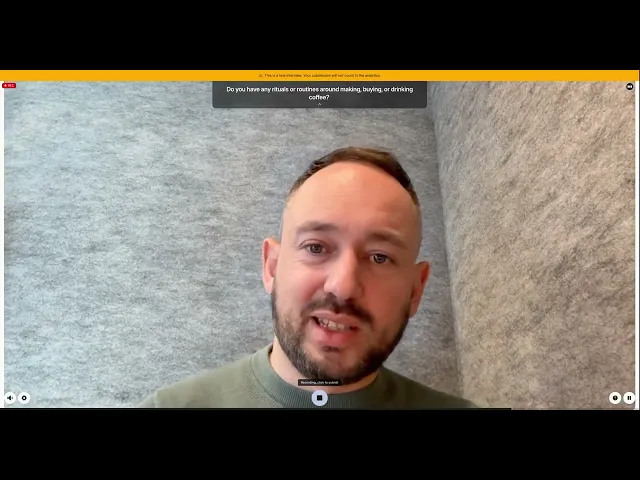
Turn Findings into Linked Clips and Quotes
Evaluative conclusions only hold weight when stakeholders can trace them back to the source. In Conveo, every finding links to a timestamped video clip and a verbatim quote from the original session. When a product manager challenges whether users actually struggled with an interaction, the answer isn't a summary slide. It's the exact moment, on screen, in the participant's own words.
The compounding benefit extends beyond individual studies. Every clip, quote, and theme feeds into a searchable insight library that persists across evaluative cycles, so recurring questions about usability, comprehension, or feature value get answered faster over time. Teams also receive interim findings while a study is still running, rather than waiting for a final readout, since sessions and synthesis occur in parallel. Evaluative cycles that once took three to four weeks compress to days when recruitment, moderation, transcription, and synthesis run in parallel.
Evaluative Research Deliverables That Stakeholders Trust
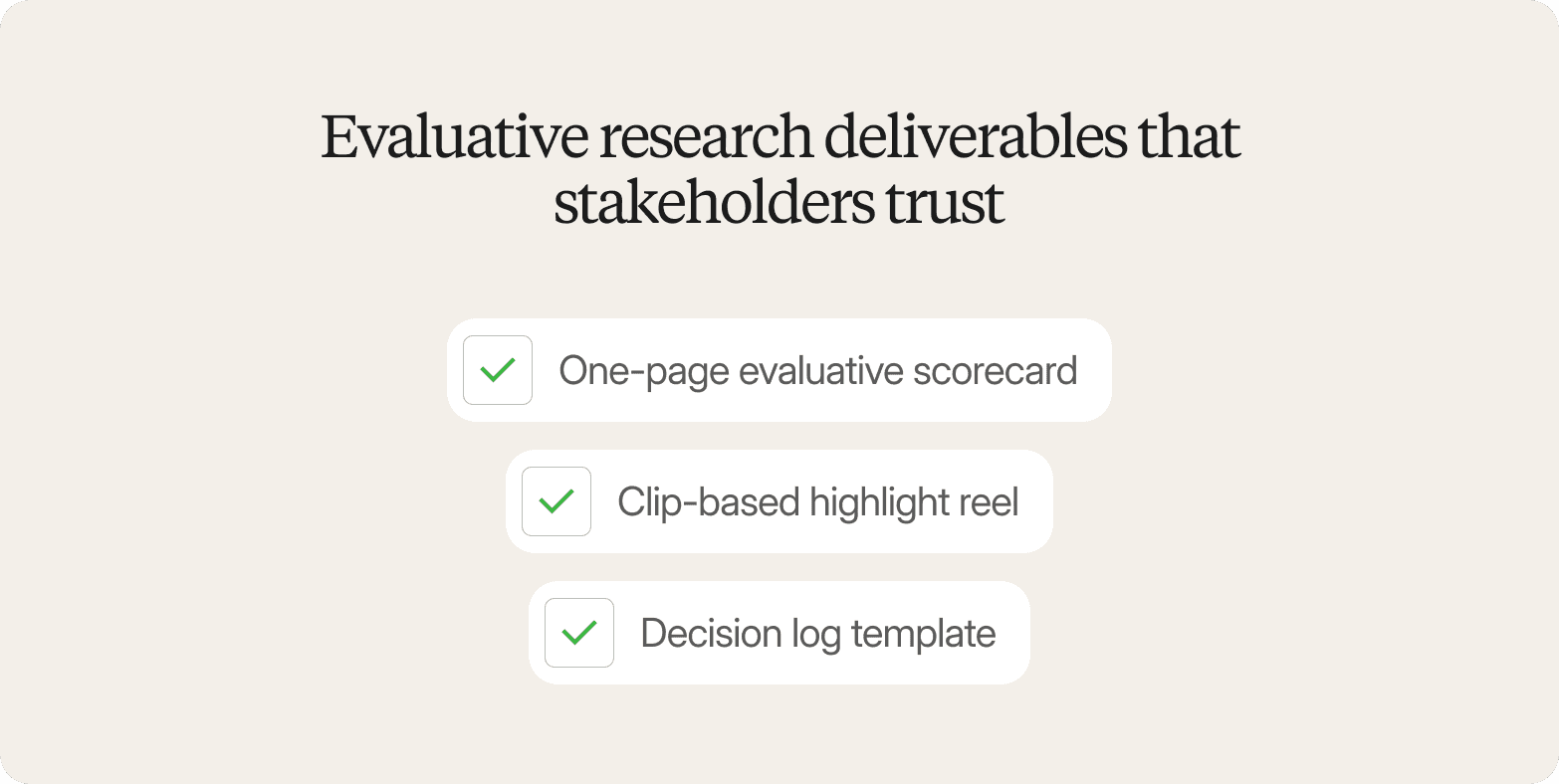
Evaluative insights get dismissed as subjective when success criteria were never defined upfront, and findings can't be traced to a specific user moment. A stakeholder who reads "users found the navigation confusing" will push back. One who watches a 45-second clip of a user pausing, backtracking, and saying "I have no idea where I am" will not. The format of your deliverable determines whether evaluative research lands as valuable insights or opinion.
Three deliverable formats are worth building into your standard workflow, each built to turn user feedback into actionable insights rather than a pile of unused notes.
One-page evaluative scorecard
This lists each success criterion defined before the study, the finding against it, and a direct link to the supporting evidence: a quote, a clip timestamp, or a theme tag. It's designed for stakeholders who need a decision-ready summary without reading a full report, and it works by presenting criteria and findings side by side. This format reduces post-readout debate and speeds up decision-making, because the criteria were agreed on before data collection, not invented after.
Clip-based highlight reel
A three-to-five-minute compilation of key user reactions, verbatim quotes, and nonverbal signals, pulled directly from session recordings. It is raw evidence, lightly curated. A product manager watching a user struggle with onboarding in their own words, with their own hesitation visible, responds differently than one reading a bullet about "friction at step three." Conveo generates highlight reels directly from multimodal session data, so researchers aren't spending hours in video editing software to turn valuable feedback into something stakeholders will actually watch.
Decision log template
This documents what was tested, which criteria were applied, what the findings showed, and what decision resulted. Its value compounds: each entry becomes a reference point for future improvements, preventing teams from re-testing answered questions and giving new team members context on why past decisions were made. It's also a record of stakeholder involvement, showing who weighed in and when, which matters the next time a decision gets revisited.
What makes all three credible is the same thing: traceability. Every finding links back to a real user moment, not a researcher's interpretation of it, turning evaluative research into a genuine input to decision-making rather than a report nobody reopens.
Remote Asynchronous Evaluative Research: When It Works and When It Doesn't
Asynchronous evaluative research compresses timelines, but that compression creates a real risk: without a moderator in the room, poorly designed studies produce surface-level feedback that confirms what teams already believe rather than surfacing what they need to know.
Evaluative research in UX contexts is well-suited to asynchronous delivery when the task is self-contained. Concept testing, messaging validation, prototype walkthroughs, and feature prioritization all translate cleanly because participants can engage with the stimulus independently and respond without real-time guidance. It's a natural fit for ux researchers who need to gather feedback on user preferences or user satisfaction without adding another live session to an already packed calendar, and it works just as well for customer satisfaction studies run outside a formal ux research team.
The format breaks down in predictable situations. Complex multi-step workflows, physical product testing, and studies where participants are likely to get stuck or misinterpret instructions all require live moderation. When a task demands guidance to complete, removing the moderator produces incomplete data, not faster data.
Three design principles keep asynchronous evaluative research from producing shallow feedback:
Define clear tasks. "Show me how you would use this feature" generates behavioral evidence. "What do you think of this?" generates opinion.
Probe based on responses. Adaptive probing distinguishes a well-designed async study from a video survey. When Conveo's AI moderator senses hesitation or a clipped answer, it follows up rather than moving on, surfacing pain points a fixed script would skip past.
Capture video, not just text. A pause before answering, a flat tone, a furrowed expression at a pricing screen: none of these appear in a text transcript.
When tasks are clear, probing is adaptive, and sessions are captured on video, asynchronous evaluative research produces findings that hold up in a sprint review and feed directly back into the design process.
How Conveo Compresses Evaluative Research Timelines
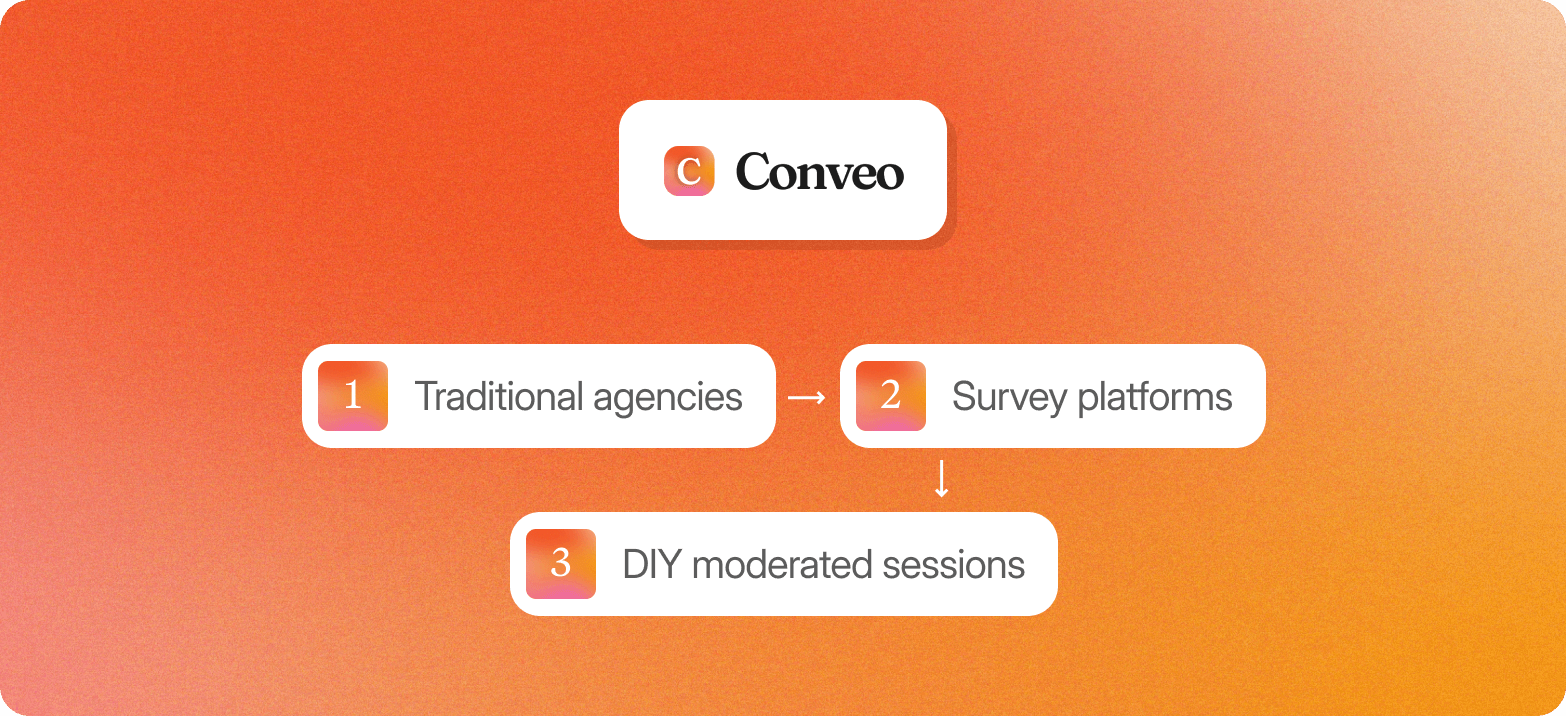
Three alternatives dominate how teams approach evaluative research today, and each creates a tradeoff:
Traditional agencies deliver the rigor stakeholders expect, but their 6- to 12-week turnarounds make recurring validation impractical for sprint cycles.
Survey platforms quantify preference at speed, but they miss the signals that matter most: the hesitation before answering, the workaround a participant invents mid-task, the shift in tone when a prototype doesn't behave as expected.
DIY moderated sessions preserve conversational depth, but manual transcription and synthesis turn every study into a multi-week effort regardless of how fast the interviews run.
Conveo, a video-first AI research platform, resolves all three trade-offs in a single workflow. Asynchronous, AI-moderated video interviews with real participants run in parallel, recruited through Conveo's integrated panel network or your own list, with no scheduling coordination needed to gather feedback at scale. The AI moderator probes adaptively based on what participants actually say, so hesitation and workarounds surface as findings rather than disappearing between lines of a transcript. Every insight links back to the original video moment, so stakeholders can verify the claim before the decision is made, not after a debrief deck lands two weeks later.
In 2026, the result is evaluative cycles that compress from weeks to days. Enterprise teams, including Google, Bosch, Reddit, and FOX, use Conveo to run evaluative user research at a pace that traditional methods cannot match, giving product and research teams (and, in some organizations, program managers overseeing broader research studies) evidence-based insights on a sprint timeline rather than a quarterly one. Evaluative user research stops functioning as a one-time gate before launch and becomes a continuous validation capability that runs alongside the work it is meant to inform.
Frequently Asked Questions
What is evaluative user research?
Evaluative user research measures how well a product, feature, or concept performs against defined success criteria and user needs. Where generative research explores problems worth solving, evaluative research validates whether your proposed solution actually solves them. In practice, it answers three questions every product team needs before a decision point: Does this work as intended? Does it meet real user needs? Should we ship this? Answering them with confidence requires structured research methods, including usability testing, concept validation, and task-based interviews, not instinct or stakeholder consensus.
What is an example of evaluative user research?
A product team tests a redesigned checkout flow before shipping it. Rather than asking users what they think of the design, they observe what actually happens: time to complete checkout, number of clicks required, where users hesitate or backtrack, and whether participants feel confident their order went through. Those data points tell a more reliable story than preference ratings alone. If users consistently stall at the payment step, that is a finding with a clear next action: iterate before release. If completion rates are high and confusion is minimal, the team has the evidence to ship.
What are common evaluative research methods?
The most widely used evaluation research methods in product and UX work are usability testing, concept testing, A/B testing, tree testing, focus groups, and prototype validation. Usability testing measures task completion and the friction points that prevent it. Concept testing measures whether an idea lands clearly and appeals to the right audience. A/B testing measures preference between two variants under real conditions. Tree testing checks whether users can navigate a proposed information architecture. Prototype validation measures whether a design actually solves the problem it was built to address. All of these share the same constraint: they require time to recruit participants, moderate sessions, analyze findings, and produce output teams can act on.
How is evaluative research different from generative research?
Generative research explores problems and opportunities; evaluative research tests whether a proposed solution actually works. Generative asks open questions before a solution exists: "What frustrates users about our onboarding?" Evaluative asks targeted questions after a concept is defined: "Does this new onboarding flow reduce drop-off?" Generative work happens earlier, when teams are still mapping the problem space. Evaluative work happens once a direction is set but before a decision is locked in, giving teams the evidence to commit or course-correct with confidence rather than on assumptions.
How does evaluative user research relate to program evaluation?
Evaluative user research and program evaluation are cousins, not the same discipline, but they share a common ancestor in social science research design. Program evaluation typically assesses whether a specific program achieved its intended goals, using formative evaluation early on and summative or outcome evaluation once a program has run its course. Evaluative user research applies that same logic to a narrower, faster cycle: is this feature, concept, or flow achieving what it was built to achieve, checked in days rather than at the end of a funding cycle.
What makes evaluative research findings credible?
Evaluative findings lose credibility when criteria aren't defined upfront, and evidence can't be traced back to real user moments. Three mechanisms close that gap. First, define success criteria before fieldwork begins, so findings are measured against an agreed standard rather than retrofitted after the fact. Second, link every finding to timestamped clips and verbatim quotes so any stakeholder can inspect the source. Third, capture nonverbal signals on video: a pause before a pricing question, a flat tone describing a feature benefit, a furrowed brow at a concept claim. Stakeholder debates over whether a finding is "real" end when teams can play the exact clip that backs the claim.

About the author
Abby Euyang
Research Impact Lead
Abby studied psychology, fell for research there, and spent four years on the UX research team at PayPal. She compared the AI-moderated platforms before choosing Conveo for the researchers it had gathered, and now sits in the sessions where researcher feedback becomes product changes the same day.
Meet Abby on film →Qualitative insights at the speed of your business.
Conveo runs AI-moderated video interviews and structures everything they say.