In this article
TL;DR
Generative research methods uncover user behavior patterns and unmet needs before solutions are built. Traditional qualitative methods deliver that depth, but at a pace that breaks sprint cycles.
Best for in-depth interviews: One-on-one research sessions that surface behavioral patterns and latent motivations. Traditionally takes 6 to 10 weeks from recruitment to synthesis. AI-moderated video interviews compress that to days by removing scheduling bottlenecks and manual transcription overhead.
Best for contextual inquiry and field studies: Observational research that captures how users behave in their natural environment. Asynchronous video formats now extend this method beyond physical presence, allowing participants to record in-context without a moderator present.
Best for diary studies: Longitudinal methods that track user behavior and sentiment over time. Structured asynchronous prompts sent at intervals replicate the cadence without researcher-led check-ins.
Best for continuous discovery programs: Teams that need to gather insights from real users every sprint, not every quarter. Adaptive AI probing surfaces depth surveys cannot reach, while automated synthesis with human review turns raw sessions into actionable insights without manual coding.
The credibility mechanism: Every finding traces back to video clips and verbatim quotes. Stakeholders can inspect the source, not just read a summary.
Most UX teams run generative research methods once a quarter, if that. Not because the questions aren't there, but because the operational weight of scheduling participants, moderating exploratory interviews, and synthesizing open-ended responses doesn't fit inside a two-week sprint. Generative research methods in UX are treated as projects rather than practices, which means findings arrive after the decision window has already closed.
The consequence is predictable: product teams build on assumptions. Designers validate what's already been decided. Researchers spend their time catching up to a roadmap that moved without them.
This article covers the generative research methods UX teams rely on most, when each one fits the problem at hand, how to compress a traditional research cycle into something that can inform an in-flight decision, and how to produce findings that product managers and engineers will act on. It's written for UX researchers, product researchers, and CX leads who already know why generative research matters and need to remove the bottlenecks that make conducting user research at speed feel impossible.
3 Core Generative Research Methods for UX
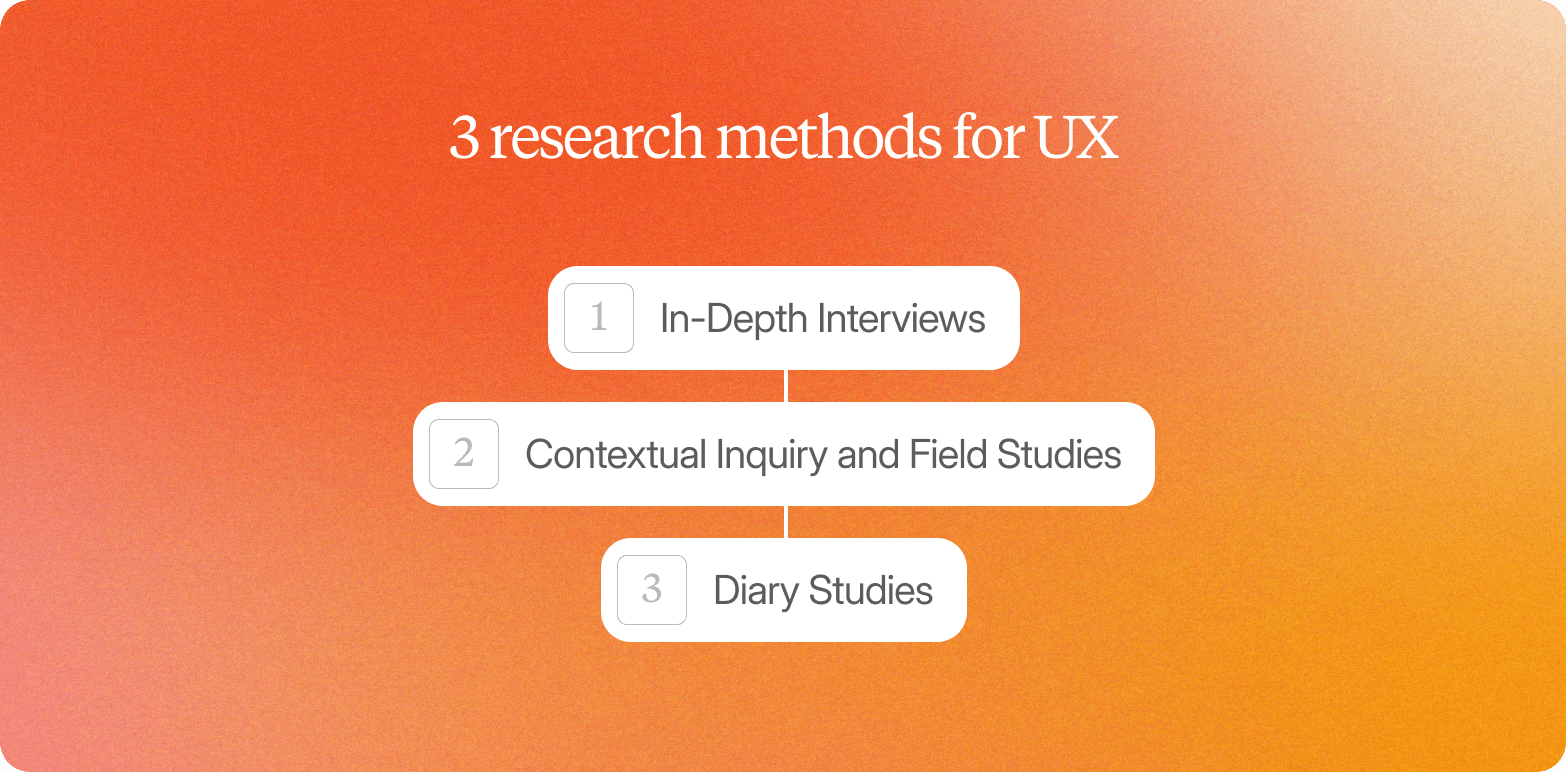
There are three primary generative UX research methods teams rely on: user interviews, contextual field studies, and diary studies, each with different tradeoffs around depth, speed, and logistical complexity. Focus groups are another option for gathering qualitative insights from multiple participants at once, though they suit exploratory reactions to concepts better than in-depth behavioral discovery.
In-Depth Interviews
One-on-one research sessions are the highest-yield method in generative user research. When a participant explains why they abandoned a checkout flow, or describes the workaround they built because your product didn't quite fit their process, no survey captures that texture. Open-ended questions invite elaboration, and a skilled moderator follows the thread wherever it leads, surfacing valuable insights about user behavior and pain points that structured methods miss.
That adaptive quality is also where traditional IDIs create friction. Live moderation means scheduling 20 or 30 participants, one at a time, often across time zones and over two or three weeks. By the time synthesis is complete, the sprint that needed the input has already shipped without it.
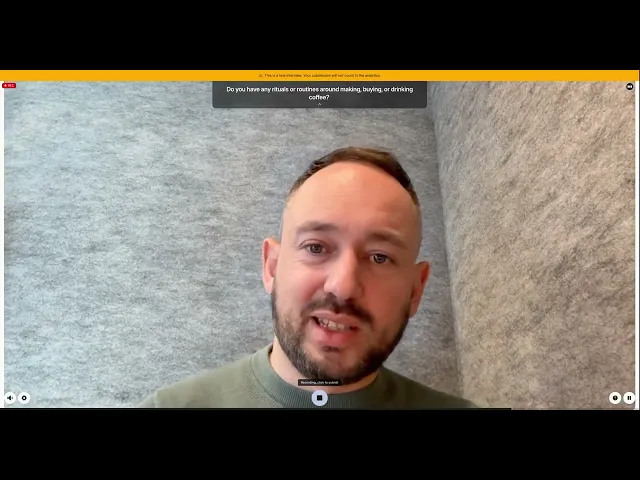
Asynchronous AI-moderated interviews change the operational model without changing the method. Participants open a link on their own schedule. The AI moderator listens, detects when an answer is thin, and probes further. Fifty conversations can run in parallel. The depth of generative user research stays intact; the calendar bottleneck disappears.
See how AI-moderated video interviews actually work →
Contextual Inquiry and Field Studies
Contextual inquiry observes users in their natural environment: beside a logistics coordinator navigating a procurement system, or watching a warehouse manager work around a UI that never quite fits their process. Closely related to ethnographic research, it captures user behavior in context rather than relying on users' retrospective reports.
Workarounds are data. The spreadsheet someone built next to your software, the sticky note on the monitor, the step they always skip: these surface behavioral realities that no interview question reliably uncovers. Environmental factors shape usage in ways participants rarely think to mention, because those factors feel invisible to them.
The constraint is scale. Contextual inquiry, like broader ethnographic studies, requires physical presence or a live screen-sharing session, which limits geographic reach and makes a continuous sprint cadence impractical. Use it when the workflow is complex, the environment is consequential, or the product involves physical interaction.
Diary Studies
In a diary study, participants document their experiences, behaviors, or reactions over days or weeks through written entries, photos, or short video clips. Rather than asking someone to recall how they used a feature last month, diary studies capture user feedback in real time.
The core strength is longitudinal visibility: a single interview gives you a snapshot; a diary study gives you a sequence. That matters when you're mapping the user journey across multiple touchpoints: understanding habit formation, onboarding friction that compounds over time, or any experience that unfolds in stages.
The practical limitation is significant. Sustained logging is a real ask, and dropout rates are high enough that over-recruiting at the start is standard practice. Synthesis is also slow: unstructured text, photos, and video clips don't organize themselves into themes. Diary studies are the right choice when the research question genuinely requires time. For questions that a well-moderated interview can answer, the overhead rarely pays off.
Generative vs. Evaluative Research: When to Use Each
| Dimension | Generative Research | Evaluative Research |
|---|---|---|
| Research question | What are the unmet needs? | Does this design solve the problem? |
| Timing in the product cycle | Early stages, before concepts exist | After concepts or prototypes are defined |
| Method examples | User interviews, field studies, diary studies | Usability testing, user testing, tree testing |
| Output type | Themes, opportunity areas, user motivations | Task success rates, preference data, and usability issues |
| Participant task | Open-ended discussion | Structured tasks that users complete to measure performance |
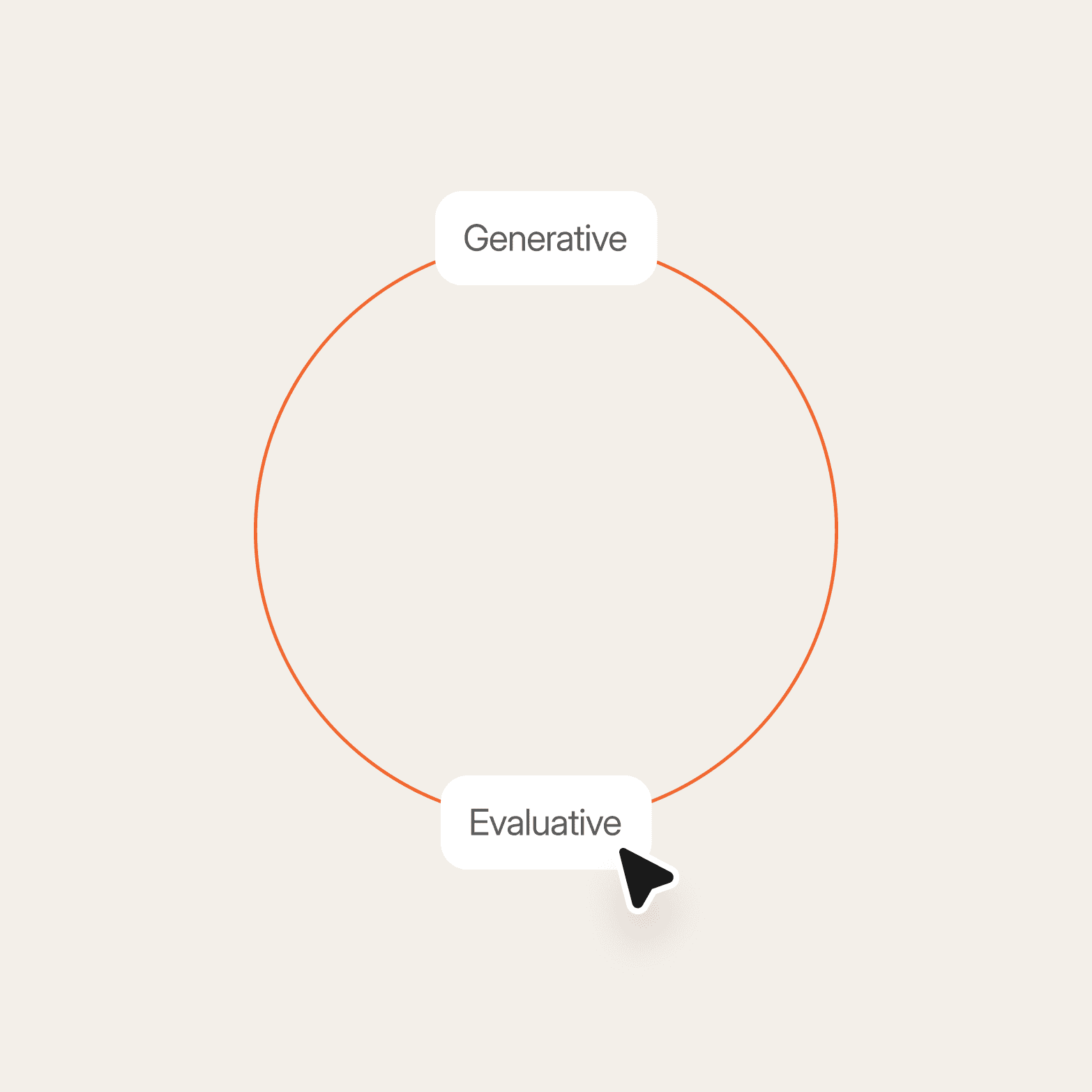
Teams run generative and evaluative methods in sequence: generative research first to understand the problem space, then evaluative methods once a concept exists to test. Generative work defines the question; evaluative work scores the answer.
In practice, this sequencing gets inverted. Unlike generative research, evaluative research methods are easier to scope, faster to run, and produce quantitative data (such as task success rates and satisfaction scores) that require little interpretation. Evaluative research centers on testing existing solutions against established usability principles. Evaluative research aims to measure performance against specific benchmarks, including user satisfaction, error rates, and task completion rates. Generative research, by contrast, gathers qualitative and quantitative data together: qualitative insights from open-ended conversations, combined with patterns across diverse perspectives that quantitative methods alone cannot surface.
Understanding the distinction between generative and evaluative research matters because the imbalance is so common. A product team running usability tests every sprint but no customer interviews, is optimizing a solution that may be solving the wrong problem. When the overhead of conducting generative research drops, the balance shifts. Conveo, a video-first AI research platform, handles the moderation and synthesis that make generative research operationally expensive, which is why teams using the platform report running discovery studies alongside evaluative work rather than treating them as sequential phases.
How to Choose the Right Generative Research Method
The right generative method depends on your constraints, not your feature wishlist. The best generative UX research methods are those that fit your timeline, your target audience, and the evidence you actually need to prove.
Use this framework to match method to situation:
If you need depth and speed: Asynchronous AI-moderated video interviews let hundreds of research sessions run in parallel across time zones. Studies that would take three weeks to field live can close in days.
If you need behavioral context: Contextual inquiry captures workarounds, environmental cues, and in-the-moment decision-making that qualitative methods like user interviews can't fully replicate on their own. When the behavior is the data, observation is non-negotiable.
If you need longitudinal patterns: Diary studies track how user behavior and perception shift over days or weeks. Design for brevity: completion rates drop as study duration increases.
If you need multi-market insight: Asynchronous interviews with AI moderation in 50+ languages compress global generative research timelines from months to weeks.
If stakeholders distrust AI outputs: Video-first interviews with adaptive probing generate traceable evidence: timestamped clips, verbatim quotes, and sentiment arcs tied directly to the source conversation. That's a fundamentally different credibility standard from that of a summary from a generic language model.
The core trade-off is between throughput and depth. One moderator can run five to eight live sessions per week at best. Asynchronous AI-moderated interviews deliver comparable depth at roughly 10 times the throughput because the AI follows up on unexpected answers and pushes for the "why" behind each response, which is where user needs and pain points actually live.
How to Run a Generative Research Study: 5 Steps
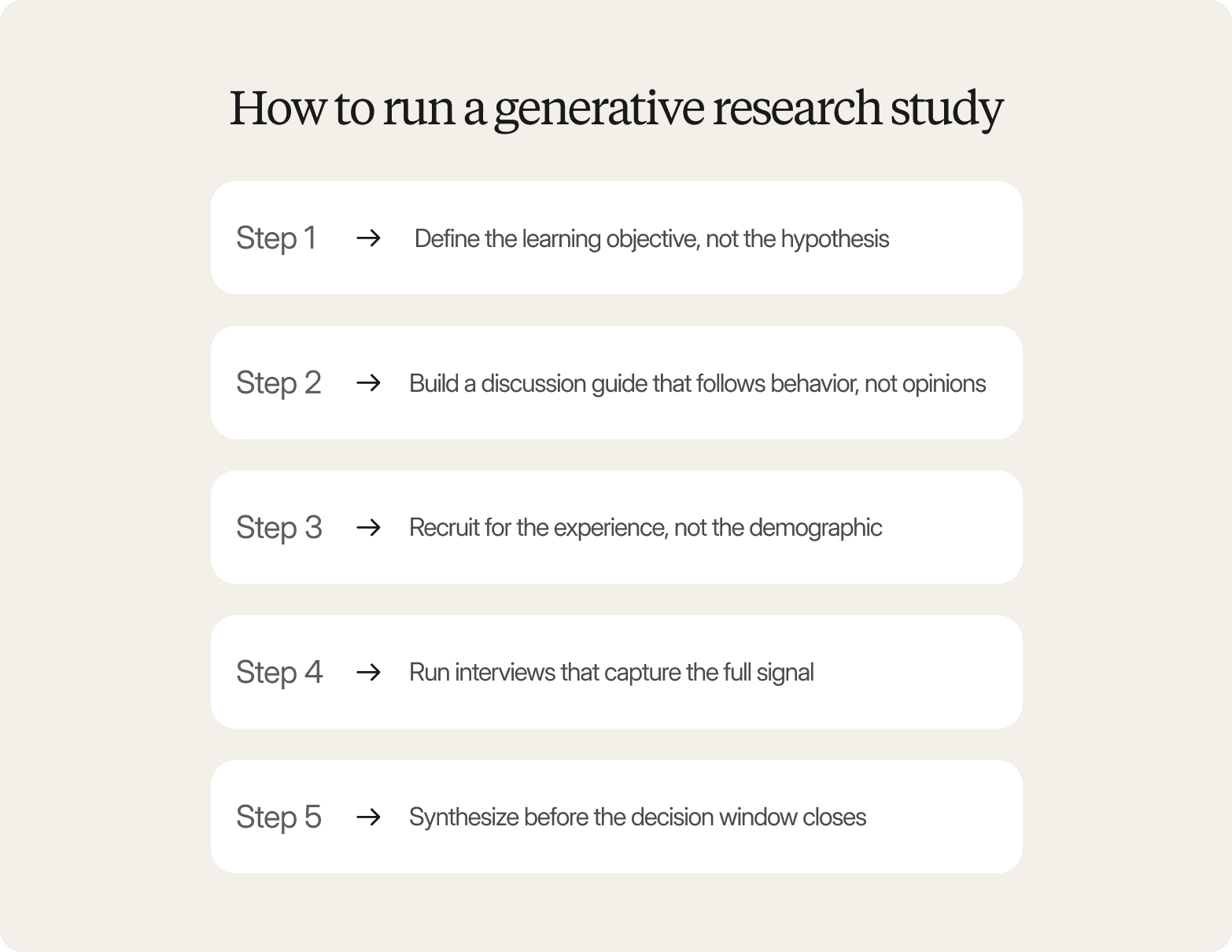
Most generative studies fail not at the method level, but because of weak discussion guides, slow synthesis, or findings that arrive too late. These five steps address each failure point directly.
Step 1: Define the learning objective, not the hypothesis
State what your team genuinely does not know. "We want to know why users abandon the onboarding flow" is a hypothesis dressed as a question. "We want to understand how new users mentally model the product in their first week" is a learning objective. One leads to confirmation; the other leads to discovery. Most research projects fail at this stage because they are designed to confirm rather than explore.
Step 2: Build a discussion guide that follows behavior, not opinions
Anchor participants in specific past experiences rather than hypothetical preferences. "Tell me about the last time you had to [behavior]" produces richer material than "What do you think about [feature]?" Plan three to five core topic areas, each with behavioral prompts and room for the moderator (human or AI) to follow the thread. Over-scripting is the most common guide failure.
Step 3: Recruit for the experience, not the demographic
Define your screener around behaviors and contexts, not job title or age range. To gather insights from the right target audience, behavioral screeners yield far richer generative data than demographic filters. Conveo's integrated panel network applies quality and fraud flagging so low-quality sessions surface automatically at the screener stage, so participants sourced through panel partners or your own lists are already qualified against your criteria.
Step 4: Run interviews that capture the full signal
In traditional moderated research, the moderator juggles note-taking, probe decisions, and time management simultaneously: something always gets missed. AI-moderated video interviews on Conveo run asynchronously, so every session is recorded, transcribed, and coded as it completes. Multimodal analysis captures tone shifts, hesitation, and facial response alongside verbal content, surfacing behavioral signals that a human moderator would not have caught in a live session. This layer of signal is critical for understanding what user feedback reveals about underlying needs, not just what participants say.
Step 5: Synthesize before the decision window closes
The goal is structured output (thematic clusters, key quotes, and video clips) delivered within the same week interviews close. Conveo's AI research assistant is designed to let teams interrogate completed data the same day sessions land. The research process, from launch to actionable insights, compresses from weeks to days. The output is traceable to the source video, so stakeholders can verify findings rather than take them on faith.
How to Make Generative Research Findings Stakeholder-Ready
Generative research often produces the most valuable qualitative insights a team will ever collect. It also has a well-documented graveyard: the 40-slide deck that stakeholders skim once and quietly set aside. Critical insights do not die because they lack substance, but because they aren't traceable back to the conversations that produced them.
When a stakeholder can't click from a theme to the video moment that supports it, they're asked to take the researcher's word for it. That's a credibility gap that compounds over time, especially when findings challenge existing assumptions or require significant investment to act on.
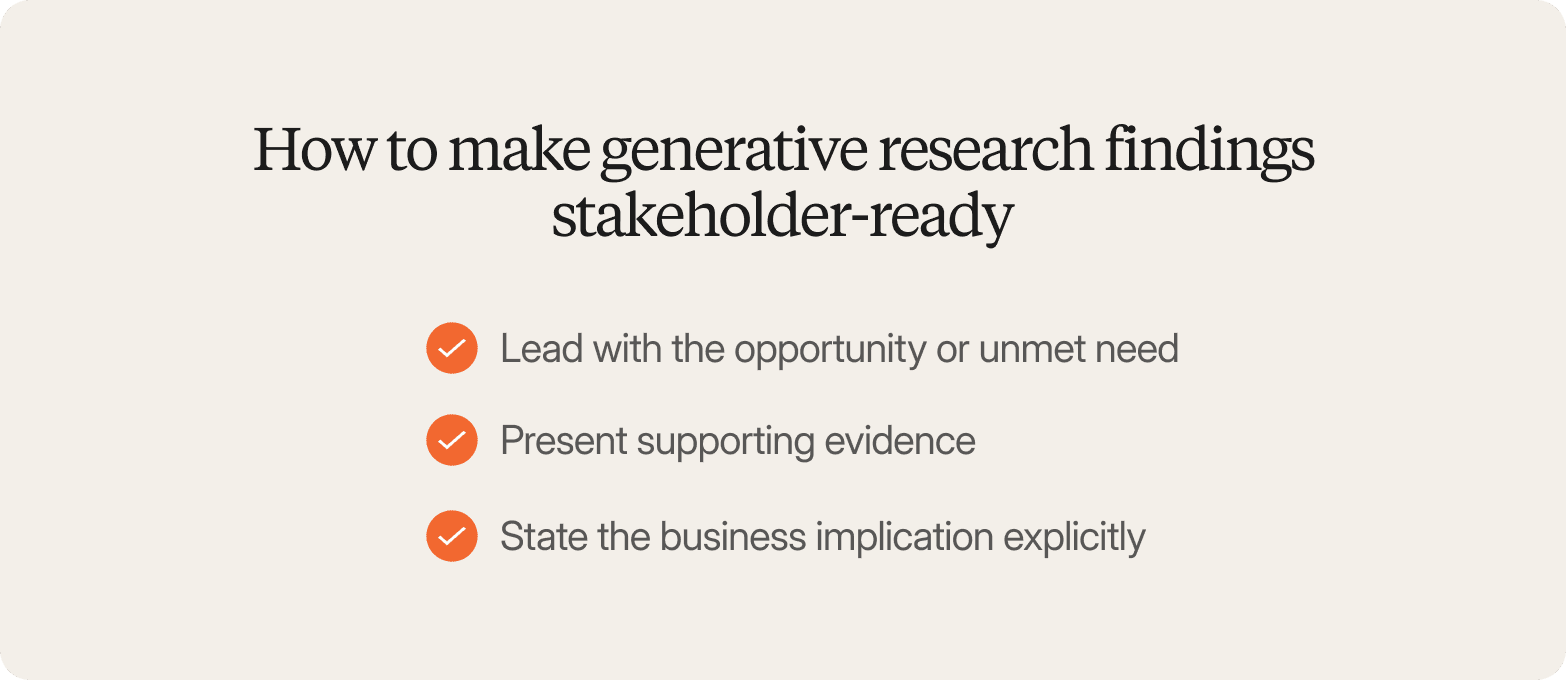
The reporting structure that works follows a consistent three-part pattern:
Lead with the opportunity or unmet need: state the finding as an actionable problem, not a data observation.
Present supporting evidence: verbatim quotes and video clips, not summaries. Skeptics need to inspect the source.
State the business implication explicitly: what decision does this finding inform, and what does it mean for user satisfaction or product direction?
This is where the generative research UX method benefits most from modern platform infrastructure. Conveo's multimodal analysis links every synthesized theme directly to the source video moments that produced it. Stakeholders don't read a summary of what users said; they can watch the moment a participant's tone shifted, or hear the exact phrasing that recurred across 20 interviews.
The compounding benefit builds over time. Every generative study feeds Conveo's insight library, so findings don't expire when the deck is filed. When a product team asks a question six months later, the answer may already exist, traceable and searchable from a study they never knew was relevant.
How AI-Moderated Interviews Compress Generative Research Timelines
Traditional generative research takes 6 to 10 weeks from kickoff to synthesis: recruit participants, coordinate schedules across time zones, moderate sessions one at a time, transcribe recordings, and manually code themes. By the time findings land, the sprint they were meant to inform is already closed.
Asynchronous AI-moderated interviews remove every one of those bottlenecks. There is no scheduling to coordinate: participants open a link on their own time, in their own language. Because sessions run in parallel, a study that would have required three weeks of live moderation can collect 50 responses in five days. Automated synthesis delivers thematic clusters, sentiment patterns, and supporting video evidence within 48 hours of study close.
The depth holds. Conveo's AI moderator adapts its follow-up questions based on what each participant actually says. That adaptive probing surfaces motivations, user expectations, and unmet needs that survey-only research misses, because it responds to hesitation, contradiction, and unexpected language the way a skilled moderator would. Every theme links back to real video conversations with real participants. Stakeholders can watch the evidence behind the finding, not just read a slide.
Conducting generative research at this velocity changes what's possible for product development and innovation: teams can test assumptions before they harden into roadmap commitments, surface shifting user expectations before competitors do, and run continuous discovery without adding headcount.
In a representative scenario, a UX team running 15 live interviews manually typically delivers findings seven weeks after the brief. The same team, running 50 asynchronous interviews on Conveo, receives structured thematic synthesis with video evidence within days of launch.
"Within days, we had insights that would've taken a traditional agency a month"
Head of Customer Insights, JDE Peet’s
Generative research methods in UX can now inform decisions while they are still being made.
Frequently Asked Questions
What is generative research in UX?
Generative research (sometimes called exploratory or discovery research) is conducted in the early stages of product development to surface unmet needs, understand user motivations, and identify opportunities before any solution is defined. Understanding why generative research is important for UX teams comes down to timing: it shapes what gets built, not just how well it's built. Where evaluative research asks "Does this work?", generative research asks "What should we build?" Generative research depends on open-ended conversations where participants lead, rather than on scripted tasks where they react. Platforms like Conveo run AI-moderated video interviews asynchronously, so generative studies can happen continuously rather than as one-off projects timed around researcher availability.
What are the most common generative research methods?
The three most common generative research methods in UX are user interviews, contextual inquiry (field studies), and diary studies. Qualitative methods like these deliver the behavioral and motivational depth that quantitative methods alone can't capture; they build a deep understanding of user needs, pain points, and expectations that surveys and analytics can only approximate. Gathering diverse perspectives across geographies and contexts is what makes qualitative research valuable: it surfaces the "why" behind behavior, not just the "what." Asynchronous AI-moderated interviews have emerged as a practical alternative that addresses the core constraint shared by all three: time. Teams can run hundreds of video interviews in parallel, with participants responding on their own schedule, and receive structured themes and verbatim evidence within days.
How is generative research different from evaluative research?
Generative research happens before any solution exists. Evaluative research tests solutions that already do. That timing difference shapes everything: the methods, the questions, and what you can act on. In practice, generative and evaluative research diverge in structure. Generative work uses open-ended qualitative research methods (user interviews, diary studies, field observations) to surface what you don't yet know. Unlike generative research, evaluative research uses structured tasks: usability tests, A/B tests, and first-click studies, where the goal is to measure how well something performs. Most product teams run far more evaluative research than generative, which is why teams often build the wrong thing well rather than the right thing at all.
How long does generative research take?
Traditional generative research runs 6 to 10 weeks from kickoff to synthesis. The bottlenecks are predictable: coordinating participant schedules across time zones, running every session live, manually transcribing recordings, and coding themes by hand, each step waiting on the previous one. With AI-moderated interviewing, sessions run in parallel and asynchronously; transcription and initial coding occur as recordings land; and teams report moving from launch to actionable insights in days rather than weeks.
How do you analyze generative research data?
Generative research produces unstructured qualitative data: interview transcripts, video recordings, diary entries, and field notes. Analysis follows thematic coding, identifying recurring patterns, grouping related observations into themes, and mapping those themes to opportunity areas or design implications. The goal is to turn raw qualitative insights into critical insights that teams can act on. The challenge is speed. Manual coding across 20 to 50 interviews can take weeks, which is why findings often arrive after the decision they were meant to inform. AI-assisted synthesis compresses this by automatically identifying thematic clusters, linking each to supporting quotes and video moments, and structuring findings as searchable, traceable evidence. The key differentiator is auditability: stakeholders can verify any theme by watching the source clip rather than trusting a summary in isolation.

About the author
Kelsey Allen-Niesen
Research Impact Lead
Kelsey spent three years in insights and strategy at Kelton Global, then led innovation consumer insights at Pharmavite, before a Kellogg MBA with a summer at Bain. She joined Conveo in October 2026 and spent her first week at the product hackathon, helping ship a routing improvement on day one.
Meet Kelsey on film →Qualitative insights at the speed of your business.
Conveo runs AI-moderated video interviews and structures everything they say.