In this article
TL;DR
In today's data-driven world, qualitative research takes six to twelve weeks from brief to findings, routinely missing the decision windows it was meant to inform
Three structural bottlenecks drive the delay: data collection, sequential interviewing, and manual data analysis
Automation compresses research timelines from weeks to days by running interviews in parallel, moderating with adaptive AI, and turning raw data into actionable insights automatically
Speed without traceability is not a solution: every finding must link back to the real participant video, maintaining the data quality that decision makers need to make informed decisions
Conveo, a video-first AI research platform, removes all three bottlenecks in a single workflow, with the compliance infrastructure enterprise procurement requires
Research findings have a timing problem. By the time a qualitative study completes (covering data collection, scheduling, moderation, synthesis, and stakeholder review), the strategic decisions it was meant to inform have already been made. Teams end up presenting retrospective validation instead of forward-looking evidence.
Understanding how to reduce time-to-insight with automation starts with recognizing the core constraint: manual moderation followed by manual data analysis, which caps the number of studies a team can run in a given quarter. That is a throughput problem, not a talent problem. Without the right tools to remove it, teams either rely on gut feeling or wait too long for insights that no longer inform decision-making; neither path yields the data-driven decisions that move the business forward.
Most teams evaluating their options land in one of three categories: survey platforms (fast but shallow), traditional methods through agencies (thorough but slow), or AI-powered analytics tools (variable on credibility). There’s a better path: automation removes scheduling dependencies and turns raw data into structured synthesis that researchers refine rather than build from scratch, compressing multi-week cycles into days.
Why Time-to-Insight Matters More Than Ever
Product teams run two-week sprints. Campaign windows open and close in days. While data analytics teams and business intelligence functions have access to real-time dashboards and live data points, qualitative research commissioned through an agency still takes six to twelve weeks from brief to findings. For decision-makers trying to stay ahead of market trends, those two timelines are simply incompatible.
The consequences are specific and familiar:
Campaign concepts get locked for production before consumer feedback returns
Product features ship before usability testing completes, and the fix costs three times what early-stage validation would have
Brand positioning gets finalized in a room full of internal stakeholders because the messaging validation study is still in the field
What follows is a quieter but more damaging problem: marketing and product teams (the core business users of research) stop requesting it altogether. Not because they don't value understanding customer experiences, but because they have learned those insights will not arrive in time to matter. Research becomes a post hoc exercise in justification rather than a data-driven input for decision-making. Teams unable to make fully informed decisions revert to gut feeling, absorbing the downstream operational costs of reversals that better-timed research would have prevented.
What they need is faster speed to insights that drive smarter decisions and a real competitive advantage, without sacrificing the depth that makes those insights credible.
The 3 Bottlenecks That Keep Research Slow
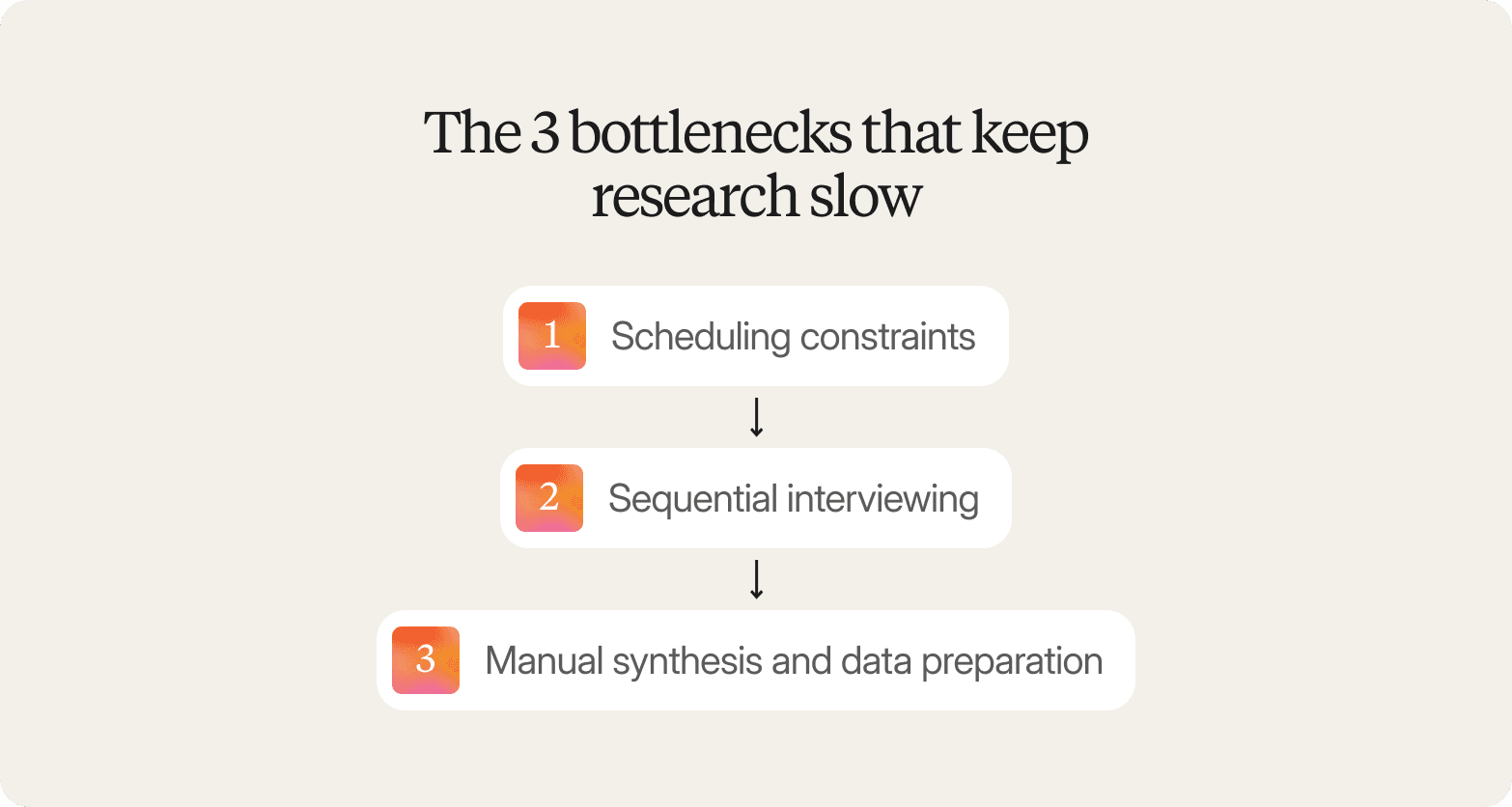
Three structural problems represent the biggest challenges in qualitative research timelines. They are baked into the traditional workflow, and they compound each other.
Scheduling Constraints
Recruiting 20 participants, confirming availability, managing time zones, handling no-shows, and rescheduling cancellations typically takes 2 to 3 weeks. No insight is produced during this data collection phase. The clock is running, the stakeholder is waiting, and the team is still negotiating calendar slots.
Sequential Interviewing
Traditional methods require a researcher to be present for every session. Twenty interviews at one hour each is 20 hours of moderator time, spread across multiple days or weeks. Sessions cannot overlap. The throughput ceiling is set by the number of hours a researcher can physically sit in interviews, a structural constraint that hiring does not quickly solve.
Manual Synthesis and Data Preparation
Once fieldwork closes, the real time sink begins. Data preparation is the most labor-intensive stage: coding raw data from transcripts, identifying themes across 20 hours of conversation, and building a stakeholder-ready report typically takes another two to three weeks. Human error in manual coding introduces an additional risk: inconsistencies in how transcripts are labeled and categorized can quietly compromise data quality. This is skilled analytical work that cannot be rushed without affecting findings.
Add it up: two weeks for data collection, two to three weeks for interviewing, and two to three weeks for data preparation and analysis. A typical agency-led qualitative study takes six or more weeks from kickoff to final report. That is the timeline teams focus on when looking for ways companies can speed up data-insight delivery, because the gap between research and decision timelines is now impossible to ignore. By the time a multi-week study returns, the budget is allocated, the brief has shipped, and the decision has been made.
How Automation Compresses Research Timelines
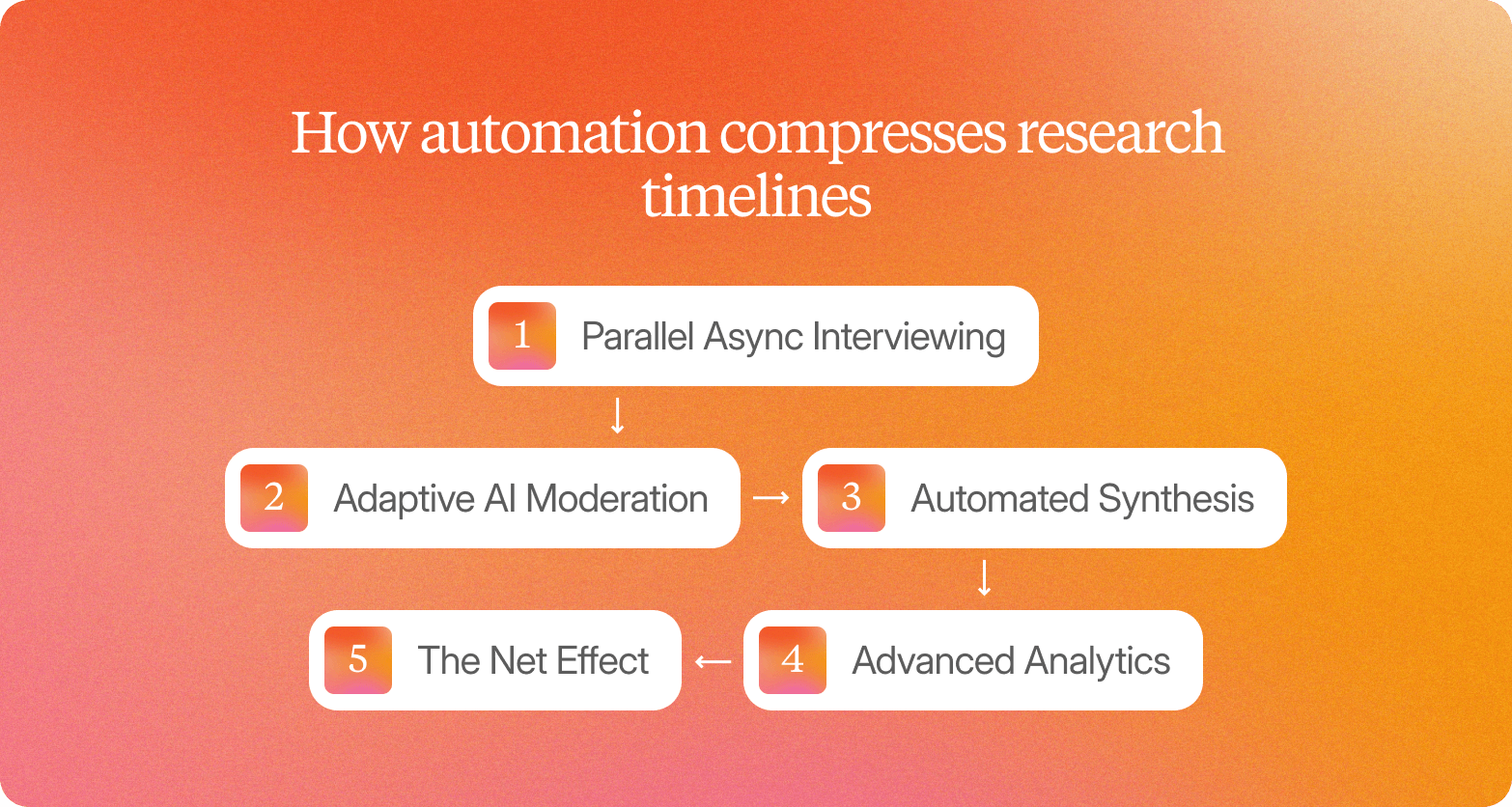
Automation removes all three bottlenecks simultaneously. Understanding how to reduce time-to-insight with automation means understanding how each removal compounds the others.
Parallel Async Interviewing
Instead of coordinating 20 video calls across three weeks, teams launch a single study link. Participants complete video interviews on their own schedule, and data arrive continuously as responses come in, with data points from hundreds of participants accumulating in real time. Whether a study requires 20 participants or 2,000, collection happens in parallel. Volume no longer drives linear increases in timeline.
Adaptive AI Moderation
The depth that makes qualitative research valuable has always come from skilled probing: a moderator who notices hesitation, follows an unexpected thread, or pushes past the surface answer. AI-powered tools replicate this dynamic using machine learning and natural language processing to respond to what participants actually say rather than following a rigid script. AI agents moderate each conversation adaptively, capturing the "what" and the "why" in a single workflow, without requiring a human moderator for every session.
Automated Synthesis and Advanced Analytics
Instead of building structure from raw transcripts, researchers receive drafted summaries, thematic clusters, and video clip extractions already tied to verbatim quotes. Advanced analytics are applied automatically, turning raw data into actionable insights and uncovering patterns that manual data analysis would take days to surface. Teams report cutting analysis time by a substantial margin, moving from days of manual coding to a few hours of review and refinement.
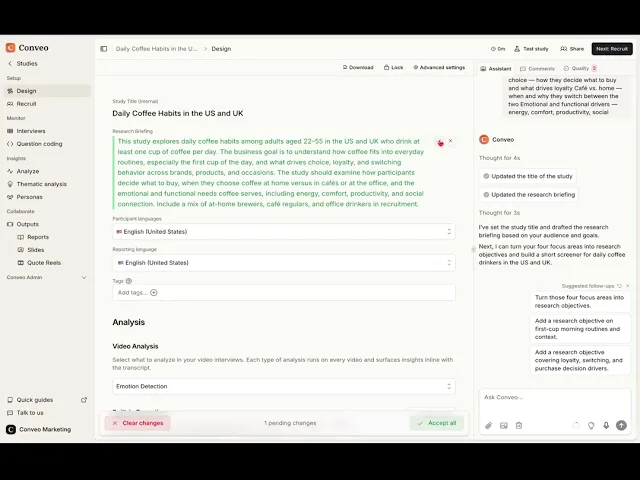
See it in action: How to build and launch a study in Conveo →
The Net Effect
Automation shifts research from a sequential, human-bottlenecked process to a parallel, machine-augmented workflow. AI-powered synthesis replaces the manual steps (transcription, data preparation, initial coding) that had nothing to do with research quality and everything to do with operational efficiency. A study that previously required six or more weeks has been compressed to days. That is what it means to reduce time-to-insight with automation: not cutting corners on methodology, but using the right tools to streamline operations without compromising the integrity of findings.
"Within days, we had insights that would've taken a traditional agency a month."
Head of Customer Insights, JDE Peet’s
What Automation Cannot Replace (and Why That Matters)
The objection most enterprise stakeholders raise about automated qualitative research is not about speed. It is about trust. When findings arrive without visible evidence (without the ability to trace a claim back to a real person saying a real thing), the output loses credibility before it reaches the decision room. Faster speed to insights only solves the business problem when decision makers are willing to act on what they receive.
Automation belongs in specific parts of the research workflow:
Scheduling coordination and data collection logistics
Transcription, translation, and data preparation
Initial coding and thematic clustering
Clip extraction and highlight reel creation
AI-powered transcription and initial coding also eliminate the human error that manually coded transcripts routinely introduce. What automation should not touch is the interpretive layer. Nuanced findings, contradictory signals, and the gap between what participants say and what they mean all require human judgment and business context to resolve. Removing the operational burden frees researchers to focus on that work and ensures the relevant data captured actually translates into business value.
Two requirements make automated research credible and its data quality trustworthy:
Traceability. Every theme and finding must link back to verbatim quotes and video clips that stakeholders can inspect themselves. Accurate data depends on this chain of evidence. A summary without traceable sources is not a research output.
Real participants. Real human conversations, verified by video, not synthetic participants or avatar-based simulations. Valuable data comes from real human voices, not manufactured proxies.
The infrastructure holding all of it must also meet SOC 2 certification, GDPR, and data residency requirements. This is not a box-checking exercise; it is data security and risk mitigation built into the research workflow before it enters enterprise procurement review.
6 Practical Steps to Implement Research Automation
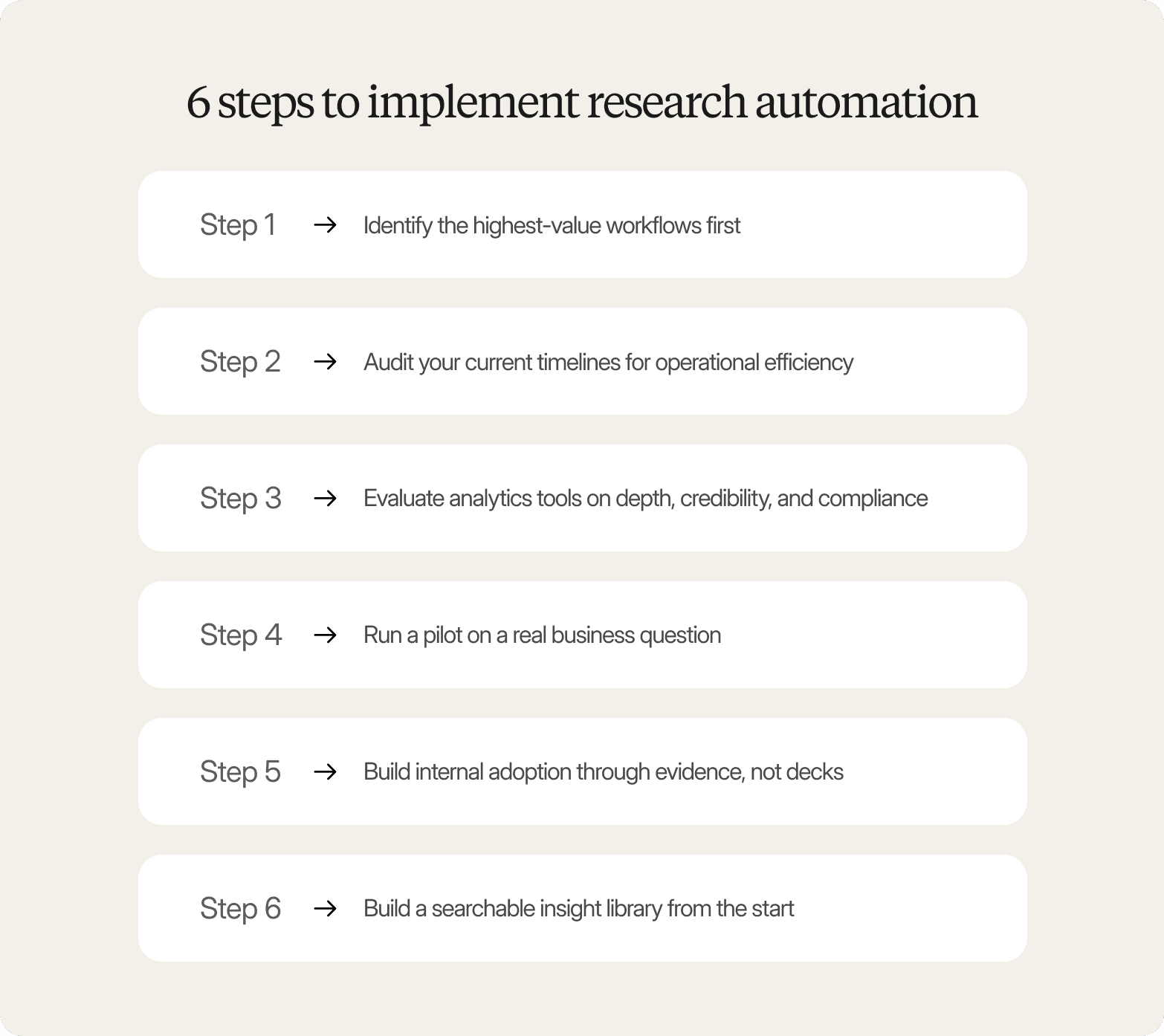
Teams asking how to reduce time-to-insight with automation rarely have a process problem at the surface. They have a prioritization problem underneath it. The key benefits of automation only compound over time when teams build toward a clear analytics strategy, not just a faster one-off study.
Step 1: Identify the highest-value workflows first
Concept testing, ad testing, messaging validation, and continuous discovery share a common characteristic: strategic decisions tied to them move faster than traditional research can respond. Start there, not with workflows that are already working.
Step 2: Audit your current timelines for operational efficiency
Map where time actually goes in a typical study. Scheduling, transcription, initial data preparation, and clip extraction are consistently the highest-friction steps and the highest-impact automation targets. When businesses plan this audit honestly, they often find that operational costs and timeline overruns stem from a handful of fixable bottlenecks, many of them rooted in legacy systems and manual handoffs between disconnected tools.
Step 3: Evaluate analytics tools on depth, credibility, and compliance
Depth: Does the platform capture the "why" behind a response, or only the "what"? Credibility: Can stakeholders inspect the evidence? Compliance: Does it meet SOC 2, GDPR, and data residency requirements? Most analytics tools will claim to cover all three, but these questions quickly filter out most of the market. Faster tools that score low on credibility or compliance don't actually solve the business problem. Risk management in regulated industries makes compliance a non-negotiable filter, not an afterthought. Look for platforms that consolidate your data sources into a single workflow rather than adding more handoffs.
Step 4: Run a pilot on a real business question
A test study with no decision stakes tells you little. Run a pilot on a question your team needs to answer, with real timelines and real stakeholder expectations. This generates the evidence that moves business users from skeptical to invested, and proves business value before any larger commitment is made.
Step 5: Build internal adoption through evidence, not decks
A data-driven culture builds faster when people can watch a 90-second video clip than when they read a five-page summary. Informed decisions happen when stakeholders trust the evidence behind a finding, and traceability does more for that trust than any speed claim.
Step 6: Build a searchable insight library from the start
A searchable insight library prevents learnings from being orphaned in presentation decks, siloed in Microsoft Teams channels or data warehouses, or lost when team members leave. When a new question surfaces six months later, accessing historical data from past studies may already yield the answer, and the organization's data compounds in value with every study completed.
How Conveo Helps Teams Move From Weeks to Days
The bottleneck in most research cycles is not the interview itself. It is everything around it: recruiting, scheduling, transcribing, coding, and assembling a deck that stakeholders will read. Each step adds days. Collectively, they add weeks.
Conveo is a video-first AI research platform built to reduce time-to-insight with automation across the entire qualitative workflow. Study setup, AI-moderated video interviewing, automated transcription and translation, AI-drafted synthesis, and stakeholder-ready reporting all live in one place, consolidating the data sources that typically span a recruiting vendor, a transcription platform, and a separate analysis tool.
As recordings land, Conveo's AI-powered engine transcribes, translates, and codes each session automatically, streamlining operations that previously required days of manual effort. Real-time response tracking lets teams monitor fieldwork in real time. The platform drafts thematic summaries, clusters sentiment patterns, and extracts video clips tied to verbatim quotes, delivering real-time insights as fieldwork runs, not days after it closes. Every finding links back to the original video moment, so decision-makers inspect the evidence rather than read a summary of it.
The compliance layer is built in, not bolted on: SOC 2 certified, GDPR compliant, and EU data hosting available: the data security enterprise procurement requires. Every study feeds a searchable insight library, so the organization's data compounds in value across projects rather than dying in decks or data warehouses no one revisits. The result is smarter decisions, a sustainable competitive edge, and a research program that helps teams stay ahead.
Frequently Asked Questions
How do you reduce the time to insight with automation in qualitative research?
Reducing time to insight with automation means compressing a workflow that typically spans six or more weeks into days, without cutting the depth that makes qualitative findings credible. A standard agency-led study runs roughly two weeks of data collection and recruiting, two to three weeks of sequential interviewing, and another two to three weeks of manual data analysis. Every stage depends on the one before it. Automation breaks that dependency at two points. First, parallel async interviewing: teams launch a study link and collect video responses simultaneously, eliminating the need for calendar coordination entirely. Second, AI-powered synthesis automatically turns raw data into actionable insights, drafting themes, summaries, and video clip extractions tied to verbatim quotes as recordings land, uncovering patterns that manual analysis would take days to surface. Teams report cutting analysis time by a substantial margin. Researchers apply their business context to refine structured outputs rather than building frameworks from raw transcripts over several days. The result is a research cycle measured in days, with findings traceable back to accurate data from real participant video at every step.
Do you need custom code or developer tools to automate research?
Reducing time to insight with automation does not require a code repository, custom development, or a team of data analysts, data specialists, or data scientists standing up infrastructure. Conveo is a managed platform with a pre-built, enterprise-ready automation workflow. What comes out of the box: AI-moderated video interviewing, automatic transcription and translation across 50+ languages using natural language processing, thematic analysis, sentiment coding, clip extraction, and stakeholder-ready reporting. Teams can start collecting valuable data from their first study within hours, without writing a line of code, filing a ticket with engineering, or needing data experts to configure or maintain the system. SOC 2 certification, GDPR compliance, EU data hosting, and enterprise procurement data security requirements are part of the platform's infrastructure, not implementation tasks. For teams trying to collect more data faster, legacy systems and open-source tools built for data scientists typically move in the wrong direction. Using machine learning that is already trained and configured means teams get the benefits of advanced analytics without the setup cost.
What is the fastest way to get qualitative insights?
Parallel async video interviewing with AI-powered tools is the fastest way to get qualitative insights without sacrificing depth. Traditional methods require scheduling 20 one-hour video calls across time zones, a process that typically consumes two to three weeks before the first interview even starts. Parallel async interviewing removes that constraint entirely. Teams launch a study link and collect hundreds of video responses simultaneously, with no calendar coordination required. The speed advantage does not come at the cost of depth. AI moderation with adaptive probing captures the "why" behind customer experiences. When a participant hesitates or gives an unexpected answer, the AI follows up in the moment, tracking market trends, emotional signals, and behavioral context that surveys miss entirely. Relevant data is captured at depth, not just at scale. In practice, teams report getting real-time insights within days, with a faster speed-to-insight that delivers a genuine competitive edge over teams still relying on gut feeling or six-week agency cycles.
How do you measure time-to-insight?
Time-to-insight is the elapsed time from when a research question is formally documented to when a stakeholder-ready finding reaches the people who need to act on it. Breaking the measurement into five stages makes it actionable: study design and setup, data collection and participant recruitment, fieldwork, data analysis and synthesis, and stakeholder delivery and review. Most teams, when they track this honestly using real-time tracking at each stage, find that organizational latency adds substantial time to the research workflow itself: internal approvals, stakeholder alignment, and review cycles can consume as much calendar time as the research. The practical model: record a timestamp when the research question is formally documented; record a second when the final report is delivered. Tracking these data points consistently is how companies can speed up data insight delivery over time, surfacing exactly where delays accumulate and supporting data-driven decision making at the organizational level. Over time, this discipline also supports a broader analytics strategy: understanding where research cycles are longest helps teams allocate resources toward the workflows where automation delivers the greatest return. For enterprise and regulated-industry teams, compliance review (data residency verification, GDPR documentation, SOC 2 audit requirements) must be built into the measurement model as part of risk management. Any benchmark that ignores governance overhead will consistently undercount the real number.
What slows down qualitative research the most?
Three structural bottlenecks account for the majority of time lost in a typical qualitative research cycle. Scheduling is where timelines collapse first. Coordinating 20 interviews across participant time zones and moderator availability routinely takes two to three weeks before a single conversation begins. Sequential interviewing compounds the problem. Traditional methods require a researcher to be present for every session, one at a time. There is no way to run conversations in parallel without adding headcount. Manual synthesis is typically the longest single phase. Data preparation (coding transcripts, identifying themes, building structure from raw data) commonly takes two to three weeks after fieldwork closes. Human error in manual coding is an underappreciated source of data quality risk at this stage. Each bottleneck is structural. Addressing anyone in isolation produces modest gains. Addressing all three simultaneously (replacing manual data-collection logistics, sequential moderation, and labor-intensive data preparation with AI-powered automation) compresses a multi-week cycle into days. This shift toward a data-driven culture in research operations is central to reducing time-to-insight through automation.

About the author
Florian Hendrickx
Head of Growth
Florian is Conveo’s Chief Growth Officer, leading growth strategy and go-to-market execution as the company scales. He’s held growth leadership roles at companies like Deliverect, Robovision, and Aikido Security, and brings hands-on experience across marketing, sales, and product.
More by Florian →Qualitative insights at the speed of your business.
Conveo runs AI-moderated video interviews and structures everything they say.