In this article
TL;DR
In-depth interviews (IDIs) remain among the most effective qualitative research methods for uncovering the why behind customer decisions, but traditional execution is too slow for most insights teams
Rigid discussion guides produce surface answers; adaptive probing that follows participant responses is where the real signal lives, and where rich qualitative data comes from
IDIs, focus groups, surveys, and observational research answer fundamentally different questions; choosing the wrong method produces findings that look credible but miss what matters
Rapport-building and psychological safety in the first minutes determine the quality of honest responses and everything that follows
Video-first capture, automated transcription, and AI-assisted thematic coding compress the most time-intensive data analysis phases from weeks to days
Saturation typically arrives between 15 and 30 interviews for homogeneous audiences; multi-segment studies need 30 to 50
AI-moderated asynchronous interviews remove the scheduling bottleneck, allowing hundreds of conversations to run in parallel without adding moderators
Qualitative research is in the middle of a structural shift. For decades, in-depth interviews have ranked among the most valuable qualitative research methods for understanding why customers make the decisions they do. That hasn't changed. What has changed is the operational reality: insights teams of one to five researchers are expected to serve organizations, making decisions faster than ever, and the traditional IDI workflow (recruit, schedule, moderate, transcribe, synthesize) cannot keep pace.
The shift happening now is not about replacing rigor. It is about removing the operational constraints that prevent teams from conducting in-depth interviews at the scale modern decision-making demands. Adaptive AI probing can surface the meaning behind what participants say in real time, without a human moderator having to manage every follow-up. That changes the pace from weeks to days without sacrificing the depth that makes in-depth interview research worth running.
This guide covers what makes in-depth interviews effective, where traditional execution breaks down, and how teams scale IDIs without sacrificing rigor.
What Are In-Depth Interviews in Qualitative Research?
Understanding in-depth interviews begins with recognizing what sets them apart from other qualitative research methods. An IDI is a one-on-one conversation designed to explore a participant's personal experiences, motivations, and decision-making processes in detail. Where a survey captures what a customer thinks, an IDI surfaces why they think it. A survey can tell a product team that 62% of users find onboarding confusing. Only a well-run IDI can tell you which specific moment breaks their confidence, what mental model they brought into the product, and whether the confusion is about the interface or the underlying concept.
IDIs are typically semi-structured: the interviewer works from a prepared discussion guide but adapts the conversation based on what participants actually say. This places them between fully structured interviews (which follow a strict script) and unstructured interviews (which follow no fixed agenda). The semi-structured format is what enables contextual understanding of individual behavior while still producing comparable qualitative data across participants.
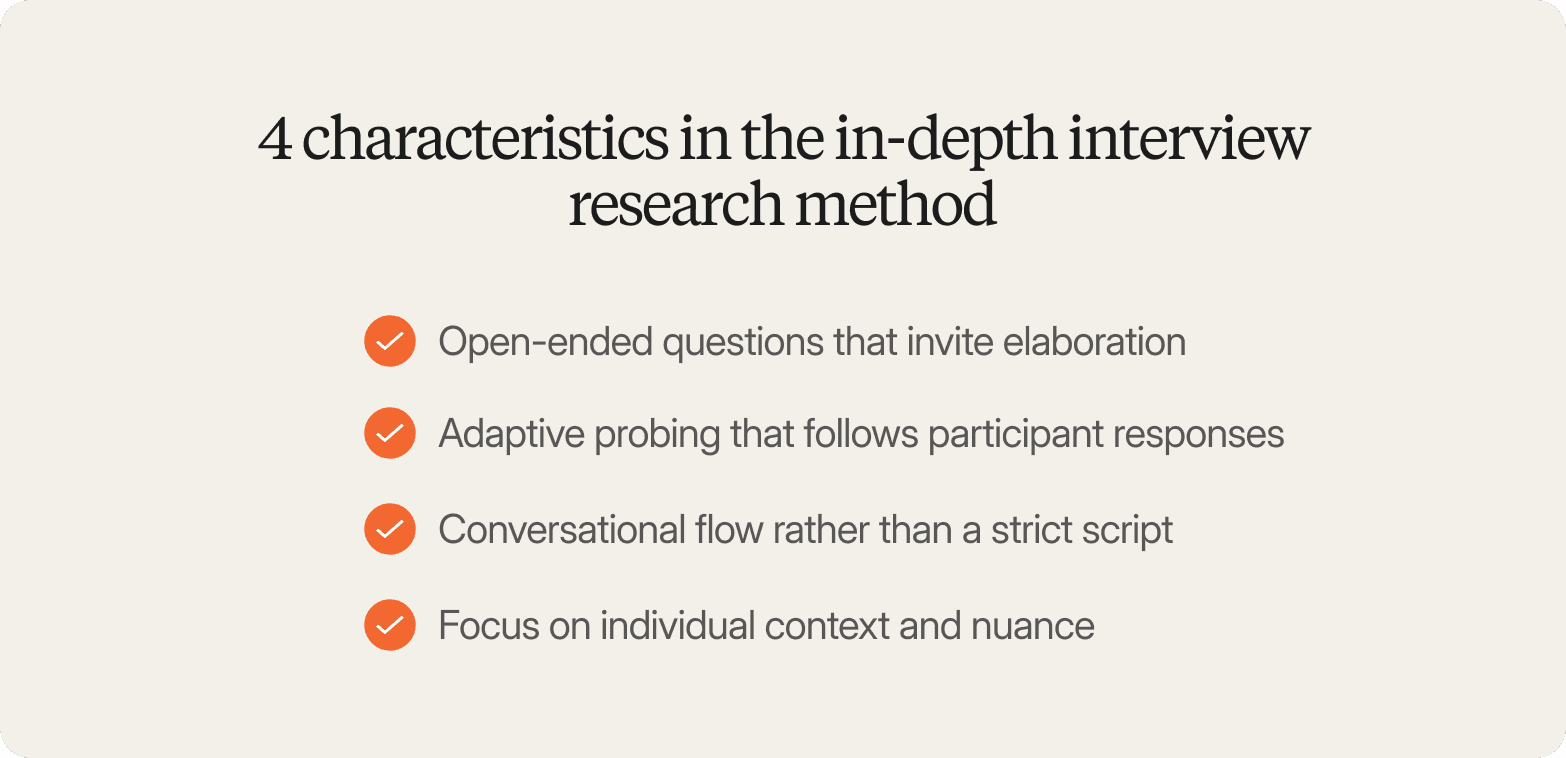
The in-depth interview research method is defined by four characteristics:
Open-ended questions that invite elaboration. Participants construct answers in their own words, surfacing language and priorities the interviewer could not have anticipated.
Adaptive probing that follows participant responses. Skilled moderation listens for the moment a participant hesitates, contradicts themselves, or introduces an unexpected frame, and pursues it. That responsiveness is where the real signal lives.
Conversational flow rather than a strict script. The discussion guide is a scaffold. Effective IDIs allow the conversation to move where participant experience leads, capturing detailed data about individual decision-making that rigid question lists consistently miss.
Focus on individual context and nuance. Unlike focus groups, IDIs give each participant space to speak without social pressure, generating nuanced insights that group settings routinely suppress.
The tradeoff is time. Each IDI requires recruiting and scheduling a participant, running a session of expected duration (typically 45 to 60 minutes), transcribing the recording, and coding and analyzing the output. This process is time-consuming by design: a study of 20 participants can take three to four weeks from brief to findings, too slow for most sprint-based teams and too expensive to run continuously. That tension between the method's value and its operational cost is the central challenge this guide addresses.
When to Use In-Depth Interviews vs. Other Research Methods
Choosing the right method is a research design decision, not a preference. IDIs, focus groups, surveys, and observational approaches each answer different questions. Using the wrong tool for the research goal produces findings that look credible but miss what matters.
In-depth interviews vs. focus groups
IDIs and focus groups are not interchangeable. They answer fundamentally different questions.
IDIs give you the individual: no group dynamics moderating the room, no participants adjusting their answers to match the loudest voice. When a researcher needs to understand a complex personal decision-making journey, the one-on-one format creates conditions for honest disclosure and responses that groups cannot replicate. Sensitive topics especially require it.
Focus groups are faster to recruit, have a lower cost per participant, and are useful when the research objective involves group dynamics: how people negotiate opinions, how a concept lands when discussed rather than when reflected on alone.
Decision rule: if the research question lives at the individual level, IDIs are the right method. If the question benefits from collective reaction, focus groups earn their place.
In-depth interviews vs. surveys
Surveys are the right call when you need to measure or track something across a large group. They scale efficiently, produce statistically valid results, and move fast. The structural tradeoff: survey questions anchor people to your categories. Closed-ended formats cannot surface what you didn't think to ask.
IDIs work differently. The conversation follows the participant, not the script. When a participant's tone shifts when describing a frustrating onboarding moment, that is a signal a survey would have buried in an "other" text box. Unlike surveys, IDIs surface rich qualitative data rooted in personal experiences, the kind that makes stakeholders lean forward rather than scroll past.
Decision rule: Use surveys when you need to measure. Use IDIs when you need to understand.
In-depth interviews vs. observational and ethnographic research
Observational research captures what people actually do, not what they say they do. Ethnographic research extends this further by embedding the researcher in participants' natural environments to document human behavior and social context over time. Both methods can reveal structures participants may be unaware of, a genuine advantage for certain research questions.
But observed behavior alone rarely tells the full story. A UX researcher can watch a user abandon a checkout flow and still not know whether the friction came from confusion, distrust, or a competing priority. IDIs and ethnographic interviews answer different questions: ethnographic research documents what happens in context; IDIs surface the reasoning, trade-offs, and motivations behind it.
Decision rule: choose observational or ethnographic methods when the question is about what happens. Choose IDIs when the question is about why it happens.
How to Conduct Effective In-Depth Interviews
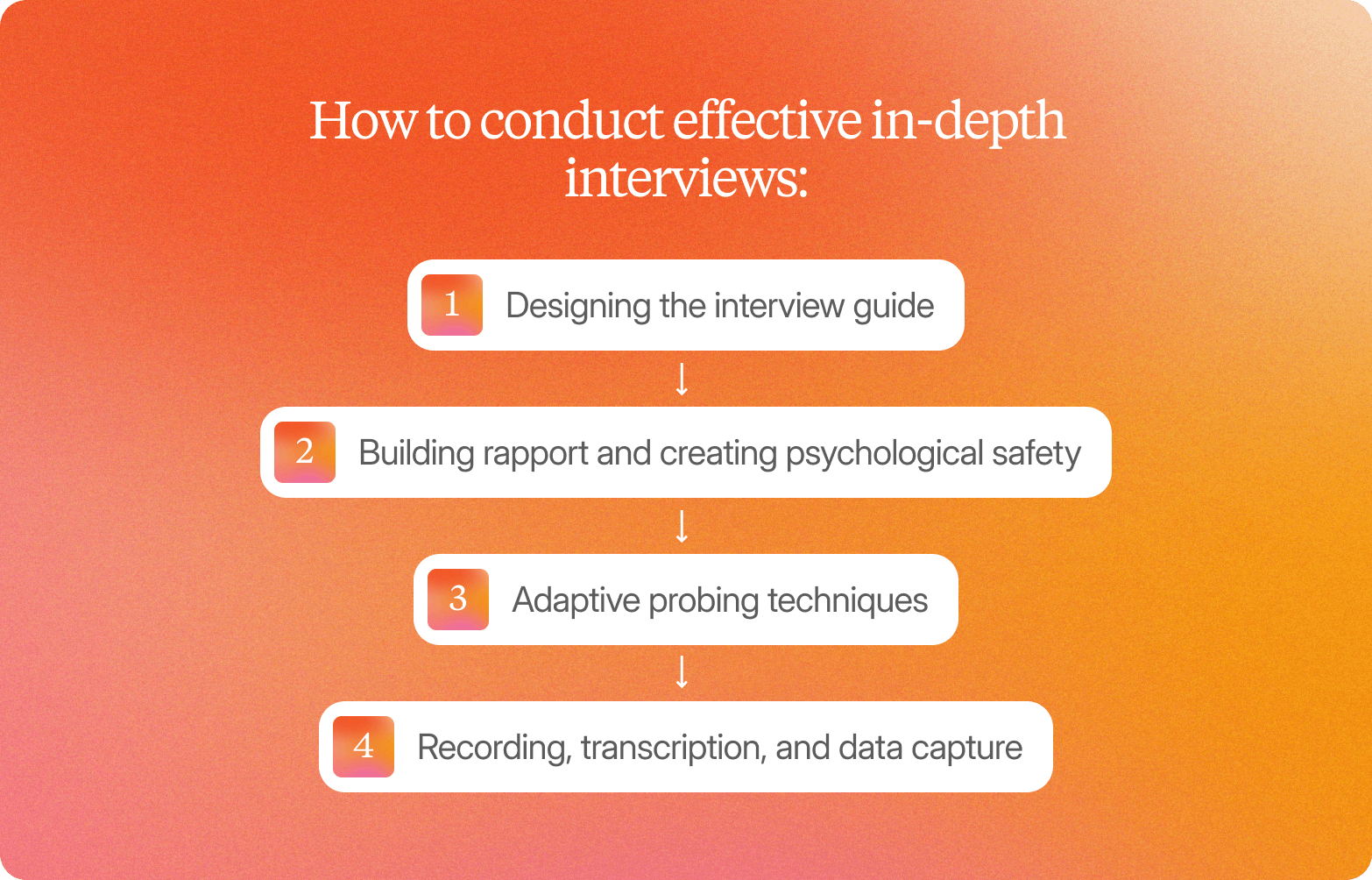
Designing the interview guide
Every strong interview guide starts with research goals, not questions. Before writing a single prompt, define what decisions your findings need to support and what qualitative data would actually move them. That discipline keeps the guide from becoming a list of things you are curious about rather than a structured instrument for generating actionable evidence.
Once your research goals are clear, build core questions that invite storytelling: "Walk me through the last time you had to make that decision," or "Tell me about a situation where that became a problem." Structure the guide around two or three core questions per phase (warm-up, exploration, closing) with probing prompts for common response types. Unlike a strict script, the guide is a scaffold that bends to the conversation, keeping the discussion focused on the specific topic at hand while leaving room to explore unexpected areas.
Avoid leading questions at every stage. "What did you find frustrating about that process?" presupposes frustration. "How would you describe that experience?" does not.
Building rapport and creating psychological safety
The first few minutes of an IDI determine whether participants give honest responses or polished ones. Participants who feel evaluated rather than heard self-edit instinctively.
Start by explaining the purpose of the session and how findings will be used. Frame the absence of right or wrong answers explicitly; participants often arrive expecting a test. Then encourage participants to speak freely: the goal is their honest feedback, not a performance.
Active listening does more structural work than the discussion guide. Verbal affirmations signal that you are following, not just waiting for the next question. Strategic pauses after a participant finishes often produce the most valuable material. Mirroring participant language (using their exact words rather than your own reframing) reduces the interpretive distance between what they mean and what gets recorded.
Adaptive probing techniques
The difference between a scripted follow-up and an adaptive probe is the difference between moving forward and actually understanding. Adaptive probing enables interviewers to delve deeper into participant reasoning, explore unexpected areas, and surface motivations a rigid question list would never reach.
Four probes do most of the work in practice:
"You mentioned [X]. Can you tell me more about that?" Signals you were actively listening and invites depth without leading.
"What made you feel that way?" Shifts from event to meaning.
"How did you decide between [A] and [B]?" Surfaces the actual criteria people use, almost never the criteria they would list if asked directly.
"Can you walk me through what happened next?" Recovers sequence and context, often surfacing friction that participants have normalized.
Contrast this with shallow probing: "Interesting. Next question." That exchange extracts nothing. The unexpected insight almost always lives one probe deeper than where most interviewers stop.
Watch it in action: How Conveo's AI Moderator Probes Adaptively →
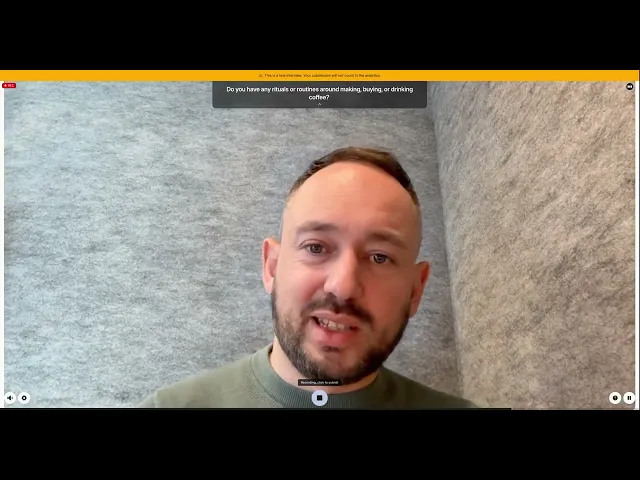
Recording, transcription, and data capture
Video over audio, where possible
Facial expressions, hesitation, and a glance away when a question lands uncomfortably. These carry interpretive weight that a transcript cannot recover. Reserve audio-only for situations where participants prefer it or technical constraints apply. Whatever recording equipment you use, confirm it produces clean audio before fieldwork begins.
Note-taking alongside recording
Even with automated transcription, live note-taking during sessions helps interviewers flag moments worth revisiting: a hesitation, a contradiction, a phrase that surfaced unexpectedly. These in-session notes accelerate data analysis by marking priority segments before the formal coding pass begins.
Transcription and translation at scale
Manual transcription of a one-hour IDI typically takes three to five hours, making data collection from a 20-participant study a weeks-long effort before analysis even starts. Automated transcription compresses that window to minutes. For multi-market studies, Conveo supports 50+ languages for AI moderation and recruitment across 50+ markets, enabling simultaneous rather than sequential data collection.
3 In-Depth Interview Examples: Real Research Scenarios
Concrete examples clarify how adaptive probing uncovers nuanced insights that a static discussion guide would miss. Each scenario below shows the difference between a surface response and the finding that actually shapes a decision.
Example 1: Concept testing (brand team)
A CPG brand was exploring consumer behavior around a new snack concept with health-conscious buyers. Opening question: "What's your first reaction to this product concept?" Participants consistently said the product "seems healthy."
The adaptive probing sequence went further: "What makes it seem healthy to you?" → "How important is that when you're choosing a snack?" → "Can you think of a time when you chose a snack for that reason?"
What surfaced was unexpected. Participants were not responding to the ingredient list. They were responding to portion size. "Healthy" meant a product that made it easy to stop eating. The brand used that finding to reframe messaging before launch, shifting from ingredient transparency to built-in portion cues.
Takeaway: A survey would have logged "positive health sentiment." Adaptive probing revealed that "healthy" and "natural ingredients" were not the same signal.
Example 2: Churn driver analysis (CX team)
A SaaS CX team interviewing churned customers kept hearing: "It was too expensive." Exit surveys confirmed it. The product team assumed a pricing problem.
Adaptive probing shifted the frame: "What made it feel too expensive?" → "Was there a specific moment when you decided the cost wasn't worth it?" → "What would have needed to change for you to stay?"
Participants described confusion during setup, never finding features they were promised, and gradually losing confidence that the product would deliver value. The root cause was not price: it was an onboarding gap that prevented customers from reaching the core value.
Takeaway: Adaptive probing revealed that "too expensive" was a symptom of an onboarding failure, a finding that a survey would have recorded as a pricing problem and sent the team in entirely the wrong direction.
Example 3: Packaging research (FMCG team)
A beverage brand needed to choose between three redesigned labels. Opening question: "Which design do you prefer?" A participant said, "I like the blue one." Finding recorded: Blue preferred. Reason: clean aesthetic. Technically accurate. Nearly useless for a positioning decision.
The adaptive probing sequence: "What about the blue one stands out to you?" → "How does that compare to what you usually look for on a shelf?" → "Can you describe a situation where you'd choose this over your usual brand?"
The participant said they would expect it to cost more than the brand usually charges. The blue design read as premium. The brand's equity was built on value. The design preference was real, but it created a price expectation the brand could not fulfill without repositioning.
Takeaway: Not "blue is preferred." The actual finding: "blue signals a price point that contradicts the brand's positioning." No survey captures a contradiction like that.
How to Analyze In-Depth Interview Data
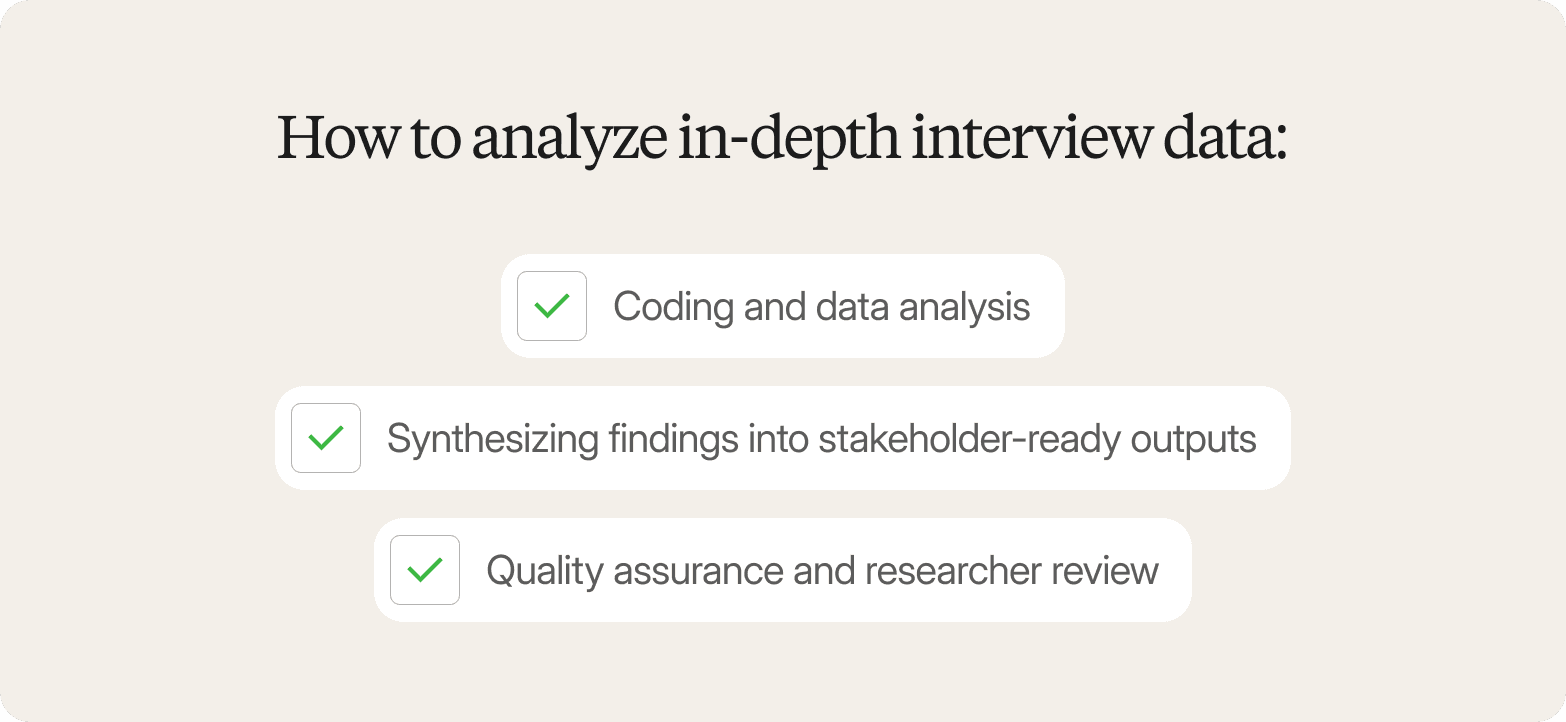
Coding and data analysis
Data analysis begins with coding: tagging transcript segments with labels that describe what each segment is about. Those tags accumulate across interviews and become the raw material for thematic analysis. Foundational frameworks for this work, documented extensively in academic literature published through SAGE Publications Ltd, have shaped how qualitative researchers structure IDI analysis and approach inductive versus deductive coding.
Two dominant approaches reflect different research intentions. Inductive coding allows themes to emerge from the data, making it ideal for exploratory research without preconceived frameworks. Deductive coding starts with a theory and seeks to confirm or disconfirm it. Most IDI studies use a combination: deductive codes anchor the analysis to research goals, while inductive codes capture unexpected patterns that a structured framework would miss.
Pattern recognition is where the real analytical work happens. A single participant expressing frustration with onboarding is an anecdote. Seven out of twelve participants using nearly identical language to describe the same moment is a finding. Researchers look for frequency, intensity, and consistency before elevating a code to a theme.
Synthesizing findings into stakeholder-ready outputs
Stakeholders discount findings when they cannot trace a conclusion back to a real conversation. The difference between key insights that move decisions and findings that get filed away is almost always traceability: can the reader see the direct quotes, hear the tone, watch the moment?
Evidence-backed reporting ties every theme to direct quotes and, where video is available, to the specific clip that generated it. Meaningful insights presented without traceability invite skepticism; the same finding, when linked to video evidence, invites action. Because every Conveo insight flows into a searchable library, rich insights connect across studies over time, building organizational knowledge rather than sitting in isolated decks.
Quality assurance and researcher review
AI-assisted data analysis raises the stakes for researcher review, not lowers them. When a platform generates thematic clusters across dozens of sessions, the researcher's job shifts to critical evaluation: are these themes grounded in participant language, or are they artifacts of how the model was prompted?
Saturation is the clearest signal that a study has collected enough meaningful data. When two or three consecutive interviews confirm existing themes without introducing new ones, you have likely reached it. For multi-researcher projects, an inter-coder reliability check (two researchers independently coding a subset of sessions and reconciling disagreements) strengthens the credibility of valuable insights presented to stakeholders.
Scaling In-Depth Interviews Without Losing Rigor
AI-moderated asynchronous video interviews
The core problem with live moderation is not quality. It is physics. One interviewer can run one conversation at a time. Traditional face-to-face interviews and live video sessions are time-consuming to schedule and cannot run in parallel, which is why a research program calling for 50 IDIs across three markets turns a two-week study into a six-week project.
AI-moderated asynchronous video interviews directly change that constraint. Participants complete sessions on their own schedule, with no need to coordinate calendars. Hundreds of conversations can run in parallel without adding a single interviewer to the team.
The quality case is equally important. Static discussion guides ask every participant the same follow-up regardless of what they just said. Conveo's AI moderator reads the response and probes accordingly: following a hesitation, exploring unexpected areas, and pursuing a contradiction. Asynchronous participation also reduces no-show rates: participants complete sessions when they are ready to engage, producing more considered responses and more honest feedback.
"Within days, we had insights that would've taken a traditional agency a month."
Head of Customer Insights, JDE Peet’s
Sample sizing and saturation heuristics
For IDIs targeting a homogeneous audience, saturation typically arrives between 15 and 30 interviews. Multi-segment studies require more, with each segment needing its own saturation threshold. Running IDI market research across four distinct customer segments, with a total sample of 20 IDIs, yields roughly five participants per group, which is unlikely to yield reliable patterns. For complex, multi-segment studies, 30 to 50 interviews are more defensible.
The most practical way to monitor saturation is to run interviews in waves rather than scheduling all sessions upfront. Complete a first wave of eight to ten interviews, conduct a rapid thematic review, and assess whether new patterns are still emerging before launching the next wave.
Multi-market consistency and QA checks
Scaling IDIs across markets introduces quality risks: inconsistent moderation, translation gaps, and participant verification that varies by vendor.
Conveo handles multi-market IDIs through a unified workflow: automated transcription and translation run in the same platform where interviews were conducted, with no export-to-translate step. Fraud filtering and participant verification run at the recruitment stage, using behavioral screening to identify bad-faith participants before they enter a session. Cross-market data analysis uses a consistent codebook, so researchers compare patterns across Germany, Brazil, and South Korea with the same codes rather than reconciling outputs from different tools.
How Conveo Transforms In-Depth Interview Research
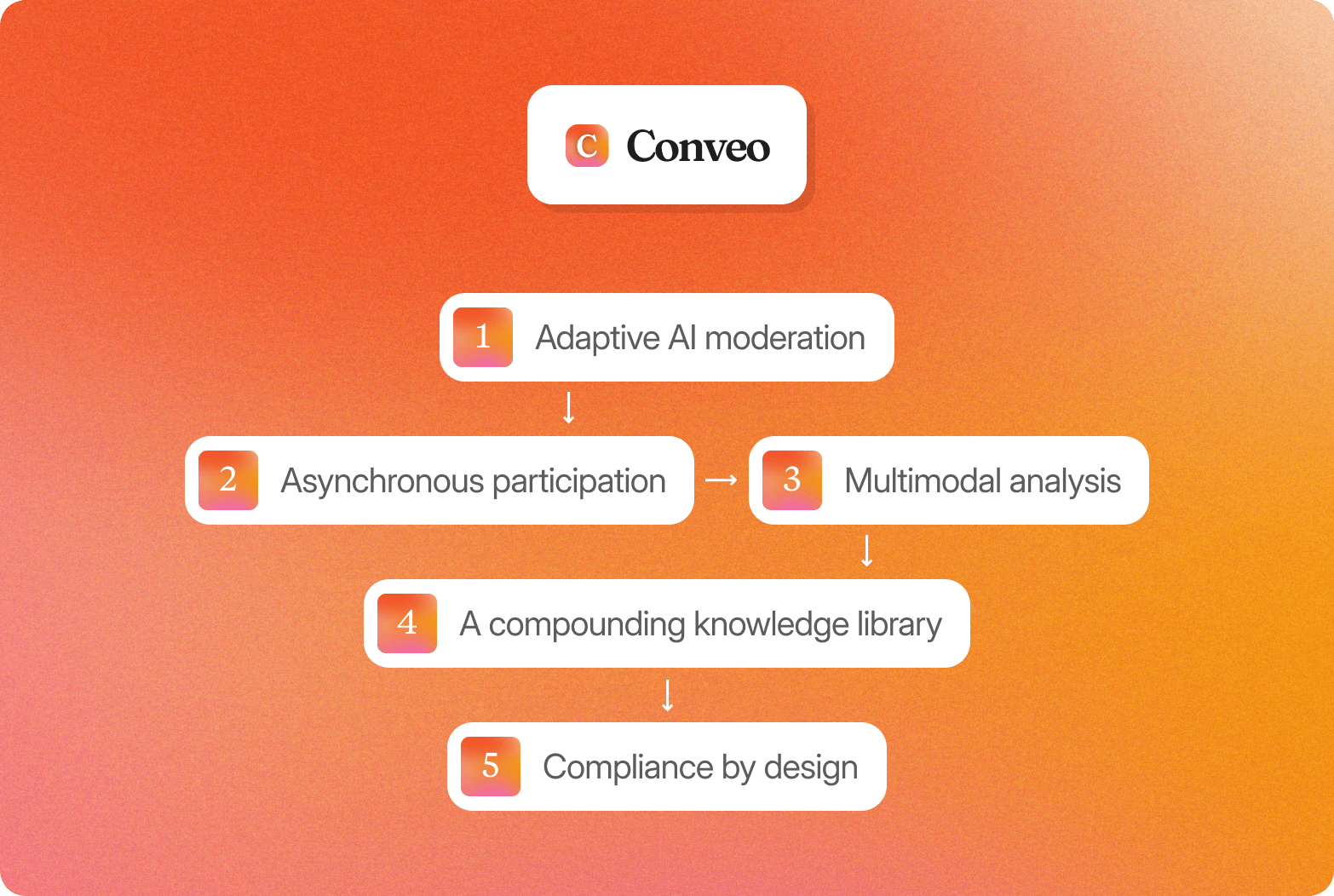
The challenges covered in this guide share a common root: the operational overhead that prevents insights teams from running enough IDIs to keep pace with the decisions being made around them. Conveo, the video-first AI research platform, addresses each constraint within a single workflow.
Adaptive AI moderation replaces rigid discussion guides with probing that follows participant responses in real time. When a participant hesitates, contradicts themselves, or introduces an unexpected frame, Conveo pursues it, surfacing the meaning behind the answer rather than recording the surface response.
Asynchronous participation removes the scheduling bottleneck. Hundreds of conversations run in parallel on participants' own schedules, compressing fieldwork from weeks to days without adding interviewers.
Multimodal analysis handles transcription, translation, thematic coding, and sentiment analysis as sessions land. Every AI-generated theme links back to the source video, so key insights carry the traceability that stakeholders need to act.
A compounding knowledge library connects findings across studies over time. Themes from a concept test six months ago surface alongside last week's usability findings, building organizational knowledge rather than sitting in isolated decks.
Compliance by design. SOC 2-certified infrastructure, GDPR-compliant data handling, and built-in consent workflows mean that enterprise teams meet regulatory requirements without bolting on a separate compliance layer.
No synthetic respondents. Real participants, real conversations, real video.
Frequently Asked Questions
What is the difference between an in-depth interview and a structured interview?
A structured interview follows a fixed question order (essentially a strict script) with every participant receiving the same prompts. In-depth interviews are semi-structured: the interviewer uses a discussion guide as a flexible scaffold and adapts based on participant responses. This adaptive approach surfaces nuanced insights and honest feedback that rigid, scripted formats miss.
How many in-depth interviews do I need for a qualitative study?
For a homogeneous audience, saturation typically arrives between 15 and 30 interviews. Multi-segment studies need more, with each segment requiring its own threshold. The key indicator is when consecutive interviews confirm existing themes without introducing new ones.
Can AI-moderated interviews replace human moderators?
AI-moderated interviews handle the operational mechanics of adaptive probing and session management at scale. They are most effective for studies requiring high participant volumes across multiple markets and for collecting data from geographically distributed audiences without the resources to field a global team of interviewers. Human moderators remain valuable for sensitive topics, executive interviews, and research requiring real-time judgment calls beyond the discussion guide.
How do you ensure data quality in asynchronous video interviews?
Quality comes from three layers: behavioral fraud filtering at recruitment, adaptive AI probing during the session, and researcher review of AI-generated themes against the source video afterward. The combination ensures findings are grounded in genuine participant responses, not surface-level answers.
What types of research questions are best suited to in-depth interviews?
IDIs are the right method when the research question is about individual experience, motivation, or decision-making: concept testing, customer journey mapping, churn analysis, consumer behavior research, brand perception studies, and any exploratory work where the goal is to understand why rather than measure what.

About the author
Anna Sharp
Client Growth Manager
Anna got into market research by asking the CEO of one of the largest agencies in the world out for a juice. Eight years on she is an ethnographer who backs methods she believes in. She runs studies with media and consumer clients, including the one that went from a Friday-morning brief to a finished project by Saturday.
Meet Anna on film →Qualitative insights at the speed of your business.
Conveo runs AI-moderated video interviews and structures everything they say.