In this article
TL;DR
The decision rule for inductive vs deductive coding: use deductive coding where the categories are known, and inductive coding where they are not.
Deductive codes applied to exploratory research miss anything not already in the codebook, so the most important findings never reach the report.
Inductive coding applied to monitoring work lets themes shift each wave, so labels drift between analysts and quarter-over-quarter comparison becomes unreliable.
Hybrid coding answers both needs: discover themes inductively, freeze validated themes into a fixed codebook, then run deductive prevalence coding in every wave.
Most insights teams inherit their coding direction from the last project. Last quarter's codebook gets reused on exploratory work, or a monitoring wave gets coded from scratch, and the mismatch surfaces only when a stakeholder asks why the findings missed something obvious. This guide covers how to choose a direction deliberately, what each one looks like on the same dataset, and how to run a hybrid that holds across waves.
What inductive and deductive coding mean in qualitative research
Inductive vs. deductive coding in qualitative research is a study-specific choice. Both are qualitative coding approaches for labeling textual data such as interview transcripts and field notes, and they differ in where codes come from.
Inductive coding is a bottom-up approach in which codes emerge from participants' language as the qualitative researcher works through the raw data, with no framework set in advance. It is the right choice when you don't yet know what matters in the data, or when little existing theory covers the topic.
Deductive coding is a top-down approach where codes come from a predefined framework, existing theory, or codebook tied to the research questions. It is the right choice when you already have stable categories and need consistent tagging across interviews and waves.
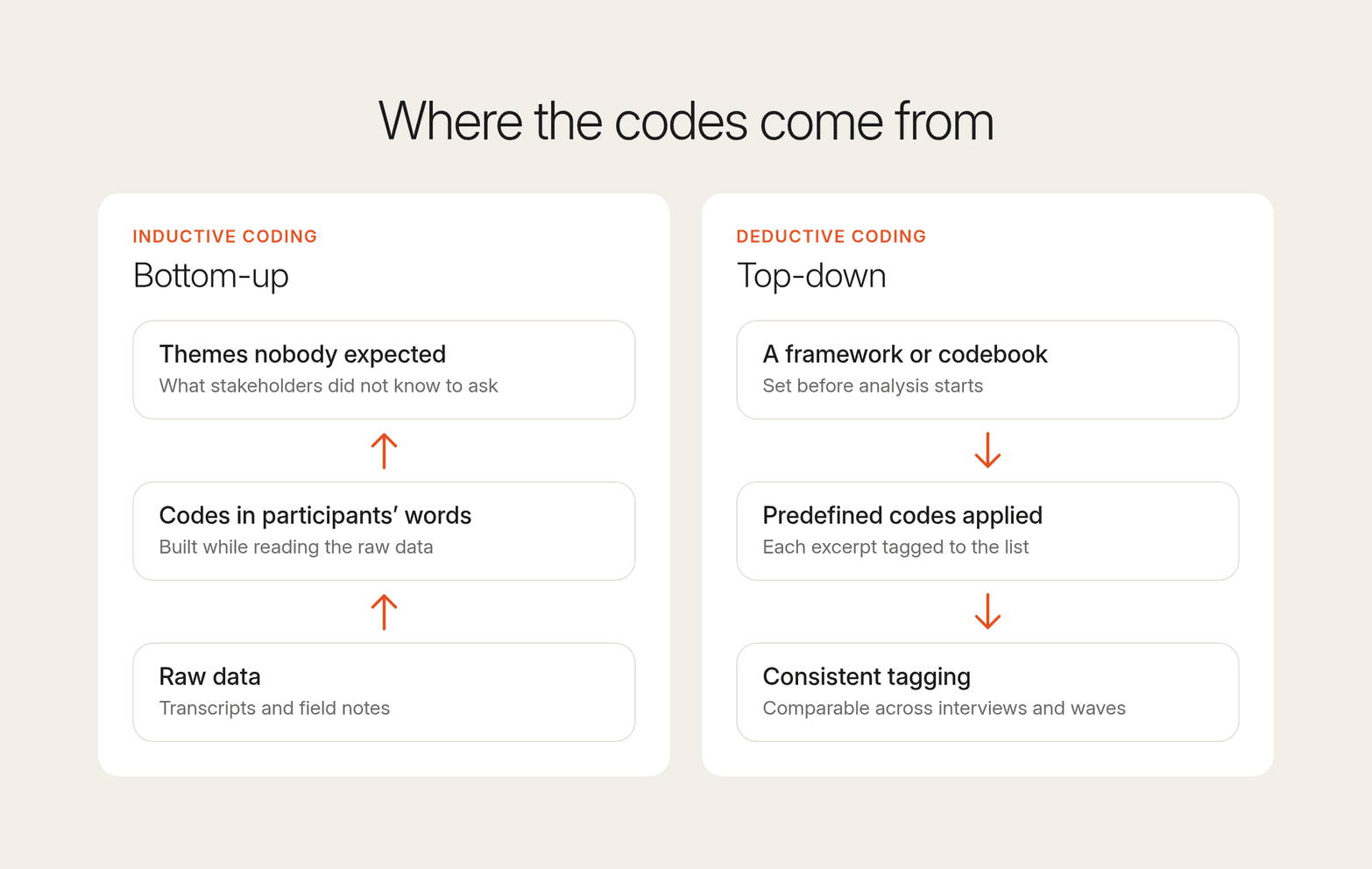
The difference between deductive and inductive coding decides what the report can claim. Inductive analysis follows inductive reasoning, from specific observations to broader patterns, so it surfaces what stakeholders didn't know to ask about. Deductive analysis follows deductive reasoning, testing an existing theoretical framework against new evidence, so it suits confirmatory aims such as tracking a known issue across waves.
Is thematic analysis inductive or deductive?
Thematic analysis can be inductive, deductive, or both. Thematic analysis, as formalized by Braun and Clarke (2006), is a qualitative data analysis method for identifying themes and interpreting patterns, and the direction is a separate decision. Grounded theory, introduced by Glaser and Strauss (1967), sits at the inductive end, building new theory from the data up about human behavior.
Deductive versus inductive coding deserves the same deliberate decision as sampling, because an inherited codebook carries the previous study's questions and its preconceived notions into a new context.
Takeaway: in inductive vs deductive coding, code deductively when categories are known, inductively when they are not, and decide per study.
The cost of defaulting to the last project's direction
Consider an exploratory study on why purchase intent dropped for a new product line. To save time, the team codes the interview transcripts against last quarter's codebook. Several participants hold back because a competitor's similar launch failed, yet the report presents a clean picture of price and usability, and the launch moves ahead with the budget committed.
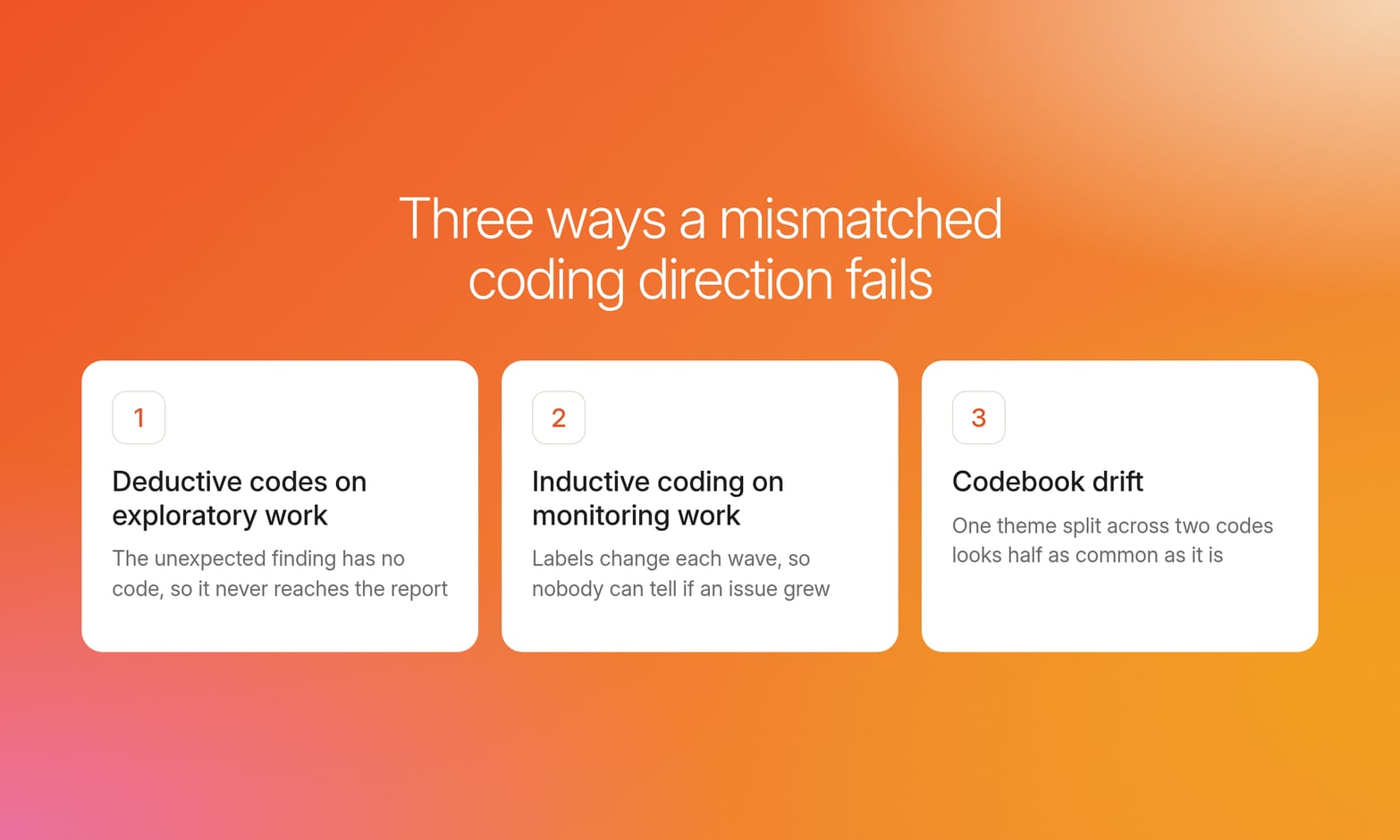
A mismatched direction fails quietly in three ways:
| Failure | What happens | What the report loses |
|---|---|---|
| Deductive codes on exploratory work | A predefined set of codes has no slot for the unexpected, so each time a participant mentions it, the passage is forced into an existing code or left untagged | Anything missing from the code list, often the most decision-relevant finding |
| Inductive coding on monitoring work | Analysts develop codes from scratch each wave, so "checkout friction" becomes "payment trust" | Any way to tell whether an issue grew, shrank, or was relabeled |
| Codebook drift | Two analysts assign codes to the same excerpt differently: "price concern" versus "value perception" | Clean aggregation, since a theme split across two different codes looks half as common as it is |
Either mismatch in inductive vs deductive coding produces findings that answer a question nobody asked.
The pressure behind the default is operational: many teams find manual qualitative coding hard to sustain beyond roughly 15 to 20 interviews, even with coding software, so they reach for the familiar codebook, and in always-on research that shortcut repeats every wave.
Takeaway: a mismatched direction costs more than analysis time, because it sends a decision forward on findings with a gap nobody can see.
Inductive vs deductive coding: a decision framework
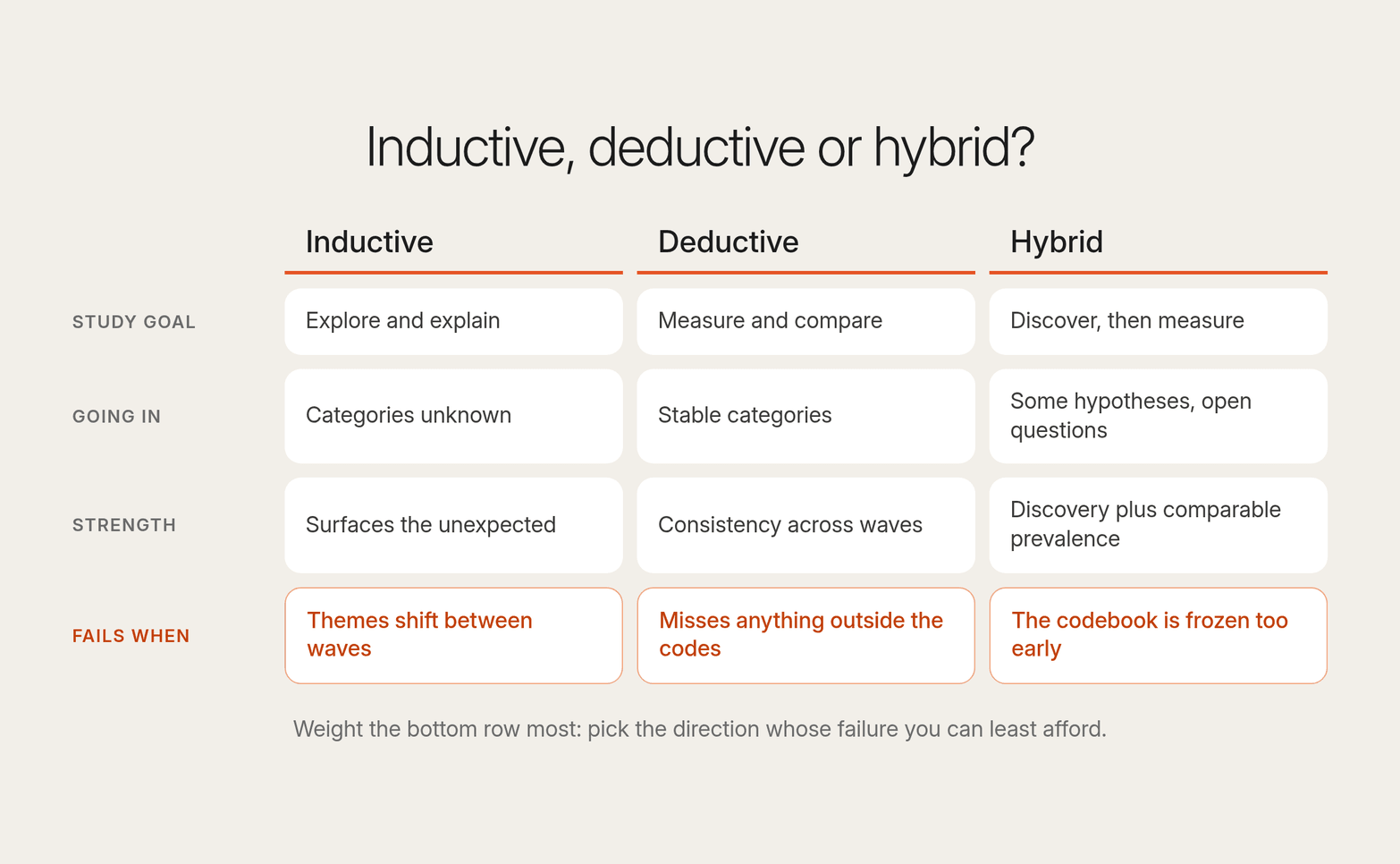
Choose between inductive and deductive coding based on the study goal and research aims. The table compares the three coding approaches on the criteria that decide fit.
| Criterion | Inductive | Deductive | Hybrid |
|---|---|---|---|
| Study goal | Exploratory research and explanation | Measure and compare | Discover, then measure |
| What you know going in | Little existing theory; categories unknown | Stable categories or an existing theoretical framework | Some hypotheses, open questions |
| Codebook source | Codes based on participant language | Predefined codes from existing research or a prior codebook | Inductive themes, then a frozen codebook |
| Strength | Surfaces the unexpected | Consistency across interviews and waves | Discovery plus comparable prevalence |
| Failure when misapplied | Themes shift between waves | Misses anything outside the preset codes | Codebook frozen before themes are validated |
| What the report shows | Themes with explanatory narrative | Code frequencies and trend lines | Themes with prevalence by segment |
| Comparability across waves | Low unless codes are fixed | High | High once the codebook is versioned |
Weight the failure row most.
In practice, the study goal maps to a direction like this:
Concept testing: hybrid. Start with an inductive approach to catch unanticipated reactions, then code against fixed concept attributes to compare concepts side by side.
Ad testing: deductive. Code against the brief's intended messages, and log unexpected reads as candidate new codes.
Brand tracking "why" follow-ups: deductive. Take a deductive approach: freeze the codebook to tracker dimensions so explanations line up wave over wave.
Continuous discovery: inductive, then hybrid. Keep early analysis open, then promote recurring themes into a versioned codebook. This pattern underpins always-on programs like Conveo StoryLines, which run on a wave-based cadence.
Deductive vs inductive coding is rarely a fixed choice in continuous work: a theme found inductively in month one can become a deductive code by month three, once validated. Revisiting the coding structure on a set schedule keeps that iterative process deliberate.
Key questions to ask before you open the codebook
Do I already know the categories that matter? If not, a codebook only confirms your assumptions.
Will I compare these results against earlier waves? If yes, keep the codes fixed.
Is the aim to explain or to measure? Explaining favors inductive discovery; measuring favors deductive prevalence.
Who will challenge the findings and on what grounds? Finance leads question frequencies; product leads question whether themes reflect real participants.
How many transcripts will this involve? Volume limits how much line-by-line inductive coding the team can sustain.
Takeaway: five key questions, from known categories to transcript volume, decide the inductive vs deductive coding direction, and the study goal outranks habit.
Inductive vs deductive coding examples from the same dataset
This section codes one set of research data both ways: 14 participant interviews about a new meal-kit subscription concept, ahead of a decision on quantitative testing.
Illustrative excerpt (generic quotes, not from a real study):
P3: "The price seems fair for what you get."
P7: "I like it, but the last one of these folded within a year. I'd wait and see."
P9: "The app looks fine. But the last company that did this shut down, so I'd hold off."
P12: "Another brand tried this and pulled out. Why would this one last?"
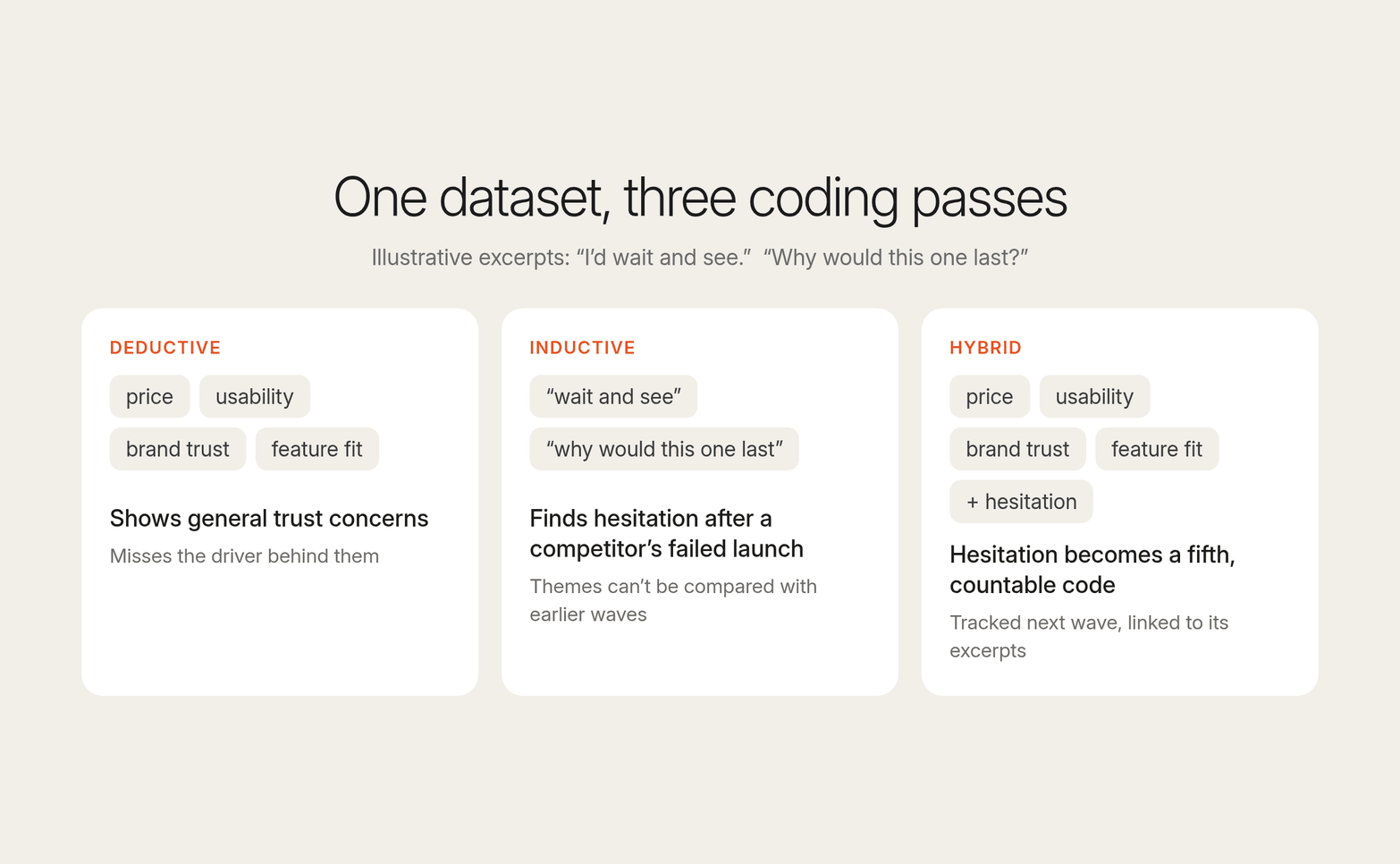
Deductive pass. The team applies a predefined codebook of four specific codes: price, usability, brand trust, and feature fit. P3 codes cleanly to price, while P7, P9, and P12 get forced into brand trust, so the report shows moderate trust concerns and misses the driver behind them.
Inductive pass. Using in vivo coding from participant language, the same excerpts produce codes in the participants' own words, such as "wait and see" and "why would this one last." Descriptive coding would label them more plainly as "longevity concern." Both group into one theme: hesitation driven by a competitor's failed launch.
Hybrid pass. The validated hesitation theme becomes a fifth code with inclusion and exclusion rules, so the team can count it, track it next wave, and link each count to its excerpts. Abductive analysis, sometimes called abductive coding, is a separate idea: Timmermans and Tavory (2012) use it when a surprising finding generates new theory.
| Pass | What it surfaced | What it missed or risked |
|---|---|---|
| Deductive | Price, usability, and general trust concerns | The competitor-driven hesitation behind the trust codes |
| Inductive | Hesitation driven by a competitor's failed launch | Themes that can't be compared with earlier waves |
| Hybrid | The hesitation theme, now countable and trackable | Freezing the theme before it is validated |
Run on the same data, inductive vs deductive thematic analysis produces two different reports from identical transcripts. Negative case analysis keeps the inductive version credible: look for participants who contradict the dominant pattern, such as P3, who raised no hesitation at all. If contradicting cases cluster in one segment, the theme is narrower than it first appears, and the report should say so.
Takeaway: deductive coding gains comparability, inductive coding gains discovery, and the hybrid keeps both only when themes are validated before they are frozen.
Combining inductive and deductive thematic analysis with rigor
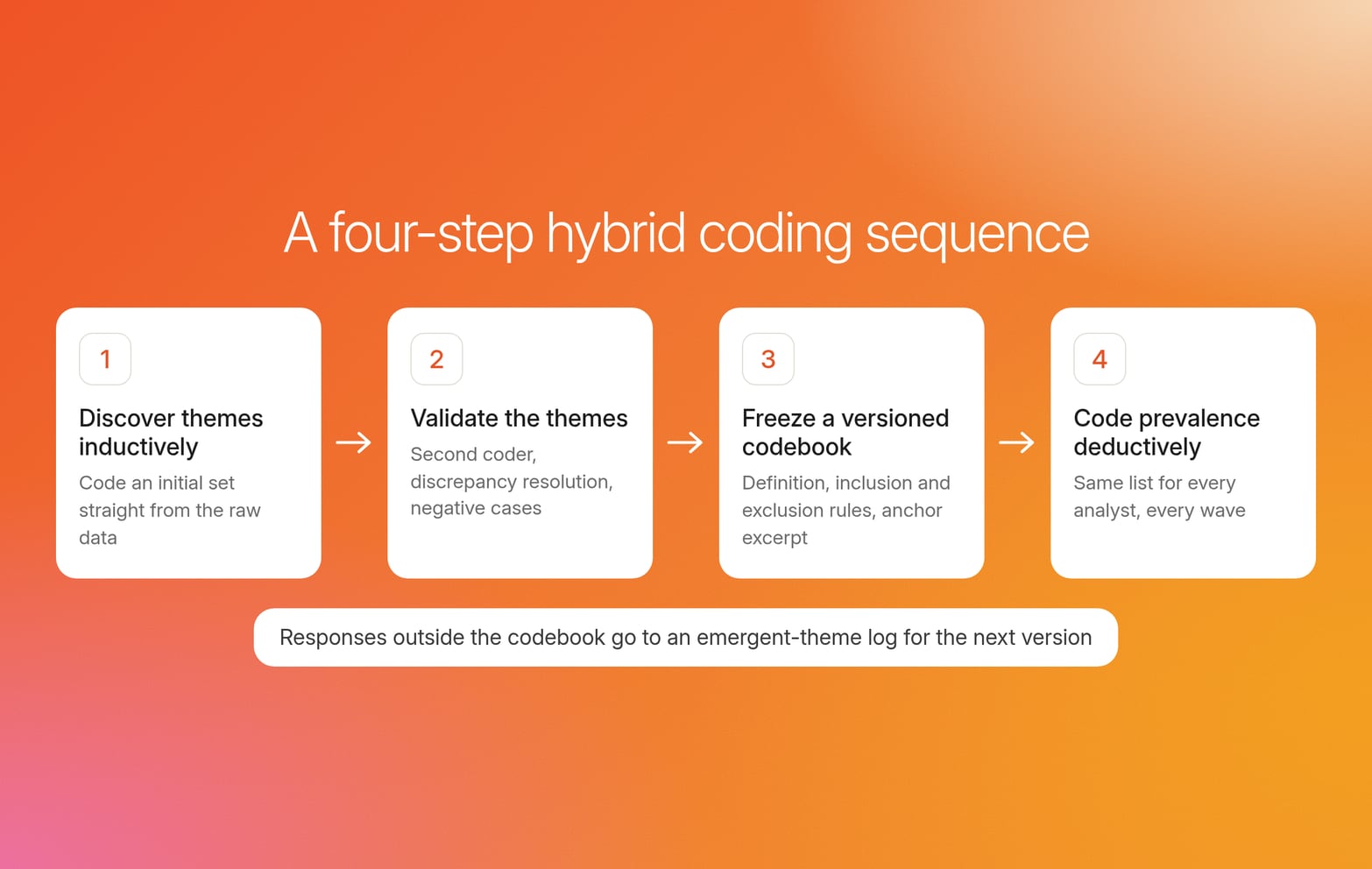
Hybrid inductive and deductive thematic analysis, formalized by Fereday and Muir-Cochrane (2006), answers both "what is happening and why" and "how often and where" from the same dataset. Combining inductive and deductive thematic analysis works only when the sequence holds: discovery before measurement, and validation before freezing.
Run inductive thematic analysis to discover themes. Using an inductive approach, code an initial set of transcripts directly from the raw data, then develop themes as patterns emerge, keeping each tied to the relevant passages that produced it.
Validate themes through discrepancy resolution and negative case analysis. Have a second analyst code a sample independently, then resolve disagreements against the transcript. Revise or drop any theme that participants contradict as more data arrives.
Convert validated themes into a fixed, versioned codebook. Write each theme as a code with a definition, an inclusion rule, an exclusion rule, and an anchor excerpt. Version the coding structure before deductive coding begins.
Run deductive prevalence coding against that codebook. Apply the frozen codebook to the full dataset and later waves, so every analyst assigns codes from the same list, then report prevalence by segment, market, or wave.
Codebook governance that holds up
Governance keeps inductive and deductive coding from blurring once several analysts share the coding process.
Precise definitions: define every code with an inclusion rule and an exclusion rule.
Version control: version the codebook and log each change with its date and reason.
Reflexivity notes: following the reflexive thematic analysis tradition, record the assumptions and preconceived notions each analyst brings to the data, and revisit them when themes are validated.
Discrepancy rules: resolve coder disagreements against a written rule applied the same way every time.
Emergent-theme log: freeze the codebook for monitoring waves, route responses that fall outside it to a separate log, and promote recurring ones as new codes in the next version.
The payoff is prevalence stakeholders can act on. In an illustrative example (small sample, not statistically projectable), a theme in 65% of European interviews versus 20% of US interviews tells a regional team where to act first, which a theme list alone can't show.
Takeaway: in hybrid coding, validate themes before freezing the codebook, because a codebook frozen too early will measure the wrong things with perfect consistency.
How to explain your coding direction to stakeholders
Your inductive vs deductive coding direction is a defensible methodological choice, and stakeholders should hear it before they see a single theme.
1. State the direction and the reason
Open the readout with one line, such as "We coded inductively because we didn't yet know what was driving hesitation," or "We coded against the tracker codebook so this wave compares with the last four." Deductive and inductive analyses answer different questions, and stating the direction first keeps debate about the analysis process from derailing the findings.
2. Name what the direction couldn't see
Naming each direction's limit pre-empts the challenge. For a deductive approach, explain how out-of-codebook responses were handled; for an inductive study, explain how themes were validated and which negative cases the team checked.
3. Trace every finding to a real participant
Skeptical stakeholders push back on qualitative analysis that reads like analyst opinion. Pair each finding with a verbatim quote and, where available, the video clip, so anyone can check the relevant passages behind the claim.
Takeaway: a stated direction, a named limit, and a traceable quote turn a coding choice into a finding stakeholders can defend in their own meetings.
Choosing between inductive, deductive, and hybrid coding
Choose your inductive vs deductive coding direction from the study goal and research aims. Code inductively when you don't yet know what matters or little existing theory applies. Code deductively when the categories are stable and comparison matters, and use hybrid coding when you need both.
For most continuous programs, the hybrid is the strongest default, backed by an emergent-theme log for what participants raise next.
How Conveo supports both directions in one program
A codebook built for last quarter's monitoring wave can't catch what this quarter's launch decision depends on. In Conveo, teams keep their established coding frame while still seeing responses that fall outside it.
First-pass coding with researcher-led validation. A first pass across AI-moderated interviews surfaces recurring patterns before manual tagging, and the qualitative researcher validates, refines, and decides which themes hold up.
A codebook that stays the team's own. Researchers add their codes as facets, and Conveo extracts them across every interview in the study and in later waves, so every analyst works from the same code list. Researchers can inspect and correct the coding, and Talk to Your Data surfaces topics the code list didn't anticipate, which they can add as a new facet in one click.
Findings that trace to a real participant. Each theme links to the participants behind it, with video clips and verbatim quotes stakeholders can audit. Video preserves the hesitation, tone shifts, and contradictions that a transcript alone can flatten.
Themes that compound across studies. Studies recognize recurring themes and facets in a searchable insight library, so the next wave builds on what earlier ones established instead of starting with a blank codebook.
Multi-market fieldwork without scheduling delays. Asynchronous AI-moderated interviews remove scheduling dependencies and run in 50+ languages, so findings arrive while the launch decision is still open.
"You see them physically doing it. Testing the product for the first time, being probed right there. That unfiltered, in-the-moment reaction is possibly the most powerful thing you can see as a researcher."
Dafydd Jones, Associate Director, Ninth Seat
Procurement and legal reviewers start from SOC 2 Type II certification, GDPR compliance, and EU hosting (Belgium).
Frequently asked questions
Can a study switch from inductive to deductive partway through?
Yes, and in continuous programs it usually should. Validate the theme, write it into the codebook, and code it deductively from the next wave on, with the switch point set in the analysis plan.
What's the difference between a code and a theme?
A code is a label tied to specific excerpts of textual data. A theme is a pattern across multiple codes or excerpts that answers part of the research question. Codes are the building blocks of qualitative analysis; themes are what gets reported.
Does deductive coding work with a small sample size?
It can, but prevalence percentages from a small sample need a visible base-size caveat. A theme in 3 of 10 interviews is not a stable rate, even if it's worth reporting as a signal.
Can inductive coding be used for ongoing monitoring work, not just one-off exploration?
Only with discipline. Inductive coding starts open, so themes need to be validated and frozen into a codebook before comparison across waves matters. Otherwise, labels drift, and nobody can tell if an issue grew or was just relabeled.

About the author
Meg Gerli
Research Impact Lead
Meg is a Research Impact Lead at Conveo, working with insights and research teams on the studies they run with Conveo.
Meet Meg on film →Qualitative insights at the speed of your business.
Conveo runs AI-moderated video interviews and structures everything they say.