In this article
TL;DR
Best for: Insights and CMI teams running enterprise-scale qualitative research projects who need findings that arrive while the decision is open and hold up with senior stakeholders.
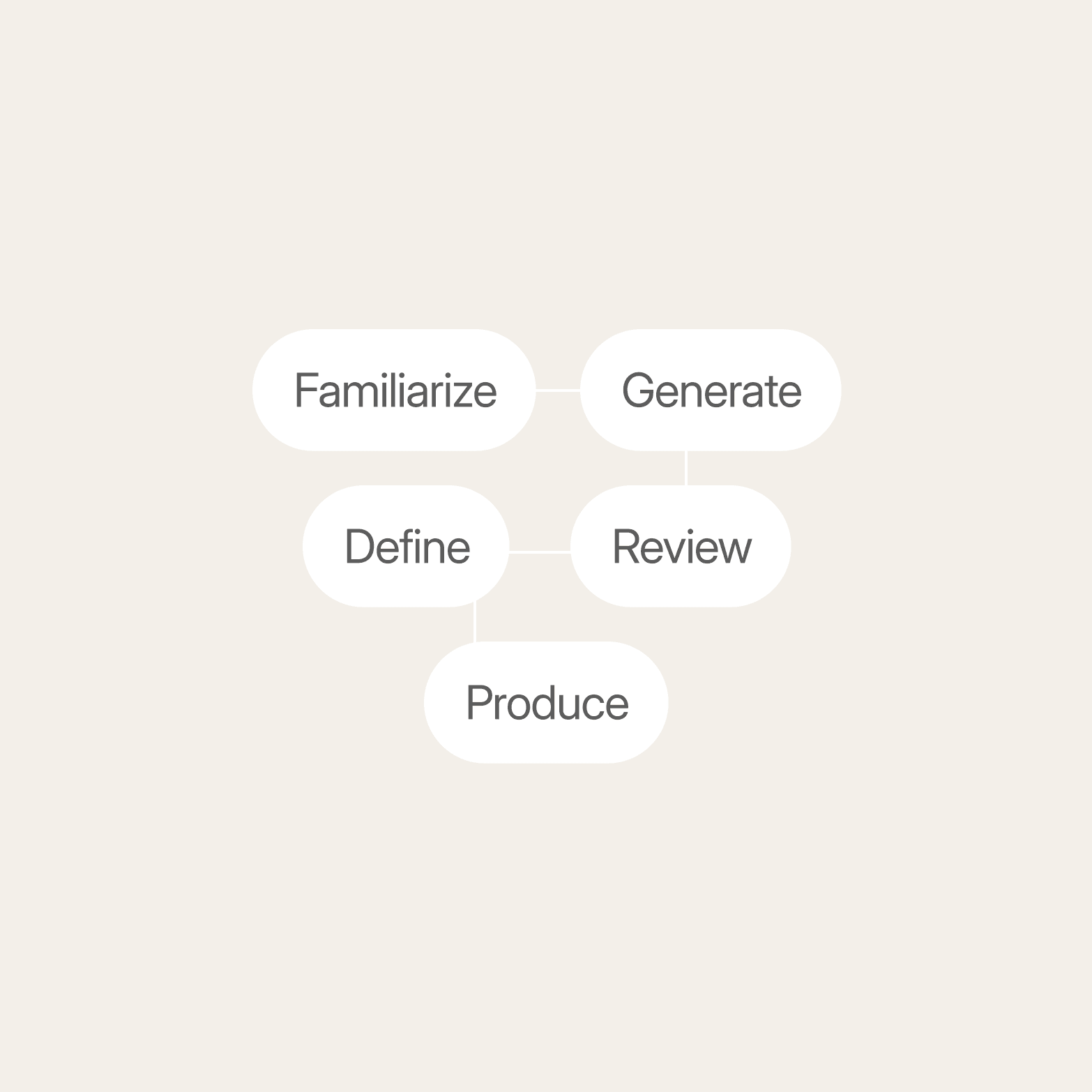
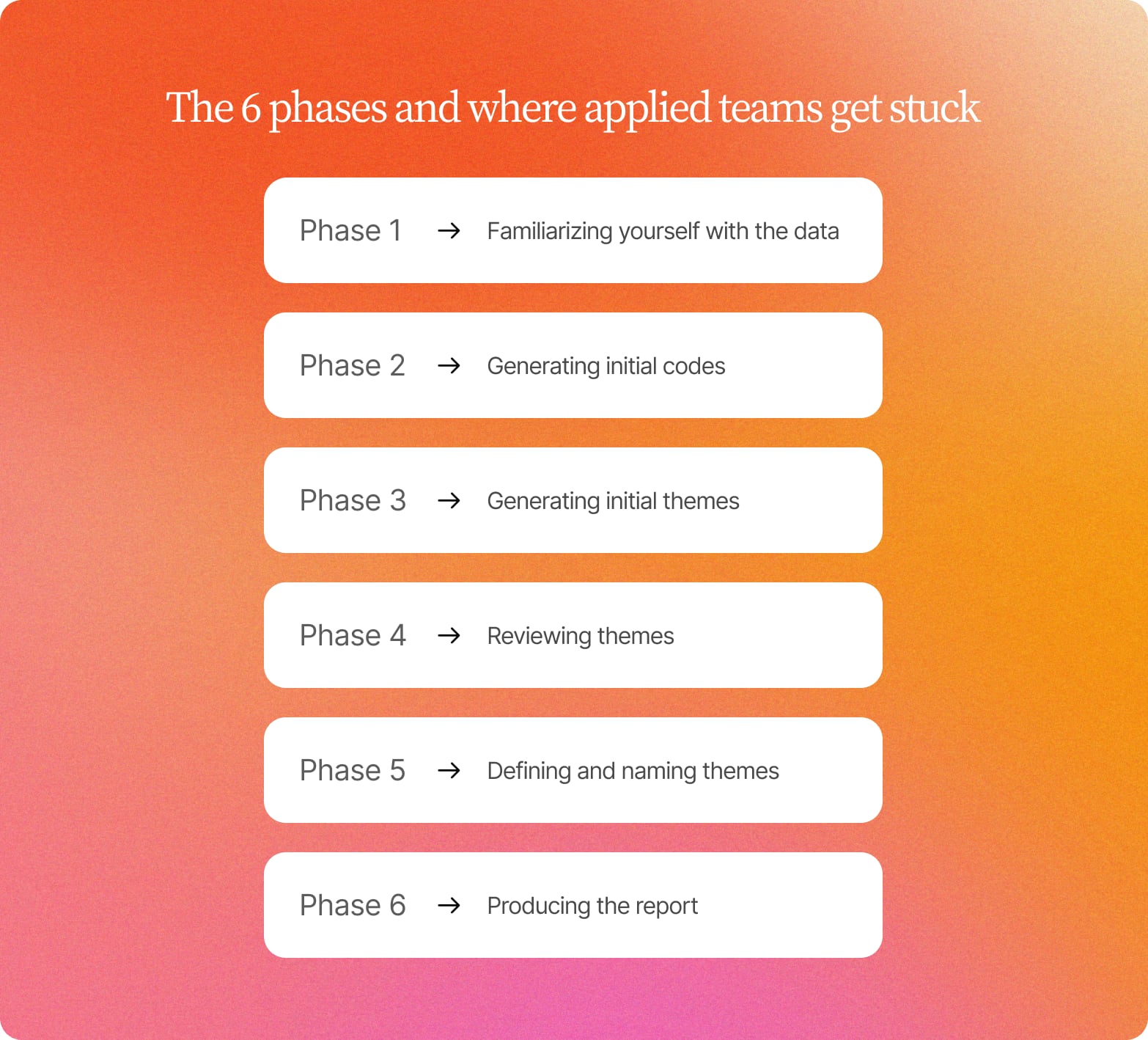
Braun and Clarke thematic analysis has six phases: familiarizing yourself with the data, generating initial codes, generating initial themes (originally "searching for themes"), reviewing themes, defining and naming themes, and producing the report.
Running all six phases sequentially on a 30-interview dataset consumes most of a typical brief window.
Teams that follow the phases literally miss the decision; teams that skip phases lose the audit trail that makes findings credible when a stakeholder asks how a theme was reached.
Phases 1 and 2, familiarization and initial coding, carry the most compression risk. Phases 3 through 5 run faster when teams record analytical decisions as they happen instead of reconstructing them afterward.
Teams using Conveo get every theme linked to its supporting quotes and video clips as the analysis runs, so the path from a participant's words to a final theme is there without a separate documentation pass.
The decision closes before the theme is defensible. That gap determines whether qualitative research influences anything.
Why the decision closes before the theme is defensible
A brief locks on Friday. The theme that would have changed it becomes defensible the following Tuesday. Research that arrives after the decision might as well never have happened.
Velocity and hit rate on new products, campaigns, and channels now decide who stays competitive, and neither survives understanding that lands late.
Braun and Clarke's thematic analysis, developed by psychologists Virginia Braun and Victoria Clarke, is one of the most widely cited qualitative research methods for turning raw qualitative data into defensible themes. Braun and Clarke set the six phases out in their 2006 paper, and its influence now runs well beyond critical psychology into the social sciences.
Qualitative researchers rarely dispute the framework's rigor; the friction is timing. The question for an enterprise team is whether you can build the audit trail while the decision is still open. For the executive signing off on the launch, the pricing change, or the media plan, the audit trail determines what they approve: participant evidence or a researcher's interpretation.
Speed versus rigor is a false choice. Rigor makes moving faster worth it.
Why teams struggle to apply Braun and Clarke thematic analysis in business timelines
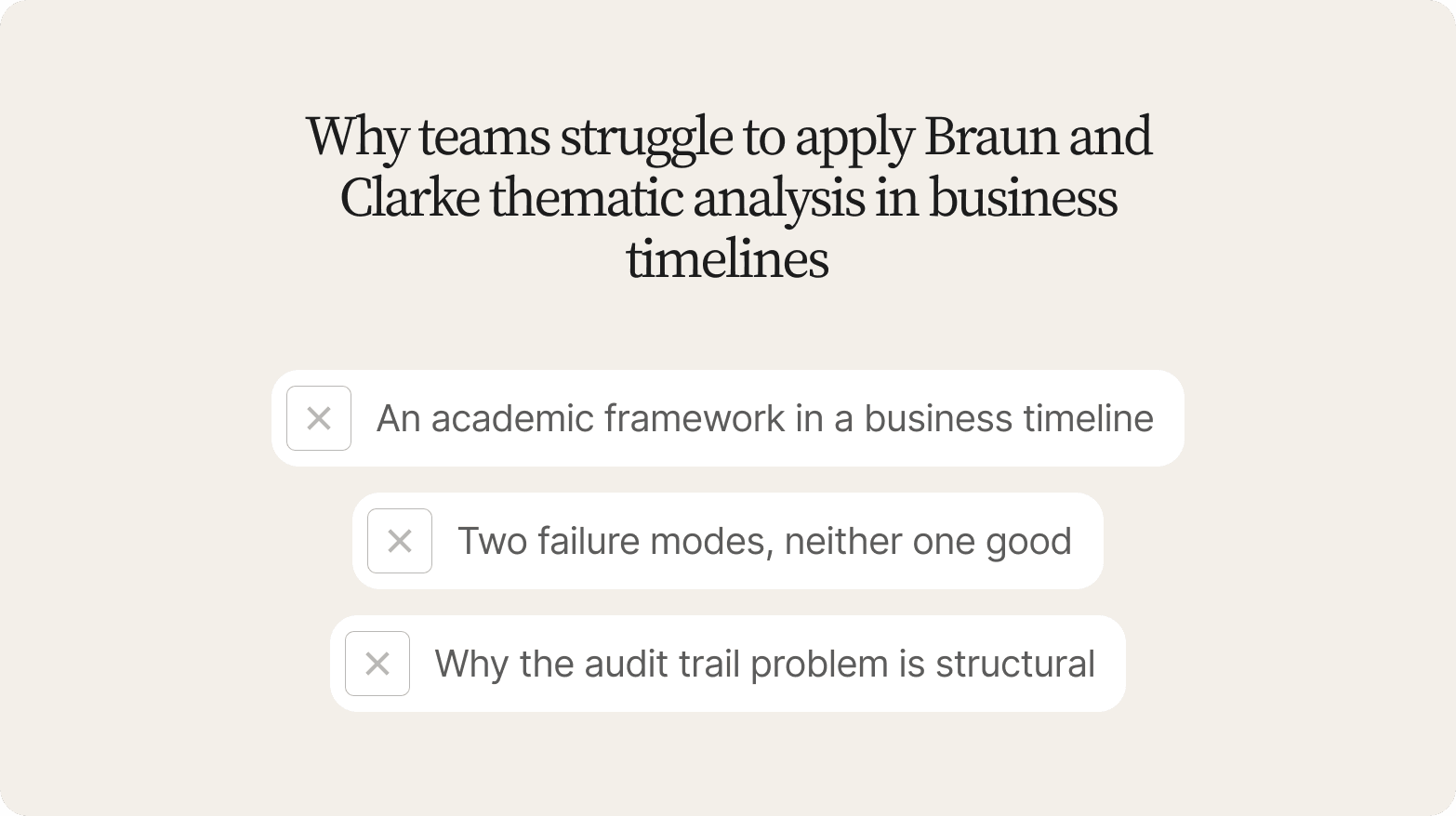
An academic framework in a business timeline
The framework was developed for thematic analysis in psychology and published in the academic journal Qualitative Research in Psychology. Academic timelines allow extended familiarization, iterative coding, peer review of theme structures, and refinement against existing literature. Those conditions are absent in a business context, where a two-week product sprint leaves no room to read and re-read transcripts until patterns emerge.
Two failure modes, neither one good
So teams make a choice, and neither works well:
Follow the phases faithfully. Deadlines overrun by weeks, and findings arrive after the decision has already been made another way.
Compress or skip phases to hit the date. When a stakeholder challenges a theme, the researcher cannot reconstruct the path from raw transcript to reported finding. The theme exists without an audit trail.
Stakeholders who cannot verify how a finding was reached treat it as the researcher's interpretation and discount it as participant evidence. At that point, the finding stops influencing the decision.
Why the audit trail problem is structural
Without traceability from theme to verbatim quote to a specific participant, reported findings carry no more authority than a well-informed opinion. Manual coding compounds the problem at scale: as a rule of thumb, past roughly 15 to 20 interviews, coding transcripts, developing a defensible codebook, and refining themes tend to take over the calendar.
The resolution is a workflow that preserves the method's defensibility and traceability requirements, so the audit trail arrives with the finding, while the decision is still open.
The 6 phases and where applied teams get stuck
The six phases build the audit trail that makes findings defensible, though they were designed for academic rigor, not business timelines. Follow the Braun and Clarke 2006 process completely and you overrun the deadline; compress phases and you lose the defensibility that made the framework worth citing.
The original paper, Using Thematic Analysis in Psychology, remains the reference for how each phase should work. A handful of key concepts from that paper still define what good thematic analysis looks like today:
Active, ongoing researcher judgment throughout
A recursive process, where later phases send you back to earlier ones
Theme quality over theme count
It helps to think of the six steps in two halves. Phases 1 and 2 are close, hands-on work with the raw qualitative data. Phases 3 through 5 are where a coherent narrative takes shape out of that raw material, and where a qualitative researcher's judgment does the most work. Braun and Clarke later refined this half under the label reflexive thematic analysis, making explicit that theme development is an active role the researcher plays throughout the analytical process.
Phase 1, familiarizing yourself with the data: read transcripts in full, watch recordings where available, and note initial impressions before coding begins.
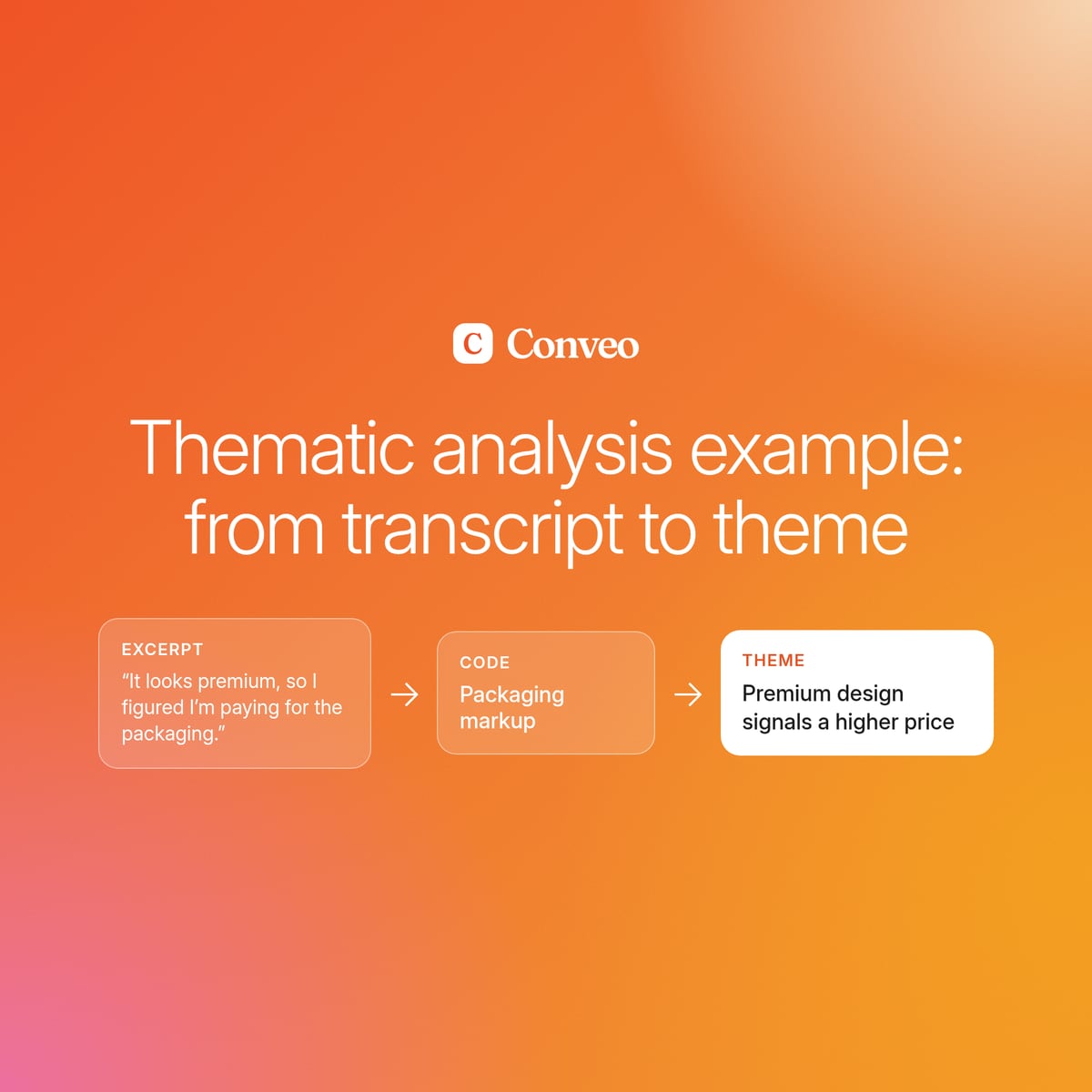
Phase 2, generating initial codes: read every transcript line by line and attach descriptive labels to extracts that carry meaning for your research question.
Phase 3, generating initial themes: group related codes into candidate themes that share a coherent underlying idea instead of a shared topic area.
Phase 4, reviewing themes: test each candidate theme against the full dataset, and collapse, split, or discard the ones that do not hold.
Phase 5, defining and naming themes: write a definition of each theme that sets its scope and boundaries, then name it after the claim it makes.
Phase 6, producing the report: select the most vivid extracts and ground each claim in verbatim quotes and timestamps.
For the full process, phase by phase, see the guide to thematic analysis.
Which phases can be compressed and which must remain intact
Not every phase takes the same time, and knowing which stage can be compressed without losing rigor separates fast analysis from sloppy shortcuts.
Phases that can be compressed
Phase 1 and Phase 2 are the strongest candidates for acceleration. An AI-supported first pass processes transcripts as a session closes, shifting analyst time from line-by-line tagging to validating the structure those tags produce. The mechanical work moves faster; interpretation stays with the researcher.
Phases that cannot be compressed
Phases 3, 4, and 5 require human judgment. A researcher decides whether two codes represent one theme or two, and whether a pattern holds across the dataset or only a subgroup, precisely the active role reflexive thematic analysis insists a researcher must keep.
Where most teams lose defensibility
Phase 6 is where the audit trail breaks down. Teams summarize themes without preserving traceability to quotes and timestamps, so findings arrive in stakeholder decks with no visible path back to the conversations that produced them, and get treated as opinion.
Documentation checklist for each phase
Rigor in applied settings is mostly a documentation discipline: writing decisions down as they happen instead of reconstructing them later.
Phase 1, initial memos: patterns, contradictions, and surprises noted before coding begins.
Phase 2, living codebook: define each code, bound it, and anchor it to an example extract.
Phase 3, candidate theme definitions: one or two sentences per theme, plus supporting codes.
Phase 4, revision log: record every theme collapsed, split, or discarded, with the reasoning.
Phase 5, final theme statements: scope, exclusions, and the central interpretive claim.
Phase 6, evidence map: each claim linked to a verbatim quote, a participant, and a timestamp.
Choosing between thematic analysis and content analysis
Thematic analysis and content analysis answer different questions, and applied teams often pick the wrong one. A short scoping decision at study design saves a reanalysis later.
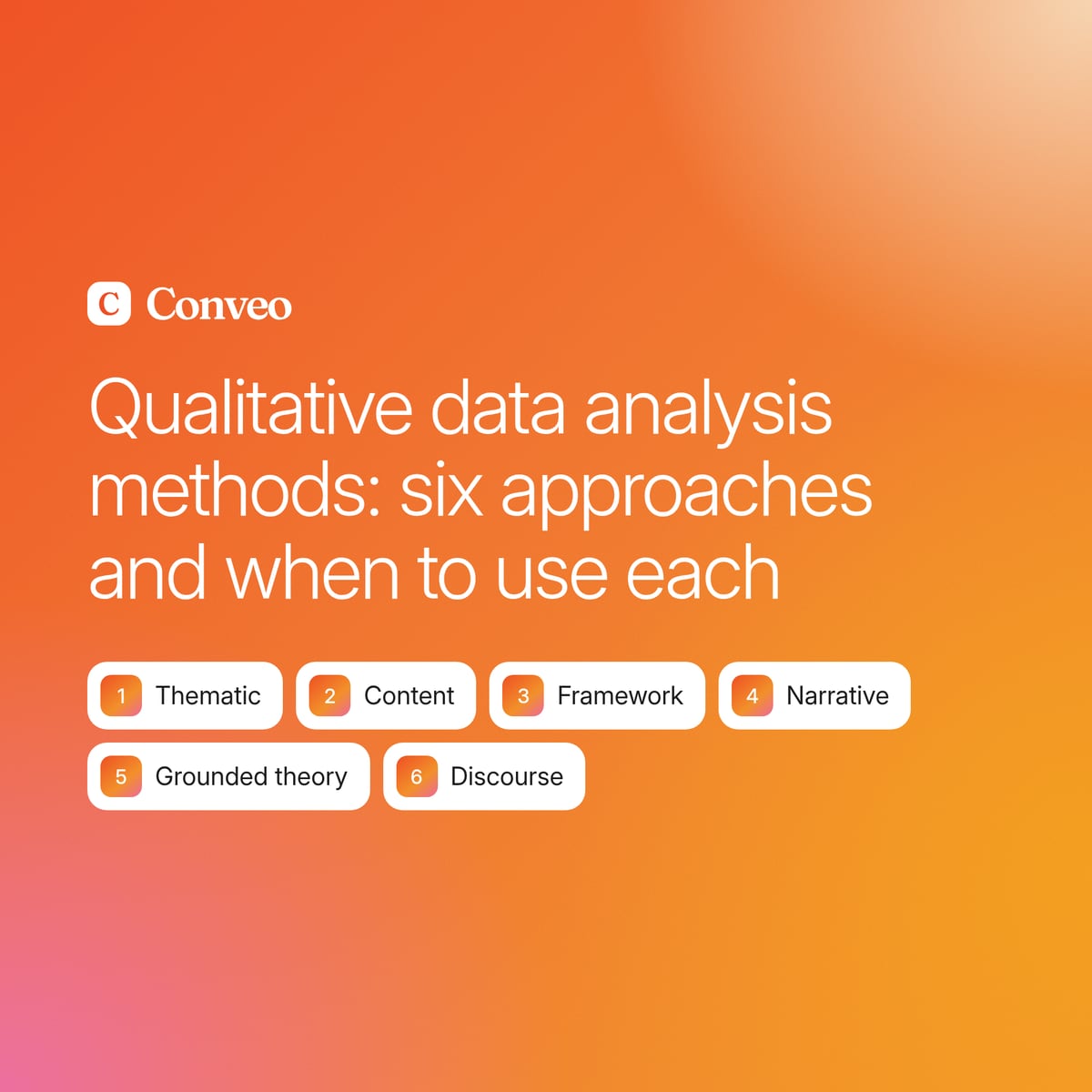
Grounded theory, for instance, is built to generate a new theoretical model from the data itself, a heavier commitment than most business questions need. Thematic analysis offers a flexible research process that doesn't require adopting a full theoretical framework before analysis begins, which is why it travels so well from critical psychology into applied social sciences and business research.
When thematic analysis is the right choice
Choose thematic analysis when the research question is interpretive: why participants hesitate, how they frame a category, what trade-offs they are actually making.
When content analysis is the right choice
Choose content analysis when the question is about frequency and distribution within a defined coding frame: how often a specific attribute is mentioned, and by which subgroup.
Sequencing both in one workflow
Run thematic analysis first to establish the themes, then apply the codebook as a content analysis frame to see how they distribute. In a representative scenario (an illustration, not a client study), a checkout-hesitation theme appears in 65% of one regional market and 20% of another, changing the recommendation from a product fix to a market-specific one. State the base size next to any such percentage, since qualitative samples don't support projectable incidence.
Academic-paced execution and a compressed workflow compared
A comparison between academic-paced execution and a compressed workflow is only useful if it is honest about where each is stronger. Academic pacing buys depth in places a compressed workflow does not.
| What matters | Academic-paced execution | Compressed workflow supported by Conveo |
|---|---|---|
| Familiarization and initial coding | Sequential reading passes by the researcher | AI-supported first pass, validated by the researcher |
| Theme searching, review, and definition | Researcher judgment across iterations | Researcher judgment, unchanged |
| Traceability to verbatim and participant | Maintained by hand in a separate pass | Every theme linked to quotes and clips as the analysis runs |
| Peer review depth | Extended external peer review across multiple refinement rounds | Internal review only, compressed into the study window |
| Typical cycle | Weeks | Days to weeks, with traceability built during the study |
Where academic pacing still wins: publication-grade rigor benefits from extended peer review, which no compressed workflow reproduces. Teams doing methodological or academic work should plan for the longer cycle deliberately.
Keeping themes traceable to the person who said it
Video-first data changes what Phase 1 and Phase 6 can produce. In an AI-moderated interview, a researcher hears the hesitation before an answer and the shift in tone that a transcript flattens.
"The analysis is instantaneous. I can synthesize all the data, and also go back and watch every interview. You can ask it to challenge your own thinking. It's so easy to talk to your data."
Dafydd Jones, Associate Director, Ninth Seat
With Conveo, video-first capture shows up as three concrete changes to the workflow:
From theme to moment. Teams move from a theme in the report to the coded excerpt, then to the moment a participant said it. A stakeholder challenge takes one click to answer.
Faster access to evidence. That is what makes a theme defensible in the room as well as in the appendix.
Findings that persist. Recurring themes and facets are recognized across studies in the searchable insight library, so the next study starts from what earlier ones established.
Considerations and where this workflow is not the right fit
Compressing analysis is a fit question. It pays off for some teams far more than others.
Teams with shallow, infrequent research demand won't get much from this documentation discipline, nor will findings that never need to persist beyond one readout.
The workflow assumes a researcher stays accountable for Phases 3 through 5. An AI-supported first pass that nobody validates produces codes without interpretation, a faster route to the same problem.
Where a study needs publication-grade peer review, plan the academic cycle instead.
Why Conveo fits defensible thematic analysis
Decision lag is the problem thematic analysis keeps running into: the framework is sound, and the theme still lands after the brief has closed. Teams using Conveo run AI-moderated interviews as an always-on layer alongside existing studies.
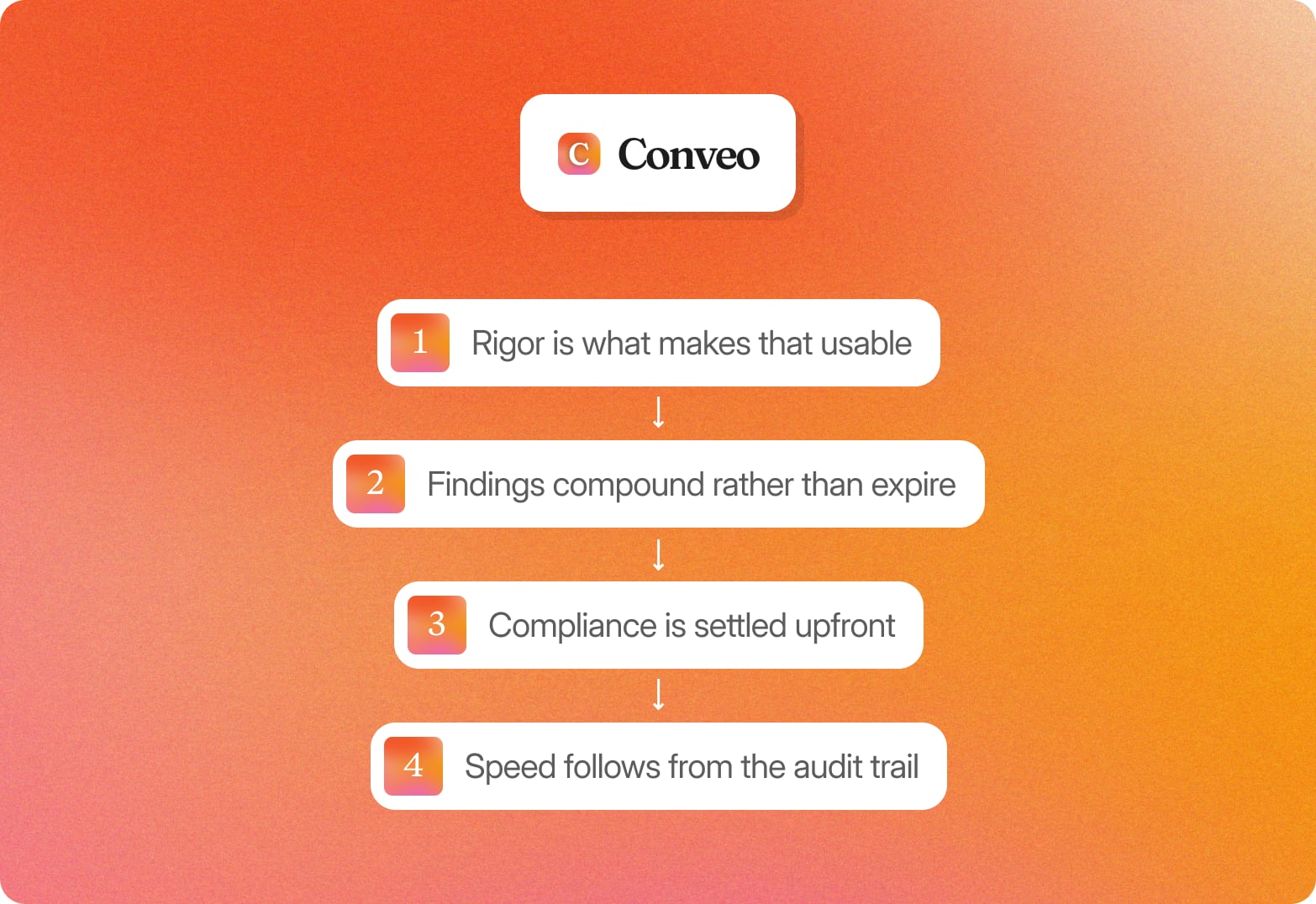
1. Rigor is what makes that usable
Conveo is built by researchers, and the researcher keeps Phases 3 through 5, the active role Braun and Clarke emphasize throughout their reflexive thematic analysis guidance. Every finding traces back to a real participant, supported by participant quotes and video.
2. Findings compound rather than expire
Recurring themes and facets are recognized across studies in the searchable insight library, so the next study starts from what earlier ones established.
3. Compliance is settled upfront
Conveo is SOC 2 and GDPR compliant, with data hosted in Europe, which procurement usually asks about first.
4. Speed follows from the audit trail
The audit trail arrives with the finding, while the decision is still open.
Frequently asked questions
What are the six phases of Braun and Clarke thematic analysis?
Familiarization with the data, generating initial codes, generating initial themes, reviewing themes, defining and naming themes, and producing the report. They are recursive rather than strictly linear.
Can thematic analysis be done in a week?
Parts of it can. Familiarization and initial coding compress well when transcripts are processed as sessions close and the researcher validates the code structure instead of building it by hand. Generating initial themes, reviewing them, and defining them depend on human judgment and should not be compressed.
Which phases of thematic analysis can AI support?
Phases 1 and 2, where the work is mechanical. Phases 3 through 5 require interpretation, since deciding whether two codes are one theme is an analytical judgment. Phase 6 benefits from AI support only for evidence retrieval.
How do you make a theme defensible to a stakeholder?
Keep the path from raw transcript to reported claim visible: a codebook with bounded definitions, a log of every theme collapsed or split with the reasoning, and each claim linked to a verbatim quote, a participant identifier, and a timestamp.
How many interviews does thematic analysis need?
Many applied teams work with 12 to 30 interviews per segment as a rule of thumb, and stop when new transcripts stop producing new codes. Past roughly 15 to 20 interviews, manual coding consistency typically starts to slip, though this varies by study. State the base size behind any reported percentage.
What is reflexive thematic analysis?
Virginia Braun and Victoria Clarke refined their original framework, making the researcher's active role in theme development explicit instead of treating themes as something that simply emerges from the codes. It reframes phase 3 as generating initial themes.

About the author
Meg Gerli
Research Impact Lead
Meg is a Research Impact Lead at Conveo, working with insights and research teams on the studies they run with Conveo.
Meet Meg on film →Qualitative insights at the speed of your business.
Conveo runs AI-moderated video interviews and structures everything they say.