In this article
TL;DR
Thematic analysis identifies patterns of meaning across qualitative data, and its hardest step is deciding when a group of codes becomes a theme: shared code definitions, a participant bar the team sets and records before coding, and negative cases that narrow the claim.
The problem: Coders reach different themes from the same qualitative data because no method guide shows when a code becomes one, so instinct decides.
The walkthrough: A six-step thematic analysis example from raw data to named theme, with excerpts at the judgment call.
The result: Themes teammates can verify, and meaningful insights stakeholders can act on, with the evidence kept visible.
Best for: Skeptical qualitative researchers.
Conveo is Consumer Understanding Infrastructure that keeps every theme traceable to its participants.
Why theme sets fall apart between coders on the same project
Here is a thematic analysis example most research teams have lived through: on one qualitative research project, two experienced researchers code the same 15 interviews and return different theme sets. Both followed the method. Neither can point to the exact moment a code became a theme. Method guides describe each phase of the coding process in order but never illustrate that judgment call, so each analyst fills the gap with memory and instinct.
The drift starts small. One coder tags a comment about shelf price as "price anxiety." The other tags a near-identical comment as "packaging markup." Neither label is wrong, but the two cannot be aggregated into one pattern until both coders agree which reactions belong under the same code.
Fixed codebooks and transcript-only review make that agreement harder, regardless of the qualitative data analysis software the team uses. The labels get compared while the underlying responses sit out of view, so nobody sees how different codes can describe the same reaction.
Coding qualitative data by hand gets harder to keep consistent as the interview count grows, and the longer the analysis runs, the more time definitions can drift before anyone catches it.
What follows makes that judgment call visible, using one representative study traced through the full thematic analysis journey, from raw data to named theme.
What separates a theme from a code
Every credible thematic analysis example rests on one hard line between a code and a theme. The clearest examples of codes and themes in thematic analysis show the gap:
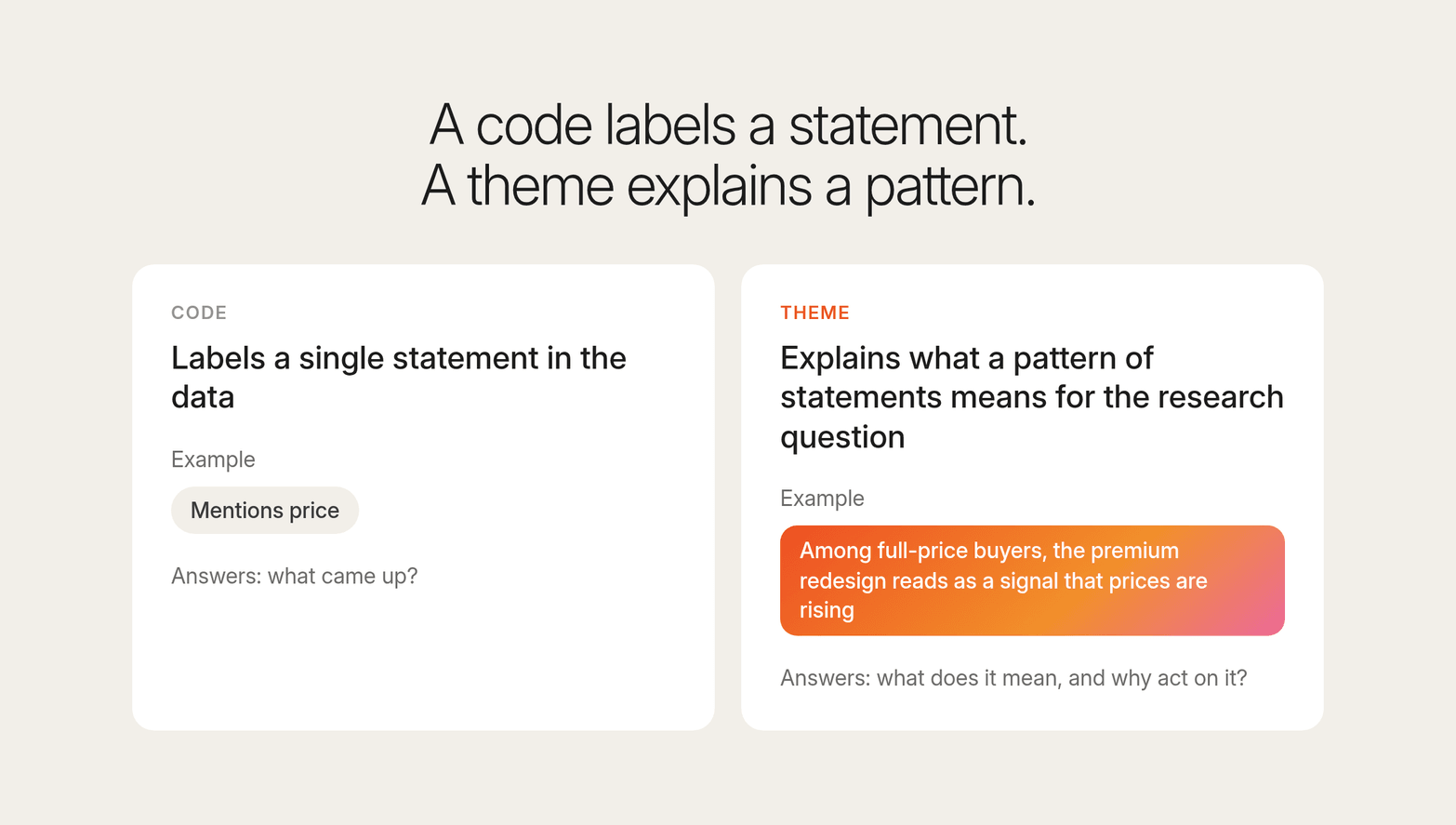
Code: labels a single statement in the qualitative data. "Mentions price" is a code.
Theme: explains what a pattern of statements means for the research questions. Identifying patterns is only the start: a theme says what those price mentions add up to, and why the team should act on it.
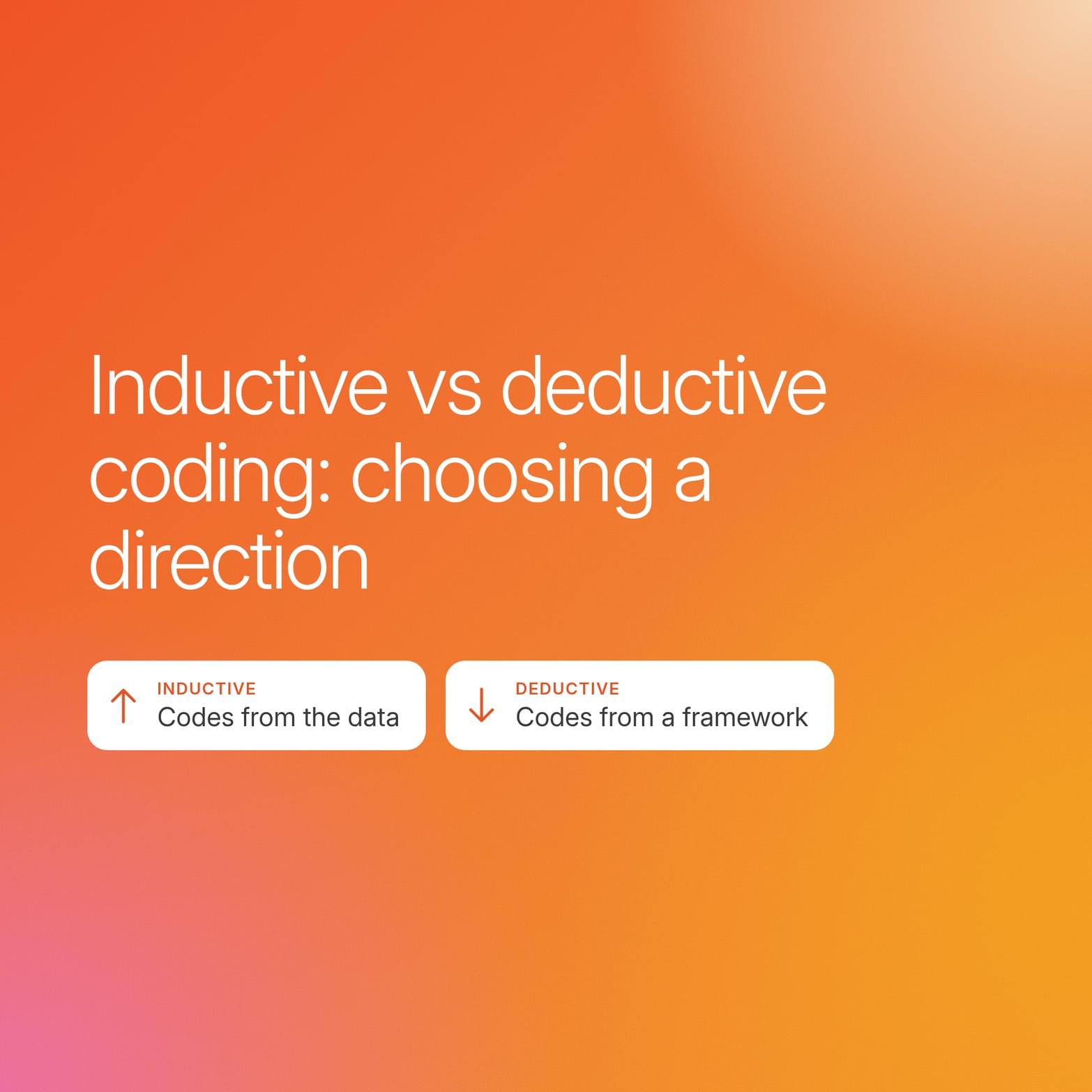
Deductive coding starts from existing theories or theoretical frameworks. With inductive coding, codes come from participants' own language, and themes emerge from the data itself. The step between coding and thematic analysis is interpretation: a theme earns its name when it explains what participants mean and why it matters. Counting how often a code appeared is content analysis; the content analysis vs thematic analysis split comes down to counting versus interpreting, two research methods with different uses.
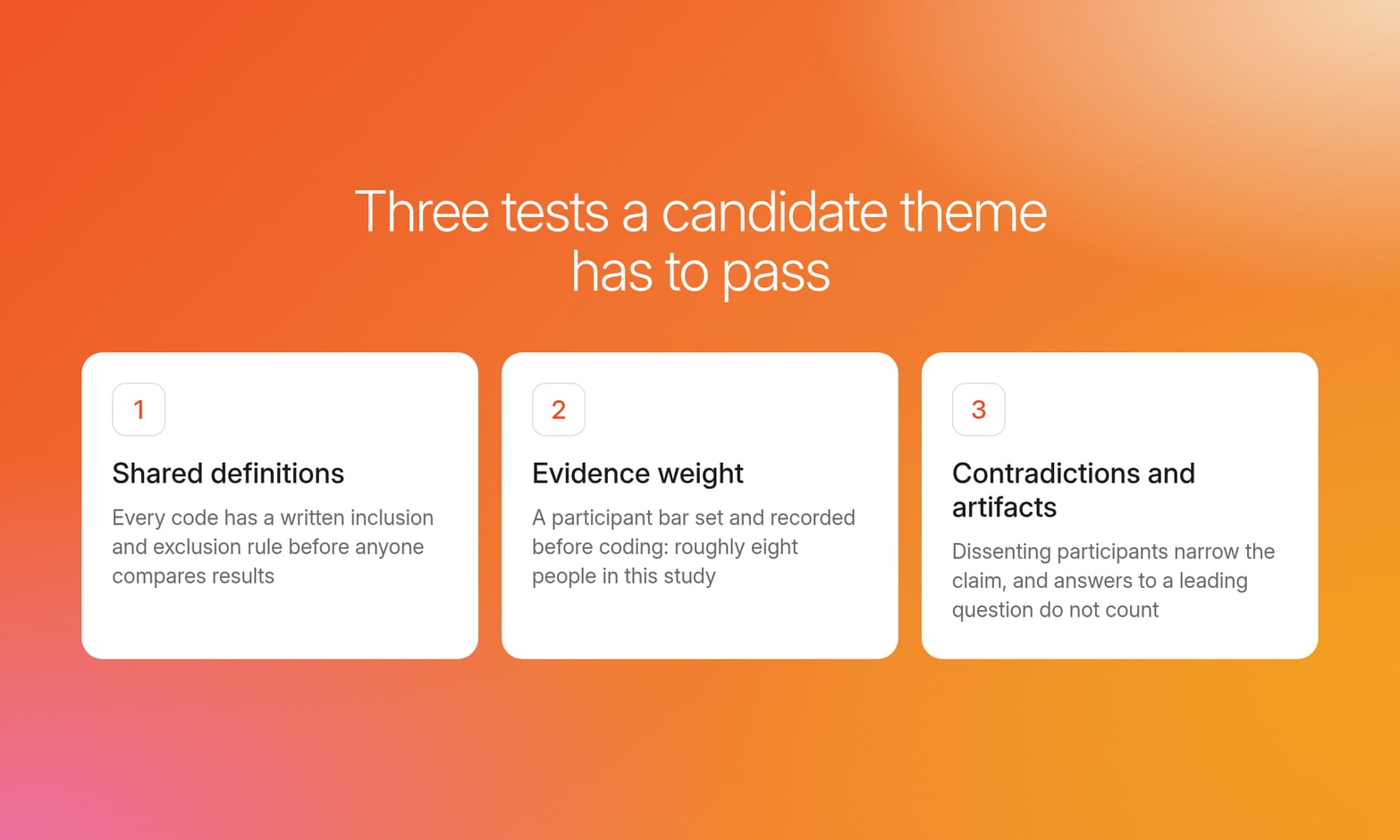
In any study, a candidate theme has to pass three tests:
Shared definitions. If "price anxiety" and "packaging markup" mean different things to different coders, no theme built on them aggregates cleanly. Write each definition with an inclusion and exclusion rule while creating codes, before anyone compares results. Shared definitions make coding systematic.
Evidence weight. A theme built on two participants is an anecdote with a label. In this study, the team set a working bar of roughly eight participants before naming a theme. Braun and Clarke treat prevalence as one signal among several, so set and record your own bar before coding. Pair the participant bar with a check on data saturation in qualitative research: stop naming themes when new transcripts add no new meaningful patterns.
Contradictions and artifacts. Maintaining analytical rigor also means accounting for the participants who contradict a pattern. Eight participants repeating one phrase after a leading question point to an interviewer artifact instead.
Conveo's position is that a theme without its participants attached is an opinion, however carefully it was coded.
A six-step thematic analysis example from transcript to named theme
This Braun and Clarke thematic analysis example applies the six phases first published in 2006, now framed as reflexive thematic analysis, to one study, because they are clearer when applied than described in the abstract. The study is a representative packaging research study built for illustration: 15 in-depth interviews about a redesigned premium packaging line, used to show how to do thematic analysis one decision at a time.
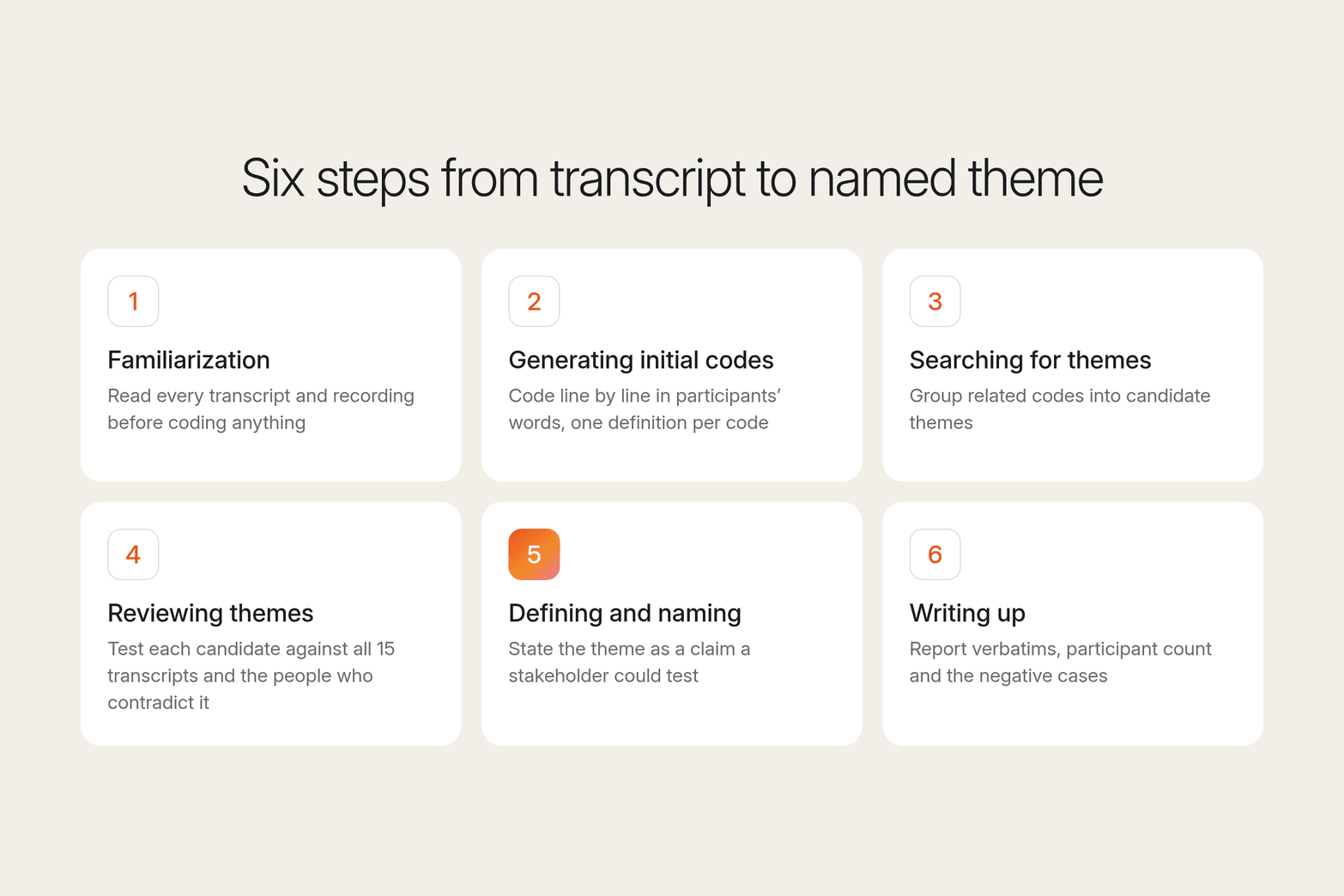
Familiarization. Once data collection ends, read all the data, every transcript and every recording, before coding anything. Keep detailed notes on first impressions, because they become the earliest record of potential themes. In the example: A content analysis pass here would count mentions: visual appeal in 80% of interviews, sustainability in 60%, and price in 40%. Most participants mentioned price indirectly, through comments about how premium the design looked, so the mention count understates it. Those counts show what came up. They say nothing about what it meant.
Generating initial codes. Start coding qualitative data line by line in participants' own words, labeling data segments and writing a one-line definition for each code as it appears. One excerpt can carry multiple codes, so tag every meaning it holds. In the example: Resist early merging. "Design looks expensive" and "worried about price" stay separate until the written definitions show they overlap.
Searching for themes. Group related codes into initial themes, organizing data around what each group explains about the packaging decision. In the example: Two emerging themes stand out. Premium design signals a higher price, and loyal buyers feel disconnected from the modern aesthetic.
Reviewing themes. Check each candidate against its coded data excerpts, then against all 15 transcripts. Borrow constant comparison from grounded theory: test each new excerpt against the candidate and search for participants who contradict it. In the example: The price-signal candidate appears in 10 participants, voiced as quality, a warning, and resignation. The loyal-buyer candidate appears in nine. Both clear the team's working bar of roughly eight participants and move forward to theme refinement. Negative case check: Three participants saw the premium design and expected no price change, because they buy the line on promotion. They stay in the analysis and narrow the claim to full-price buyers.
Defining and naming. State the theme as a claim a stakeholder could test, and check how it fits the overarching patterns across the study. Record which participants and quotes support it, and which limit it. In the example: "Among full-price buyers, the premium redesign reads as a signal that prices are rising."
Writing up. In the research report, present each theme with its supporting verbatims, participant count, and the negative cases that shaped its boundary. A teammate should be able to retrace every decision without asking the analyst who made it. For layouts beyond the theme table, see how to present qualitative data. The test: If the write-up cannot answer "which participants, and who disagreed," the theme is not finished.
| Theme | Participants | Boundary decision |
|---|---|---|
| Among full-price buyers, the premium redesign reads as a signal that prices are rising | 10 of 15 | Three promotion buyers expected no price change, so the claim narrows to full-price buyers |
| Loyal buyers feel disconnected from the modern aesthetic | 9 of 15 | Participant 12 noticed the unchanged price, and her reaction anchors this separate finding |
Theme table from the six-step thematic analysis example.
In Conveo, researchers review the evidence behind a theme as it forms during the thematic analysis process, and that difference shows most clearly on a live study.
Where the analyst's judgment still decides the theme boundary
Thematic analysis in qualitative research still depends on a human call about where a theme begins at every stage of the process. Conveo leaves that analytical call to the researcher. AI-assisted grouping can surface emerging themes faster. It cannot decide which ones are real.
Teammates diverge at two moments in any qualitative analysis:
Sufficiency. In a systematic analysis, the analyst decides a theme has crossed the participant bar set before coding by counting distinct people and checking that they phrased it differently. Then the analyst confirms no probe led them there.
Contradiction. A dissenting participant either narrows the claim or reveals a separate finding. Quietly dropping that participant is never an option.
Example: A candidate theme surfaces across 11 participants. The researcher reviews the clips, finds two were agreeing with a leading follow-up question, and removes them as false positives. Nine remain, so the theme holds, with a narrower claim.
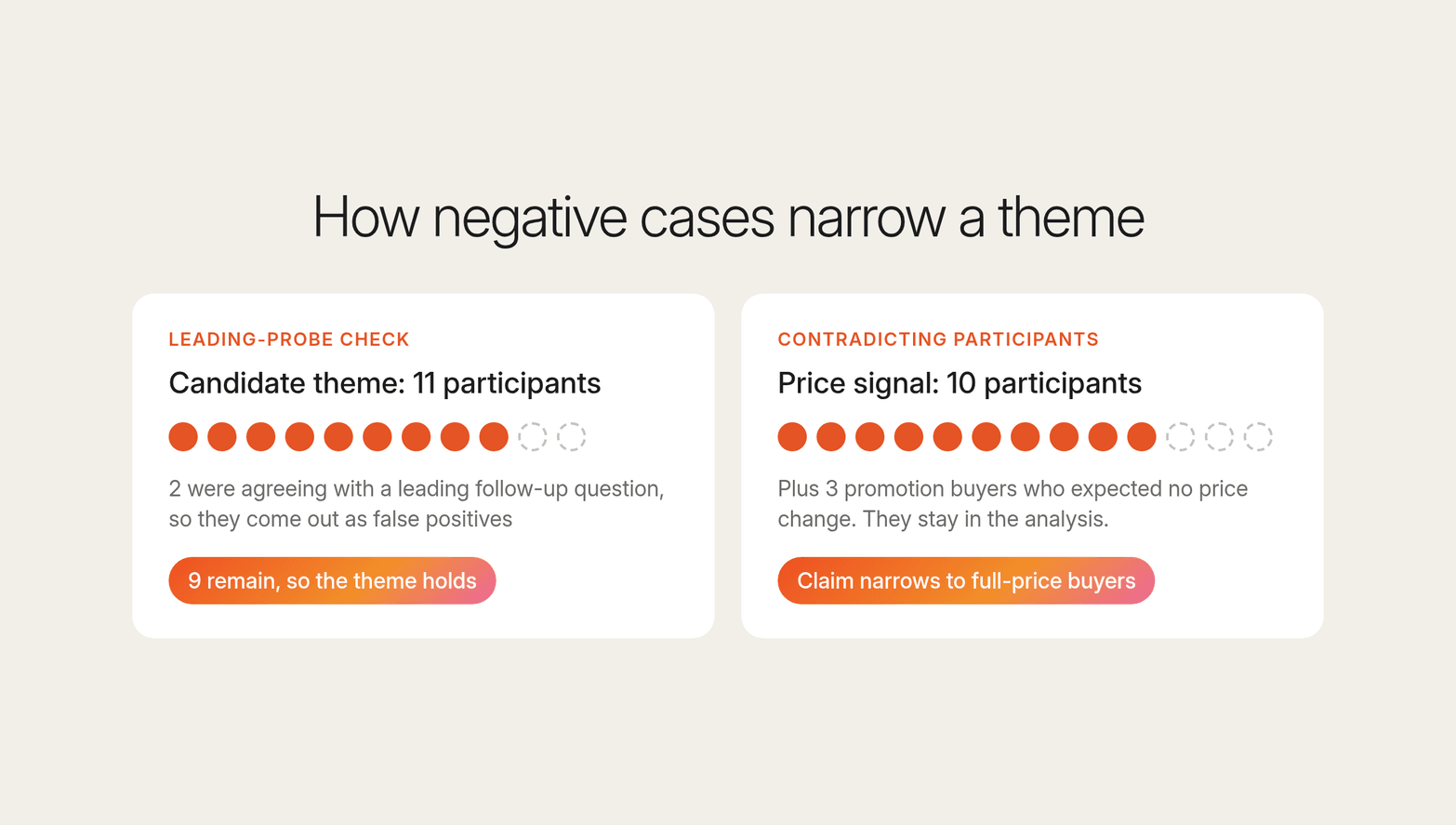
In Conveo, researchers inspect and correct the AI coding, check the clips behind each theme, and decide what is strong enough to report. Conveo groups the evidence. The analyst draws the line, and the analyst's name stays on the finding.
A thematic analysis example in three transcript excerpts
This thematic analysis example starts with Participant 4, a full-price buyer, describing the redesigned packaging. Like the rest of this walkthrough, it is a representative scenario written for illustration, not a client dataset.
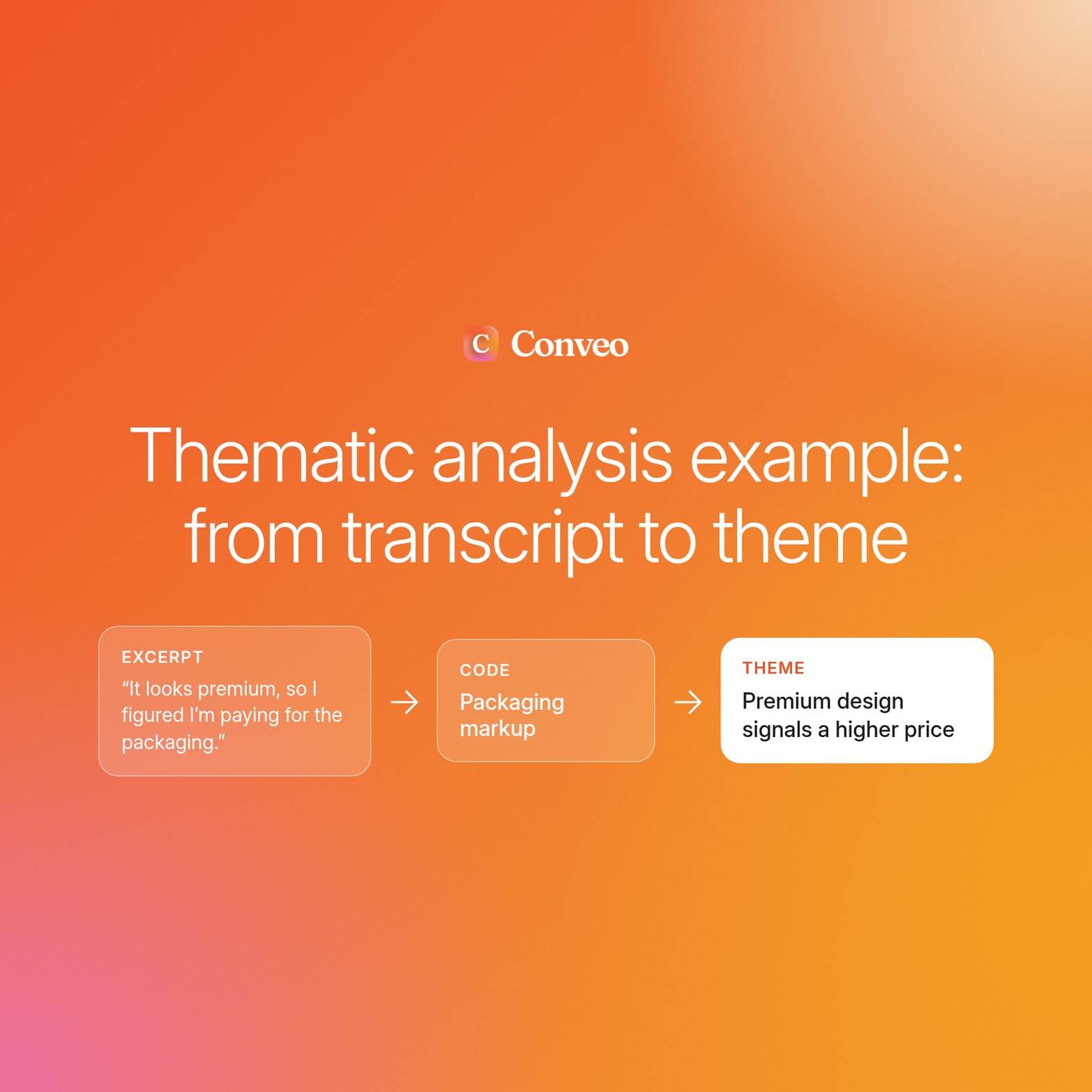
Participant 4: "It looks like the kind of box that costs more. I assumed the price went up before I even checked the shelf tag."
Participant 9: "Recyclable, sure, everyone does that now. What I noticed is that it looks premium, so I figured I'm paying for the packaging."
Participant 12: "I've bought this brand for years. The new one looks nice, and the price is the same. It doesn't feel like it's for me anymore."
Three judgment calls turn these excerpts into themes:
Merging codes. The first coder tagged Participant 4 as "price anxiety" and Participant 9 as "packaging markup." Read against the written definitions, both describe the same reaction: premium design implies a higher price. That shared meaning is why the two excerpts sit in one theme despite the different codes, and categorizing codes by meaning is what lets them merge.
Checking the threshold. Two excerpts do not make a theme. Before naming it, the analyst searches the other 13 transcripts for the same meaning in different words, and finds eight more participants who express it. That spread, with variation in tone, clears the team's bar.
Testing the negative case. Participant 12 runs through negative case analysis next. She noticed the unchanged price, which contradicts the price-signal pattern, but her discomfort is about identity. The analyst decides she does not narrow the price theme. She anchors a separate finding, built from related codes about loyalty and aesthetic fit: loyal buyers feel disconnected from the modern aesthetic.
Participant 9 also shows sustainability working as an assumption, something expected of any package rather than a reason to buy, a signal that may feed broader themes in later studies.
| Participant | Excerpt | Code | Theme |
|---|---|---|---|
| Participant 4 | "I assumed the price went up before I even checked the shelf tag." | Price anxiety | Premium design signals a higher price |
| Participant 9 | "It looks premium, so I figured I'm paying for the packaging." | Packaging markup | Premium design signals a higher price |
| Participant 12 | "It doesn't feel like it's for me anymore." | Loyalty, aesthetic fit | Loyal buyers feel disconnected from the modern aesthetic |
Example of thematic analysis table: three excerpts mapped from code to theme.
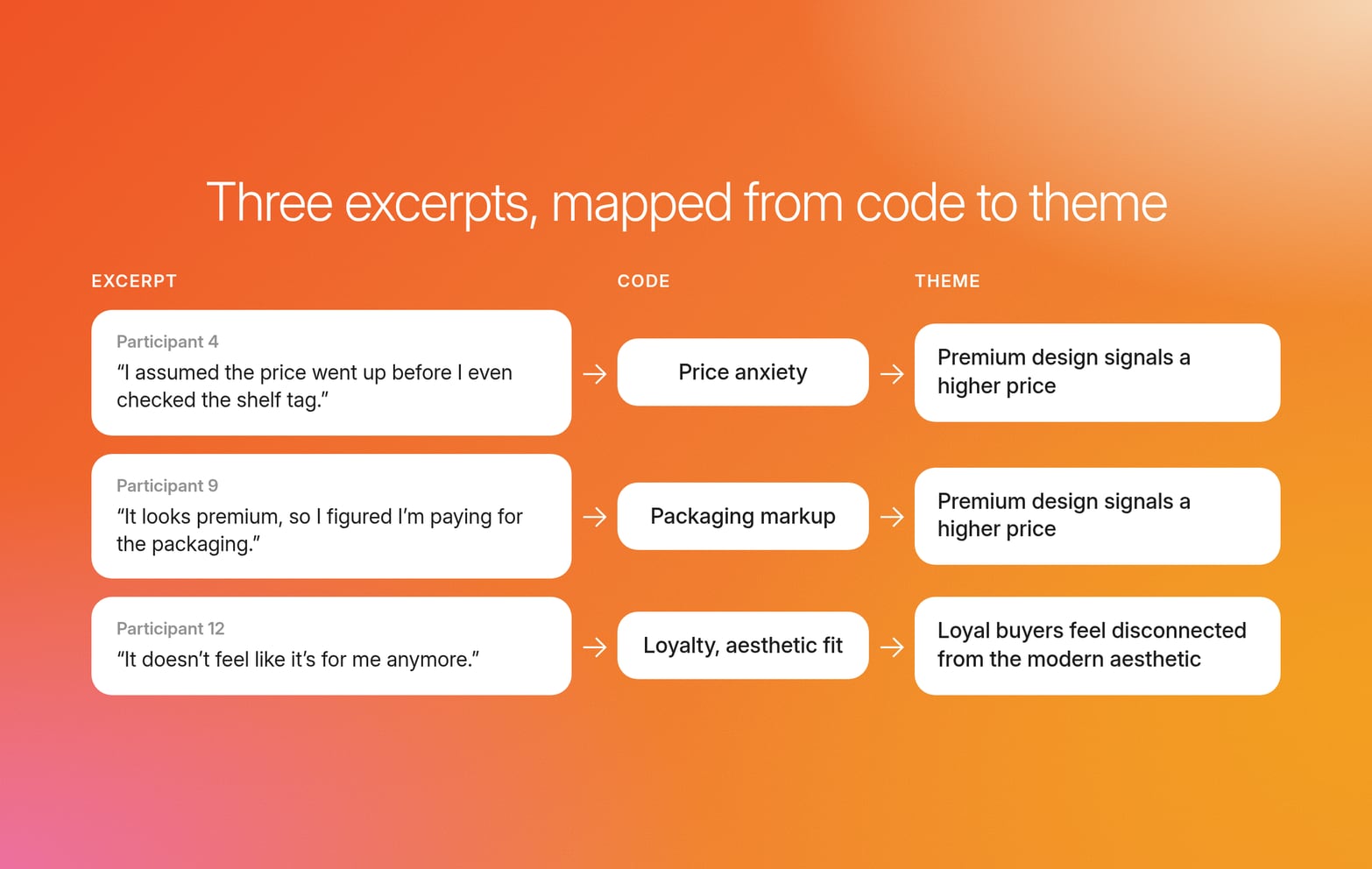
The decision is visible at every point of the analysis process. Anyone on the team can reread the three excerpts, test the grouping against the definitions, and reach the same theme or argue specifically against it.
Coding mistakes that produce themes no one else would recognize
A thematic analysis example falls apart in peer review for a small set of repeatable reasons, and they are the common challenges teams hit when analyzing interviews at scale. In practice, each traces back to an instinct-driven judgment call. Audit your own thematic analysis coding, across all your data, against this list.
Definitions written after coding. Two labels for the same reaction drift apart when coders generate initial codes with definitions in their heads. Write inclusion rules for all the codes before the second transcript.
Topic codes standing in for meaning. "Mentions packaging" records that a subject came up. Thematic coding labels what the participant claims. Skip that, and the theme inherits the vagueness.
Mentions counted instead of participants. One talkative participant repeating a point six times is still one participant, a trap that is even more common in focus group discussions. Count people, then check how differently they say it.
Themes named on thin evidence. Two vivid quotes feel like a pattern. Hold the theme until it clears the participant bar you set before coding, with real variation.
Contradicting cases dropped quietly. Skipping negative case analysis inflates claims. Name the participants who disagree, and limit the theme to the people it describes.
Prompted answers coded as unprompted. Check the interviewer's question before coding the reply. Agreement with a leading probe is weak evidence for any theme.
Every mistake on this list shares a root cause in the coding process: the evidence behind the label is out of view when the decision gets made. In Conveo, each theme links to the participants behind it, with video clips and verbatim quotes stakeholders can audit, so a reviewer can catch a leading-probe artifact or a thin-evidence theme before it ships.
How Conveo keeps the evidence visible while the theme is forming
The theme-boundary problem in this thematic analysis example comes down to analyzing qualitative data with the evidence out of view when the decision gets made. Coders compare labels and memories, and the responses behind them stay buried in transcripts.
"You see them physically doing it. Testing the product for the first time, being probed right there. That unfiltered, in-the-moment reaction is possibly the most powerful thing you can see as a researcher."
Dafydd Jones, Associate Director, Ninth Seat
In Conveo, researchers work with that evidence in view:
Themes linked to evidence. Researchers choose a theme while reviewing what supports it. Each theme links to the participants behind it, with video clips and verbatim quotes stakeholders can audit, so the coding and the evidence sit in one place.
Signal a transcript hides. Conveo's multimodal analysis covers speech, tone and facial cues across every session. Because analysts can watch the clip behind each quote, they catch the hesitation a transcript drops.
Hours spent on judgment. Conveo's AI codes responses question by question and surfaces candidate themes, so analysts spend their hours validating and interpreting. Every boundary call in the research process stays with the researcher.
Findings that compound. Recurring themes and facets are recognized across studies in a searchable insight library, so the next wave starts from what earlier ones established instead of a blank codebook. Over time, those recurring themes become overarching themes, and the team builds a broader understanding of its category.
The outcome is a theme set a teammate can audit clip by clip. The next packaging study starts from traced evidence, and a stakeholder acting on a theme can see exactly which participants and clips it rests on.
See it in action: a Conveo report with every theme linked to its quotes and clips.
Frequently asked questions
What is an example of thematic analysis in qualitative research?
A strong thematic analysis example traces one study, such as a representative 15-interview packaging study, from transcript to theme. Two themes cleared the study's working bar of roughly eight participants: premium design signaling higher prices among full-price buyers (10 of 15 participants) and loyal buyers disconnected from the modern aesthetic (nine of 15). The key patterns also showed sustainability expected rather than motivating, which stayed a supporting observation. The data analysis ran through familiarization, developing themes iteratively, and contradiction checks.
What format should a thematic analysis follow?
A defensible thematic analysis format runs from raw data to defined codes to a named theme stated as a claim that answers the research questions. When reporting patterns, each theme carries verbatim quotes or source clips, because stakeholders cannot audit it otherwise. The format also lists negative cases: participants who contradict the pattern and limit the claim. Align code definitions first, or "price anxiety" and "packaging markup" cannot merge.
What does a thematic analysis table look like?
A theme table is the most common data visualization in a qualitative analysis: it maps each transcript excerpt to its code, then to its theme. That mapping, along with visual tools like a code-to-theme diagram, makes the boundary call traceable. A prevalence table counts mentions, such as visual appeal in 80% of packaging interviews. The hybrid route turns validated themes into a fixed codebook, such as the two packaging themes applied to 50 more interviews across six markets, where cultural context shapes how participants voice the same reaction. The same codebook can then run across other data sources, such as open-ended survey responses.
How do you do thematic analysis on a single interview?
On a single interview, code line by line and flag candidate themes, then test them against the rest of the study. A code becomes a theme only when its meaning recurs across all your transcripts, in other participants' words. The same rule applies to focus group transcripts: one vocal speaker is still one participant. Transcripts can misrepresent meaning by omitting pauses, tone, and facial expressions. Because analysts can watch the clip behind each quote, they catch the hesitation a transcript drops and the deeper insights behind it, and Conveo's multimodal analysis covers speech, tone and facial cues across every session. Researchers still inspect and correct the AI coding, check the clips behind each theme, and run negative case checks as part of the method.
Does a thesis thematic analysis example apply to enterprise research?
A thematic analysis example from a thesis teaches the right discipline. Academic work often follows reflexive thematic analysis and anchors themes to existing literature, while enterprise teams anchor them to research objectives and a business decision, under tighter constraints. Either way, deciding when codes become a theme is the hardest step in any qualitative research project, often made by instinct. Analyzing qualitative data by hand strains as interview counts grow. With Conveo's integrated panel network supporting data collection and AI-assisted first-pass coding, analysts shift their time from line-by-line tagging to validation.

About the author
Florian Hendrickx
Head of Growth
Florian is Conveo’s Chief Growth Officer, leading growth strategy and go-to-market execution as the company scales. He’s held growth leadership roles at companies like Deliverect, Robovision, and Aikido Security, and brings hands-on experience across marketing, sales, and product.
More by Florian →Qualitative insights at the speed of your business.
Conveo runs AI-moderated video interviews and structures everything they say.