In this article
TL;DR
The decision closes before the insight lands. A bank fixes the step where mortgage applications stall, or an insurer rewrites its claims messaging, and the qualitative evidence explaining customer behavior arrives afterward. Velocity and hit rate on those calls now decide which financial institutions stay competitive.
Rigor is what makes fast evidence usable. Adaptive probing surfaces the hesitation behind an answer, and each theme traces to a real person who said it, on the record, with the timestamp attached.
Understanding should compound across studies. Conveo's searchable insight library connects findings across projects so nothing is researched twice.
Governance is the entry ticket in this sector. SOC 2 Type II certification, GDPR compliance, EU hosting (Belgium), and on-demand PII deletion clear the security review before the methodology is discussed.
Speed is supporting proof. Teams report multi-market fieldwork moving from weeks to days, while the evidence standard holds.
A bank's insights team learns why consumers abandon mortgage applications mid-process about a month after the product team has already re-sequenced the form. An insurer learns which phrase in a claims letter triggers distrust after the letter has gone out. The research is good. It is also, for practical purposes, historical.
That is decision-lag, and it is the real constraint on market research in financial services. Product roadmaps lock, campaign briefs get approved, and channel budgets get committed on a cycle that qualitative fieldwork struggles to keep pace with. When understanding arrives after the fact, the organization makes its most consequential decisions on instinct and then pays for evidence that confirms or contradicts a choice it can no longer revisit.
This article is written for insights and CMI professionals at banks, credit unions, insurers, and fintech companies who need consumer evidence inside the decision window, distinct from real time fraud detection or transaction monitoring, which run on statistical signals rather than qualitative interviews: the rigor that makes always-on qualitative research defensible, the compounding that makes it cheaper over time, and the governance that gets it through procurement.
Why market research in financial services arrives after the decision closes
Traditional agency qualitative research runs on a timeline financial services teams plan around rather than plan with. Briefing, recruitment, moderation, synthesis, and delivery stack sequentially, and the full cycle runs for months in most financial services sector programs, making market research here a different discipline from effective market research in unregulated categories.
The lag shows up in three places:
Sequential execution compounds across markets. Qualitative market research banking teams commission typically runs country by country: one market completes before the next begins, translated deliverables arrive from different vendors on different schedules, and synthesis waits on the last transcript. By the time [INTERNAL LINK NEEDED: multi-market qualitative research] reaches a consolidated view, the stakeholder who commissioned it has often moved to a different priority.
Surveys report the what while the why stays hidden. Consumer research financial services teams face a second, less visible gap: the distance between what a survey reports and what actually drives behavior. A survey can tell you that 62% of participants found a product message "clear." It cannot tell you the same people hesitated before answering or described a workaround that signals the message landed differently than the percentage implies. Aggregated industry reports have the same limitation: they describe a market based on averages, while the hesitation that will sink a launch remains invisible. In regulated categories, where comprehension and trust carry legal weight, those hesitations are often the most consequential finding in the data.
Slide-deck findings lose to opinion internally. When findings arrive as slide-deck summaries, stakeholder alignment shifts from evidence to opinion. A persona claim that cannot be traced to a specific consumer quote becomes negotiable, and product, brand, compliance, and legal each read the summary through their own lens.
What financial services teams need from qualitative research
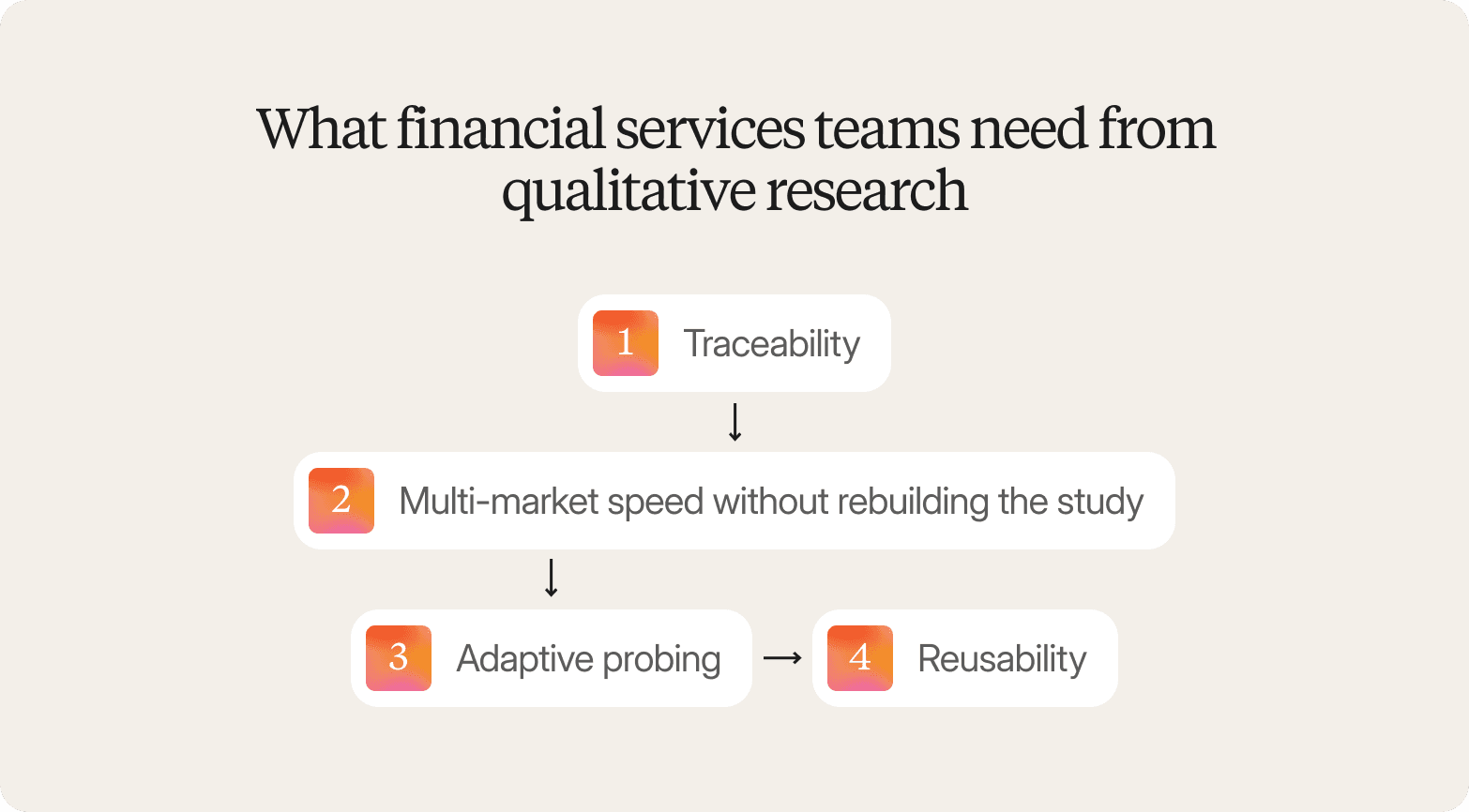
Financial services research sits at a harder intersection than most: decision cycles are short, and the evidence bar is high. Speed and rigor both operate as conditions of the work here, and both are conditions for research that genuinely helps teams understand customer intent and keep pace with shifting customer expectations.
Traceability. When each theme links directly to timestamped video clips and verbatim quotes, compliance stakeholders verify the claim themselves rather than trusting a researcher's interpretation. That is what carries a finding into a product decision or a regulatory response.
Multi-market speed without rebuilding the study. Coordinating translation, recruiting in-language moderators, and scheduling across time zones adds weeks to an international study before a single insight exists. The data collection method involves collecting data across 50+ languages without rebuilding the research design per market, which removes that queue and gives teams a faster way to gather feedback.
Adaptive probing. Adaptive probing in qualitative interviews is where the most useful signal in financial services UX research lives. Participants rarely volunteer compliance objections or decision friction unprompted. When a moderator follows up on hesitation instead of moving to the next scripted question, the pain points surface in the participant's own words.
Reusability. The customer insights financial services teams generate should compound. When clips, themes, and quotes from one study stay searchable in the next, a question answered six months ago does not need to be commissioned again from scratch, and the same data points can be reused to identify trends across waves.
The practical test is whether a finding survives the approval chain: the insights lead, the product owner, brand, legal, and often a regulator-facing function. That's why traceability, sampling discipline, and documented governance belong in the study design rather than in the write-up.
How AI-moderated interviews work in regulated industries
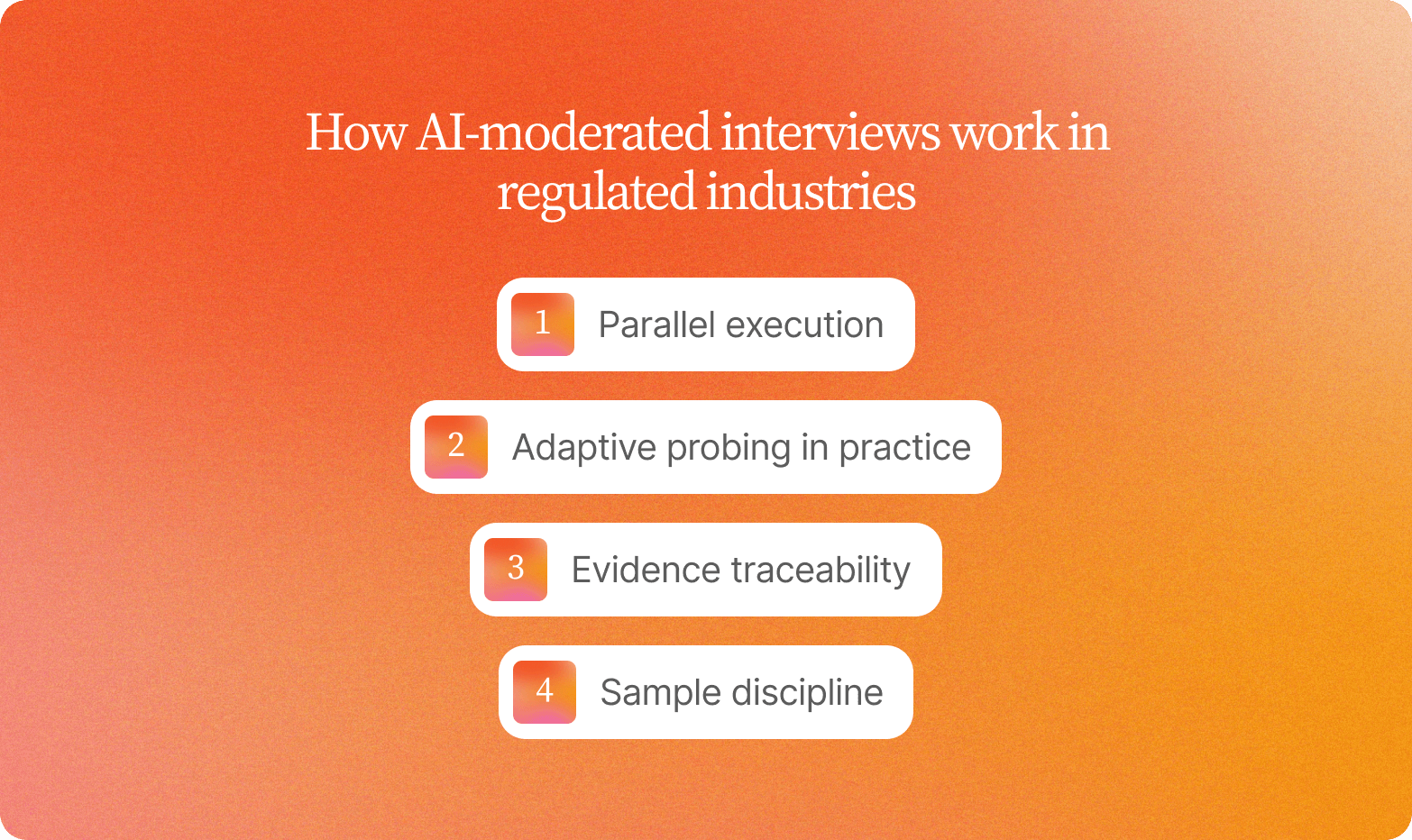
AI-moderated interviews are depth interviews conducted by an AI moderator trained on research methodology, running asynchronously on video while participants answer in their own language and on their own schedule. The moderator works from the discussion guide the research team writes, then probes based on what each participant actually says. Teams evaluating a customer insights platform for regulated work usually encounter Conveo here, the essential tool that runs the moderation and the analysis behind it.
Parallel execution
Instead of scheduling individual sessions across markets over weeks, AI qualitative research financial services teams field 10 to 1,000 conversations simultaneously across time zones and languages. Fieldwork that once ran for months now yields usable findings in a fraction of the time because scheduling constraints have been removed.
Adaptive probing in practice
For qualitative interviews banking sector teams run, credibility lives or dies on adaptive probing: a rigid guide asks the same follow-up regardless of what a participant just said. Conveo's AI moderator does the opposite: it registers hesitation, contradiction, or an unexplained shift in tone, and probes exactly there. The most consequential findings in financial services research rarely surface in response to the opening question.
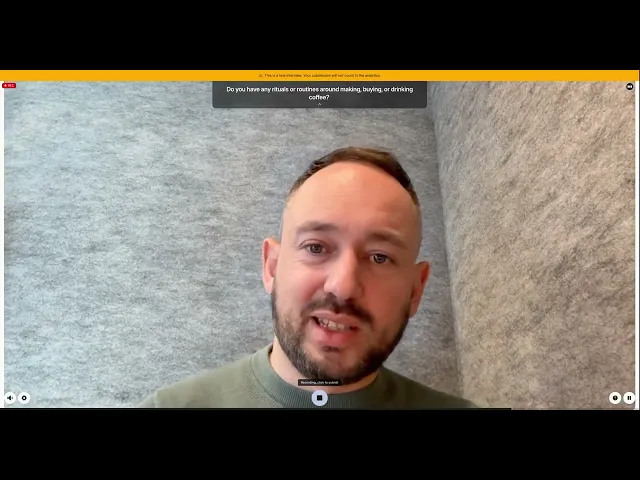
In insurance customer research, a participant who says a claims process "seems fine" but slows down and adds "I suppose" is signaling something a static survey never captures. Conveo's AI moderator can pick up that hesitation and ask what specifically felt uncertain, producing verbatim evidence, hard data rather than an inferred rating, that product and compliance teams can act on rather than a score they have to interpret.
See it in action: How AI-Moderated Interviews Work
Evidence traceability
Transcription and translation mean synthesis begins while fieldwork is still running, and each theme carries its source with it. When a stakeholder challenges a finding, the answer is a clip of a real participant saying it, at a specific moment in a specific session.
Sample discipline
Recruiting 5 to 15 participants per defined segment is typically sufficient to surface stable behavioral patterns, provided screening criteria and research objectives are set before fieldwork begins rather than adjusted to fit early results, across distinct groups such as mortgage holders and claimants. Teams recruit through Conveo's integrated panel network or bring their own list, drawing on existing customer interactions with potential customers and new customers alike.
Multi-market execution: From sequential to parallel
Running multi-market research sequentially is the most predictable way to miss the decision it was meant to inform. Each market has its own vendor, moderation team, and translation pipeline, and the overall timeline can stretch for months before cross-market synthesis can begin.
Parallel execution changes the operational structure rather than the method. With AI-moderated interviews running across 50+ languages at once, all markets field at the same time, in participants' native languages, with the same discussion guide adapted for local context. Because transcription and translation happen as sessions close, analysis does not wait for fieldwork to end.
In a representative scenario, a global bank running bank customer experience research on a new digital onboarding flow spanning web, mobile apps, and other digital platforms across multiple channels and 12 markets completes fieldwork in days rather than waiting a quarter for a consolidated read. The team recruits through participant recruitment and behavioral screening, or brings its own customer list, and sessions run in parallel and in-language without coordinating a network of regional moderators.
Governance continuity holds throughout in consumer insights banking work: each market's findings stay linked to their source recording in the original language, so regional compliance teams verify a claim against what the participant said rather than a translated summary.
Evidence standards for high-stakes decisions
Personas built from demographics, age bracket, income band, region, tell you who bought. They rarely tell you why, and in regulated buying cycles, that gap is where messaging fails. Key performance indicators and key metrics, like customer churn, can flag that something has changed; they rarely explain what changed and rarely deliver the critical insights a brand team needs. When a team cannot identify which consumers expressed a specific concern or what words they used, psychographic traits invented in a workshop are treated as marketing fiction.
The credibility problem is structural. Workshop personas are assembled from inference and professional instinct, a reasonable way to generate hypotheses, but a weak basis for justifying messaging decisions where regulatory scrutiny sits inside every launch.
Voice of customer financial services programs hit a specific version of this. A consumer described as "slow to decide" is often less hesitant than the term implies. Teams report the label frequently masks institutional friction: auditability requirements, multi-stakeholder sign-off, and approval chains the individual cannot bypass. Only verbatim evidence surfaces that difference, because it preserves the language the participant used about their own situation. These are the standard voice-of-customer program requirements that regulated industries must meet before their findings carry weight.
Consider an insurance consumer insights team testing a claims messaging framework, an exercise that touches brand strategy and brand health research as much as compliance, and that sits at a sensitive point in the customer journey. Before legal review, the team needs to show not only that "participants found the liability language confusing," but when, in which session, and in whose words that confusion appeared. A clip attached to the theme gives the reviewer something they can evaluate for themselves.
Evidence at that standard is also worth keeping and delivers key insights well beyond the original question. Conveo's searchable insight library stores clips, themes, and quotes in a format that the next study can query, turning durable data analytics into something the whole insights function can use. When the same liability confusion resurfaces in a later wave, the team connects both moments and shows a pattern rather than an anecdote.
Compliance, privacy, and governance in financial services research
For market research financial services teams, the blockers that slow platform adoption sit in governance and risk management, and in disciplined data privacy practices as regulatory changes reshape what counts as acceptable from one year to the next. Conveo is SOC 2 Type II certified, GDPR compliant, EU hosting (Belgium), which resolves much of that review before the methodology conversation begins.
Consent and PII handling. Qualitative research in banking involves collecting personal data, including sensitive customer data, from regulated consumers, which entails consent obligations, defined retention periods, and restrictions on cross-border data transfer.
Hosting location. EU hosting (Belgium) keeps participant data in the jurisdiction, which shortens the legal review cycle and gives many institutions a straightforward answer to a question that used to require outside counsel. There is no transfer impact assessment to complete and no additional safeguards to negotiate with a data protection officer.
On-demand PII deletion and SSO. These cover the remaining items on most security questionnaires, as shown by data governance checklists in consumer research in this sector.
Audit trail. When findings inform regulated communications or product disclosures, compliance teams need every claim in the report to trace back to something a real participant said. Linking each theme to timestamped video clips and verbatim quotes creates exactly that trail, checkable without the researcher in the room, and it does more to protect a bank's reputation than any disclaimer buried in a report appendix.
In a representative scenario, a multinational bank testing a credit card offer, one of several financial products moving through the pipeline that quarter, across European markets satisfies its GDPR obligations through in-jurisdiction hosting and gives compliance teams video proof behind every claim in the final report. Legal review is no longer on the critical path.
When to use AI-moderated interviews vs. traditional methods
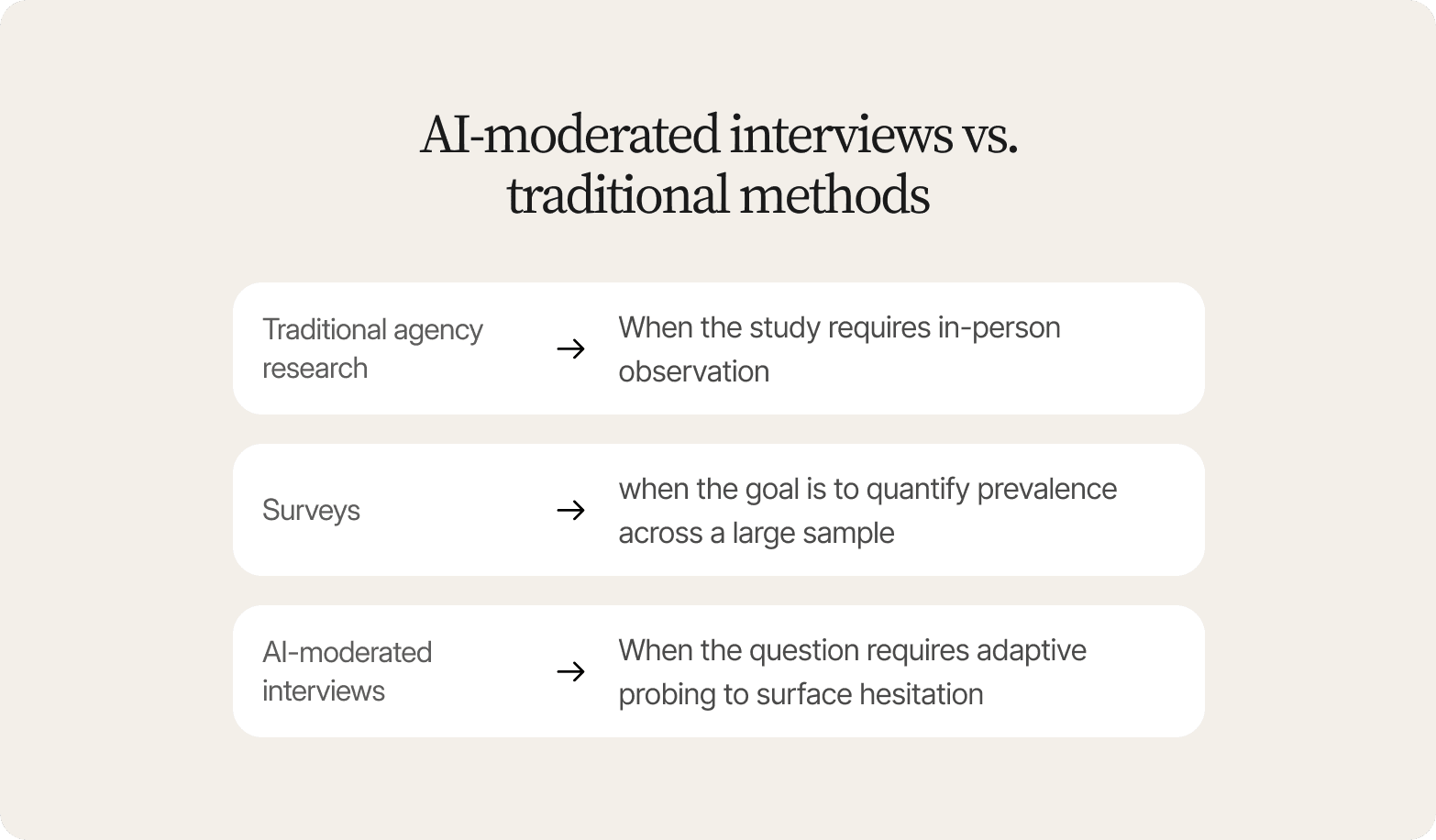
Financial services teams typically weigh three approaches to running qualitative research at scale: traditional agency research, survey platforms, and AI-moderated interviews. Each is the right call in specific circumstances, and conflating them, rather than weighing the competitive edge each approach offers, is where research spend gets wasted.
When traditional agency research fits
Traditional agency qualitative research earns its place when the study requires in-person observation, and it can still provide valuable insights no asynchronous format will replicate: branch experience ethnographies, in-home financial planning sessions, or studies where the physical environment is itself the research object. The same applies when the question depends on real-time group dynamics, such as watching retail investors react to each other's risk attitudes in a focus group setting.
When surveys fit
Surveys are well-suited when the goal is to quantify prevalence across a large sample: how many customers hit a specific friction point or what percentage intend to switch providers. A stack of percentages with no verbatim behind it can quietly become a data dump nobody revisits. Where surveys fall short is on the why: why people hesitate at a particular step in a mortgage application, or what compliance language triggers distrust.
When AI-moderated interviews fit
Use AI-moderated interviews when the question requires adaptive probing to surface hesitation, contradiction, and workarounds a scripted sequence would miss. Participants are 68% more open than with a human moderator, which matters in financial contexts where social desirability effects are strong and sensitive topics like financial wellness are the norm. The scale is what expands capacity, helping teams identify opportunities and growth across segments. Teams choose this route for continuous discovery and concept testing across markets, where evidence must remain traceable.
The combination most teams land on
In practice, many financial services teams run AI-moderated interviews for continuous discovery and concept testing, then commission traditional moderated research for high-stakes strategic decisions that need real-time facilitation or physical presence, a distinction that matters in a highly competitive category where every quarter of lead time helps a bank remain competitive against the broader competitive landscape. The two approaches complement each other; the practical question is which one fits the study in front of you.
Building always-on consumer understanding in financial services
Static personas have a short shelf life in this category. Attitudes toward trust, fees, and digital experience move faster than most research calendars accommodate, often in step with broader economic shifts, and a persona built from a study completed last year is already drifting. Commissioning a full refresh study every time is rarely available to a team on a flat budget, and the gap between what teams believe and what customers feel quietly erodes customer satisfaction, increased customer loyalty, and eventually retention of satisfied customers.
Continuous programs close that gap. Conveo StoryLines runs wave-based, AI-moderated research under its Continuous Consumer Understanding positioning, so understanding carries over between studies rather than being reconstructed from scratch. It sits as the understanding layer between tracker waves, explaining the movement a tracker can only register. Cadence is typically bi-weekly or monthly, set by the team rather than by vendor availability, and scoped against clear business goals rather than run as a general check-in.
Rigor is what makes an ongoing read trustworthy enough to act on. Conveo is built by researchers, and each wave adheres to the same standards as a one-off study would: screening criteria set before fieldwork, adaptive probing rather than scripted prompts, and findings that trace to a named session and a real participant, with follow-up for every theme.
"You can see genuine research fluency in the product decisions. It's not the only reason we'd choose Conveo, but it's a strong proof point especially compared to competitors who are building without that research foundation."
Matt Harris, Research & Insights Lead, EMEA, Canva
Understanding then compounds instead of expiring, a discipline of continuous improvement rather than a single fix. The searchable insight library keeps clips, themes, and quotes connected across projects, so researchers query what already exists and target new fieldwork where it adds the most, whether the question involves customer churn or a shift across digital channels, with iterative improvements to messaging tied back to what a specific participant said, improving efficiency across the whole research function. The institutional knowledge that used to die in a PowerPoint deck stays alive and searchable, which is the practical form continuous consumer understanding programs take.
Governance travels with the program rather than being renegotiated per wave. SOC 2 Type II certification, GDPR compliance, EU hosting (Belgium), on-demand PII deletion, and SSO are set up once at the infrastructure level.
Speed is the consequence here. Teams report reaching decision-ready findings in days to weeks, which makes a research program capable of answering questions while the decision window is still open, and of supporting sustainable growth rather than one-off wins. If your team is weighing what an always-on program would look like on your categories and markets, see how Conveo works in practice.
Frequently Asked Questions
What is market research in financial services?
Market research in financial services is the practice of gathering, analyzing, and applying consumer insights to inform product development, marketing efforts, and customer experience decisions in banking, insurance, and other regulated industries. It involves collecting data directly from regulated consumers. Unlike general consumer research, it operates under strict data governance requirements, participant consent obligations, and regulated handling of personal information, playing a critical role in how these institutions understand customer needs. Teams that conduct market research well here treat every finding as something that must survive legal, compliance, and brand reviews simultaneously.
How do banks and insurers conduct qualitative research?
Three methods dominate. Traditional agency research, moderated focus groups, and depth interviews commissioned through external firms remain common for high-stakes decisions and can run for months per program. Survey platforms are faster but capture what consumers say rather than why they say it, telling a team little about the unmet customer needs sitting behind a given answer. AI-moderated interviews run asynchronously across markets at once, with adaptive probing and findings that trace back to a named session.
What are the compliance requirements for financial services research?
Consumer research in this sector carries three baseline requirements: SOC 2 Type II certification, GDPR compliance, and hosting in the right jurisdiction for the participants involved. Financial services adds participant consent obligations and documented governance that withstands regulatory scrutiny. Conveo is SOC 2 Type II certified, GDPR compliant, EU hosting (Belgium), with on-demand PII deletion.
How long does financial services market research take?
Traditional agency qualitative research runs for months from briefing to final report, and multi-market studies that run sequentially stretch further because each market waits on the last. When AI-moderated interviews run in parallel across 50+ languages, those markets field simultaneously, with analysis beginning as sessions close rather than after the last transcript arrives.
What is the difference between qualitative and quantitative research in banking?
Qualitative research in banking work focuses on why consumers react the way they do, through adaptive probing, verbatim quotes, and video evidence. Quantitative research measures prevalence across large samples using surveys and structured questionnaires. Surveys report percentages, but they miss the hesitation and contradictions that explain why a message stalls in regulated buying cycles. The strongest research programs combine quantitative and qualitative data rather than treating the two as substitutes.
How do you recruit participants for financial services research?
Two methods dominate: recruiting through an integrated panel network, or bringing an existing customer list. Recruiting 5 to 15 participants per defined segment is typically enough to surface stable behavioral patterns when screening criteria are set before fieldwork rather than adjusted midstream, targeting distinct groups of new customers and potential customers rather than a generic sample. Recruit through Conveo's integrated panel network, or bring your own list.

About the author
Florian Hendrickx
Head of Growth
Florian is Conveo’s Chief Growth Officer, leading growth strategy and go-to-market execution as the company scales. He’s held growth leadership roles at companies like Deliverect, Robovision, and Aikido Security, and brings hands-on experience across marketing, sales, and product.
More by Florian →Qualitative insights at the speed of your business.
Conveo runs AI-moderated video interviews and structures everything they say.