In this article
TL;DR
UX research principles break down when teams focus only on usability issues and miss user behavior and motivations. Tracking where users click tells you what happened. Understanding why requires real conversations, not click maps.
Survey-only qualitative data captures surface responses, not meaning. Open-ended text fields tell you what users typed. They don't capture the hesitation before answering, the reasoning behind a choice, or the frustration that shaped both.
User personas become liabilities within six months when research isn't refreshed. A persona built on a single study round hardens into assumption, and teams start designing for target users who no longer exist.
Stakeholders challenge findings when claims can't be traced to real participant moments. Following sound user research methods means producing actionable insights that survive a roadmap meeting, not just a research debrief.
Video-first user interviews surface what text responses miss entirely. Hesitation at a pricing screen, confusion before a drop-off, the reasoning a participant works through out loud: none of it appears in a survey response.
Your team runs usability tests every sprint. You flag friction points, document drop-offs, and ship the findings to a Confluence page nobody reads after standup. Then, three months later, the same feature ships with a workaround baked in because users found a path you never anticipated. UX research principles exist to prevent this: they push teams to conduct user research that goes past surface-level usability toward the motivations and mental models that explain user behavior, not just what people click or where they stop.
The gap between knowing that and doing it consistently is where most product development processes break down. A user experience research framework provides teams with the structure to move from theory to practice within the broader UX research process. That structure means:
Defining research goals before a study launches
Choosing research methodologies that match the depth of the question
Producing outputs that hold up when a product manager asks "how do you know?"
Without that structure, research becomes reactive and disconnected from the development process.
Survey-only research makes this worse. Closed-ended responses give you quantitative data on what users clicked and where they dropped off, but rarely what they meant, expected, or worked around instead. Blending qualitative and quantitative data closes that gap: quantitative research shows what's happening at scale, and qualitative research gives you the deeper understanding of why. That combination is what turns raw data collection into user insights someone can act on. When a stakeholder challenges a finding, a percentage from a post-task survey is not enough to anchor a decision.
What changes the dynamic is evidence stakeholders can inspect directly. Video user interviews with timestamped clips and verbatim quotes let anyone trace a finding back to the exact moment a participant said it, shifting the conversation from defending conclusions to examining evidence together.
Why UX Research Principles Fail in Practice
Most content on UX research design principles covers the theory well: triangulation, sample selection, discussion guide construction. What it skips is the operational reality that leads to findings being challenged or ignored. When stakeholders push back in a roadmap meeting, the question isn't whether you followed the right research methodologies. It's whether you can point to a specific participant moment that supports the claim on the slide. Most teams can't.
Three patterns cause it:
Research goals get written as directions, not decisions. "Understand our users" isn't specific enough, so findings land flat in reviews.
User personas built from a single sprint harden into assumptions within months.
Survey-only "qual" captures what users clicked but not why they did it.
The six principles below address each pattern directly, producing valuable insights that are specific to a decision, grounded in recent user behavior, and traceable to real evidence. Together, they form the backbone of any credible ux research methodologies playbook, whether you're conducting research in-house or bringing in outside support.
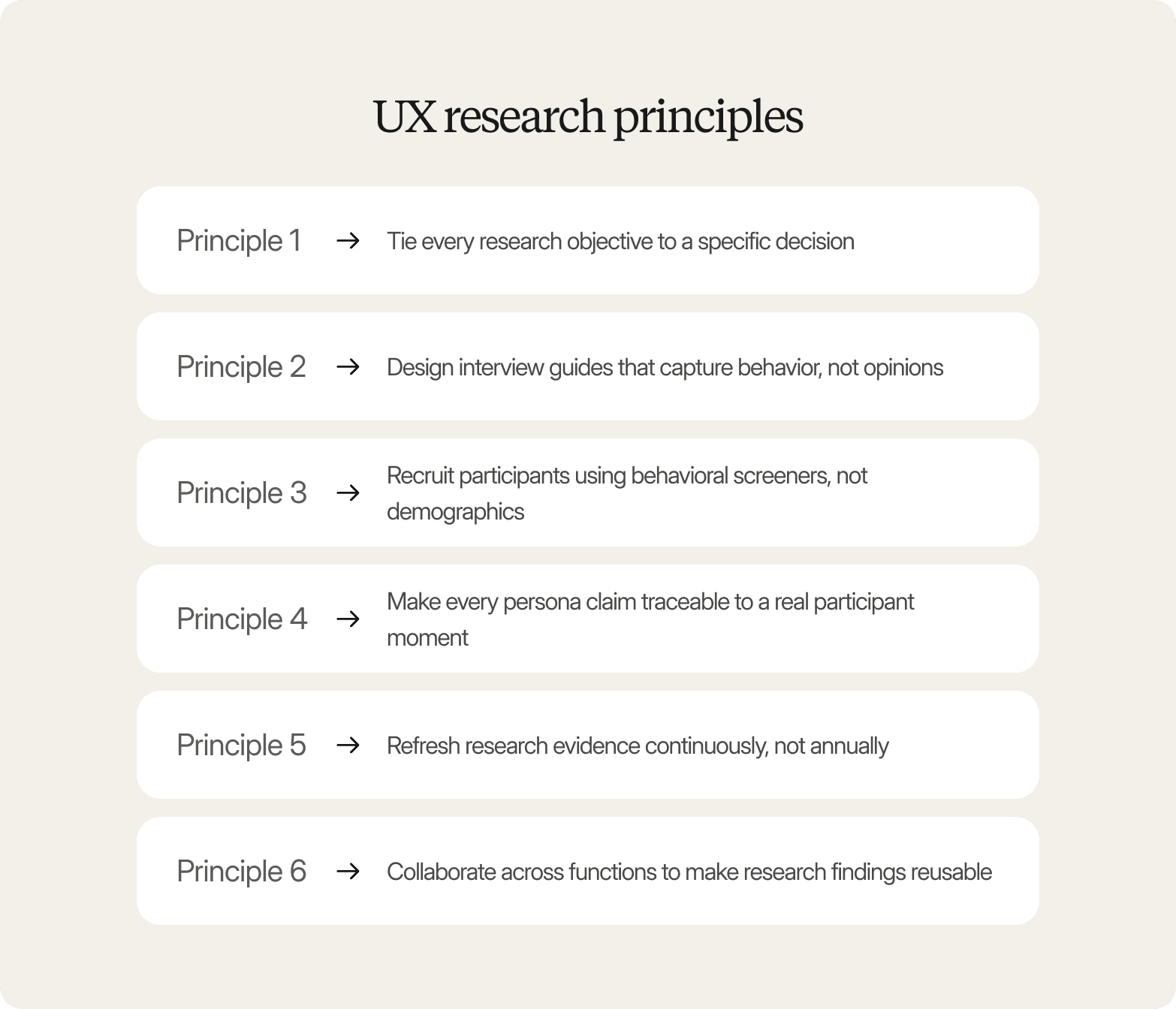
Principle 1: Tie Every Research Objective to a Specific Decision
One of the most consistent failures in applying UX research principles is a research objective that sounds substantive but doesn't connect to anything a team will actually decide. "Understand our users" is a direction, not a research goal. Without a specific decision waiting on the other side, findings land in a deck, get presented once, and stop influencing anything.
The principle is straightforward: before you conduct user research, every objective should be able to answer the question, "What decision will this evidence inform?" If it can't, the objective isn't ready.
Three examples of decision-tied objectives:
"Should we prioritize onboarding flow A or B for first-time users?"
"Which messaging angle resonates more with our target audience of enterprise buyers: speed or security?"
"What causes users to abandon checkout at the payment step?"
Compare those to objectives that produce findings nobody acts on: "understand user needs," "explore pain points," "gather feedback." A team that finishes a study with "users want things to be simpler" has gathered user feedback, but not learned what to do next. That gap is where research budgets quietly disappear.
Operationalizing this principle means writing the decision question first, then working backward through the user research methods that would generate evidence specific enough to answer it. The decision type determines the method; the method determines the participant criteria and helps you gain insights that are usable rather than merely interesting.
Video-first user interviews make the connection between evidence and decision more traceable. When a participant explains exactly why they hesitated at the payment step, a timestamped clip captures not just what they said but how they said it: the pause, the shift in tone, the moment uncertainty appeared. That's harder to dismiss in a product review than a synthesized theme on a slide, and it turns a single session into an actionable insight the team can act on immediately.
Principle 2: Design Interview Guides That Capture Behavior, Not Opinions
One of the most consequential UX research best practices is also the most overlooked: the type of question determines the quality of the data you collect. Guides built around behavioral research prompts produce evidence of what users actually do. Guides built around opinion prompts produce attitudinal research at best: evidence of what users believe they do, or what they think the researcher wants to hear.
The distinction matters because memory is reconstructive and social desirability is real. Behavioral questions sidestep this by anchoring participants in specific, concrete moments they lived through, ideally moments observed in their natural environment rather than a lab setting.
| Opinion Question (Avoid) | Behavioral Question (Use) |
|---|---|
| "Do you find onboarding confusing?" | "Walk me through the last time you set up a new account. What happened?" |
| "Would you use this feature?" | "Tell me about a time you needed to do X. What did you do?" |
| "Is this design intuitive?" | "Show me how you'd complete this task. Talk me through what you're thinking." |
The rule across user research methods is consistent: open with "how," "what," or "walk me through" rather than closed prompts that invite a yes-or-no answer. Leading questions compound the problem: "Did you find onboarding confusing?" primes a yes, while "What was your experience with onboarding?" leaves the participant to characterize it themselves.
This is also where structured methods earn their place alongside open interviews, because they observe how someone actually attempts to complete tasks rather than asking them to predict their own behavior:
Usability testing sessions and tree testing on navigation labels reveal where people get stuck.
Card sorting exercises show how users mentally group content, which helps teams conduct usability testing as a distinct qualitative method, separate from general user testing.
A/B testing plays a similar role on the quantitative side, showing which variant performs better even when self-reported preference data point the other way.
User errors captured during a task, not just opinions volunteered afterward, are often the most reliable signal in the whole session.
Video-first interviews create a meaningful advantage on top of all of this. When a participant pauses before answering, backtracks mid-sentence, or frowns before saying "it seems fine," those signals are visible in the recording. For stakeholders who weren't in the sessions, a video clip of a participant struggling to complete tasks is more persuasive than a bullet point summarizing that three users found it difficult.
"The video clips make it tangible; it's not just data anymore, it's real people with real emotions"
CMI Lead, Edgard & Cooper
Principle 3: Recruit Participants Using Behavioral Screeners, Not Demographics
One of the foundational principles of UX research is that reliable participant recruiting determines whether findings are usable or merely plausible. The right target users produce patterns; the wrong ones produce noise that looks like insight until a product decision gets made on top of it.
Demographics describe who users are; behavioral screeners describe what users do. Product decisions require the latter. A progress bar that asks someone to rate their own technical sophistication is especially unreliable, since self-reported data is often optimistic, inconsistent, and impossible to defend to a skeptical stakeholder.
Three examples of behavioral screeners that produce high-signal test participants:
"Used our product at least once in the last 30 days," which separates active users from lapsed ones.
"Evaluated at least two competitors before choosing a product or service," surfacing prospective users who formed opinions through comparison rather than habit.
"Manages a team of five or more people and makes purchasing decisions," combining role context with authority that a job title alone never confirms.
On segment size, five to 15 participants per segment produces reliable patterns, whether you're running generative research to explore a new space, ethnographic research in a participant's own environment, focus groups, or evaluative research to test a specific design:
Fewer than five risks anecdotal findings.
More than 15 rarely changes the pattern but adds cost, timeline, and synthesis volume.
Most studies run two to five segments across your target audience, so a well-scoped study typically involves 15 to 50 interviews total.
The practical constraint that collapses recruiting quality in fast-moving teams is scheduling: coordinating five participants across three time zones and a two-week sprint window is where studies stall. Remote testing removes most of this friction on its own, and async, AI-moderated interviews remove the rest. Participants join on their own schedule, so a study spanning multiple regions fills without calendar coordination, and because sessions run in parallel, exploratory evidence lands in days rather than weeks.
Principle 4: Make Every Persona Claim Traceable to a Real Participant Moment
Every claim inside a well-constructed user persona needs to trace back to a specific participant moment. Applying UX research principles to persona design means treating unsourced attributes as liabilities rather than assets.
The failure mode is familiar: a persona is assembled from interview notes and team intuition, and ends up with attributes like "tech-savvy (7/10)" or "values efficiency and collaboration" that nobody can trace back to real research data. When a product manager challenges it, the researcher has nothing to point to except "we felt this was representative."
Compare two versions of the same claim:
Before (untraceable): "Sarah, 34, Marketing Manager. Tech-savvy (7/10). Values efficiency and collaboration. Frustrated by slow tools."
After (traceable): "Sarah (P07, timestamp 4:32): 'I tried the export feature three times before I gave up and just copied everything into a spreadsheet. It's faster even though it's manual.' Pattern: 8 of 12 participants described similar workarounds when the export feature failed."
The second version survives scrutiny: the behavior is specific, the source is identified, and data analysis across the sample helps reveal patterns rather than relying on a single anecdote. When using psychology principles in UX research deliverables, this is the standard to hold every user persona attribute to.
This matters most in roadmap meetings and design critiques, where "where did this come from?" is a reasonable question, not a hostile one. Timestamped clips and direct quotes convert "the research team said so" into "here is the participant, here is the moment, here is the evidence." And when every claim links to a source, that research data becomes reusable: a searchable insight library indexed by theme, participant, and clip means one set of user interviews can populate a persona, a jobs-to-be-done map, a mental model, and an empathy map without running separate studies for each.
Principle 5: Refresh Research Evidence Continuously, Not Annually
Personas built on stale evidence don't gradually lose accuracy; they actively mislead. A persona has a shelf life. Markets shift, user behavior evolves, and competing products raise the baseline of what users consider acceptable. Most teams treat persona development as a project with a finish line rather than an ongoing process, which means the research underpinning product decisions can be 12 to 18 months old before anyone questions it.
Three signals indicate research needs refreshing before the calendar says so:
A competitor launches a feature your users start requesting in support tickets or NPS verbatims.
Stakeholders begin qualifying findings with "but is this still true?" during reviews.
Usage analytics contradict the persona's predictions.
The fix isn't a bigger annual study. It's a different cadence:
Run smaller studies of five to ten participants every quarter against a specific decision or hypothesis, rather than trying to understand everything about a segment at once.
Treat it as an ongoing process tied to the product development cycle, rather than a single milestone at a specific stage.
The operational barrier that historically prevented this cadence was time, since recruiting, scheduling, moderating, and synthesizing even a small study could consume two to three weeks. AI moderation removes that constraint. Studies can run hundreds of interviews in parallel, with research synthesis beginning as recordings land, so evidence that previously took weeks to gather can be ready in days. For teams researching across multiple markets, AI moderation in 50+ languages removes the localization bottleneck that typically makes international research a separate, slower workstream.
Principle 6: Collaborate Across Functions to Make Research Findings Reusable
The principles of UX research rarely fail at the study level. They fail afterward, when findings land in a deck, get presented once, and disappear into a shared drive no one searches. The fix isn't more research; it's structuring what you already have so it compounds and keeps feeding into the product development process, rather than sitting outside it.
One set of user interviews can populate personas, inform a jobs-to-be-done map, feed a mental model, and ground an empathy map. None of those frameworks require a separate study; they require findings well organized enough to be reused throughout the ux design process.
Three practices make research genuinely reusable:
Tag findings by theme, feature, and user segment so a stakeholder searching for what users said about onboarding can find it in seconds.
Build a timestamped clip library so product, design, and marketing teams can pull evidence for their own deliverables instead of waiting on a summary.
Maintain a shared insight repository that grows with every study, so the second study builds on the first rather than duplicating it.
This matters most for small UX and research teams asked to serve product, design, engineering, and marketing simultaneously with limited, resource-intensive headcount. Reusable research data extends what a team of two or three can actually support:
Teams can generate ideas from data collected months earlier instead of starting over.
The function shifts from a bottleneck into a compounding source of meaningful insights.
The whole organization can maintain a user-centered approach and mindset throughout the design process.
How to Apply These Principles in AI-Era Workflows
Any UX research principles guide covering AI-era workflows has to be honest about two things at once: what genuinely improves when teams adopt AI-moderated interviews, and what must stay rigorous regardless of how the interview is conducted or which ux research tools are involved.
What changes is speed, scale, and reach:
AI moderation can run hundreds of interviews in parallel, so evidence that once took weeks to gather can be gathered in days.
Async interviews remove time-zone friction, letting participants join on their own schedule without coordinating calendars across markets.
AI moderation in 50+ languages removes the localization bottleneck that has historically slowed multi-market research, letting teams run concept testing across several regions in a single study, with translation handled automatically.
What must stay rigorous does not change at its foundation:
Consent is non-negotiable. Participants must know they're speaking with an AI moderator and how their data will be used.
Governance requires active attention. AI-generated summaries must be audited against source transcripts; teams that treat AI output as ground truth will produce findings that can't withstand scrutiny.
Participant quality cannot be assumed. Behavioral screeners and fraud detection remain critical regardless of moderation method.
Traceability is the thread that holds everything together. Every claim must trace back to a real, timestamped participant moment.
Before adopting any of the ux research tools on the market, pressure-test the platform against four questions:
Does it capture video and audio, not just text chat?
Can you inspect timestamped transcripts to verify AI-generated summaries?
Does it support behavioral screeners and fraud detection?
Are consent and governance controls built in, not bolted on?
The case for video-first user interviews comes down to what text cannot capture: hesitation before a pricing question, visible confusion at a feature description, the reasoning a participant works through out loud. All of it is invisible in a survey and only partially recoverable from a transcript, whether the underlying method is generative research early in a project or evaluative research closer to launch.
Operational Playbook: Mapping Principles to Sprint Cadence
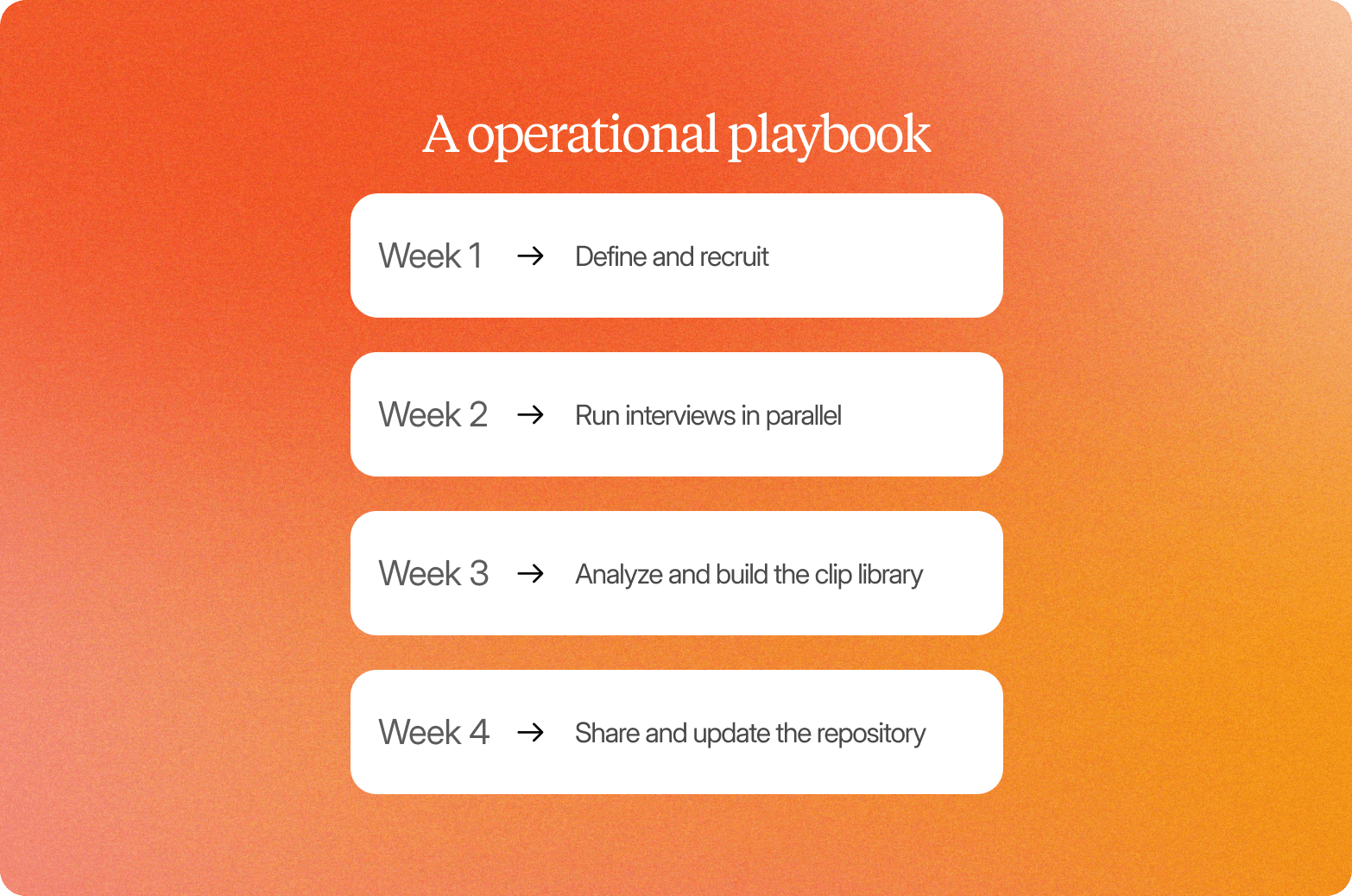
The gap between knowing UX research best practices and actually conducting ux research every sprint usually comes down to one thing: the process has too many moving parts to repeat without friction.
The weekly cadence:
Week 1: Define and recruit. Write a clear decision question, not "learn about onboarding" but "understand why users abandon the setup flow before completing step three." Build the screener around behavioral criteria and confirm it matches your target audience.
Week 2: Run interviews in parallel. Five to ten AI-moderated sessions run simultaneously across participant schedules. The AI moderator follows the guide, probes on unexpected responses, and captures tone and hesitation transcripts alone would miss as participants attempt to complete tasks.
Week 3: Analyze and build the clip library. Tag themes as findings land, analyze data for recurring patterns, and create timestamped clips tied to specific moments.
Week 4: Share and update the repository. Findings go to product and design teams in a format they can act on, and the insight repository gets updated so this study is searchable alongside everything before it.
Staffing the cadence depends on team size: a solo researcher can sustain one to two studies a month with AI moderation handling interviewing and initial synthesis; a small team of two to three researchers can run four to six; a larger team of four or more can run eight to 12, specializing by product area or segment.
Building repeatable templates means maintaining a library of behavioral screener questions by segment, interview guide templates for recurring decision types such as concept testing and feature validation, and standardized tagging taxonomies so themes are searchable across studies. Methods like card sorting and tree testing fit neatly into this template library whenever a study touches navigation or information architecture on the user interface.
Principles for Participant Quality and Authenticity
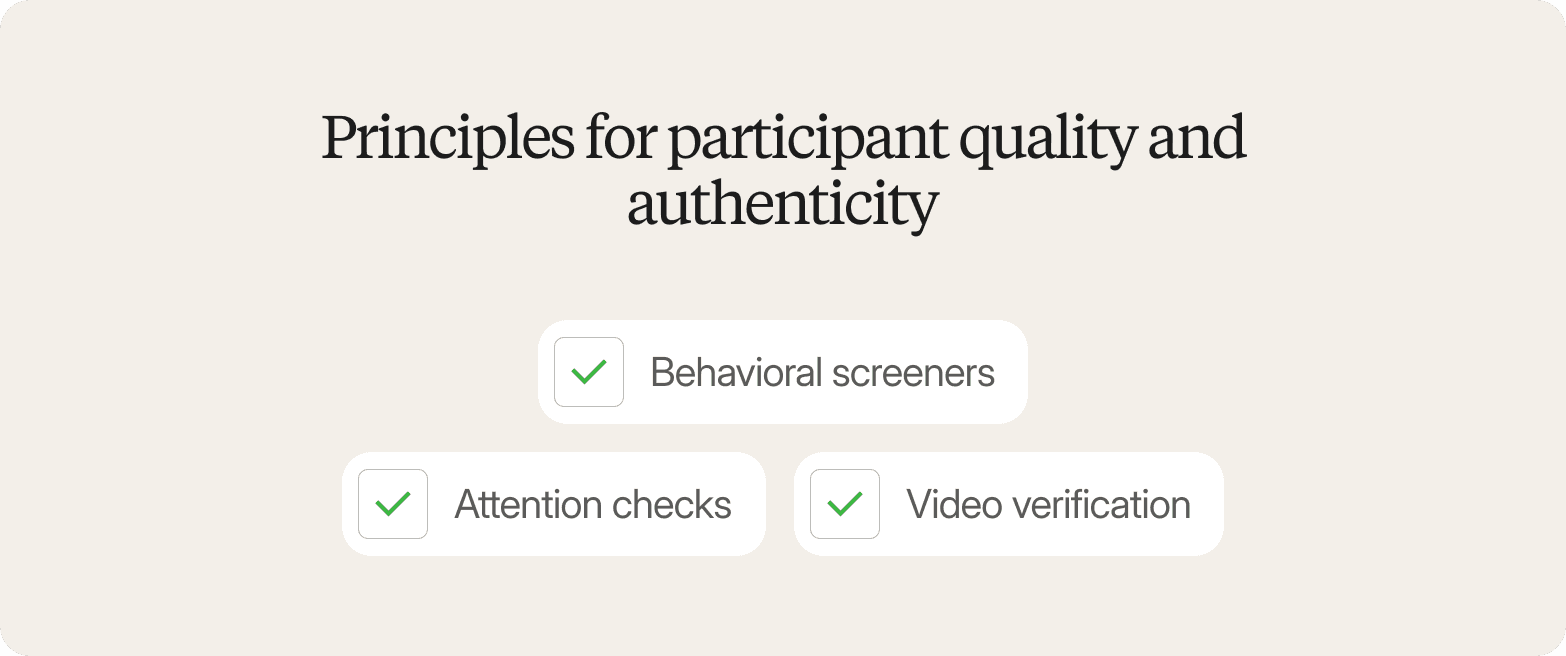
Participant quality problems don't announce themselves. A participant who doesn't match your target users, a bot cycling through panel incentives, or someone giving socially acceptable answers instead of honest ones quietly degrades findings before analysis even begins.
Three controls do most of the work:
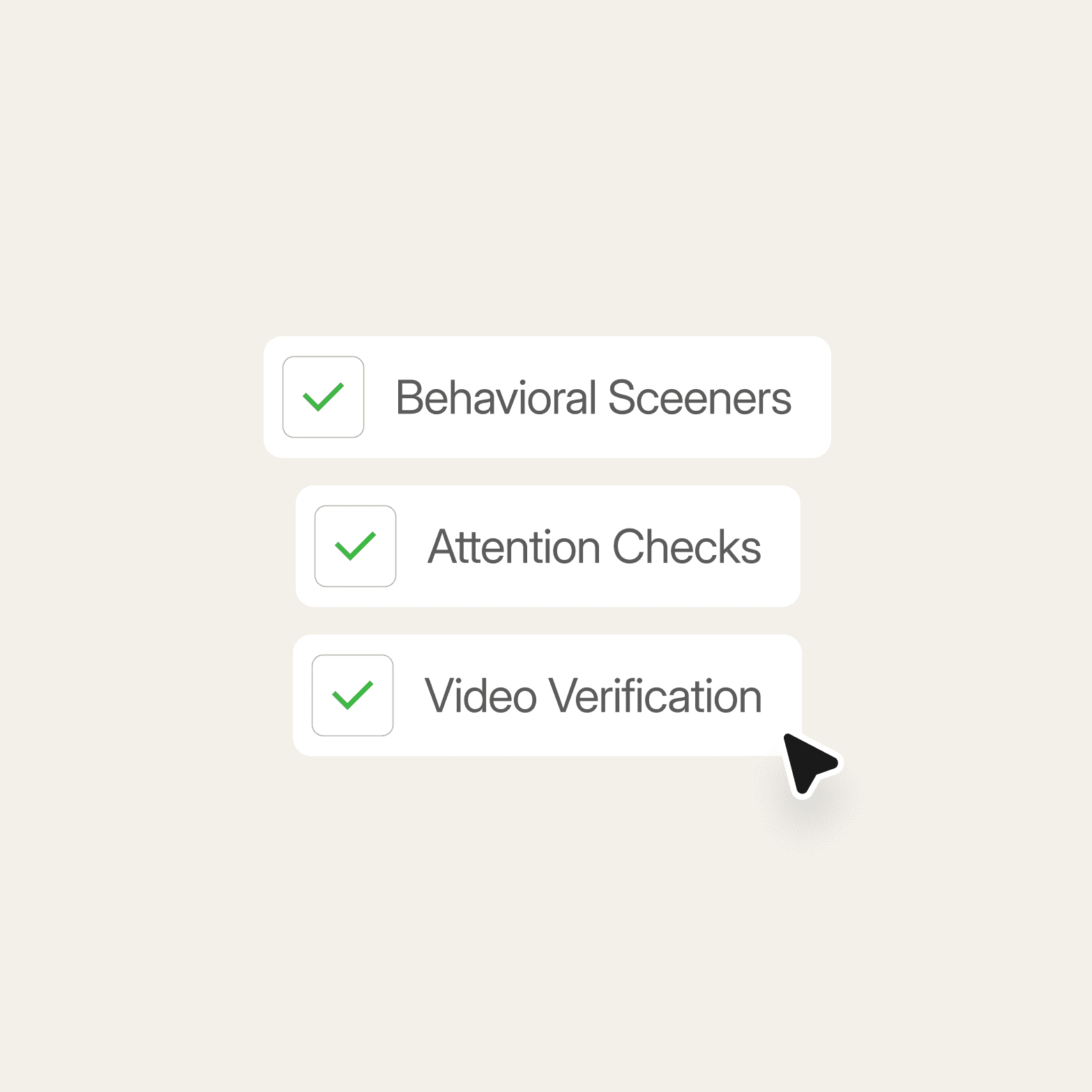
Behavioral screeners filter participants before the interview starts, targeting actual behavior rather than self-reported data.
Attention checks are conducted mid-interview to verify that participants are engaged and answering thoughtfully; inconsistencies with earlier answers are a reliable warning sign.
Video verification is the most structurally significant control. When participants appear on camera, it's substantially harder for bots or misrepresented profiles to pass as authentic.
Three questions worth applying to every session:
Does the participant's video match their stated demographics and behavior?
Are responses specific and detailed, or generic and evasive?
Does the participant reference concrete examples from their own experience and their own research into the product?
Video-first interviews reduce fraud risk structurally, since video captures hesitation, user errors, and genuine reasoning that text can't replicate. A survey response can be fabricated in seconds; a consistent, on-camera conversation that demonstrates real product familiarity is substantially harder to fake.
Making Continuous UX Discovery Sustainable With Conveo
The principles in this guide share one operational dependency: they only hold if the evidence behind every finding is real, traceable, and reusable. That's the problem Conveo, the video-first AI research platform, is built to solve for UX and product teams conducting ux research at scale.
Conveo interviews real participants, recruited through its integrated panel network or your own lists, with no synthetic respondents. Consent and data governance are built into the workflow rather than bolted on afterward, which is what enables findings to withstand legal review and stakeholder scrutiny alike.
From there, the capabilities in this guide become routine. Behavioral screeners qualify participants on what they've done. Conveo's AI moderator runs your guide asynchronously in 50+ languages, probing for unexpected answers while capturing video, tone, and hesitation that text can't capture.
See it in action: How AI-Moderated Video Interviews Actually Work

And every session feeds a compounding insight library, indexed by theme, participant, and timestamped clip, so one study populates personas, journey maps, and mental models without rerunning fieldwork, turning gathering insights into a genuinely ongoing process rather than a one-off project.
Frequently Asked Questions
What are the core UX research principles?
Tie every objective to a specific decision; design guides around user behaviour rather than opinions; recruit with behavioural screeners; keep every user persona claim traceable to a real participant moment; refresh research data continuously; and structure findings so they can be reused across teams.
How is a UX research principle different from a UX research method?
A principle is a standard that governs how research should be designed and used, such as "every claim must trace to a participant moment." A method, whether it's user interviews, tree testing, or card sorting, is the technique used to gather data. Principles determine which research methodologies you choose and how you apply them.
Why does survey-only research fall short for product decisions?
Surveys capture quantitative data on what users clicked and where they dropped off, but not what they meant or how they worked around it. Video user interviews with timestamped clips let anyone trace a finding back to the exact moment a participant said it.
How many participants do I need for a qualitative study?
Five to 15 per segment reliably produces patterns. Fewer than five risks anecdotal findings; more than 15 rarely changes the pattern while adding cost. Most studies run two to five segments, so a well-scoped study is typically 15 to 50 interviews.
How often should personas and research data be refreshed?
Continuously, not annually. Smaller studies of five to ten participants each quarter, against a specific decision, keep evidence current. Refresh sooner when a competitor launches a requested feature, when stakeholders hedge findings, or when usage analytics contradict a persona.
What should I look for in an AI research platform?
Confirm it captures video and audio rather than text chat alone, lets you inspect timestamped transcripts to verify AI-generated summaries, supports behavioral screeners and fraud detection, and has consent and governance built in rather than bolted on.

About the author
Alex de Hemptinne
Business Impact Lead
Alex is a Business Impact Lead at Conveo, partnering with enterprise teams to embed AI-led research into their workflows. From the first study to full-scale rollout, she helps customers shift from project-based research to continuous customer intelligence.
Meet Alex on film →Qualitative insights at the speed of your business.
Conveo runs AI-moderated video interviews and structures everything they say.