In this article
TL;DR
The prototype testing questions teams ask during validation determine whether findings arrive in time to change anything
A five-layer framework (research goal, task scenario, primary question, probe ladder, evidence capture) maps every question back to the decision it needs to inform
Adaptive probing, following hesitation, surprise, and contradiction, is where the deepest findings live
Question design must adapt to prototype maturity: concept-stage questions test whether the problem is real; low-fidelity questions test information architecture and task flow; high-fidelity questions test trust, comprehension, and emotional response
Testing early at each of these different stages, before a product is fully functional, reduces the cost of change and improves the chances of a successful product launch
AI-moderated video interviews let teams run adaptive, depth-first prototype research with real users at scale, without requiring a moderator for each session
Product teams ship features before prototype feedback returns. That gap between "we think users want this" and "we know users want this" is where bad decisions compound. The prototype testing questions teams ask during validation determine how much of that gap closes, and whether findings arrive in time to change anything.
The operational challenge is real. A UX researcher serving three product squads cannot run moderated sessions quickly enough to keep pace with sprint velocity. Recruiting takes days. Scheduling eats hours. Synthesis is manual and inconsistent. The result: teams skip validation, run a quick survey that misses behavioral reality, or wait for findings that land after the decision window has closed.
Surveys tell you what users chose. They rarely explain why a user hesitated before clicking, what mental model broke when navigation shifted, or what emotional reaction surfaced the moment a pricing screen appeared. That gap is exactly where prototype testing questions earn their value.
This article walks step by step through building prototype testing questions that map directly to research goals: how to structure task scenarios, which primary questions generate usable evidence, how to build probe ladders that follow hesitation, and what outputs the development team can act on.
What makes prototype testing questions effective
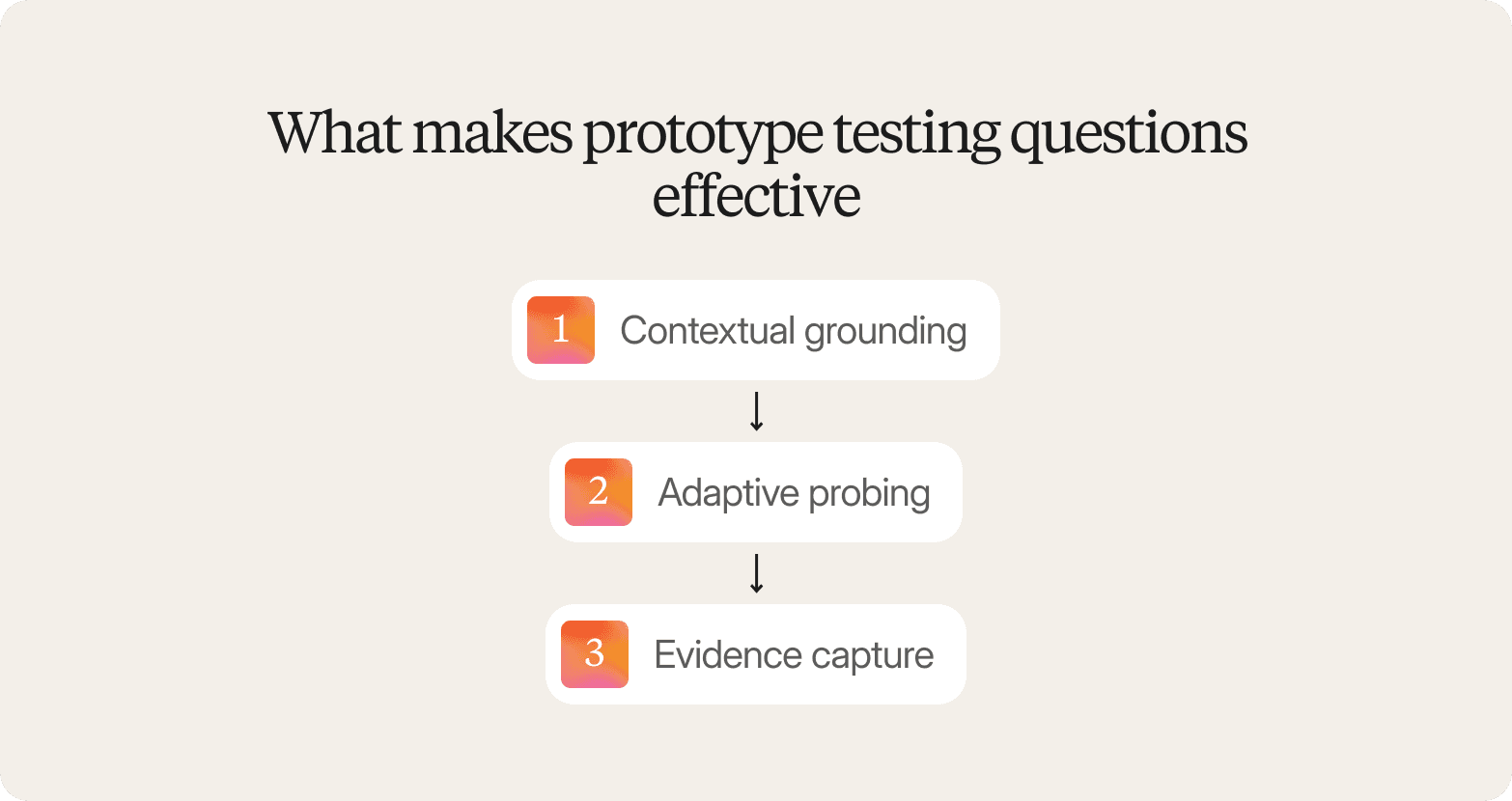
The cardinal rule of prototype research is also the most violated: ask about behavior, not opinions. Most teams default to questions that feel intuitive but produce noise, treating prototype sessions as usability testing that only requires a thumbs-up or thumbs-down. Effective prototype testing questions are designed to elicit observable, traceable evidence rather than surface-level ratings.
Three criteria separate questions that generate evidence from those that generate noise.
Contextual grounding
Questions anchored in real usage scenarios produce richer responses than questions about abstract preferences or hypothetical situations. When asked whether they like a feature, participants answer as critics. When asked to walk through a specific task they would actually perform, they answered as users. The mental model shifts, and what comes out is behavioral rather than evaluative. Effective user testing questions for a prototype place participants inside a realistic situation before any interaction begins: "Imagine you've just received a notification that your account needs attention. Show me what you'd do next."
Adaptive probing
Scripted discussion guides treat every participant as if they'll respond the same way. When a participant hesitates, expresses surprise, or contradicts an earlier statement, a fixed guide moves on regardless. Effective task-specific questions create space to follow up on what participants actually say. "You paused there. What was going through your mind?" surfaces the insight that a scripted path would have buried.
Evidence capture
Questions should be designed with the output in mind. If a stakeholder needs to understand why users abandoned a flow, the researcher needs a quote or a video clip to review. Questions that invite narration ("Talk me through what you're doing as you go") generate the verbatim and non-verbal evidence that makes user feedback credible to people who weren't in the room. The goal is not just useful feedback but actionable feedback tied to a specific moment in the design process.
The failure modes are predictable: leading questions, yes/no prompts that shut down elaboration, and vague questions that produce surface-level feedback. Instead of "Do you like this feature?", ask "Walk me through how you'd use this feature to complete [specific task]. What's going through your mind?" The first produces a rating; the second produces a behavioral trace your team can build from.
Effective questions require a framework that connects research goals to the specific evidence you need to capture.
The prototype testing question framework
The prototype testing process breaks down when teams write questions that sound thorough but don't connect to any specific decision. A step-by-step approach forces clarity before a single participant is recruited. The five-layer framework below maps every element of a discussion guide back to the decision it needs to inform.
| Layer | What it defines | Example (checkout flow) |
|---|---|---|
| Research goal | The business decision this test informs | Determine whether users understand the new payment options and trust the security messaging enough to complete a purchase |
| Task/scenario | The real-world context for the interaction | "You're purchasing a $50 item as a gift. Walk through checkout as you normally would." |
| Primary question | The open-ended prompt that initiates interaction | "What's going through your mind as you see these payment options?" |
| Probe ladder | Follow-up questions tied to observed behavior | "You hesitated there. What made you pause?" / "How does this compare to checkout experiences you trust?" |
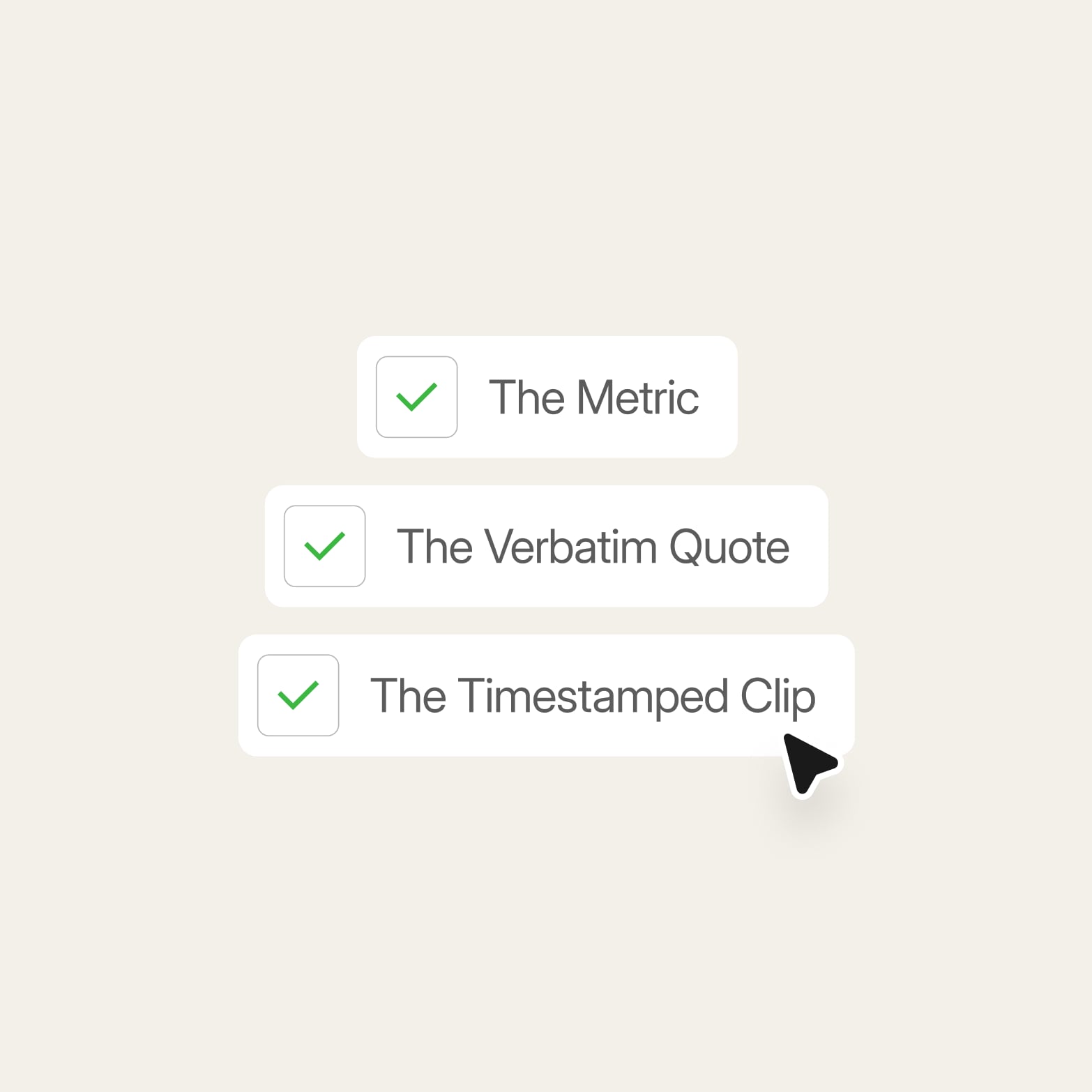
| Evidence to capture | Specific outputs the decision requires | Video clip of hesitation moment, verbatim quote about trust signals, facial reaction to security badge |
Each layer constrains the next. A sharp research goal produces a realistic scenario. A realistic scenario generates a primary question that participants can answer from genuine experience. A well-constructed probe ladder surfaces the "why" behind what the primary question reveals. A pre-defined evidence list ensures the session produces clips, quotes, and signals that directly support the decision.
The five layers take roughly 30 minutes to work through before a study launches, and pay off in synthesis, where pre-specified evidence targets replace open-ended searches through hours of footage.
If you cannot specify what evidence a question would produce, it is usually the wrong question. "What do you think of this?" produces an opinion. "Walk me through what happened when you reached this step" produces a behavioral trace, a verbatim quote, and a facial signal: exactly what the product team needs to decide which design issues to address.
Findings without traceable evidence are increasingly questioned by stakeholders. Conveo anchors this in practice: every finding links to a timestamped clip and verbatim quote, so stakeholders can inspect the source rather than accept a summary.
This framework works across prototype maturity levels, but the questions must adapt to whether you're testing a concept, a low-fidelity wireframe, or a hi-fi prototype approaching a finished product.
Prototype testing questions by maturity stage
Concept and early-stage prototype questions
Concept validation is the first and most frequently skipped step in the prototype testing process. Prototypes come in many forms, but concept testing asks one question: Does your target audience understand what this is, and does the product idea resonate with a need they actually have? Teams that skip this stage often invest in building an early version of a feature, only to discover later that the underlying problem wasn't real or that they were testing with the wrong audience.
At the concept stage, you are not testing whether a design works. You are testing whether the problem is real, whether users recognize it as their own, and whether your concept lands with enough clarity to be worth building out. Questions here must surface mental models and user expectations before anchoring users to any specific design direction.
Problem grounding (ask before showing anything)
"Describe a recent time you faced [problem this prototype solves]. What did you do?"
"How often does this come up for you? What's your current workaround?"
"If you could wave a magic wand and solve [problem], what would that look like?"
First impressions (show the concept, say nothing)
"Talk me through what you think this does."
"Who do you imagine this is built for? Does that include you?"
"What questions come to mind as you look at this?"
Fit and motivation
"If this existed today, how would it fit into your workflow?"
"What would make you trust this enough to try it?"
The most common mistake at this stage: asking "Would you use this?" before users understand what "this" is. The question produces false positives. AI-moderated video interviews reveal whether users are genuinely connecting the concept to a felt need, or simply reacting to novelty. That distinction is what concept validation is actually for.
Low-fidelity prototype questions
Low-fidelity prototypes, whether paper prototypes, clickable wireframes, or rough digital mockups, exist to test structure, not appearance. The questions to ask when testing a low-fidelity prototype concern information architecture and task flow: whether users find what they need, complete core actions in the expected order, and recover when they get lost. User expectations are shaped by previous experiences with similar products, and low-fidelity testing surfaces the gaps between what users expect and what the prototype delivers.
Every question should push test participants to do, not to evaluate.
"Your goal is to [specific task]. Walk me through how you'd do that using this prototype."
"What do you expect to happen when you tap or click here?"
"You paused. What are you looking for right now?" (Hesitation is data. Name the moment and make it safe to explain.)
"If you got stuck here in real life, what would you do next?"
"How does this flow compare to other platforms you use for [similar task]?"
"What's missing that you expected to see at this step?" (Reveals assumptions about core features: whether users expect a search feature, a back button, or a progress indicator that didn't make it into the prototype.)
"On a scale where 1 is 'I have no idea what to do,' and 5 is 'this is obvious,' how would you rate this step?"
Never apologize for the lack of visual polish before a session. It primes users to focus on aesthetics and undermines the structural feedback you are there to collect.
Do not let hesitation pass without probing. When a user backtracks or lingers on a screen, that moment contains the finding. If the moderator stays silent, it disappears. In AI-moderated sessions, Conveo detects hesitation automatically so no moment goes unexplored.
High-fidelity prototype questions
High-fidelity sessions are where interaction design gets its real test. The visual polish is close to final, participants respond as if the product were live, and teams have their last opportunity to surface usability issues, design flaws, and pain points before a finished product goes to the development team. UX research prototype testing questions at the hi-fi prototype stage should reveal friction, delight, and trust signals while there is still time to act on them.
Attention and visual hierarchy
"As you interact with this, talk me through what you notice first, second, third."
"Where does your eye go when this screen loads? What draws it there?"
"Is there anything you almost missed? What made it easy to overlook?"
Microcopy and label comprehension
"What does this button label make you think will happen when you click it?"
"Read this instruction out loud. Now tell me in your own words what it's asking you to do."
Confidence and trust signals
"How confident do you feel about what you just did? What would increase that confidence?"
"At any point did you feel unsure whether your action had worked? Walk me through that moment."
Emotional response
"What part of this feels most polished? What feels unfinished?"
"You [smiled/hesitated/leaned in] there. What triggered that reaction?"
"If you could change one thing about this interaction, what would it be?"
The most consistent error at this stage: treating the high-fidelity prototype as a near-final product that needs only a confidence check. Skipping probes about trust and comprehension is where critical design flaws get buried until after launch.
Advanced probing techniques for prototype testing
The questions that shape product decisions are rarely the ones you planned. They're the probes that follow an unexpected click, a long pause, or a sentence that trails off: the core questions to ask while user testing of a prototype, and what separates sessions that surface genuine user insights from those that collect surface impressions.
Four probe types cover most situations:
| Probe type | When to use | Example |
|---|---|---|
| Behavioral | When a test participant does something unexpected | "You clicked back there. What were you expecting to find?" |
| Emotional | When a user hesitates or shows a non-verbal signal | "You paused there. What made you hesitate?" |
| Comparative | To surface the reference frame shaping judgment | "How does this compare to how you currently handle this?" |
| Clarification | When vague feedback needs specificity | "When you say 'confusing,' what specifically felt unclear?" |
Each probe type opens a different door. Behavioral probes reveal navigation logic. Emotional probes reveal trust signals. Comparative probes surface the competitive context shaping judgment. Clarification probes turn a vague impression into a precise, actionable design note.
Unlike surveys limited to predefined responses or choices, qualitative data from probed sessions reflect what participants actually experience. Probing generates more insights than any static list of questions because it follows the participant's actual path rather than a hypothetical situation the researcher anticipated.
What makes probing genuinely difficult is that the best follow-up questions are ones you couldn't have written in advance. Consider how a probe ladder unfolds in practice:
Participant: "I'm not sure I trust this." Probe 1: "What specifically makes you feel that way?" Participant: "There's no security badge or anything." Probe 2: "What would need to be here for you to feel confident?" Participant: "Maybe a logo from a payment company I recognize, or a guarantee."
In three exchanges, a vague trust concern becomes a specific design intervention. A static script would have logged "user expressed trust concerns" and moved on.
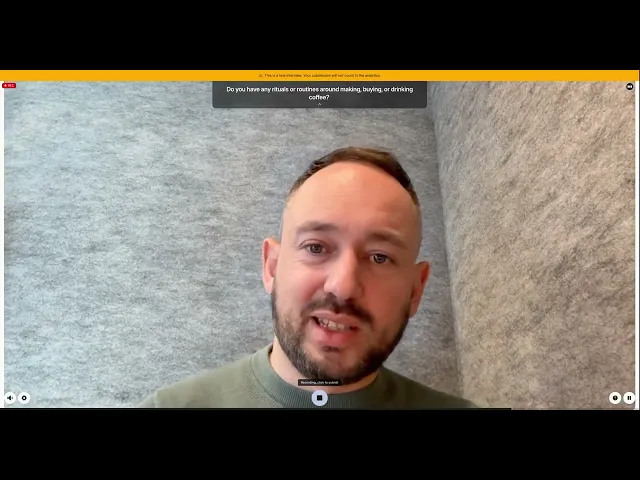
Pre-written question lists treat every participant's response as expected. Real conversations rarely are. Conveo's AI moderator senses hesitation, mirrors participant language, and follows up on the moments that scripted guides skip.
See it in action: how Conveo's AI moderator probes adaptively in a live session
Moderated vs. unmoderated prototype testing: How questions change
The testing method you choose shapes the questions you can ask, the depth of feedback you'll get, and whether findings hold up when a product manager asks, "But why did users do that?" Understanding the tradeoffs helps you pick the right approach for each stage of the prototype.
| Method | Question style | Strengths | Limitations |
|---|---|---|---|
| Moderated (human-led) | Open, conversational | Deep probing; responsive to unexpected behavior | Requires scheduling, moderator time, and manual synthesis |
| Unmoderated (self-guided) | Hyper-specific and task-focused | Scales easily; no scheduling overhead | Surfaces symptoms, not causes; limited probe depth |
| AI-moderated async | Structured like moderated, delivered asynchronously | Adaptive depth at unmoderated scale | Requires quality question design upfront |
Unmoderated sessions, which rely on predefined choices or scripted task sequences with no branching, produce quantitative data on task completion but struggle to explain why users find certain steps confusing. Moderated sessions close that gap by allowing follow-up on the exact moments when behavior diverges from expectations.
Consider how a single primary question branches when prototype user testing questions are deployed adaptively:
Primary question: "Walk me through how you'd use this feature to complete this task."
If the participant says "I'm confused," Conveo's AI moderator probes: "What specifically feels unclear right now?"
If the participant completes without friction: "That seemed straightforward. What made it feel intuitive?"
For small research teams supporting multiple product squads, this changes the capacity equation. Running 100 prototype conversations no longer requires 100 scheduled sessions or a larger team.
Where traditional testing approaches fall short
The right prototype testing questions reveal not just what users prefer but why they hesitate, where they feel confused, and what they actually value. That's where most alternatives fall short.
Survey platforms return quantitative data at scale but cannot capture the moment of hesitation, the tone shift signaling frustration, or the unspoken assumption that makes a clean prototype feel off. Surveys built on predefined choices and predefined responses tell you which option users selected, not what they expected or why. For teams trying to collect valuable feedback on whether a design works, surveys aren't enough.
"It picks up on the nuances a survey never could."
CMI Lead, Edgard & Cooper
Transcription and research repository tools create a different bottleneck. Recruiting, interviewing, and synthesizing findings all require separate workflows and separate platforms. For a researcher supporting three product teams across active sprint cycles, that fragmented stack adds up to days of overhead per study.
Synthetic avatar platforms entirely avoid the operational burden of real participants. The credibility gap surfaces when stakeholders are asked to make consequential decisions: there is no video clip to inspect, no verbatim quote to trace back. Useful feedback on a prototype requires real users responding to a real product. The speed gain is real. The trust deficit is too.
Conveo combines AI-moderated, video-first prototype interviews with adaptive probing built into the interview itself. The AI moderator follows what participants actually say, surfacing qualitative data on emotional reactions, pain points, and perceived value in real time. Every finding links to a verbatim quote and video clip, so stakeholders can inspect the evidence rather than accept a summary.
Prototype question bank by role
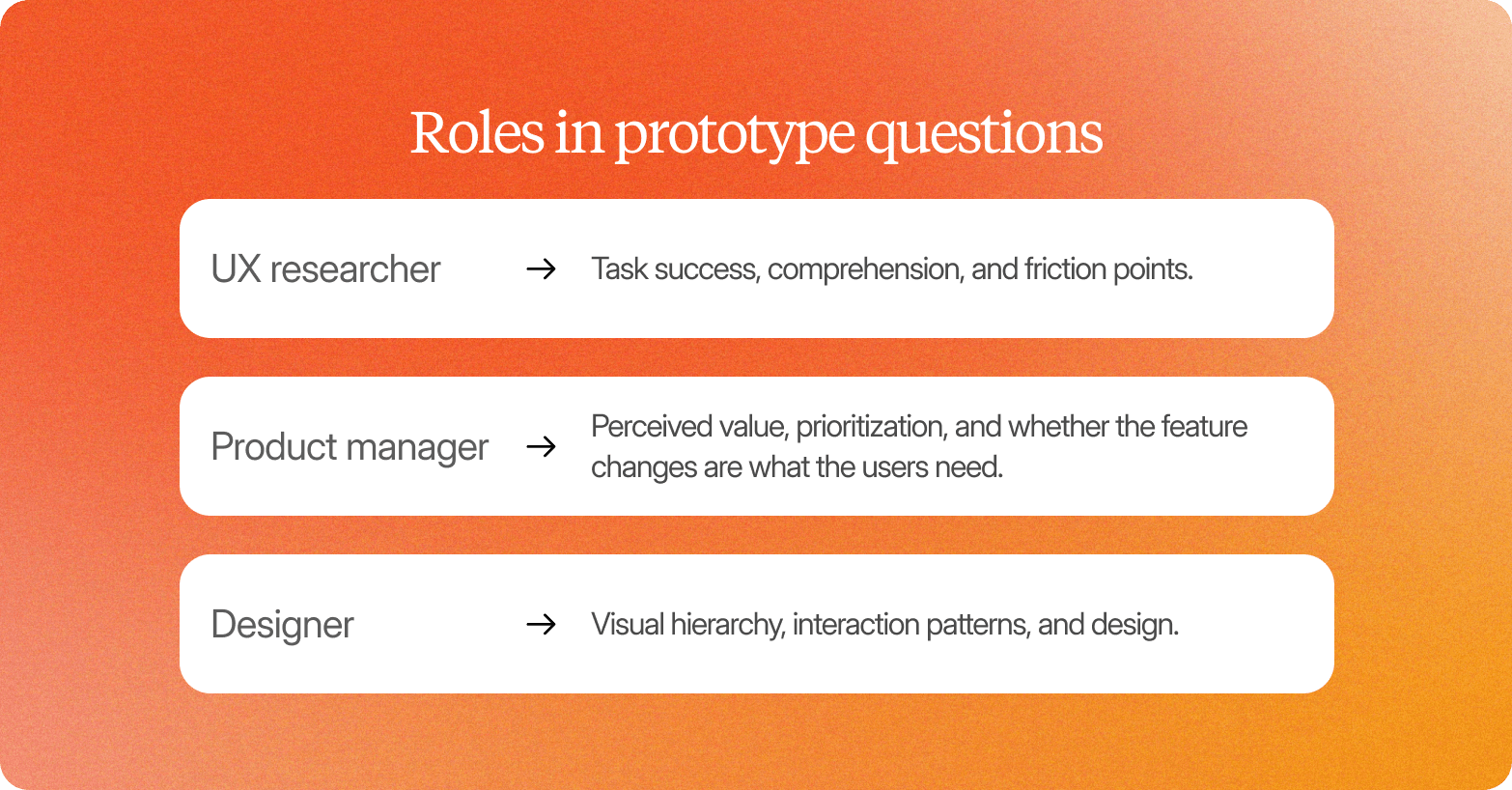
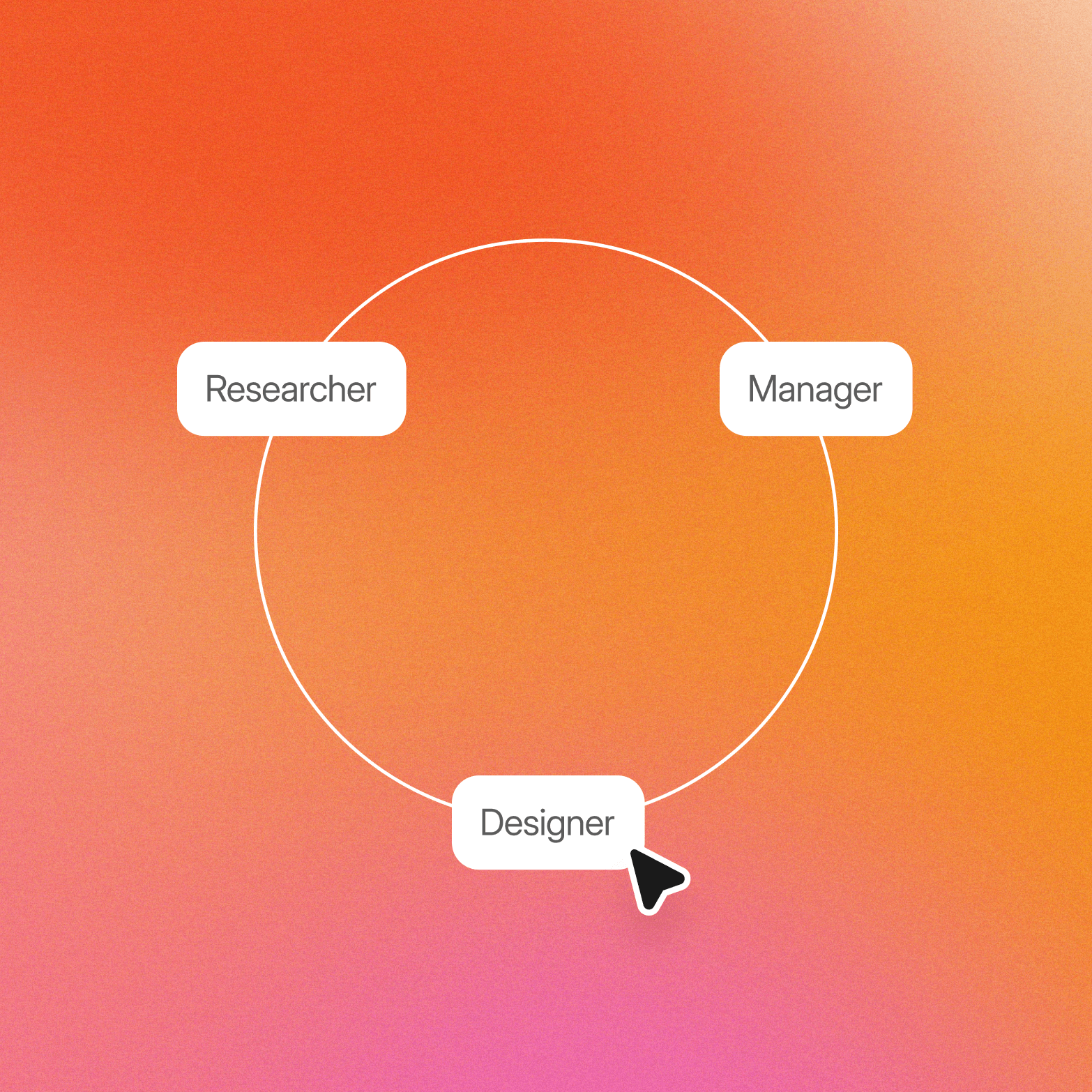
Different roles arrive at prototype testing with different priorities. A UX researcher validates whether the interface communicates what it should. A product manager validates whether the feature is worth building. A designer validates whether visual and interaction decisions hold up under real use. The right questions for each role surface the user insights that matter for that decision.
UX researcher
Validating: Task success, comprehension, and friction points.
"Walk me through how you'd complete [specific task] using this prototype."
"What do you expect to happen when you interact with this element?"
"You hesitated. What were you looking for in that moment?"
"How does this compare to other platforms you use for [similar task]?"
"If you got stuck here in real life, what would you do next?"
"On a scale of 1 to 5, how confident do you feel about what you just did?"
"What's one thing that would make this clearer to use?"
Adaptation example: "Do you like this feature?" becomes "Walk me through how you'd use this feature to [specific task]. What's going through your mind?" The second version captures user expectations and the exact point where comprehension fails.
Product manager
Validating: Perceived value, prioritization, and whether the feature addresses a real need that users would change behavior for.
"Before we go through it together, what problem do you think this is trying to solve for you?"
"After seeing this, how likely would you be to use it in your normal workflow? What would need to be true for you to use it regularly?"
"Which part felt most useful? Which felt least relevant to you?"
"If you had to choose between this and [alternative approach], which would you pick and why?"
"What would make you trust this enough to rely on it for something that actually matters?"
"What part of this felt like it was built for someone else's workflow, not yours?"
"If this shipped tomorrow and you used it weekly, what would success look like three months in?"
Adaptation example: "Would you use this?" becomes "Which part felt most useful, and which felt least relevant to you?" This separates genuine interest from courtesy and surfaces the prioritization signal the PM needs.
Designer
Validating: Visual hierarchy, interaction patterns, and whether design decisions communicate intent without relying on copy to do the work.
"When you first looked at this screen, where did your eye go? What did you notice first?"
"Which elements looked like you could interact with? Did anything surprise you?"
"Did the visual weight of any element feel out of place: too prominent, or too easy to miss?"
"If you had to describe the personality this design gives off in three words, what would they be?"
"Was there anything that felt visually cluttered or hard to parse at a glance?"
"Did the spacing and grouping of elements help you understand how things were related, or did anything feel disconnected?"
"What would you change about the layout if you were the designer?"
Adaptation example: "Do you like the design?" becomes "When you first looked at this screen, where did your eye go, and what drew your attention away from?"
How Conveo supports continuous prototype testing
Prototype testing is an essential part of the design process, not a one-time event before product launch. For development teams running continuous discovery, the constraint is not the research method but research throughput. Conveo, a video-first AI research platform, connects the framework in this article to the operational throughput that makes it practical.
Its AI moderator runs adaptive prototype interviews asynchronously, deploying probe ladders based on what each test participant actually says. Every session produces timestamped video clips, verbatim quotes, and behavioral signals stakeholders can inspect directly. Teams use Conveo to validate core features and collect valuable feedback at every stage, from early concept validation through to final hi-fi sign-off.
Hundreds of enterprise teams, including Google, Bosch, Reddit, and FOX, use Conveo to compress research cycles and accelerate their path to a successful product launch.
Frequently Asked Questions
What are prototype testing questions?
Prototype testing questions are structured prompts used to evaluate a prototype's usability, value, and functionality before committing to full development. They are an essential part of the design process, helping teams identify usability issues and surface design flaws while changes are still inexpensive. They take many forms, from open-ended concept probes to detailed interaction prompts for hi-fi interfaces.
How many prototype testing questions should I include per session?
Aim for five to eight primary questions per session, each with two to three follow-up probes. Fewer, well-probed questions produce more actionable feedback and more insights than a long list of surface-level prompts. The right questions go deep; a long list stays shallow.
When should I use moderated vs. unmoderated prototype testing?
Use moderated testing when you need to probe emotional reactions and unexpected behaviors in real time. Use unmoderated testing for rapid-scale validation of specific task flows. AI-moderated async interviews combine probe depth with an unmoderated scale. The right approach depends on how much qualitative data you need and how much access you have to your target audience.
How do I avoid leading questions in prototype testing?
Frame questions around tasks and observations, not opinions. Instead of "Do you like this feature?", ask "Walk me through how you'd use this feature to [specific task]." Let participants describe their experience before introducing evaluative framing. The cardinal rule: let users find the friction before you name it for them.
What is the difference between concept testing and prototype testing questions?
Concept testing questions explore whether real users understand and value a product idea before any design work begins. Prototype testing questions evaluate whether a specific design implementation works: whether users can complete tasks, understand interactions, and trust the experience. Concept testing asks whether the right audience sees value in the idea; prototype testing asks whether the functionality and information architecture match how users expect to interact with it.
About the author
Kelsey Allen-Niesen
Research Impact Lead
Kelsey spent three years in insights and strategy at Kelton Global, then led innovation consumer insights at Pharmavite, before a Kellogg MBA with a summer at Bain. She joined Conveo in October 2026 and spent her first week at the product hackathon, helping ship a routing improvement on day one.
Meet Kelsey on film →Qualitative insights at the speed of your business.
Conveo runs AI-moderated video interviews and structures everything they say.