In this article
TL;DR
We showed the 2026 Tesco and Sainsbury’s Christmas ads to 60 UK adults. Tesco’s won the vote, 33 to 27.
Sainsbury’s made more people likelier to shop there: 26 raised their score, against 18 for Tesco.
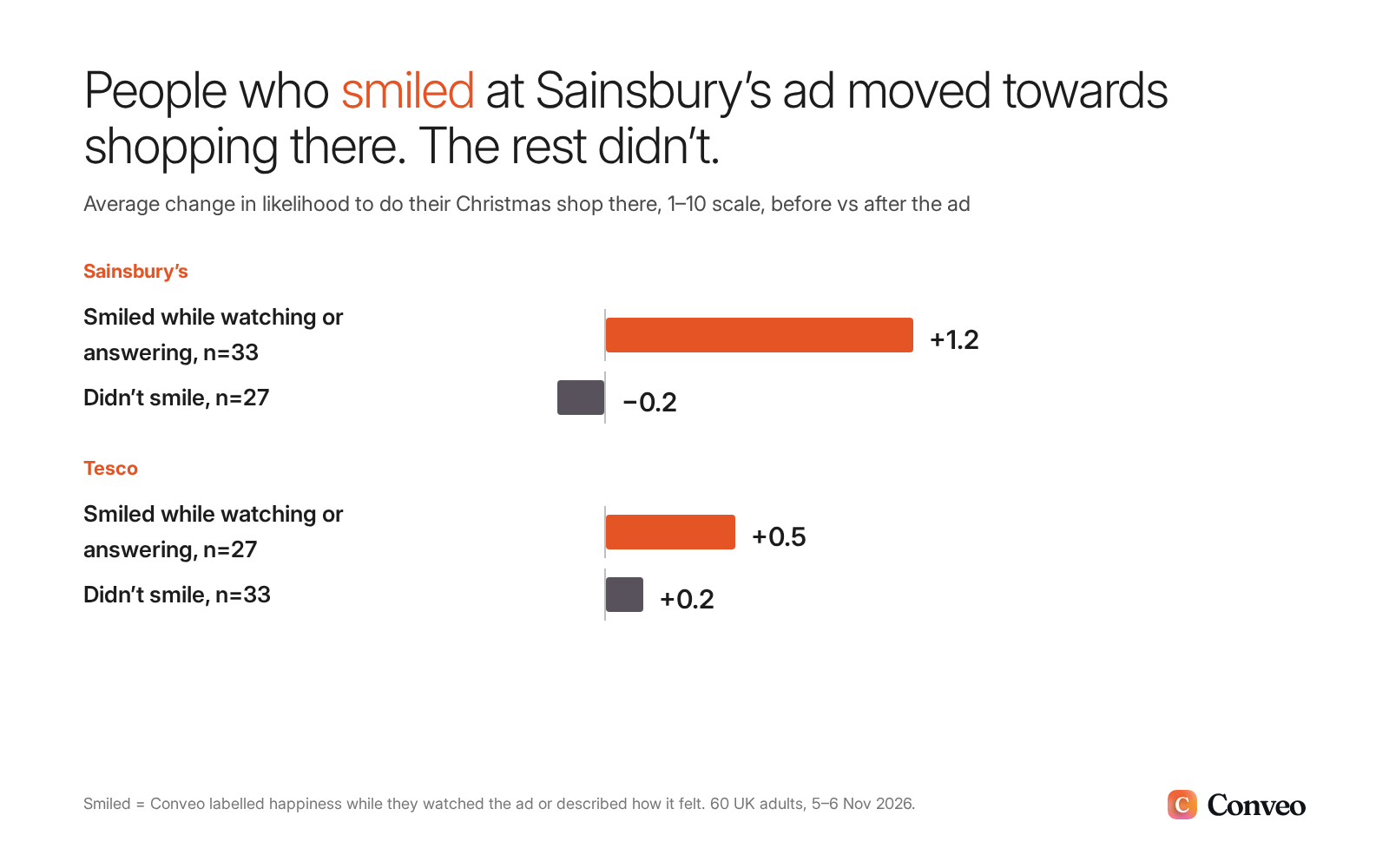
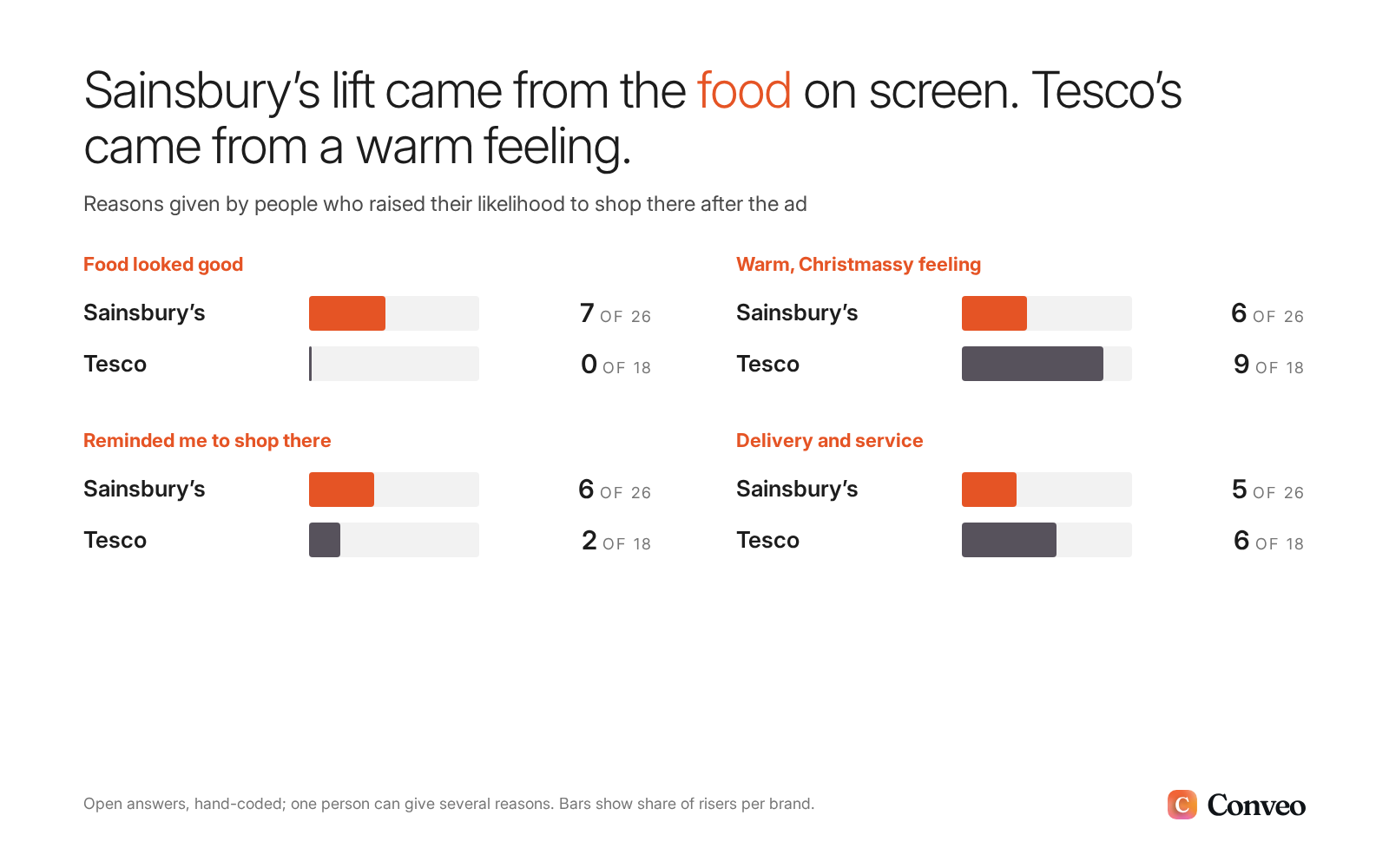
People who smiled while watching or talking about the Sainsbury’s ad raised their score by 1.2 points on average. Those who didn’t smile dropped 0.2. 7 of the 26 who raised their Sainsbury’s score mentioned the food at the end.
Social Studies is a Conveo series that runs studies on what people are talking about right now. This time it was the two big UK supermarket Christmas ads. We showed both to 60 UK adults, asked which they preferred and how likely they were to do their Christmas shop at each one. We also measured each person’s emotional response to both ads with Conveo’s emotion detection, which reads facial expressions while people watch and while they talk, and asked them to explain every score in their own words.
For anyone who runs a brand or an insights team, the useful part is the gap between the ad people liked and where they said they’d shop.
Tesco won the vote, 33 to 27
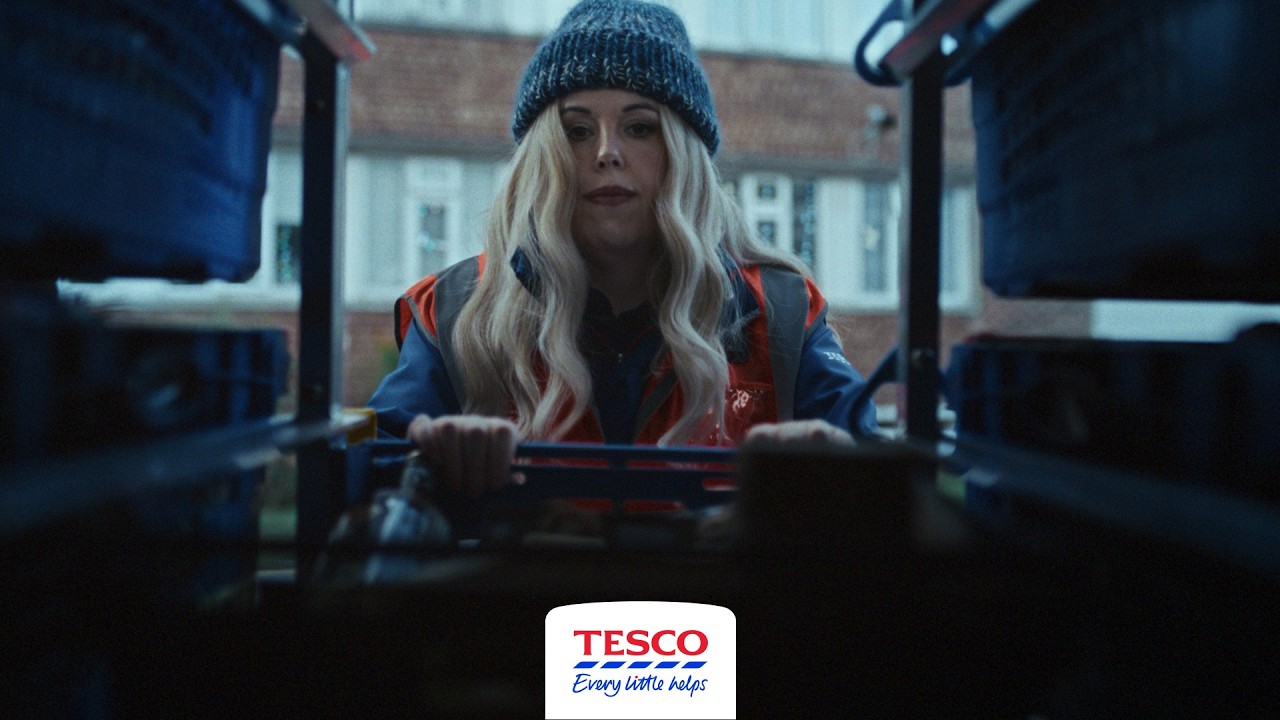
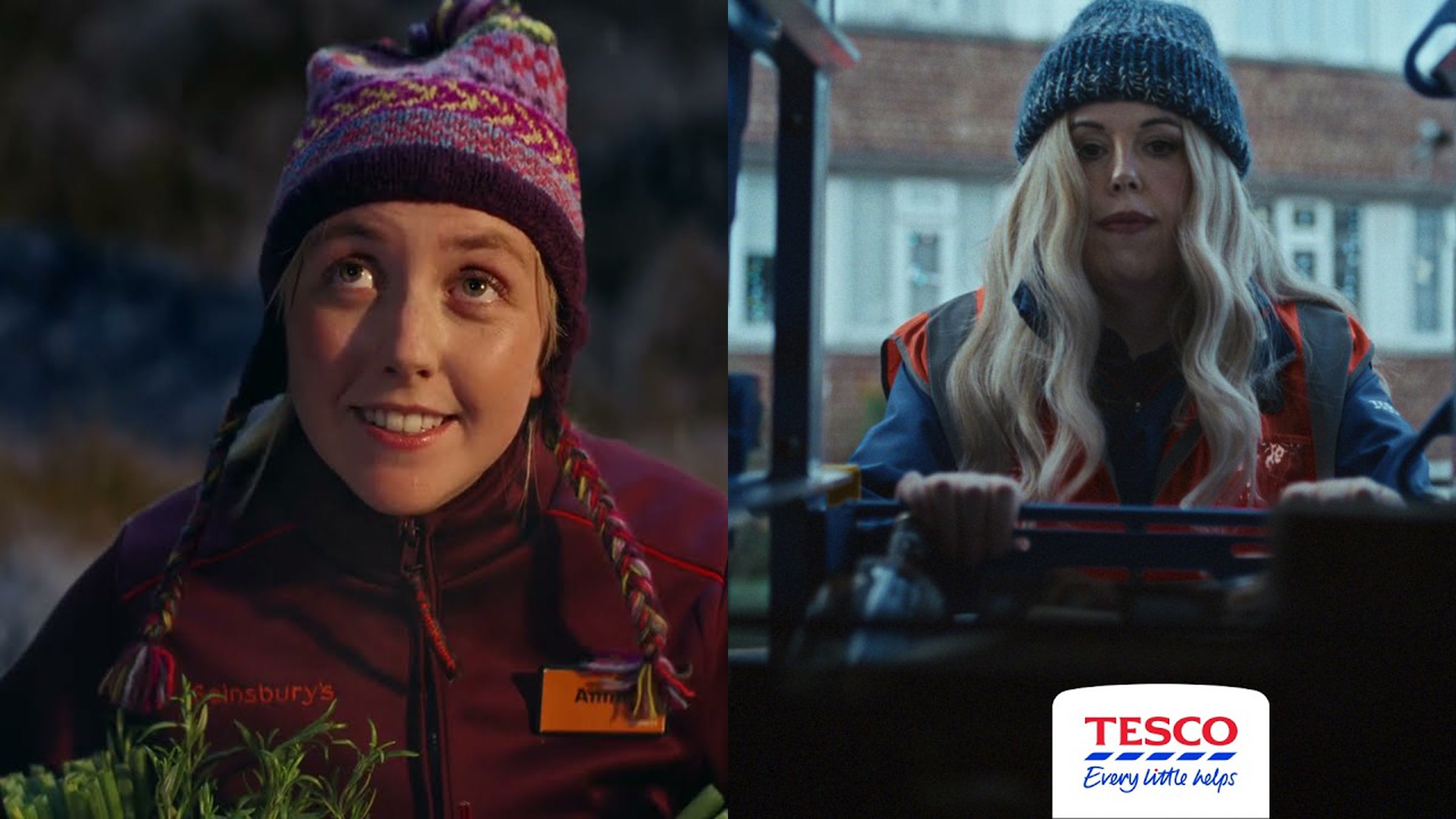
Tesco’s 2026 Christmas advert, ‘The Wrong Address’, stars comedian Roisin Conaty as Polly, a Tesco delivery driver who unexpectedly reunites with an old school friend facing a festive crisis. The ad was made with BBH London. 33 of the 60 people we spoke to preferred it, and 27 picked Sainsbury’s. The gap is small, so read it as a lean, not a clear win.
The reunion is what moved people.
“I feel quite teary actually after watching that.”
Participant, UK
Another said: “I think the fact that it came across as Tesco being very giving, trying to help people. It’s a tough time at the moment and it sort of gave the message that we all need to help each other.”
40 of the 60 said the ad was about delivery and helping out. Only 7 mentioned Christmas food.
Sainsbury’s gave the bigger lift in likelihood to shop
Both retailers started at the same score. On average, people rated their likelihood of doing their Christmas shop there at 7.4 out of 10. After the ads, Sainsbury’s went up to 8.0 and Tesco to 7.8.
26 people raised their Sainsbury’s score after watching, against 18 for Tesco
12 went down for Sainsbury’s and 11 for Tesco
31 kept the same Tesco score
Sainsbury’s made more people smile, and the people who smiled moved
Conveo’s emotion detection tagged each person’s facial expression while they watched each ad and again while they talked about it afterwards. Every emotion it tags links back to that moment in the recording. The clip below is from our Social Studies episode: four of the 60 viewers watching each ad, with the share of viewers smiling over time.
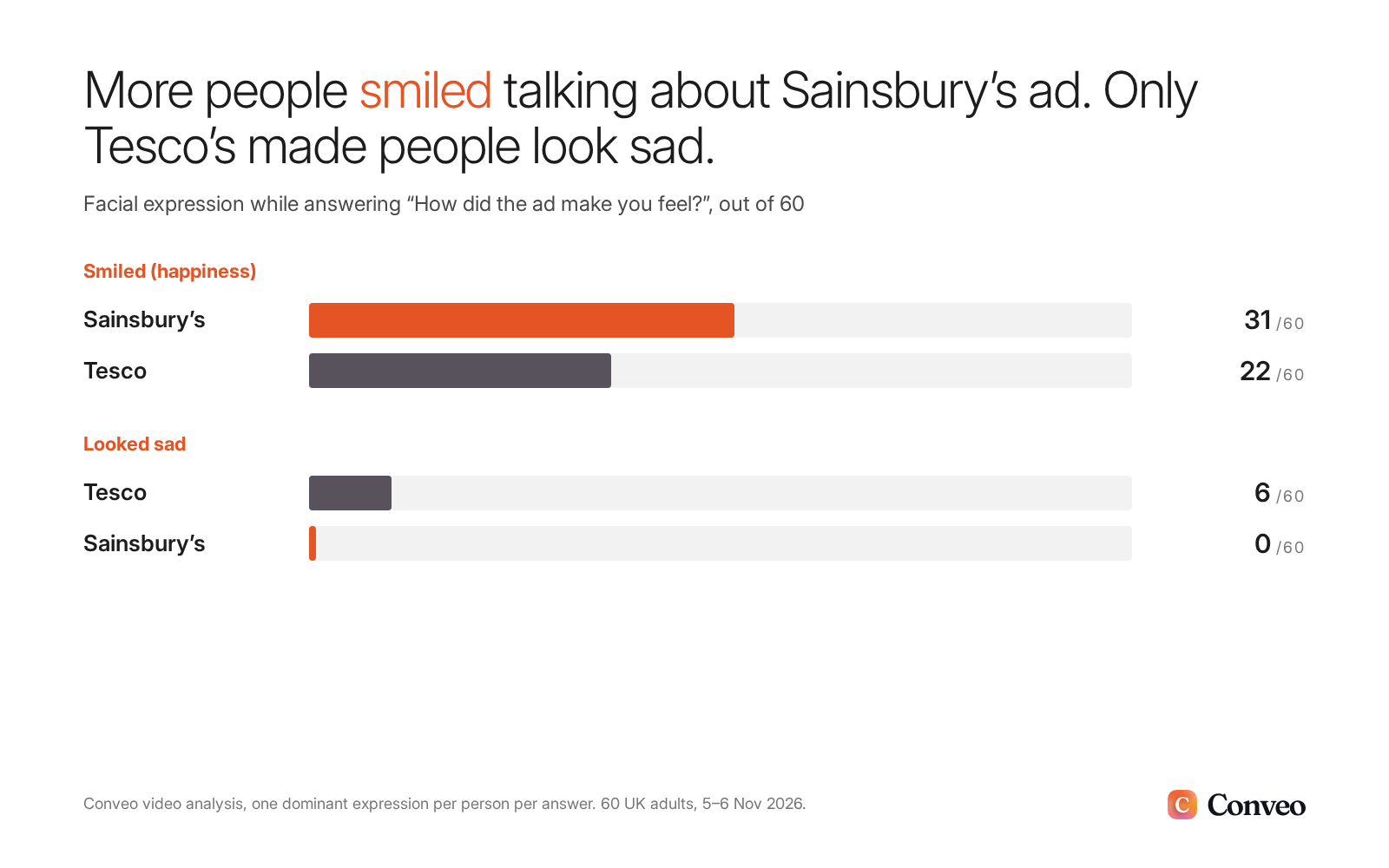
While people watched, most faces stayed neutral: 49 of 60 for Sainsbury’s and 50 of 60 for Tesco. The difference showed up when they talked about the ads afterwards. 31 people smiled while describing how the Sainsbury’s ad made them feel, against 22 for Tesco. Six looked sad describing Tesco’s, and nobody did for Sainsbury’s.
“It made me feel all warm inside… it really made me smile.”
Participant, UK, on the Sainsbury’s ad
The people who smiled were the ones who changed their minds. Those who smiled while watching or talking about the Sainsbury’s ad raised their likelihood to shop there by 1.2 points on average. Those who didn’t smile dropped 0.2. For Tesco the gap was smaller: +0.5 against +0.2.
The food at the end did a lot of the work

Sainsbury’s 2026 Christmas advert brings back the BFG for a third year. He’s ill in bed, so Sainsbury’s colleague Annie and her sidekick Fred drive a Christmas feast across Giant Country to his cave, dodging the Greedy Giant on the way. The ad was created by New Commercial Arts. The final spread is what people talked about.
“I’m quite eager to go and check out the Christmas foods that Sainsbury’s are doing this year because they looked delicious.”
Participant, UK
Another raised their score “because the food at the end of the advert did look really good.” 11 of the 60 mentioned Christmas food when describing Sainsbury’s message.
We asked everyone whose score went up why. 7 of the 26 Sainsbury’s risers named the food, and none of Tesco’s 18 did. Tesco’s risers talked about how the ad made them feel (9 of 18).
The fantasy didn’t work for everyone. One participant found it “chaotic and a bit stressful rather than sort of heartwarming.”
Liking an ad and choosing where to shop are different decisions
51 of 60 gave Tesco’s ad four or five stars, and 18 said they were more likely to shop there. For Sainsbury’s it was 46 and 26.
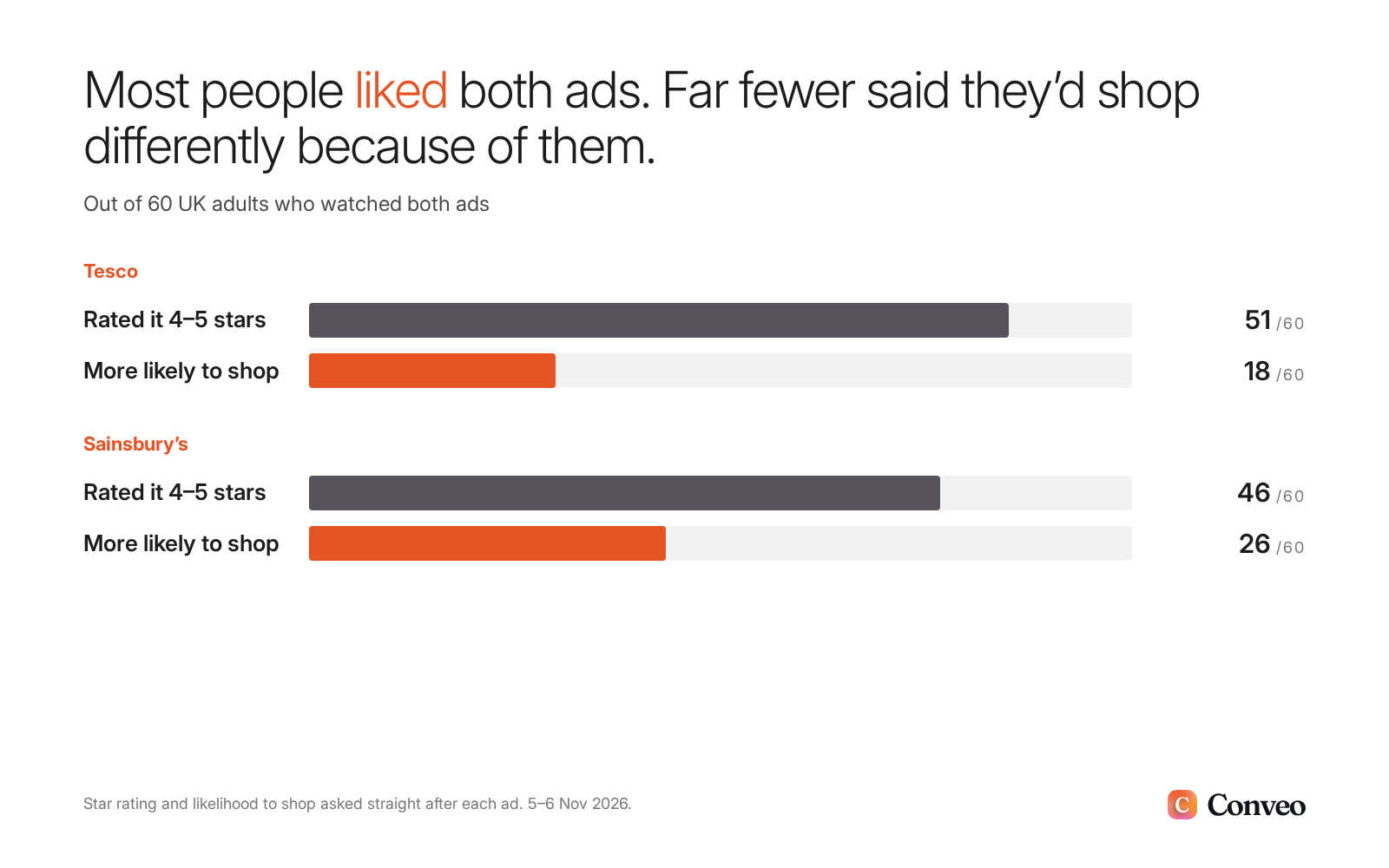
For a lot of people, the ad wasn’t what decided it. “It’s not as much the facts of the ad, it’s the fact that I’ve already got my Christmas slot booked,” one said. Anyone who started at 10 couldn’t go any higher.
Where people started mattered. Those who already rated a retailer 8 or higher dipped slightly after the ads. Among the 27 who started at 7 or lower, 20 raised their Sainsbury’s score and 14 raised their Tesco score.
Tesco’s message of kindness and giving back won people over. Sainsbury’s adventure, humour and food gave them a reason to imagine shopping there.
What marketers can take from this
Measure movement as well as liking. Star ratings put both ads close together. The likelihood question, and the reasons people gave for their answer, separated them.
Watch faces while people talk about the ad. Faces were mostly neutral during the ads themselves. Smiles while people described the ad were a clearer sign of who would move.
Check what people remember about the brand. 40 of 60 said Tesco’s ad was about delivery and helping out, and 7 mentioned Christmas food. About half (30 of 60) picked up Sainsbury’s “nobody should miss Christmas” message, and 6 took away a reason to shop there.
Look at who can still be won. The 27 people who started at 7 or lower moved the most. For people who already planned to shop at a retailer, the ad mostly confirmed it.
About this study: 60 UK adults in AI-moderated video interviews on Conveo, run on 5 and 6 November 2026. All 60 interviews were completed in under 23 hours, between the evening of 5 November and midday on 6 November. Everyone watched both ads, and the ad order was rotated: half saw Sainsbury’s first, half saw Tesco first. Likelihood to shop is stated intent, measured right after watching. Facial expressions come from Conveo’s emotion detection, which gives one dominant expression per person for each question. Reasons for score changes were coded by hand from the open answers, and one person can give several. Results describe the people we interviewed and are not nationally representative.