
TL;DR
The limitations of qualitative research are operational and methodological constraints built into how qualitative work is designed and delivered, not evidence that the approach itself is flawed.
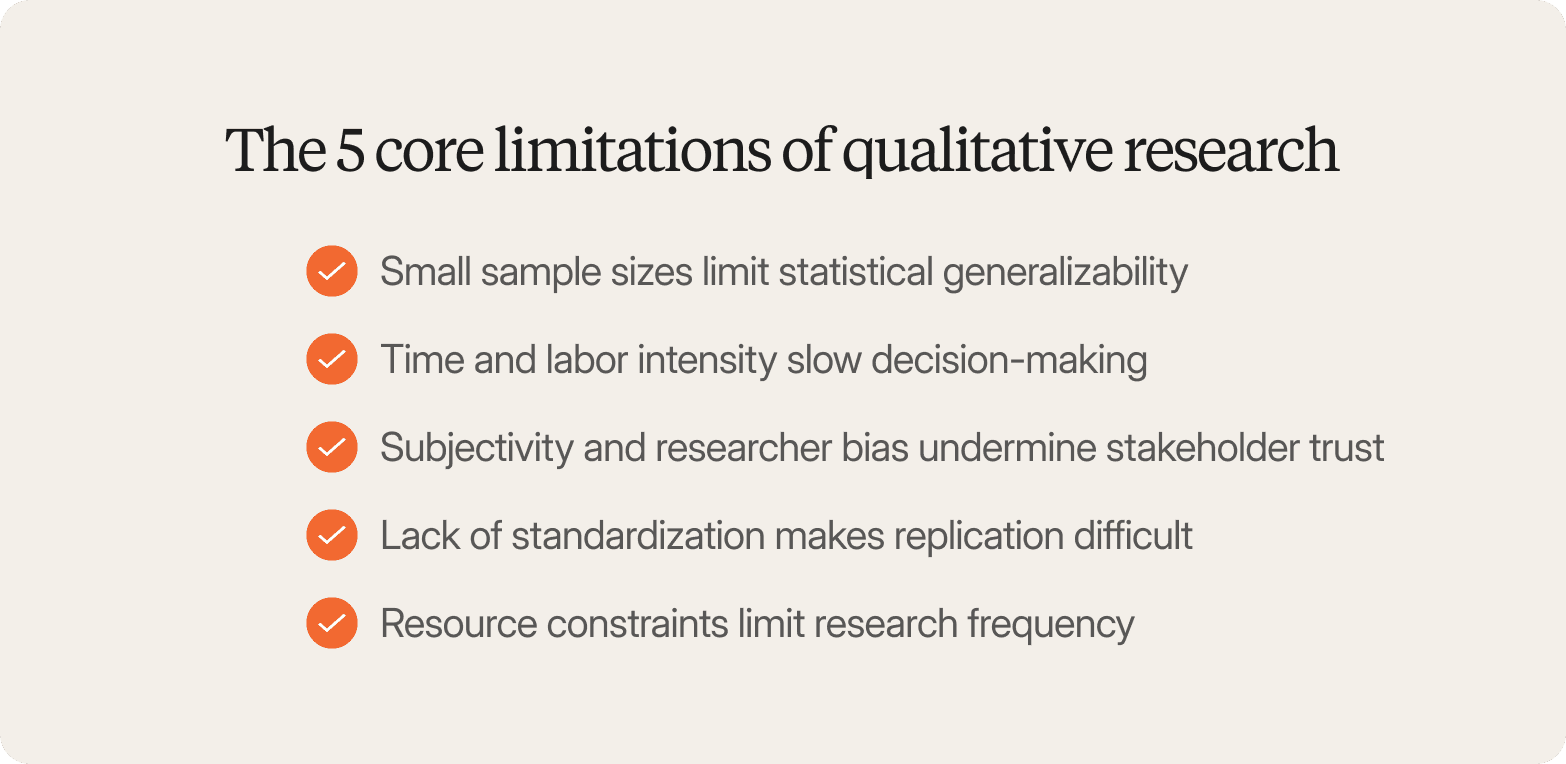
The five core qualitative research limitations:
Small sample sizes: Qualitative findings reflect depth over statistical representation, which limits generalizability across large populations
Time and labor intensity: Traditional qualitative data collection and analysis (recruiting, moderating, transcribing, synthesizing) compresses decision windows and strains small teams
Subjectivity and bias risk: Moderator influence, participant self-reporting, and analyst interpretation introduce potential biases that require active mitigation
Lack of standardization: Without consistent discussion guides, coding frameworks, and output formats, qualitative findings are hard to compare across studies or teams
Stakeholder trust gaps: Qualitative information without traceable sources or video evidence is harder for executives to act on with confidence
The limitations of qualitative research are well understood by anyone who has sat in a stakeholder readout and watched the room turn skeptical. "How many people did you talk to?" is rarely a genuine methodological question. It is a credibility challenge, and when qualitative findings come from 12 or 20 participants, even experienced qualitative researchers find themselves defending the sample before the insight gets a hearing.
What has changed is the cost of losing that argument. When qualitative findings arrive late, or stakeholders dismiss them as "just a few interviews," the research function loses influence at the moment it should matter most. Market research budgets have stayed flat. Decision timelines have compressed. The expectation from leadership has not softened: insights should shape decisions before they are made, not explain them afterward.
There are two distinct categories of constraint, and conflating them leads teams to either accept problems they do not have to live with or waste energy on genuinely irreducible ones. The first category is methodological: small samples and interpretive judgment are features of qualitative research methods, not flaws. The second is operational: slow recruitment, manual moderation, and weeks-long reporting cycles are artifacts of how qualitative research has historically been conducted, not of the discipline itself. Modern research technology has largely dissolved the second category. This article maps both so practitioners can identify whether they are facing a tradeoff to accept or a constraint they can now address.
What are the limitations of qualitative research?
The limitations of qualitative research include small sample sizes that constrain generalizability, time-intensive data collection and analysis, risks of subjectivity and researcher bias, a lack of standardization across qualitative studies, and gaps in stakeholder trust when qualitative findings cannot be traced back to primary data sources.
These limitations fall into two groups: inherent methodological trade-offs (small sample sizes, the subjective nature of interpretive judgment) that define qualitative research by design, and operational constraints (speed, cost, scalability) that AI-augmented qualitative methods are now addressing directly. Understanding which is which is what separates research teams that improve their practice from those that spend energy defending constraints they do not have to accept.
The 5 core limitations of qualitative research
1. Small sample sizes limit statistical generalizability
Qualitative studies typically involve between eight and 40 participants. For a researcher, that reflects a deliberate methodological choice. For a senior stakeholder being asked to approve a product direction or reallocate budget, it can feel like thin ground.
Qualitative research methods are designed to produce depth, not distribution. Unlike quantitative data from large-scale surveys, a well-moderated interview with 20 carefully selected participants surfaces motivations, mental models, and decision logic that numerical data alone cannot capture. The tradeoff is that qualitative studies cannot tell you how many people share those motivations. External validity (the ability to generalize findings to a broader population) is not what qualitative methods are built to deliver.
Stakeholders unfamiliar with qualitative research methods often respond by stalling, demanding quantitative validation before acting, which adds weeks and budget to the project. Findings that are directionally clear sit unused while teams wait for a survey to confirm what the interviews already showed.
Two practices reduce this friction. Purposive sampling (selecting participants who represent the specific customer segments most relevant to the research problem) provides stakeholders with context to evaluate findings accurately, rather than defaulting to headcount as a proxy for credibility. Running qualitative research continuously, not as isolated projects, builds pattern recognition across studies over time: when three separate studies surface the same barrier in the purchase journey, that convergence carries a different kind of confidence than any single sample can provide.
2. Time and labor intensity slow decision-making
Traditional qualitative research operates on a timeline that rarely matches the pace of business decisions. A full project cycle (recruitment, scheduling, moderation, transcription, analysis, reporting) typically runs two to eight weeks end-to-end. By the time findings land in a stakeholder deck, the product feature is in development, the campaign has shipped, or the pricing decision has been made.
Manual moderation requires coordinating participant schedules across time zones, often stretching recruitment alone to one or two weeks. Transcription creates a backlog that grows linearly with study size. Qualitative data analysis demands sustained researcher attention before a single finding reaches a stakeholder.
Campaign concepts go into production without consumer input. Product features launch without validation. CX teams wait months for qualitative information that should be shaping the next iteration, not explaining the last one.
Asynchronous interviewing eliminates scheduling friction: participants respond on their own schedule, sessions run in parallel, and findings can be delivered incrementally rather than held for a final report. Automated transcription and initial coding reduce the time required for qualitative data analysis from days to hours.
A traditional 20-interview study might take six weeks from kick-off to findings. Conveo, a video-first AI research platform, manages the entire process, from recruitment through qualitative data analysis, with findings available as sessions land, compressing the typical cycle to as few as three days without sacrificing conversational depth.
"Within days, we had insights that would've taken a traditional agency a month."
Head of Customer Insights, JDE Peet’s
3. Subjectivity and researcher bias undermine stakeholder trust
Stakeholders who were not in the room often distrust qualitative findings for one specific reason: the conclusions feel like interpretation rather than evidence. When a research report says "customers feel anxious about the onboarding process," the instinctive response from a skeptical VP is: Did customers actually say that, or did the researcher decide that is what they meant?
Qualitative researchers apply judgment at every stage of the research process: deciding which themes are significant, selecting which quotes are representative, and synthesizing patterns across dozens of conversations. Confirmation bias (where qualitative researchers unconsciously let preconceived notions shape their analysis) is a documented risk. Leading questions during moderation can introduce researcher bias before analysis even begins.
Findings die in slide decks when stakeholders suspect cherry-picking. Research that should shift decisions instead generates debate about methodology.
Mitigation starts with transparency. Using multiple coders to cross-validate themes surfaces potential biases in the data. Documenting the coding framework before synthesis creates an auditable record. Tying every insight to verbatim quotes (rather than paraphrased summaries) gives stakeholders direct access to data sources they can evaluate themselves.
Conveo links qualitative findings directly to timestamped video clips, shifting the stakeholder experience from "trust the researcher's interpretation" to "watch the participant say it yourself." 83% of participants report being as open as, or more open, with an AI moderator than with a human researcher, indicating that the source material is richer and more candid than traditional sessions typically yield.
"The video clips make it tangible; it's not just data anymore, it's real people with real emotions."
CMI Manager, Edgard & Cooper
4. Lack of standardization makes replication difficult
Qualitative research is adaptive by design. A skilled moderator follows the thread a participant opens; a qualitative researcher codes themes based on context rather than a fixed taxonomy. That flexibility is the method's core strength, and the reason standardization is genuinely difficult without undermining what makes qualitative work valuable.
The replication problem surfaces when a second researcher tries to build on prior qualitative studies. What counted as "price sensitivity" in one study may have been coded differently in the next. Without documented coding logic, two qualitative researchers interpreting the same collected data will often reach different conclusions, not because the data is ambiguous, but because the interpretive framework was never written down.
When findings live in slide decks rather than searchable repositories, organizational knowledge degrades. A new qualitative researcher starting a brand tracking study cannot trace what prior waves found and instead re-establishes the context already established by prior research, rather than pointing toward further research questions.
Standardization is best understood as a spectrum. Complete standardization eliminates the adaptive probing that creates qualitative depth; no standardization means every study is an island. The practical middle ground: structured templates for common study types (concept testing, ad testing, brand tracking), paired with documented coding frameworks that give qualitative researchers a consistent starting point without constraining interpretation.
Conveo's knowledge library stores themes, quotes, and video evidence from the data collected across studies in a structured, searchable repository. New research builds on prior qualitative findings rather than starting from scratch, thereby compounding organizational knowledge.
5. Resource constraints limit research frequency
A single agency-led qualitative study typically runs $15,000–$40,000 once you account for recruitment, moderator fees, transcription, analysis, and reporting. Costs scale linearly with study volume, and for small insights teams serving large organizations, that equation closes the door on recurring research before the conversation starts.
The result is predictable: qualitative researchers run studies once or twice per year, tied to major launches or annual reviews. Customer understanding becomes a series of periodic snapshots. Decisions made between studies rely on assumptions, survey data that cannot explain the underlying reasons behind customer choices, or institutional knowledge that degrades over time.
Asynchronous AI moderation eliminates moderator scheduling overhead. Automated transcription and thematic analysis reduce analyst burden. A platform-led study with the same depth as an agency engagement might cost $2,000–$5,000 rather than $15,000–$40,000.
Teams using Conveo report up to 75% lower research spend compared to agency-led projects, while running qualitative studies in parallel rather than sequentially. Study setup takes approximately 30 minutes, eliminating the procurement overhead that can turn a quick-turn study into a month-long research process. The constraint was never the appetite for customer understanding. It was the cost structure that made acting on that appetite impractical.
Modern limitations: Remote, asynchronous, and AI-assisted qualitative research
Remote and asynchronous interviewing: Loss of real-time rapport
Asynchronous video interviewing removes the scheduling bottleneck that makes qualitative research time-consuming to deploy. That operational gain comes with a real tradeoff: when participants record responses on their own time, the live conversational dynamic disappears.
In a live session, a skilled moderator reads hesitation, adjusts pacing, and builds trust that draws out authentic observations about real experiences, motivations, and behaviors. Asynchronous qualitative methods cannot replicate this in real time. There is no moment to probe a telling pause or redirect when a response feels rehearsed.
The mitigation is meaningful but partial. Adaptive AI probing (follow-up questions generated based on what a participant actually said) compensates for some of what live moderation provides. Conveo participants respond with 3–4x longer answers than in static surveys, and video preserves tone, facial expressions, and physical reactions in ways text-based interviews cannot.
The practical question is whether the tradeoff is acceptable for the study at hand. For concept testing, ad testing, or gathering qualitative insights into existing experiences, the speed and scale advantages typically outweigh the loss of rapport. For exploratory qualitative research on sensitive topics where trust is a prerequisite for honest disclosure, live moderation remains the stronger choice.
AI-assisted analysis: Risk of decontextualization
AI-assisted qualitative data analysis can compress days of manual work into hours. It also introduces a distinct problem: findings that look complete but have lost the context that made them meaningful.
AI systems identify surface-level patterns efficiently but cannot assess the quality of individual observations: for example, distinguishing between a participant who mentioned price hesitation in passing and one whose entire interview pivoted on it. They miss the shift in tone, the pause before a critical answer, or the contradiction between what someone said early in a conversation and what they revealed later.
The mitigation is to position AI correctly in the research process. AI handles initial coding and theme identification. Human researchers then review, interrogate the clusters, and validate whether patterns reflect genuine qualitative findings or coincidental language overlap. In practice, AI-generated theme labels are often directionally correct but interpretively shallow, requiring human refinement before conclusions are credible enough to present.
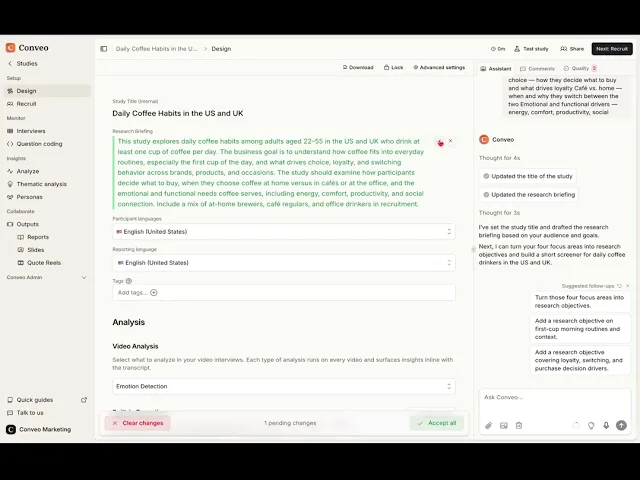
Discover how to build and launch a study in Conveo:
Every finding produced through automated qualitative data analysis should link directly to its source. Enterprise decision-makers increasingly reject AI-generated conclusions that arrive without evidence. Traceability is not about protecting the researcher: it is about making the insight usable.
Synthetic and avatar-based research: credibility gaps
Synthetic participant platforms generate qualitative information by querying large language models or pre-trained personas, so the responses reflect patterns in the models' training data rather than actual human behavior. The "participants" have never bought your product, encountered your packaging, or formed an opinion about your brand.
This distinction matters when findings carry financial weight. Teams report that synthetic outputs are increasingly rejected at the stakeholder review stage, not because the qualitative findings look wrong, but because decision-makers cannot trace them back to real observations from real people. The credibility of qualitative research depends on its grounding in actual human behavior.
Every Conveo conversation is with a real, verified participant, captured on video, in their own words, with their hesitations and reactions visible on screen. No synthetic respondents, no simulated personas, no approximations. That standard of authenticity is the difference between qualitative findings that enterprise teams trust and those they do not.
When qualitative research is the right method (and when it is not)
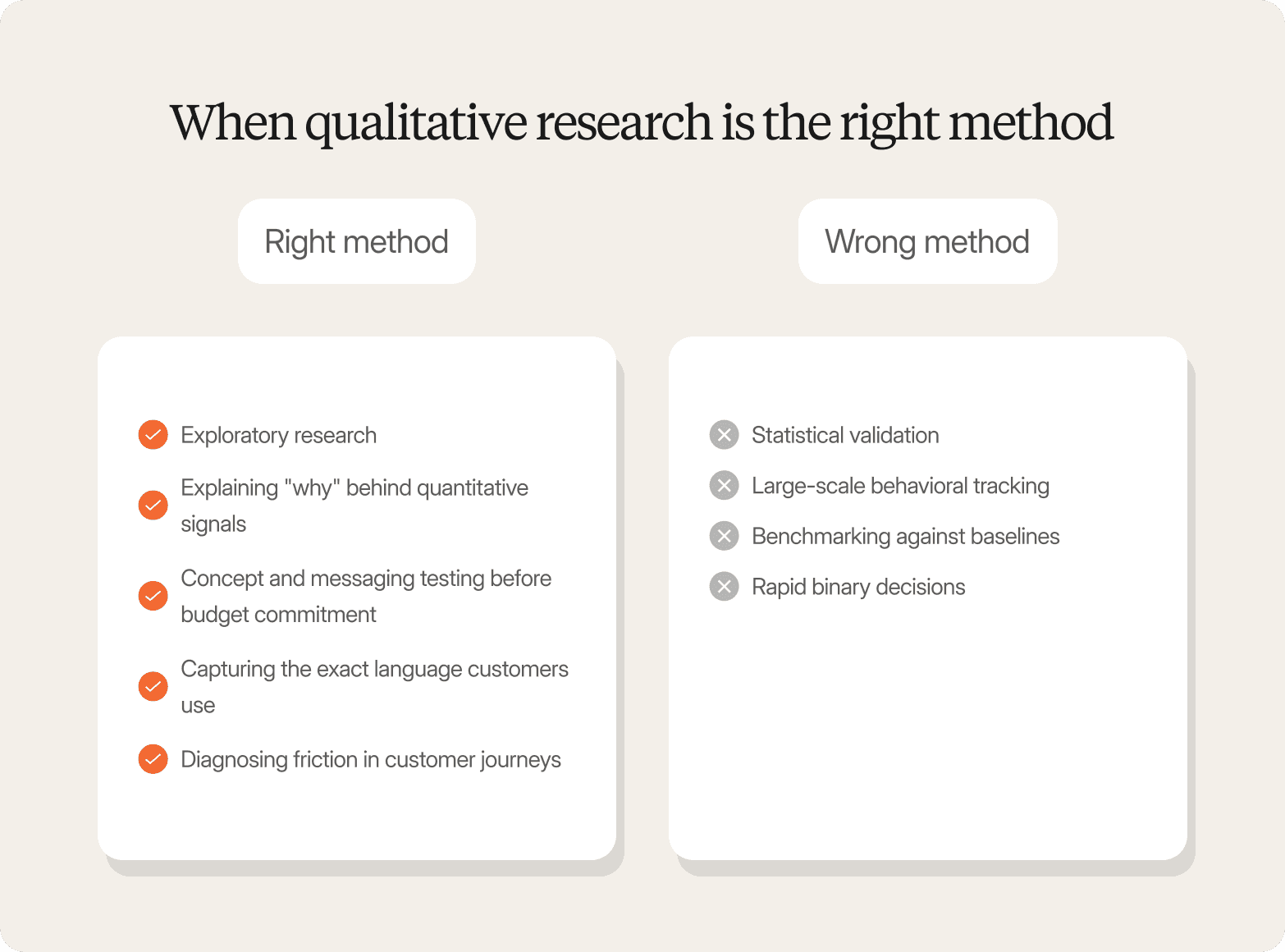
When to choose qualitative research
Understanding the limitations of qualitative research also clarifies when it is the right approach to deploy. Five research problems make qualitative methods the strongest call.
Exploratory research
When entering a new market or problem space where hypotheses do not yet exist, qualitative research is the right starting point. You cannot design a meaningful survey around assumptions you have not formed. Conversations surface the language and mental models (the social phenomena driving customer decisions) that make subsequent quantitative research more precise.
Explaining "why" behind quantitative signals
NPS dropped three points. Feature adoption stalled. A campaign underperformed. Quantitative data tells you something changed; qualitative methods surface the underlying reasons: the motivations, expectations, and friction behind the behavior that numerical data alone cannot explain.
Concept and messaging testing before budget commitment
Before a campaign ships or a product concept moves to development, qualitative research lets teams evaluate assumptions at low cost. Study goals at this stage are not statistical validation. They are understanding how real participants interpret the idea and whether the intended message is landing.
Capturing the exact language customers use
Verbatim customer language is one of the most underused outputs of qualitative work. The words participants reach for when describing a research problem or a product experience are often more resonant than anything a marketing team would write from the inside, and directly inform positioning, UX copy, and sales enablement.
Diagnosing friction in customer journeys
When customers are dropping off or churning, qualitative methods build a comprehensive understanding of what that experience felt like from the inside: moments of confusion, distrust, or unmet expectations that behavioral data alone cannot capture.
When to choose a different method
Statistical validation
When the research problem requires statistically significant results (e.g., pricing optimization, conversion rate testing, market sizing), quantitative research methods are the primary approach.
Large-scale behavioral tracking
When you need to understand what people do at scale, not the underlying reasons why (usage analytics, A/B testing, transaction data), quantitative data is more reliable than qualitative inference.
Benchmarking against baselines
When the goal is to compare performance against industry norms or historical data, quantitative methods provide a structure that qualitative research design cannot match.
Rapid binary decisions
When the answer is yes/no, and the stakes are low, a survey or poll is faster and cheaper.
The strongest research programs combine both approaches: qualitative methods to generate hypotheses and capture human behavior in context, quantitative research to rigorously test those hypotheses at scale. Understanding when you need each, and when to combine them, is as important as knowing how to run either well.
How Conveo addresses the core limitations of qualitative research
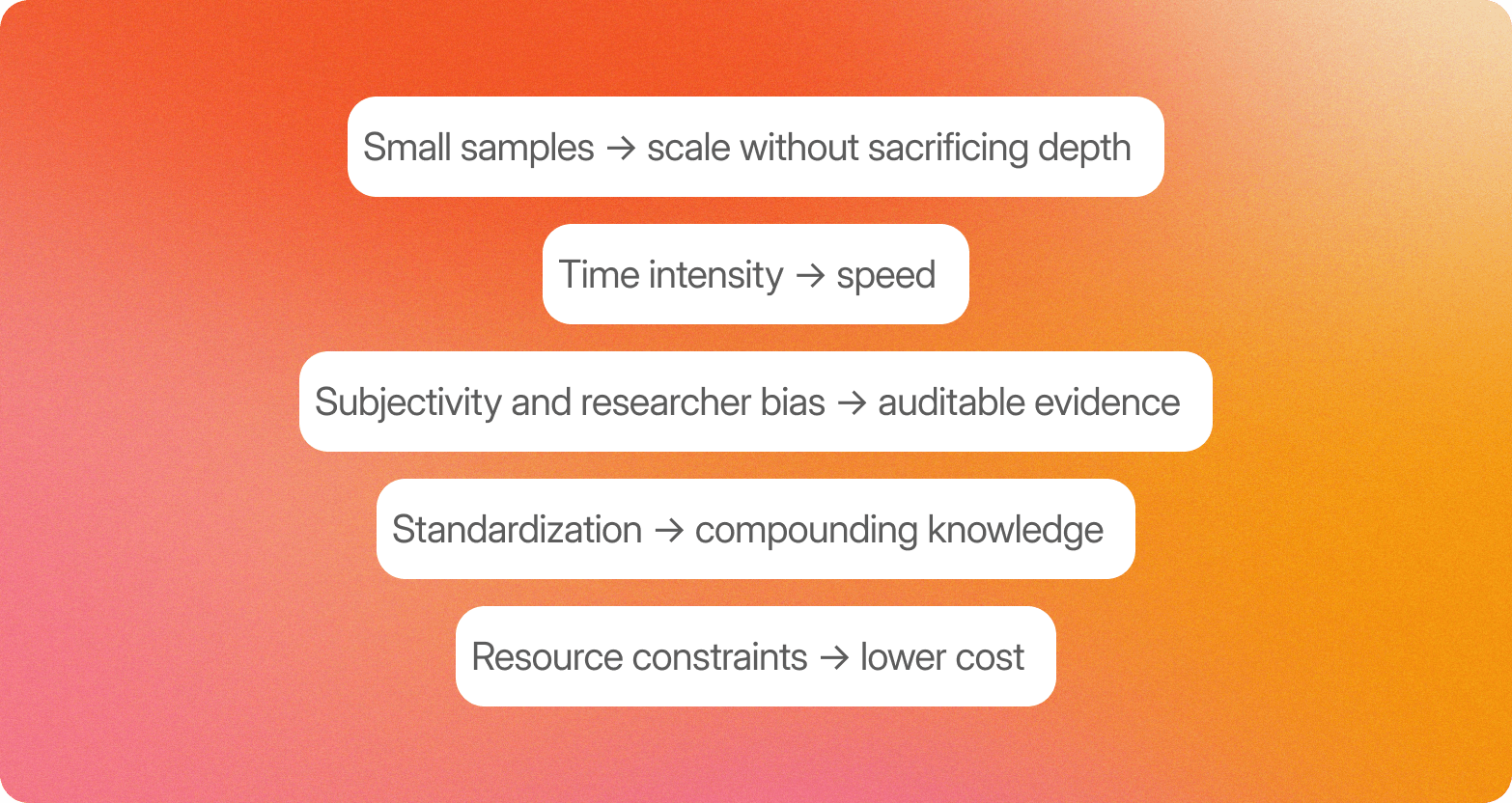
The operational constraints that have defined qualitative research methods for decades are now solvable. Conveo, a video-first AI research platform, is designed to remove those constraints while preserving the depth and quality that make qualitative research worth running.
Small samples → scale without sacrificing depth. Conveo's asynchronous format runs hundreds of real participant conversations in parallel. Unlike focus groups (which are limited in scale and subject to social conformity effects), asynchronous individual interviews let each participant respond independently, building confidence through volume without sacrificing depth.
Time intensity → speed. The entire process, from recruitment through qualitative data analysis and reporting, is compressed from six weeks to three days. Study setup takes approximately 30 minutes.
Subjectivity and researcher bias → auditable evidence. Every AI-generated theme links directly to timestamped video clips and verbatim transcripts. Stakeholders audit the data sources, not just the summary. Researcher bias becomes a verifiable question rather than an assumed risk.
Standardization → compounding knowledge. A searchable knowledge library stores themes, quotes, and video clips across qualitative studies, building organizational knowledge rather than losing it to slide decks.
Resource constraints → lower cost. Up to 75% lower market research spend compared to agency-led projects. Small teams run more qualitative studies without adding headcount.
"Conveo's video-first approach is a real differentiating methodological advantage. The ability to distill insights from reactions and not just hear answers adds context you simply can't get from transcript-only tools, or any other tool in the market for that matter."
Senior Marketing Research & Insights Manager, Google
Frequently Asked Questions
What is the biggest limitation of qualitative research?
How do you address small-sample-size criticism from stakeholders?
Can AI solve qualitative research limitations?
What are the limitations of qualitative interviews specifically?
What is the difference between the limitations of qualitative and quantitative research?