In this article
TL;DR
User interview recruitment is the single biggest bottleneck in UX research and qualitative studies, often consuming more time than the research itself
Channel selection (CRM lists, user panels, recruitment agencies, community sourcing) shapes who shows up, how honest they are, and how much you can trust findings
Screeners that require evidence and behavioral validation (not self-reported claims) are the most underinvested lever for finding best fit participants
Video-first validation makes authenticity inspectable rather than assumed, giving stakeholders traceable evidence and meaningful insights behind every finding
End-to-end platforms that unify recruitment, moderation, and analysis compress research cycles from weeks to days
Conveo integrates all three quality layers (fraud filtering, behavioral screeners, AI-moderated interviews) into a single workflow
User interview recruitment consumes a disproportionate share of project time. Teams build the discussion guide, align on research goals, get stakeholder sign-off, then spend two or three weeks chasing screener responses, disqualifying candidates one by one, and rescheduling no-shows before a single research interview runs. Manual screening is time-consuming: someone must review each applicant against behavioral or attitudinal criteria that a standard panel filter may miss. Scheduling runs sequentially rather than in parallel, which means a study that could take days often stretches to three weeks. For niche audiences (such as category switchers, caregivers of specific age groups, or recent purchasers of a specific SKU), standard panel access falls short and requires custom recruitment, adding cost and time before research even starts.
This article covers the research recruiting channels worth evaluating, the quality mechanisms that separate real users from low-effort candidates, the workflow infrastructure that keeps studies moving without manual coordination, and how teams are compressing user interview recruitment cycles from weeks to days.
This guide is for teams running recurring qualitative studies who need recruitment infrastructure, not one-off project coordination.
Why does user interview recruitment take so long?
Small insights teams (often one to five researchers serving a much larger organization) can spend 40 to 60 percent of a project’s total time on recruitment coordination rather than study design, moderation, or analysis. Recruiting research participants becomes the constraint that determines how much research the team can run, not headcount, not budget, not expertise.
General panels compound the problem. They are built for demographic segmentation, not behavioral segmentation. When your research process requires participants who have used a specific feature in the last 30 days or who have recently switched from a competitor, no standard panel provides a ready pool of participants. Teams frequently pull from three or four sources simultaneously and still struggle to gather enough relevant data from the right users.
By the time recruitment is complete, the decision window has often closed. The research arrives with answers to questions (about customer pain points, unmet needs, or product friction) that no one is still asking.
How to recruit users for interviews: Channels and tradeoffs
Choosing the right research method for sourcing is one of the most consequential decisions in qualitative research design. The channel shapes who shows up, how honest they are, and how much you can trust what they say. Different methods carry different tradeoffs depending on your research goals, timeline, and risk tolerance.
| Channel | Best for | Key tradeoff |
|---|---|---|
| Existing user base (CRM, in-product intercepts) | Continuous discovery, feature validation, satisfaction research | Engagement bias: target users may soften criticism |
| User panel/panel providers (User Interviews, Respondent, Conveo) | Concept testing, competitive research, multi-market studies | Cost per session, risk of professional respondents |
| Recruitment agencies and partner lists | Executive interviews, regulated industries, specialist B2B profiles requiring specialized knowledge | 1-2 week coordination premium; not repeatable at scale |
| Online communities (LinkedIn, Reddit, Slack, Facebook groups) | Early-stage exploratory research, hypothesis generation | Heavy manual screening; social media ads and targeted ads offer faster reach but inconsistent quality |
Conveo, a video-first AI research platform, goes beyond panel sourcing by integrating recruitment, AI-moderated interviewing, and analysis into a single workflow. Teams can source participants through the integrated panel network or bring their own lists via CSV upload, giving teams more control over their participant pool without adding coordination overhead.
The right channel depends on research risk (bias, confidentiality, representativeness) and timeline realities. Most teams use a mix of other methods depending on the study type.
3 methods for screening potential participants for user interviews
Verification badges and fraud detection catch obvious bad actors. They do not catch potential participants who misrepresent their behaviors to qualify. Someone who claims to use project management software daily but has not opened it in six months will pass a standard panel check as a qualified research participant. That misrepresentation does not surface until the findings do.
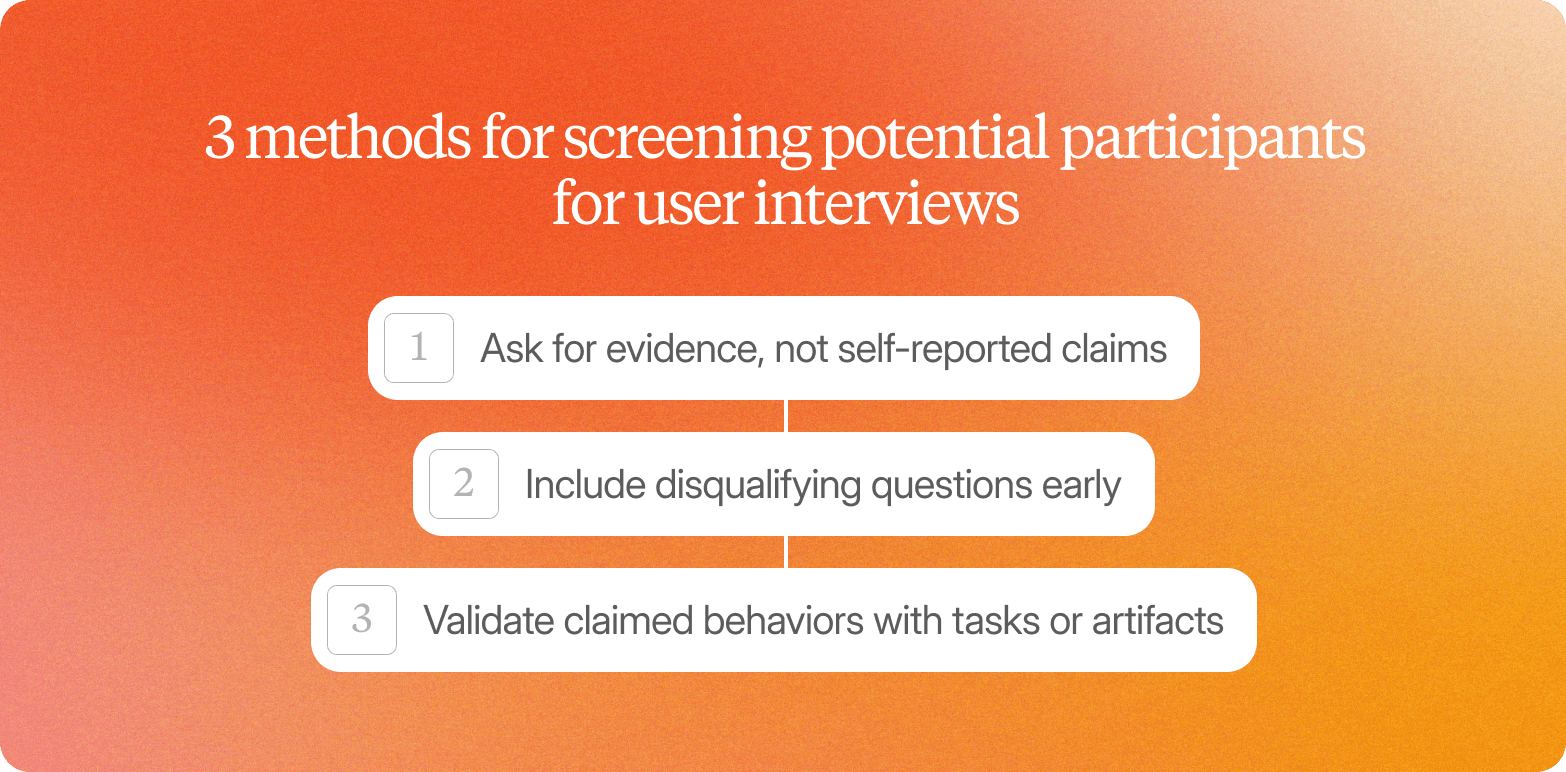
A well-designed screening survey is one of the most underinvested levers in recruiting user research participants. Three principles make a meaningful difference.
Ask for evidence, not self-reported claims
Closed-ended screener questions are easy to game. Instead of “Do you use project management software?”, ask: “Which tool do you use daily? Describe the last task you completed in it.” Screener questions built around a specific user persona (rather than generic demographics) force recall of a concrete, specific experience that ideal participants can answer naturally and poor-fit candidates cannot fake.
Include disqualifying questions early
Ask how many research studies a participant has taken in the last 90 days. Anyone who answers more than three or four warrants scrutiny. Attention-check questions in the screening questionnaire reveal whether someone is reading carefully or pattern-matching through the screener survey.
Validate claimed behaviors with tasks or artifacts
Ask potential participants to share a screenshot, submit a work sample, or complete a brief task before confirmation. Best-fit participants who genuinely use a product complete these in minutes. Those who cannot are self-selecting out before they consume an interview slot.
Strong screener questions add 10 to 15 minutes to recruitment setup but save hours of wasted interview time. Conveo’s behavioral screener applies these principles within the platform, automatically filtering participants based on behavioral criteria and flagging the best-fit candidates before they enter an interview.
How do you verify participant quality beyond fraud detection?
Most recruitment platforms compete on panel size and speed to fill. Both matter, but neither addresses whether findings will hold up in a stakeholder meeting. The real question is whether you can conduct user interviews with research participants who will produce impactful, provable insights.
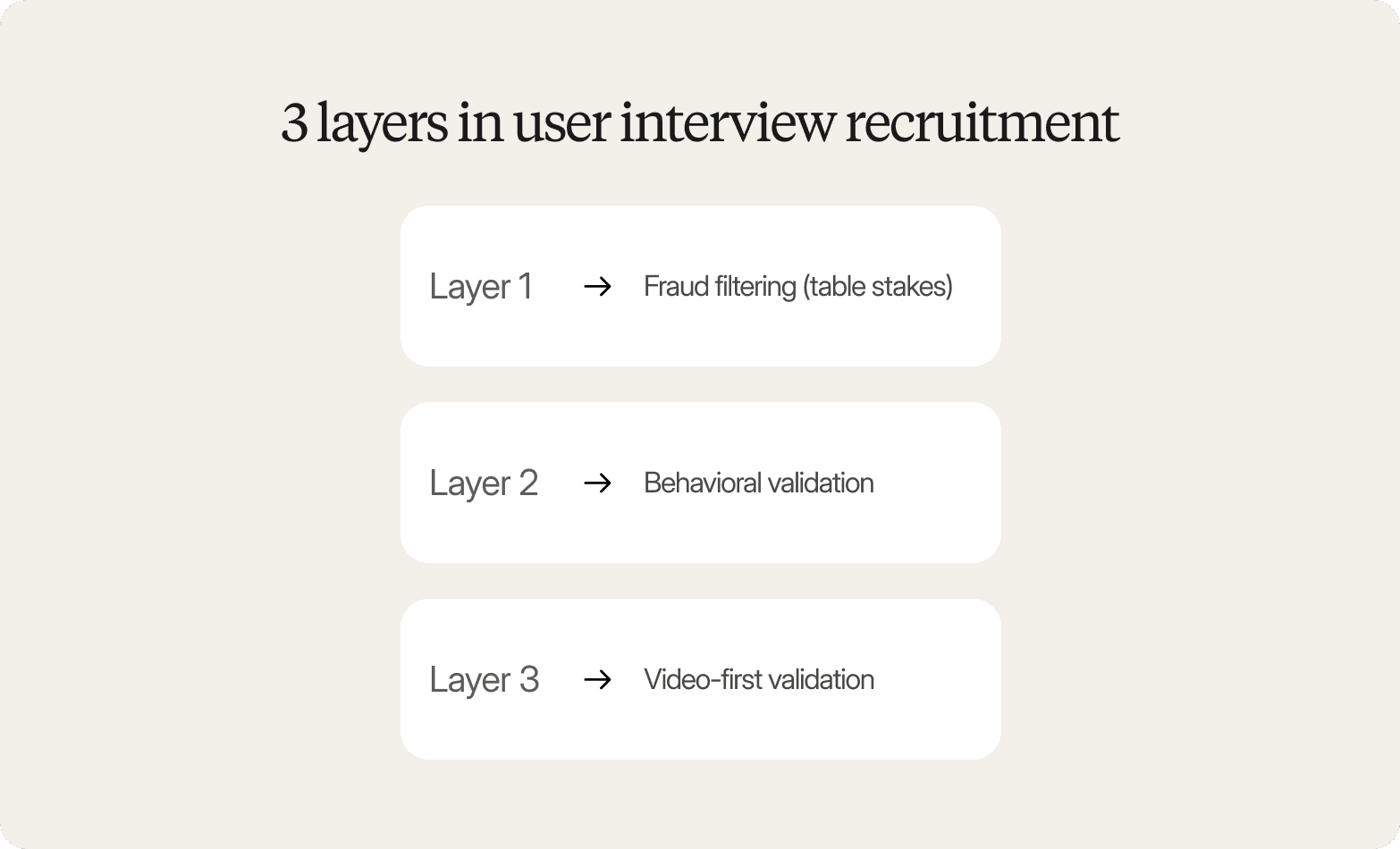
There are three distinct quality layers in user interview recruitment, and most platforms address only the first.
Layer 1: Fraud filtering (table stakes)
IP validation, device fingerprinting, and duplicate detection prevent bots and repeat sign-ups. Necessary, but fraudulent participants who misrepresent their category usage pass every fraud filter cleanly because they are real people telling untrue stories.
Layer 2: Behavioral validation
A screening questionnaire that requires evidence rather than self-report reduces misrepresentation. The tradeoff: behavioral screener surveys add review overhead and slow recruitment timelines at scale.
Layer 3: Video-first validation
When real users complete real voice and video conversations, authenticity becomes inspectable rather than assumed. Follow-up questions test whether claimed behaviors hold under probing. A participant who claims to be a frequent online grocery shopper but cannot identify a single pain point in the checkout flow reveals that misrepresentation in the first two minutes. Stakeholders can watch the clip, read the transcript, and form their own judgment: meaningful insights with a verifiable source.
Conveo combines all three layers. Recruitment outputs do not arrive as a name-and-demographic list; they arrive as verified, inspectable conversations traceable back to real users.
End-to-end workflow: From recruitment to stakeholder-ready findings
Most teams manage at least three separate platforms to conduct user interviews: one for recruitment, one for scheduling tools and session management, and another for transcription and analysis. Each handoff adds delay and introduces the risk of participant drop-off before a session begins.
Traditional fragmented workflow:
Source participants via panel provider: 3-7 days
Schedule and conduct research interviews manually: 1-2 weeks
Transcribe via separate platform: 1-3 days
Analyze and synthesize manually: 1-2 weeks
Total cycle time: 4-6 weeks minimum
Conveo end-to-end workflow:
Study setup with interview guide, screener survey, and recruitment parameters (demographics, job title, behaviors, usage patterns): 30 minutes
Automated sourcing, fraud filtering, participant confirmation: 2-3 days
Asynchronous AI-moderated video interviews in parallel: 3-5 days
Automated transcription, coding, thematic synthesis: hours, not weeks
Stakeholder-ready outputs with video clips and verbatim quotes: same day as interview completion
Grand total cycle time: 5-8 days
Watch the walkthrough: How Conveo Handles Participant Recruitment →
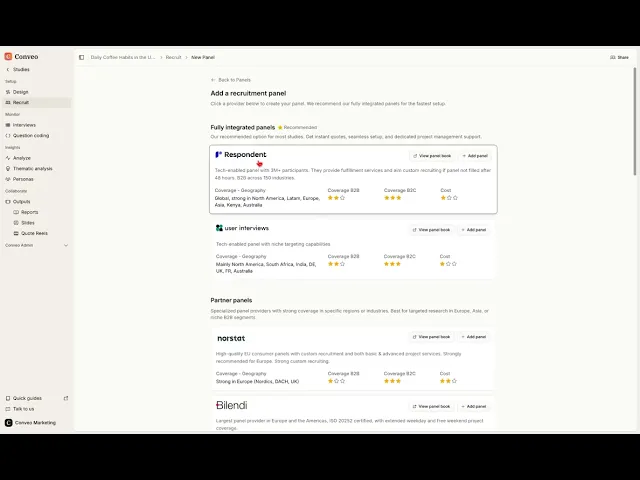
Shortening user interview recruitment cycles from weeks to days means research can influence decisions before the window closes. There is also a compounding advantage fragmented stacks cannot replicate: every study flows into a searchable insight library, so teams query existing findings before starting recruiting for another round on a similar question.
"We pull richer insight in hours, not weeks."
Head of Customer Insights, JDE Peet’s
Multi-market note
For teams conducting research across diverse locales, Conveo’s AI moderator supports 50+ languages with automated transcription and translation. SOC 2 certification, GDPR compliance, and optional EU data hosting reduce the due diligence burden when user interview recruitment involves participant data crossing regional boundaries.
Comparing recruitment solutions: Point tools vs. end-to-end platforms
Teams evaluating user interview recruitment solutions, comparing different methods, face a clear choice: point platforms that handle only sourcing, or end-to-end platforms that include the full workflow from conducting user interviews to synthesis.
| Solution type | Strength | Common tradeoff |
|---|---|---|
| Analysis tools (Dovetail, Notably, Otter) | Deep analysis for UX research teams with existing recruitment workflows | Recruitment remains a separate project and vendor |
| Recruitment agencies (Kantar, Ipsos) | Vetted quality, specialist access, specialized knowledge for complex studies | 6-12 week turnarounds; cost makes recurring research impractical |
| Synthetic / avatar platforms | Instant results, no recruiting research participants required | Outputs lack traceability; dismissed by stakeholders at the executive level |
| Conveo | Recruitment, AI-moderated interviewing, and synthesis in one platform | Purpose-built for recurring research programs, not one-off studies |
The right solution depends on whether your team needs user interview recruitment infrastructure for recurring qualitative studies, or one-off project support using other methods assembled from separate vendors.
How does Conveo handle user interview recruitment from start to finish?
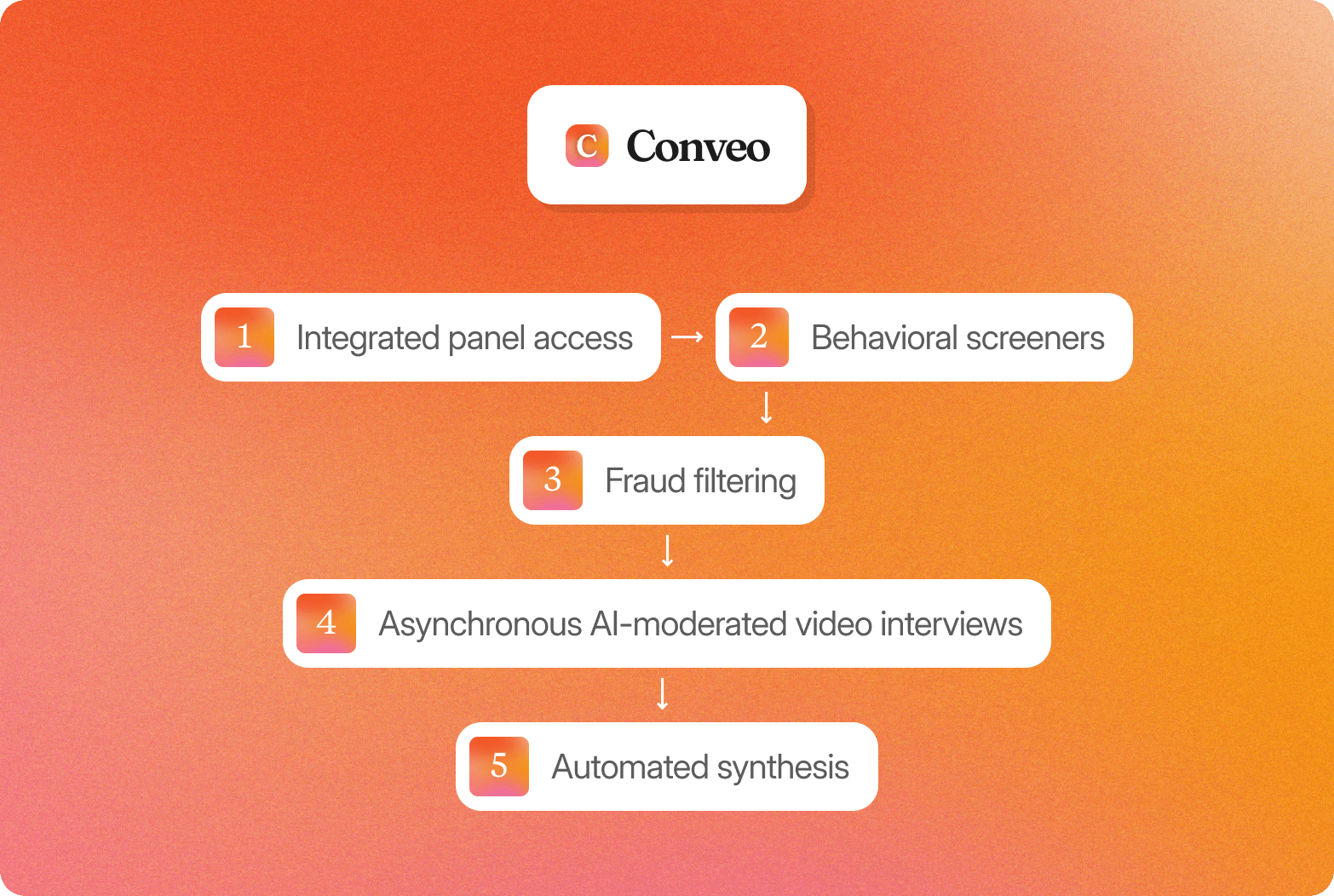
Conveo is a video-first AI research platform built for teams running recurring qualitative studies. Instead of treating participant sourcing as a separate logistics problem, Conveo connects recruitment, screening, AI-moderated interviewing, and synthesis into a single workflow.
Integrated panel access with demographic, behavioral, and job title targeting, so the right participants are sourced without a separate agency or vendor
Behavioral screeners are configured once and applied automatically, filtering out misrepresented participants before they consume an interview slot
Fraud filtering is built into the recruitment flow, not added as an afterthought
Asynchronous AI-moderated video interviews run in parallel, so adding participants does not extend the timeline
Automated synthesis producing stakeholder-ready outputs the same day interviews are complete
Teams that previously ran four to six-week recruitment-to-insight cycles report completing the same scope in five to eight days. Every study feeds a searchable insight library, so repeat recruitment for similar questions decreases over time.
Frequently Asked Questions
What is a user interview recruitment template?
A user interview recruitment template is a reusable document that defines the criteria and copy a research team uses to find and qualify participants for user research. At a minimum, it covers screener criteria (the target-audience filters that determine who qualifies), recruitment messages and outreach copy, scheduling logic, and consent language. The problem is that most templates are static: they capture who you were looking for in the last study. When research goals shift to behavioral or usage-based filters ("participants who abandoned checkout twice in the last 30 days"), a static document cannot adapt. Crafting new recruitment messages and screening questions from scratch for every study is what makes user interview recruitment so time-consuming. Dynamic recruitment parameters work differently. Teams define participant profiles directly within the research platform, which auto-filters based on demographics, job titles, behaviors, and product usage patterns, enabling them to reach the right target audience quickly without manual re-screening. Built-in panel recruitment combined with automated fraud filtering reduces the risk of unqualified participants entering interviews before a session runs.
What is the user interview recruitment process?
The standard research process for recruiting research participants follows a predictable sequence: define criteria, source participants, run a screening survey, schedule sessions, send confirmations, and manage no-shows. Each step sounds manageable in isolation. Together, they compound into weeks of coordination before a single research interview runs. Reviewing 50 potential participants to find 10 qualified candidates can consume a full week of a researcher's time, and that is before the first follow-up question has been asked. Most enterprise teams run this across separate platforms: one for recruitment, another for scheduling tools, a third for interviews, and a fourth for analysis. Each handoff creates delay and attrition risk. End-to-end platforms collapse that sequence into a single environment. Because AI-moderated interviews run asynchronously, there is no scheduling bottleneck: hundreds of participant conversations can run in parallel. Teams consistently report shortening recruitment-to-insight cycles from four to six weeks to five to eight days.
How many participants should I recruit for user interviews?
For qualitative studies, 5 to 8 participants per segment tends to surface 80% of usability issues or thematic patterns. For concept testing or brand research, 10 to 15 per segment improves confidence when you need findings that will hold up to stakeholder scrutiny. The underlying principle is saturation: keep recruiting research participants until new conversations no longer yield new themes. Saturation arrives faster with homogeneous audiences and later with a diverse group spanning complex segments. Getting the sample size wrong in either direction carries real cost: too few risks missing critical edge cases; too many increases analysis time without proportional insight gain; and, without enough relevant data from the right users, findings lack the data needed to drive decisions. Asynchronous AI-moderated interviews let you recruit flexibly. Start with 10 participants, review emerging themes, and add to your participant pool if saturation has not been reached. Because interviews run in parallel, increasing the sample size does not extend your timeline as traditional scheduling does.
How do I recruit users for interviews if I don't have a customer list?
Knowing how to start recruiting for user interviews without an existing user base is a common first hurdle. The most accessible option is online communities: posting in LinkedIn groups, relevant Reddit threads, Facebook groups, or industry Slack channels. This approach costs little but creates significant downstream work: manually screening for fit, filtering out poor-fit candidates, and chasing no-shows can consume more time than the interviews themselves. Paid ads, social media ads, and targeted ads accelerate reach but require a well-defined user persona and a clear screener survey to avoid wasting budget on the wrong target users. The more reliable path to source participants at scale is a vetted user panel provider. Panel providers offer pre-screened research participants with built-in demographic, behavioral, and job-title targeting. User Interviews and Respondents are well-known options. But once participants are sourced, you still need a separate infrastructure to conduct user interviews, transcribe, and analyze. End-to-end platforms cover the full research process. Teams define their participant profile, add a screening questionnaire, and launch from the same environment where interviews run. Integrated panel partners handle sourcing and fraud filtering automatically, and because sessions run asynchronously in parallel, hundreds of research interviews can be completed simultaneously without calendar bottlenecks.
How do I measure the quality of recruited participants?
Most teams evaluate recruitment quality only after research interviews are complete, by which point it is too late to correct for poor-fit participants. Three signals are worth tracking proactively to ensure you have the right users delivering impactful insights: Completion rate. What percentage of recruited research participants complete the full interview? Low completion suggests gaps in screening questionnaires or misaligned incentives. Response depth. Are participants providing detailed, specific answers to follow-up questions, or generic surface-level responses? Video-first interviews make this visible in real time, so you can identify best-fit candidates versus low-effort respondents early. Stakeholder confidence. Can decision-makers trace findings back to specific participant clips and verbatim quotes? Traceable evidence from real users increases trust in research outputs and reduces the due diligence burden on the insights team. Platforms that combine user interview recruitment and interviewing (like Conveo) surface these quality signals within the same workflow, rather than requiring post hoc analysis across separate tools.
About the author
Ivayana Abdi
Research Impact Lead
Ivayana has worked in market research since 2017, most recently as group manager of research operations and logistics at Culturati, and trained at RIVA and the Burke Institute. She joined Conveo for the hybrid researcher model: agile with new methods, fluent in the traditional ones, and able to combine the two for clients who want to try new things.
Meet Ivayana on film →Qualitative insights at the speed of your business.
Conveo runs AI-moderated video interviews and structures everything they say.