In this article
TL;DR
A research-grade user research interview template follows a semi-structured interview format with six components: research objective, participant context, warm-up questions, thematic question buckets, probing rules, and wrap-up prompts
Without a shared template, teams that conduct user interviews produce findings that cannot be compared across sessions, and synthesis has no consistent structure to map against
Question design determines analysis quality before a single session runs: open-ended, behavior-focused, depth-probing questions gather data that produce traceable findings; leading questions, hypothetical scenarios, and confirmation-seeking probes do not
Static templates keep conversations on track, but cannot adapt to probing, scale across markets, or connect to analysis workflows
Conveo, a video-first AI research platform, standardizes interview guides while adding adaptive AI moderation, asynchronous multi-market fieldwork, and a compounding insight library
Download the Template
The template below follows the exact six-section structure covered in this article. It includes editable question buckets, a probing rules table, wrap-up questions, and post-interview synthesis prompts. Copy it, adapt it to your research objective, and run your first session.
The template covers:
Research objective and participant screener
Consent and recording language
Warm-up questions with moderator notes
Three pre-built thematic question buckets (with probing rules)
Universal probing rules table
Post-interview synthesis prompts
Why User Research Interview Templates Matter
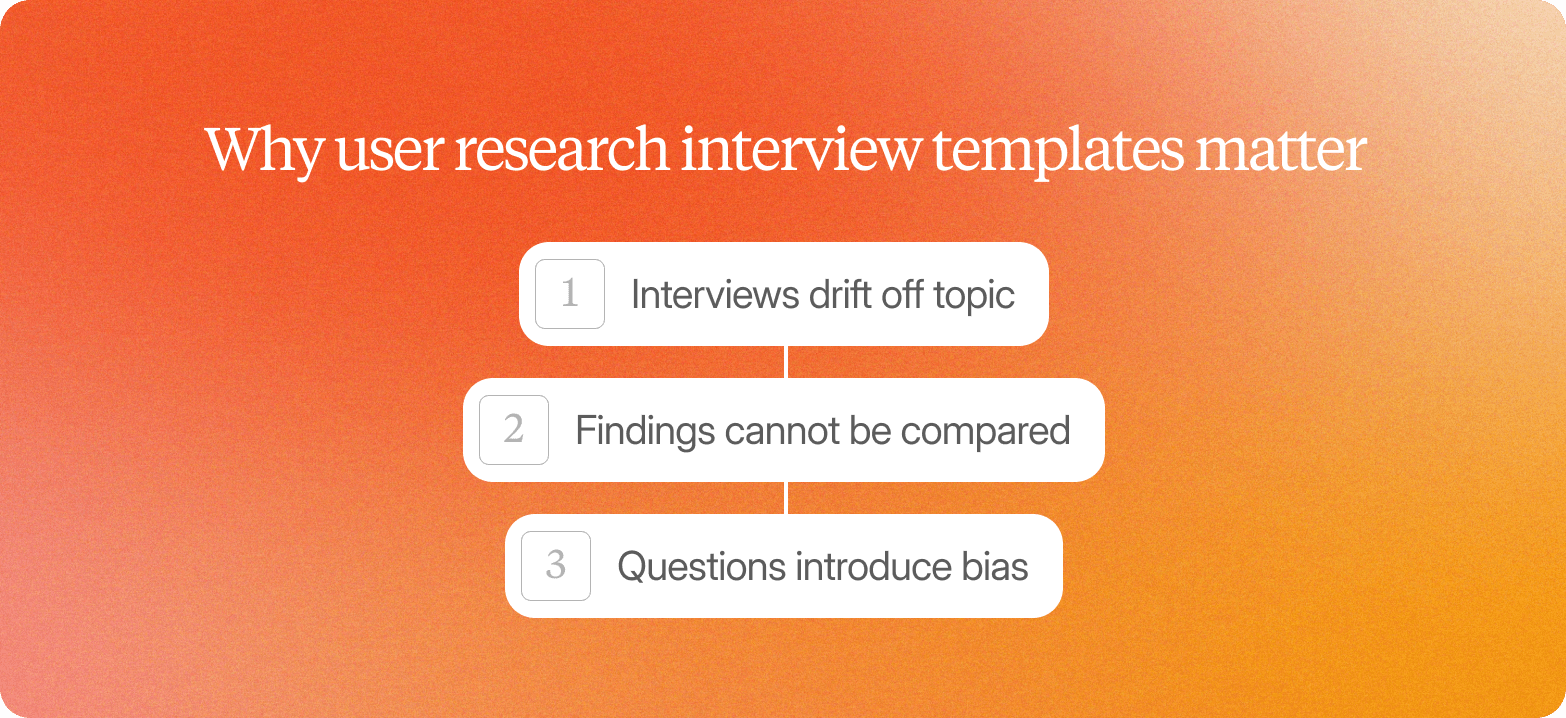
Teams that regularly conduct user interviews without a shared framework run into the same three problems.
Interviews drift off topic.
Without a clear objective anchoring each question block, interviewers follow what feels interesting rather than what the study needs. Synthesis becomes harder, and thematic analysis is inconsistent.
Findings cannot be compared.
When researchers probe differently across sessions, patterns that should surface across studies stay buried. Valuable insights get lost because there is no consistent structure to map them against.
Questions introduce bias.
Poorly structured questions (including leading questions that signal a preferred answer) lead participants toward expected answers rather than surfacing real user behavior. The result is data that looks credible but cannot support a decision.
The business impact is direct: research that takes months to design, run, and synthesize arrives after the decision window has already closed.
A well-built UX interview template solves this at the source. It keeps the interview process aligned to research objectives, ensures consistent probing across sessions, and maps participant responses to reusable analysis categories from the start, so every session your team runs adds to a growing base of comparable evidence about your target users.
6 Core Components of a Research-Grade Template
A good user research interview template follows a semi-structured interview format: structured enough to keep every session consistent, flexible enough to follow where participants lead. Each of the six sections below does a specific job. Remove anyone, and the session becomes harder to analyze.
| Section | What it contains | Why it matters |
|---|---|---|
| 1. Research objective | 1-2 sentences stating the decision this study informs | Prevents scope creep mid-session; keeps every question accountable |
| 2. Participant context | Screener criteria to identify target users, consent language, and recording disclosure | Ensures qualified participants and legally usable data |
| 3. Warm-up questions | 2-3 low-stakes openers | Build rapport before harder questions arrive; surface vocabulary participants use naturally |
| 4. Thematic question buckets | 3-5 topic areas, each focused on a particular topic aligned to the objective, with 2-4 open-ended questions | Becomes your analysis categories; structure them carefully |
| 5. Probing rules | Explicit guidance on when and how to follow up | Prevents thin answers from passing; prevents leading follow-ups that skew responses |
| 6. Wrap-up and synthesis prompts | Closing question + immediate post-session notes | Captures initial impressions before the next session overwrites them |
Many teams also assign a dedicated note-taker to each session, freeing the interviewer to focus on listening and probing rather than on transcription.
Example thematic bucket: A bucket labeled "Understanding current workflow" might contain questions such as "Walk me through the last time you had to pull data for a stakeholder report," and "What made that experience frustrating or smooth?" Thematic buckets become your analysis categories, so how you structure them determines how cleanly you can synthesize later.
Template Examples by Research Goal
The right template depends on what you are trying to learn. The four archetypes below cover the most common goals for UX and product teams, with example questions for each. Treat them as a starting point.
Discovery interviews
Use when exploring unmet needs, pain points, or unknown workflows before designing anything. The goal is to understand user motivations and actual user behavior, not confirm assumptions.
"Walk me through the last time you had to [do X]. What triggered it, and what did you do first?" "What part of that process frustrates you most, and why?" "Tell me about a time that approach didn't work the way you expected."
Concept validation interviews
Use when testing early ideas or prototypes against real user problems. These sessions typically include stimulus presentation to understand how people interact with a new concept before it is fully built.
"Before I show you anything, how would you expect something like this to work?" "What's your first reaction to what you're seeing?" "How does this compare to how you handle it today?"
Churn and retention interviews
Use when diagnosing why customers leave or stay. These sessions focus on reconstructing the user journey around a key decision point and surfacing the motivations behind it.
"Walk me through what was happening in your work around the time you decided to stop using it." "Was there a specific moment when your confidence in the product changed?"
Usability interviews
A well-constructed UX interview script for user testing combines task-based observation with think-aloud prompts. The goal is to understand how people interact with existing products or interfaces and where the user journey breaks down.
"Without clicking anything yet, tell me what you'd expect to do here." "What's going through your mind as you look at this screen?"
How to Structure User Interview Questions That Produce Traceable Findings
The quality of your analysis is determined before a single interview runs. Poorly designed user interview questions produce data that cannot be traced back to a specific behavior or decision. Three rules govern questions worth asking.
Open-ended, not leading
"What challenges do you face with onboarding?" surfaces real friction. "Do you find onboarding frustrating?" is a leading question that confirms what you already suspect. One gathers data you can act on; the other produces agreement. Leading questions are among the most common sources of confirmation bias in qualitative research: they shape responses before participants have a chance to describe their experiences in their own words.
Behavior-focused, not hypothetical
"Tell me about the last time you switched tools mid-task," reveals actual user behavior. "What would you do if the interface changed?" asks about future behavior and produces speculation rather than evidence. Ask participants to describe what they actually did, not what they imagine they might do.
Probing for depth, not confirmation
"Why did that matter to you?" opens a thread. "So that feature was helpful?" closes it. Follow-up questions that encourage participants to explain their reasoning produce the detailed responses that make findings defensible. Stakeholders can act on reasoning; they cannot act on confirmation.
Yes/no questions, hypothetical scenarios, and confirmation-seeking probes all share the same flaw: they introduce confirmation bias and produce shallow data. This is also where probing rules earn their weight. Platforms like Conveo enforce consistent follow-up by having the AI moderator probe based on what participants actually say, so depth does not depend on which interviewer is running the session.
Static Templates vs. Adaptive Interview Frameworks
A user research interview guide built in Word or Notion does one thing well: it keeps the conversation on track. What it cannot do is follow up when a participant says something unexpected, flag when a line of questioning deserves more depth, or adapt in real time to what someone actually reveals.
Three limitations compound over time:
No adaptive probing. When a participant signals hesitation or introduces a new frame, a static document cannot respond. The moment passes, and the detailed responses that would have emerged from a well-timed follow-up question never surface.
Manual coordination overhead. Teams that regularly conduct user interviews at scale need resources: recruiting, scheduling, and logistics. Traditional moderated interviews require weeks of that overhead before a single conversation happens. Findings arrive after the decision has already been made.
Disconnected workflow. Point solutions for transcription, tagging, and analysis sit in separate systems. Teams stitch outputs together manually rather than synthesizing them.
"No more waiting weeks for an agency to summarize what consumers said"
CMI Lead, Edgard & Cooper
Conveo, a video-first AI research platform, addresses all three. Interview guides are standardized, so studies stay consistent across interviewers and projects. The AI moderator then probes based on what participants actually say, surfacing depth that a static template often misses. Because sessions run asynchronously, teams can complete multi-market studies in days rather than weeks.
From Interview Template to Stakeholder-Ready Outputs
A well-designed UX interview template should map directly to the thematic categories your analysis will use, so transcription and coding become a matter of matching responses to a framework already defined before the first session begins. The goal is to gather feedback in a form that stakeholders can interrogate, not just read.
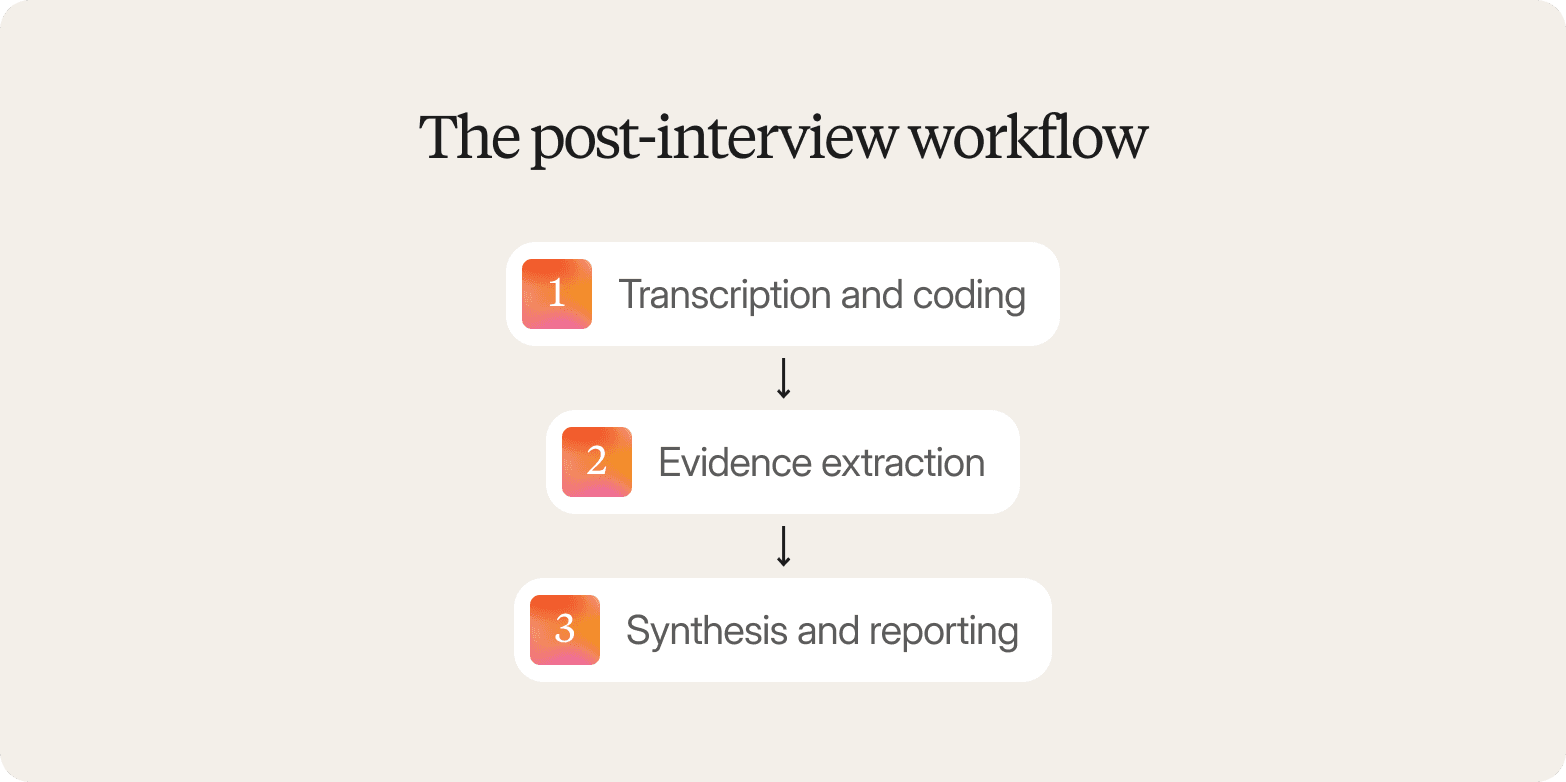
The post-interview workflow matters as much as the guide itself:
Transcription and coding. Map participant responses to your thematic buckets, tagging quotes by theme.
Evidence extraction. Pull verbatim quotes and video clips that illustrate each insight; these are the evidence that makes findings credible.
Synthesis and reporting. Structure findings so stakeholders can trace every conclusion back to a real participant conversation, not a summary slide.
This is where most research breaks down. Findings presented without traceable evidence lose credibility fast, and it rarely makes sense to any stakeholder that months of talking to people produced only a deck. Conveo ties every finding to verbatim quotes and video clips, and a searchable insight library designed to preserve that evidence across studies. Learnings compound instead of disappearing after a single presentation.
Choosing the Right Template for Remote and Multi-Market Research
Remote and async research changes what a user research interview template needs to do. When target users join asynchronously from different time zones, the template carries more structural weight: there is no interviewer in the room to clarify or re-establish context.
Three adaptations matter most:
| Adaptation | Why it matters |
|---|---|
| Consent and recording prompt at the start | Participants need to understand the format before they begin |
| Self-contained questions | Each question should stand alone contextually; participants responding hours apart cannot rely on the session flow for context |
| Translation-safe question language | Idiomatic phrasing and compound questions degrade across languages; cultural differences in how people describe a typical day or workplace experience can change what a question means entirely |
Conveo's AI-moderated interviews run asynchronously in 50+ languages, with recruitment across 50+ markets and built-in automated transcription and translation. Teams can complete cross-market fieldwork in days without the scheduling overhead that makes multi-market qual impractical at scale.
How Conveo Turns Templates Into a Scalable Research Workflow
A structured interview template is the starting point. What determines whether research actually scales is what happens around it: recruitment, moderation, transcription, synthesis, and evidence management in one place, not five.
Conveo connects all of these in a single platform. Interview guides are built once and enforced consistently across every session. The AI moderator adapts probing to each participant's responses, surfacing behavioral depth that static templates miss and encouraging participants to elaborate on the motivations and pain points that matter most. Every finding is tied to verbatim quotes and video clips, stored in a searchable insight library designed to grow with each study.
Because Conveo is built on real participant conversations with your target audience, not synthetic respondents, and is SOC 2 certified and GDPR-ready, the data holds up to both methodological and compliance scrutiny.
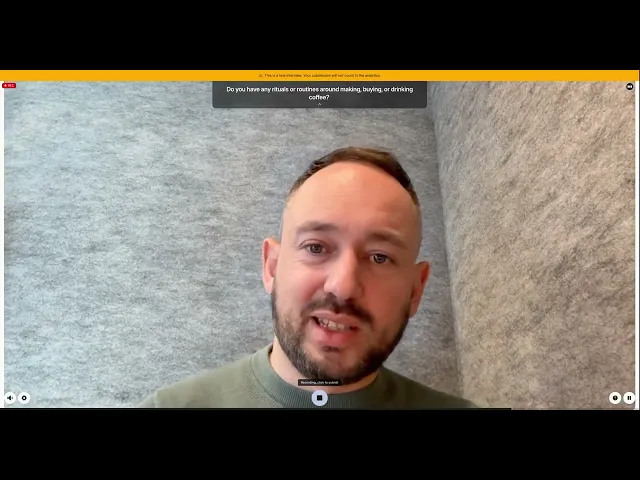
See it in action: How AI-Moderated Interviews Work
Frequently Asked Questions
What is a user research interview template?
A user research interview template is a standardized user interview guide that structures qualitative interviews to ensure consistency across researchers, sessions, and studies. It typically follows a semi-structured interview format: a stated research objective, participant screener, warm-up questions, thematic question buckets, probing rules, and wrap-up prompts. Without one, each researcher runs interviews differently, producing findings that stakeholders cannot compare or trust across studies. The template is not a rigid script; it is a shared framework that keeps every session anchored to the same objectives while leaving room for adaptive follow-up.
How do I conduct user interviews with a template?
Start with four steps. First, define the research objective in one sentence. Second, map 3-5 thematic buckets aligned to that objective, each focused on a particular topic relevant to your research question. Third, write open-ended, behavior-focused user interview questions under each bucket; avoid leading questions and yes/no phrasing. Fourth, add probing rules that specify exactly when and how to follow up to encourage participants to provide detailed responses. Before fielding, pilot the template with 2-3 participants from your target audience to surface confusing questions or missing topics. Consider assigning a note taker so the interviewer can focus on listening. See the Core Components section above for detailed guidance on each element.
What questions should I include in a user interview template?
Every user interview template should include three question types regardless of the research goal. Warm-up questions build rapport and open the conversation without pressure ("Tell me about your role and what a typical day looks like"). Behavior-focused questions anchor responses in real experience and help you understand actual user behavior ("Walk me through the last time you did X"). Follow-up questions go beyond surface-level answers to gather feedback stakeholders can act on ("Why did that matter to you?" / "Can you describe what happened next?"). For goal-specific example questions, see the template examples in the research goal section above.
Can I use a Word document as a user research interview template?
A user research interview template in Word is suitable for a single interviewer conducting a single study. The problems surface at scale: separate copies diverge, version control becomes manual, and Word cannot enforce structure during a live session. It also cannot adapt follow-up questions based on what a participant actually says, so detailed responses that depend on timely probing get missed. Transferring notes and recordings to transcription and analysis platforms is another manual step that adds hours and introduces inconsistency. Conveo standardizes guides within the platform so that every researcher uses the same structure, and findings flow automatically into analysis.
Are there free user research interview templates?
Free user research interview templates are widely available as a starting structure. Three gaps limit how far they take you: static templates cannot adapt probing based on participant answers, so the follow-up questions that surface user motivations and pain points never get asked; they have no integration with transcription or synthesis tools, so teams stitch point solutions together manually; and there is no searchable insight library, so findings stop compounding after the deck is presented. Conveo's templates include the full workflow around them: adaptive probing, automatic analysis, and a persistent insight library.
How long should a user research interview template be?
Most user research interview templates are designed for 30-60 minute sessions: roughly 8-15 core questions plus follow-up questions. A reliable structure is 5 minutes for warm-up, 20-45 minutes for thematic questions, and 5 minutes for wrap-up. Pilot the template with one or two participants before full fieldwork; what feels like a 40-minute guide on paper typically runs longer once natural conversation and probing are factored in. Longer sessions lead to participant fatigue and lower-quality responses; shorter sessions rarely yield enough data to support a decision.

About the author
Abby Euyang
Research Impact Lead
Abby studied psychology, fell for research there, and spent four years on the UX research team at PayPal. She compared the AI-moderated platforms before choosing Conveo for the researchers it had gathered, and now sits in the sessions where researcher feedback becomes product changes the same day.
Meet Abby on film →Qualitative insights at the speed of your business.
Conveo runs AI-moderated video interviews and structures everything they say.