In this article
TL;DR
Most UX teams choose qualitative methods by habit, not by question, leading to studies that miss the brief or arrive too late to matter
A three-axis framework (question type, constraints, evidence type) makes method selection almost automatic
The core user research methods (interviews, usability testing, diary studies, concept testing, card sorting, contextual inquiry, and focus groups) each answer a distinct research question
Asynchronous, AI-moderated interviews remove the scheduling and synthesis bottleneck that forces teams to choose between depth and speed
When qualitative user research runs at a sprint pace, it shifts from a periodic project to a continuous discovery that informs decisions before they ship
Most product teams working with UX qualitative research methods make the same mistake: they choose a method by habit rather than by question, run it after the key decisions are already in motion, and receive findings when the sprint has moved on.
The operational reality is straightforward. Traditional qualitative user research methods, including moderated usability sessions, in-depth interviews, and focus groups, require recruiting research participants, coordinating calendars, moderating sessions live, and manually synthesizing hours of recordings. That process typically takes six weeks or more from brief to debrief. A two-week sprint cannot wait for it.
Consider a typical pattern: a team runs a survey because it's fast. Analytics tools show where users drop off in the checkout flow; they don't show why. The survey confirms that a third of users abandon at the payment step; it still doesn't explain what stopped them. Five user interviews using qualitative methods would have revealed that the address validation field rejects international postcodes. A straightforward fix. Instead, the team debates hypotheses in Slack and ships a redesign built on assumptions.
What has changed is the infrastructure around qualitative user research methods. AI-moderated research can now deliver real conversations that surface valuable insights surveys cannot, at a pace that fits how product teams actually work. This guide provides a framework for matching qualitative UX research methods to specific questions, with execution approaches that fit sprint-based workflows.
Why UX teams struggle to choose the right qualitative method
Choosing among the user research methods UX practitioners rely on most (interviews, usability testing, diary studies, contextual inquiry, card sorting, concept testing) sounds methodological. In practice, it stalls research before it starts. Teams face six to eight viable options for any given question without a clear framework for weighing tradeoffs, so either research gets delayed while the team debates approach, or it moves forward with the wrong research methodology.
Three failure modes show up repeatedly:
Running usability tests when the question requires motivational depth
Watching task completion shows where drop-off happens. It doesn't explain the frustration, competing priorities, or user attitudes driving it. That requires a conversation.
Choosing interviews when the question requires behavioral observation
Users describe their workflows coherently in interviews, then behave completely differently in context. Contextual inquiry surfaces the gap; interviews miss it.
Defaulting to surveys because qualitative methods feel too slow
Surveys return data quickly, but they cannot probe the "why" behind a pattern. Teams get statistical confidence in a finding they still can't explain or act on with any precision.
Most method guides explain what each method is, not when it fits or how to weigh tradeoffs against research goals. Wrong method selection wastes research budget, delays decisions, and produces findings that stakeholders dismiss as "not answering the question we asked."
The UX qualitative research methods selection framework
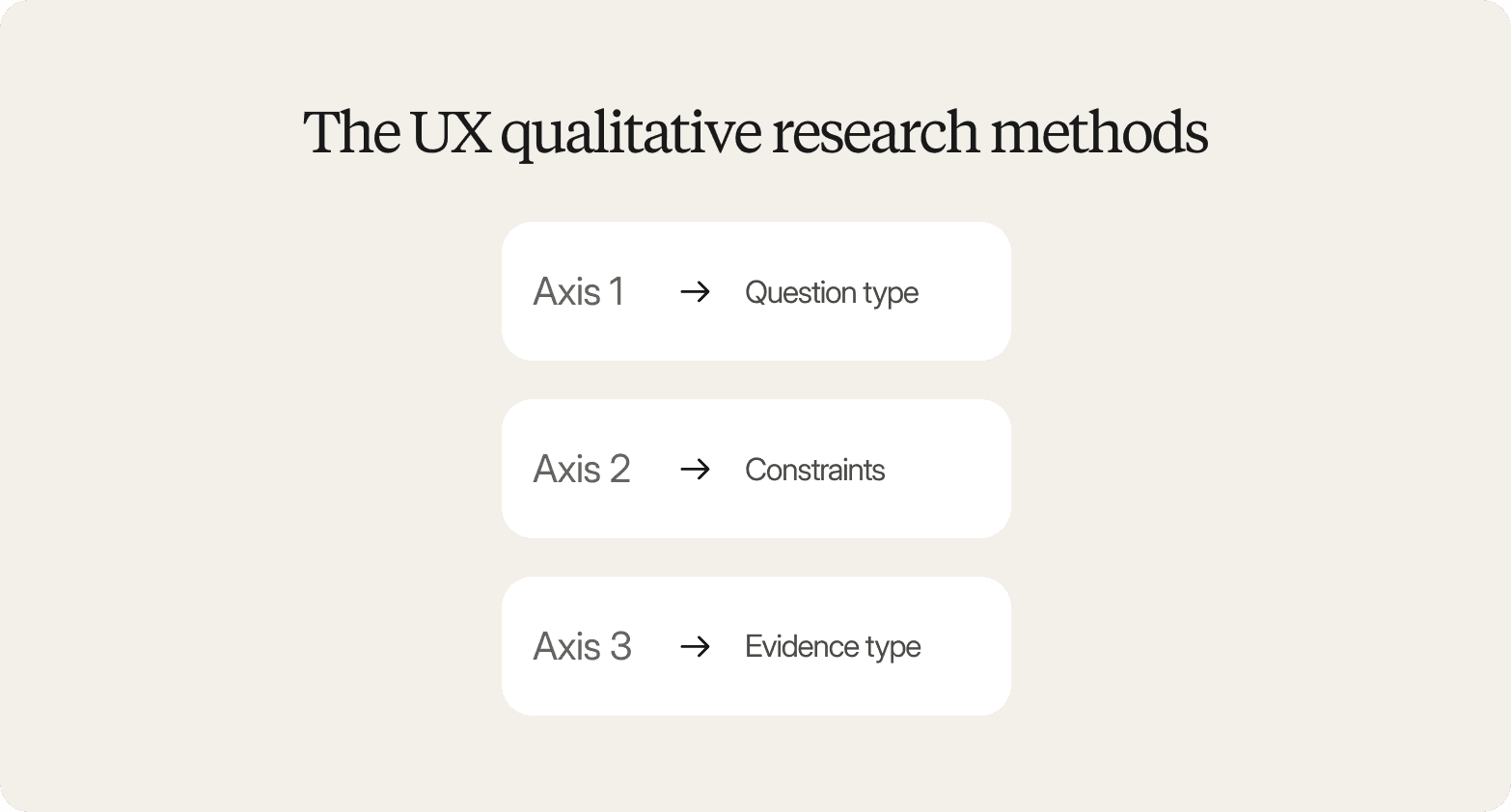
Method selection starts with the research question, not the method you're most comfortable running. A practical framework runs on three axes.
Axis 1: Question type
| If the question is... | Use... |
|---|---|
| "Why did users behave this way?" | User interviews with adaptive probing |
| "Where do users encounter friction?" | Usability testing with task observation |
| "How does behavior evolve over time?" | Diary studies with repeated check-ins |
| "Which concept resonates?" | Concept testing with comparative evaluation |
| "How do users organize information?" | Card sorting with the think-aloud protocol |
| "What happens in users' real environment?" | Contextual inquiry in natural settings |
Axis 2: Constraints
Timeline, sample size, budget, and participant availability determine whether research actually happens. A diary study requiring four weeks of check-ins doesn't fit a two-week sprint. A synchronous usability session requiring scheduled slots doesn't fit a team with no recruiting capacity. The target audience you need to reach, and how quickly you can reach them shape every research process decision. When UX qualitative research methods like interviews and concept tests can run asynchronously with AI moderation, timeline, and scheduling stop being the constraints that force teams into surveys by default.
Axis 3: Evidence type
Distinguishing between qualitative and quantitative UX research methods matters here. Interviews and diary studies produce rich, contextual evidence with smaller samples; concept tests at scale build confidence in patterns across larger groups. Ten interviews yield deep qualitative insights and motivational depth but limited statistical confidence. A concept test with 100 participants produces measurable data and reliable directional patterns, but less behavioral depth per participant.
That tradeoff used to force a choice. Asynchronous, AI-moderated interviewing narrows it considerably. When hundreds of conversations run in parallel with adaptive probing, the depth-versus-scale constraint doesn't disappear, but it shrinks. Research that required choosing between rigor and speed increasingly allows teams to pursue both.
7 core UX qualitative research methods explained
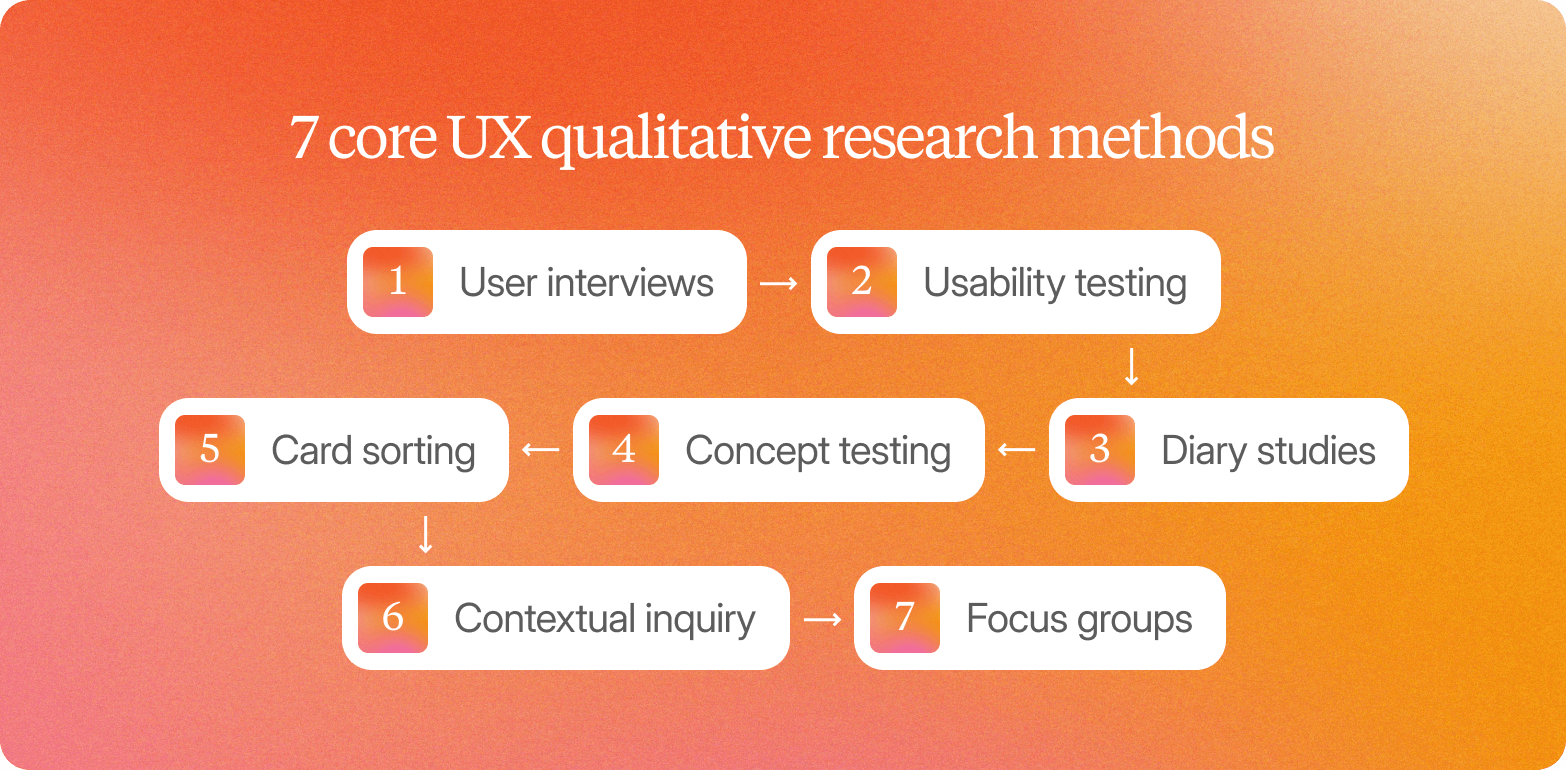
Each method answers a different question. The right user research methods depend on what you need to learn, how quickly you need the answer, and what type of evidence your stakeholders require. User researchers should treat this as a practical reference for aligning their data-collection approach with each type of research question.
User interviews
What it reveals: Motivations, decision-making processes, and the "why" behind observed user attitudes and behaviors: what analytics and surveys structurally cannot capture.
When to use: When you need to understand user goals, frustrations, or the context behind a behavioral pattern. Qualitative UX research focuses on these motivational questions and gathers user feedback that quantitative data alone cannot capture.
Execution tradeoffs: Rich depth but traditionally slow. Recruiting, scheduling, and transcribing 20 interviews can take six weeks or more. AI-moderated interviews with adaptive probing compress that timeline to days by running sessions in parallel without sacrificing follow-up depth. If a user describes a feature as "confusing," the AI moderator asks, "What specifically felt confusing?" in the same way a skilled human researcher would.
Example question: "Why do users abandon the checkout flow before completing payment?"
Usability testing
What it reveals: Friction points, task completion barriers, and user interface comprehension issues as users interact with prototypes or live products.
When to use: When you need to observe behavior rather than hear opinions. Watching a user fail to find a filter three times is harder to dismiss than a survey comment saying navigation "feels a bit confusing."
Execution trade-offs: Produces video evidence that stakeholders can see and lets teams track usability metrics such as task completion rates and time on task. Lab-based usability testing offers the most controlled conditions for task observation; asynchronous user testing extends this to real environments, where participants complete tasks on their own schedule while screen recordings capture every click, pause, and backtrack. Important distinction: usability testing shows where users struggle; pairing sessions with a short follow-up interview reveals why.
Example question: "Where do users get stuck when trying to filter search results?"
Diary studies
What it reveals: Longitudinal behavior patterns, habit formation, and how user needs evolve across days or weeks: what single-session user research methods structurally cannot see.
When to use: When your research question includes the words "over time." Skip them when a single session can answer the question: the synthesis burden alone disqualifies diary studies for anything an interview could resolve in an hour.
Execution tradeoffs: Qualitative research takes significantly longer when diary study data collection spans weeks of participant submissions. Asynchronous diary studies with structured prompts reduce dropout while maintaining longitudinal depth, but synthesizing large volumes of unstructured qualitative data remains demanding.
Example question: "How do users' information needs change throughout their first month using the product?"
Concept testing
What it reveals: Comparative preference, message resonance, and concept comprehension earlier in the development process, before committing to building or launching.
When to use: When validating two or more versions of an idea, messaging variant, or design with real users before the product development process commits resources.
Execution trade-offs: Fast validation, but concept testing surfaces preferences, not motivations. Knowing users prefer one onboarding flow over another is a useful signal; understanding why requires a follow-up. Video-based concept testing closes part of that gap: verbal reactions, hesitations, and facial responses carry meaning a rating scale would flatten. Running concept tests through an AI-moderated, video-first platform captures those signals at scale with adaptive follow-up probing.
Example question: "Which of the three onboarding flows is most intuitive for new users?"
Card sorting
What it reveals: How users mentally organize information, categories, and navigation structures, surfacing the gap between internal product logic and user mental models that often drives poor UX design decisions.
When to use: When a product team or design team is designing information architecture or navigation. Works best paired with tree testing or moderated usability sessions that validate whether the resulting structure actually supports task completion.
Execution tradeoffs: Produces clear taxonomies but limited insight into motivations or task behavior.
Example question: "How do users expect product features to be grouped in the navigation menu?"
Contextual inquiry
What it reveals: Real-world workflows, environmental constraints, and workarounds users have adapted around so thoroughly they'd never mention in a sit-down interview. Contextual inquiry draws from ethnographic research traditions, prioritizing direct observation in users' natural environment over self-reported accounts.
When to use: When environmental context is the variable that matters most, not when speed or breadth is the priority.
Execution tradeoffs: Rich contextual insight, but requires field access and is expensive to scale. Reserve contextual inquiry for questions where the behavior you need to observe can only be captured in a natural environment.
Example question: "How do warehouse workers use the inventory app during their shift?"
Focus groups
What it reveals: The range of user attitudes within a population and how people negotiate differences in conversation, useful for mapping the poles of a debate before designing quantitative measurement.
When to use: Exploring broad themes or generating ideas. Not for individual behavior or task observation.
Execution tradeoffs: Fast for gathering diverse perspectives but prone to groupthink. Individual interviews typically produce more behaviorally grounded responses. Reserve focus groups for exploratory attitudinal work where group dynamics add genuine value.
Example question: "What is the range of attitudes toward subscription pricing models?"
How to match qualitative methods to research questions
Qualitative data helps teams understand why users behave the way they do, but only when the method matches the question. The table below helps user researchers identify patterns in the relationship between research goals and research design.
| Research question type | Best-fit method | Why this method fits |
|---|---|---|
| "Why did users abandon this flow?" | User interviews | Surfaces motivations and decision-making processes that behavioral data and surveys miss |
| "Where do users encounter friction?" | Usability testing | Observes task completion in real time and captures the exact point at which friction occurs |
| "How does behavior change over time?" | Diary studies | Captures longitudinal patterns that single-session methods cannot see |
| "Which concept resonates most?" | Concept testing | Validates preference before committing development resources |
| "How do users organize information?" | Card sorting | Reveals mental models for navigation and taxonomy decisions |
| "What happens in users' real environment?" | Contextual inquiry | Observes actual workflows, workarounds, and environmental constraints in situ |
Even when a method fits the question, execution constraints (timeline, budget, team capacity) may make the theoretically correct method impractical. Most method guides describe what to do, not how to do it under real operational pressure. When method selection is clear and execution overhead is removed, research becomes a standing input to product decisions, not a gate that slows them down.
See how UX teams run qualitative research in days, not weeks: book a demo.
Qualitative vs. quantitative UX research methods: When to use each
The key differences between qualitative and quantitative UX research methods come down to the type of question each can answer. Confusing them is one of the most common reasons research fails to drive decisions.
Use qualitative methods when you need:
Motivations, decision-making processes, or unmet needs
Depth and behavioral nuance, especially when the problem space is still exploratory, and you don't yet know what to measure
Evidence stakeholders can see and hear: video clips, verbatim quotes
The "why" behind an observed behavioral pattern that statistical data alone cannot explain
Use quantitative user research when you need:
Numerical data, measurable data, and statistical analysis across large samples
Metrics compared across segments or time periods
Validation that a qualitative finding holds at scale
The common mistake: defaulting to surveys (quantitative) when the question requires behavioral depth (qualitative). Surveys return answers fast, but only to the questions you already thought to ask. Qualitative research surfaces the questions you didn't know to ask.
Quantitative and qualitative research work best in sequence. Qualitative identifies the problem and generates hypotheses. Quantitative measures prevalence and validates patterns using statistical data. A mixed-methods approach (combining both) gives teams the depth to understand behavior and the breadth to confirm that it holds at scale. Mixed methods research is increasingly the standard for mature qualitative and quantitative research programs.
Analytical tools for quantitative user research collect data efficiently across large samples. The practical constraint has historically been on the qualitative side: qualitative research takes weeks when run manually. Asynchronous, AI-moderated interviews have changed that equation: qualitative and quantitative UX research methods can now operate at comparable speeds, removing the tradeoff between depth and cadence.
"Conveo gives us quant-level robustness and qual-style depth"
CMI Lead, Edgard & Cooper
How AI-moderated interviews change qualitative UX research execution
Running a traditional qualitative study with 20 research participants takes six weeks or more: recruiting, scheduling, moderating, transcribing, and synthesizing. That timeline doesn't fit a two-week sprint. UX teams either skip qualitative research because it can't keep pace or deliver findings after the decision is already closed.
AI-moderated interviews shift three specific points in the research process:
1. Asynchronous participation
Removes calendar coordination, typically the first two to four weeks of a traditional study. Research participants complete interviews on their own schedule, across any time zone, without a user researcher present. Research that previously took weeks to schedule now completes in days. The sample doesn't shrink to fit availability windows; it expands to match the actual research question.
2. Adaptive probing
Separates AI-moderated interviews from scaled surveys. Follow-up questions change based on what a participant actually says. If a user describes a feature as "confusing," the AI moderator asks, "What specifically felt confusing?" rather than advancing to the next scripted question. That depth, replicated across hundreds of parallel conversations, is what makes AI-moderated interviewing a rigorous approach to qualitative data collection and thematic analysis: not a survey shortcut.
3. Automated synthesis
Shifts the user researcher's role from transcription and coding to review and interpretation. AI-assisted tools use thematic analysis to automatically identify patterns across sessions, extracting themes, verbatim quotes, and video clips, so researchers start with structured output rather than raw recordings. The manual burden is reduced, not eliminated; researchers still validate findings and apply judgment.
Watch it in action: How AI-moderated interviews work in a live Conveo session

One credibility requirement holds across all three execution changes: participants must be real. Stakeholder trust in AI-assisted research depends on traceable evidence: verbatim quotes tied to specific sessions, video clips showing the actual conversation. Conveo's video-first approach means every finding links back to a real human participant, on camera, in their own words. As one Senior Insights Manager at Google noted, this "video-first approach is a real differentiating methodological advantage."
Building a continuous UX qualitative research practice
Traditional qualitative research operates as periodic projects. A study gets commissioned, runs for six weeks, produces a report, and the organization waits for the next budget cycle. In sprint-based environments, that model breaks down: by the time findings land, the feature has shipped.
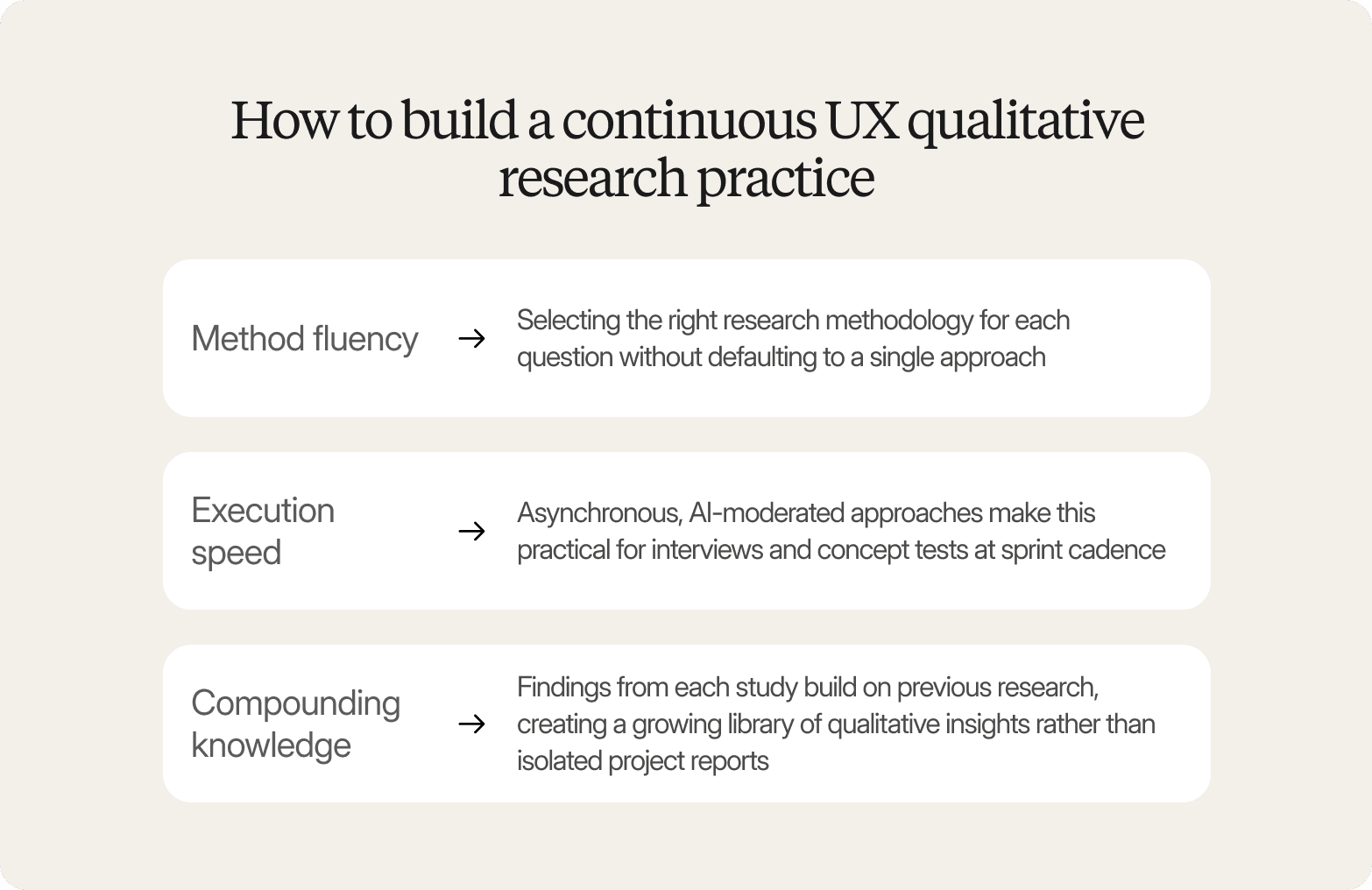
Building a continuous qualitative practice requires three things:
Method fluency: selecting the right research methodology for each question without defaulting to a single approach
Execution speed: asynchronous, AI-moderated approaches make this practical for interviews and concept tests at sprint cadence
Compounding knowledge: findings from each study build on previous research, creating a growing library of qualitative insights rather than isolated project reports
When qualitative user research runs at the pace of product development, it shifts from a periodic project to continuous discovery that informs decisions before they're made. Teams that previously ran four studies a year can sustain that cadence per quarter, without adding headcount.
How Conveo supports UX qualitative research at scale
The method selection framework in this guide is method-agnostic by design. The right method depends on the research question, not the platform. But the execution constraints that prevent teams from choosing the right method are where Conveo changes the calculation.
Conveo is a video-first AI research platform built for the execution challenges user experience research teams face. AI-moderated interviews run asynchronously, removing the scheduling bottleneck. Adaptive probing preserves the depth of skilled human moderation across hundreds of parallel conversations. Automated synthesis delivers structured themes, verbatim quotes, and video clips so user researchers start with insight, not transcripts.
Conveo's insight library connects findings across studies: each new study builds on what came before, so the tenth study is faster and richer than the first. Every finding is traceable to a real participant, on camera, in their own words. Conveo maintains SOC 2-certified security standards [NOTE: confirm with CS before publishing], addressing the compliance and credibility concerns that slow adoption of user experience research in enterprise environments.
Frequently Asked Questions
What are UX qualitative research methods?
UX qualitative user research methods are research approaches that explore the "why" behind user behavior. They include user interviews, usability testing, diary studies, concept testing, card sorting, contextual inquiry, and focus groups. Each method answers a different type of research question and produces different forms of evidence: from motivational insight to behavioral observation to longitudinal patterns.
How do I choose between qualitative and quantitative UX research methods?
Use qualitative user research when you need to understand motivations, mental models, or unmet needs, especially when the problem space is still exploratory. Use quantitative research methods when you need to measure prevalence, compare segments, or validate that a qualitative finding holds at scale. The two work best in sequence: qualitative generates hypotheses, quantitative validates them.
What is AI-moderated interviewing, and how does it differ from surveys?
AI-moderated interviewing uses an AI moderator to conduct in-depth user research interviews asynchronously. Unlike surveys, which follow a fixed script, AI-moderated interviews adapt follow-up questions based on each participant's responses. This preserves the probing depth of traditional moderated user research while removing the scheduling and moderation bottleneck that limits sample size.
How long does qualitative UX research take with AI moderation?
Traditional qualitative user research studies with 20 research participants typically take six weeks or more from brief to debrief. With asynchronous, AI-moderated interviews, the same study can be completed in days. Participants complete sessions on their own schedule, and automated synthesis produces structured themes and verbatim clips without manual transcription.
When should I use diary studies instead of user interviews?
Use diary studies when your user research question involves behavior that changes over time: onboarding adoption, habit formation, or evolving needs across a product lifecycle. If a single session can answer the question, an interview is more efficient. Diary studies carry a higher participant dropout risk and synthesis burden, so reserve them for questions where the temporal dimension is the variable that matters most.

About the author
Alex de Hemptinne
Business Impact Lead
Alex is a Business Impact Lead at Conveo, partnering with enterprise teams to embed AI-led research into their workflows. From the first study to full-scale rollout, she helps customers shift from project-based research to continuous customer intelligence.
Meet Alex on film →Qualitative insights at the speed of your business.
Conveo runs AI-moderated video interviews and structures everything they say.