In this article
TL;DR
Best for: B2B market research teams whose studies treat one participant as a proxy for an entire buying committee.
B2B findings often land after the decision they were meant to inform has already closed, making them a record of what happened instead of input into what happens next.
Most studies define the target audience as a single buyer persona, while the actual buying committee spans six to ten prospective buyers with different priorities, risk tolerances, and veto points.
Role-based committee research maps priorities, conflicts, and consensus paths across every relevant role inside the same account, so the output shows where deals stall and why, instead of averaging opinions into a composite buyer nobody ever meets.
Teams use Conveo to run committee research in parallel across roles, markets, and languages, with analysis that connects responses by role rather than flattening them.
What B2B market research misses when it treats committees as individuals
Findings that arrive after the decision
By the time many B2B market research studies reach a stakeholder review, the decision they were commissioned to inform has closed. The shortlist was set, the campaign brief signed, the roadmap committed. A finding that arrives after that point is an expensive one that changes nothing, least of all for the sales team still waiting on an answer to the objection that actually stalled the deal.
Buying committees decide B2B purchases. A complex deal pulls in six to ten people across IT, finance, legal, procurement, and the business unit sponsoring the purchase. When a study fields to whoever answers the recruitment email, one participant stands in for a group of prospective buyers with conflicting priorities, and the findings describe one opinion inside a decision nobody makes alone.
Each function frames the same purchase through a different lens: integration risk, total cost of ownership, contractual exposure, supplier risk, and the pain points each role is personally accountable for solving. Research that captures one of those lenses and presents it as "the buyer view" describes a decision that does not exist in that form.
What the data says about consensus
Research shows a clear link between consensus and outcome. Gartner's survey of 632 B2B buyers found that buying groups reaching consensus are 2.5 times more likely to report a high-quality deal outcome, and that 74% of B2B buyer teams show a pattern of "unhealthy conflict" during the decision process: members holding conflicting objectives, disagreeing on the best course of action, or being overruled by external decision-makers.
When a deal stalls, the instinct is to look for a feature gap or a pricing objection. More often, the blocker is a disagreement inside the buying group that the research never surfaced, and nobody was in a position to address it because it only spoke to one member.
Designing for the committee from the start, as role-based buying committee research does, keeps a study from reopening the decision it was meant to close.
Why B2B differs from consumer research
In consumer research, one person decides whether to buy a shampoo or switch streaming services. The cycle is short, the decision is preference-driven, and the unit of analysis is the individual.
B2B enterprise research operates under different conditions. Gartner puts the average buying group for a complex solution at 6 to 10 decision-makers, each arriving with their own independently gathered research, priorities, and concerns, over a sales cycle that routinely runs well beyond a single quarter.
Four roles, four different lenses
The structural difference that matters most is that the buying group does not share one lens:
IT directors evaluate integration complexity and security architecture.
Finance approvers calculate total cost of ownership and payback period.
Procurement and legal gatekeepers negotiate terms and assess vendor stability, contractual exposure, and data handling.
End users weigh workflow friction and the daily cost of switching.
These committees share one goal: reducing risk while meeting the organization's financial, technical, and operational needs. Positioning that speaks to one of these perspectives fails the others, and in a committee decision, any one of them can block a deal. That holds across every industry that sells into committees, from professional services and technology to manufacturing, wherever the target audience for a purchase is a room rather than a single buyer.
Why the timeline makes it worse
Traditional agency-led B2B research typically runs for weeks or months from briefing to findings. By the time those findings arrive, the buying cycle has moved on, and the personas used to frame the study may no longer reflect who is in the room.
The design implication: treat the buying group as the unit of analysis. Recruit across functions instead of the primary user alone, probe for role-specific objections instead of general attitudes, and capture how different stakeholders weigh the same evidence. Skip that step, and the strategic planning and marketing efforts built on the findings become guesswork dressed up as insight. That divergence is where positioning either holds or breaks down.
The role-based research framework: capturing buying groups as groups
Most B2B market research still treats the account as a single voice. One IT director gets interviewed, their perspective gets synthesized into a persona, and the team ships messaging built on a sample of one. It is a shortcut that turns a genuine research project into a single, convenient interview. What that study misses is the procurement manager who rejects the integration timeline, the finance lead who disputes the TCO model, and the end user who has already decided the interface is too complex. Those are the people who stop deals.
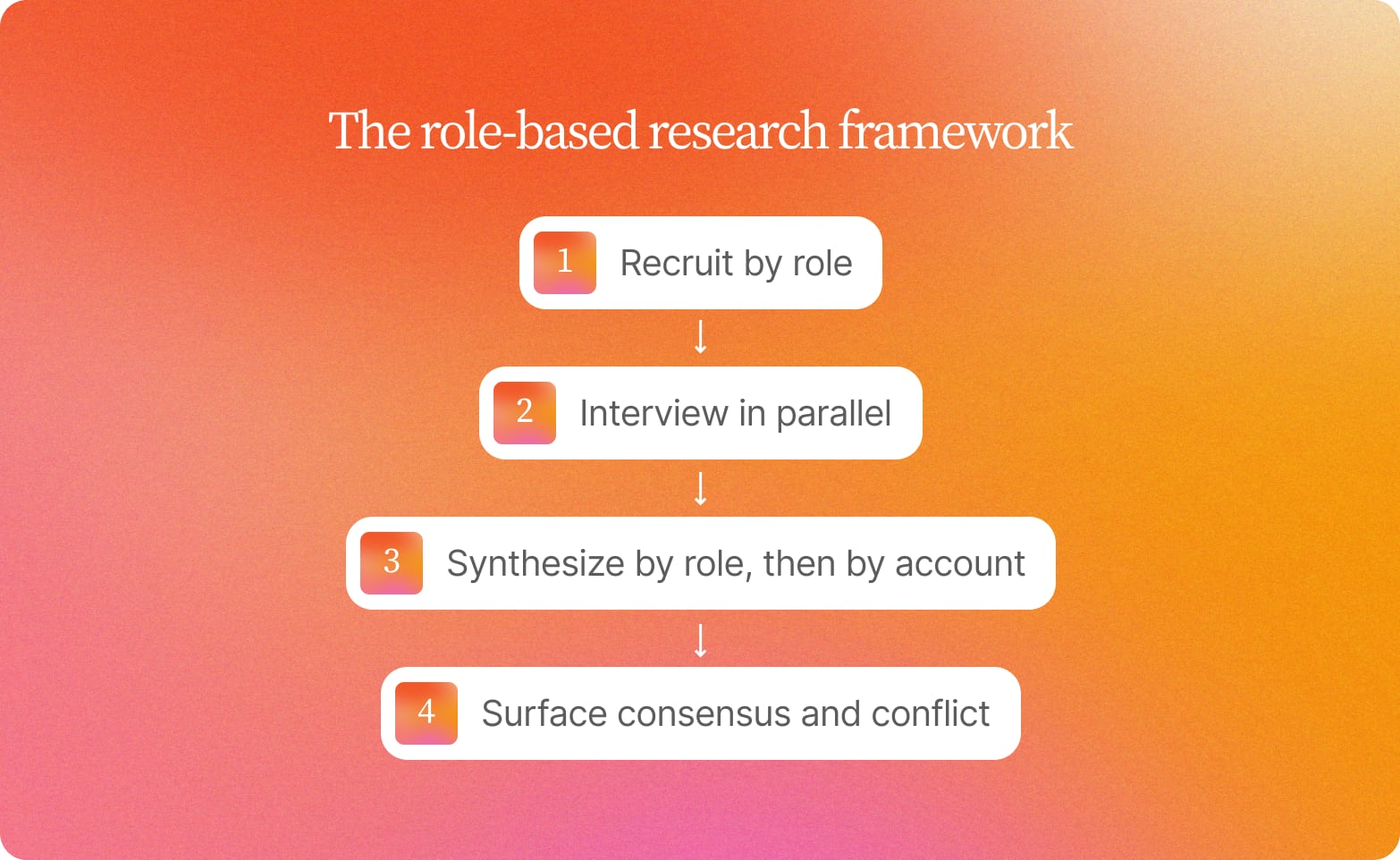
The fix is a role-based research process: recruit by role across the same account type, interview in parallel, and synthesize findings within each role and across the full buying group. The goal is to build one connected picture of the buying group, assembled from its distinct roles.
1. Recruit by role
Define the buying group structure before fielding: decision-maker, end user, gatekeeper (procurement or legal), and administrator. Recruit 8 to 12 participants per role, the minimum needed to distinguish role-level patterns from individual variation.
2. Interview in parallel
Run in-depth interviews across all roles simultaneously, each guided by a discussion guide calibrated to that role's success metrics: IT on integration risk and security requirements, finance on TCO and approval thresholds, end users on workflow friction, procurement on evaluation criteria and contract risk. The same product, four different conversations.
Data collection happens across every role in parallel, company by company, a deliberate departure from traditional focus groups, where one room's loudest voice tends to drown out every dissenting opinion at the table.
3. Synthesize by role, then by account
First identify and analyze patterns within each role, then map where the buying group aligns and where it fractures. Consensus signals where effective messaging will hold. Conflict signals where deals stall.
4. Surface consensus and conflict
The output is a stakeholder map showing which claims land across all roles, which generate pushback from specific functions, and which trade-offs the group resolves differently depending on who is in the room. Teams that want to dive deep on a single role's objections can still do that, then cross-reference it against every other seat at the table.
Why this holds up under scrutiny
Developing this kind of connected view takes research expertise beyond the AI tooling itself. Teams using Conveo tag every participant by account and role as part of the research design, so conversations stay connected instead of being treated as independent data points. The IT director's concern about API documentation sits alongside the procurement lead's concern about SLA terms, and both connect to the finance lead's question about implementation cost. Researchers calibrate Conveo's AI research assistant to each role's language, so it probes the trade-offs IT weighs against procurement, and every claim links to timestamped video evidence instead of a summary slide.
That traceability matters because internal skepticism about research findings runs high in B2B settings. A product team can see that three of ten procurement leads flagged the same contract term as a blocker, then click through to the moment each one said it, which is what lets them address the actual objection instead of guessing at it. That is what keeps a role-level study usable: the specificity survives even when several roles are being interviewed at once.
Choosing a method: qual, quant, or mixed
When quantitative research works
Quantitative research earns its place when the question is a closed-ended hypothesis across a sample large enough to segment by role or company size. A structured survey collects data at scale, clearly showing whether IT directors rank integration above cost and letting you slice the answer by function or geography.
Where it falls short
A survey can't explain what happens when two stakeholders with opposing priorities must decide together. When 70% of IT directors rank integration first, and 65% of finance leads rank TCO first, the survey reports two numbers. It cannot probe the trade-off, only confirm that it exists. B2B qualitative research explains why deals stall, or how a finance lead's real pain point plays out in the room.
The case for mixed methods
Mixed-method design captures both: quantitative methodologies measure which priorities dominate by role and which concerns are widespread, while qualitative interviews explain how conflicts between IT, finance, and procurement get resolved in practice. In a well-structured study, the quantitative findings frame the interview guide, so the qualitative phase looks for how a known tension resolves rather than whether it exists. On Conveo, the number and the reasoning behind it come from the same person in the same session, with data processing that keeps the two connected instead of stitched together after the fact.
The async advantage
Scheduling is the usual objection to qual in enterprise research: a 15-person series across IT, finance, and procurement at large organizations can take weeks to coordinate, the same constraint that makes a live focus group hard to schedule at all. Async, AI-moderated interviews remove that bottleneck and let a single study address every role without waiting for a shared calendar slot. Participants respond on their own schedule, so conversations run in parallel rather than sequentially, closing a cycle that would otherwise take weeks through calendar coordination alone, without compressing the depth of what participants share.
Method choice should follow the research question instead of the vendor's preferred format or the team's default, and a research process built around one method rarely fits every stage of a buying decision.
How to preserve rigor when compressing B2B research timelines
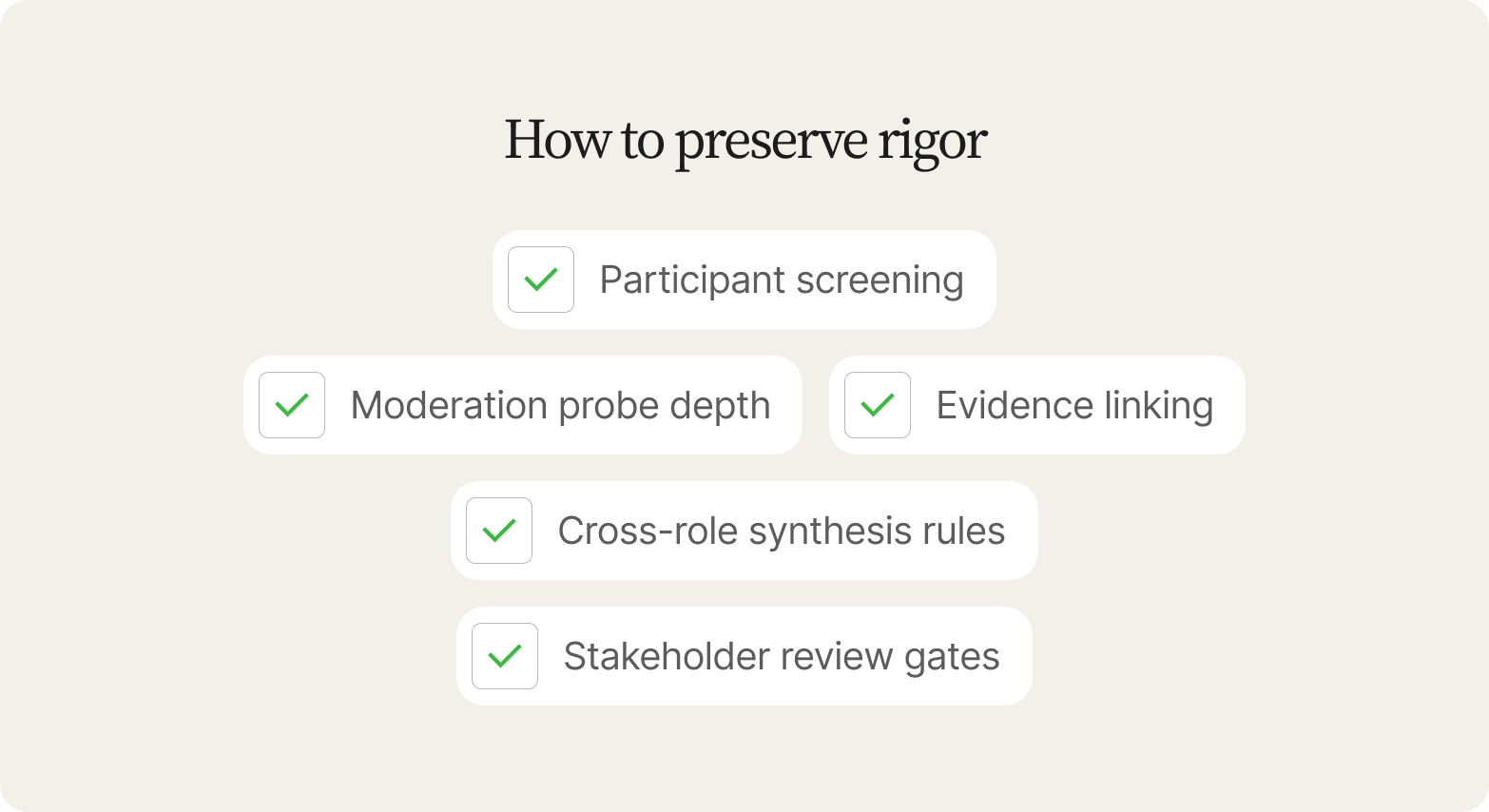
When timelines compress, experienced researchers ask whether AI probing goes deep enough to surface the trade-offs buying group members negotiate before a vendor gets a decision. Rigor comes from controlling five quality variables in the research design, whether the timeline runs in weeks or days.
| Quality control step | What to verify |
|---|---|
| Participant screening | Job title, company size, and decision authority confirmed before fielding |
| Moderation probe depth | Role-specific language used; trade-offs between IT, finance, and procurement actively probed |
| Evidence linking | Every persona attribute and priority claim linked to a timestamped video clip |
| Cross-role synthesis rules | Findings connected within the same account instead of aggregated across companies |
| Stakeholder review gates | Research leads and subject matter experts review AI analysis before findings reach executives |
Participant screening
This is where B2B studies most often fail silently. Incidence rates for senior buyers with genuine decision authority are low, and one misqualified participant can invalidate a whole role segment.
Moderation probe depth
This is where the AI-versus-human question becomes concrete. Researchers close the gap by calibrating the AI research assistant to role-specific vocabulary and defining which trade-offs must be probed rather than asked about uniformly, work that depends on research expertise a fixed script cannot replicate.
Evidence linking
Evidence linking is what separates findings executives act on from findings they set aside. In practice, that traceability is what gets research past the "I'm not sure this reflects our actual buyers" objection in the debrief room.
"The analysis is instantaneous. I can synthesize all the data, and also go back and watch every interview. You can ask it to challenge your own thinking. It's so easy to talk to your data."
Dafydd Jones, Associate Director, Ninth Seat
Cross-role synthesis
This is where multi-stakeholder studies most often break down. Aggregating opinions across 30 companies tells you what the market thinks on average; connecting findings within the same account tells you where consensus exists and where conflict lives, which is the part that explains why deals stall.
Stakeholder review gates
Stakeholder review gates are non-negotiable before findings reach executive audiences. Detecting a pattern and interpreting what it means for a specific organization's buying dynamic are different tasks, so research leads and subject matter experts validate that interpretation before it moves upstream.
A fast process still has to be trustworthy, or speed becomes a liability.
Choosing an execution model: Agency, in-house, or platform
How a study gets run is as consequential as the question it answers. Get it wrong against a fast-moving competitive landscape, and even a rigorous study answers the wrong question at the wrong speed. Study type, timeline, internal ownership capacity, and rigor requirements each pull the decision in a different direction.
| Study type | Timeline | Internal ownership required | Best fit |
|---|---|---|---|
| Large-sample quant validation, syndicated multi-market reports, analyst-led strategic consulting | Weeks to months acceptable | Low: external team owns design, moderation, and synthesis | Agency-led |
| Depth interviews, group sessions, or concept tests where an internal lead can design, moderate, and synthesize | Weeks acceptable | High: internal researcher owns end-to-end | In-house, traditional tools |
| Qual or mixed-method studies where findings are needed in days, personas need recurring refresh, and every claim must link to video proof | Days | High: internal team retains ownership, platform carries the operational load | Modern research platform |
All three models can produce rigorous findings; the differentiator is which constraints each handles without friction.
Agency-led
This fits when internal capacity is close to zero, and the question requires large-sample validation or multi-market syndication no single in-house team could coordinate, at the cost of a timeline measured in weeks and months. It is also the model most professional services firms and consultancies still default to for one-off strategic planning work, and a reasonable choice when the timeline can absorb it.
In-house with traditional tools
This works when a senior researcher has the capacity to carry a study end to end, keeping rigor researcher-controlled, though sequential interviews and manual synthesis cap how many studies a small team can run per quarter.
Modern research platform
A modern research platform fits when the timeline is compressed, internal ownership is non-negotiable, and traceability is a baseline requirement, for example, when a brand team needs persona validation before a campaign brief closes, or a CMI function is expected to refresh consumer understanding quarterly instead of annually. On Conveo, fielding 100 interviews in 3 days is the kind of turnaround that keeps findings arriving while the decision is still open, with video-first evidence behind every claim.
The advantage compounds through capacity: when moderation, transcription, translation, and synthesis happen at the platform level, the same team can run more studies, expanding what the insights function can credibly promise its internal stakeholders. That capacity turns research spend into a competitive edge: teams see shifts in the buying group's dynamics before a competitor's account team does, and act earlier.
Building a searchable B2B insight library
A searchable insight library is a store of findings organized by role and theme rather than by project, so any new question can be checked against what previous research already established. Most B2B market research still runs the way it did a decade ago: a question surfaces, a study gets commissioned, a deck gets presented, and the findings age on a shared drive. The next question starts from zero because findings never connect, no matter how strong any individual study was.
The same principle holds outside procurement decisions. A team studying customer experience, or watching how competitors position against a shared buyer, gets deeper insights faster when a research program keeps its findings connected instead of filing them by project.
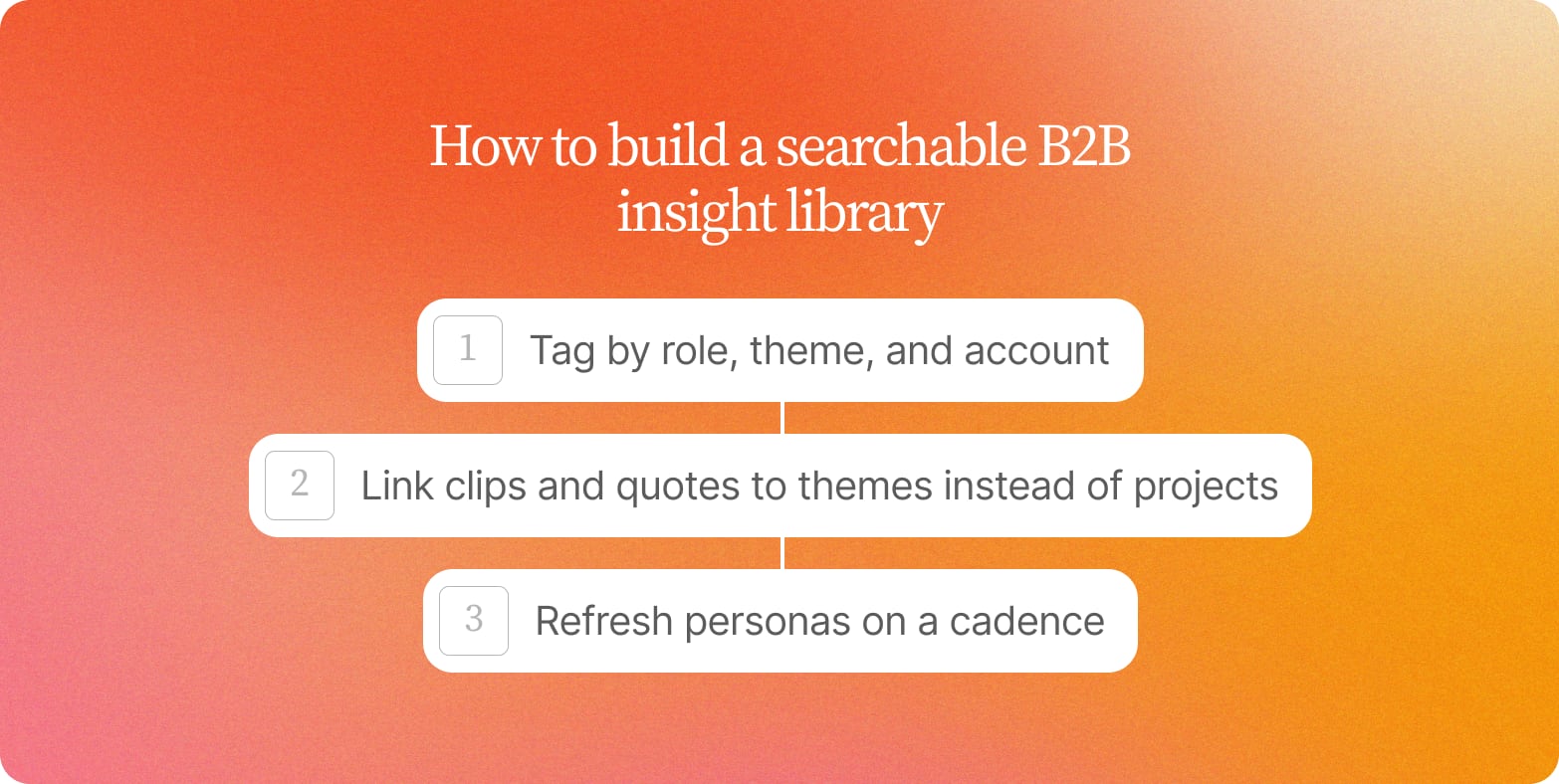
Three choices determine whether a library actually works:
1. Tag by role, theme, and account
The moment a study closes, tag every key insight by buyer role, theme, and account segment. Without this taxonomy, an insight library is just a better-organized shared drive.
2. Link clips and quotes to themes instead of projects
When a participant confirms or challenges a theme, the clip and verbatim quote should attach to the theme record, with the study as metadata, so a search on pricing objections returns every relevant clip rather than a list of folders to open one by one.
3. Refresh personas on a cadence
A persona accurate in January may be misleading by July as markets shift and buyer language changes. A searchable library that surfaces contradictions as new findings land, and shows where new findings diverge from a tagged theme, keeps understanding current instead of merely authoritative-sounding.
Conveo's searchable insight library connects findings, clips, and quotes across studies by role and theme, so a messaging question in Q3 starts from what a Q1 committee study already established. Conveo StoryLines keeps feeding it as a continuous, wave-based program, for example every two weeks or monthly, rather than one study at a time.
Who Conveo is not the right fit for
Teams running single-question concept or claim tests, where one closed-ended read answers the whole question and no role-level depth is needed.
Teams whose research demand is comfortably met by existing internal capacity, with no backlog of unanswered questions.
Studies that need in-store or real-time observation of behavior as it happens, since AI-moderated interviews produce richer recall instead of live capture.
Programs where findings do not need to persist across teams.
How teams use Conveo for buying committee research
Buying committee research fails commercially when the answer arrives after the decision. Insights and CMI teams use Conveo to keep buyer understanding running continuously, so a question about how a committee is shifting meets a recent answer rather than a new project brief.
Built by researchers, kept visible
Rigor is what makes that speed usable. Conveo is built by researchers, and the method starts with an open mind about where the real objection sits, rather than a persona assumed in advance. The method stays visible throughout: the discussion guide, the probe logic, the screening criteria, and the video behind every claim. Findings trace to a real participant who said it, and they survive skeptical stakeholder review. The value compounds because findings connect: clips, quotes, and themes link across studies by role and theme, so a messaging question in Q3 builds on what a Q1 committee study established rather than starting from zero.
Who runs this kind of research?
This framework fits insights and CMI teams evaluating a purchase that runs through more than one function, whatever the vertical, enterprise software, industrial equipment, or professional services among them. Consumer brands use the same approach in their B2B relationships: retail category buyers, distributors, foodservice operators, and trade customers make the calls that decide what makes it onto a shelf or a menu, and they are every bit as much a committee as an IT buying group.
Compliance and reach
For procurement and security reviewers on the committee, and for European buyers in particular, the compliance position is straightforward: SOC 2 Type II certified, GDPR compliant, EU hosting (Belgium). Moderation runs in 50+ languages, and participants come through Conveo's integrated panel network or your own lists.
The value of that turnaround is timing: findings arrive while the decision is still open, instead of after the committee has already moved on.
Frequently asked questions
What is AI-moderated qualitative research, and how is it different from a survey?
AI-moderated qualitative research uses an AI research assistant to conduct adaptive video interviews, probing based on what each person says rather than following a fixed script. A survey presents the same static questions to everyone and captures responses in isolation. AI-moderated research outputs verbatim quotes, video clips, and thematic synthesis tied to real people, so every finding can be traced back to who said it.
How long does B2B market research take with an AI research assistant instead of a traditional agency?
The timeline depends on study complexity and recruitment. Traditional B2B research runs for weeks or months, covering recruitment, scheduling, moderation, transcription, analysis, and reporting, often long enough that the buying decision has moved on by the time findings land. An AI research assistant compresses the middle: interviews run asynchronously, and analysis begins as each conversation closes, so findings are more likely to arrive while the decision is still open.
Are participants more open with an AI research assistant than with a human?
Many participants are more candid without a researcher in the room. People are less inclined to shape answers to please an interviewer and more willing to voice criticism or uncertainty, which matters most in B2B contexts covering purchasing decisions, supplier evaluations, and brand perceptions.
How do you make AI-moderated findings credible enough for senior stakeholders?
Credibility rests on the moderation methodology, the traceability of every finding, and the researchers who designed the study. Every insight should trace back to a real participant who said it, supported by verbatim quotes and video rather than an unsourced summary. Study design still requires experienced researchers to frame hypotheses and interpret findings in a business context.
Can AI-moderated interviews run across multiple languages and markets at once?
Yes. Moderation operates across 50+ languages, so a single study can run simultaneously in markets that would otherwise require separate agency engagements, local moderators, and sequential fieldwork under a traditional model.

About the author
Dieter De Mesmaeker
Co-Founder & CEO
Dieter is CEO and co-founder of Conveo. Before starting the company, he founded DataCamp and scaled it into one of the leading edtech platforms in the world.
More by Dieter →Qualitative insights at the speed of your business.
Conveo runs AI-moderated video interviews and structures everything they say.