In this article
TL;DR
Understanding that lands after the decision has closed changes nothing. Velocity and hit rate on new products, campaigns, and channels now decide who stays competitive.
Four approaches fall under a single label, each with different evidence standards: synthetic personas, AI-moderated interviews, transcript analytics, and behavioral data mining.
The dividing line is traceability. Can you show the participant who said it, on video, in their own words?
Study design, interpretation, stakeholder translation, bias review, and method selection stay with researchers.
Conveo is Consumer Understanding Infrastructure: always-on AI-moderated interviews with real participants, built by researchers.
A positioning call is scheduled for a meeting on Tuesday. The study commissioned to inform it reports back long after the direction has been set, the budget committed, and the launch date fixed. The finding may be excellent, but it arrives too late to influence a decision that has already closed, so it might as well never have happened.
Velocity and hit rate on new products, campaigns, and channels now decide who stays competitive. Neither survives a market research process that reports a quarter late.
That gap is why AI in market research arrives with so much pressure. Vendors pitch AI-driven market research as the fix, and marketing teams are often the first ones to test it. It shows up as a Slack message from a product manager who found a synthetic persona generator. Or as a budget question: why commission a study when a model can simulate the customer?
Stakeholders pushing for AI-generated behaviors are not wrong to want the decision window served. They are wrong to assume speed and evidence are the same thing, and that confusion is exactly where traditional market research methods and AI market research tools start to blur together.
Anyone who has defended a concept kill before a senior review committee knows the moment it falls apart. Someone asks to see the source interview, and there is no interview to show. The taxonomy below distinguishes AI used for operational work, including moderation, translation, transcription, and coding support, from AI used as a substitute for human participants. That distinction decides which findings survive scrutiny, and it is a large part of why human expertise stays load-bearing even as AI tools take on more of the workload.
Why AI in market research arrives as a patchwork
Integrating AI into a research function rarely happens as a strategy. It happens as a series of sensible decisions made by different people across research and marketing teams at different moments. The same pattern shows up in user research, brand tracking, and concept testing alike.
A product team buys an AI-moderated interview platform, one of many AI market research tools promising faster answers, to move faster on concept testing. An insights team adds transcript analytics to reduce coding time. Marketing brings in a synthetic persona generator to populate workshop decks and steer early marketing efforts.
Each purchase solves a real problem. None of them connect:
Recruiting lives in one platform
AI-moderated interviewing lives in another
Analysis lives in a third
Stakeholder reporting lives in a fourth
Every handoff reintroduces the coordination overhead the purchases were meant to remove, and the same pattern repeats across the business world wherever functions buy point solutions independently.
Context also leaks at each seam, and data quality degrades a little more at every handoff. Files get exported, reformatted, and re-uploaded, and every platform in the chain has to process data it never collected itself. What began as rich data collection during the interview gets flattened into a transcript, and insight generation is further compressed as the transcript is summarized into themes. By the time findings reach a stakeholder, the chain of evidence from participant to conclusion has broken at least twice.
The governance gap beneath the surface
What makes this harder to fix is that no single stakeholder owns the question of which parts of the market research process should stay human. Platform decisions are made at the team level, while the quality standard belongs to the function, and no one maps one to the other.
So method choices accumulate through procurement, one license at a time, rather than through the function accountable for the findings. That holds until a brand relaunch or a market-entry call across multiple markets comes under internal scrutiny. Then the evidence trail leads back to behaviors a model invented rather than behaviors real people demonstrated.
Traditional research, and traditional qualitative research specifically, does not have this problem, for all its friction, which is also why research companies with agency roots still win trust on the highest-stakes studies. Agency-led programs run sequentially, with human oversight at recruiting, moderation, analysis, and reporting. The output is stakeholder-ready because every finding traces to a person who said it on record. AI moderation changes the speed of that process while the evidentiary standard the findings must meet stays exactly where it was.
A taxonomy of AI in market research: 4 approaches and their tradeoffs
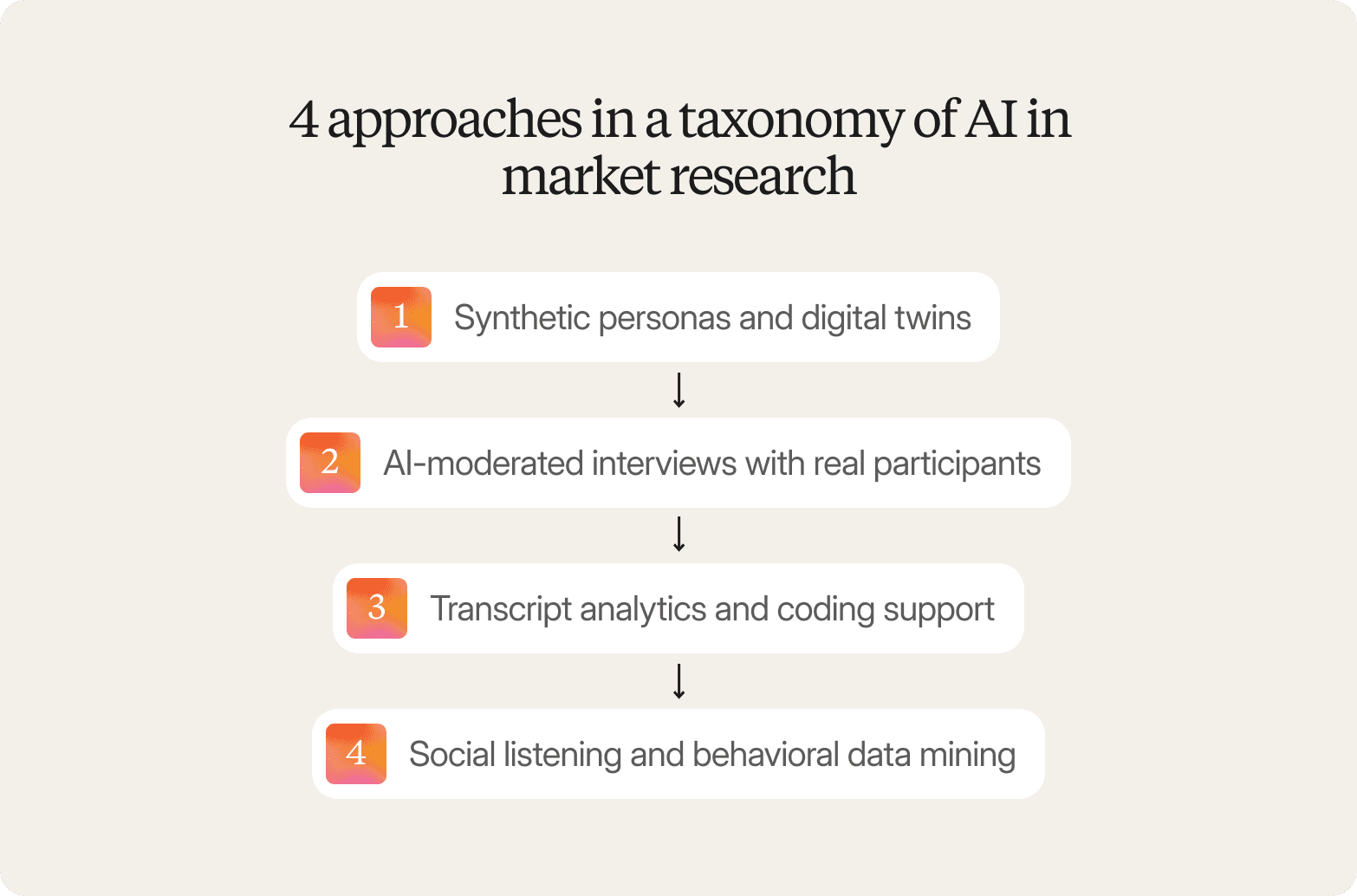
Four distinct approaches to artificial intelligence now travel under the same label as traditional market research, and they are not interchangeable. Each solves a different problem, carries a different evidence standard, and fails differently when pushed past its limits. Insights leaders who name which one a stakeholder is proposing can answer the synthetic shortcut question with a principle rather than a preference.
1. Synthetic personas and digital twins
Synthetic personas rely on generative AI to simulate consumer behaviors from demographic inputs, workshop assumptions, or internet-trained machine learning models, thereby producing personas without recruiting participants. The cost and turnaround advantages are real. So is the evidence problem: when a stakeholder asks which customer said this, the answer is no one.
Behaviors are inferred rather than observed. The result is synthetic data that tends to mirror the biases in its training set, overstate purchase intent, and guess at customer preferences rather than asking about them directly, producing recommendations that sound plausible but trace back to nothing. For exploratory ideation, the approach has a role. For decisions that require participant evidence, traditional market research methods and traditional methods more broadly still carry the weight.
2. AI-moderated interviews with real participants
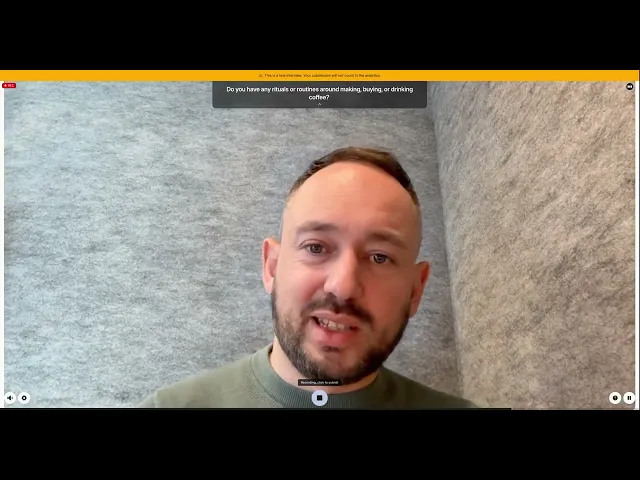
An AI-moderated interview is a voice or video conversation with a real participant. An AI moderator runs it, using conversational AI and contextual understanding to probe participants' responses rather than following a fixed script. Because sessions run asynchronously rather than sequentially, programs that once took weeks can now report in days.
The differentiator is traceability: every finding connects to a specific participant, their video, and their verbatim words. A stakeholder who pushes back can watch the moment it was said. The fit is strongest in recurring programs: concept testing, ad testing, packaging research, and continuous discovery. In each, arriving inside the decision window matters as much as depth.
See it in action: How AI-Moderated Video Interviews Actually Work
3. Transcript analytics and coding support
AI, acting like a research assistant that never tires of tagging the fortieth transcript the same way it tagged the first, builds the initial coding frame and tags themes across transcripts using natural language processing, removing the most resource-intensive stage in many in-depth interview programs. The coding frame itself typically runs on large language models fine-tuned for theme extraction rather than on a generic chatbot, and it can process data, including qualitative data, faster than any coder working by hand. Paired with human-moderated sessions, it expands throughput without reducing methodological oversight, which is advanced analytics with a visible audit trail rather than a black box.
The risk surfaces when the system cannot show which participant quote supports which theme. Black-box synthesis, where themes appear without source attribution, creates the credibility problem that makes stakeholders distrust AI-generated findings, and the same generative AI capability that drafts a theme summary can just as easily invent one without a source. Transparent coding that links each theme to its source evidence is what separates useful support from a liability.
4. Social media monitoring and behavioral data mining
AI analyzes public conversations on social media platforms, reviews, and behavioral signals at scale. It works well for:
Identifying trends and tracking consumer sentiment across vast datasets, with sentiment analysis flagging a shift in customer behavior before it shows up in sales figures
Watching competitor data and competitor pricing: launch cadence, review volume, promotional timing
Supporting competitive analysis and surfacing emerging trends and market trends early, when paired with predictive analytics
What it cannot do: answer why questions, probe decision logic, or explain the reasoning behind a stated preference. The signals are real, the market data behind them is real, and the context, including the reasons behind customer preferences, is absent.
The decision rule across all four: AI is reliable on interviewing and analysis work, and researchers stay accountable for interpretation and recommendations. The safeguard against invented findings is data lineage, meaning every finding links back to a participant, their video, and their exact words. Without that chain, the output is an opinion rather than evidence.
The credibility wall: When stakeholders ask for the source interview
The credibility wall appears at a specific moment. A high-stakes recommendation reaches legal, the C-suite, or a board committee, and someone asks to see the participant who said it. Teams working from synthetic profiles have no answer, the recommendation stalls, and the decision reverts to intuition.
That is a governance failure rather than an analysis failure. Traceability is the standard the analysis has to clear, because no one can defend a finding they cannot source. Sophistication on its own buys very little in that room.
Consumer Understanding Infrastructure is the alternative frame. It is an always-on layer that continuously produces traceable consumer understanding, with insight generation and market trend tracking that run alongside the CRM and the ERP rather than being commissioned on a study-by-study basis.
Most teams already shop for a version of this, just under different names:
Market insights software
A way to track customer satisfaction over time
What they are really looking for is more than a single market research tool. The shift worth making is from buying periodic answers to running AI-driven market research, transforming market research from a project into infrastructure.
Key points: Where AI moderation works, and where judgment stays human
AI's ability to run parallel sessions is the clearest example of where AI moderation removes operational drag, automating repetitive tasks like scheduling, transcription, and first-pass tagging while leaving judgment calls to the researcher:
Parallel interviewing: sessions run asynchronously, so conversations that would otherwise be scheduled one at a time field simultaneously. Teams report completing 100 interviews in 3 days.
Adaptive probing: when a participant hesitates or contradicts an earlier answer, the AI moderator follows up rather than moving to the next question, unlike survey design, which fixes the questions before anyone answers.
Multi-language moderation: AI moderation across 50+ languages relies on natural language processing tuned to each market, removing the dependency on recruiting and briefing moderators market by market.
Transcript coding: the mechanical work of building a coding frame and tagging themes across qualitative data handles the grunt work of data analysis at machine pace, with each theme linked to its source.
Structured outputs: one set of interviews can populate personas, jobs-to-be-done frameworks, mental models, and empathy maps; feed straight into the research tools and industry reports teams already produce; and support trend identification across studies once enough waves have run.
Researchers keep the judgment work. This is where human expertise sits:
Study design: the researcher decides which questions serve the business decision and sequences probes to avoid priming bias.
Interpretation: the platform surfaces themes, and the researcher determines which finding is strategically consequential.
Stakeholder translation: the researcher frames the same evidence for a brand director and a CFO, and defends the method in the room.
Bias review: the researcher audits for training bias, overstated intent, and tidy themes that flatten what participants said.
Method selection: the researcher decides fit before fielding, including when focus groups or in-home visits are the better instrument.
The boundary matters as much as the capability list. Quality of AI-moderated output depends on the research design that precedes it. That is why the researcher's role gets more consequential rather than less.
Evidence and representative scenarios
The scenarios below are representative rather than specific client engagements and are written to show where the two approaches diverge.
Concept testing for a product launch. The traditional research pattern recruits 20 participants and schedules 20 one-hour calls across two weeks. Coding and synthesis follow, and the report lands after the brief has moved on. With AI-moderated interviews, a team recruits 50 participants, fields asynchronously, and reviews coded, traceable findings in days, generating actionable insights while the decision window is still open. The trade-off is less live rapport per session in favor of more participants and a report that arrives while the decision is still open.
"The pace, responsiveness, and research expertise of the Conveo team, on top of the top AI-moderated qual platform, has been invaluable to us in scaling brand advertising internationally."
Matt Harris, Research & Insights Lead, EMEA, Canva
Continuous discovery for a product team. Quarterly depth interview waves report back after the sprint they were meant to inform has shipped. Conveo StoryLines runs wave-based, AI-moderated programs instead, typically biweekly or monthly, under the banner of Continuous Consumer Understanding. Themes carry across waves, so a product team validates hypotheses before committing engineering time.
The same wave structure supports continuous brand understanding across markets. The value there is the reason behind a movement in equity, rather than the movement itself.
What happens inside these sessions is measurable. Participants tend to speak more openly with an AI moderator than in a scheduled call with a person, and voice and video responses run materially longer than the open-ended survey responses collected without follow-up. Teams also report lower research spend than agency-delivered qualitative programs. [NEEDS: sourced figures for participant openness, response depth, and cost comparison, or cut the sentences above.] The more consequential result is capability: large-scale analysis that used to require a research vendor's entire coding team, research you could not previously run at agency scale.
Practical guidance: A governance checklist for AI in market research
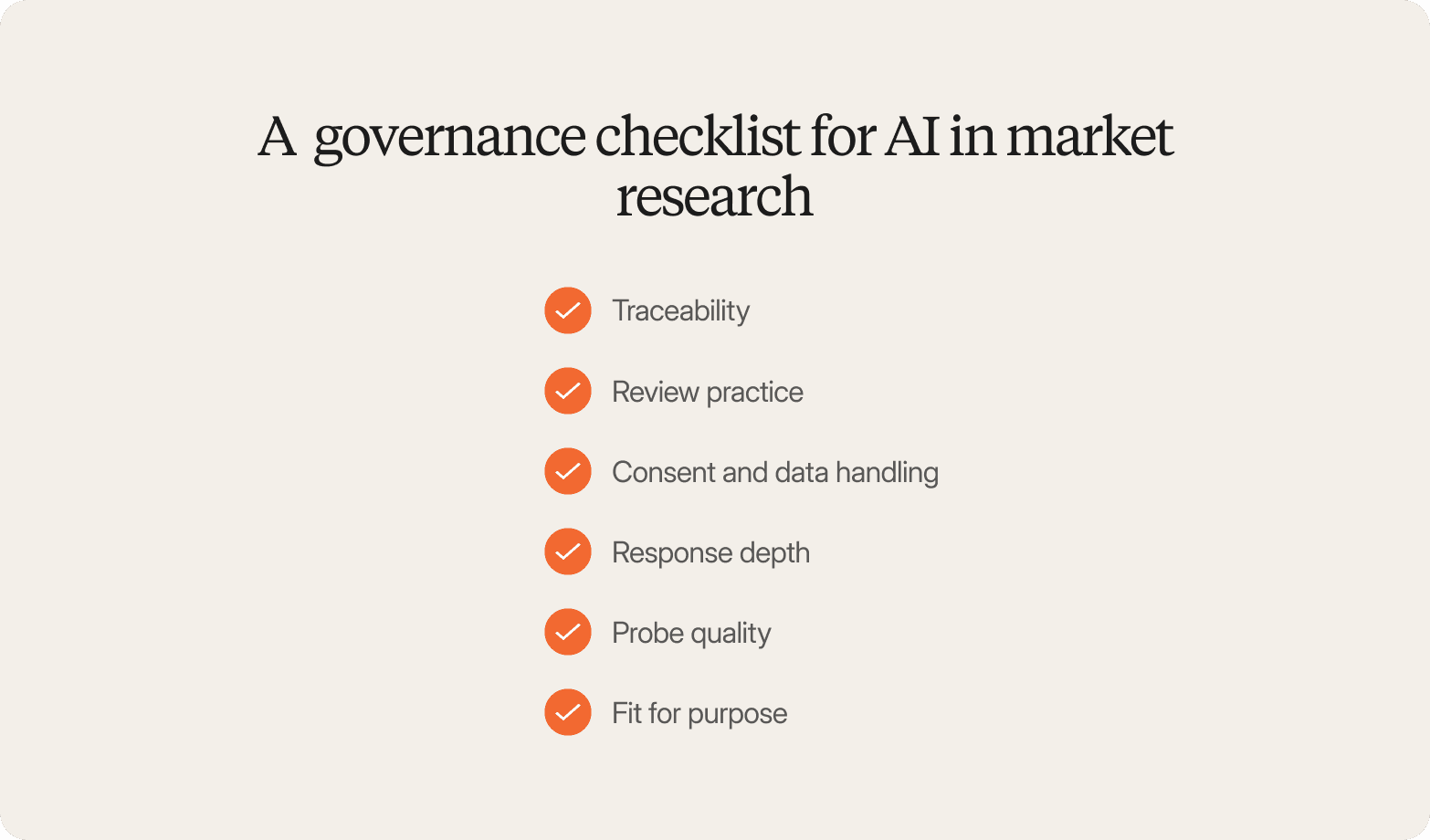
Quality standards are not universal across use cases. This checklist sets the floor, and the insights leader decides where a given study falls relative to it.
Traceability. Confirm every key finding links to a participant, their video, and their verbatim words. If the source interview cannot be surfaced, the finding is not stakeholder-ready.
Review practice. Decide who audits AI-generated probes, coding decisions, and synthesis for bias and error, and when. This requires more research judgment than technical expertise, and it belongs to the research function. Treat this as research practice you own rather than a feature you buy.
Consent and data handling. Check compliance credentials before procurement does. Conveo is SOC 2 Type II certified, GDPR compliant, EU hosting (Belgium). Verify status directly with any vendor, since it changes.
Response depth. Voice and video sessions should yield materially richer answers, using data collection methods that capture decision logic and hesitation, than typed surveys or open-ended survey responses collected without follow-up.
Probe quality. Follow-ups should respond to what surfaces in the conversation, which depends on contextual understanding carried across the whole session rather than just the last answer. Conveo's AI moderator is built on that principle: without probing, a session is a survey with a video interface, closer to survey design than to research, and data quality drops to match.
Fit for purpose. Decide the method against the question. Group dynamics, tactile product handling, and ethnographic observation call for the methods designed to capture them.
The decision rule: concept tests and ad testing tolerate faster workflows where traceability holds, and probe quality is high. Strategic segmentation and brand positioning need deeper rigor and active human oversight at design and interpretation.
Considerations: Failure modes and diagnostic questions
Five failure modes account for most of the trouble teams hit when they bring artificial intelligence and new research tools into a research function. Each has a question that exposes it before a contract does.
| Failure mode | What happens | Diagnostic question |
|---|---|---|
| Invented behaviors | Personas built from internet-trained models can manufacture intent or reflect training bias back as consumer insight, producing synthetic data with no participant behind it. | Can every claim be traced to a quote from a specific real person? |
| Black-box synthesis | Coding that cannot show which quote supports which theme collapses the first time a stakeholder pushes back. | Is the reasoning visible and correctable by the researcher? |
| Workflow handoffs | Point solutions that require manual export and cross-referencing reintroduce the coordination overhead they were bought to eliminate. | Does a single workflow handle recruiting, interviewing, analysis, and reporting? |
| Compliance gaps | Platforms without recognized security and data-handling credentials stall during legal review for enterprise accounts. | Are those credentials confirmed by people with the technical expertise to read them, before procurement is involved? |
| Method mismatch | AI-moderated interviews are better suited to depth work than to live group interaction or in-context observation, where traditional methods like focus groups or field ethnography remain the better instruments. | Does this question call for a focus group, an in-home use test, or field ethnography instead? |
Method choice here is a matter of fit rather than hierarchy. The strongest research teams run AI-moderated interviews alongside human-moderated work and pick per question.
How Conveo Clears the Credibility Wall
Teams at Google, Unilever, AB InBev, Kellanova, and General Mills rely on Conveo to continuously understand their consumers rather than study them on a per-study basis. That is the always-on layer this article argues for. AI-moderated video interviews are conducted with real participants in 50+ languages, and analysis is completed as each conversation closes, capturing customer interactions as they happen rather than sampling them after the fact.
Rigor is what makes that understanding usable, and it shows up in a few concrete ways:
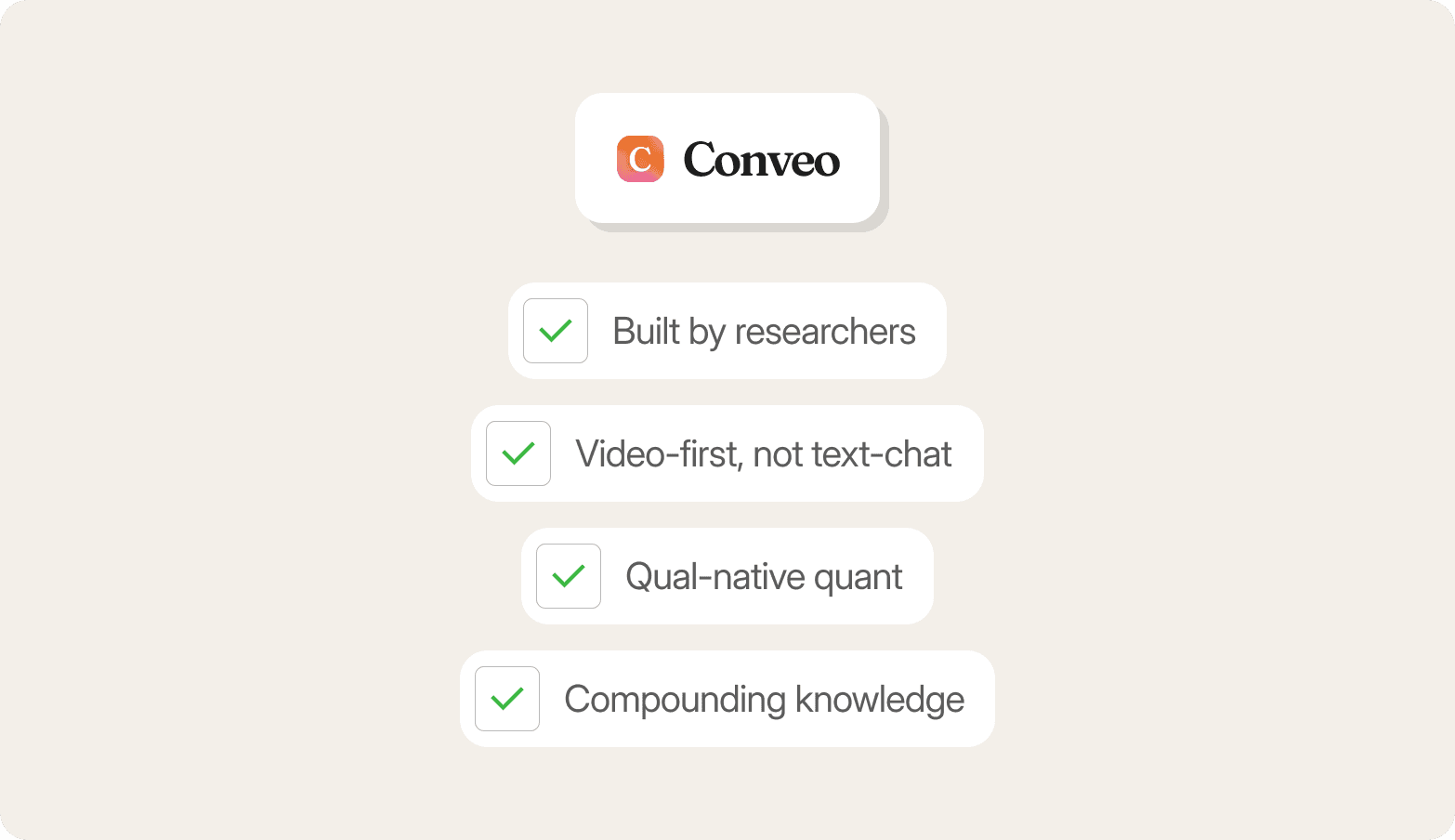
Built by researchers. The method stays visible, and every key finding traces to a real person who said it, with verbatim words and video attached.
Video-first capture. Real participants on camera are the wedge against synthetic personas and text-chat platforms.
Qual-native quant. The number and the reason come from the same person in the same session. MaxDiff tells you what people prefer. Conveo's MaxDiff tells you why.
Compounding knowledge. Understanding compounds into actionable insights that go well beyond raw transcripts. A searchable insight library connects market insights across projects, and each study starts from what previous research already established.
Compliance built in. SOC 2 Type II certified, GDPR compliant, EU hosting (Belgium), which supports the case for procurement and European buyers.
Speed is the last argument in that list, and it earns the position. Teams report compressing depth interview programs from weeks to days, thereby putting evidence within the decision window.
Frequently Asked Questions
What is AI in market research?
AI in market research and AI market research tools cover four distinct applications. They are synthetic personas, AI-moderated interviews with real participants, transcript coding and synthesis, and behavioral data mining. They are not interchangeable, and none of them is a single market research tool. Each carries a different evidence standard, and only some produce findings that trace back to a participant.
Can synthetic personas replace interviews with real participants?
No. Synthetic personas infer behavior from demographic inputs and training data rather than observing it, so no participant stands behind the output. They can support early ideation and pressure-test a brief. For decisions that will face internal scrutiny, findings need a real person who said it, on record.
How do AI-moderated interviews stay traceable?
Each session is recorded with a real participant, and every synthesized theme links back to the words that produced it. A stakeholder challenging a finding can watch the source interview rather than accepting a summary. Traceability is the reason AI-generated synthesis can be defended in a business review.
Where is AI-moderated research a poor fit?
It fits depth work rather than situations where the environment or the group interaction is itself the data. Live group dynamics, tactile product handling, and in-context ethnography call for the methods built to capture them. Study design and interpretation stay with a researcher in every case.
What is the difference between an AI moderator and an online survey?
A survey asks a fixed set of questions in a fixed order, and survey creation locks that order in before the first response comes back. An AI moderator follows what a participant says because conversational AI can branch as a human moderator would, probing hesitation, contradiction, and unexpected reasoning. That difference matters more than survey analysis alone can show, and it is why voice and video sessions produce materially longer responses than static surveys, with the decision logic attached.
What should insights teams check before adopting an AI research platform?
Check four things. Whether every finding traces to a participant and their own words. Whether coding decisions are visible and correctable. Whether security and data-handling credentials pass internal review, and whether probing is adaptive rather than scripted. Confirm compliance status directly with the vendor.

About the author
Niels Schillewaert
Head of Research and Methodologies
Twenty-nine years in consumer research. Niels co-founded Human8 (formerly InSites Consulting), served as president of ESOMAR and teaches marketing at Vlerick Business School. At Conveo he sets the methodology and pressure-tests every feature against real-world research practice.
Meet Niels on film →Qualitative insights at the speed of your business.
Conveo runs AI-moderated video interviews and structures everything they say.