In this article
TL;DR
Consumer intelligence programs fail when findings arrive after the decision they were meant to shape has already been made
The core bottleneck is a throughput problem: small teams cannot run enough studies manually to keep pace with business decisions
Fixing the timing gap requires three structural shifts: scaled throughput through asynchronous AI-moderated interviews, traceable evidence tied to real video conversations, and a compounding insight library that builds institutional memory across studies
Organizations that treat consumer intelligence as a continuous capability rather than an episodic project make faster decisions and build institutional knowledge that survives team turnover
Video-first, AI-moderated research workflows let enterprise teams run hundreds of conversations in parallel, delivering actionable insights in days, not weeks, without sacrificing methodological rigor
Consumer intelligence programs fail the moment qualitative findings arrive after the decision they were meant to shape has already been made. That is not a methodology problem. It is a timing problem, and it is more common than most insights functions want to admit.
Marketing, product, and innovation teams are making consequential calls on positioning, packaging, and concept direction at a pace that traditional research cycles were never designed to keep pace with. The raw data exists: consumer data, behavioral data, transactional data, and customer feedback accumulate constantly across channels. Customer conversations happen. But collecting customer data is only the starting point. Analyzing customer data well enough to produce decision-ready intelligence is where most programs break down, and turning that analysis into actionable insights the business will actually use is harder still.
Consumer intelligence that actually influences decisions requires something different: findings delivered inside the decision window, built on real customer conversations, and structured so they compound across studies rather than expire in a presentation. This article examines what that requires in practice, and how video-first, AI-moderated research workflows are making it achievable for enterprise teams without sacrificing the rigor that makes consumer intelligence worth acting on.
What Consumer Intelligence Actually Is
Consumer intelligence, often shortened to customer intelligence (CI), is the continuous process of translating customer signals into decision-ready business intelligence. It is not a research report delivered at the end of a project. It is not a dashboard of behavioral data. It is the ongoing capability to understand customer preferences, expectations, behaviors, and interactions across every stage of the customer journey, and to have that understanding available when decisions are made.
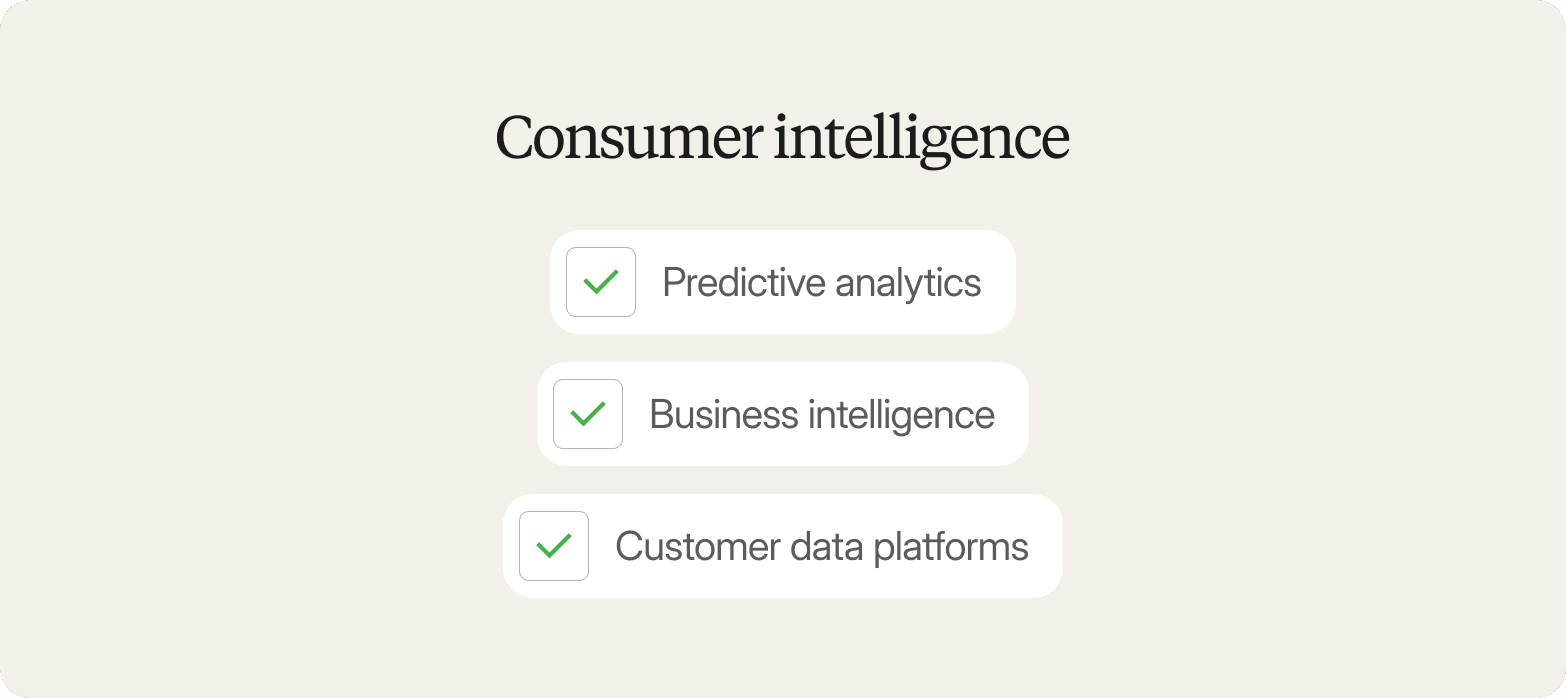
Consumer intelligence is easy to conflate with adjacent concepts. Worth separating them out:
Predictive analytics forecasts what customers might do next based on historical patterns. Consumer intelligence explains why customers behave the way they do right now, which is the context predictive models cannot generate on their own.
Business intelligence draws on internal operational data: revenue, churn, conversion, usage. Consumer intelligence goes further, layering in what customers actually say and mean, as well as the motivations and tensions that no internal metric captures.
Customer data platforms store and segment customer intelligence data, including behavioral, transactional, and demographic data, but storage is not interpretation. Intelligence requires both: the raw data and the analytical layer that turns data points into something a brand director or CMI lead can act on.
A genuinely robust customer intelligence program treats customer analytics, customer intelligence analytics, and customer analysis as a means to an end, not the end itself. Organizations that treat consumer intelligence as a continuous capability rather than a project category make faster decisions, catch broader market trends and industry trends earlier, and build institutional knowledge that survives team turnover.
4 Reasons Why Consumer Intelligence Programs Fail
Most consumer intelligence programs do not fail because the researchers are not skilled enough. They fail because the operating model was never built to keep pace with the decisions it is supposed to support.
The timing problem is the most visible symptom. A study commissioned in response to a live strategic question typically returns findings six weeks or more later, through an agency. By then, the product roadmap has been locked, the campaign has shipped, or the market entry decision has already been made. The research does not inform the decision. It validates, or contradicts, a choice no one can reverse.
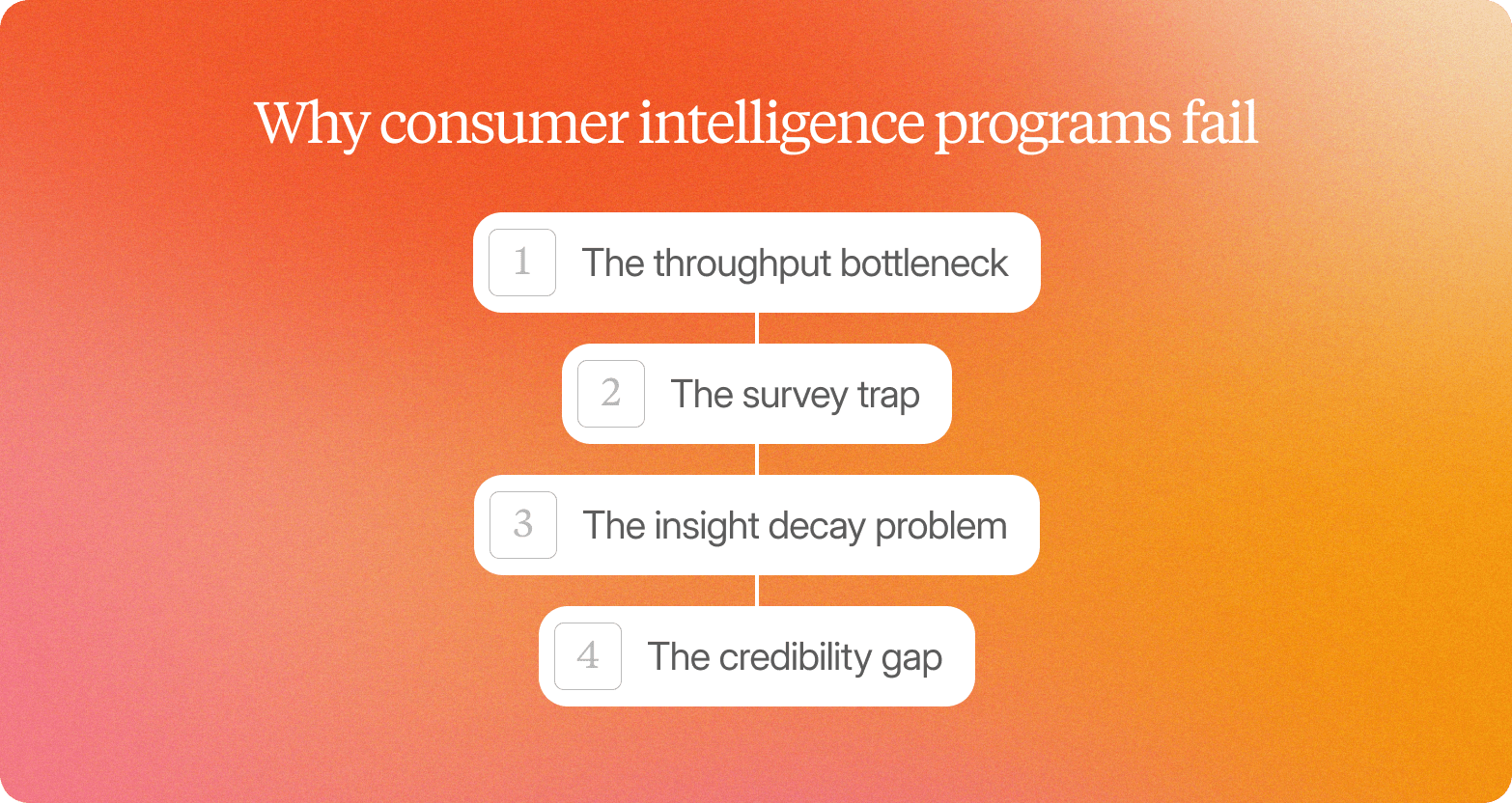
The throughput bottleneck
Sits underneath the timing problem, and most teams do not name it directly. Manual moderation, transcript review, and synthesis require researcher hours that small teams lack. A team of three cannot run 60 studies a year when each study demands 40 hours of human effort to close. The ceiling is not ambition. It is capacity.
The survey trap
Teams reach for consumer surveys because they are fast and scalable, and for measuring volume or tracking shifts in stated preference, they work. But surveys cannot answer the questions that matter most in consumer intelligence work: why a customer hesitated at the point of purchase, what made a message feel off, or what drove them to a competitor. They capture what happened. They rarely explain it, and analyzing data at that level of granularity means little without real conversations with individual customers to explain the pattern, since surveys miss the attitudinal data and psychographic data that actually explain customer behaviors.
The insight decay problem
Compounds over time. Past studies are organized in decks by project name and quarter, not by question or theme. When a new brief lands, teams often start from scratch rather than build on what was already learned, and pain points identified in one study go unaddressed because no one thought to identify pain points and search for them across the archive. Valuable insights sit unused. Institutional memory resets with every initiative.
The credibility gap
Compounds it all. Stakeholders increasingly challenge summaries they cannot trace back to real consumer conversations. A thematic cluster without a source quote, a video clip, or a verbatim tied to an actual participant does not hold up in a senior review.
As organizations move toward digital consumer intelligence workflows, the expectation is that findings arrive in days, not weeks. The teams that cannot meet that expectation are not failing on skill. The operating model is what breaks.
What Consumer Intelligence Actually Requires
Consumer intelligence that shapes decisions has three structural requirements. Speed alone is not enough. Neither is depth without traceability. The organizations that close the gap between research and decision-making are the ones that have rebuilt their workflows around all three at once.
Throughput at Scale
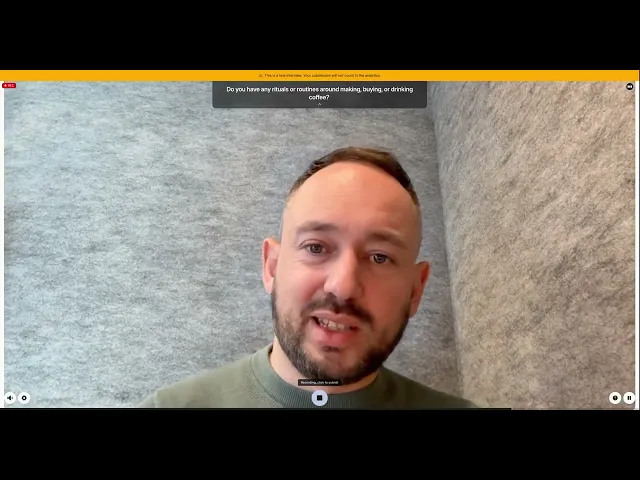
The first requirement is the ability to collect real conversations at the volume business decisions demand, without that volume creating a weeks-long backlog. Video-first, AI-moderated interviews run asynchronously, which means hundreds of conversations can take place within the same calendar window that once took to field a handful. Sessions happen on participants' schedules, not a moderator's. Findings arrive in hours or days, not at the end of a six-week agency cycle. That shift changes what consumer intelligence can do: instead of informing a decision that has already been made, it reaches the team before the decision is made.
The video-first format matters beyond speed. Adaptive probing during an interview follows what a participant actually says, not a fixed script. When someone hesitates before answering a pricing question, or uses unexpected language to describe a competitor, a well-designed AI moderator follows that thread. A survey cannot. That follow-up logic is where the nuance lives: why customers switch, why a message does not land, why a concept that tests well in concept still fails at launch. Conveo, the video-first customer intelligence platform, captures what structured questionnaires are designed to skip by running adaptive video conversations with real participants at enterprise scale.
See it in action: How AI-Moderated Video Interviews Actually Work
Traceable Evidence
The second requirement is auditability. Stakeholders who distrust research summaries are not being difficult; they are responding rationally to outputs that cannot be verified. When every theme links back to specific video clips and verbatim quotes, findings stop being an analyst's interpretation and become evidence. That traceability is what allows consumer intelligence to travel across an organization, from the researcher who ran the study to the CMO presenting to a board, without losing credibility at each handoff.
Compounding Institutional Memory
The third requirement is the hardest to build but the most valuable over time. Most research resets with each study. A searchable insight library that accumulates across initiatives means each new study builds on prior findings rather than starting from scratch. Consumer intelligence compounds. Patterns across markets, categories, and time periods become visible. Contradictions between old assumptions and new evidence surface automatically, rather than staying buried in a deck no one opens.
Multi-market execution adds one more structural fix. Running consumer intelligence across markets traditionally means separate recruiting, moderation, and translation workflows for each geography. AI-moderated interviews in 20+ languages, with recruitment across 50+ markets and automated transcription and translation, remove that bottleneck without requiring a separate workstream per market.
How Consumer Intelligence Compounds Over Time
Most qualitative research dies the moment the deck gets filed. A study runs, findings get presented, stakeholders move on, and six months later a different team commissions nearly identical interviews to answer a question that was already answered. The cost is real: redundant agency spend, duplicated fieldwork, and insights that never compound into anything durable.
The alternative is not running more research. It is building research that accumulates and delivers a deeper understanding of customer preferences with every cycle.
When every study flows into a searchable, structured insight library, each new project builds on what came before rather than starting from scratch. A concept test run in Q1 informs the brand positioning work in Q3. A customer satisfaction study surfaces a behavioral pattern that reframes how the product team interprets their next round of discovery interviews. Consumer intelligence moves from a series of isolated snapshots to institutional memory, helping teams build stronger customer relationships over time rather than reacting to campaigns one at a time.
The mechanism that makes this work is traceability. Findings that can be traced back to real consumer conversations, with verbatim quotes, video timestamps, and source attribution, stay credible long after the original study closes. Stakeholders who can inspect the evidence behind a claim are far more likely to act on it, and far less likely to dismiss past intelligence as outdated. That credibility is what makes compounding consumer intelligence reusable rather than archived, and turns a single study into a customer intelligence asset the whole organization can draw on.
The insight library Conveo builds with every study changes the redundant research spend math described above. New questions get answered by interrogating existing customer intelligence data before a new study is even scoped, which is exactly what a robust customer intelligence program is supposed to do: identify trends before a competitor does.
"Powerful if you can just look back and just ask AI about the past"
Hikaru Maeda, ASICS US
Organizations that build compounding consumer intelligence over time carry a structural advantage: they move faster not because they research less, but because each new initiative starts from a foundation of accumulated understanding rather than a blank page.
Consumer Intelligence vs. Synthetic or Unverified AI Outputs
In 2026, enterprise procurement teams are asking harder questions about AI research outputs than they were two years ago. The core concern is not speed or cost. It is whether the findings reflect what real people actually said, or whether they were generated, inferred, or approximated by a model with no human participant behind them.
Consumer intelligence built on real video conversations carries a different evidentiary weight than outputs generated from synthetic respondents or text-based AI summaries. When a stakeholder asks "who said this and where does it come from," a video-grounded finding has a traceable answer: a specific participant, a specific moment, a specific response. A synthetic output does not. That traceability gap matters more as organizations use research to justify larger strategic and investment decisions.
The tradeoff is not that synthetic approaches are without value. For early ideation or rapid hypothesis generation, they can move quickly. The friction arises when those outputs need to hold up under scrutiny: in a brand review, in a regulatory context, or in a cross-functional decision where non-researchers are weighing in. Consumer intelligence that cannot be traced back to a real human conversation tends to erode stakeholder confidence over time rather than build it.
Compliance infrastructure compounds this distinction. Procurement blockers quietly stall deals when research crosses jurisdictions, so this matters more than it might first appear:
SOC 2 certification
GDPR alignment
Alignment with frameworks like the California Consumer Privacy Act
Optional EU regional data hosting
Sound data management practices, including fraud-filtering and incentive management within a single workflow, reduce the risk of low-quality or fabricated responses entering the dataset. That is a separate but equally serious credibility threat that no amount of AI analysis can correct after the fact.
Practical Operating Model for Small Enterprise Insights Teams
Most enterprise insights teams are not under-resourced because the work is hard. They are under-resourced because the traditional research model was never designed for a team of three people to serve 15 internal stakeholders across marketing, product, innovation, customer experience (CX), and customer service simultaneously. Findings that once informed a single roadmap now need to shape marketing efforts, product decisions, and marketing strategies simultaneously. The operating model needs to change before output quality can improve, and business growth depends on getting it right.
AI-assisted synthesis with human review changes the throughput equation without changing the quality standard. A skilled researcher's judgment still governs what gets delivered. The difference is that they are no longer spending the majority of their time on tasks that do not require that judgment: scheduling, transcription, initial coding, and report formatting.
A practical weekly rhythm for a small team looks like this:
Week 1: Launch two to three asynchronous studies in parallel. Concept tests, ad validation, and customer satisfaction studies can run simultaneously because video-first, AI-moderated interviews remove the scheduling bottleneck entirely. Participants receive a link, complete their session on their own schedule, and the recordings are uploaded to the platform as they come in. No moderator time required during fieldwork.
Week 2: AI-assisted synthesis, drawing on machine learning algorithms to cluster themes across every transcript, surfaces thematic clusters, sentiment analysis, customer sentiment, and verbatim highlights across all sessions, without requiring a team of data scientists to interpret the output. The researcher's job at this stage is review, not construction: confirming the themes hold, flagging nuance the model may have missed, and shaping the narrative. This is where methodological expertise earns its keep and where consumer intelligence begins to take shape.
Week 3: Stakeholder-ready outputs go out with video clips and verbatim quotes attached. Every finding links back to its source. Stakeholders who distrust AI-generated summaries can watch the moment themselves. That traceability is what converts consumer intelligence from a research deliverable into a decision input, and it's what helps teams improve customer satisfaction by acting on real evidence rather than assumption.
Week 4: Findings move into a searchable insight library. The next study does not start from zero. Consumer intelligence compounds across projects rather than expiring in a deck.
This is a structural shift in how a small team operates, not a shortcut. The capacity gain comes from removing the manual steps that were never a good use of a researcher's time in the first place. Teams report cutting research timelines from 6–8 weeks to 3–5 days while maintaining the same headcount, which is the only sustainable solution to a research backlog that never shrinks.
Governed, Multi-Source Consumer Intelligence
Most enterprise teams are sitting on more data than they can use:
Social listening dashboards on social media platforms
Search trend reports
Behavioral analytics and CRM signals
Social media data and feedback data
These external data streams run constantly. The problem is not volume. It is that none of those streams can tell you why a consumer made the decision they did.
Governed consumer intelligence is the practice of combining external quantitative signals with internal qualitative data within a clear framework that specifies how each source is used and when each takes precedence. Effective data integration matters here: signals scattered across disconnected tools are far harder to reconcile than those brought into a single workflow. This is not purely a data engineering challenge. It is a governance question about which evidence answers which type of question.
The framework is straightforward in principle, harder to hold in practice:
Quantitative Signals Answer "What" and "How Many"
Social volume, search trend shifts, behavioral clickstreams, average order value, and survey scores tell you that something changed, and at what scale. They are the early warning system. Use them for trend detection and hypothesis generation across audience segments and demographic data.
Qualitative Findings Answer "Why" and "How"
Voice and video interviews with real consumers reveal the motivation, context, and decision logic behind the patterns quantitative data surfaces. They are the explanation layer. Use them to understand customer preferences before acting on a trend.
When They Conflict, Investigate the Mismatch
A brand tracker showing declining consideration while interview participants express strong category affinity is not a contradiction to resolve by picking the louder signal. It is a diagnostic: the mismatch often points to differences across audience segments, question framing issues, or a gap between stated and revealed customer behaviors that neither method would catch alone.
This is where video-first qualitative research becomes structurally important. Digital consumer intelligence data streams capture behavior at scale, but they cannot capture the hesitation in a participant's voice when they describe a price point, or the shift in tone when a competitor brand comes up. Real voice and video conversations provide the motivational depth, grounded in attitudinal data rather than inference, that makes quantitative signals actionable rather than merely observable.
How Conveo Powers Consumer Intelligence That Compounds
The structural requirements this article outlines- throughput at scale, traceable evidence, and compounding institutional memory- are exactly what Conveo was built to deliver. Among customer intelligence tools built for enterprise teams, Conveo is designed around one premise: customer understanding, backed by traceable evidence rather than summary, is one of a company's most valuable assets.
Conveo's AI moderator conducts adaptive video interviews with real participants, running hundreds of conversations in parallel without a single scheduling bottleneck. Every session produces traceable, auditable evidence: verbatim quotes, video clips, and timestamped moments that stakeholders can inspect directly. Findings are not summaries of summaries. They are sourced.
The Insight Library turns every study into a building block. Themes, clips, and findings from each project are searchable and reusable, so a concept test from Q1 can inform a brand positioning study in Q3 without anyone having to dig through old decks. Consumer intelligence compounds across studies, markets, and time periods, strengthening a company's customer intelligence efforts with every cycle rather than resetting them.
For enterprise teams navigating compliance requirements across jurisdictions, Conveo is SOC 2 certified, GDPR-aligned, and offers optional EU regional data hosting. Recruitment runs through integrated panel partners and supports BYO participant lists, CSV uploads, QR codes, and WhatsApp recruitment, with AI-moderated interviews available in 20+ languages across 50+ markets.
Frequently Asked Questions
What is consumer intelligence?
Consumer intelligence is the continuous process of translating real customer signals into decision-ready business intelligence that shapes active decisions as they form. Unlike market research, which delivers periodic snapshots, or business intelligence, which draws on internal operational data, consumer intelligence treats customer understanding as a standing input to the business rather than a scheduled output.
What is the importance of consumer intelligence for businesses?
The importance of consumer intelligence for businesses is that it keeps real customer evidence inside the decision window, so campaigns, product roadmaps, and brand positioning reflect what customers actually think rather than what teams assume. Without it, decisions get made on instinct and corrected later, at high cost to customer retention and business growth alike.
What are consumer intelligence jobs?
Consumer intelligence jobs are strategic roles responsible for translating customer data and real human conversations into business intelligence that decision-makers can act on. They go beyond data collection: practitioners in these roles are measured not just on research quality but also on whether the consumer and customer insights they produce arrive within the decision window. Modern consumer intelligence professionals need both methodological rigor and the operational capacity to deliver credible insights fast enough to shape decisions that are still in motion.
What are consumer intelligence examples?
Consumer intelligence examples span the full range of decisions that enterprise teams make before committing budget and direction. A brand team runs video interviews with target consumers before a campaign launches, capturing not just which message scores higher but also why one framing creates doubt while the other builds confidence, and uses the resulting consumer insights to shape targeted marketing strategies before spend is committed. An innovation team tests a new product concept with real participants and surfaces a purchase barrier and the underlying pain points behind it that never appeared in the survey data. A CMI team tracks brand perception and consumer sentiment across quarters using a searchable insight library, so when sentiment shifts, they can trace it back to specific consumer language rather than a dashboard trend line. A customer service team pulls the same customer insights to spot recurring friction points before they lead to churn. What connects these examples is timing: the findings arrive while the decision is still open, not after the brief has been signed off.
What is a consumer intelligence survey?
A consumer intelligence survey is a quantitative instrument that captures what customers do and how many share a given preference, but it rarely explains why they switch, hesitate, or reject a message outright. Fixed survey scripts cannot follow a surprising answer down a more revealing path. When a participant says a product "feels too expensive," a survey records that response and moves on. A video-first qualitative interview probes the hesitation: expensive relative to what? Compared to which alternative? That follow-up logic is where decision-making context lives. The tradeoff is real and worth respecting. Surveys deliver speed at scale. Qualitative interviews deliver depth, and the motivational reasoning that surveys structurally cannot reach. The most reliable consumer intelligence workflows use both consumer surveys to detect trends and shifts across large samples and qualitative interviews to explain the human logic behind those shifts before teams act on them. Consumer Intelligence Surveys Video-First Qualitative Interviews Answers What, how many Why, how Depth Shallow Deep Speed Fast Days, not weeks Traceability Aggregated data Verbatim video, sourced themes Best for Trend detection, tracking Motivation, decision logic When to use surveys vs. qualitative interviews in consumer intelligence workflows.
How is consumer intelligence different from customer intelligence?
Consumer intelligence focuses on market-level understanding: category buyers, prospects, and competitive dynamics. Customer intelligence focuses on existing relationships: usage patterns, churn signals, customer lifetime value, customer loyalty, and expansion opportunities. This is also where consumer intelligence differs from customer relationship management: a CRM system records what an existing customer did (purchases, tickets, renewals), while consumer intelligence and customer intelligence explain why, drawing on real conversations a CRM was never built to capture. The overlap is significant. Both require translating behavioral data into decision-ready findings, and both benefit from qualitative workflows that surface the "why" behind the data, and both ultimately aim to build stronger customer relationships and support a coherent customer intelligence strategy.
About the author
Jake Brown
Brand and Consumer Insight
Jake came to Conveo from three and a half years in social listening, which is where his interest in brand and consumer insights started. A people person who is energised by not knowing something yet, he works with US clients on brand and consumer studies.
Meet Jake on film →Qualitative insights at the speed of your business.
Conveo runs AI-moderated video interviews and structures everything they say.