In this article
TL;DR
Traditional CPG qual studies take 6 to 12 weeks; most in-flight decisions need consumer input within 2 to 4 weeks.
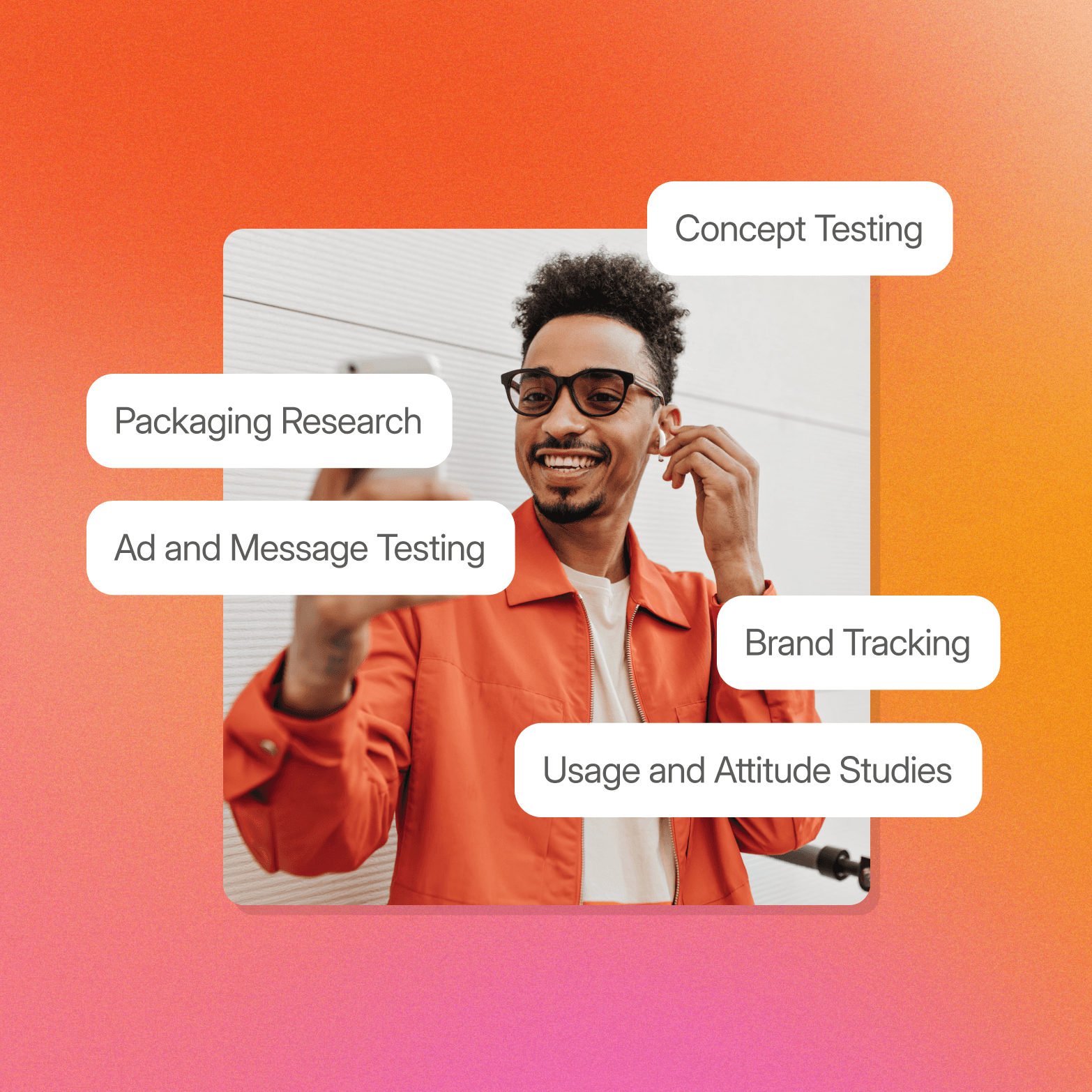
This article covers five primary research methods: concept testing, packaging research, ad testing, brand tracking, and usage and attitude studies.
AI-moderated video interviews compress those timelines from weeks to days without sacrificing conversational depth.
Consumer packaged goods (CPG) teams that operationalize continuous qualitative research turn raw consumer behavior data into actionable insights before competitors see the pattern.
Most CPG market research arrives after the decision it was meant to inform has already been made. A concept test returns while production specs are being locked. Packaging research concludes once shelf placement is confirmed. Ad testing completes the week after media buys are signed. The research is rigorous. The timing is wrong.
Traditional agency engagements deliver credible, methodologically sound findings, but they run on 6- to 12-week timelines that bear no resemblance to the pace at which brand, innovation, and marketing decisions are actually made. CPG teams have adapted with imperfect workarounds: survey platforms that offer speed but yield shallow data, or fragmented point solutions that require teams to stitch together separate systems for recruitment, moderation, and analysis.
Consumer packaged goods brands need research to make informed decisions before decision windows close. This article explains which CPG market research methods deliver both speed and depth, when each approach is the right fit, and how modern research workflows compress timelines without trading away rigor. CPG teams that operationalize continuous qualitative research gain a structural advantage: they understand consumer behavior as it shifts, not after it has settled.
Why CPG Market Research Timelines No Longer Match Decision Windows
CPG product cycles have compressed (concept-to-shelf in 6 to 9 months is now standard), but traditional research timelines have not. Competitive dynamics have accelerated across nearly every CPG category, narrowing the window between concept validation and the launch decision. Three scenarios illustrate the gap:
A snack brand testing a new flavor for a summer seasonal window has a four-week brief-to-production deadline.
A packaging redesign cannot wait ten weeks for a focus group debrief before going to print.
An ad message test needs to be completed before media buys lock, not two months after.
In each case, the research is valuable. The timeline makes it impractical.
Shifting market trends and evolving consumer interest add further pressure: a concept that tests well in Q1 may face a meaningfully different competitive landscape by Q3. When research consistently arrives late, teams run fewer studies. Fewer studies mean less institutional learning and more reliance on intuition for subsequent launches, compounding risk across the entire portfolio and surrendering a competitive edge to teams who can move faster. Modern CPG market research workflows address this by compressing recruitment, moderation, transcription, and synthesis into a single automated sequence, shrinking qual cycles from weeks to days without sacrificing depth.
Primary vs. Secondary Research for CPG Brands
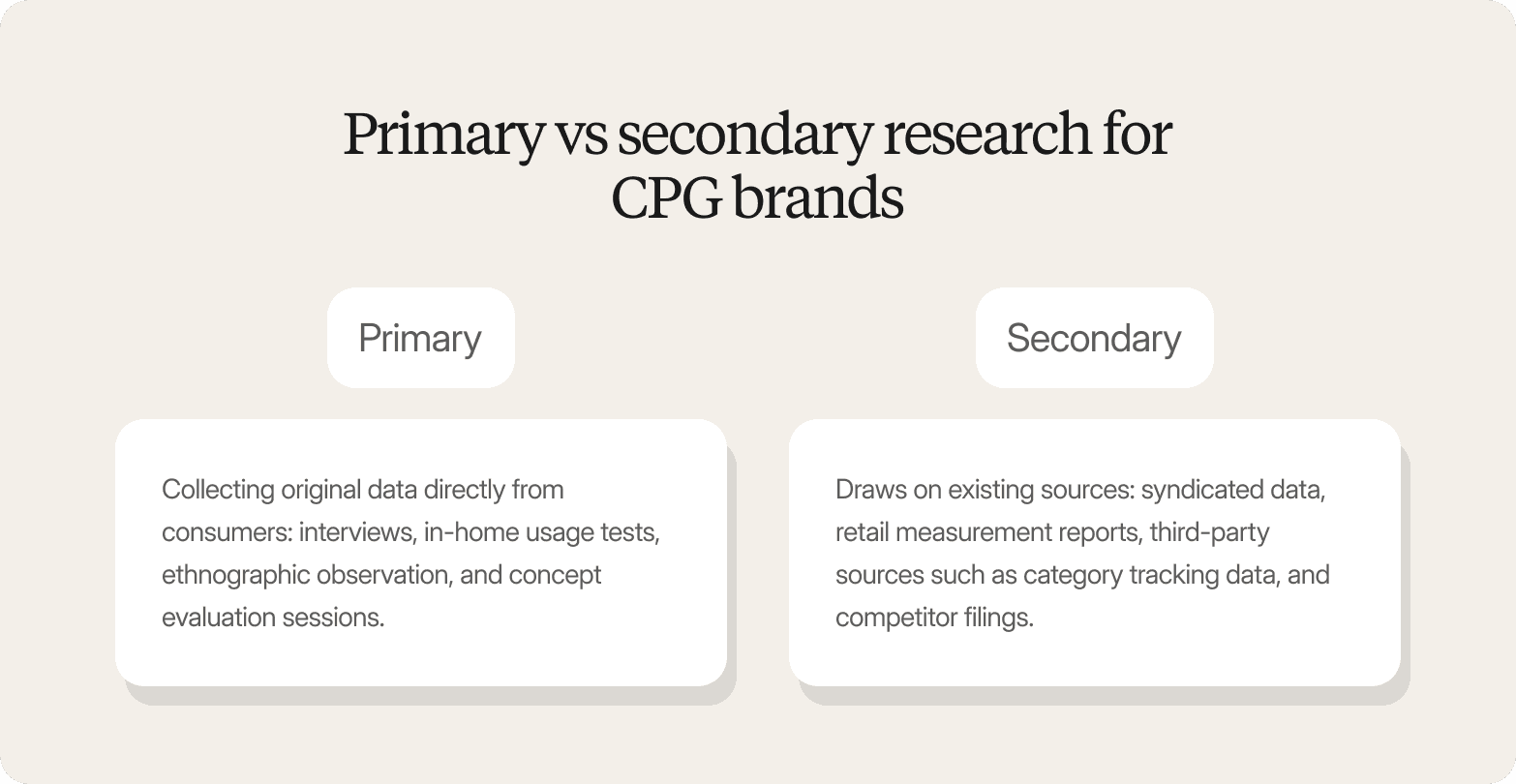
Primary research means collecting original data directly from consumers: interviews, in-home usage tests, ethnographic observation, and concept evaluation sessions. Secondary research draws on existing sources: syndicated data, retail measurement reports, third-party sources such as category tracking data, and competitor filings.
The distinction matters because they answer different questions. Secondary research sizes a category, tracks market trends, estimates market size and market share, and monitors competitive positioning. Consumer packaged goods market research via primary methods answers what secondary data cannot: why a shopper reaches for a competitor's product instead of yours, whether a packaging claim lands the way your team intended, and what language consumers actually use to describe the need your brand is trying to meet.
Key factors in choosing between them: if the question involves scale, share, or category-level trends, secondary sources usually suffice. If the question is about consumer motivations, consumer segmentation, or the reasoning behind consumer behavior, primary research is the only reliable path. Understanding which research methodologies apply to which decisions is where most CPG insights teams find their biggest efficiency gains.
This article focuses on primary qualitative methods, where the speed-versus-depth tradeoff creates the most pressure and where the stakes of getting it wrong are highest.
Qualitative vs. Quantitative Methods in CPG Market Research
Qualitative and quantitative CPG research are complementary, not competing. Quant tells you what and how many. Qual tells you why.
Quantitative data measure purchase intent at scale, size, and segment preferences, and track key metrics over time. Run an online survey across 1,000 consumers, and you know that 60% prefer Concept A over Concept B. That number is useful. It does not tell you why.
Qualitative data reveals the reasoning behind the numbers: why shoppers choose one product over another, how they interpret a packaging claim in-store versus online, what drives repeat purchase beyond price and habit. Consumer CPG research conducted through in-depth interviews surfaces customer preferences and consumer expectations that quantitative surveys consistently miss: the hesitation before choosing, the unarticulated dissatisfaction with a functional benefit, and the language consumers actually use to describe what they want. That distinction changes what the team does next.
A comprehensive understanding of your target customers requires both approaches. The constraint has been that qual is historically slower and more expensive to run. AI-moderated video interviews change that: studies that once required four to six weeks of agency coordination now run in days, delivering meaningful insights about consumer behavior with the behavioral depth that online surveys and quantitative data alone cannot capture.
5 Common CPG Market Research Methods
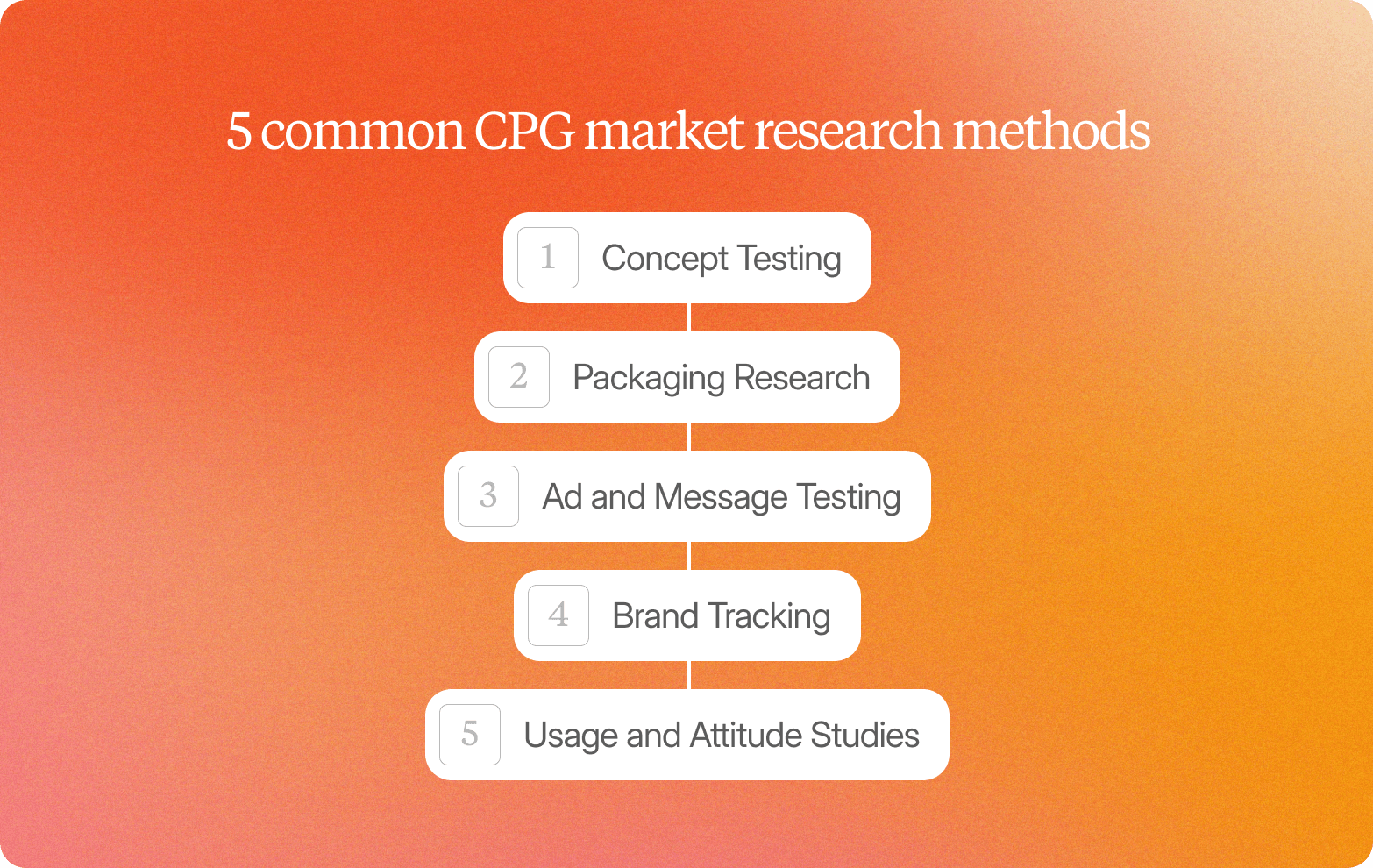
The right method depends on the decision type: concept risk (will consumers want this?), execution risk (will they understand the claim?), or market risk (will it perform across regions?). The five methods below cover the full range of CPG research decisions for consumer packaged goods (CPG) brands.
Concept Testing
What it is:
Evaluating a new product concept, flavor, or format before committing to production.
What it measures:
Purchase intent, uniqueness, and price sensitivity
Brand fit and functional benefits clarity
Use when:
Early-stage product innovation, line extensions, and seasonal launches are especially effective when health-conscious consumers are a primary target customer segment.
Timelines:
Traditional 6–8 weeks → Modern 3–5 days with asynchronous AI-moderated video interviews and automated synthesis.
The critical advantage over online surveys is that adaptive probing captures why consumers find a concept appealing or confusing, not just whether they'd buy it. Product testing in this format surfaces consumer preferences that fixed answer options never reach. When a participant hesitates at a price point or struggles to articulate what feels off about a product concept, the moderator follows up in the moment. That follow-up is where the actionable insights live, and it's precisely what a survey's fixed answer options cannot surface.
Packaging Research
What it is:
Validating packaging design, claims, and shelf presence before print production.
What it measures:
Shelf findability and claim comprehension
Purchase trigger and brand alignment
Use when:
Redesigns, new SKU launches, regulatory claim validation, and sustainable packaging claims that require consumer comprehension testing before going to market.
Timelines:
Traditional 8–10 weeks → Modern 4–6 days for digital mockup testing via video interviews. In-store components still require physical placement.
Shelf testing in a digital format presents participants with high-fidelity mockups in realistic shelf contexts, capturing shopper insights that static surveys miss entirely. Video evidence captures real-time reactions: the moment a participant scans a shelf simulation and their eye skips past your pack, or the pause before they misread a claim. For consumer packaged goods research, that behavioral signal is more actionable than a post-exposure rating scale.
Ad and Message Testing
What it is:
Evaluating campaign concepts, taglines, and creative executions before media spend.
What it measures:
Message clarity and emotional resonance
Brand recall and purchase influence
Use when:
Pre-launch marketing campaigns validation, A/B creative decisions, and regional message adaptation. CPG market analysis consistently shows that localized validation among the intended target audience reduces post-launch creative failures in multi-market rollouts, particularly when consumer expectations vary significantly by region.
Timelines:
Traditional 6–8 weeks → Modern 2–4 days. Participants respond to ad stimuli in their own environment, on their own schedule. Conveo captures real-time facial reactions, tone shifts, and verbal responses (not just a post-exposure rating scale) while the creative team still has time to act.
Brand Tracking
What it is:
Monitoring brand health, awareness, and perception over time.
What it measures:
Aided/unaided awareness and brand attribute associations
Purchase consideration, customer loyalty, new customers acquisition signals, and competitive positioning
Use when:
Quarterly or biannual tracking, post-campaign measurement, and evaluating product performance across launch waves.
Timelines:
Traditional 8–12 weeks per wave → Modern: continuous tracking with rolling video interviews analyzed in real time.
The more damaging pattern in traditional tracking is what happens between waves. Brand perception shifts gradually, and periodic snapshots miss it. A competitor entering the market, a product quality issue surfacing on social media, or a messaging misalignment with a key segment can build momentum for months before the next wave emerges. Conveo's rolling interview model surfaces shifts in customer loyalty signals, sentiment, and consideration as they form (not at the end of an eight-week field-to-report cycle), giving brand teams a longitudinal view that reflects how key metrics and category growth trend over time.
Usage and Attitude Studies
What it is:
Understanding how consumers use products in real contexts and what drives satisfaction or dissatisfaction.
What it measures:
Usage occasions and unmet needs
Pain points and repeat purchase drivers
Use when:
Product improvement, innovation pipeline prioritization, customer retention strategy, and any time the team needs to understand consumer behavior and customer preferences beyond what purchase data reveals.
Timelines:
Traditional 10–12 weeks (often includes in-home ethnography) → Modern 5–7 days for attitudinal and behavioral components via video diaries and asynchronous interviews. Physical in-context observation still requires in-person visits.
Participants record themselves in context, at the moment of use, without a moderator present. That removes scheduling friction and, in practice, often produces more candid footage than a researcher-attended session. The insights gleaned from in-context video are irreplaceable for any team seeking a comprehensive understanding of how and why consumers actually use a category.
How AI-Moderated Video Interviews Compress CPG Research Timelines
The biggest constraint in CPG market research has never been the quality of the questions. It has been the time required to collect data through each step in sequence: recruit participants, schedule moderated discussions, conduct live interviews, transcribe recordings, translate across markets, and synthesize findings.
AI-moderated video interviews restructure that sequence. Participants receive a link and complete their interview on their own schedule, removing the scheduling bottleneck. The AI moderator probes adaptively based on what each participant actually says, unlike traditional moderated discussions that follow a fixed guide. Sessions run in 20+ languages, with transcription and translation happening automatically as recordings land.
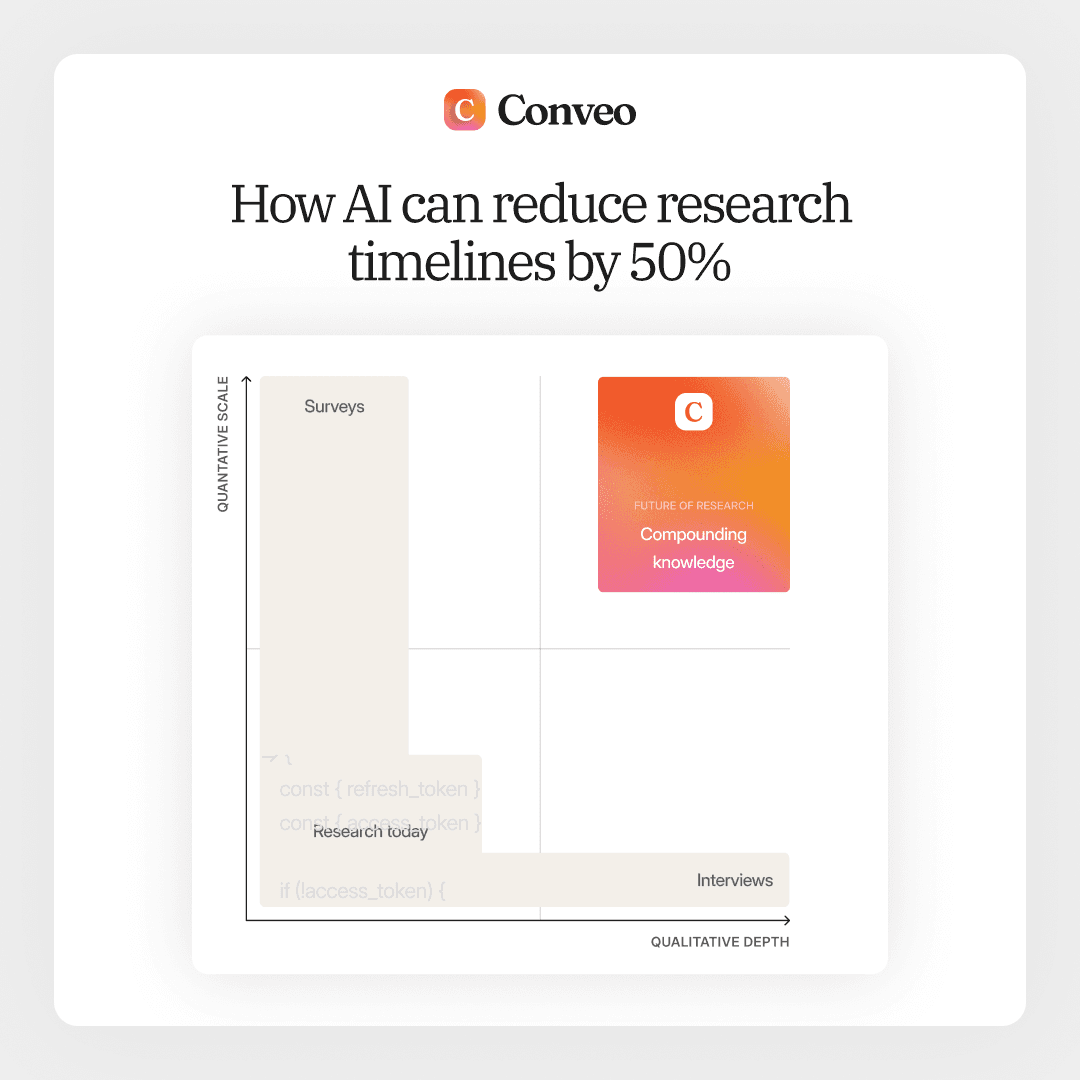
Because these steps run in parallel rather than sequentially, consumer packaged goods market research timelines shrink from 6–12 weeks to 3–7 days for a typical concept or packaging study. The research design remains consistent with traditional qualitative standards; what changes is the duration of each phase.
A beverage brand testing three packaging concepts across the US, UK, and Germany would traditionally spend ten weeks on recruitment, moderation, transcription, translation, and synthesis across three separate vendor relationships. On Conveo, 150 video interviews across all three markets (with full transcription, translation, and thematic analysis) were completed in five days. Findings arrive before the print deadline, not after it.
"Within days, we had insights that would've taken a traditional agency a month."
Head of Customer Insights, JDE Peet’s
Two concerns come up consistently when insights teams evaluate this approach:
Rigor: Adaptive probing addresses this. Because the AI moderator follows up on what participants actually say, the depth of responses is closer to that of a skilled human moderator than to a survey with fixed answer options. Teams can analyze data at the clip level, review verbatim, and trace every meaningful insight back to its source.
Watch it in action: How AI-Moderated Interviews Actually Work
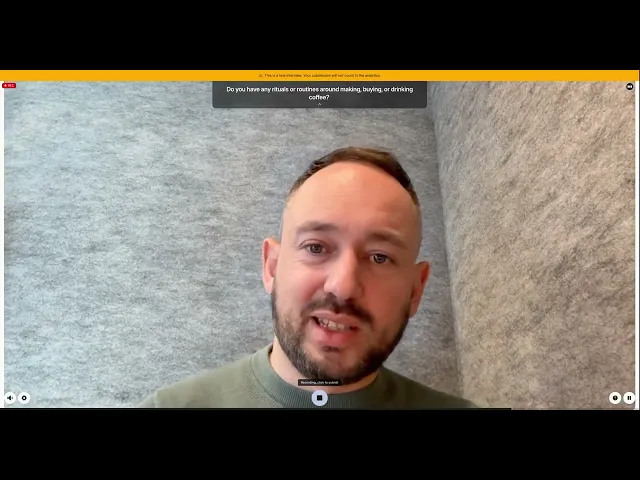
Stakeholder trust: Video evidence resolves it. Every theme and finding links back to the original participant recording, so stakeholders can watch the consumer say it rather than reading a summary they cannot verify.
Conveo also supports hundreds of simultaneous conversations, meaning teams can run three concept iterations in the time it previously took to complete one.
Building a Searchable Insight Library Across CPG Studies
Most CPG insights disappear not because they were wrong, but because they were filed in a deck and never connected to anything that came after. A team researching why consumers choose organic in the snacking category delivers a report and moves on. Eighteen months later, the beverages team asks the same question. Every CPG market research study starts from zero.
Before You Field a Study
A searchable insight library connects findings from CPG studies in plain language, allowing teams to query past research by theme, product category, or consumer segment. A CPG team launching a new protein bar can query the library for "high-protein snacking occasions" and surface clips and thematic findings from three prior studies, before a single participant is recruited. Understanding consumer preferences at the category level becomes cumulative rather than episodic. When insights gleaned from prior studies are immediately accessible, research briefs sharpen, hypothesis formation accelerates, and consumer interest signals stop getting lost in filing systems.
Stakeholder Trust
Every insight in the library links back to its source: a video clip, a verbatim quote, a timestamped moment in a real conversation. When a brand director challenges a recommendation, the response is the original evidence, not a summary slide. As the library grows, CPG teams build compounding customer understanding rather than starting from zero with each launch, allowing Conveo to provide brands with a genuine institutional memory, not just a repository of old reports.
Choosing the Right CPG Research Method: A Decision Framework
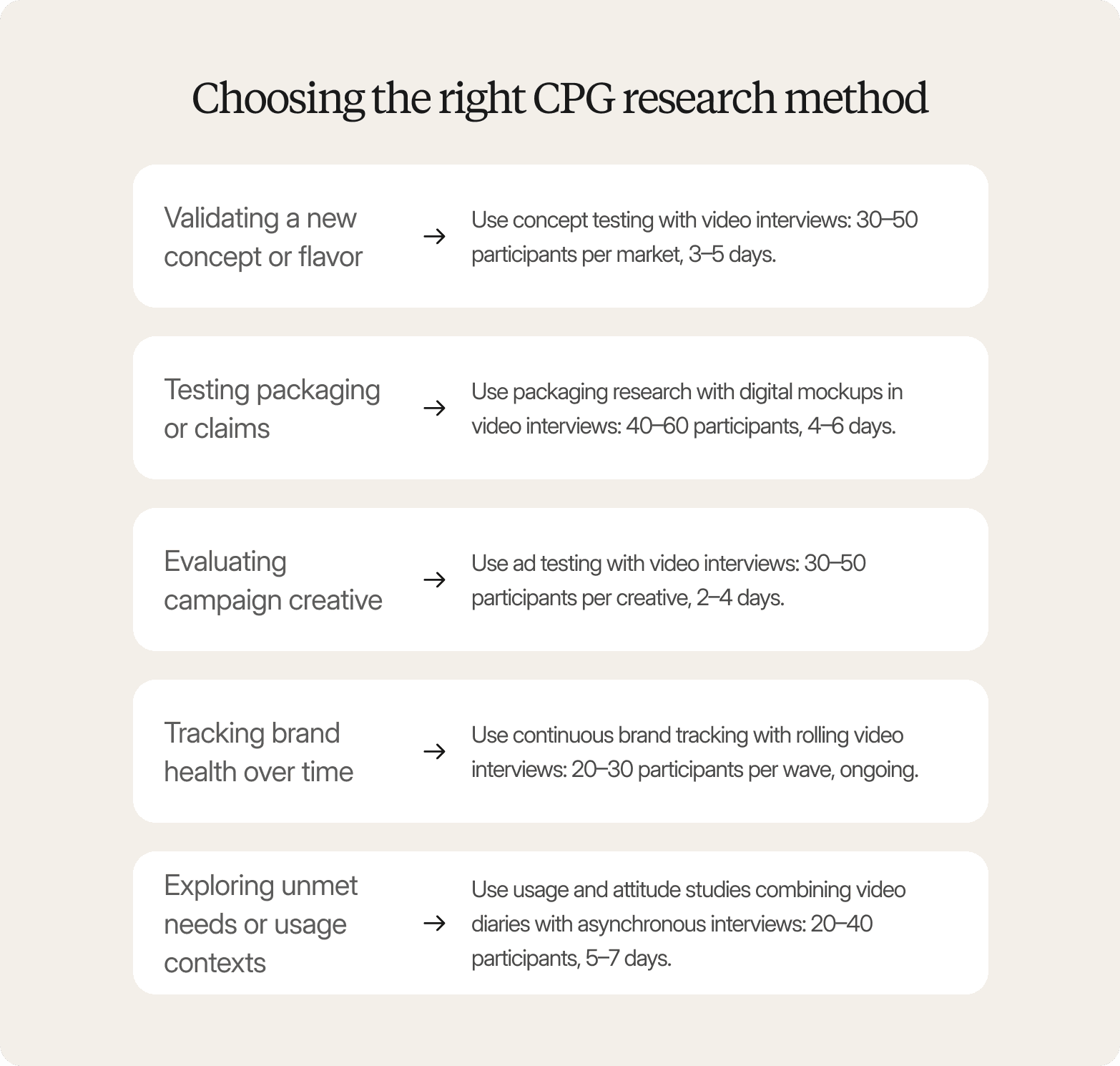
Selecting the right method for consumer packaged goods research starts with three questions: What decision type is at stake? What is the timeline constraint? What sample size does the decision require?
The key factors that distinguish one method from another are not speed or cost in isolation. They are the type of consumer insight the decision requires and the consumer segmentation the team needs to reach. Getting this right is how CPG teams make informed decisions rather than informed guesses.
Validating a new concept or flavor
Use concept testing with video interviews: 30–50 participants per market, 3–5 days. Adaptive probing surfaces consumer preferences and consumer expectations, not just whether they'd buy it.
Testing packaging or claims
Use packaging research with digital mockups in video interviews: 40–60 participants, 4–6 days. Video evidence captures real-time shelf testing reactions and shopper insights that static surveys miss entirely.
Evaluating campaign creative
Use ad testing with video interviews: 30–50 participants per creative, 2–4 days. Follow-up probing after the first viewing reveals which messages in your marketing campaigns landed versus which required explanation.
Tracking brand health over time
Use continuous brand tracking with rolling video interviews: 20–30 participants per wave, ongoing. For CPG market analysis of shifting perception and category growth, the compounding value comes from a searchable insight library that connects findings across waves and surfaces meaningful insights about customer loyalty in real time.
Exploring unmet needs or usage contexts
Use usage and attitude studies combining video diaries with asynchronous interviews: 20–40 participants, 5–7 days. Video diaries capture consumer behavior in the moment, in consumers' own kitchens and routines, rather than reconstructing it from memory in a survey.
The decision framework has not changed: match the method to the decision type, not to the calendar. Modern CPG market research workflows support all five methods with compressed timelines. The constraint is now strategy, not speed.
How to Put This Into Practice With Conveo
Every method in this article shares the same operational bottleneck: the sequential steps between fielding a study and delivering findings to the team that needs them. Conveo removes that bottleneck by running recruitment, AI-moderated interviews, transcription, translation, and thematic synthesis in a single workflow, enabling consumer packaged goods brands to make informed decisions before launch windows close.
For CPG insights teams, the practical outcomes are:
Concept tests that complete in 3–5 days instead of 6–8 weeks, surfacing actionable insights on consumer interest and product innovation readiness
Packaging research that delivers shelf testing and shopper insights data before the print deadline
Ad testing results that arrive while creative teams can still act on them
Brand tracking that functions as a continuous signal on customer loyalty and key metrics, rather than a periodic snapshot
Multi-market studies across 50+ markets in one coordinated workflow, not five separate vendor engagements
Every finding links back to a timestamped video clip, giving stakeholders the evidence they need to act with confidence. Conveo is SOC 2 certified, GDPR-compliant, and offers EU data hosting. Participant data is never used to train third-party AI models.
Frequently Asked Questions
What is CPG market research?
CPG market research is the process of gathering consumer insights to inform product development, packaging, messaging, and brand strategy for consumer packaged goods companies. It draws on two primary research types: qualitative methods, including in-depth interviews, moderated discussions, and ethnographic observation, which help teams understand consumer behavior and consumer preferences; and quantitative methods, including surveys, sales data analysis, and brand tracking, which measure how many and how often. CPG companies use this research to reduce launch risk, validate product concepts before committing to production, and understand consumer expectations before products reach distribution channels.
What are examples of CPG market research?
CPG market research covers any study designed to understand how consumers discover, evaluate, buy, and use consumer packaged goods. Common examples include concept testing for new product formulations, packaging research, and shelf testing to compare design variants, ad testing to measure how messaging lands before a campaign goes live, brand tracking and category tracking to monitor equity and purchase intent over time, and in-home usage studies that capture how consumers actually interact with a product in their daily routines. For teams that need to understand consumer preferences across segments, conjoint analysis is a commonly used quantitative method for measuring the relative importance of product attributes. Qualitative methods are especially valuable in CPG because they surface the reasoning behind purchase behavior: why a shopper reaches for one product over another, what language they use to describe a need, and where a new concept falls short of consumer expectations.
How long does CPG market research take?
Traditional qualitative studies using agency-led workflows typically take 6 to 12 weeks from brief to final report, covering recruitment, live moderation, transcription, and synthesis as sequential steps. With AI-moderated video interviews, the range compresses to 3 to 7 days, because recruitment, moderation, transcription, and synthesis run in parallel rather than one after another. The actual timeline depends on method complexity, sample size, and the number of markets included in the study.
What is qualitative market research in CPG?
Qualitative market research in CPG refers to methods that capture the "why" behind consumer behavior through video interviews, in-home diaries, and focus groups, rather than numerical surveys. CPG teams use qualitative research when they need to understand what drives purchase decisions, test how a message or claim resonates with real consumers, surface unmet needs in a category, or validate that packaging communicates the intended benefit. It provides the depth of reasoning that quantitative data alone cannot reveal.
How much does CPG market research cost?
Costs vary widely depending on method, sample size, number of markets, and whether the research is agency-led or platform-led. Agency-led qualitative studies tend to cost more because moderation, transcription, and synthesis are performed manually by specialist teams. Platform-led approaches reduce per-study costs by automating those steps, enabling CPG teams to run research more frequently without a proportional increase in spend. No specific figures apply across all study types and suppliers.
About the author
Kelsey Allen-Niesen
Research Impact Lead
Kelsey spent three years in insights and strategy at Kelton Global, then led innovation consumer insights at Pharmavite, before a Kellogg MBA with a summer at Bain. She joined Conveo in October 2026 and spent her first week at the product hackathon, helping ship a routing improvement on day one.
Meet Kelsey on film →Qualitative insights at the speed of your business.
Conveo runs AI-moderated video interviews and structures everything they say.