In this article
TL;DR
Discuss alternatives that are worth considering when research needs to scale beyond live moderation, when you want the full research workflow in one platform, or when procurement requires compliance credentials that the platform hasn’t confirmed.
Five criteria separate capable platforms from point solutions: end-to-end workflow, compliance credentials, video-first evidence, multilingual support, and a cross-study insight library.
Conveo is the recommended choice for teams that need a single compliant platform for continuous AI-moderated research with a compounding insight library.
The comparison table on this page maps all five platforms against these criteria.
As enterprise research programs scale, the list of non-negotiables grows. Studies need to run across multiple markets, so the platform needs to support multiple languages. Findings need to hold up in front of leadership, so every insight needs to trace back to a source. Procurement needs a paper trail, so compliance can't be an afterthought.
Discuss.io handles live and AI-moderated interviews across global markets, which makes it a natural starting point for enterprise shortlists. Whether it's the right endpoint depends on where your program is heading.
This guide evaluates six platforms against the five criteria that matter most at enterprise scale: end-to-end workflow, compliance infrastructure, video-first evidence, multilingual research capabilities, and a compounding insight library. By the end, you’ll have a clear view of each alternative and the information you need to know which best fits your business.
What enterprise research teams need from a qualitative platform: 5 key criteria
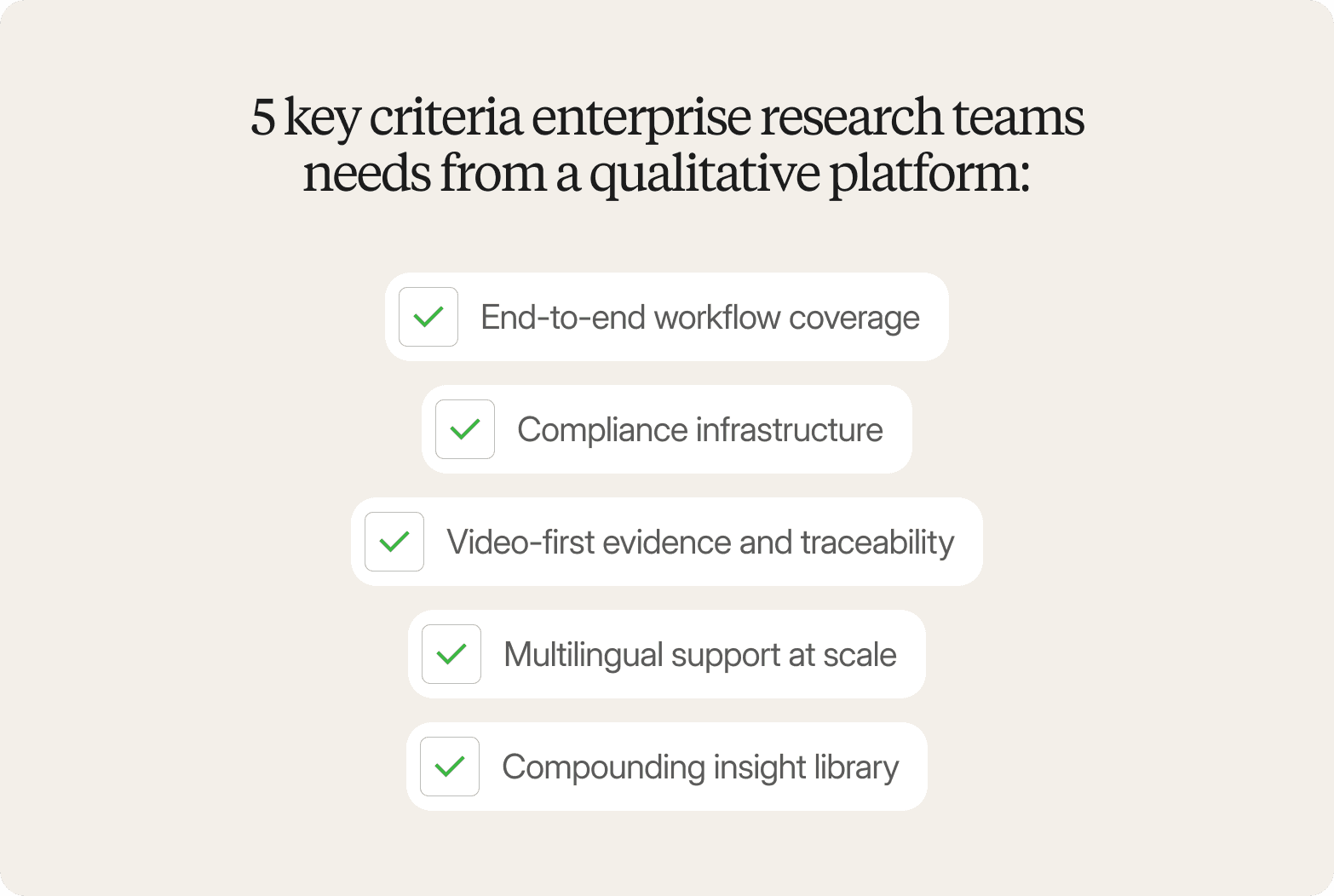
Five criteria separate a capable qualitative research platform from a point solution that forces teams to stitch together the rest of their workflow.
1. End-to-end workflow coverage
A platform that handles recruitment through reporting in a single environment eliminates the friction that builds across a multi-tool stack. Every handoff between systems is a compliance gap, a delay, and a point where data can lose its trail.
2. Compliance infrastructure
SOC 2 certification, GDPR compliance, EU data hosting, and SSO support are procurement requirements. Without confirmed credentials, enterprise IT and legal teams won't approve the vendor, and the research team's requirements never enter the conversation.
3. Video-first evidence and traceability
Findings that stakeholders can't trace back to a real conversation aren't findings they'll act on. A platform must link quotes, themes, and conclusions directly to the source video, not just transcripts, so any claim can survive scrutiny if stakeholders push back.
4. Multilingual support at scale
Research conducted in one language doesn't represent global customers. Vetted panels, automatic transcription, and AI moderation across 50+ markets should come built in. When localization is an add-on, some markets receive structured research, while others rely on workarounds.
5. Compounding insight library
A searchable, cross-study insight library means every study builds on the last. Teams that can query findings across multiple studies answer stakeholder questions without reopening a full research cycle.
H2: Discuss.io alternatives compared at a glance
Use the table below to review and compare Discuss competitors across five core enterprise criteria before diving into the full platform profiles.
| Platform | End-to-end workflow | Video-first evidence | Compliance | Multilingual support | Insight library | Best for |
|---|---|---|---|---|---|---|
| Conveo | Study design → recruitment → AI-moderated interviews → analysis → reporting | ✓ | • SOC 2 ✓ | ✓ 48 languages; 50+ markets; auto transcription and translation | ✓ | Research stack consolidation; AI-moderated research at enterprise scale |
| Discuss.io | Study design → recruitment → interview execution → analysis | ✓ | • SOC 2 ✗ | ✓ 80+ languages; accuracy varies across three tiers; English output only | ✓ | Enterprise qualitative programs without EU data residency requirements |
| Outset.ai | Study design → recruitment → interview execution → per-study analysis | ✓ | • SOC 2 ✓ | ✓ 40+ languages; auto-translation | ✗ Requires Dovetail integration | High-volume async AI interviews |
| Voxpopme | Recruitment → interview execution → analysis → reporting | ✓ | • SOC 2 ✓ | ✓ 27-markets; auto-translation for survey delivery | ✓ | Video feedback at scale |
| Dscout | Study design → recruitment → interview execution → per-study analysis | ✓ | • SOC 2 ✓ | ✓ 9 app languages; no auto-translation | ✗ | Mobile ethnography and in-the-moment research |
| UserTesting | Study design → recruitment → test execution → analysis → reporting | ✓ | • SOC 2 ✓ | ✓ 22 study languages; no auto-translation | ✓ AI querying requires Ultimate tier and doesn't cover moderated sessions | High-volume unmoderated usability testing |
The best Discuss.io alternatives: Full reviews
Explore the most common Discuss alternatives including pros and cons, who they’re right for, and how they stack up against five essential enterprise criteria.
1. Conveo: Best for end-to-end AI-moderated research at enterprise scale
Conveo is a video-first AI research platform that runs the full research workflow in one place, including study design, participant recruitment, AI-moderated video interviews, analysis, and stakeholder-ready reporting. Trusted by research teams at Google, Reddit, FOX, and Bosch.
What it does well
Workflow consolidation: The Conveo platform handles study design, recruitment, AI-moderated video interviews, multimodal analysis, and stakeholder-ready reporting as a connected sequence. Research that previously required separate tools for recruitment, moderation, transcription, and analysis runs without handoffs between platforms.
AI-moderated video interviewing: Conveo's AI interviewer conducts real voice and video interviews, adapting its questions based on what participants actually say. Participants share responses that are 3 to 4x longer than in static surveys. Every conversation is grounded in real people talking on camera, not synthetic simulations or text-based chat.
See Conveo’s AI Moderation in action:
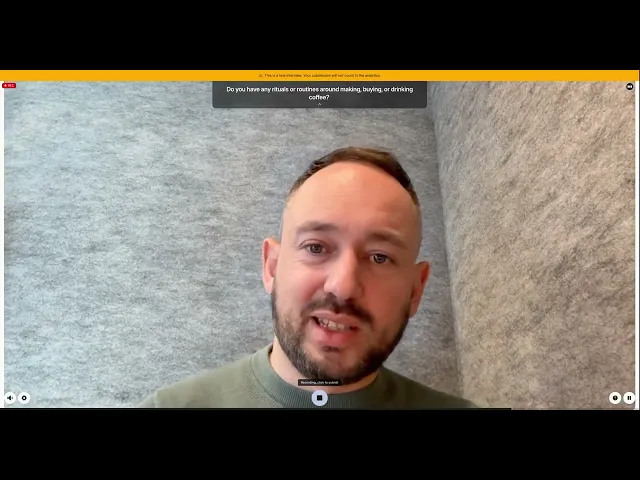
Video-first evidence and traceability: Every finding links directly to the source video clip. Stakeholders can watch the conversation behind a theme or quote, not just read a summary of it. For enterprise buyers whose leadership teams scrutinize research outputs before acting on them, that traceability is what separates defensible evidence from a slide deck.
Compliance infrastructure: Conveo is SOC 2-certified, GDPR-compliant, and offers EU regional data hosting with SSO support. For CMI teams navigating enterprise procurement, these are the credentials that keep a platform off the blocked list.
Multilingual support and global reach: Conveo supports 50+ markets with vetted global panels and automatic transcription and translation. Teams running multi-market research don't need separate vendors per region.
Compounding insight library: Every study feeds a searchable insight library. Teams can query research from six months ago in plain language alongside current data. Stakeholders across product, brand, CX, and product research functions draw on a growing body of customer understanding that no single-study tool can replicate.
"Conveo's video-first approach is a real differentiating methodological advantage. The ability to distill insights from reactions and not just hear answers adds context you simply can't get from transcript-only tools, or any other tool in the market for that matter."
Senior Marketing Research & Insights Manager, Google
Best for
Insights, CMI, UX, and product research teams at enterprise companies that need to replace a fragmented research stack and run qualitative research continuously, rather than project-by-project.
2. Discuss.io: Best for enterprise teams running live and AI-moderated studies
Discuss is a platform for running large-scale qualitative research programs across global markets, including live and async interviews, online focus groups, and concept testing.
What it does well
End-to-end workflow: Teams can move from audience sourcing through interview execution to analysis without leaving the platform, and can switch between AI-moderated and live-moderated sessions within the same study.
Video-first evidence: Transcripts sync with recorded video, and researchers can highlight any quote to generate a timestamped clip, making individual findings traceable to the source.
Compounding insight library: Discuss has a cross-study qualitative repository where teams can upload research from Discuss and other sources. You can use Genie, the platform's GenAI assistant, to run analysis across studies to uncover trends and detect themes.
Language coverage: Discuss transcribes in 80+ languages, but accuracy varies across three tiers.
Where it falls short
Compliance infrastructure: SOC 2 certification isn't publicly confirmed, and data is hosted in Virginia with no EU hosting option, so teams with EU data residency requirements won't clear the enterprise security review.
Best for
Enterprise market insights, CX, and UX teams running qualitative research across multiple audiences who don't have EU data residency requirements.
3. Outset.ai: Best for product and UX teams running high-volume async AI-moderated interviews
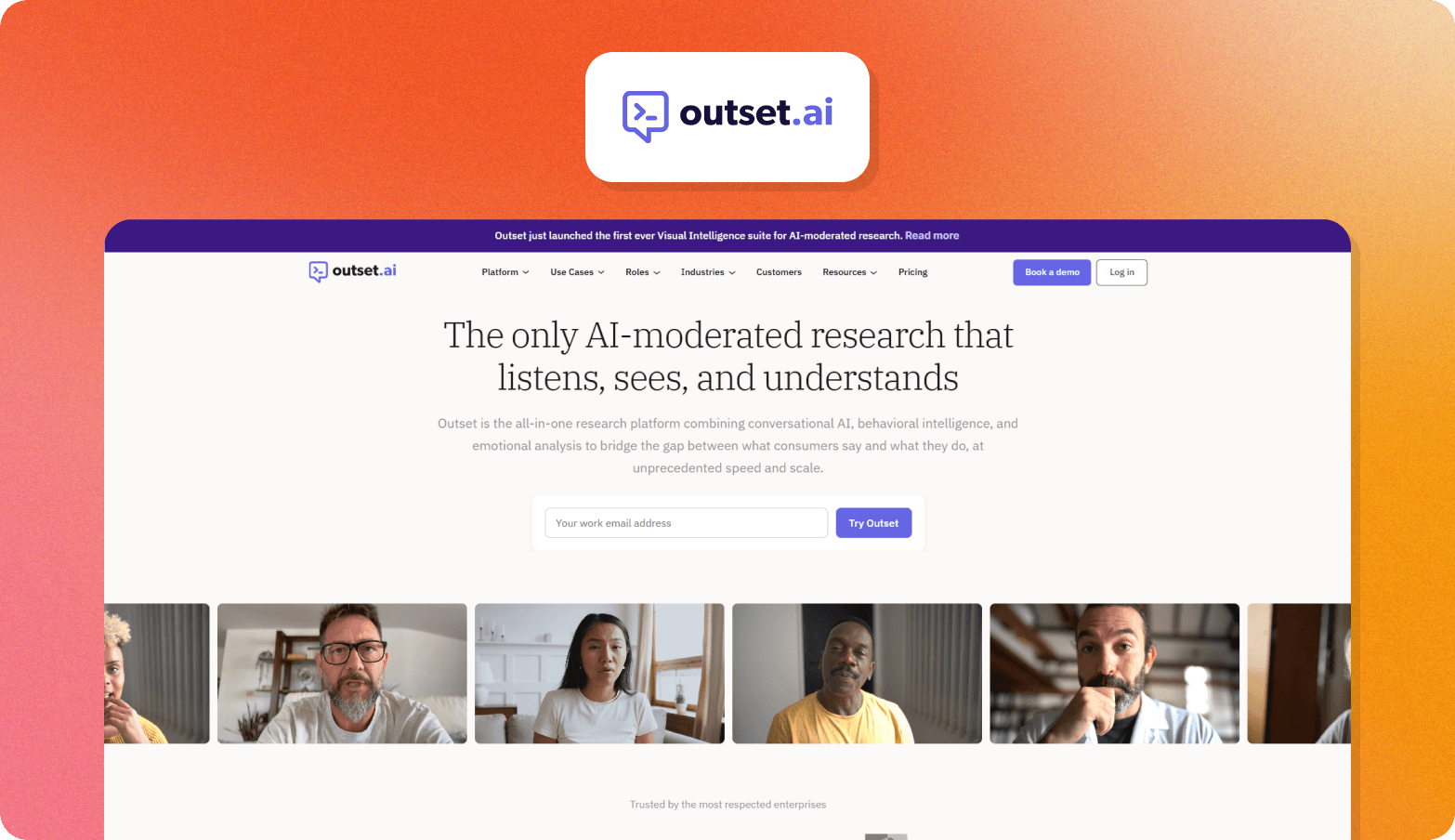
Outset runs AI-moderated interviews in video, voice, or text format, with an adaptive AI interviewer that probes dynamically based on participant responses.
What it does well
Video-first evidence: Outset automatically generates transcripts and themes after each session, and teams can trace findings back to participant quotes and video clips.
Multilingual support at scale: Outset supports 40+ languages with automatic translation.
Where it falls short
End-to-end workflow: Outset covers recruitment through analyzing sessions, but cross-study compounding requires a Dovetail integration, so teams not already using Dovetail need both tools.
Compliance infrastructure: SOC 2 Type II and GDPR are confirmed, but EU hosting isn't publicly confirmed, which creates issues for teams with EU data residency requirements.
Best for
Best for product and UX research teams running frequent qualitative studies whose main priority is speed-to-insight and not building a research repository.
4. Voxpopme: Best for video feedback at scale
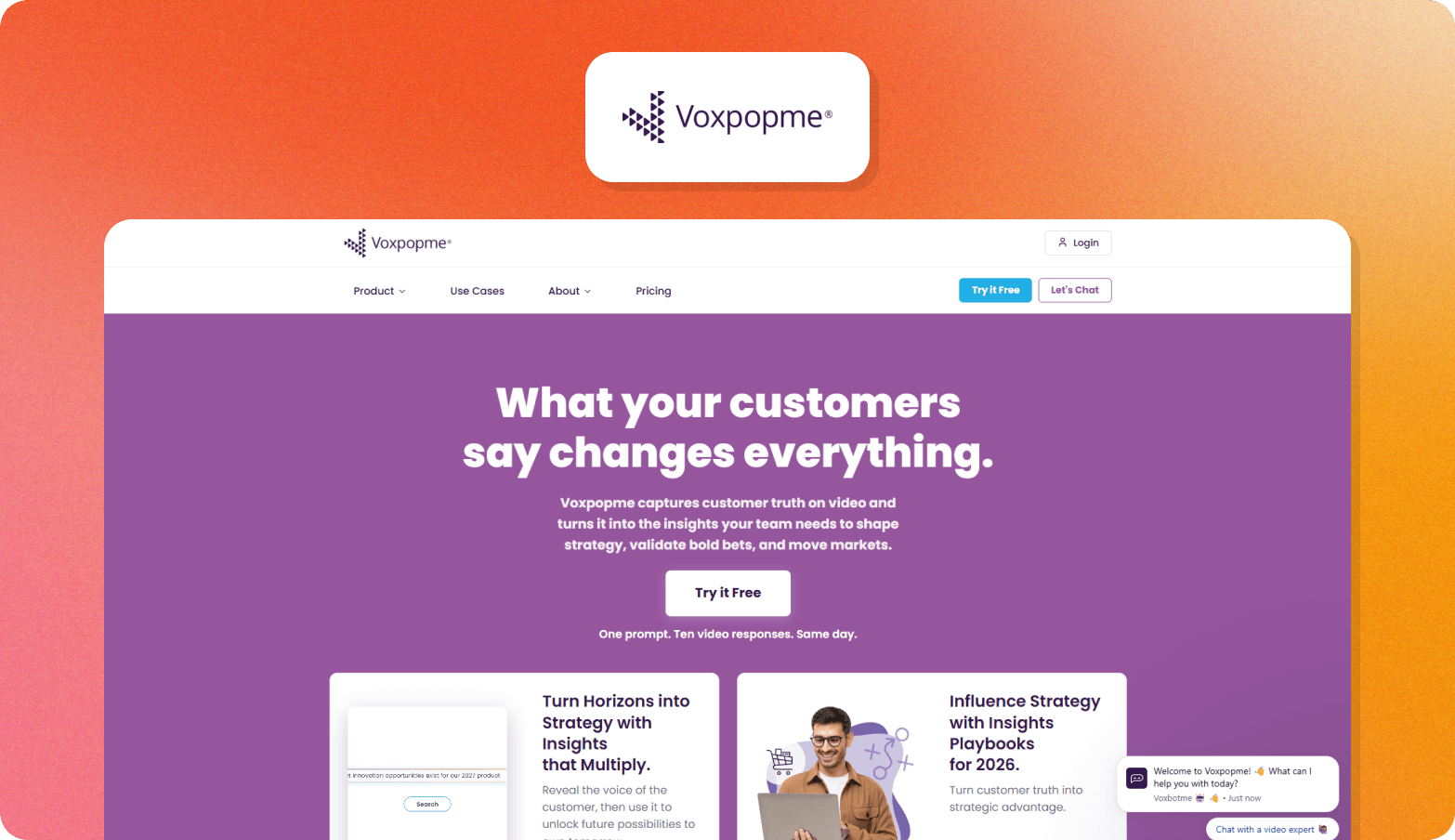
Voxpopme is a consumer research platform that combines participant-recorded video surveys, live interviews, and AI analysis.
What it does well
End-to-end workflow: Voxpopme covers the full research cycle from recruitment through stakeholder-ready output.
Video-first evidence: Theme Explorer links every identified theme directly to the video clips where participants mentioned it, playing the video at that exact moment when clicked.
Compounding insight library: The Data & Insights Repository centralizes videos, transcripts, tags, and themes across all projects. Teams can run natural-language queries and cross-project analyses to surface patterns that don't appear in individual studies.
Where it falls short
Compliance infrastructure: SOC 2 Type II and GDPR are confirmed, but EU data hosting isn't publicly documented, which may pose blockers for teams with EU data residency requirements.
Multilingual support at scale: Voxpopme's panel reaches 27 markets, which may fall short for some enterprise programs.
Best for
Consumer insights teams at large brands that run a variety of research methods and don't have strict EU data residency requirements.
5. Dscout: Best for mobile ethnography and in-the-moment research
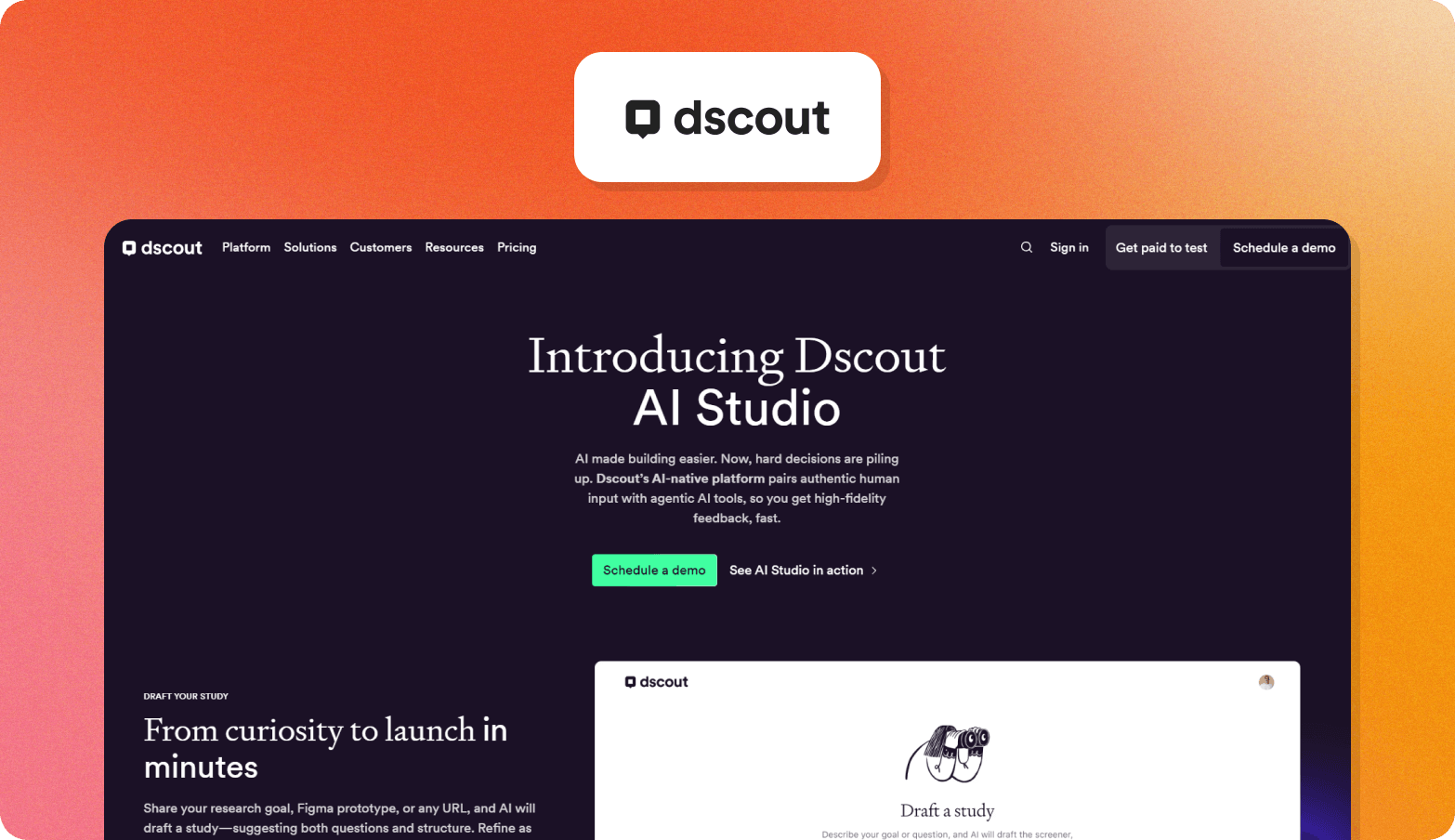
Dscout is a mobile-first platform where participants capture their own experiences in real time.
What it does well
Video-first evidence: Interview sessions are recorded to video with transcripts that sync to the timeline. Researchers can create clips from any moment, and AI-notable moments link directly to timestamps in the recording.
Where it falls short
End-to-end workflow: Dscout covers study design, recruitment, and execution through per-study analysis, but there's no cross-study repository, so findings don't build across projects.
Compliance infrastructure: SOC 2 Type II and GDPR are confirmed, but EU data hosting isn't publicly documented.
Multilingual support at scale: Partner Panels reach 28 countries, but there’s no automated translation. Researchers write study content in the target language themselves.
Best for
Consumer insights and UX teams for products where getting authentic participant reactions in the moment is more important than building on previous studies.
6. UserTesting: Best for UX and usability research
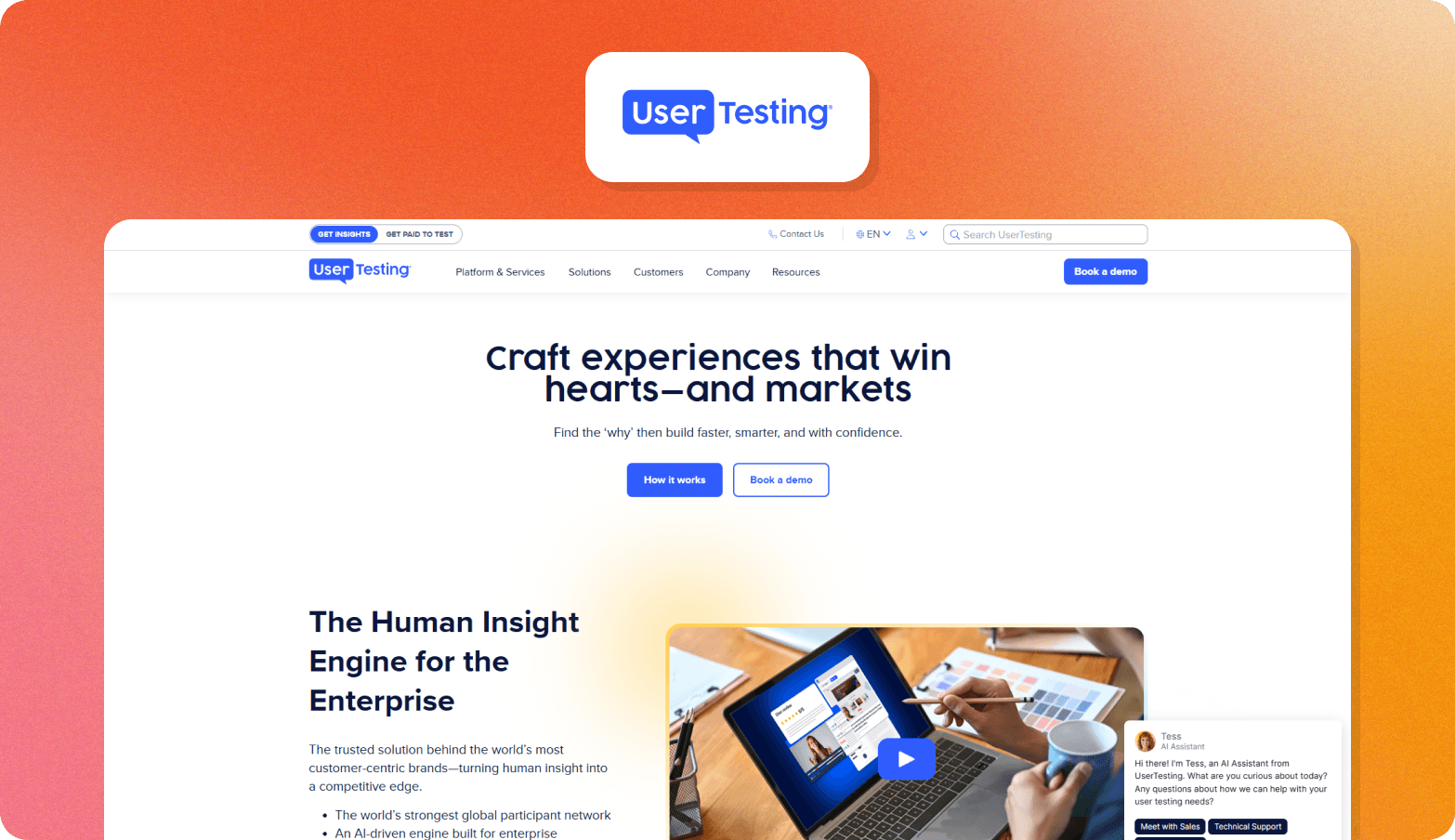
UserTesting is an enterprise human insights platform built primarily around unmoderated usability testing and think-aloud studies.
What it does well
End-to-end workflow: The platform supports study creation, participant recruitment, test execution, and reporting within a single system. IntelliZoom also handles local-language recruitment and delivery across more than 60 countries, so teams don’t need a separate recruitment tool.
Compliance: The platform is SOC 2 Type II certified, GDPR compliant, and offers EU data residency. Teams can choose EU, US, or APAC hosting during setup to meet enterprise data localization requirements.
Video-first evidence: Insights Reports stores findings in a shared hub with embedded video clips, allowing stakeholders to watch the original participant moment rather than relying solely on written summaries.
Compounding insight library: EnjoyHQ gives teams a searchable repository across studies using keyword and semantic search. However, AI querying is only available on the Ultimate tier, and the repository doesn’t include moderated sessions.
Where it falls short
Multilingual support at scale: UserTesting supports 22 study languages but doesn’t have automated translation. Teams running research across markets outside those 22 need supplementary tooling to localize studies and recruit in-language participants.
Best for
Product and UX teams running unmoderated usability tests where scale and reliable participant recruitment matter more than deep multilingual research.
How to choose the best Discuss alternative for your team
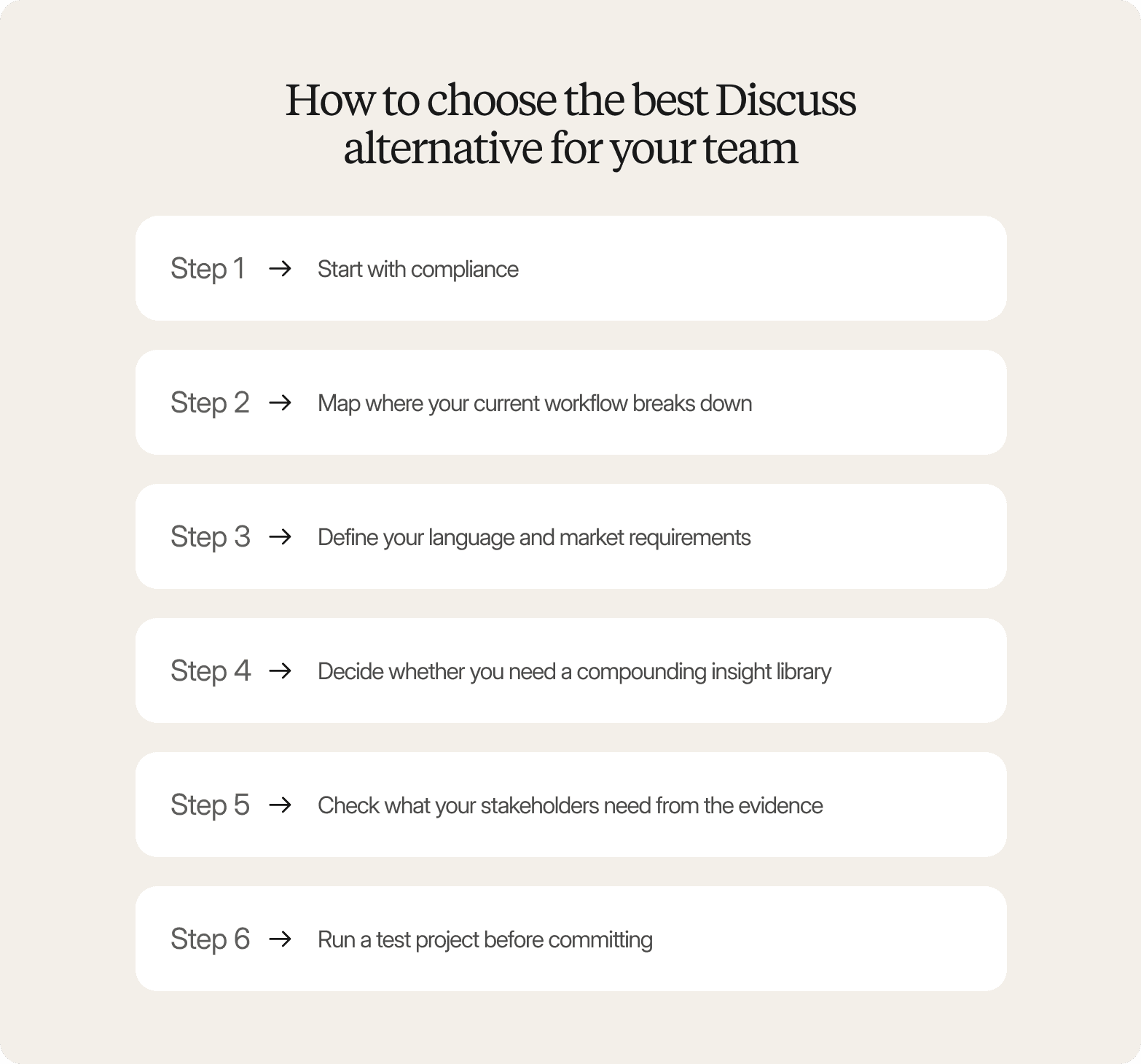
The five criteria in this guide cover what enterprise research programs need. How you weight them depends on where your current stack falls short. These steps help you apply them to your specific situation.
Step 1: Start with compliance
Before evaluating any platform in detail, confirm your non-negotiables with IT and legal. Ask procurement which credentials they require: SOC 2 Type II, GDPR documentation, EU data hosting, and SSO support are standard requirements in any enterprise security review. Any platform that can't confirm all four is off the list before the evaluation begins, which saves weeks of back-and-forth later.
Step 2: Map where your current workflow breaks down
Start by writing down every tool your team currently uses to complete a single research project: recruitment, moderation, transcription, analysis, and reporting. Identify the handoffs where data loses context or decisions stall. The goal is a single platform that covers the full sequence, not a variety of point solutions stitched together.
Step 3: Define your language and market requirements
List the markets your program needs to cover now and in the next 12 months. Check whether each platform supports those markets with vetted local panels and automatic translation, or whether you'd need to consult a separate vendor per region.
Teams running multi-market programs need to account for translation accuracy, not just language count, otherwise you risk creating more manual work per study.
Step 4: Decide whether you need a compounding insight library
If your team conducts continuous research and stakeholders regularly ask questions that existing studies could answer, a cross-study insight library is non-negotiable. If your program runs project-by-project, per-study analysis may be enough. Understanding the difference now avoids paying for capability you won't use, or missing the one that matters most.
Step 5: Check what your stakeholders need from the evidence
Speak to the people who act on your research findings before you choose a platform. Some decision-makers are comfortable with a written summary. Others want to watch the conversation themselves before they act on a finding. If your stakeholders scrutinize sources, video-first traceability is a hard requirement, not a nice-to-have.
Step 6: Run a test project before committing
Request a trial and film a real study on a topic your team is actively researching, not a demo scenario. Review how findings link back to source conversations and whether the reporting format is one your stakeholders will engage with. One real project tells you more than any number of sales calls.
Conveo for qualitative research at enterprise scale
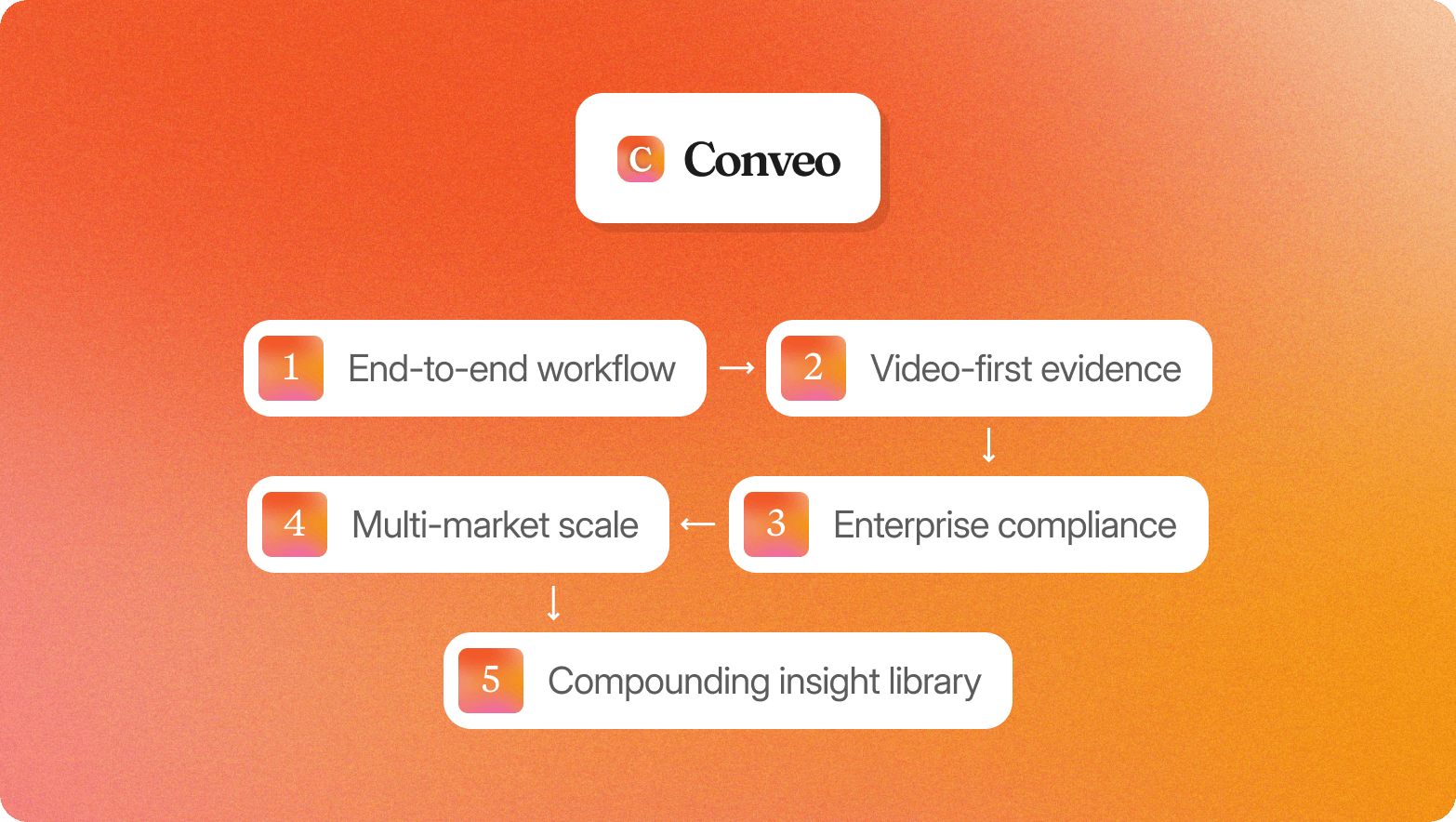
Research teams that have outgrown Discuss or need AI-moderated research at scale tend to run into the same problem: they need to stitch together five platforms to complete a single study. The end result is more manual work and a research cycle that takes too long to complete.
Conveo solves those problems by addressing each of the five criteria this article opened with:
End-to-end workflow: Run a complete study from recruitment through reporting on one platform, eliminating handoffs where data loses context and decisions stall.
Video-first evidence: Trace every finding back to its source conversation so any claim can be verified down to the smallest detail if stakeholders push back.
Enterprise compliance: Meet security review requirements with SOC 2 certification, GDPR compliance, and EU data hosting, all confirmed.
Multi-market scale: Run research across 50+ markets using vetted panels to ensure clear communication across your entire participant base.
Compounding insight library: Query findings across every study the team has run, so each new project builds on an existing body of customer understanding and enhances future studies.
Teams running continuous research also report up to 80% lower research spend compared to agency-delivered qualitative programs.
Conveo is built for insights, CMI, UX, and product teams at enterprise and mid-market companies running qualitative research continuously.
Frequently Asked Questions
What are the main reasons research teams look for a Discuss alternative?
Teams look for a Discuss alternative when live moderation no longer scales, when compliance reviews surface credential gaps, or when they need a research library that builds across projects. Live-moderated sessions require a researcher for every conversation, which makes continuous programs expensive, and Discuss hasn't publicly confirmed SOC 2 certification and doesn’t have EU data hosting, which creates issues in security review. Discuss also treats each project as a standalone study, so findings don't accumulate across a research program.
What’s the difference between AI-moderated and live-moderated qualitative research?
Live moderation suits complex B2B studies where a researcher needs to make real-time judgment calls: probing unexpected answers, redirecting a conversation, or handling sensitive topics with senior decision-makers. AI-moderated research fits programs where volume, speed, or multi-market coverage makes live sessions cost-prohibitive. The right choice depends on the methodology, the respondent group, and what stakeholders need to see in the findings.
How do I evaluate a qualitative research platform for enterprise compliance?
During a security review, request SOC 2 certification documentation, including the audit date, GDPR compliance confirmation, data residency options, including EU hosting, SSO support, and audit log access. Platforms that can't produce confirmed credentials at this stage won't pass enterprise IT and legal review, which means the research team's requirements never enter the conversation.
Can AI-moderated research replace agency-delivered qualitative studies?
AI-moderated research doesn't replace every use case for agencies. Complex B2B work with senior respondents, highly sensitive topics, or multi-method ethnographic projects still benefits from human oversight. For continuous consumer research, concept testing, brand studies, and multi-market programs, AI-moderated platforms deliver comparable depth faster and at lower cost than a full agency engagement.
Which qualitative research platform is best for multi-market or multilingual research?
Look for native support across 50+ markets, vetted panels drawn from local research communities, automatic transcription and translation, and AI moderation tested in non-English contexts. Platforms that handle each market through a separate vendor add compliance overhead and coordination work to every study, slowing research by weeks.
What should I look for in a qualitative research platform's insight library?
A useful insight library is searchable across studies, not just within a single project, so teams can surface relevant findings without reopening individual reports. Quotes and themes should link back to the source video or transcript so that any findings can be verified by the reviewer. Account access controls should allow stakeholders outside the research team to consult and use findings without requiring a researcher to pull a report on their behalf.

About the author
Florian Hendrickx
Head of Growth
Florian is Conveo’s Chief Growth Officer, leading growth strategy and go-to-market execution as the company scales. He’s held growth leadership roles at companies like Deliverect, Robovision, and Aikido Security, and brings hands-on experience across marketing, sales, and product.
More by Florian →Qualitative insights at the speed of your business.
Conveo runs AI-moderated video interviews and structures everything they say.