In this article
TL;DR
UserTesting alternatives range from usability testing tools to end-to-end qualitative research platforms, so the best choice depends on how your team runs research.
UserTesting works well for occasional qualitative research, but every interview still needs a human moderator, making continuous, high-volume research harder to scale.
This guide breaks 15 alternatives down by what they’re built for, their main strength, and their biggest limitation to help you build a shortlist.
Conveo replaces the human moderator with AI, running interviews in parallel and linking every finding back to the original video and quote.
UserTesting works well for occasional qualitative research, but every interview still needs a person to run it. That's not a problem for a handful of interviews. It becomes more difficult when a team wants to run research continuously or at a scale where interviewer availability slows things down.
This guide compares 15 UserTesting alternatives, explaining what each platform is built for, where it works best, and its main trade-offs. By the end, you’ll have a shortlist of alternatives to UserTesting that best fit the way your team runs research.
Why Teams Look For UserTesting Alternatives
UserTesting works well for occasional moderated studies. Teams usually start looking at alternatives when they want to run qualitative research continuously or at a larger scale. Here’s why:
Live Conversations, UserTesting's moderated research product, still needs a human moderator for every session. UserTesting says teams can typically book sessions within a day and complete a set of interviews with a general audience in 1 to 3 days. As research volume grows, every additional interview still needs moderator time, so the number of interviews a team can run depends on how many moderators are available.
Running research in several markets creates another challenge. Interviews can take place in any language the moderator and participant share, but UserTesting couldn't confirm automatic translation of moderated interview transcripts. Teams either need moderators who speak each language or must manually translate transcripts.
Teams running continuous research also need to search across prior studies. UserTesting's Insights Discovery is designed for unmoderated tests and surveys, and UserTesting couldn't confirm whether it also searches moderated Live Conversations transcripts.
Whether these limitations matter depends on how you run research. The next section looks at the criteria that make the biggest difference when comparing UserTesting with other platforms.
7 Evaluation Criteria For Comparing UserTesting Alternatives
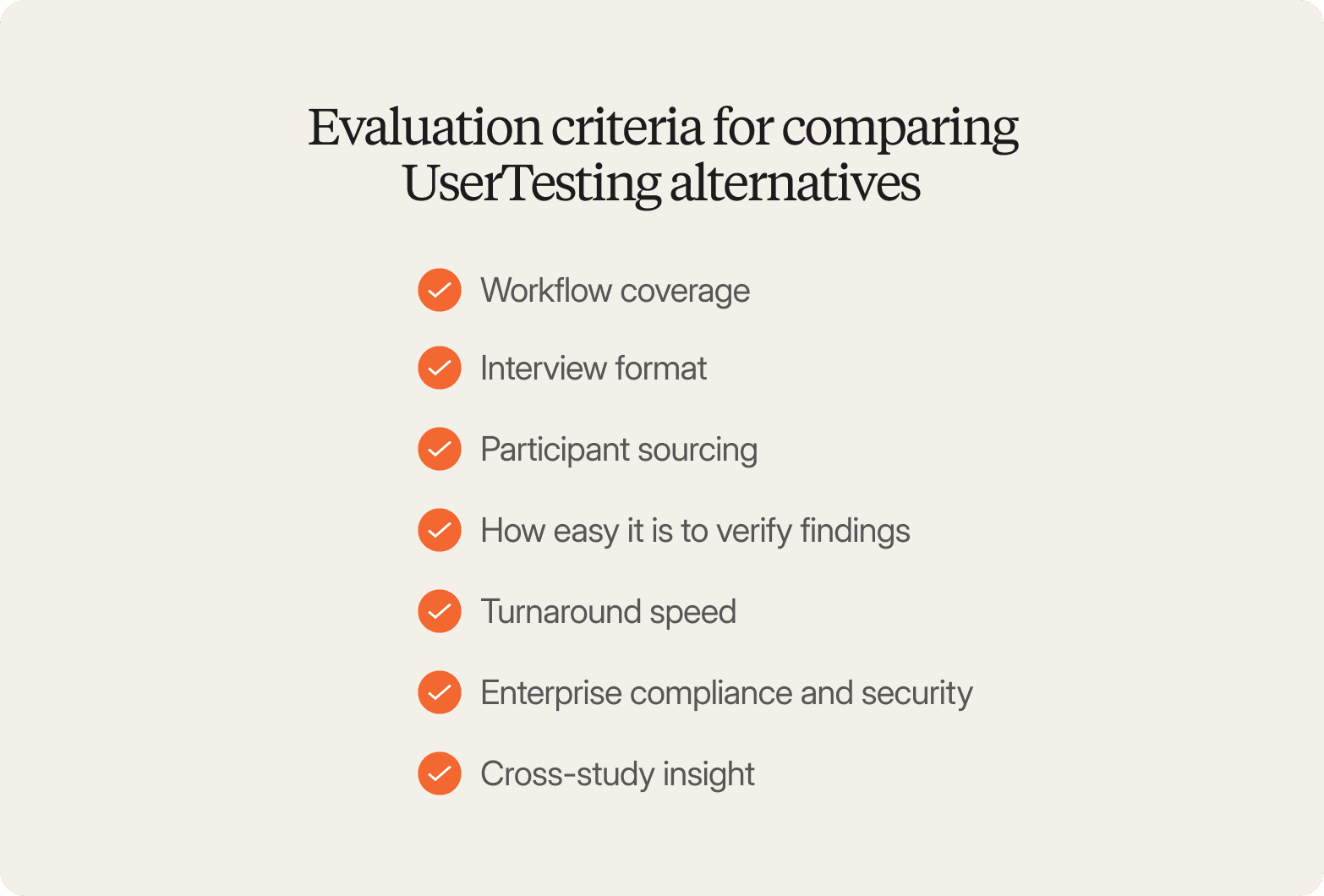
Different user testing platforms solve different parts of the research process. These criteria help you compare UserTesting competitors based on how your team works, not just which features they offer.
1. Workflow coverage
Start by deciding how much of the research process you want one platform to handle. Some UserTesting.com competitors focus on a single step, while others cover everything from recruiting participants to delivering a report. Using specialist tools can work well, but it also requires moving information between systems and managing multiple vendors.
2. Interview format
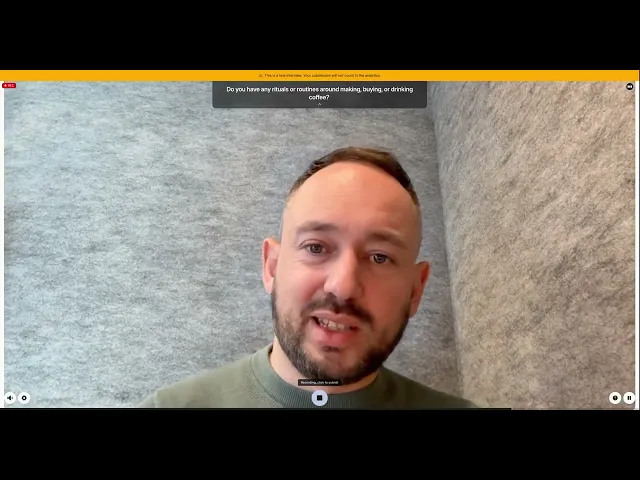
Moderator-led interviews require a moderator to be present for every session, so the number of interviews you can run depends on moderator availability. UserTesting.com alternatives with AI-moderation run interviews in parallel, making it easier to run larger studies or keep research going without scheduling every conversation.
See it in action: How AI-Moderated Interviews Actually Work
3. Participant sourcing
Think about who you need to speak to. Some platforms only provide access to research panels, while others also let you recruit your own customers. If your research depends on existing users or a specialist audience, check how easily the platform supports that.
4. How easy it is to verify findings
Research is more likely to influence decisions when people can see where each finding came from. The best UserTesting alternatives link insights back to the original interview, so anyone can review the supporting evidence instead of relying on a summary alone.
5. Turnaround speed
Consider how long it takes to move from a research question to results. Moderator-led interviews are often quick for small studies but take longer as the number of participants grows. AI-moderated interviews can run at the same time, helping larger generative research projects finish sooner.
"Within days we had insights that would've taken a traditional agency a month."
Head of Customer Insights, JDE Peet's
6. Enterprise compliance and security
If you're buying for an enterprise, check security requirements before comparing features. Requirements such as SOC 2 certification, GDPR compliance, regional data hosting, SSO, and data retention policies can rule out a platform early in the buying process.
7. Cross-study insight
Research is more useful when teams can find and reuse previous work. A searchable insight library makes it easier to build on earlier studies rather than repeat the same research each time a new question arises.
The right alternatives to UserTesting.com depend on how your team works. A team running a few usability studies each year will have different priorities from one running continuous qualitative research across multiple products or markets.
15 UserTesting Alternatives Compared
With those seven criteria in mind, here's how the 15 platforms compare. Each one covers different qualitative research methods and UX research needs, from moderated and unmoderated usability testing to AI-moderated interviews, so match the profile below to what your team is missing.
1. Conveo
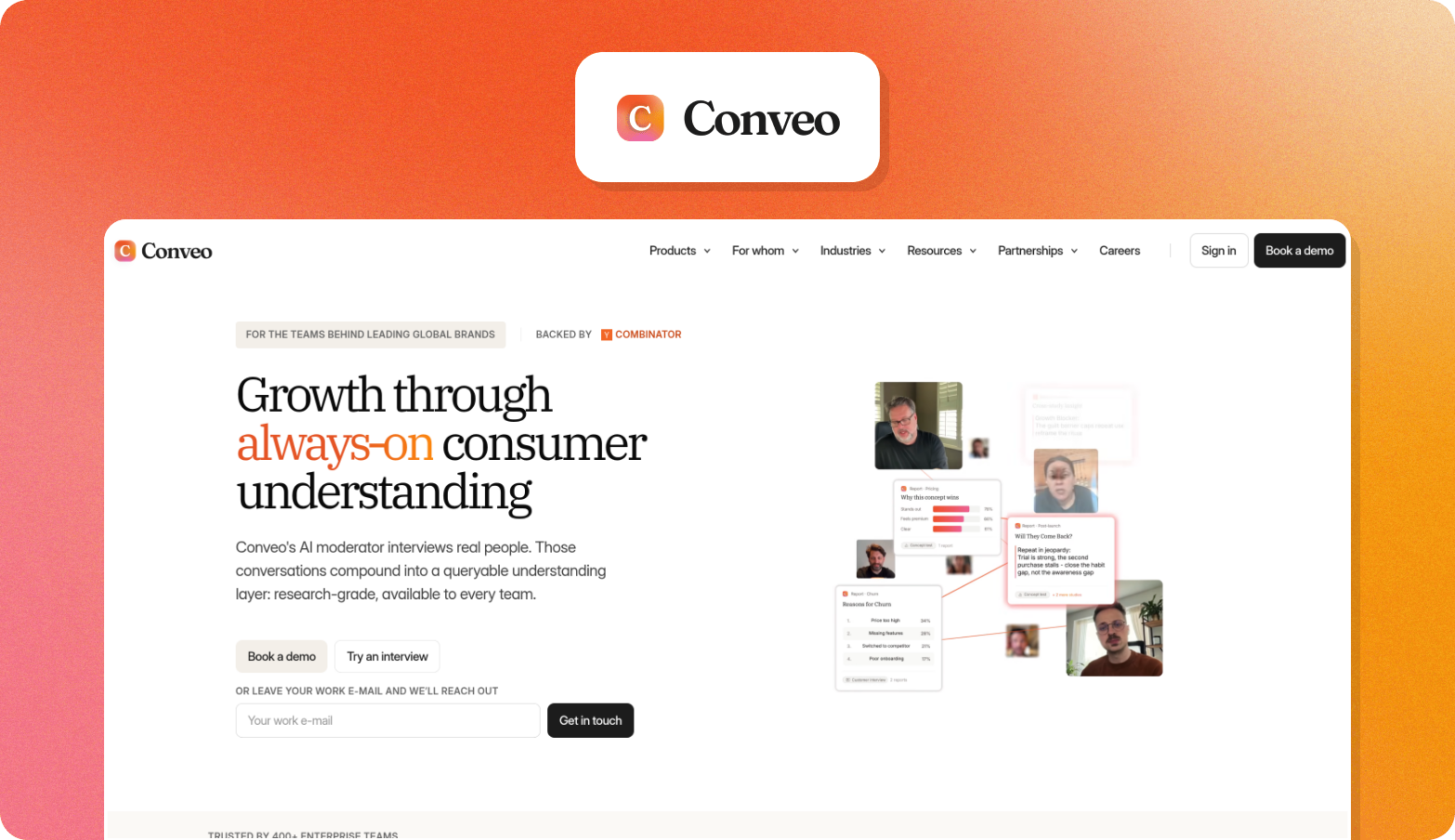
Conveo is a video-first AI research platform built for end-to-end qualitative research at enterprise scale. Unlike UserTesting's Live Conversations, which needs a human moderator for every interview, Conveo uses an AI moderator that runs interviews automatically.
Teams create a discussion guide, choose how to recruit participants, and the AI conducts each interview, asking follow-up questions based on the participant's answers. Once the study is complete, Conveo produces summaries, themes, video clips, and reports within days.
The main difference from UserTesting and most other alternatives is that the interviews themselves are automated, not just the analysis afterward. That makes it well suited to teams that need to run qualitative research regularly rather than as a one-off project.
Best for: Insights, product, and brand teams that need high-quality qualitative research quickly and want findings they can share with stakeholders.
Core strengths:
Runs AI-moderated video interviews in parallel, so teams aren't limited by moderator availability.
Follows up on what each participant says instead of sticking to a fixed script.
Links every finding to the original video clip and quote, making it easy to check the evidence.
Stores research in a searchable library, making previous studies easy to find and reuse.
Key limitation: Conveo shines when you are running qualitative research continuously. If you only carry out occasional studies, a more basic user research platform may be a better fit.
Compliance: Conveo is SOC 2 certified and GDPR compliant, with regional data hosting available as standard.
Pricing: Custom pricing, available on request.
2. Maze
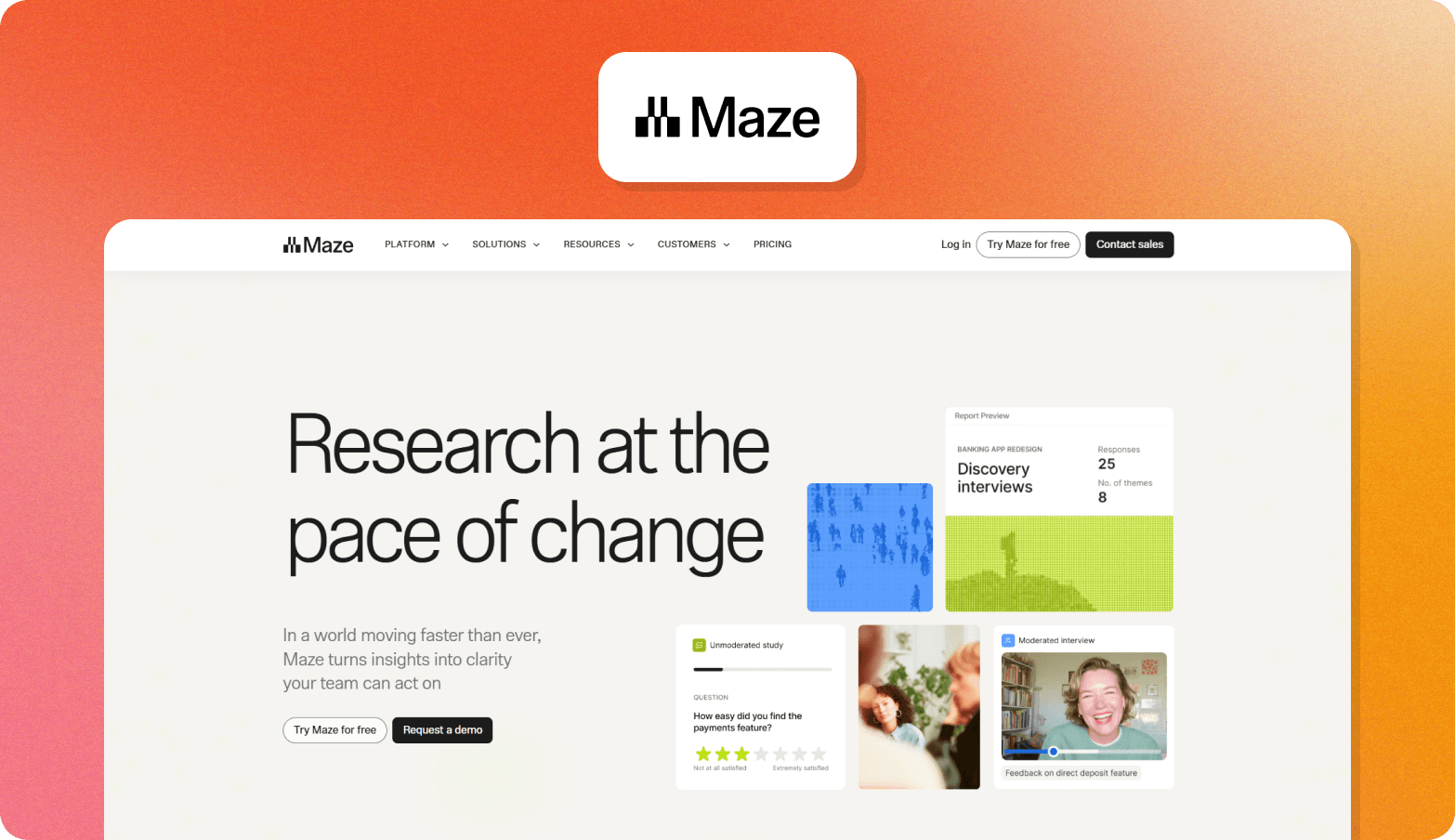
Like UserTesting, Maze also runs task-based usability tests, but it's built around prototype validation in major design tools like Figma and Adobe XD.
Best for: Product and UX teams that need quantitative usability data, such as task success rates, time on task, and misclick analysis.
Core strength: Its prototype testing capabilities cover both desktop and mobile app testing, and user engagement metrics arrive in real time.
Key limitation: AI-moderated interviews are available, but they're gated behind an Enterprise add-on rather than included in standard plans.
Pricing: There’s a free tier available for individuals and enterprise pricing is on request.
3. Dscout
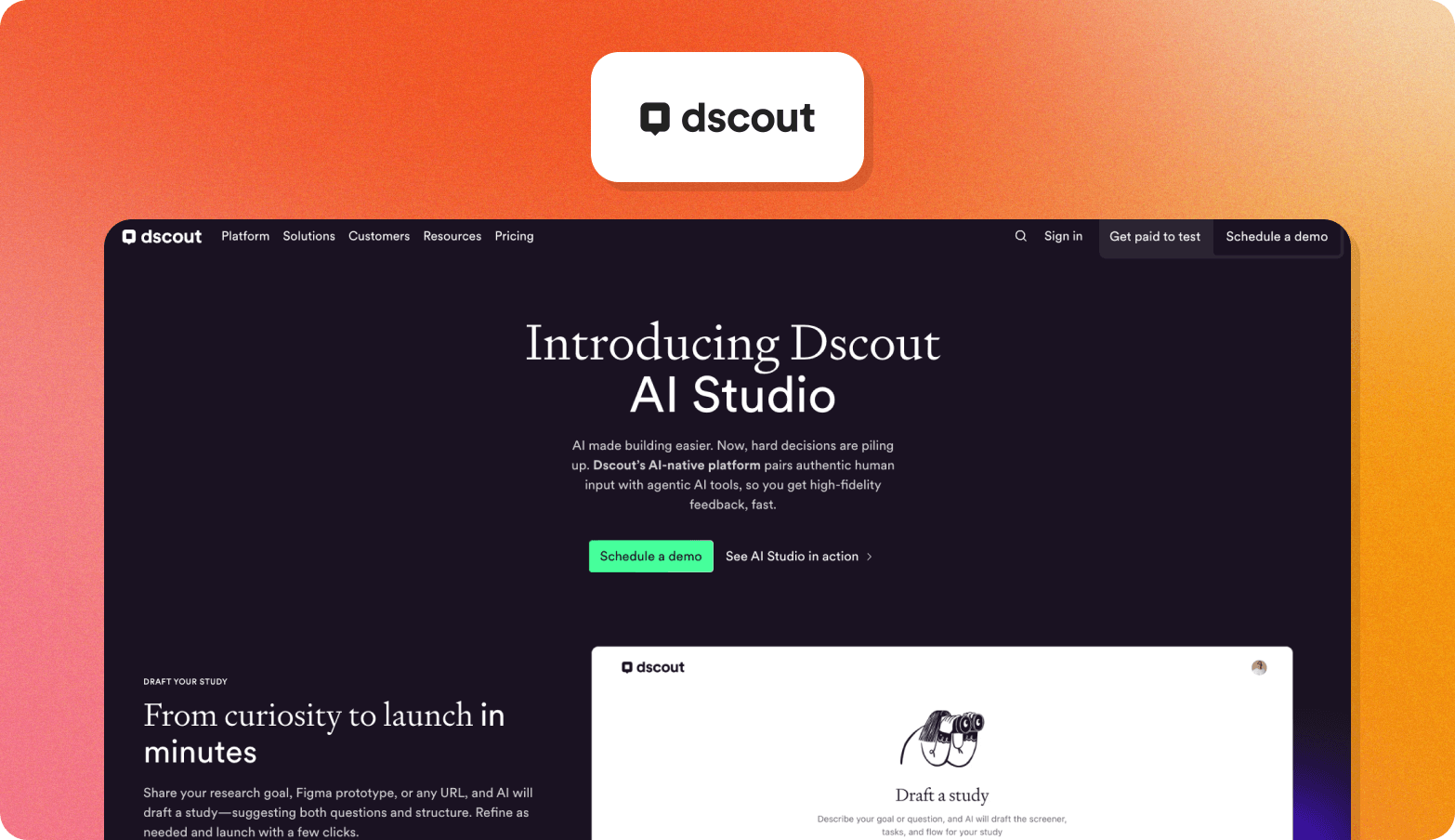
Dscout covers more research methods than UserTesting, with diary studies, field intercepts, live interviews, and usability testing, run as remote tests.
Best for: Enterprise UX and product teams that need to capture user behavior on a participant's real device and environment.
Core strength: Dscout has a strong compliance stack that makes it a fit for regulated or compliance-heavy enterprise programs.
Key limitation: AI moderation is still waitlist-only, not generally available, so interviews still depend on a human moderator.
Pricing: There are three tiers available, all priced on request.
4. Lookback
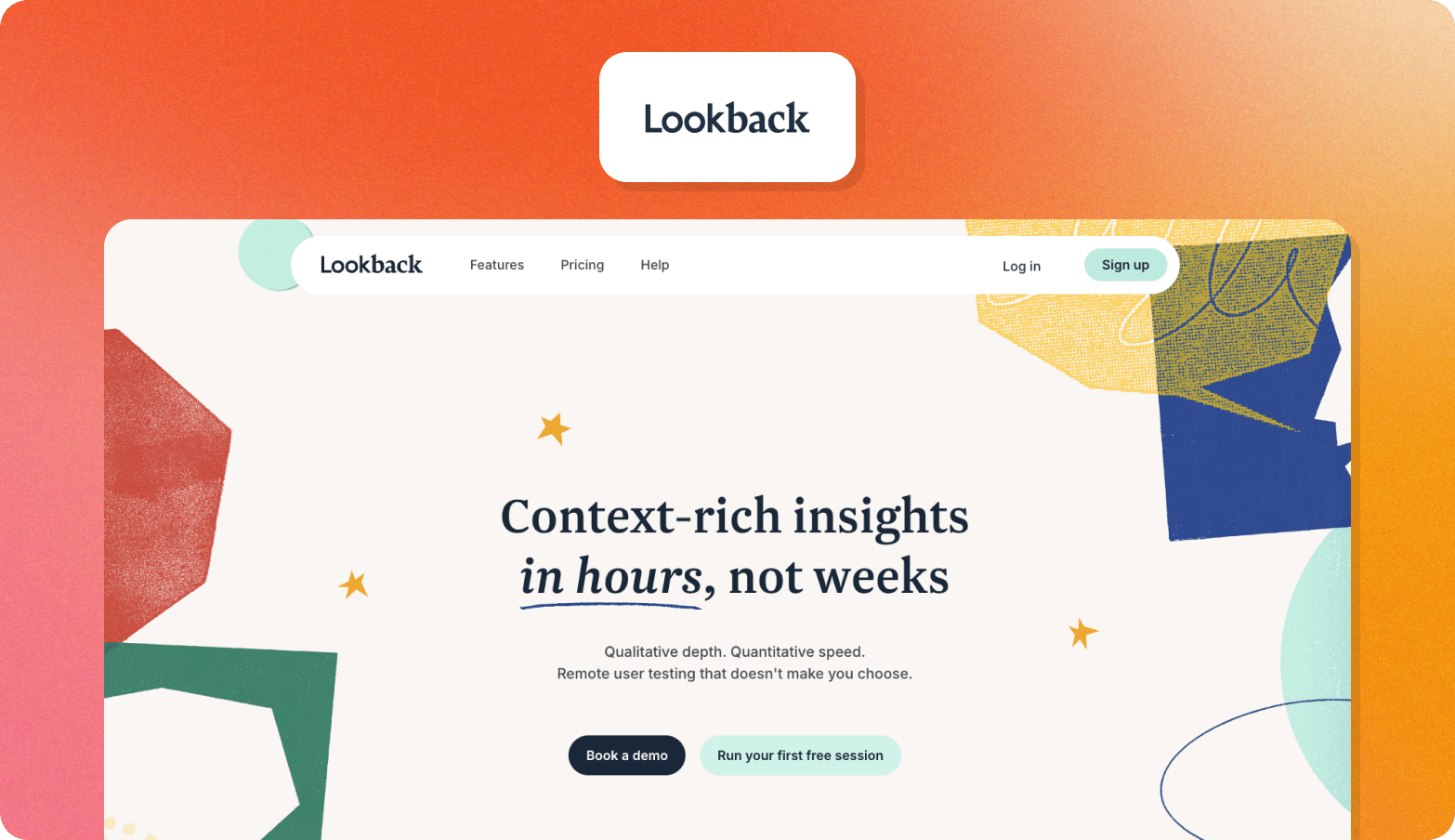
Lookback covers the same moderated and unmoderated remote usability testing as UserTesting, but on a smaller scale, across desktop and mobile devices.
Best for: Product and UX teams running regular usability testing on their own participants across apps and websites who need flexible session formats.
Core strength: Lookback's live interview mode supports real-time collaboration, so stakeholders can watch user session replays and take notes without disrupting the participant.
Key limitation: Lookback requires manual moderation and scheduling, so the testing process is capped by moderator availability.
Pricing: Paid plans start at $299 per year for individuals with enterprise pricing on request.
5. Strella
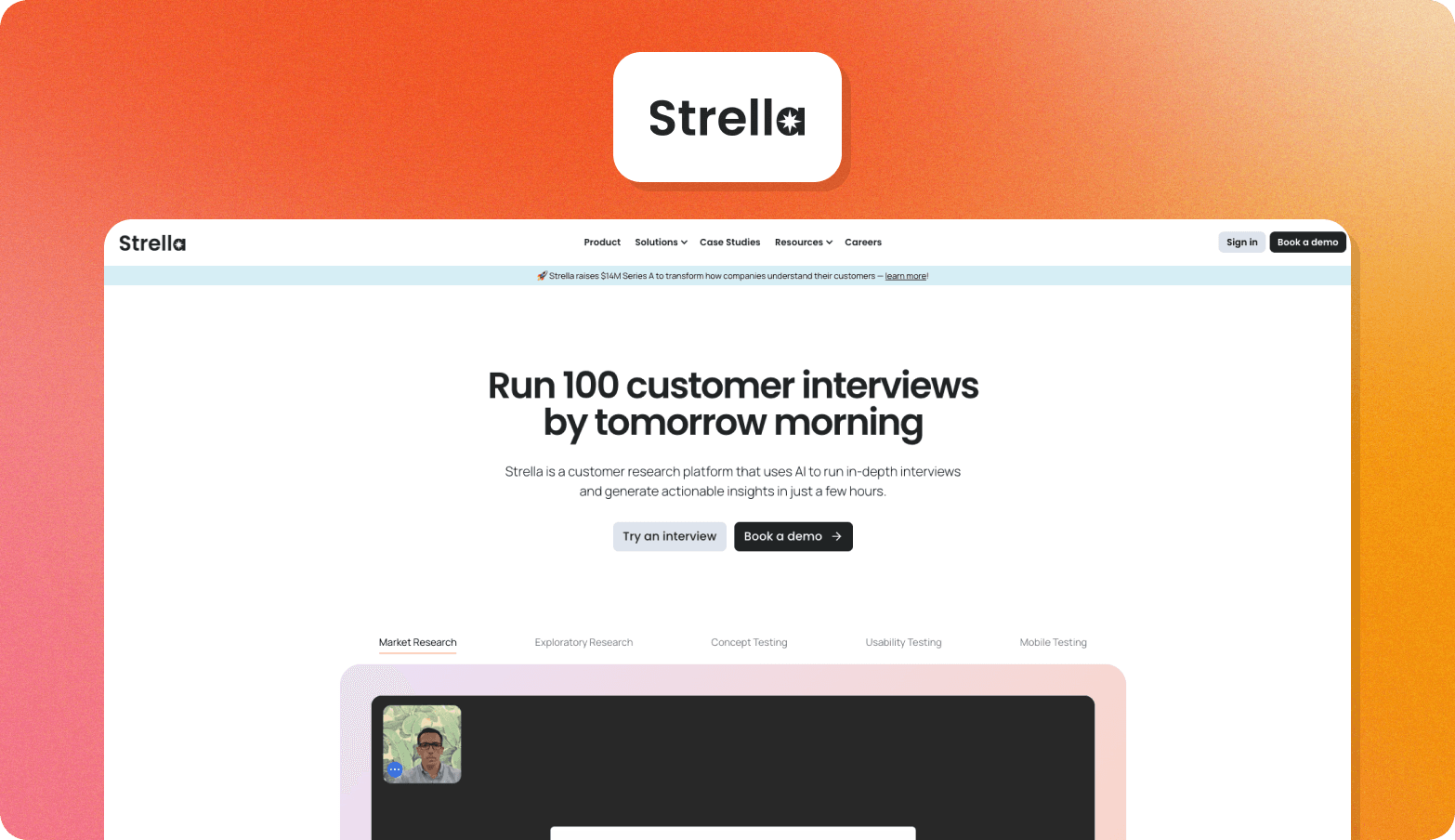
Strella covers the same moderated interview ground as UserTesting's Live Conversations, but teams can choose an AI moderator or a human moderator per session instead of committing to one.
Best for: Marketing and product teams that want to use AI moderation for straightforward studies and a human moderator for anything sensitive.
Core strength: Explorer, a chat interface, surfaces evidence across past studies in response to plain-language questions.
Key limitation: All data is processed in the US, which can be a blocker for European buyers that UserTesting doesn't have.
Pricing: Not publicly available.
6. Respondent
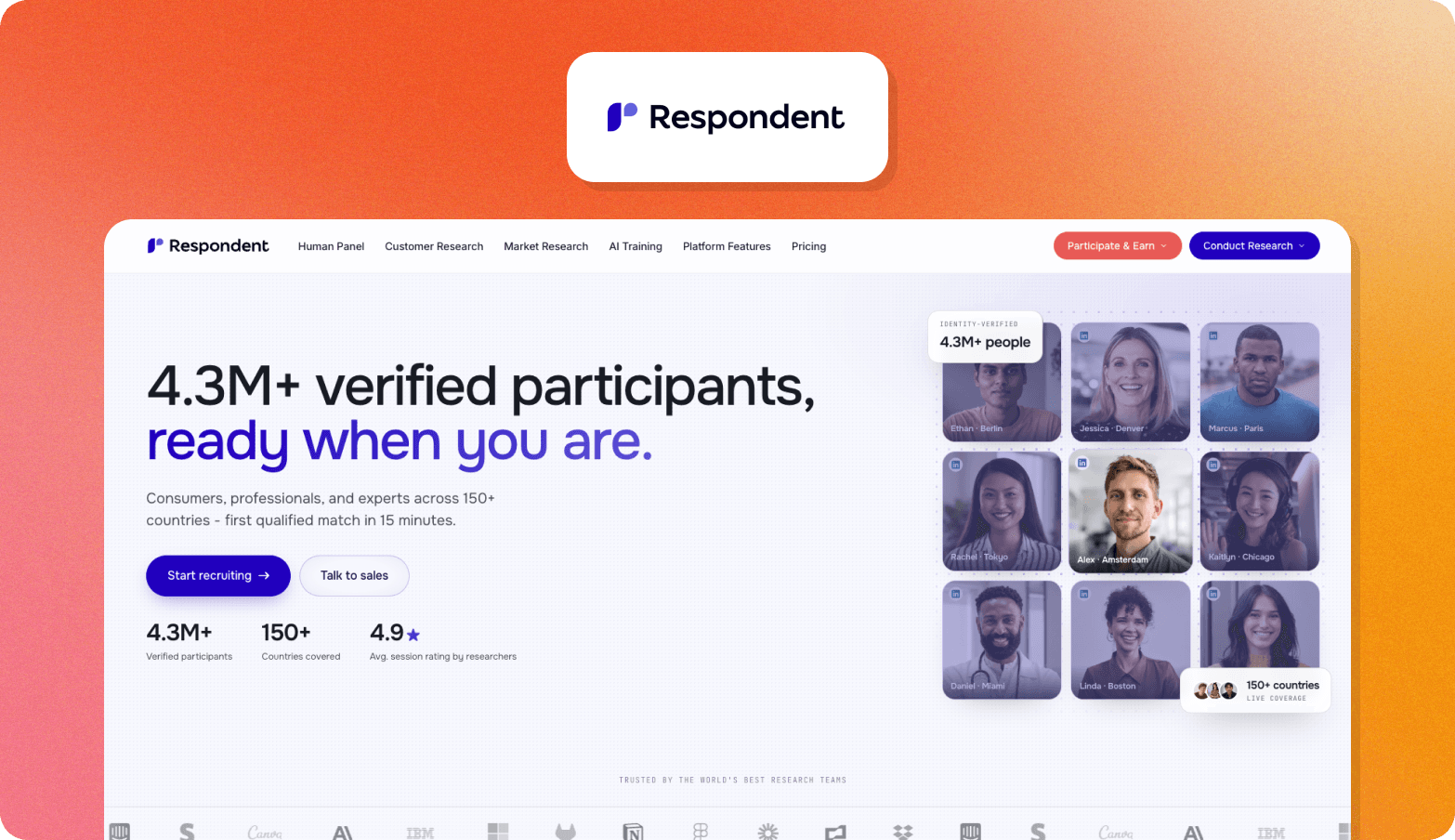
Respondent isn’t a user research tool, but it's designed to recruit verified B2B professionals and other specialist participants that UserTesting's general consumer panel isn't built to reach. Teams then run the research on UserTesting or another platform.
Best for: Teams whose UserTesting studies keep struggling to reach a specific professional audience, not teams looking to replace UserTesting entirely.
Core strength: It’s faster to source B2B participants than a general-purpose panel would allow.
Key limitation: Interviewing and analysis still happen on separate tools.
Pricing: Pay-as-you-go starts at $40 per session.
7. Userlytics
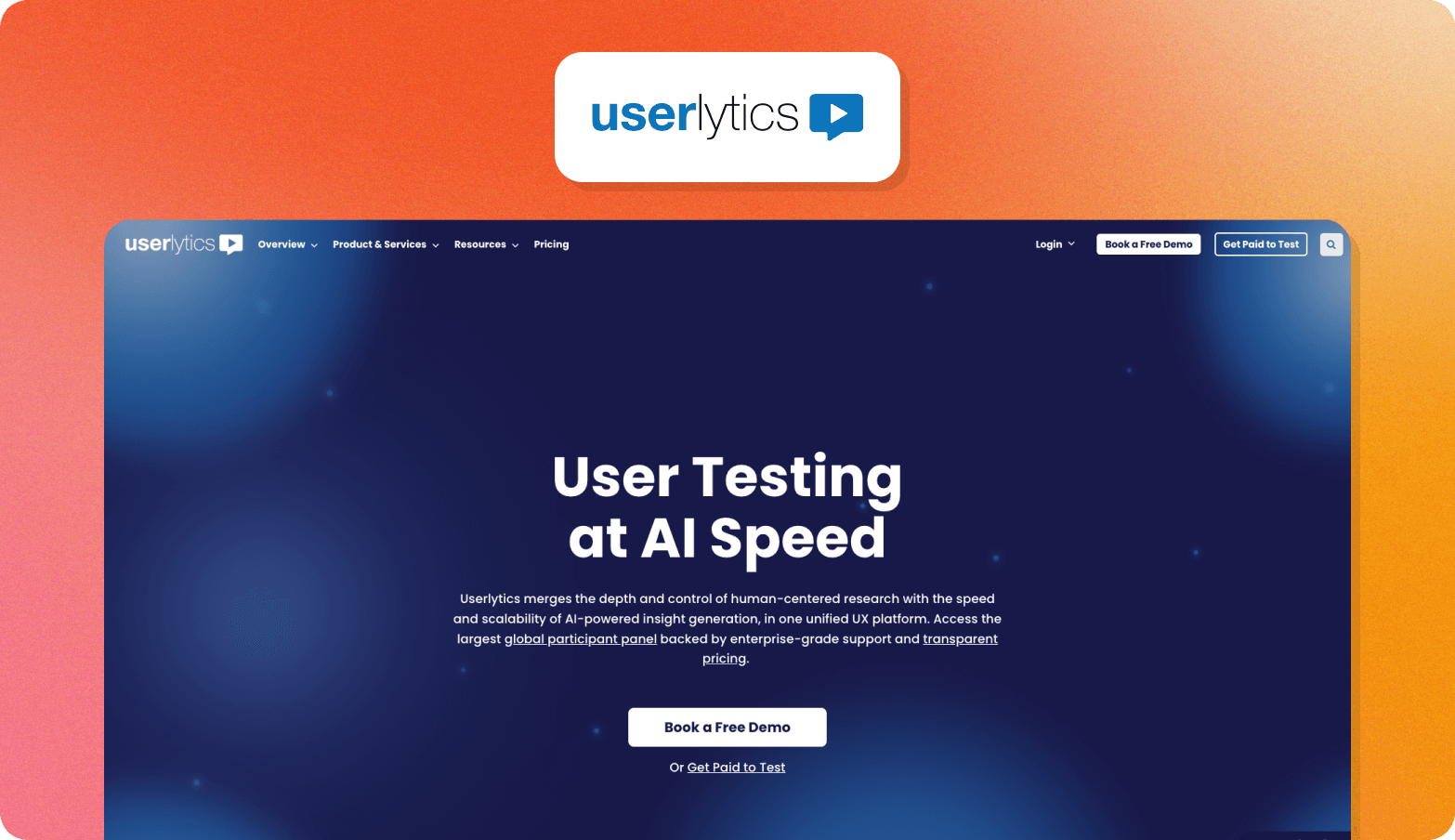
Like UserTesting, Userlytics runs moderated testing and unmoderated usability tests, but it also covers card sorting and tree testing in the same platform
Best for: Teams that need a usability testing platform with video feedback from test participants and IA methods built in.
Core strength: Userlytics offers a comprehensive AI analysis suite, so teams aren't left to analyze findings manually.
Key limitation: Like UserTesting, Userlytics still needs a human moderator for every moderated session. AI moderation is listed as coming soon, not live.
Pricing: Enterprise plans start from $30 a session.
8. PlaybookUX
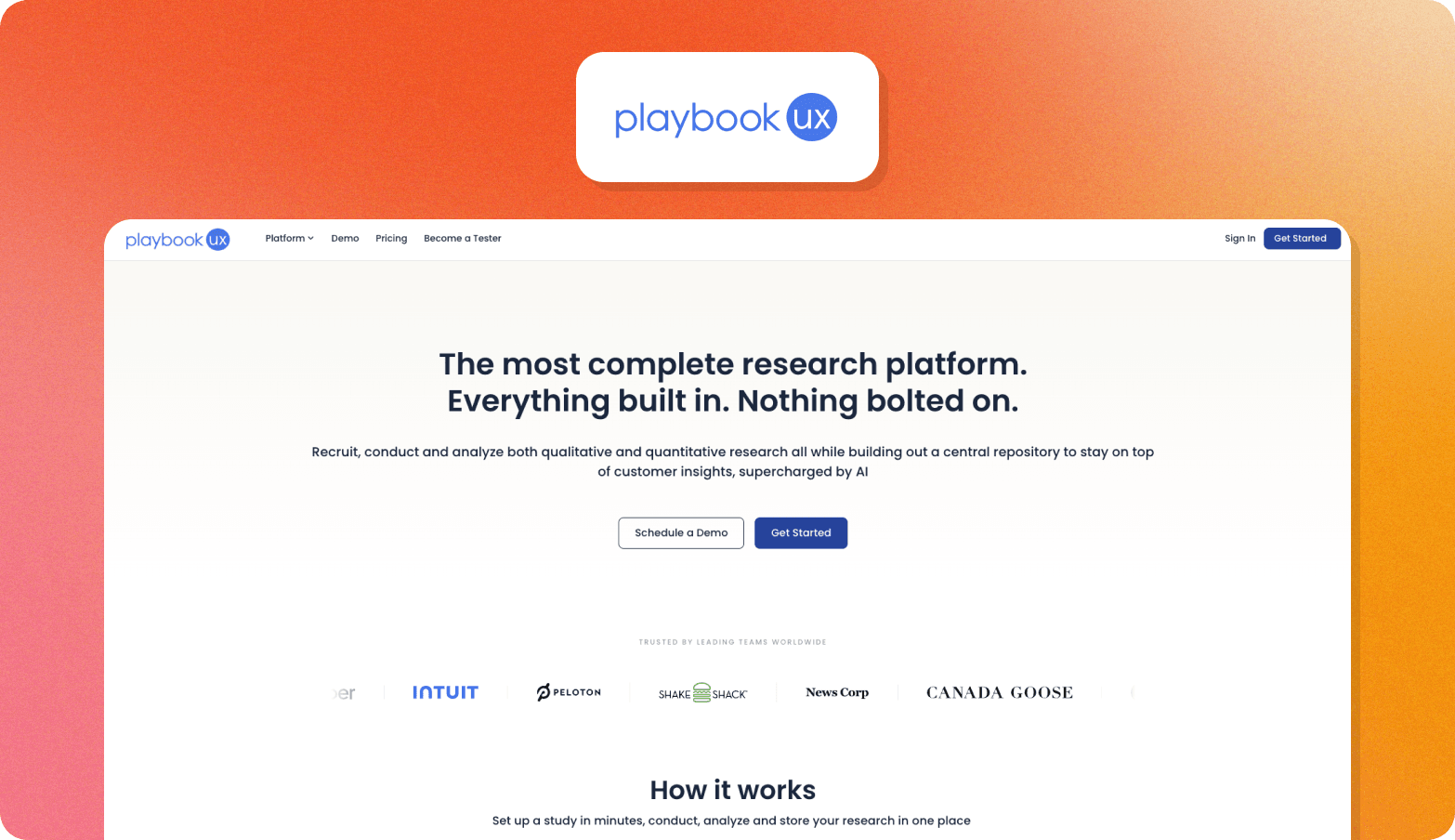
PlaybookUX is a lighter, cheaper alternative to UserTesting's unmoderated testing, with participant recruitment built in
Best for: Small teams that need rapid user feedback and lightweight usability testing without managing recruitment separately.
Core strength: PlaybookUX has test templates so studies launch quickly without a separate recruitment tool.
Key limitation: The platform is built for task-based usability testing, not qualitative depth.
Pricing: Pricing is available on request.
9. Lyssna
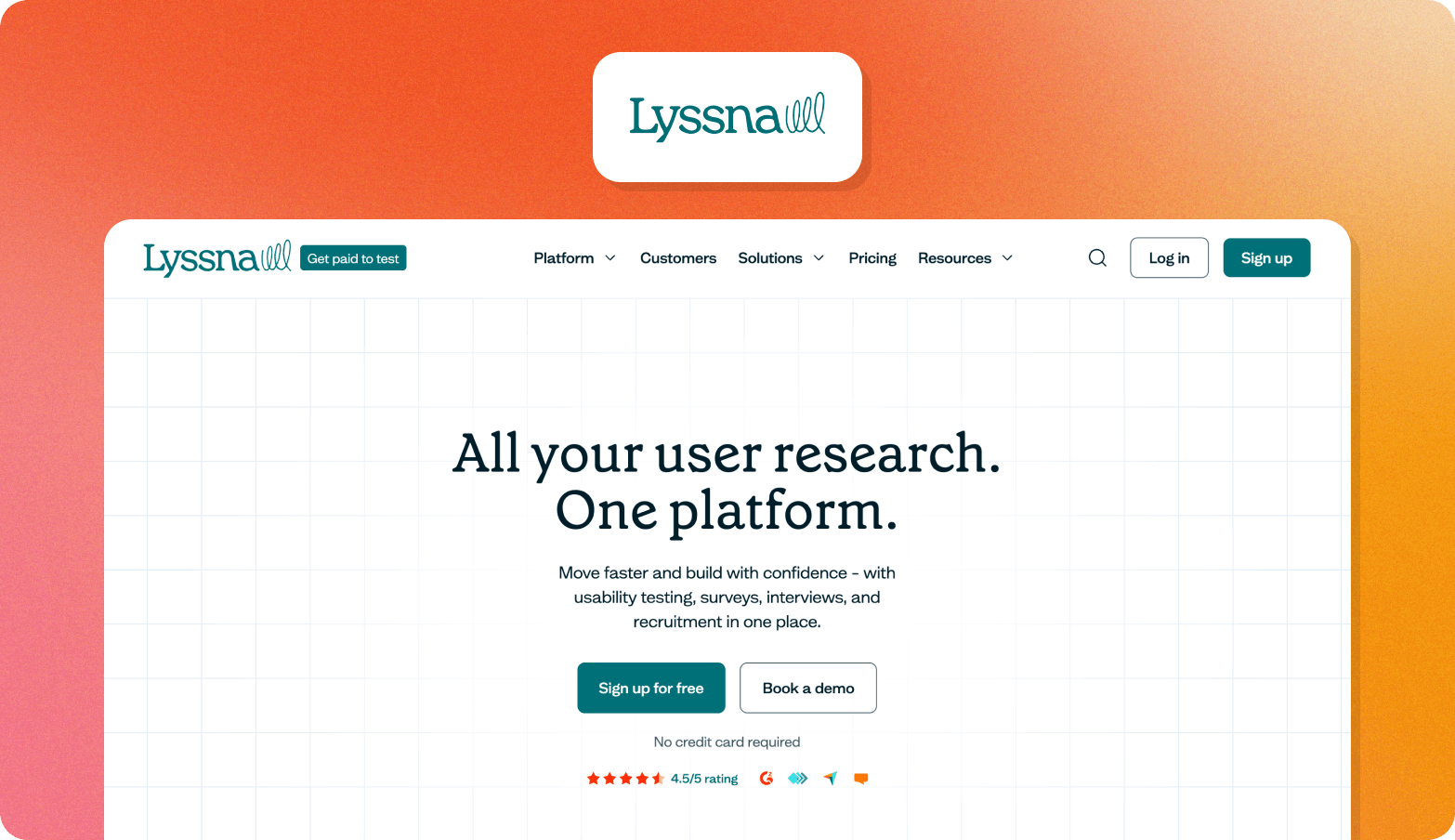
Lyssna (formerly UsabilityHub) is a comprehensive user research platform that covers more research methods than UserTesting but lacks the same panel scale.
Best for: UX and design teams that want to run several types of studies without switching between tools.
Core strength: Lyssna covers an unusually broad set of testing methods in one place, including card sorting, tree testing, first-click tests, preference tests, prototype testing, surveys, and moderated interviews.
Key limitation: There's no AI-moderated or asynchronous option, and no automated way to synthesize findings across past studies.
Pricing: There’s a free tier with paid plans from $165 per month, billed annually.
10. Optimal Workshop
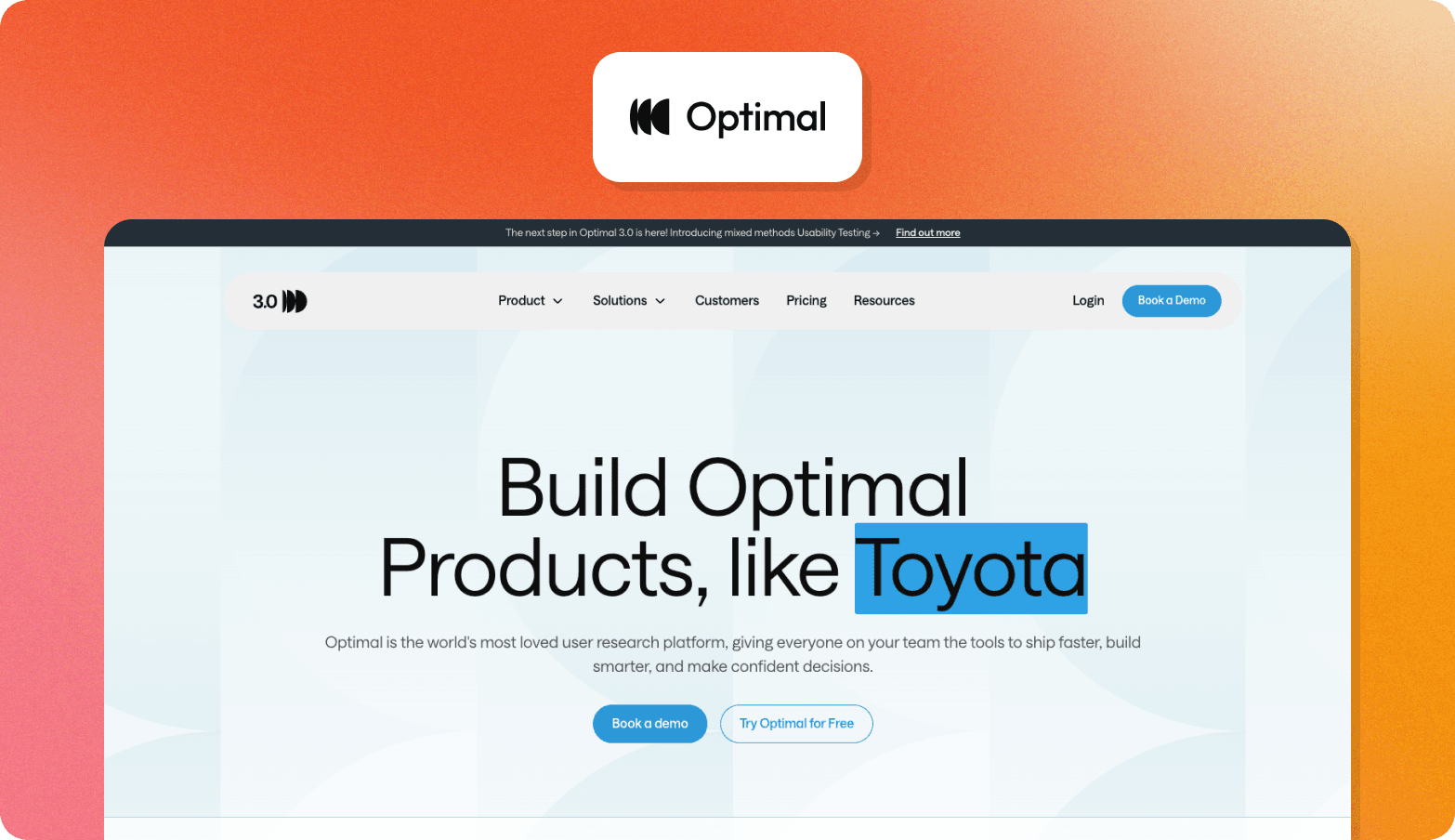
Optimal Workshop covers the information architecture methods that UserTesting doesn't, like card sorting, tree testing, and first-click tests.
Best for: UX teams optimizing navigation, site structure, and findability.
Core strength: Optimal Workshop offers specialized sorting and tree-testing methods that most general-purpose platforms don't include.
Key limitation: The platform stays narrowly focused on IA research. Teams that need broader qualitative or usability research will need additional tools alongside it.
Pricing: Plans start at $199 per month, billed annually.
11. Voicepanel
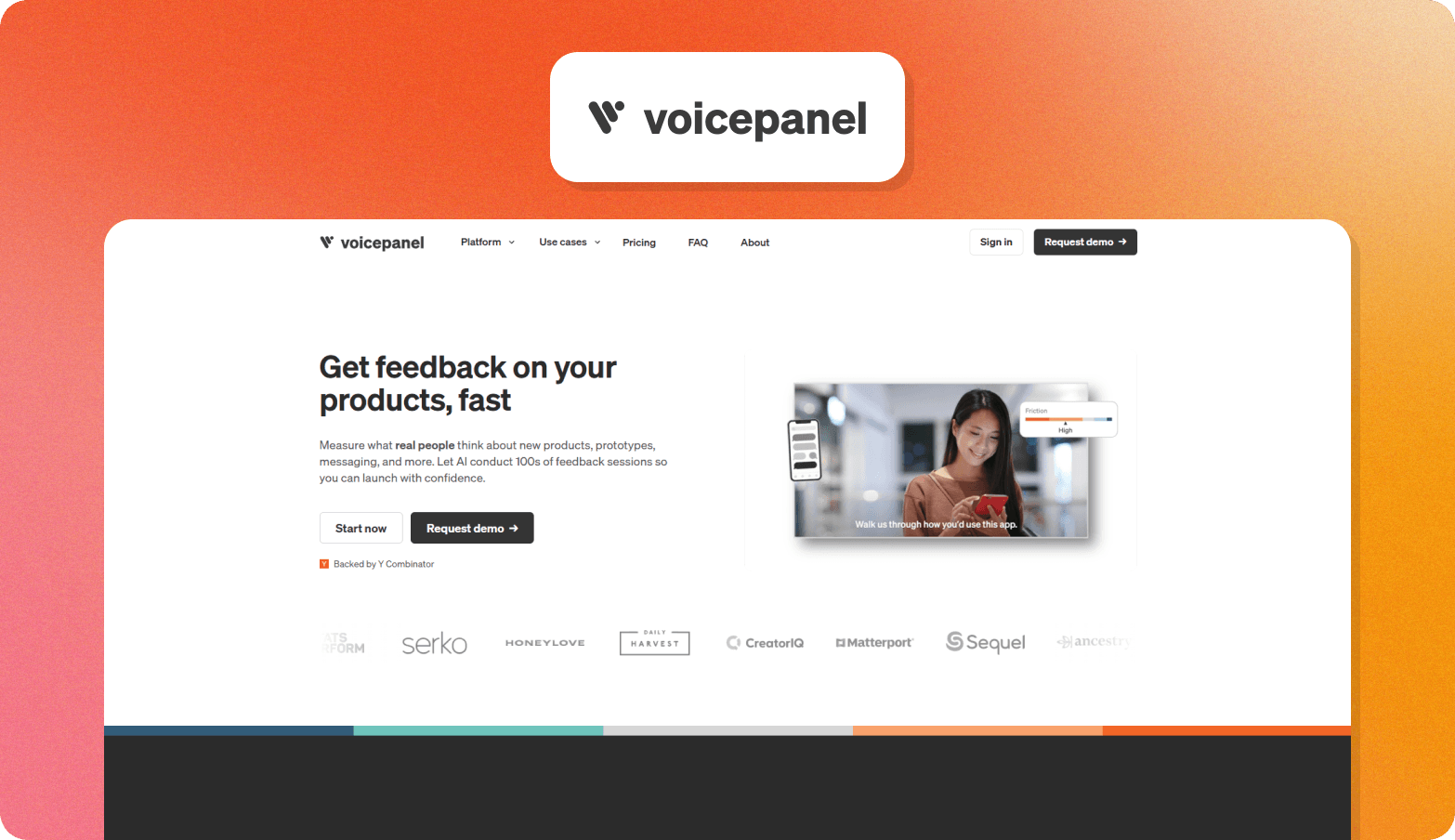
Where UserTesting separates usability tasks from interviews, Voicepanel runs usability tasks, video observation, and adaptive interviews together.
Best for: Product and UX teams that want usability tasks and interview-style probing in a single session rather than two separate studies.
Core strength: Teams can query study data directly from tools like Claude or ChatGPT.
Key limitation: There’s no cross-study library, so teams can't search findings across past studies the way they can in UserTesting's EnjoyHQ.
Pricing: There are two plans, with pricing available upon request.
12. Hotjar
Where UserTesting runs structured, moderated, or scripted sessions, Hotjar shows how users behave in the live product on their own.
Best for: UX and product teams that want to connect passive behavioral data with occasional moderated usability testing, without managing two separate tools.
Core strength: Heatmaps and session recordings run continuously on the live product.
Key limitation: Interviews are still human-moderated.
Pricing: There’s a free tier available with paid plans starting from $39 per month, billed annually.
13. Great Question
Great Question supports many of the same research methods as UserTesting, including interviews, surveys, prototype tests, and usability tests.
Best for: Product managers and designers who run their own research without a dedicated research team.
Core strength: Great Question can connect with Claude and ChatGPT through MCP.
Key limitation: The self-serve plan is limited to five seats, and the built-in participant panel costs extra on every plan.
Pricing: The self-serve plan is $1,290 per seat, per year (up to 5 seats), and enterprise pricing is custom.
14. Outset
Outset replaces UserTesting's human-moderated Live Conversations with an AI moderator named Leo, so interviews run asynchronously rather than requiring a scheduled slot.
Best for: Product and UX teams running high-volume async discovery interviews across time zones.
Core strength: Outset already has integrations with Prolific and User Interviews to reach a global panel of 1.1 billion-plus participants.
Key limitation: Teams need a separate Dovetail subscription to search findings across past studies.
Pricing: Custom, based on research and support needs.
15. Listen Labs
Listen Labs replaces UserTesting's human moderator with AI and supports a wider range of research beyond usability testing.
Best for: Consumer insights and product teams that want AI-moderated qualitative research without having to build a large research operations team.
Core strength: Teams can combine AI-moderated interviews with surveys within the same study, making it easier to collect both qualitative and quantitative feedback in a single project.
Key limitation: Teams focused mainly on usability testing may prefer a platform built specifically around UX research.
Pricing: Custom pricing, not publicly listed.
How Conveo Fits Into Your User Research Stack
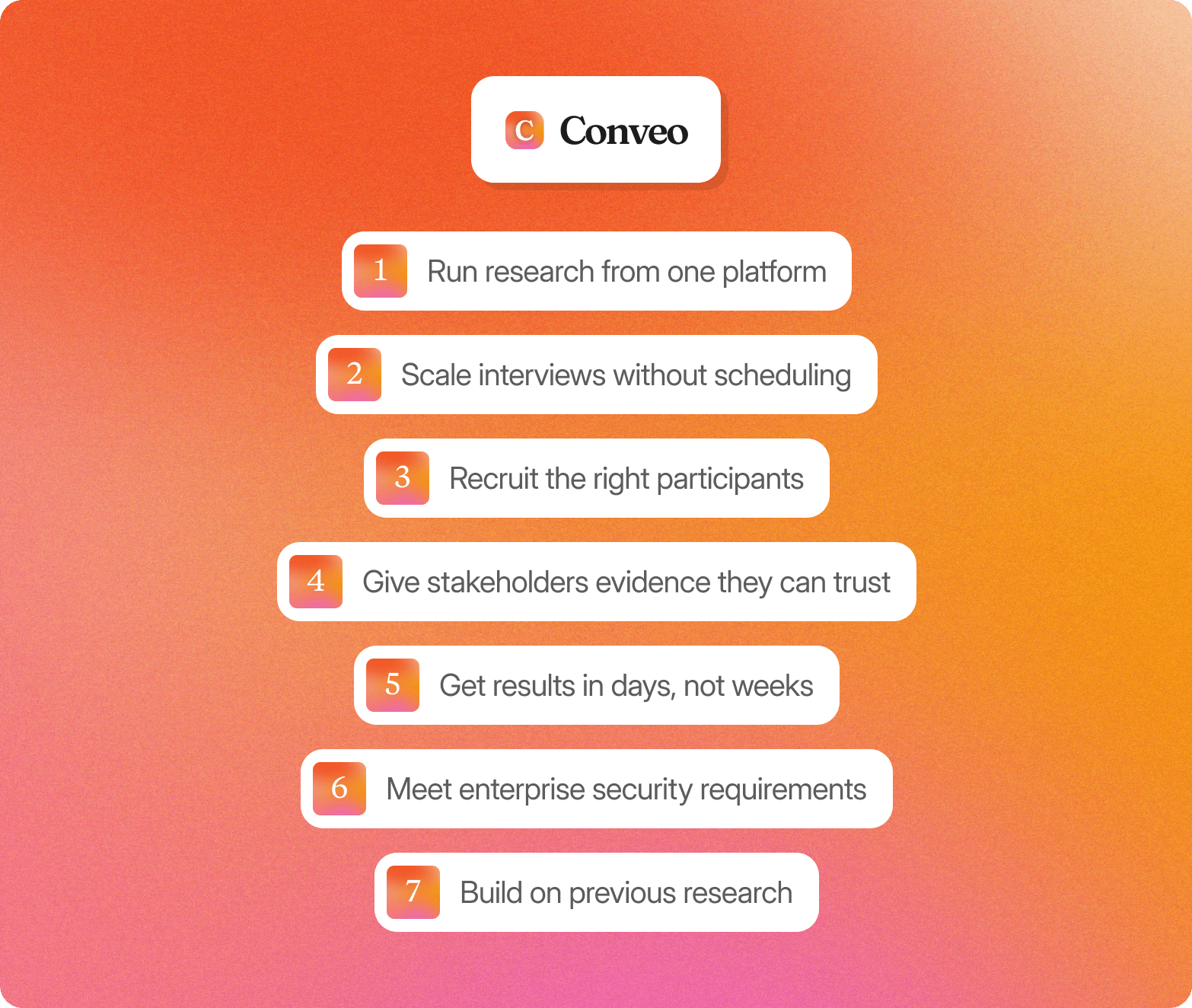
For teams that want to run qualitative research continuously rather than one interview at a time, Conveo offers an alternative to UserTesting. Here’s how it looks in practice:
Run research from one platform: Manage recruitment, AI-moderated interviews, analysis, and stakeholder-ready reporting without stitching together separate tools.
Scale interviews without scheduling: AI moderation runs hundreds of conversations in parallel, rather than waiting for a moderator to have availability on their calendar.
Recruit the right participants: Use integrated panel partners or bring your own participants through a CRM, CSV, QR code, or WhatsApp.
Give stakeholders evidence they can trust: Every finding links to the original video clip and quote, so anyone can verify its source.
Get results in days, not weeks: Interviews run simultaneously, so turnaround doesn't slow down as studies get bigger.
Meet enterprise security requirements: Conveo is SOC 2-certified, GDPR-compliant, and offers regional data hosting.
Build on previous research: A searchable library helps teams find and reuse prior studies rather than asking the same questions again.
"We just do things much quicker, cheaper, faster, and are able to have constant, ongoing dialogues."
VP Consumer Insights at a top-3 global gaming company
Frequently Asked Questions
What is the best free alternative to UserTesting?
Maze and Lyssna both offer a free plan for basic usability testing. Qualitative research generally requires a paid plan across most platforms. The right choice of alternative to UserTesting.com comes down to whether you need quantitative usability metrics or qualitative depth.
Can AI-moderated interviews replace human moderators?
AI moderation removes the need to schedule and staff a human moderator for every session, so it can scale to hundreds of conversations running at once. It works well for most qualitative research, where the AI adapts its questions based on a discussion guide. For highly sensitive topics or stakeholder-facing workshops, a human moderator can still be the better call.
What compliance certifications should I look for in a research platform?
Enterprise procurement teams typically require SOC 2 certification, GDPR compliance, and EU regional data hosting at minimum. SSO, data retention policies, and audit trails matter for larger accounts too. Platforms without these credentials tend to get blocked before evaluation even begins.
How long does it take to get results from qualitative research platforms?
Traditional, synchronous platforms scale slowly: a single small study can move fast, but the more interviews you need, the longer it takes, since each one still needs its own moderator slot. Asynchronous, AI-moderated platforms like Conveo don't have that limit because interviews run in parallel rather than one after another.
What's the difference between a point tool and an end-to-end research platform?
A point tool handles one step of the workflow: recruitment only, transcription only, or analysis only. An end-to-end platform covers the full lifecycle, from recruitment through interviewing to analysis and reporting. Point tools give you flexibility, but someone has to manually move data between each one; end-to-end platforms cut down on that handoff work but tie you to one vendor's methodology.
Is UserTesting good for qualitative research, or just usability testing?
UserTesting supports both moderated and unmoderated testing, extending to moderated live conversations as well as unmoderated studies. In the UserTesting vs. competitors comparison, most of its volume still runs through unmoderated usability and think-aloud studies. The tradeoff is that every moderated session still needs a human moderator on the call, so the number of interviews you can run is capped the same way it would be on any live-moderated platform.

About the author
Florian Hendrickx
Head of Growth
Florian is Conveo’s Chief Growth Officer, leading growth strategy and go-to-market execution as the company scales. He’s held growth leadership roles at companies like Deliverect, Robovision, and Aikido Security, and brings hands-on experience across marketing, sales, and product.
More by Florian →Qualitative insights at the speed of your business.
Conveo runs AI-moderated video interviews and structures everything they say.