In this article
TL;DR
The best qualitative research platforms now cover the full research lifecycle in one system: participant recruitment, AI-moderated interviewing, multimodal analysis, and an insight library that builds institutional knowledge across every study.
Choose Conveo if:
You need an all-in-one solution covering the full workflow: recruitment, AI-moderated interviews, multimodal analysis, and a compounding insight library
Your procurement team requires SOC 2 Type II certification, GDPR compliance, and EU data hosting
You're running 50+ studies per year and need to scale output without adding vendors or headcount
You need real voice and video conversations with real participants, not AI-generated synthetic responses
You might prefer Marvin if:
Your team already has a primary research workflow and needs a repository to organize and analyze existing data
You don't need AI-moderated interviewing and are comfortable managing recruitment and interviewing separately
You want a free entry-level tier before committing to an enterprise contract
For teams that have outgrown Marvin's repository model and need a platform that generates and stores primary research, start the evaluation with workflow coverage and compliance, not features.
Marvin is built for one part of the research workflow: organizing and analyzing data you've already collected. It transcribes interviews, tags themes, and stores findings in a searchable repository. For teams with an existing primary research process, that's a useful tool.
The question research ops teams are now asking is whether a repository is enough. AI-moderated interviewing, built-in participant recruitment, and insight libraries that compound across studies are all available in a single platform today. That changes what a complete research stack looks like, and what criteria to evaluate Marvin alternatives against.
This article covers the strongest Marvin alternatives for enterprise research operations teams, using a two-tier framework that covers compliance requirements and workflow coverage.
Marvin vs. Amazing Marvin
Search for “Marvin alternatives,” and you’ll find two different products: Marvin (sometimes called HeyMarvin), a qualitative research repository, and Amazing Marvin, a task management tool for people with ADHD. This article exclusively covers Marvin alternatives for research teams.
How to evaluate HeyMarvin alternatives: Conveo's 2-tier decision framework
For enterprise qualitative research teams, certain criteria are non-negotiable for a platform to be approved, adopted, and used at scale. These fall into two tiers: compliance requirements and workflow requirements. Here’s what to look for in each.
Tier 1: Compliance and trust (procurement gatekeepers)
Enterprise IT and legal teams are accountable for protecting organizational data and demonstrating regulatory compliance. A platform that can't provide documented evidence of its security controls puts that accountability at risk.
Here’s what to look for first in any qualitative analysis tool:
SOC 2 certification: This confirms the vendor has had its security controls independently audited. SOC 2 Type II also assesses those controls over time, not just at a single point in time.
GDPR compliance with documented DPA: A Data Processing Agreement should be available on request. A verbal claim of compliance is not enough.
EU regional data hosting: This is required when research involves EU participant data. You should confirm the exact hosting locations, not just general GDPR compliance.
SSO and role-based access controls: These are standard requirements for enterprise IT approval.
Data retention policy: The vendor should have a clear written policy explaining how long data is retained and how it is deleted.
AI model training policy: You should ask directly whether customer research data is used to train AI models. Some vendors do this, which affects participant privacy and research integrity.
Real participants only: Some platforms now use synthetic participants, which are AI-generated personas that simulate interview answers. While they can be faster and cheaper, they don’t reflect real human nuance or unpredictability and can invalidate enterprise research.
Tier 2: Workflow and intelligence (operational fit)
Once a platform reaches Tier 1, focus on how well it supports your research process. The more steps that sit outside the platform, the more handoffs you create, which leads to extra time spent moving work between tools, greater chances of context loss, and a higher risk that analysis is based on incomplete or inconsistent inputs.
The right tool will have these key features:
Recruitment coverage: Ask whether the platform provides access to a vetted participant panel or whether recruitment relies on a separate vendor. Without built-in recruitment, study timelines are tied to external coordination before you can start collecting feedback.
AI-moderated interviewing: The system should use adaptive questioning that responds to participants in real time. A fixed, script-like AI interview tends to produce survey responses rather than the deeper insights you get from qualitative research methods and real customer conversations.
Multimodal analysis: The platform should analyze voice, video, and non-verbal cues alongside transcripts. Relying on transcripts alone means you skip sentiment analysis and ignore tone, hesitation, and facial expressions, ultimately leading to missed customer insights.
Automated insight capture: Themes, quotes, and clips should be generated automatically after each session without manual tagging. Manual tagging adds time and introduces interpretation steps before analysis has properly started.
Cross-study search and knowledge compounding: AI-powered search across a structured insight library helps UX researchers and insights teams uncover patterns and spot key trends in user behavior over time. Without this, each study remains isolated rather than contributing to a shared knowledge base.
Stakeholder-ready reporting: Findings should be ready for presentation within the platform without additional formatting. If reporting is separate, the burden of turning key insights into outputs falls back on the researcher.
Platforms that meet Tier 1 criteria across all criteria and cover the full Tier 2 workflow fall into a different category from repository-only qualitative analysis tools. The comparison below applies this framework to the most common Marvin alternatives, so you can see where each platform clears the bar and where it doesn't.
Marvin alternatives: Feature-by-feature comparison
Here’s a quick overview of how each platform compares across the criteria that matter most for enterprise research teams.
| Capability | Conveo | Marvin | Dovetail | Looppanel | Outset |
|---|---|---|---|---|---|
| End-to-end workflow | Yes | Interview, analysis, and repository with no recruitment | Analysis and repository only | Analysis and repository only | Interview and synthesis with no recruitment or insight library |
| AI-moderated interviewing | Yes | Yes | No | No | Yes |
| Real participants (no synthetic respondents) | Yes | Yes | Does not run interviews | Does not run interviews | Yes |
| Multimodal analysis | Yes | Partial | Partial | Partial | Not confirmed |
| Automated insight capture | Yes | Yes | Yes | Yes | Yes |
| Cross-study search and knowledge compounding | Yes | Partial (enterprise only) | Yes | Partial | No |
| SOC 2 certified | Yes | Yes | Yes | Yes | Yes |
| EU data hosting | Yes | Enterprise only | Yes | No | Not confirmed |
| Pricing model | Credits-based, on request | Free + custom pricing | Free + enterprise custom | From $395/month | Custom, on request |
The 4 best Marvin alternatives for research operations teams
Find out more about the top Marvin alternatives, including their core strengths and any limitations to be aware of before you add them to your shortlist.
Conveo: Best for end-to-end qualitative research with built-in insight capture
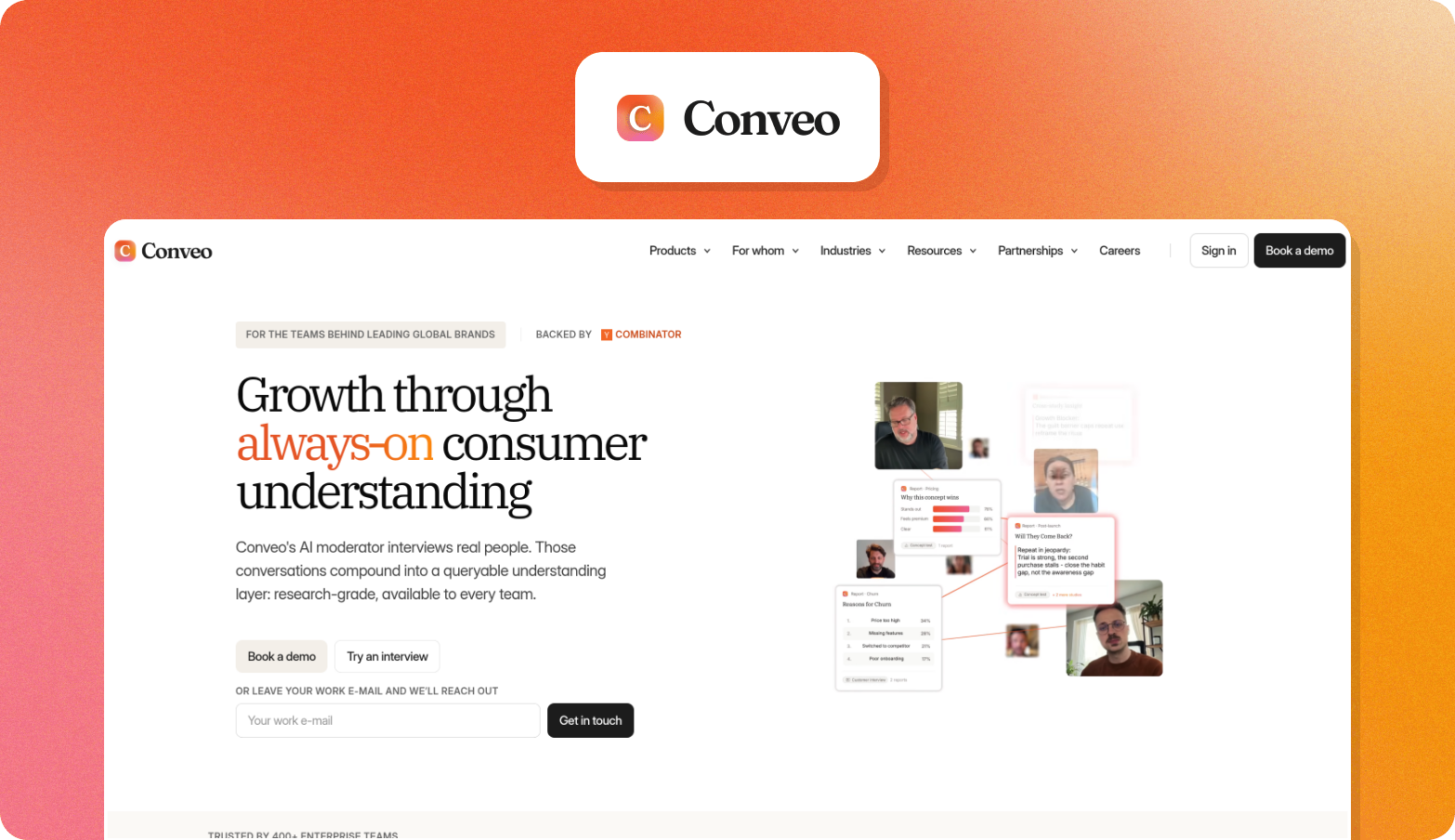
Conveo is an enterprise video-first AI research platform that gives Research Ops teams a single platform for the full qualitative research lifecycle, from participant recruitment through to a compounding insight library that builds institutional knowledge across every study.
Best for:
Conveo is built for research, consumer, and market insights teams at enterprise organizations that run 50+ studies per year and need full workflow coverage and enterprise compliance in a single platform. It supports a broad range of research types, including concept testing, brand positioning, equity research, and continuous CX studies.
Core strengths and key features:
Conveo covers the full qualitative research workflow with AI-powered tools that reduce manual tasks and accelerate the path from raw data to stakeholder-ready outputs:
Run international studies without managing separate recruitment vendors through participant recruitment across 50+ markets.
Conduct interviews faster and across time zones with AI-moderated video and voice interviews using real participants.
Capture more context and emotional nuance with multimodal analysis that processes tone, facial expression, and non-verbal signals alongside transcripts.
Build long-term institutional knowledge with a structured insight library that compounds across studies, helping you identify patterns and track how user pain points change over time.
Trace every insight back to its source with full visibility from the stakeholder report to the theme, quote, and video clip.
Discover how to build and launch a study in Conveo:
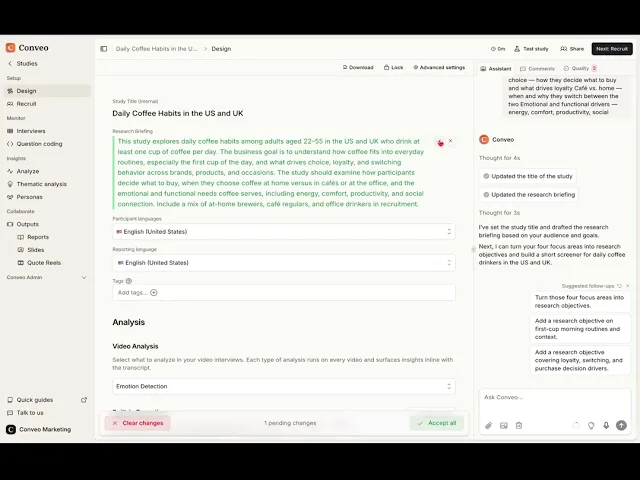
Over 400 enterprise teams, including Google, Reddit, and Bosch, use Conveo for market and user research programs that would traditionally take weeks to complete through an agency.
"Within days, we had insights that would've taken a traditional agency a month."
Head of Customer Insights, JDE Peet’s
Compliance:
Conveo holds SOC 2 Type II certification and is GDPR-compliant, with a Data Processing Agreement available upon request. EU regional data hosting and SSO are both supported, helping enterprise teams meet procurement and security requirements before research begins.
Conveo also doesn’t train AI models on customer research data, which helps protect participant privacy and research integrity.
Worth knowing:
Conveo is built for teams generating primary research at scale. Teams whose primary need is organizing historical research data, without a current need for AI-moderated interviewing, may find it too advanced for their needs.
Pricing:
Conveo operates on an enterprise pricing model, with plans available upon request. Pilot programs are available for teams evaluating the platform before committing to a full contract.
Dovetail: Best for teams that need a dedicated research repository
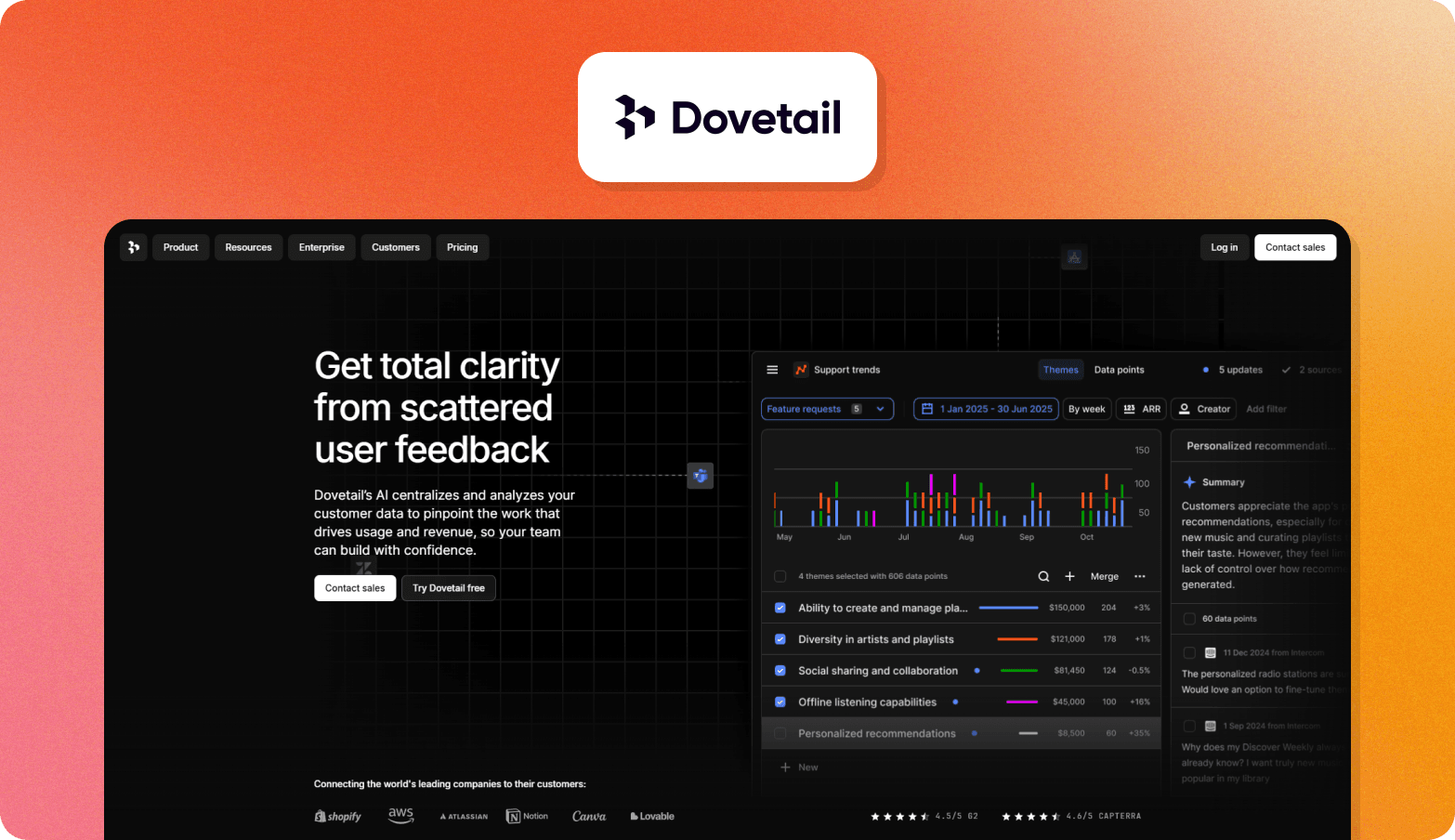
Dovetail gives research teams a structured, searchable repository for organizing and analyzing qualitative data they've already collected.
Best for:
Research teams with an existing primary research workflow who need a well-structured repository to organize, analyze, and share qualitative data across functions.
Core strength:
Dovetail centralizes unstructured data from across the research stack and applies AI assistance to surface themes, cluster patterns, generate shareable reports and highlight reels, and highlight key insights.
Compliance:
SOC 2 Type II: ✓
GDPR: ✓
EU hosting: ✓
Worth knowing:
Dovetail lacks interview moderation or participant recruitment capabilities, so teams using it for a complete research workflow still need a separate tool for primary research.
Pricing:
A free plan is available for individuals. Enterprise plans are custom-priced and available on request.
Looppanel: Best for AI-assisted analysis of existing interviews
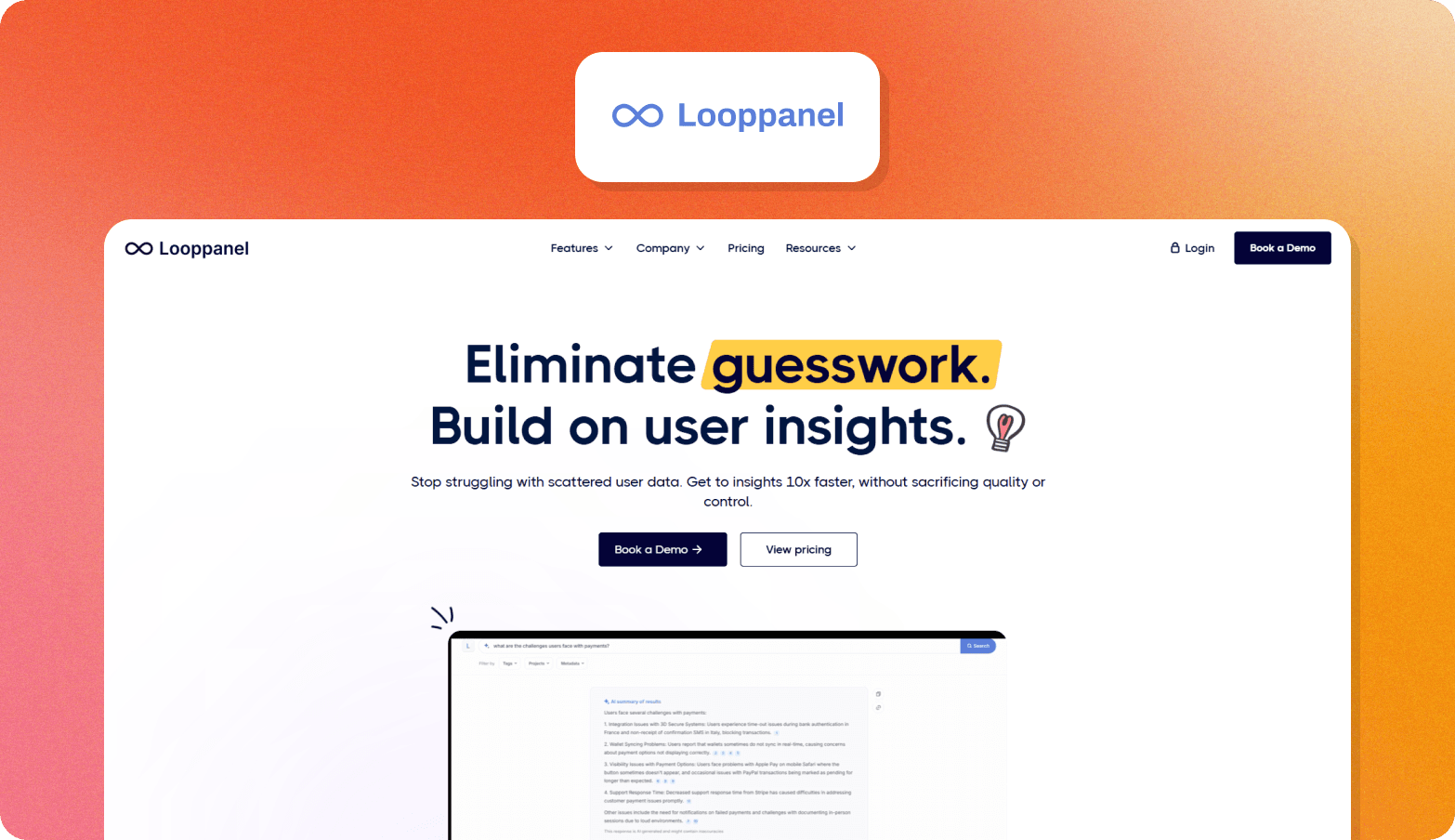
Looppanel is an AI-powered research repository that transcribes interviews, identifies themes, and stores insights in a searchable knowledge base.
Best for:
UX research teams that conduct user interviews on their own and want AI assistance for transcription, tagging, and theme synthesis.
Core strength:
Looppanel layers AI analysis onto interview recordings, auto-grouping notes by question and theme, and surfacing insights across a searchable user research repository that builds over time.
Compliance:
SOC 2 Type II: ✓
GDPR: ✓
EU hosting: ✗ (data stored in the US)
Worth knowing:
Looppanel covers analysis only. Recruitment and interview execution sit outside the platform, so teams managing a full research workflow still need separate tools for those stages.
Pricing:
The Pro plan starts at $395 per month. Enterprise plans are custom-priced and available on request.
Outset: Best for AI-moderated interviewing without repository features
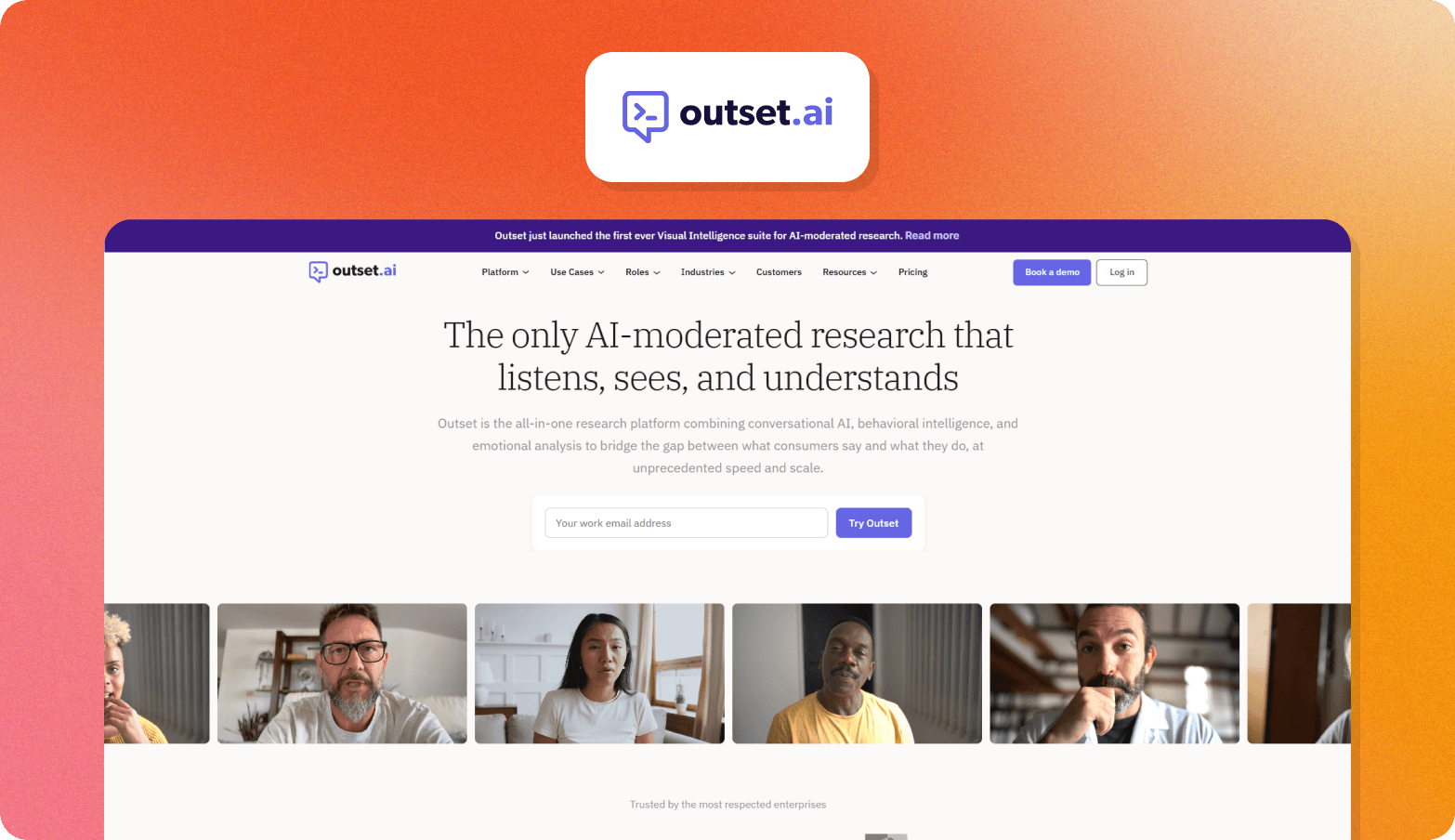
Outset runs async AI-moderated interviews with adaptive probing, asking follow-up questions based on participant responses rather than a static script.
Best for:
Product teams and UX researchers who need AI-moderated interviews at speed and manage insight storage separately.
Core strength:
Outset covers interview execution and automated synthesis on a single platform, delivering transcripts, summaries, and themes after each session without manual analysis.
Compliance:
SOC 2 Type II: ✓
GDPR: ✓
EU hosting: Not publicly confirmed
Worth knowing:
Outset handles repository and institutional memory through a native Dovetail integration rather than a built-in insight library. If your team isn't already using Dovetail, you'll need both tools to get the full workflow from interview to searchable archive.
Pricing:
Pricing is custom and available on request
End-to-end workflow vs. analysis-only repositories
All of the Marvin alternatives in this article handle the analysis part of the research workflow well. But for many, recruitment, interviewing, and transcription happen elsewhere. This approach might work fine for small teams or teams running infrequent studies, where working with different tools is more manageable.
For enterprise teams running continuous CX research workflows, the limitations of a fragmented model become more visible. Each step handled outside the platform adds extra manual tasks, increases the risk of context loss, and slows the speed at which insights move from data to output.
Conveo takes a different approach by covering the full research workflow in one system, from recruitment through to stakeholder-ready reporting. The comparison below outlines how a fragmented model differs from Conveo at each stage of the process.
| Workflow Stage | Fragmented Model | Conveo |
|---|---|---|
| Recruitment | Recruitment is handled by an external vendor, and screening is built separately, which typically introduces a 2- to 4-week lead time. | Recruitment is handled through a built-in vetted participant panel across 50+ markets with automated incentive management. |
| Interview execution | Interviews are run through agencies or separate tools, which creates scheduling overhead and often relies on manual or asynchronous recording. | Interviews are conducted via AI-moderated video and voice sessions that can run asynchronously across time zones. |
| Data collection and transcription | Data collection and transcription are managed through third-party tools or manual processes. | Data collection and transcription are fully automated within the platform. |
| Qualitative data analysis | Data is imported into tools like Marvin, where analysis depends on manual tagging and coding. | Multimodal analysis processes speech, tone, and facial expression automatically. |
| Insight capture | Findings are stored manually in decks or separate files by research teams. | Insights are captured automatically in a compounding insight library. |
| Reporting | Reporting is created manually, usually as separate slide decks. | Stakeholder-ready outputs are generated directly within the platform. |
Beyond operational differences, these two approaches affect total cost and the predictability of that cost as research volume increases.
To understand what that looks like in practice, the next section looks at pricing and ROI for research ops teams.
Pricing and ROI for research ops teams
Most data analysis software tools in this category don't publish pricing, which makes direct comparison difficult, but the more important variable for Marvin alternatives is what sits outside the platform contract.
Costs like recruitment vendors, transcription tools, agency fees for studies the platform can't run, and the researcher's time spent coordinating between them all impact the total price and ROI of your research platform.
To make that comparison concrete, here's an example of what the same research program might look like on a fragmented stack versus a consolidated platform like Conveo.
| Before Conveo | With Conveo |
|---|---|
| A 3-person insights team manages around 12 studies a year with a $150,000 agency spend, using Marvin to organize the repository. | The same team can run 50+ studies a year on Conveo because recruitment, interviewing, analysis, and insight storage are all handled within the platform, so researchers spend their time on research rather than managing vendors and moving data between tools. |
Lower per-study costs and higher study volume together significantly affect the ROI calculation. In documented cases, teams report cost reductions of 50-80% compared to agency engagements, with specific programs achieving over 95% savings.
In addition to price savings, using a consolidated platform changes how many stakeholder questions the team can answer, how many business decisions it can support, and how many actionable insights it delivers year over year.
Is Conveo the right Marvin alternative for your team?
Conveo isn’t the right fit for every team. Teams that exclusively need a repository to manage historical research data, with no current need for AI-moderated interviewing at scale, may find it a larger platform than their immediate workflow requires.
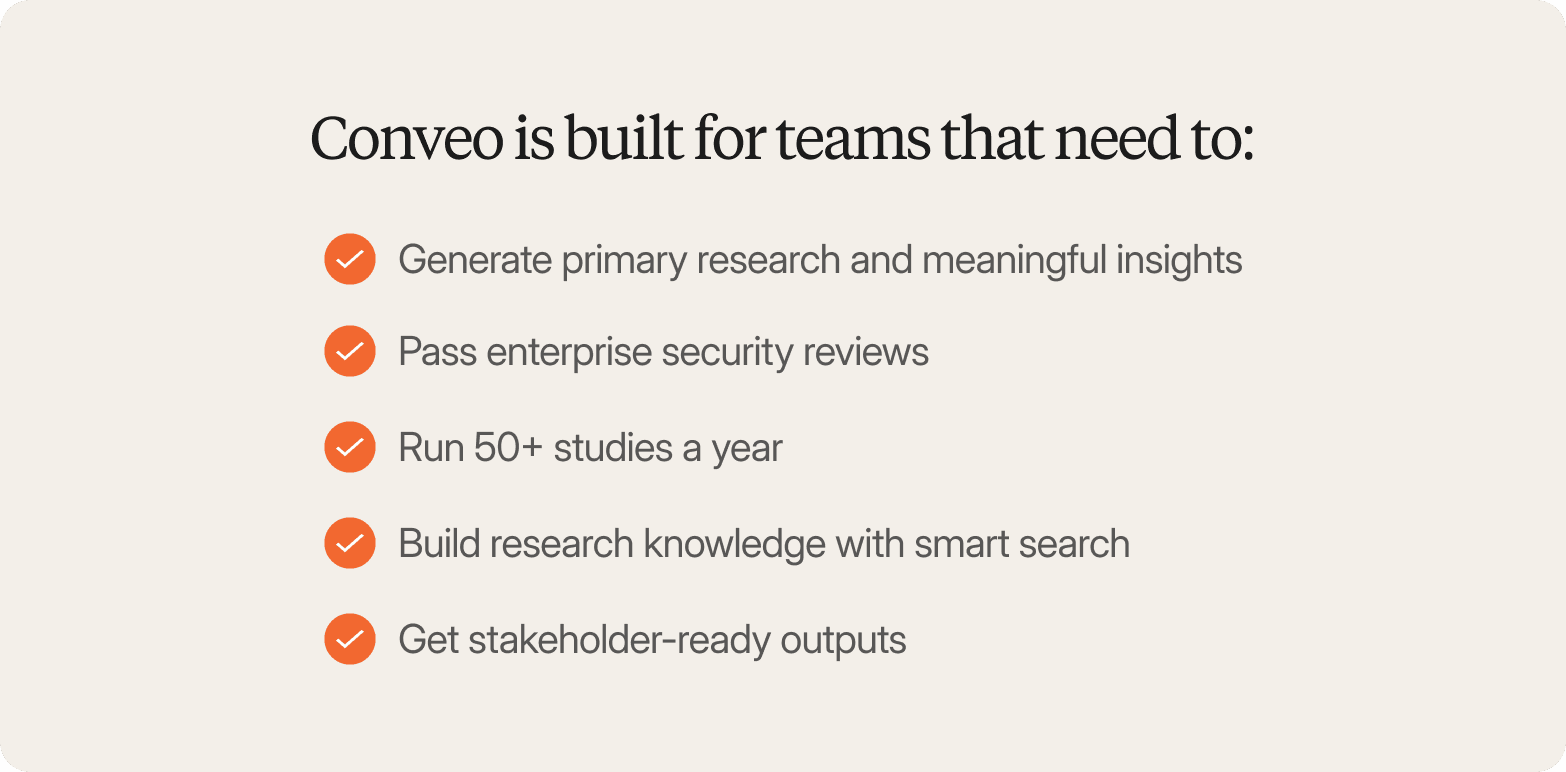
Conveo is built for enterprise Research Ops and brand and marketing teams that need to:
Generate primary research and meaningful insights at scale, not just organize what already exists
Pass enterprise security reviews needed for collecting and coding qualitative data
Run 50+ studies a year without growing the team, adding multiple vendors, or having a huge learning curve
Build research knowledge with smart search that compounds across studies, making it easier to understand consumer behavior, identify patterns, and spot market trends over time
Get stakeholder-ready outputs in days rather than weeks, even with large volumes of complex data
When you move from fragmented tools to Conveo, the compliance documents needed for procurement are available from the start. Recruitment, interviewing, analysis, and reporting all occur within a single workflow, and each study contributes to a shared insight library that the team can search and reuse.

About the author
Dieter De Mesmaeker
Co-Founder & CEO
Dieter is CEO and co-founder of Conveo. Before starting the company, he founded DataCamp and scaled it into one of the leading edtech platforms in the world.
More by Dieter →Qualitative insights at the speed of your business.
Conveo runs AI-moderated video interviews and structures everything they say.