In this article
TL;DR
Innovation pipelines stall when consumer validation takes weeks, and decision windows close before insights arrive
Traditional agency-led qualitative research runs six to twelve weeks, forcing teams to skip validation or launch on instinct
Conveo, a video-first AI research platform, compresses validation from weeks to days using asynchronous AI-moderated video interviews
Teams can run hundreds of consumer conversations in parallel across markets, with automated analysis delivering structured findings in the same working week
A continuous evidence loop, where every pipeline stage begins with a hypothesis and ends with consumer-backed decisions, is the key to turning new ideas into successful products at speed
Innovation pipelines stall when consumer validation takes weeks or months, and the decision window closes before insights arrive. A concept that needed a go/no-go call in week two doesn't benefit from qualitative findings that land in week six. By then, the team has either committed resources on instinct or shelved the idea entirely.
Manual moderation and synthesis cycles create a throughput ceiling that makes "early and often" validation practically impossible. Most innovation teams end up rationing research: running one or two studies per quarter and making smaller decisions without any customer feedback. That's what happens when the innovation process relies on methods not designed for the pace of modern product development.
Conveo, a video-first AI research platform, compresses validation timelines from weeks to days, so innovation teams can run real consumer conversations before committing development resources, not after. The platform supports the full innovation pipeline management workflow, from early concept screening to iterative refinement, without scaling headcount.
This article covers how a structured innovation pipeline works, where consumer validation typically breaks down, and how teams build continuous insight programs that keep pace with the decisions they're actually making.
What Is an Innovation Pipeline? From Idea Generation to Launch
An innovation pipeline is a structured process for moving ideas from initial concept through to a market-ready product. It gives teams a shared framework for deciding which innovative ideas deserve investment, which need more evidence, and which should be cut before they consume meaningful budget or time.
Most pipelines follow recognizable key stages: idea generation, where new ideas are surfaced and filtered; concept validation, where the strongest candidates are tested against real consumer reactions; prototyping, where selected ideas take shape into detailed concepts; market testing, where assumptions are stress-checked at higher fidelity; and launch, where the product meets the market. Each stage acts as a gate. Ideas that pass carry more evidence. Ideas that fail get retired before costs compound.
What Is an Innovation Pipeline Built to Prevent?
Without a structured approach, two failure modes dominate. Bad ideas attract resources because they sound compelling in a conference room. Valuable ideas stall because no one has the evidence to defend them when a skeptical stakeholder pushes back. The pipeline exists to solve both problems: surface the great ideas worth backing, and give teams the proof needed to move them into further development with confidence.
But the pipeline only works when teams can validate innovative ideas faster than decision windows close. In practice, the research required to move from concept to confirmed insight often takes longer than the decision itself. By the time customer feedback arrives, the budget meeting has already happened, the brief has already been written, or a competitor has already launched.
Most innovation pipelines are well-designed on paper. They break down in practice because the validation step cannot keep pace with the decision-making it is supposed to inform.
Why Innovation Pipelines Fail Without Fast Consumer Validation
Most innovation pipelines don't fail because teams have bad ideas. They fail because the feedback that would separate strong ideas from weak ones arrives after the decision window has already closed.
Traditional agency-led qualitative research commonly runs six to twelve weeks from brief to debrief. For early-stage innovation work, where teams are iterating on three to five concepts before committing to one, that timeline makes continuous validation impractical. By the time real-world feedback arrives, the team has already moved to the next stage, adjusted the brief based on internal instinct, or committed to a direction under launch pressure.
This creates a tradeoff that no amount of innovation pipeline management strategies can resolve within a traditional research model. Teams can move fast with surveys, but surveys tell them which concept scored higher, not why one framing resonated and another fell flat. Or they can commission real market research and accept that findings will arrive after the key decision has been made. Neither path delivers a consumer perspective while the concept is still shapeable.
Budget pressure sharpens the problem further. Qual budgets at most enterprise teams have stayed flat even as the volume of decisions requiring customer feedback has grown. Running shorter surveys or substituting internal reviews for real-world feedback reduces cost but also reduces signal quality, meaning teams make higher-stakes decisions on thinner evidence. Innovation initiatives stall not for lack of great ideas, but for lack of timely evidence to back them.
In a representative scenario, a CPG team needed consumer validation on a new flavor concept before a seasonal launch window. They faced a choice: wait three months for agency qual and miss the window, or proceed without validation. They launched without it. A post-launch study identified a packaging cue consumers associated with a competing brand: a signal that would have surfaced in the first week of qualitative interviews and given them a competitive edge going into market.
"We ran a concept test for a new product line, and in one night, we had 200 interviews analyzed"
CMI Lead, Edgard & Cooper
The Innovation Pipeline Stage-Gate Process: From Idea Screening to Launch
The innovation pipeline process moves through familiar key stages: idea screening, concept validation, prototyping, market testing, and launch. At each stage, a gate forces a go/no-go decision. The enterprise stage-gate process is built on the premise that the right evidence, presented at the right gate, keeps strong ideas moving and kills weak ones early.
Most teams validate once, maybe twice, across the full pipeline, not because they believe one round of research is enough, but because each validation cycle takes three to six weeks through an agency. The pipeline keeps moving. The research tries to catch up.
What stakeholders need to approve advancement at each stage is specific: traceable quotes from real consumers, evidence of how reactions differ across segments, and disconfirming signals that show the team stress-tested the idea, not just confirmed it. Strong decision-making at each gate also accounts for technical viability, market potential, and commercialization readiness, not just consumer appeal or customer satisfaction scores. A gate review built on a topline survey score looks thin next to one that shows where enthusiasm broke down, which segment had reservations, and what language consumers used when something felt off. That is gate-ready evidence and a measure of strategic fit.
In a representative scenario, a team at a major CPG company used survey scores to validate a wellness concept that tested strongly on purchase intent. What the survey did not surface was that a meaningful portion of respondents felt the product's format conflicted with the health positioning they associated with the category. That tension didn't show up in a rating scale; it showed up in conversations, in tone shifts, in the gap between what the concept promised and what consumers expected. The product launched. Adoption stalled.
Pipelines require consumer input at every gate to function as designed. Traditional research methods cannot deliver at that cadence.
Innovation Pipeline Examples: How Cross-Functional Teams Validate Faster
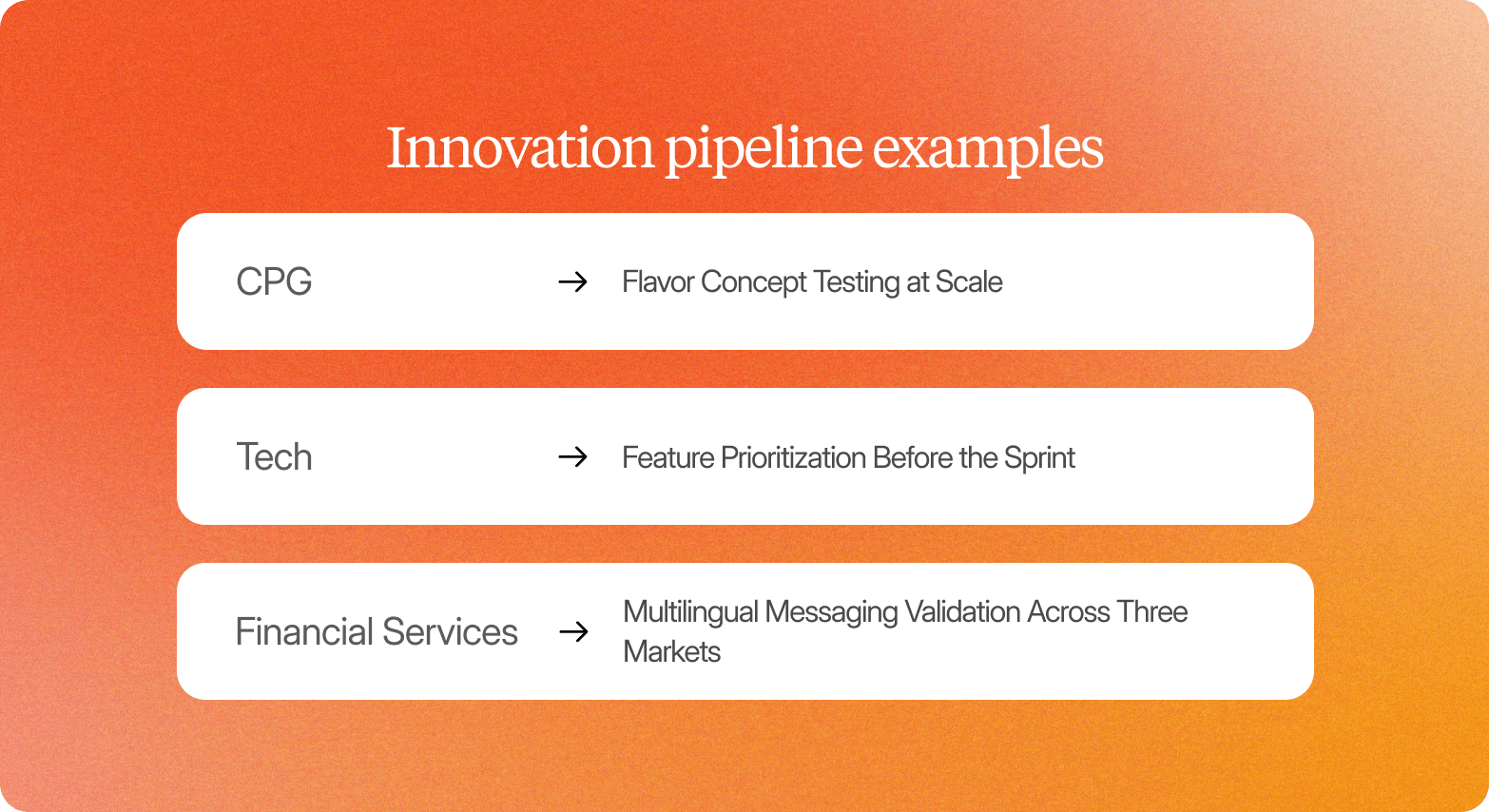
The following innovation pipeline examples illustrate the changes that occur when cross-functional teams can gather real-world feedback in days rather than waiting on agency timelines.
Note: These examples are representative scenarios illustrating common validation patterns, not specific results from Conveo clients.
CPG: Flavor Concept Testing at Scale
A food brand had six flavor concepts to evaluate before committing to production tooling. The validation question was straightforward: which concepts generate genuine purchase intent among potential customers, and why do the others fall short? With traditional focus groups and agency-led fieldwork, that answer would take eight weeks. Instead, the team ran AI-moderated video interviews with 200 consumers in five days. The multimodal analysis surfaced not just preference rankings but also the specific language participants used to describe appeal and hesitation. Two concepts were eliminated before any production spend was committed. The remaining four advanced with messaging directly informed by consumer language, a clear innovation outcome driven by the speed of insight.
Tech: Feature Prioritization Before the Sprint
A SaaS company had a product roadmap debate that surveys couldn't resolve. Three features were competing for the next sprint cycle, and the team needed to understand which friction points were actually driving churn risk. Fifty target users completed AI-moderated interviews over three days. The findings shifted the prioritization entirely. The feature ranked highest internally placed third in terms of user feedback urgency. The sprint was launched grounded in what users described in their own words, with project progress tied directly to validated business needs.
Financial Services: Multilingual Messaging Validation Across Three Markets
A bank launching a new savings product needed to validate messaging across the UK, Germany, and the Netherlands before committing to campaign production. Using automated translation and multilingual AI-moderated interviews, the team ran 90 sessions across three markets in seven days. Two of the three markets responded positively to the lead message. The third required a different framing around security and institutional trust, a distinction that would not have surfaced in a single-market survey, and that cross-functional collaboration across local teams helped interpret.
The pattern is consistent: teams that integrate continuous validation into innovation pipeline management kill weak ideas before they consume budget and advance the best ideas with evidence that their stakeholders can inspect.
Conveo vs. Traditional Research Methods: Who has the Competitive Edge
The innovation pipeline throughput problem isn't solved by improving one step in isolation. Here's how Conveo compares to the research methods and approaches most teams currently rely on:
| Approach | Key limitation | How Conveo is different |
|---|---|---|
| Point tools (transcription or analysis only) | Reduce one step; leave coordination overhead intact | End-to-end workflow: recruitment, fraud filtering, interviewing, automated analysis, and reporting in one platform |
| Generic LLM synthesis | Outputs not grounded in real consumer conversations | Every finding traces to specific participant responses, verbatim quotes, and timestamped video clips |
| Synthetic / avatar research | Stakeholders can't verify that responses came from real people | Real human participants in real video conversations, verifiable evidence for high-stakes innovation decisions |
| Surveys | Fast toplines; miss the "why" behind adoption, tradeoffs, and rejection | Adaptive AI probing follows up on what each participant actually says, capturing depth that rapid testing tools and static questionnaires miss |
Multi-market validation: Conveo supports 50+ languages for AI-moderated interviews and recruits across 50+ markets, letting cross-functional teams run parallel studies without the scheduling drag of separate local fieldwork.
Enterprise compliance: SOC 2 certified, GDPR compliant, with optional EU data hosting. These address the procurement blockers that appear when innovation pipeline research touches regulated participant data or crosses jurisdictions.
Compliance data reflects publicly available information as of June 2026. Verify directly with vendors.
Building a Customer Evidence Loop Into Your Innovation Pipeline
A customer evidence loop is a repeatable system for collecting, analyzing, and acting on customer feedback at every stage of the pipeline, not just during the final concept review. The evidence loop changes the operating model so that each stage begins with a hypothesis and ends with a decision, backed by real consumer conversations rather than internal consensus. It is the operational core of an effective innovation pipeline, and the mechanism that keeps innovation efforts aligned to business strategy rather than internal assumptions.
What good evidence looks like: Not topline agreement scores. Good evidence for innovation activities includes:
Traceable quotes linked back to the original video response
Segment-level differences reveal whether a concept works for one audience but not another
Disconfirming signals: moments when participant behavior contradicts the premise around which the concept was built
Key performance indicators tied to innovation goals: adoption signals, message comprehension rates, and stated purchase intent by segment
The loop structure is consistent regardless of pipeline stage:
Define the hypothesis about consumer behavior or unmet need
Identify the key questions that would confirm or challenge it
Set a minimum evidence threshold (and input metrics) before advancing to the next stage
Agree in advance on go, pivot, or stop criteria aligned to strategic goals
Gate-ready artifacts make the evidence actionable at the decision point. A one-page narrative with linked video clips and verbatim quotes lets stakeholders review the consumer case in under 10 minutes, not a 40-slide debrief. This structured approach to evidence presentation supports cross-functional collaboration across innovation, product, and marketing teams.
In a representative scenario, one innovation team used this approach to kill a concept in week two of development. Consumer interviews revealed that participants fundamentally misunderstood the problem the product was designed to solve. Ending the project at that stage saved an estimated six months of development time and freed budget for more promising opportunities.
The insight library compounds the loop's value through continuous improvement. When findings from each study flow into a searchable repository, teams don't have to start from scratch each cycle; they connect current concepts to what consumers said in past studies, building incremental improvements into each new validation round. When every finding links to a verbatim quote or a timestamped video clip, concept decisions also become auditable for stakeholders who weren't in the debrief.
How Conveo Powers Innovation Pipeline Effectively
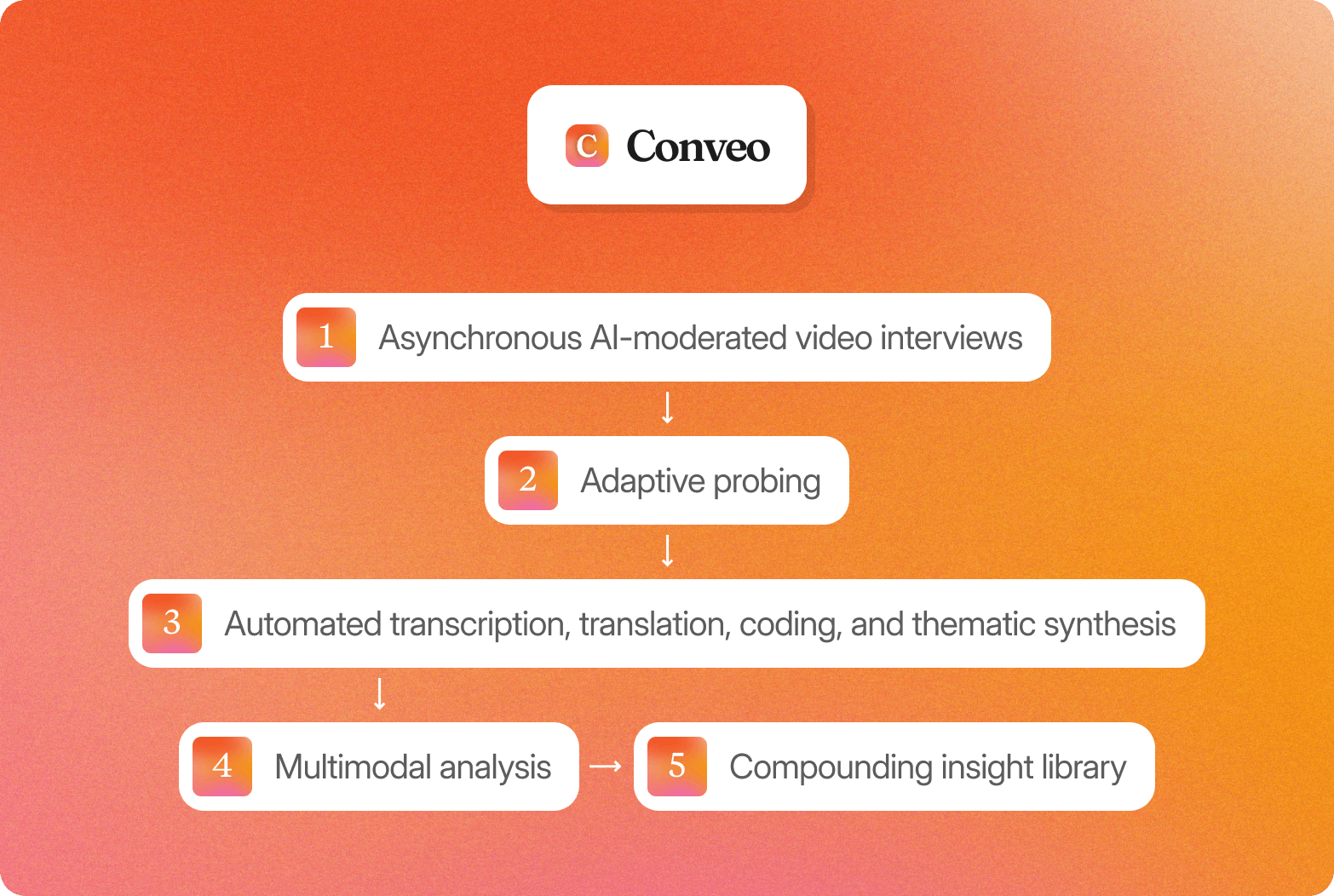
Innovation pipeline validation breaks down when research infrastructure can't keep pace with the decisions it's supposed to inform. Conveo helps teams manage innovation at scale by compressing the full qualitative cycle, from recruitment to stakeholder-ready findings, into days. Here's the mechanism:
Asynchronous AI-moderated video interviews run hundreds of conversations in parallel: no scheduling bottleneck, no fieldwork delays
Adaptive probing follows up on what each participant actually says, capturing the depth that go/kill decisions require, and that static questionnaires miss
Automated transcription, translation, coding, and thematic synthesis compresses analyst time from days to hours; human review stays in the loop
Multimodal analysis surfaces speech patterns, tonal shifts, and facial reactions alongside verbal responses, reactions that transcripts alone don't capture
Compounding insight library retains learnings across pipeline cycles, so teams track progress across studies and never start from scratch
The key takeaways for innovation teams: faster validation means better decision-making at every gate, business goals stay aligned to market demands, and the evidence behind every advancement decision is auditable. Teams that run their innovation pipeline effectively gain a real competitive edge: more ideas tested, fewer resources wasted, and market-ready solutions that reflect what potential customers actually want.
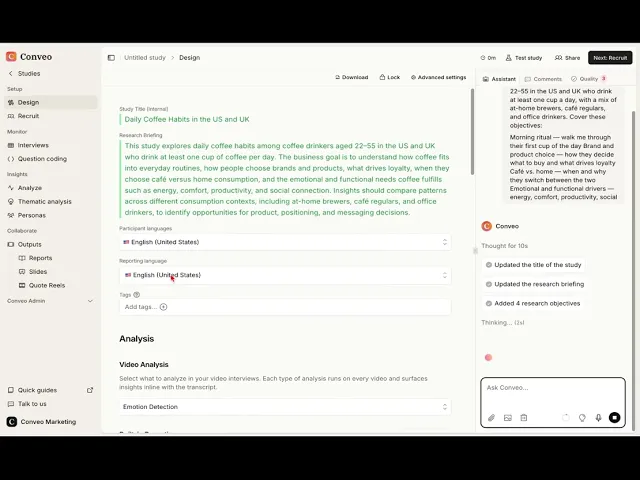
See what a concept test looks like from brief to validated insight:
Frequently Asked Questions
What Is an Innovation Pipeline Template?
An innovation pipeline template is a standardized framework for moving new ideas from initial concept through validation stages and into a market-ready product. Most templates follow a stage-gate structure: ideas enter at one end, pass through defined review points, and advance only when they meet predetermined criteria aligned with business objectives. The problem is that these frameworks assume validation can happen on a fixed schedule. When research timelines run three to six weeks per stage, even a well-designed, healthy innovation pipeline becomes a bottleneck. A CPG team might have a rigorous stage-gate template in place and still launch concepts without real consumer validation because commissioning research would have pushed the launch window back by three months. The template existed. The customer feedback did not. Template structure matters less than the speed at which teams can validate ideas at each stage. When validation cycles compress from weeks to days, teams can use the framework as intended: making go/no-go calls based on real consumer conversations rather than internal assumptions, and maximizing the impact of every innovation dollar spent.
What Are Innovation Pipeline Examples?
Innovation pipelines look different by industry, but the validation challenge is consistent. A CPG team might test 12 flavor concepts with 200 potential customers across two regions before committing to production. A SaaS company might prioritize three competing feature directions with 50 target users before a sprint begins. A bank might validate messaging for a new product across three markets simultaneously and need a directional signal within a week before a regulatory window closes. In each case, the bottleneck is rarely the pipeline structure itself; it is the speed of the validation stage sitting inside it. When a research cycle takes three to six weeks, it doesn't fit inside a two-week decision window. Asynchronous AI-moderated video interviews let teams run hundreds of conversations in parallel, compressing a pipeline validation stage from weeks to days without sacrificing the depth that makes findings credible to stakeholders.
How Do You Manage an Innovation Pipeline?
Effective innovation pipeline management depends on continuous consumer validation at every stage, not a single round of research before launch. To manage innovation well, teams need fresh ideas tested early, weak concepts cut before they absorb budget, and strategic approaches that keep validation in step with decision cadence. The operational challenge is timing. Traditional research cycles run four to eight weeks per study, which means most teams can only validate a handful of innovation projects per quarter. When validation takes days instead of weeks, teams can generate more ideas, test more of them, and cut weaker concepts before they consume budget, turning innovation management from a bottleneck into a competitive advantage.
What Is the Difference Between an Innovation Pipeline and a Product Pipeline?
An innovation pipeline focuses on validating new ideas and concepts before committing resources, while a product pipeline manages the development and launch of ideas that have already cleared that validation threshold. The innovation pipeline demands early, frequent consumer input because the ideas are less defined and the cost of pursuing the wrong one is high. Teams use consumer conversations to kill weak concepts before they consume budget, headcount, or creative energy. Product pipelines shift the research focus toward launch optimization: refining messaging, testing packaging, and confirming commercialization readiness for something already committed to development. Both pipelines benefit from continuous consumer input, but the innovation pipeline requires it at a higher frequency; concepts change shape quickly, stakeholder assumptions are less tested, and the window for course correction is narrow. Strategic alignment between the two pipelines ensures that only the best ideas, validated against real market demands, make it into development.
How Long Does Innovation Pipeline Validation Take?
With traditional agency-led qualitative research, validation cycles commonly run six to twelve weeks from brief to debrief. That timeline makes sense for an annual brand tracker or a high-stakes launch study. It makes no sense for a pipeline that surfaces new ideas every few weeks and needs customer feedback at each key stage. AI-moderated video interviews change the equation. Hundreds of conversations can run in parallel, and analysis begins as recordings land rather than after the last session closes. Teams report moving from brief to structured findings in days, not weeks: the difference between consumer input that shapes a concept and that which arrives after the decision has already been made. For innovation teams managing multiple innovation opportunities simultaneously, that speed is what separates a healthy innovation pipeline from one that perpetually lags behind market demands.

About the author
Alex de Hemptinne
Business Impact Lead
Alex is a Business Impact Lead at Conveo, partnering with enterprise teams to embed AI-led research into their workflows. From the first study to full-scale rollout, she helps customers shift from project-based research to continuous customer intelligence.
Meet Alex on film →Qualitative insights at the speed of your business.
Conveo runs AI-moderated video interviews and structures everything they say.