


TL;DR
Quantitative research measures "what" and "how many" through statistical analysis, but numerical data alone cannot explain motivation or decision logic. Without traceable evidence, a metric shift is an opinion, not a finding.
Quantitative findings can tell you a concept wins on appeal. They cannot tell you whether it fails on believability, category fit, or relevance, gaps that qualitative methods are built to close.
Analytics show where users drop off, but the underlying data points don't reveal whether the cause is confusion, skepticism, or a value mismatch.
Open-ended survey questions rarely surface specific friction because a fixed study design can't adaptively probe what a respondent actually meant.
AI-moderated video interviews close the gap by combining quantitative data collection with qualitative depth, delivering the valuable insights and context that pure numbers miss.
Your quantitative research shows a statistically significant drop in completion rates, but stakeholders are debating three interpretations because no one knows why customers abandoned the flow. That's the core limitation of quantitative data: precise, defensible, and often insufficient for informed decisions.
Surveys are a fast, scalable form of data collection, but a fixed question set can't follow a respondent's reasoning or surface decision logic the researcher didn't anticipate. When a metric shifts, quantitative approaches tell you the magnitude, not whether the cause is UX friction, a pricing concern, or a trust gap. Statistics can confirm that something changed; they rarely explain why.
For insights teams working against tight decision-making windows, that gap isn't a footnote. It's the difference between a recommendation stakeholders act on and a findings deck that raises more questions than it resolves. This article provides research teams with a practical framework for recognizing when the limitations of quantitative research undermine decision quality and when to combine quantitative rigor with qualitative research for a fuller picture.
What Quantitative Data Measures (and What It Doesn't)
Quantitative methods excel at quantity: how many users converted, what percentage churned, how a score trended over time. That focus on measurable data is exactly what makes quantitative approaches valuable for tracking performance at scale, and exactly why they struggle to explain the reasoning behind the numbers.
What Quantitative Data Tells You | What It Cannot Explain |
23% drop in completion rate | Whether the cause is confusion, skepticism, or a value mismatch |
Concept A scores 7.2/10 on appeal | Whether it fails on believability, relevance, or category fit |
NPS stable at 42 | Whether loyalty is eroding beneath the surface |
Without traceable consumer evidence, metric shifts are treated as opinions rather than signals grounded in what customers actually said. A B2B SaaS team sees flat System Usability Scale scores and assumes the experience is fine. Six months later, churn spikes. Post-exit interviews, a qualitative method built for exactly this kind of discovery, reveal users tolerated the interface but resented the underlying workflow: a bias in interpretation that pure numerical data couldn't have caught.
This isn't a failure of quantitative research; it's a reflection of what it's built to do: confirm patterns at scale, not explain the reasoning underneath them. The limitations of quantitative research only become a problem when teams treat the absence of a signal as confirmation that nothing is wrong.
5 Critical Limitations of Quantitative Research
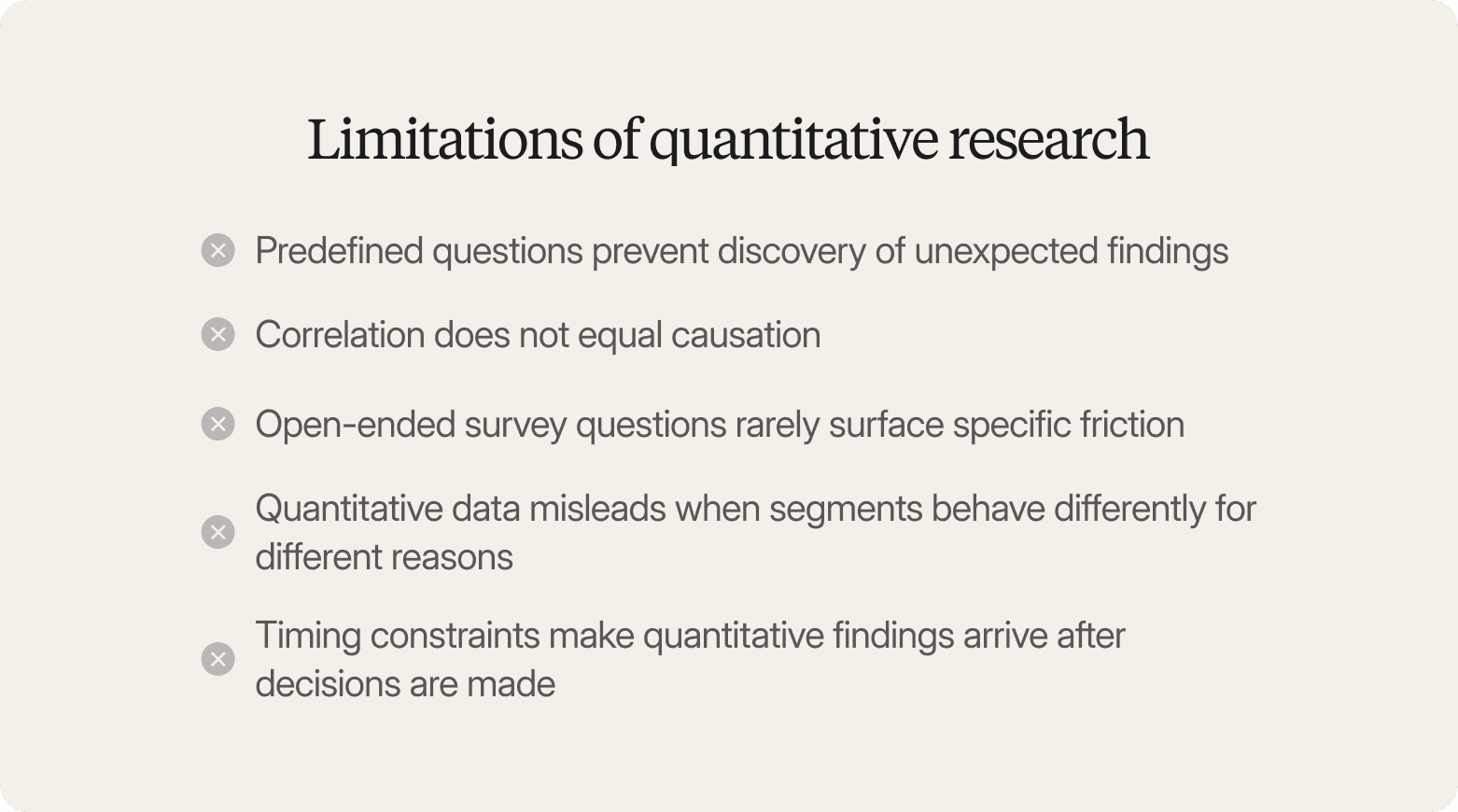
1. Predefined questions prevent discovery of unexpected findings
Every survey question reflects a hypothesis about what matters, and anything outside that scope goes unmeasured. A CPG brand tests packaging concepts on a five-point appeal scale; scores come back strong, but sales underperform. Qualitative approaches, such as one-on-one interviews, reveal the real problem: shelf findability, a dimension the survey never asked about. AI-moderated video interviews probe further in real time when a respondent mentions unexpected friction, rather than moving on to the next scripted question, and that kind of adaptive follow-up is what separates rigid tools from genuine qualitative data collection.
2. Correlation does not equal causation
Quantitative data can show two variables moving together, not which one drives the other. A fintech app notices users who enable notifications show higher engagement and assumes notifications drive engagement. Interviews reveal the reverse: highly engaged users enable notifications because they're already committed. Without qualitative interrogation to determine the actual mechanism, correlation masquerades as causation, and spend is allocated to symptoms rather than the real driver.
3. Open-ended survey questions rarely surface specific friction
Text boxes produce shallow responses because no follow-up is coming. A UX team asks, "What was confusing?" after a task; 60% of respondents write "nothing" or leave it blank, and the rest submit one-sentence answers that are too vague to act on. Conveo's AI moderator probes "confusing" until the specific moment surfaces, fitting inside sprint cycles where traditional qualitative research, like moderated focus groups or one-on-one sessions, can't keep pace.
"It truly blows my mind how much better any single question in our platform is compared to what we could traditionally do with open-ended answers"
— Charles Allison, Conveo (formerly Instacart)
4. Quantitative data misleads when segments behave differently for different reasons
Aggregate metrics hide segment-level variation. An e-commerce checkout flow shows 78% completion across all users, but mobile users complete at that rate because the flow is simple, while desktop users complete despite frustration with redundant fields. The number is identical; the underlying reality is opposite. Without qualitative follow-up, teams risk optimizing for the wrong segment of their target audience.
5. Timing constraints make quantitative findings arrive after decisions are made
Study design, fielding, and statistical analysis routinely take six to twelve weeks, a timeline that has made quantitative methods notoriously time-consuming for fast-moving teams. A brand team needs input on holiday messaging by October 15; the study delivers results November 3, and the campaign runs with untested messaging regardless. Parallel async interviewing changes that: teams can run hundreds of conversations at once, delivering the same depth of understanding in days instead of weeks.
These limitations aren't unique to marketing and product research. They're well documented across the social sciences, where researchers in psychology, economics, and education have long relied on both qualitative and quantitative methods, using experiments and controlled studies to generate measurable data while turning to interviews and observations for context and meaning. The same principle applies inside a company: neither quantitative nor qualitative research alone gives you the full picture, and the strongest research programs treat them as complementary tools rather than competing ones.
When to Recognize Quantitative Research Limitations in Real Programs
Business Question | What Quantitative Data Delivers | When to Add Qualitative Depth |
Why did feature adoption drop? | Usage declined 18% month-over-month | When stakeholders debate discoverability, value perception, or onboarding friction |
Which concept should we launch? | Concept B scores highest on appeal | When high appeal may mask low believability or category misfit |
Why is churn increasing? | Churn up 12% in Q3 | When exit surveys produce vague answers that don't explain what failed |
How do markets respond to this positioning? | Germany scores 6.8/10, UK scores 7.2/10 | When cross-market differences need cultural or language-specific context |
Across all four rows, the pattern repeats: a credible number arrives, and the room splits into competing, equally plausible interpretations that quantitative data alone can't resolve. The operational limitation isn't that the statistics are wrong. It's that quantitative findings often arrive without the "why" needed to act on them. Teams that treat the number as a starting point for targeted qualitative research, rather than the final word, reach a decision in days instead of weeks, and reach it with the kind of support that holds up under scrutiny.
How Video Interviews Address the Limitations of Quantitative Research
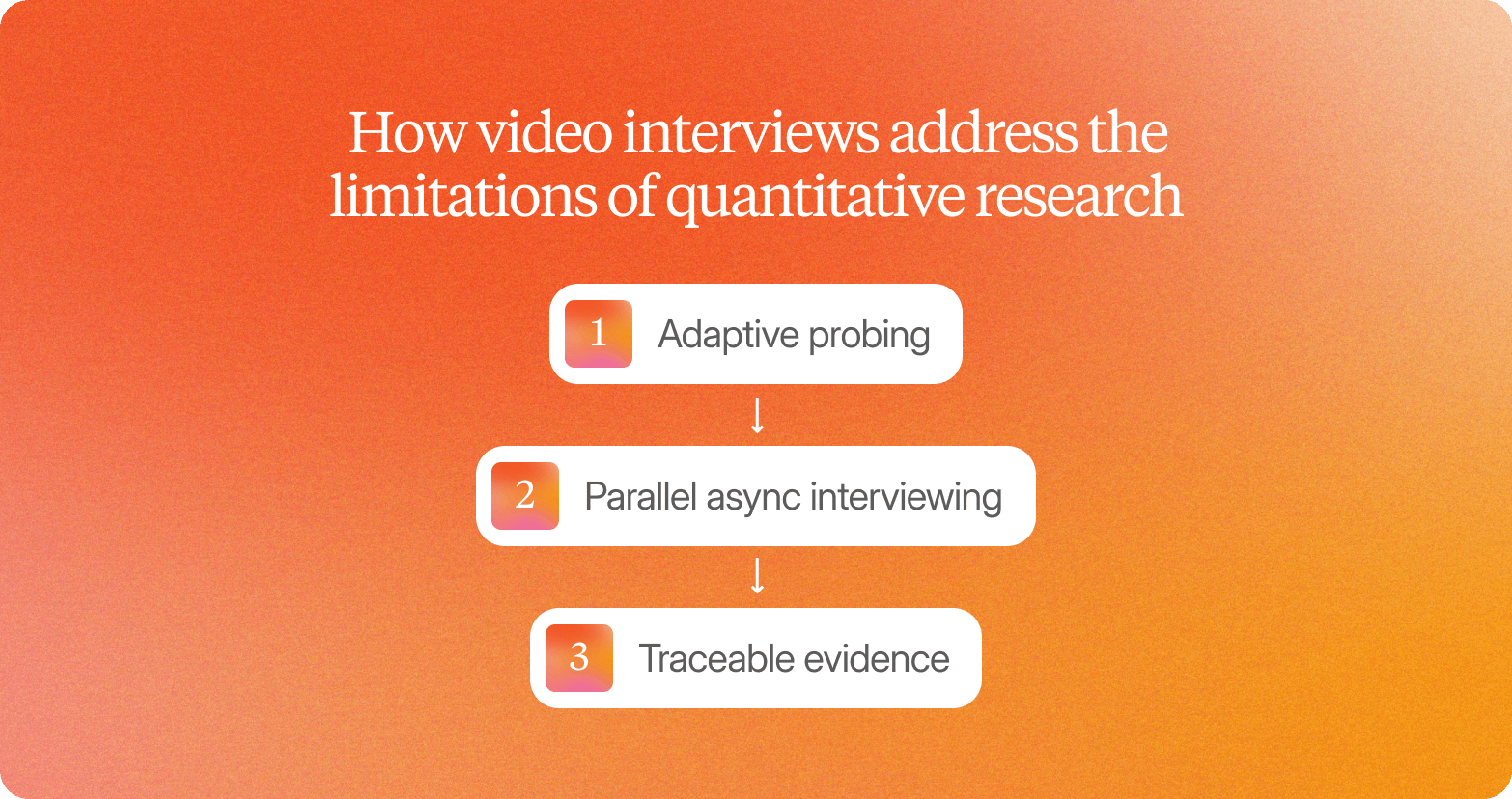
Quantitative research is precise about what is happening but rarely explains the reasoning behind it. AI-moderated video interviews add the missing layer through three mechanisms, and each one directly offsets a disadvantage of relying on numerical data alone:
Adaptive probing: When a respondent says "it was confusing," Conveo's AI moderator asks what specifically, at which step, and what they expected instead, turning a vague complaint into an actionable finding grounded in qualitative data rather than guesswork.
Parallel async interviewing: 50, 200, or more conversations can run simultaneously, giving teams a larger sample size with no scheduling dependencies or added headcount, so qualitative investigation moves at the pace of the business.
Traceable evidence: Video and verbatim transcripts link every finding back to a real respondent and moment, reducing the "this feels like an opinion" objection that undermines survey-only research and strengthening the validity and reliability of the conclusions drawn from it.
See Conveo's AI moderator in action:
A healthcare organization sees patient satisfaction fall from 8.1 to 7.6. The quantitative research confirms the decline but can't explain it. Async interviews with 50 patients, a sample size that would be impractical to schedule through traditional qualitative methods, reveal the cause: a new check-in kiosk disorients older patients expecting a staff member's help. The team redesigns the flow, and satisfaction recovers within two months. The statistics identified the problem; the interviews made it solvable.
Mitigation Checklist: Reducing Quantitative Research Limitations
Pre-test survey questions with 5–10 respondents before fielding to catch ambiguous wording or leading phrasing that skews data collection from the start.
Pair closed-ended metrics with adaptive follow-up interviews for any result that will influence a major decision, like pricing or concept selection.
Segment results by behavior, not just demographics. Identical completion rates can mask opposite underlying reasons within the same target audience.
Use video interviews to explain counterintuitive results from experiments or A/B tests before generalizing the learning across markets or segments.
Build a searchable insight library so the knowledge behind why a metric moved is reusable across multiple studies, rather than dying in slide decks.
When quantitative data shows "no change," interview a sample anyway. Flat NPS or satisfaction scores can mask emerging friction that hasn't yet reached measurable scale, and skipping this step is one of the more common disadvantages teams run into when they trust statistics in isolation.
How Conveo Turns Quantitative Gaps Into Qualitative Evidence
Every limitation in this article points to the same gap: quantitative data tells you what changed, not why or what to do about it. Conveo closes that gap without the timeline penalty that has historically made qualitative research impractical to run alongside quantitative studies.
Adaptive AI moderation means respondents aren't limited to predefined answers; when someone says a concept "doesn't feel right," Conveo's moderator probes until the specific objection surfaces, producing qualitative data with the depth of a skilled interviewer at the scale of a survey. Parallel async interviews remove the scheduling bottleneck, enabling hundreds of conversations to run at once within the same decision-making window as the quantitative research that flagged the question. Traceable video evidence lets stakeholders inspect a real clip and moment behind every insight, rather than take a summary on faith, an important support for both validity and reliability. And a compounding insight library means prior explanations don't expire, so teams build on existing knowledge rather than starting over with every new study.
Frequently Asked Questions
What are the limitations of quantitative research?
What are the strengths and limitations of quantitative research?
What are examples of limitations in quantitative research?
What are the limitations of quantitative research in healthcare?
What are the limitations of quantitative analysis?
How do you address the limitations of quantitative research methods?