
TL;DR
Packaging research has a timing problem: the traditional six-week agency cycle usually delivers findings after packaging design decisions have already been locked.
Effective packaging research needs visual stimulus in a competitive context. Without it, responses reflect imagination rather than shopping behavior.
The three core methods- in-context shelf testing, traditional surveys, and qualitative interviews- answer different questions. Only qualitative depth helps teams uncover why a shopper hesitates.
Conveo, a video-first AI research platform, runs AI-moderated interviews asynchronously and in parallel, compressing fieldwork from 6–10 weeks to 3–5 days, while preserving qualitative depth.
Every finding traces back to timestamped video clips and verbatim quotes, so product packaging decisions stay defensible across marketing, legal, and leadership.
Packaging research has a timing problem. By the time a traditional study delivers its findings, with the agency briefed, the panel recruited, the sessions moderated, and the transcripts synthesized, the design file is already at the printer. The six-week cycle that most agency-led programs require doesn't fit the reality of packaging development, where structural decisions, claim hierarchies, and visual identity are locked in weeks before production commitments close.
The consequence isn't abstract. Teams discover that their hero claim reads as generic, their pack disappears on a crowded shelf, or the category cues signal the wrong occasion for their target audience, all after the tooling cost has been sunk. Product packaging research conducted post-commitment doesn't prevent bad decisions. It documents them.
Packaging design plays a crucial role in whether a new product succeeds or stalls at launch, which is why fine-tuning it before production locks matters so much. This article offers a framework for selecting packaging research methods that close the feedback loop before design decisions are locked in, covering claim comprehension, shelf standout, and category fit, with approaches that deliver usable findings in days rather than weeks.
What is packaging research?
Packaging research is a form of design research: the systematic process of testing packaging concepts with consumers before committing to production. It's used to determine:
Whether a design earns shelf standout
Whether claims land clearly
Whether the perceived quality matches the price point
Whether the package fits or disrupts category conventions for a given product type
The reason packaging research requires visual stimulus is structural. Consumers cannot describe what catches their eye if they haven't seen the design in competitive context. Effective packaging research methods present designs within a realistic shelf set, then probe what participants notice first, what claims they absorb, and how the package reads against the four or five alternatives sitting next to it. Done well, this generates shopper insights no spreadsheet of preference scores can offer on its own, and it's a form of design research that pays off well beyond a single launch.
This is also what separates packaging research from general product research. For example, a shopper deciding between two shampoos on a crowded shelf isn't deliberating; the decision happens in seconds, often before conscious reasoning kicks in. That creates the core tension teams face: understanding why shoppers hesitate, reach for a competitor, or misread a claim requires qualitative depth. But traditional qualitative methods, including recruited focus groups and agency-moderated interviews, routinely take around six weeks to deliver findings, a window that's usually already closed by launch.
Why packaging research matters for brand and marketing teams
Packaging is the last brand touchpoint before a purchase decision, and for many customers it's also the first real introduction to a product. It signals quality tier, communicates key claims, and earns attention on a shelf crowded with established competitors. Leading brands treat packaging design as a core part of their marketing strategy rather than an afterthought handed to a design team late in the development process. Launching unvalidated packaging is one of the more expensive gambles a company can make: once production is locked, fixing a weak design means absorbing the cost of redesign, reprinting, and potentially a recall- real money that a validated concept would have avoided spending in the first place.
Packaging research exists to prevent three specific risk factors:
Claim confusion: shoppers misread benefit statements, particularly in categories with dense regulatory labeling. A "no added sugar" claim gets read as sugar-free, or an ingredient transparency panel gets ignored because the visual hierarchy buries it.
Weak differentiation: when packaging blends into the category, shoppers default to the brand they already know.
Category misalignment: when design signals premium for a value-tier product, or the reverse, the mismatch drives returns and negative reviews.
The product itself may be strong; the packaging sets the wrong frame before the customer ever tries it. Getting these elements right can be the difference between a shopper picking up your product and reaching for a competitor's.
Traditional surveys reveal none of this in sufficient depth to act, and traditional agency-led qualitative research, while rigorous, typically arrives after design decisions have already been made. Understanding this dynamic is essential for any company introducing a new product into a competitive category.
3 packaging research methods
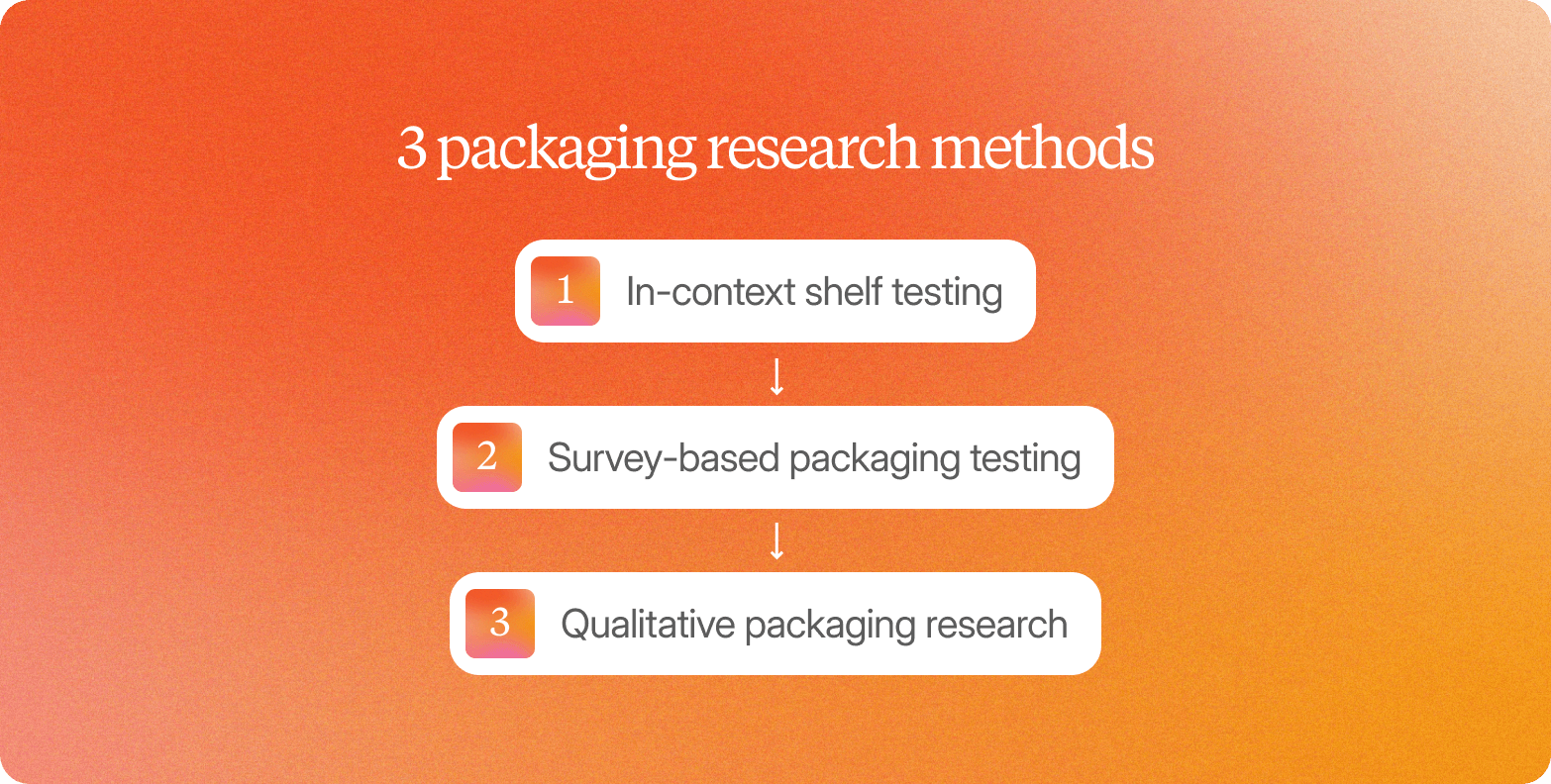
In-context shelf testing (behavioral methods)
Shelf testing places packaging in a simulated retail store environment and measures what actually happens: how quickly a design is noticed, whether it holds attention long enough to trigger a pick-up, and how it performs relative to adjacent competitors. Eye tracking shows which visual elements attract attention first, a useful proxy for a design's stopping power at the shelf, and a strong early signal of shelf success before a single sale is rung up.
The method's strength is behavioral: it captures real browsing decisions without asking consumers to explain themselves. The limitation is also behavioral. Shelf testing shows that a package loses at the fixture but cannot explain why, leaving teams knowing they have a problem without the diagnostic insight to fix it.
Survey-based packaging testing (quantitative methods)
Traditional surveys measure what large numbers of shoppers prefer, not why they prefer it. Preference rankings, purchase intent scores, and claim recall rates can be collected across hundreds or thousands of participants in days, making this the fastest method for testing multiple packaging variations across markets simultaneously.
The tradeoff is depth. When a shopper hesitates at a price point or misreads a claim, a rating scale captures the hesitation but not the reasoning behind it. Survey data sets up the question more than it answers it, and several factors that actually drive shelf success never surface in a ranked list.
Qualitative packaging research (interview-based methods)
Qualitative methods answer the question surveys cannot: not just what consumers think of a package, but why. Through adaptive probing, interview-based research surfaces claim-comprehension gaps, perceived-quality signals, category-fit judgments, and emotional reactions that closed-ended scales flatten into noise. That depth makes qualitative packaging research the diagnostic layer in any serious packaging research program, and it's the layer best suited to uncover the specific factors behind a shopper's hesitation.
The traditional limitation is structural. Agency-led qualitative packaging research follows a sequential process: briefing, recruitment, moderated sessions, and manual synthesis. That process runs around six weeks, so findings arrive after the design decision has already been made internally.
"We ran a concept test for a new product line; in one night, we had 200 interviews analyzed"
— CMI Lead, Edgard & Cooper
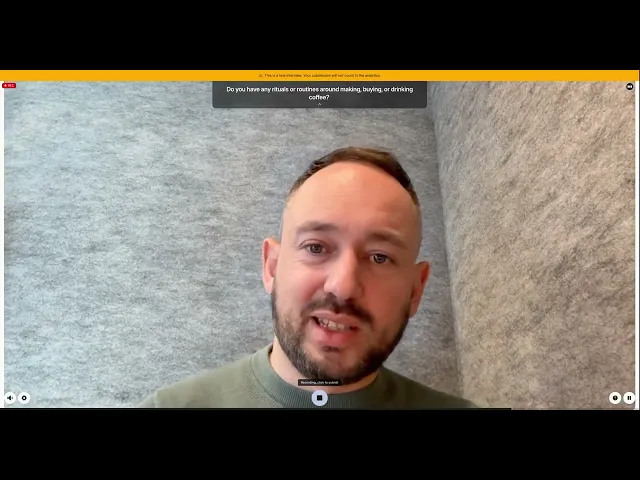
Conveo, a video-first AI research platform, resolves this without trading away rigor. Its AI-moderated video interviews preserve the qualitative depth of a skilled moderator and tie every response to traceable video evidence, backed by SOC 2 certification for enterprise data handling. Because those interviews run asynchronously and in parallel, Conveo conducts hundreds of conversations at once, in 50+ languages, with adaptive probing that follows each participant's actual responses rather than a rigid script. Companies developing a new product across several markets benefit from scale without losing the depth that makes qualitative packaging research valuable in the first place.
Method | Answers | Cannot tell you | Typical timeline |
In-context shelf testing | What shoppers notice, whether the design gets picked up | Why a design wins or loses | Days |
Survey-based testing | What large samples prefer, ranked | The reasoning behind hesitation | Days |
Qualitative interviews | Why shoppers hesitate, misread claims, or reach for a competitor | — | 6–10 weeks (agency) / 3–5 days (Conveo) |
A 4-step process that closes the loop
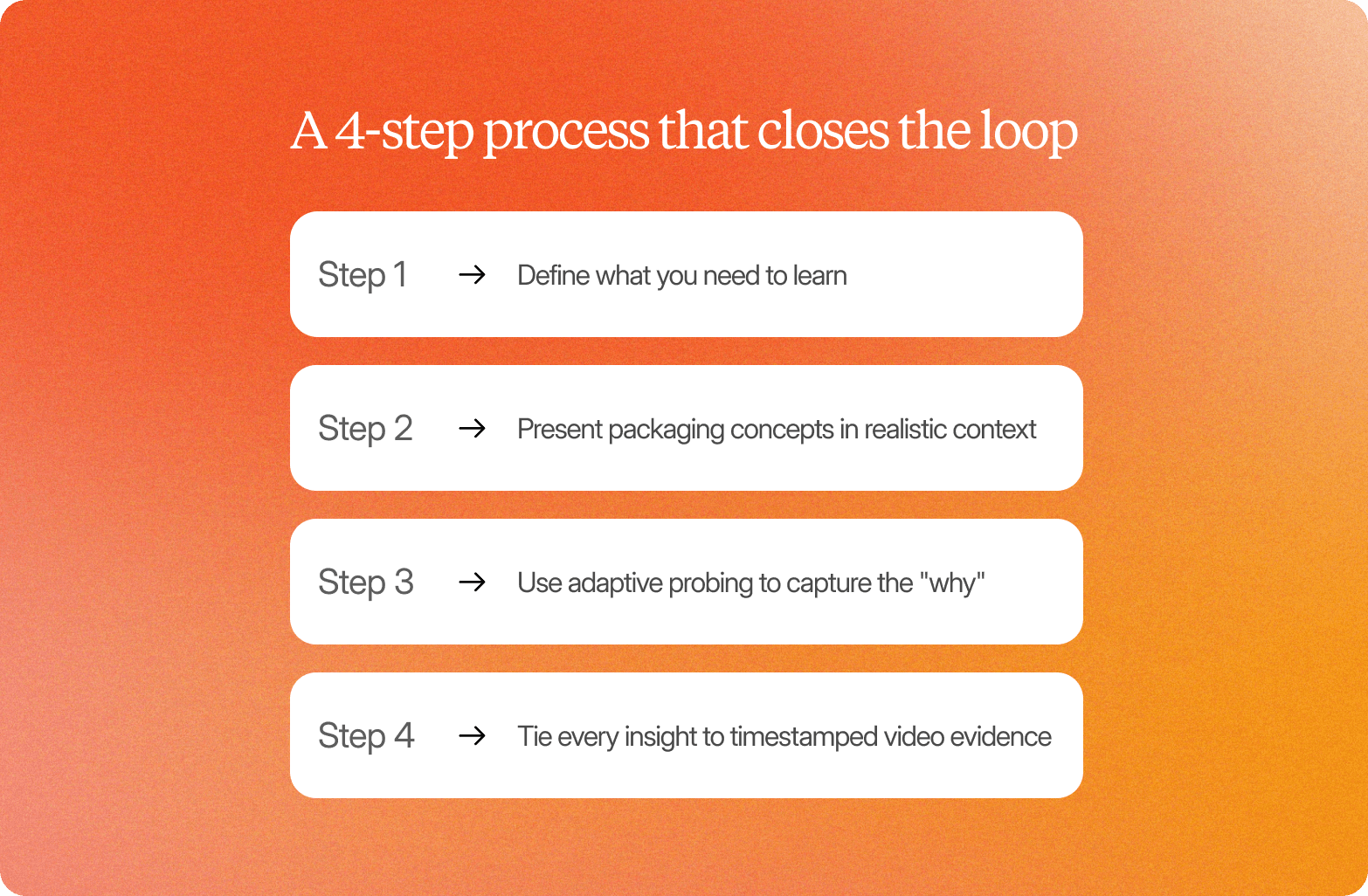
Step 1: Define what you need to learn
Packaging research covers four distinct questions, and each demands a different line of inquiry. Getting this right from the start is essential, since a poorly scoped study rarely yields findings a design team can act on, underscoring the importance of defining the question before recruiting a single participant.
Shelf standout: What catches the shopper's eye in the first 3 seconds, and does your design win that moment against the competition?
Claim comprehension: Do consumers understand the primary benefit, and do they believe it?
Perceived quality: Does the design signal the right price tier and category positioning?
Category fit: Does the package look like it belongs in this category, or does it create confusion?
Teams that try to answer all four in a single study typically get partial answers to each. A focused study built around one or two questions delivers findings clear enough to act on and to determine what changes before the final design ships to production.
Step 2: Present packaging concepts in realistic context
A design evaluated in isolation, centered on a white background with no neighbors, will elicit aesthetic feedback. A design evaluated in a realistic shelf set, surrounded by three to five competitor packages, will generate feedback on standout, category fit, and where it gets lost. Only one of those conversations predicts real purchase behavior.
For physical retail, build a shelf mockup using your concept alongside representative competitors. For e-commerce, shift the stimulus entirely: show the design as it appears in a mobile search thumbnail, a product detail page, and a scrolling feed, since a package that reads clearly at 12 inches may disappear at 120 pixels.
Step 3: Use adaptive probing to capture the "why"
Scripted questions produce scripted answers. When a consumer says "I like it" or "it feels interesting," that response tells a brand team nothing actionable about whether the design will drive purchase.
Conveo's AI moderator follows up on vague responses in real time, the way a skilled human moderator would. If a participant says the packaging feels premium, the moderator asks what specifically signals that: the color, material cues, typography, or the claims hierarchy. That probing happens across every session, at scale, without moderator fatigue flattening the depth of later interviews. This is where the real advantages of qualitative depth show up: teams stop guessing at ideas for improvement and start identifying specific design elements that move the needle. The power of Conveo's adaptive probing is that it turns customers' offhand reactions into evidence a design team can actually use, often revealing the exact difference between a package that wins the shelf and one that doesn't.
The output is diagnostic, not directional. Teams leave this step knowing which specific design elements are driving or blocking purchase intent, not just which concept ranked highest.
Step 4: Tie every insight to timestamped video evidence
Marketing, legal, and leadership stakeholders rarely approve packaging changes based on a summary slide. They want to see the evidence: who said what, in what context, and how they reacted.
Video-first packaging research answers the questions that demand it. Every consumer session produces timestamped clips tied to verbatim quotes, so stakeholders can watch the exact moment a participant hesitated over a health claim or read the back panel twice before putting the product down. Facial expressions, tone shifts, and hesitation all become part of the evidence record, not interpretations, but observable moments anyone can evaluate.
Survey data cannot do this. A preference score of 6.2 out of 10 tells you a design underperformed. It doesn't show you why or which specific element caused the drop, which is precisely the information improvement teams need before locking in a final design.
E-commerce packaging research: testing for digital shelf performance
Packaging research for e-commerce has a fundamentally different job than physical shelf testing. The question is no longer whether a design stands out at arm's length in a retail store aisle. It is whether the same design communicates brand, product, and primary benefit as a small thumbnail in a search results grid on a phone screen.
Three considerations separate digital shelf testing from traditional packaging research:
Thumbnail legibility: when a package appears as a roughly 200x200 pixel image in a search result, fine detail and subtle texture disappear entirely, so the research question becomes whether the brand name and primary benefit remain readable at that scale.
Mobile shelf context: a consumer scrolling through 20 or more options on a phone screen processes each product in under a second, a fundamentally different attention environment than a physical store aisle.
Claim verification behavior: consumers who notice a claim on a thumbnail, such as "clinically proven," often click through to the product detail page to verify it. Whether the packaging creates enough credibility to prompt that click is a question most concept tests never ask, even though how shoppers read a small claim at thumbnail size can determine whether they click at all.
Effective e-commerce packaging research presents stimuli in realistic digital contexts and probes for claim credibility and verification intent, not aesthetic preference. Conveo's AI-moderated video interviews support exactly this: researchers can present packaging mockups in simulated e-commerce environments and use adaptive probing to capture which design elements consumers notice first, which claims they trust, and which competitors they mentally compare the pack to while scrolling.
Running packaging research with Conveo
Packaging decisions are cross-functional, high-cost, and time-boxed, exactly the combination that makes them hard to research well under a traditional timeline. Conveo, a video-first AI research platform, is built for that combination, and it's a meaningful advantage for any company that needs to move fast without cutting corners on rigor.
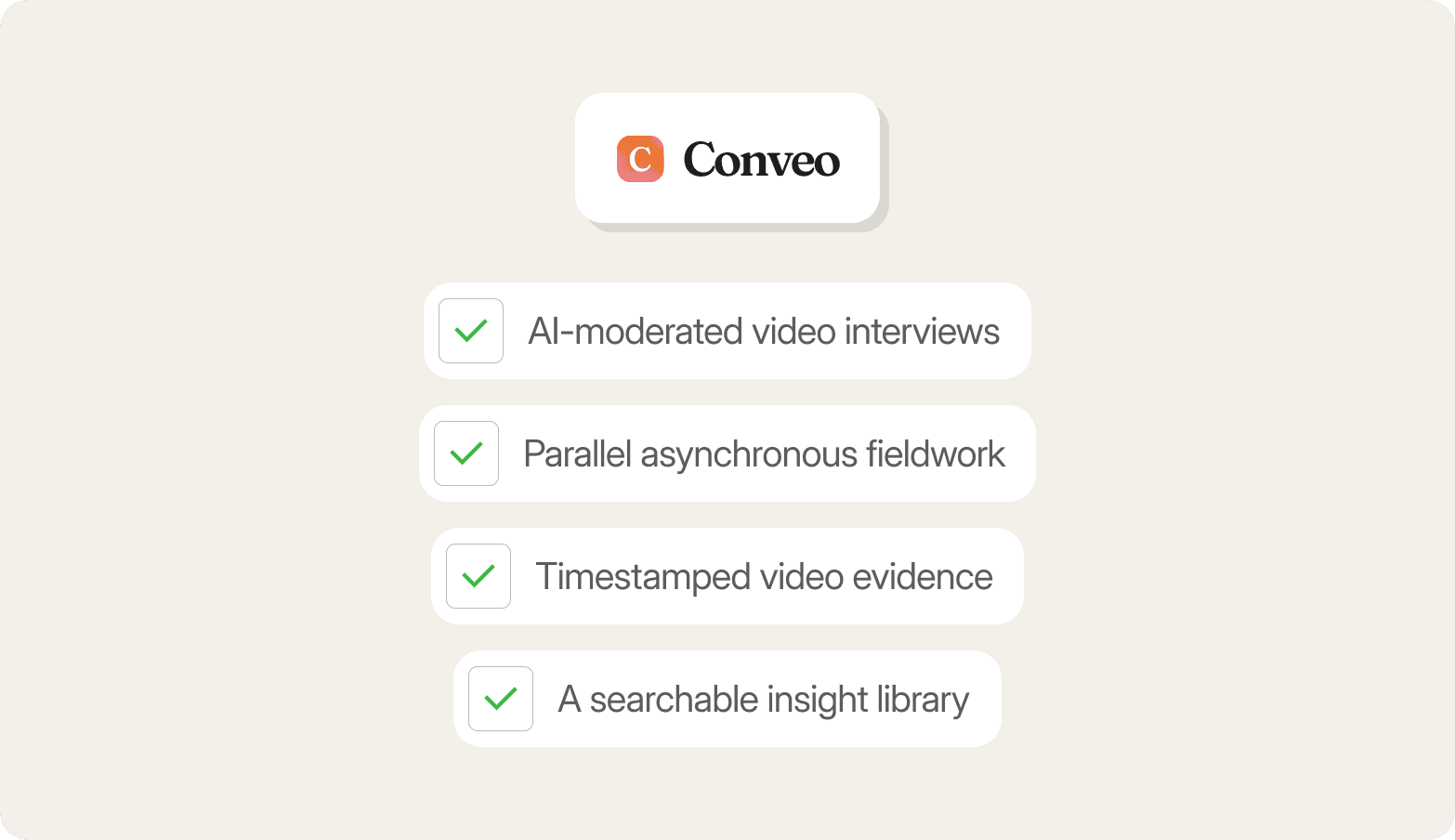
Four capabilities matter most:
AI-moderated video interviews that preserve adaptive probing
Parallel asynchronous fieldwork that compresses what used to take around six weeks into days
Timestamped video evidence that gives marketing, legal, and leadership a shared, defensible record
A searchable insight library that keeps prior claim tests and design-round reactions accessible across studies
Combined, these capabilities give research and brand teams a repeatable way to test new product ideas without having to rebuild the process each time.
See it in action: How to Run Concept and Messaging Tests Using AI-Moderated Video Interviews →
A team can upload packaging mockups, define target segments, and launch a study in under 30 minutes. The result is not faster surveys. It is qualitative depth, with the traceability stakeholders demand, on a timeline that lets the findings actually change the pack, and a measurable improvement over the six-week status quo.
Frequently Asked Questions
What is packaging research?
What are the main packaging research methods?
How long does packaging research take?
What is a packaging research paper?
Where can I find packaging research articles?
How do I test food packaging with consumers?