In this article
TL;DR
Ad creative testing validates campaign concepts with a brand's target audience and target market before media spend and ad spend are committed to the next ad campaign
Survey-based scores tell you which concept won and reflect broad consumer preferences; qualitative diagnostics deliver the in-depth understanding of why
AI-moderated interviews link every theme to timestamped video clips and verbatim quotes, turning survey responses and interview transcripts into valuable insights rather than raw collected data
A research-grade framework tests clarity, relevance, and differentiation, the key metrics that predict campaign success rather than stopping at sentiment
A searchable insight library compounds learnings across studies so every brief for future campaigns starts from what was already learned
Multi-market testing runs as a single program across 50+ languages rather than fragmented regional workflows
Ad creative testing too often ends in a conference room argument. A stakeholder challenges a recommendation, the researcher reaches for a slide deck, and the conversation stalls because nothing connects a strategic call to an actual human reaction. Preference scores say concept A beat concept B by eleven points. They do not say which line of copy made a 34-year-old pause, or why the visual hierarchy felt off to three participants in three different ways.
The gap is structural. Survey-based A/B scores measure outcome without capturing mechanism. A number tells you what won; it cannot tell you which word, image, or claim triggered the response, or what it reveals about consumer preferences more broadly.
AI-moderated interviews close that gap. In this method, an AI guides participants through a structured discussion asynchronously, probes reactions in real time, and captures video responses without requiring a live human moderator. Every theme links directly to timestamped video clips and verbatim quotes. When a pattern surfaces, a researcher can play back the exact moment it happened. Creative decisions rest on auditable evidence, and marketing teams gain insights they can defend in the room.
Skipping pre-launch validation carries a measurable cost, and the risk starts from the very beginning of the creative process:
Media budget locks into a direction before anyone outside the creative team has reacted to it, turning a bad idea into one of the costly mistakes a quick revision could have caught
Creative debates default to seniority or opinion instead of evidence
Underperforming ads surface only after spend is committed, when the fix is a relaunch rather than a revision
Teams repeat the same creative mistakes across advertising campaigns because no one captured why the last one missed, which quietly caps campaign effectiveness over time
What ad creative testing reveals (and what it misses)
Ad creative testing validates campaign concepts with real consumers before a single dollar of ad spend goes into media. The goal is straightforward: find out how a creative concept lands with the intended audience before it runs, not after.
"The pace, responsiveness, and research expertise of the Conveo team, on top of the top AI-moderated qual platform, has been invaluable to us in scaling brand advertising"
Matt Harris, Research & Insights Lead, EMEA, Canva
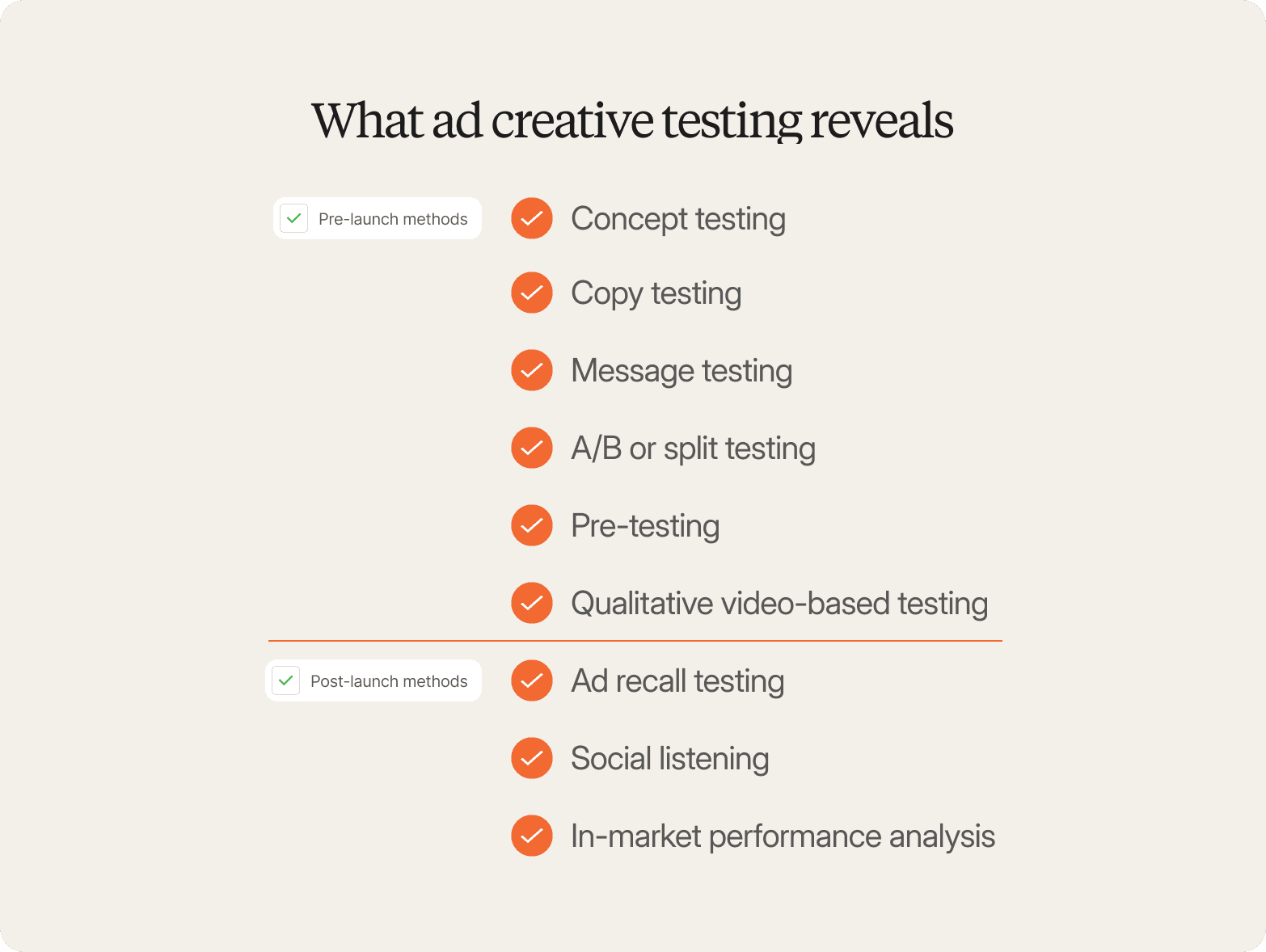
Ad creative testing spans several distinct methods, each suited to a different stage of the development process.
Pre-launch methods:
Concept testing: validating the core creative concept, as distinct from a product concept, before production
Copy testing: evaluating specific headlines, claims, and value propositions
Message testing: checking whether the core message resonates with the target demographic before creative production begins
A/B or split testing: comparing finished variants head to head
Pre-testing: fielding a completed ad before wide release
Qualitative video-based testing: probing reactions in depth with a smaller sample
Post-launch methods, used to measure advertising effectiveness:
Ad recall testing: what viewers remember after exposure
Social media monitoring: public reaction once a campaign is live
In-market performance analysis: CTR, conversion, and brand lift
This guide focuses on pre-launch methods, with the goal of catching a problem before media spend is committed.
Survey-based ad concept testing, a form of quantitative research, is the most common starting point. Online surveys deliver preference scores, attribute ratings, and purchase intent metrics that tell you which creative variant wins in a forced-choice comparison. This is typically where monadic testing comes in: each respondent group sees a single ad, or one ad concept, in isolation, which keeps survey length manageable and removes the risk of one execution anchoring reactions to the next. Careful survey design and disciplined writing of survey questions matter here, since the wrong survey components can flatten nuance the target audience would otherwise surface. For teams making binary go/no-go calls under deadline pressure, that signal from potential customers is useful, regardless of which available testing method produced it. But the method has a ceiling. When a participant rates a concept 7 out of 10 and says "it's interesting," a static survey moves on. The follow-up that would reveal whether "interesting" means genuinely compelling or politely confused never gets asked.
Video-based qualitative methods, sitting closer to qualitative market research than to quantitative research, capture what scores cannot, trading breadth for an in-depth understanding of a smaller group. A pause before answering a question about a product claim, a shift in vocal tone from engaged to flat: these signals often predict skepticism before it shows up in campaign performance data. When body language signals "too good to be true," that response appears in the video record long before it registers in a brand perception metric. Natural language processing over interview transcripts and verbatim quotes can also surface consumer responses and audience reactions that a closed-ended survey question would never capture.
Both approaches answer different questions, and the split mirrors the wider divide in qualitative market research between depth and scale. The choice between them depends on what the team needs to know before launch. For more on the tradeoffs, see our guide to AI-moderated interviews.
Why traditional qualitative ad testing arrives too late
The research arrives. The media plan is already signed. That sequence plays out more often than most insights teams want to admit, and the cause is structural: the research calendar and the media calendar run on different clocks.
Traditional qualitative testing cycles run 6 to 12 weeks from brief to findings: recruiting participants, coordinating schedules across time zones, running focus groups or depth interviews, and synthesizing the findings. Focus groups and in-depth interviews remain valuable when real-time group dynamics or extended rapport-building are important, but they introduce scheduling constraints that can delay the delivery of findings beyond the decision window.
By the time creative recommendations land in a deck, the campaign flight is locked, the assets are in production, and the budget is committed. Pre-launch ad testing often becomes a post-hoc exercise because the decision window closed before the research could close with it. For teams supporting innovation, brand, and marketing simultaneously, that lag compounds across every study in the pipeline, slowing advertising campaigns already behind schedule.
Validating creative before production spend locks in
The practical opportunity is validating concepts at the rough-cut stage, when creative direction is still adjustable, rather than after production spend is committed. That means getting findings into a brief while the brief can still change, and while lightweight message testing can still reshape a promising creative concept rather than scrapping it.
AI-moderated, asynchronous interviews make that timeline realistic. Participants respond on their own schedule, across time zones, without waiting on a calendar invite. Because interviews run in parallel rather than back-to-back, a study that would take a human moderator weeks to field can be completed in hours. Analysis synthesizes as sessions close, not after the last one wraps. Some teams report moving from weeks to days for campaign concept testing, and that compression comes from removing wait states that had nothing to do with research quality in the first place.
Conveo is built by researchers, so that expanded capacity does not come at the expense of the rigor insights teams are professionally accountable for. Every theme surfaces linked to timestamped video clips and verbatim quotes. When a creative director asks why the second concept tested stronger, the answer is auditable evidence. Teams can validate campaign concepts and bring that evidence directly into stakeholder reviews, with the source material one click away, turning gathering feedback into a repeatable step in the development process rather than a one-off scramble, so the whole team can gain insights from the same clip instead of a paraphrased slide.
What to test: A research-grade framework for ad creative validation
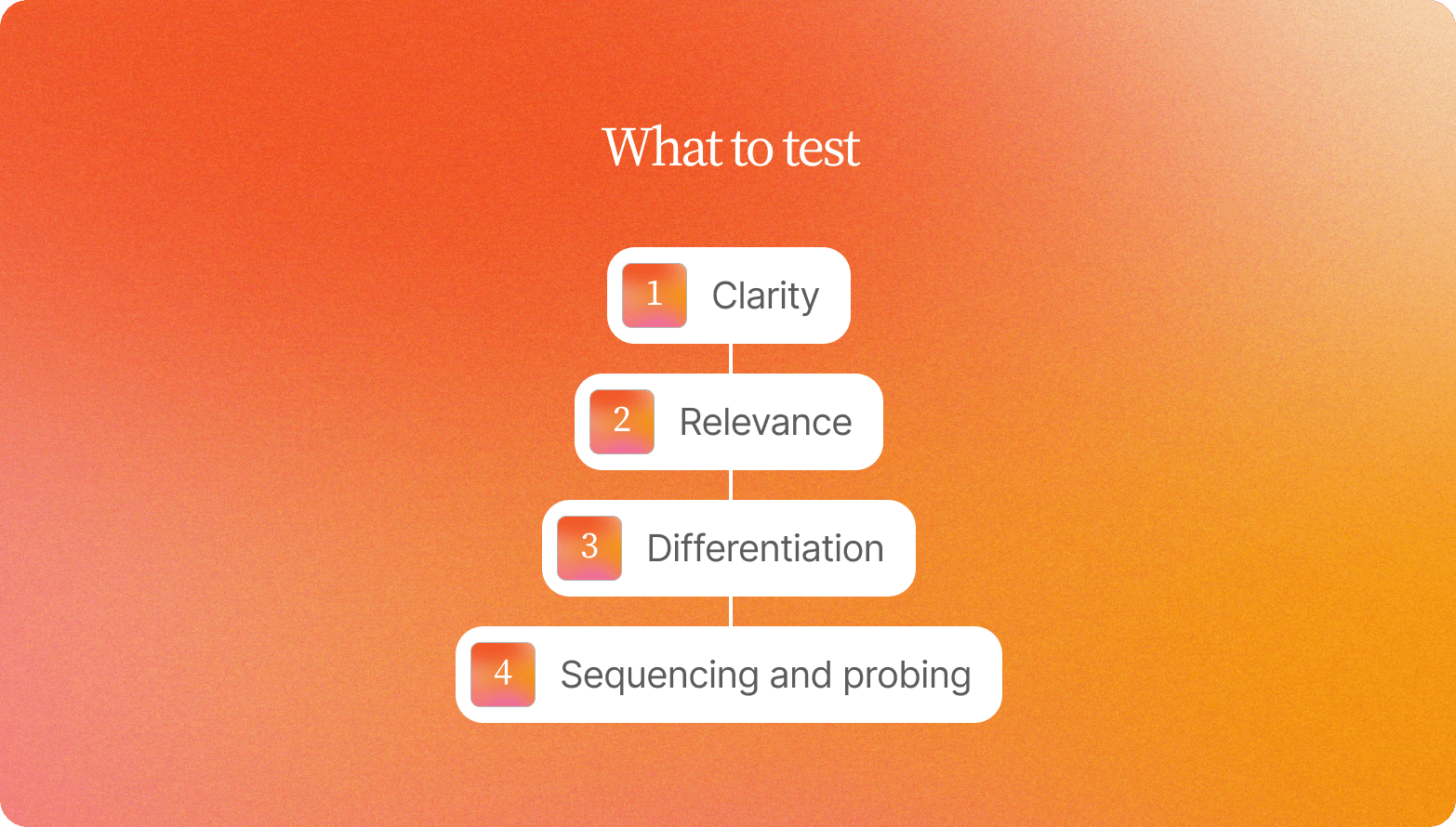
Most ad creative validation stops at sentiment. Researchers ask whether viewers like the creative, whether it feels on-brand, whether the visuals are appealing. Those questions have their place, but they leave the behavioral question open.
Most ad testing frameworks measure eight to ten surface attributes:
First impressions
Standout
Appeal
Engagement
Believability
Brand fit
Uniqueness
Purchase intent
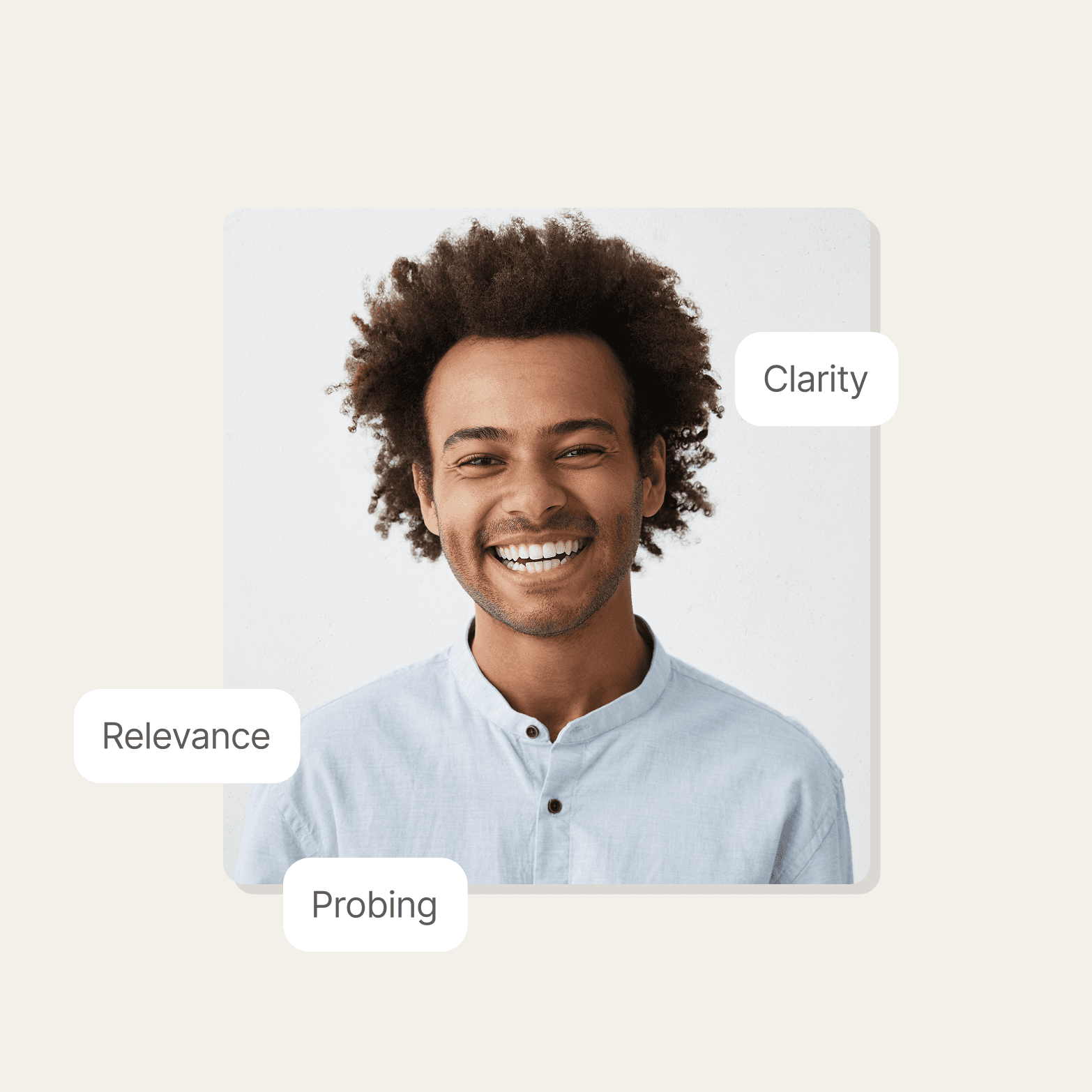
Those attributes describe reaction. Three questions explain whether the creative will change behavior, and they organize everything else, serving as the key metrics that matter most. Each is a key component of a research-grade framework. A few examples make each one concrete.
Clarity
Can a viewer immediately understand the offer and who it is for, without context or explanation? Test this by asking participants to describe, in their own words, what the ad is selling and who it seems to be aimed at after a single exposure. If their answer diverges from your intent, the creative is doing interpretive work that the target audience will not do in the real world. Clarity failures are usually fixable at the copy level, but they need to be surfaced before production spend locks in the execution.
Relevance
Relevance measures whether the problem the creative names matches the problem the target market actually has, in the language they actually use. Map participant reactions and customer preferences against the words and phrases they used to describe their own situation before you showed them anything. When the creative uses internal product language that does not align with participants' problem language, the value propositions on the page earn recognition without resonating.
Differentiation
Ask participants directly: how does this compare to what you already use or already see in-market? Do not let this stay implicit. Differentiation has to exist in the participant's mind to count as the competitive advantage the media plan assumes it will be. If participants cannot articulate what makes this distinct from their current choice, the creative is not doing the competitive work your media spend assumes it will do, and it will struggle to build brand perception over time. For structured approaches to competitive differentiation, see our guide to MaxDiff analysis.
Sequencing and probing
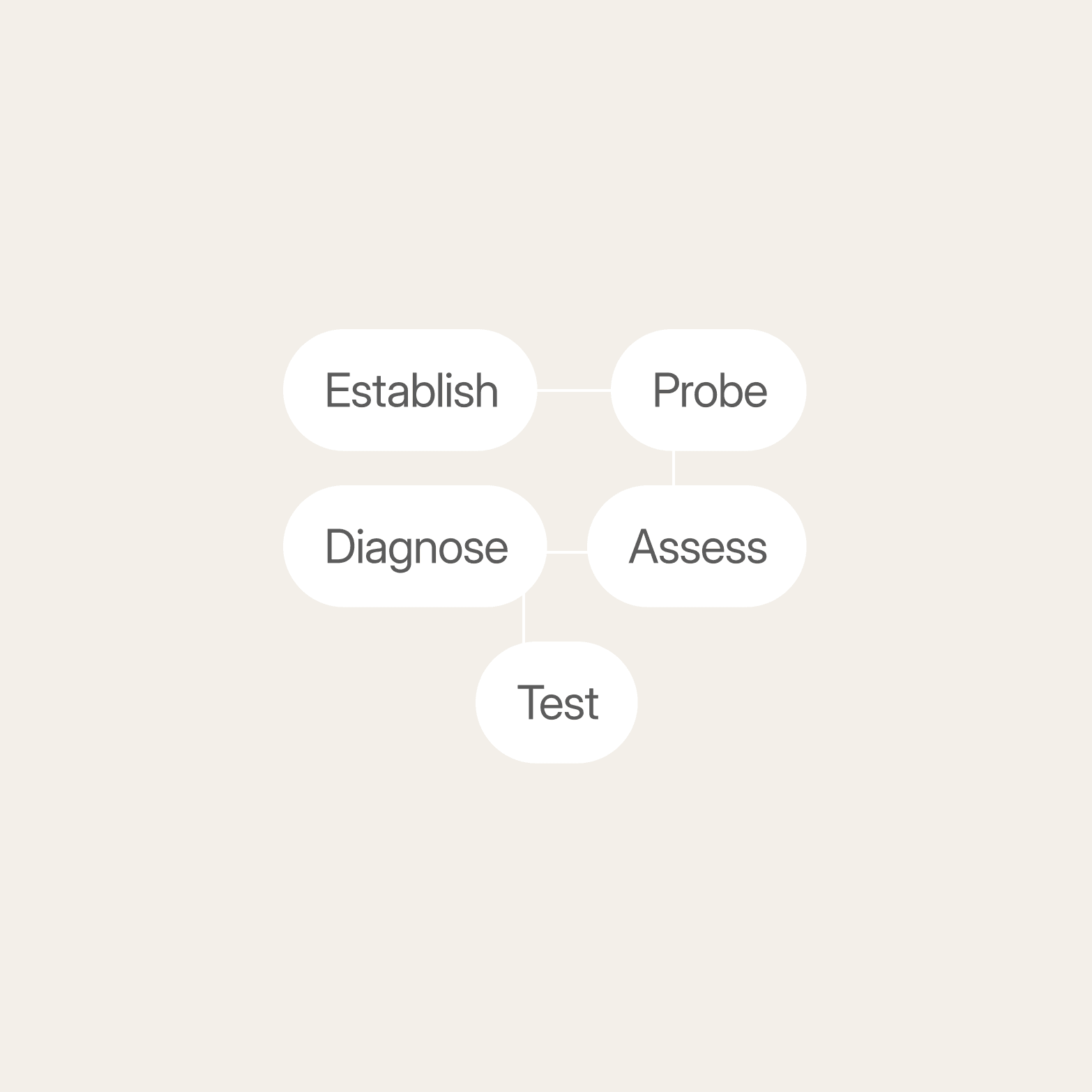
Establish baseline behavior before showing any creative, starting from the very beginning of the session rather than jumping straight to reactions. Ask what participants currently use, how they found it, and what would have to change for them to consider something else. Reactions then have a real comparison point rather than floating in the abstract, and the emotional engagement a creative concept generates means more once it is measured against that baseline.
Two probing questions generate the most actionable insights and revision guidance:
Displacement questions: "What would you stop using or ignore to make room for this?" A creative that earns enthusiasm but cannot displace anything is too weak to change behavior.
Switching criteria questions: "What would need to be different for you to choose this over what you use now?" The answers rewrite your brief more precisely than any rating scale.
Together, they turn potential customers into a source of new ideas the creative team would not have generated alone.
When a brand wants to test multiple concepts rather than a single execution, the same logic scales, with two caveats. Testing multiple concepts, or several creative ideas and ad ideas side by side, only works if the study design accounts for order effects; showing too many concepts to one participant flattens their ability to form a clear opinion on any single one. Most research-grade studies cap a session at three to four concepts for this reason, then use the same clarity, relevance, and differentiation questions to identify the most promising concept rather than relying on a simple popularity vote.
How to get from winner metrics to creative direction
Preference scores tell you which ad won. They do not tell you why the opening frame created confusion, why the hero claim landed flat with one persona but triggered belief in another, or which line made participants lean back rather than forward. Campaign creative testing that stops at ranked scores leaves the creative team with a verdict and no brief.
Watch the walkthrough: How to Run Concept and Messaging Tests Using AI-Moderated Video Interviews
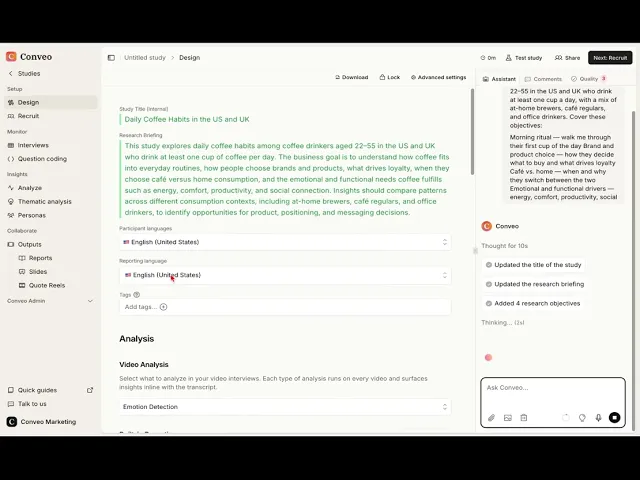
Structured qualitative diagnostics change what the team walks away with. Consumer feedback at this level maps what participants noticed first, what they misread, what triggered genuine belief, and where resistance formed, all tied to specific scenes, lines, or claims. This is where valuable data turns into valuable insights: the moderator gathers the specific feedback that maps to a fix.
The evidence problem surfaces fast when stakeholders push back. Audience personas and "insight themes" built in workshops cannot survive the question "who said this?" There is no clip to play, no verbatim to quote, no timestamp to point to. The finding becomes a summary that someone assembled, and in a room of skeptical senior stakeholders, summaries without sources lose.
Conveo's AI-moderated interviews close that gap directly. Every theme links back to timestamped video clips and exact participant quotes, so the finding is auditable. When a creative director asks why a particular headline failed, the answer is the moment on video when a participant paused, reread the line, and said they did not believe it, giving marketing teams a valuable tool for resolving the debate on the spot.
Multi-market ad creative testing as a single coordinated program
Ad testing across multiple markets typically means separate workflows per region: a brief for each local partner, separate moderation teams, fragmented fieldwork timelines, and findings that arrive in different formats weeks apart.
The deeper problem is that translation alone does not solve cultural fit. Creative that resonates in one market can fall flat or misfire in another due to humor conventions, visual symbolism, or cultural associations that a translated script cannot surface. A voiceover that sounds warm and authoritative in German may read as cold in Brazilian Portuguese. An image that signals aspiration in the US may carry different class connotations in the UK, and consumer responses to the same creative assets can vary sharply as a result.
Conveo's AI moderator conducts interviews in 50+ languages, so a multi-market study runs as a single, coordinated program rather than a series of locally managed engagements. Participants in each market respond to creative stimuli in their native language, matching the intended audience for that market, and the AI moderator probes reactions with the same methodological discipline across every session. All findings feed into a searchable insight library, so a global insights team can compare audience reactions across markets without manually reconciling reports.
Consistency also depends on design discipline. Sequential monadic testing, sometimes called sequential monadic exposure, means every participant sees each creative variant in the same rotated order, rather than each variant being tested with a separate group as in standard monadic testing. That rotation keeps reactions to a later concept from being anchored by whichever one came first, and it is the standard testing method for comparing multiple concepts within a single market.
A senior researcher at a European telecoms company described the shift: running sequential monadic testing consistently across all markets, without fragmented agency workflows, meant cross-market patterns surfaced in one place rather than across disconnected decks. For more on managing complexity across regions, see our guide to multi-market research.
How to run a defensible ad creative testing pilot
Some teams run a single pilot campaign to test multiple concepts before committing to a full rollout. The most important question when deciding how to test ad concepts is whether your current method produces findings your creative team actually acts on. Most survey-based ad testing tells you which concept scored higher. It rarely explains why the second scene felt confusing, why the voiceover undermined the message, or what a specific target demographic would need to change their minds.
The most practical pilot structure is a parallel run:
Take one campaign in active development and run AI-moderated interviews alongside your existing survey-based concept testing.
Use the same stimuli, timing, survey design, and participant criteria to avoid confounding the comparison with shifts in customer preferences.
At the end, compare the outputs rather than the scores: which method gave your creative director something to work with, and which one actually points toward campaign success?
For enterprise teams, the governance question often arrives before the methodology question. SOC 2 Type II certified, GDPR compliant, EU hosting (Belgium) means legal review does not become the reason a pilot never launches. For teams evaluating qualitative approaches alongside traditional methods, see our comparison of focus groups and AI-moderated interviews.
The compounding benefit is what makes the pilot worth running beyond a single campaign. Every creative learning, whether a message that resonated or a visual that confused, flows into the searchable insight library, helping the team spot the most promising concept faster next time. The next brief for the ad campaign starts from what was already learned, not from zero, which, over time, supports brand growth and a durable competitive advantage rather than just a single launch.
Considerations
Sample size limits what you can claim
Sample size is a key component in correctly interpreting any test, whether the study is qualitative or quantitative. Qualitative ad creative testing with 15 to 25 participants surfaces patterns and reasoning, not statistically projectable percentages. Findings reveal why participants react the way they do, which claims trigger skepticism, which visuals create confusion, but they do not deliver the statistical confidence intervals that a 200+ sample survey-based test, grounded in quantitative research, provides. Writing survey questions that hold up across 200-plus respondents also takes a different discipline than probing 15 to 25 participants in depth.
Qualitative and quantitative work together
For teams making high-stakes go/no-go budget decisions where quantified preference margins matter, qualitative testing works best alongside survey-based validation. Use qualitative diagnostics to understand why a concept wins or loses, and survey-based testing, with its longer survey length, larger respondent pool, and higher response volume, to confirm how decisively it wins across a representative sample and back up the call with data-driven insights.
It measures pre-launch potential, not in-market performance
Ad creative testing validates concepts before launch; ad performance testing (CTR, CPA, conversion rates) measures what happens once a campaign is live. The two methods answer different questions at different stages of the campaign lifecycle, and conflating them is a bad idea that leads to costly mistakes down the line.
Why Conveo for ad creative testing
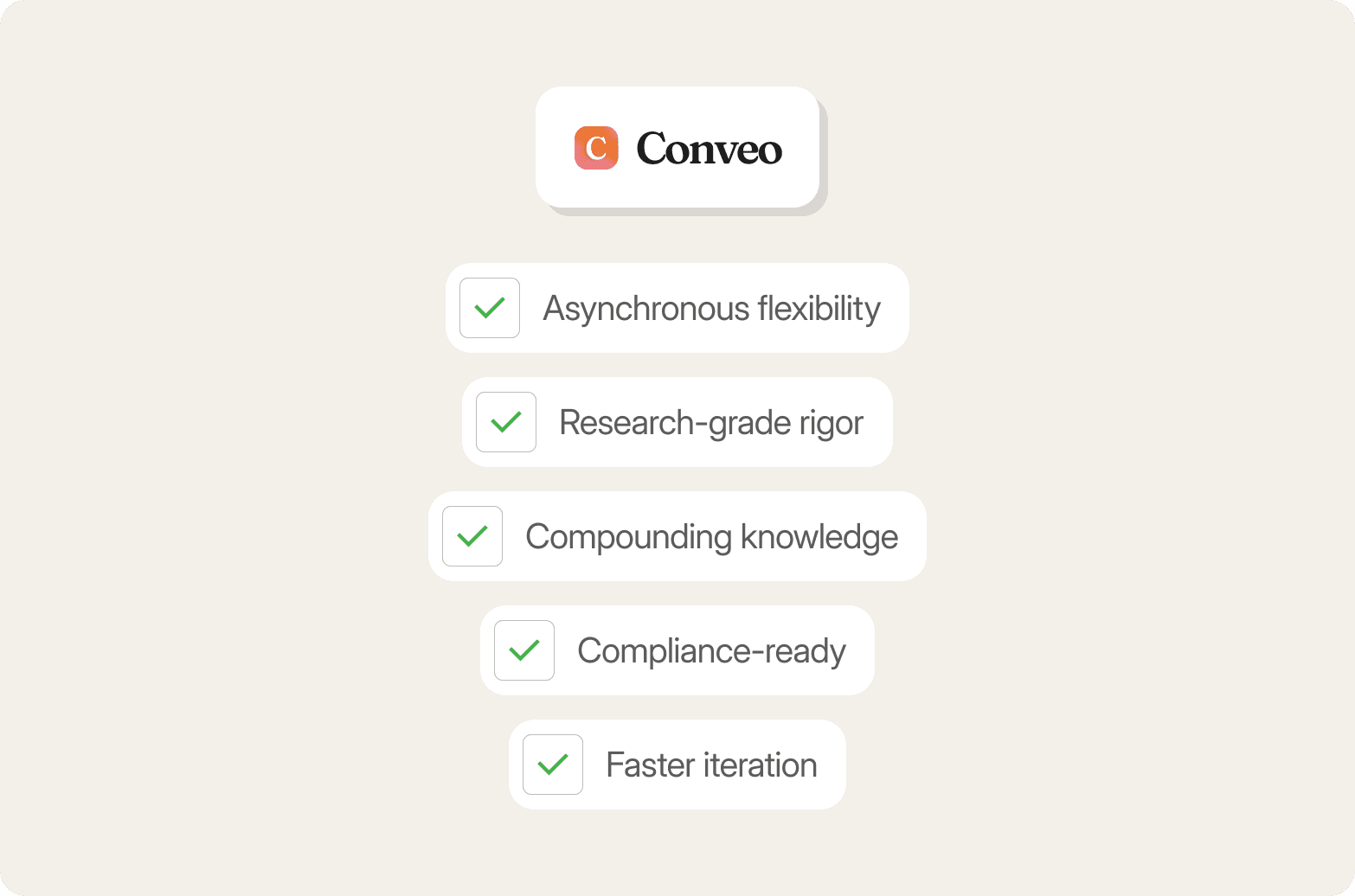
Ad creative testing needs a method that gives creative teams something to act on, and a valuable tool for judging advertising effectiveness before spend locks in. Conveo is built for that outcome.
Asynchronous flexibility
Conveo runs on demand rather than on a moderator's calendar, so creative validation fits within a campaign's production timeline. Research happens when you need it, without scheduling constraints that push findings past the decision window.
Research-grade rigor
Conveo is built by researchers, and every theme surfaces linked to timestamped video clips and verbatim quotes. Findings are auditable, which is what turns collected data into data-driven insights a creative director can act on, rather than leaving valuable data stranded in a spreadsheet.
Compounding knowledge
Every study feeds into Conveo's Knowledge Layer, a searchable insight library that connects findings across campaigns, markets, and time in service of long-term brand growth. The next brief for future campaigns starts from what was already learned, surfacing new ideas the team would not have generated from a single study alone, so understanding compounds rather than resets and campaign effectiveness improves with every wave.
Compliance-ready
SOC 2 Type II certified, GDPR compliant, EU hosting (Belgium) means enterprise governance requirements are addressed from the start.
Faster iteration
Some teams report moving from weeks to days for creative testing cycles, which means more concepts validated, more often, and more actionable insights before production spend locks in.
Frequently Asked Questions
What are some ad creative testing examples?
Ad creative testing examples range from simple concept-recall checks to full sequential-exposure studies. A few examples show the range: a single-market concept test comparing early-stage ad ideas, a sequential monadic study comparing several creative ideas without testing too many concepts at once, and a post-launch recall study. In a representative scenario, a CPG brand testing a product concept and its launch ad for a new snack line might structure the study in four stages. Establish baseline behavior: what snacks they currently buy, how often, and what drives those choices Show the creative Probe clarity: did participants understand the product benefit from the first frame? Probe relevance and differentiation together: does this snack solve a problem they actually have, and what would they stop buying to make room for it? The output connects every theme to timestamped video clips and verbatim quotes, so the creative team sees exactly which claim triggered skepticism and which participant segment responded differently, gathering feedback that a single ad's performance data alone could not surface.
Can I do ad creative testing for free?
Free options exist, and they are worth understanding before committing budget. Online surveys and social media polls can return basic A/B preference scores quickly, giving you a directional read on which concept a sample of people preferred. For early-stage creative exploration, that signal has value, even without the more sophisticated survey components a dedicated research team would normally build in. The limitation is what those scores cannot tell you: which specific headline, visual, or claim created the gap, or whether the winning concept still carries an element that will confuse part of your audience. When a participant tells a static survey "it's interesting," the survey moves on without follow-up to find out whether "interesting" meant genuinely compelling or politely dismissive. For teams making consequential creative decisions, that distinction is often where the most useful feedback lives. AI-moderated interviews link every theme to timestamped video clips and verbatim quotes, so a creative director can see exactly which line caused hesitation.
How do I test ad creative across multiple markets?
Multi-market ad creative testing requires methodological consistency: the same discussion guide structure and sequential monadic testing across all markets make results comparable. See the "Multi-market ad creative testing" section above for the full approach. The key is that all findings feed into a single searchable insight library, so cross-market patterns surface in one place rather than across disconnected decks.
What is the difference between ad creative testing and ad performance testing?
Ad creative testing is pre-launch validation with real consumers: it surfaces why a piece of creative works or fails before any media budget is committed. Ad performance testing is in-market measurement that uses metrics such as CTR, CPA, and conversion rates to identify which variant wins once a campaign is live. The two methods work together. Creative testing informs what goes into market. Performance testing confirms whether it lands as predicted. The problem is the gap between them. Performance metrics tell you which ad won. They do not tell you why the losing ad failed or what to change. Qualitative ad testing closes that gap by capturing the reasoning behind the reaction.
How many participants do I need for ad creative testing?
For qualitative ad creative testing, 15 to 25 participants per creative variant is typically sufficient to reach thematic saturation. At that sample size, recurring patterns in emotional engagement, message comprehension, and brand fit emerge clearly enough to inform a confident decision. The logic differs from survey-based ad testing, which requires 200 or more participants to achieve statistical confidence on preference scores. Qualitative research prioritizes depth over breadth: you are looking for the why behind a reaction, not a percentage that prefers version A. Running interviews in parallel means separate cohorts can evaluate different creative variants simultaneously, which makes fast iteration practical whether you are running monadic testing or a full sequential monadic design.
Can I test video ads and static ads the same way?
Yes, but the probing strategy differs by format. For video ads, probing targets comprehension at specific moments: did participants understand the offer by the three-second mark, and would the same cut work if it were the only clip from one ad they ever saw? Artificial intelligence-assisted analysis, including natural language processing over open-ended responses, captures tone shifts and facial cues that signal when a claim feels exaggerated or a scene transition feels abrupt. For static ads, probing focuses on visual hierarchy (what did they notice first?), headline clarity (did the offer land from the headline alone?), and stopping power (would this creative make them pause mid-scroll?). What stays consistent across both formats is the evidence standard: every finding should trace back to timestamped video clips or verbatim quotes tied to specific creative assets.

About the author
Dieter De Mesmaeker
Co-Founder & CEO
Dieter is CEO and co-founder of Conveo. Before starting the company, he founded DataCamp and scaled it into one of the leading edtech platforms in the world.
More by Dieter →Qualitative insights at the speed of your business.
Conveo runs AI-moderated video interviews and structures everything they say.