In this article
TL;DR
When qualitative interviews follow a fixed script, they often produce surface-level answers that confirm what teams already know.
The most valuable insights come when participants have space to speak freely and know when to ask deeper follow-up questions.
This guide includes a reusable interview template and a practical framework for asking follow-up questions, so you can get more in-depth findings in less time and with less effort.
Qualitative interviews are one of the most effective methods for qualitative research you can run to understand how people think and make decisions. But getting useful data from them is harder than it looks. If you're new to qualitative research interviewing, it can be difficult to know where to start. If you've run interviews before, you may have stuck to a fixed script and come away feeling like you missed something.
Both problems usually come down to the same thing: the interview wasn't designed to go deep enough, or the interviewer didn't know when to leave the script behind. This guide covers how to choose the right qualitative research method, interview guidelines for qualitative research, adaptive probing techniques, and how to run remote and async sessions.
What Is a Qualitative Interview?
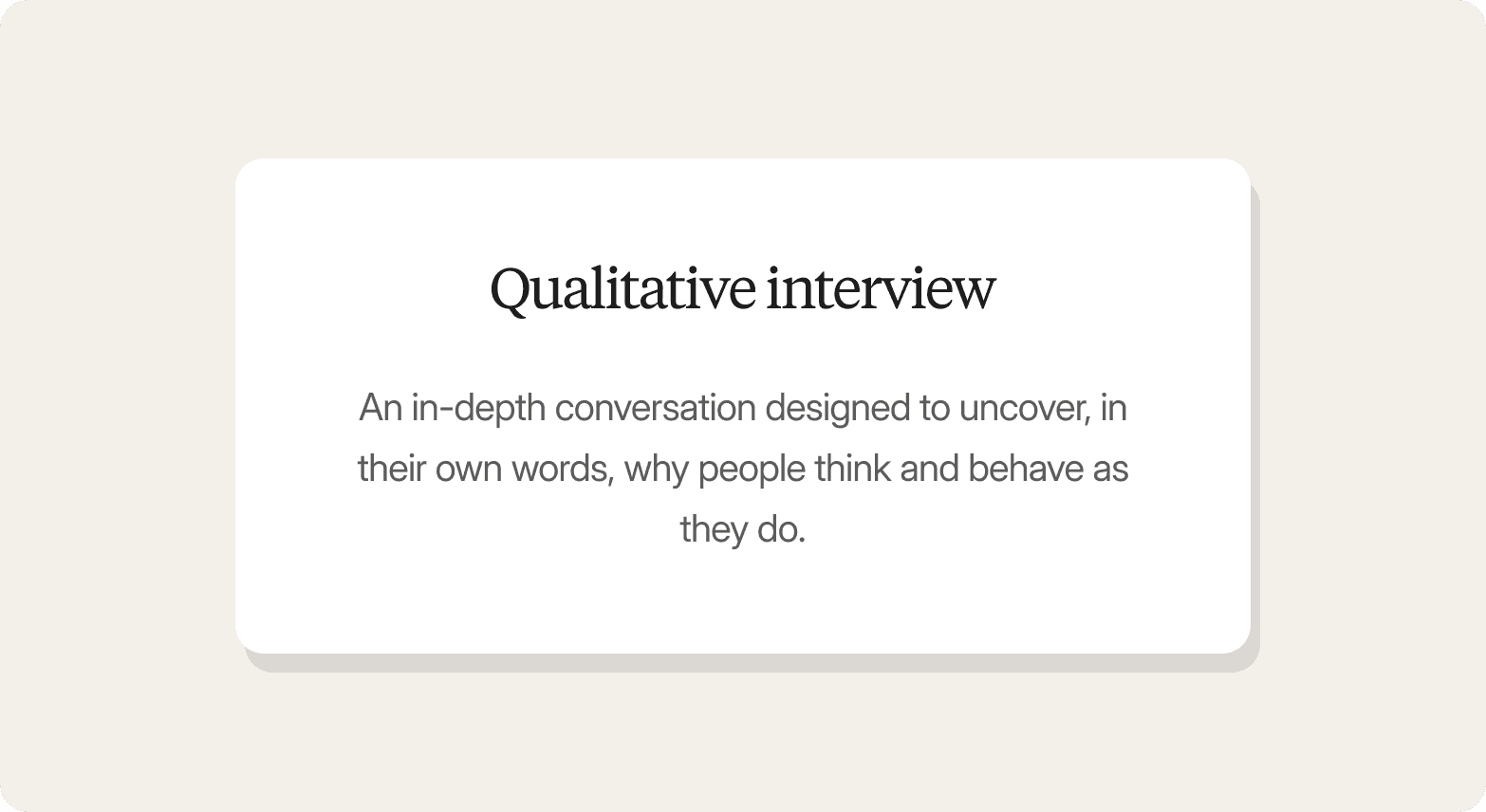
A qualitative interview is an in-depth conversation designed to uncover, in their own words, why people think and behave as they do. The interviewer asks open-ended questions to encourage more detailed information and create opportunities for unexpected or unique insights.
Surveys, by contrast, collect structured responses, such as asking participants to rate or choose from a range of predefined answers. Here are the main differences between the methods:
| Qualitative interviews | Surveys |
|---|---|
| Focus on understanding why people think or behave a certain way | Focus on measuring what people think or do |
| Use open-ended conversations | Use predefined questions and answer options |
| Allow follow-up questions and deeper exploration | Limited ability to dig deeper into responses |
| Produce rich, detailed insights | Produce structured, measurable data |
For example, a survey might tell you that 40% of customers abandoned a signup process. Qualitative methods like interviews help you understand why they abandoned it and what would have encouraged them to continue.
3 Types of Qualitative Interviews
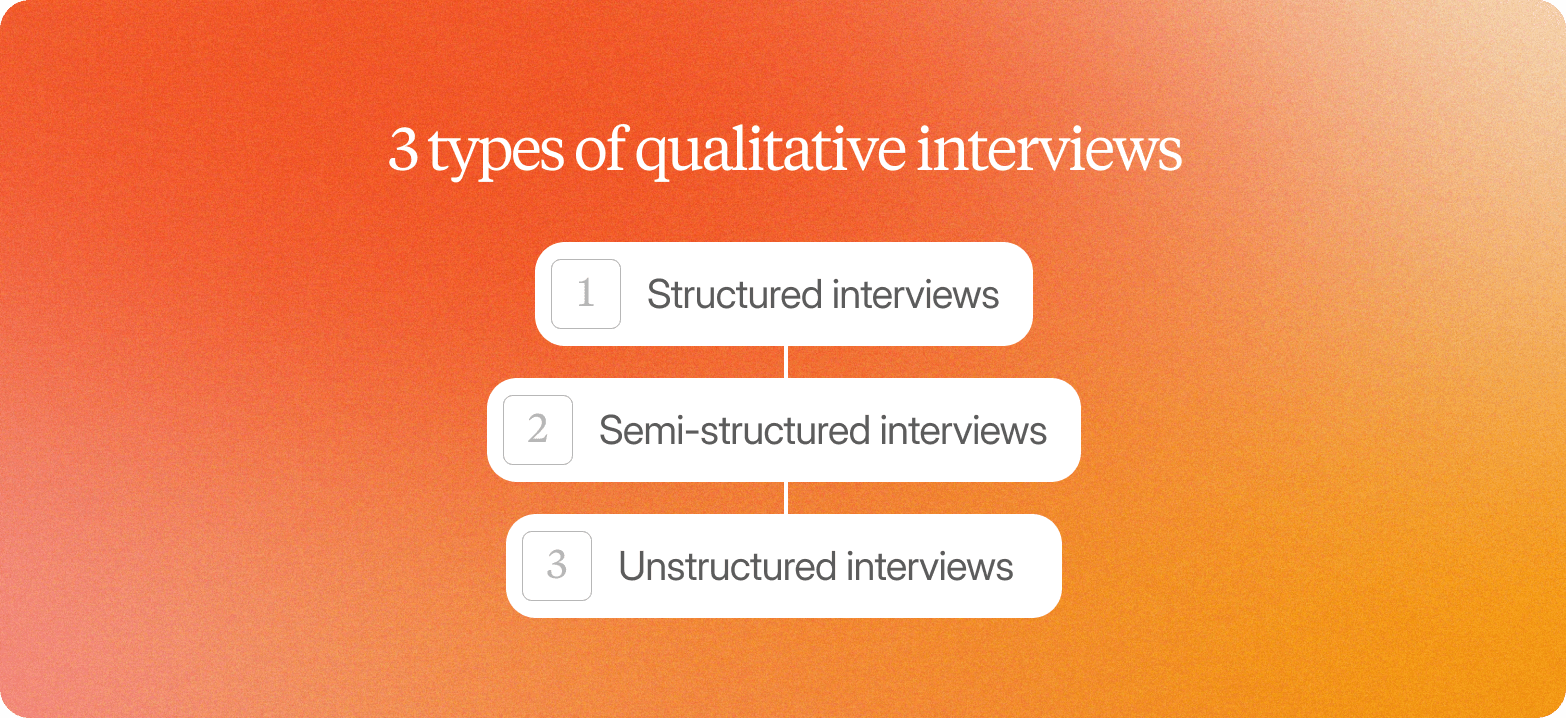
There are three ways to conduct qualitative interviews, depending on how much structure and flexibility your research topic requires.
1. Structured Interviews
Structured interviews use the same questions in the same order for every participant. Use this format when direct comparison between participants is the main goal.
For example, say a financial services team runs identical post-onboarding interviews. Because the questions are the same, the team can benchmark satisfaction scores across the segment.
If the questions were different, it would be impossible to tell whether differences in responses were due to real variation in customer experience or simply the way the questions were asked.
2. Semi-Structured Interviews
Semi-structured interviews are the most common format in business research. They use a set of core questions to keep things consistent while giving the interviewer room to follow up based on what each participant says.
This qualitative research method works well for studies where understanding the reasoning behind an answer matters more than strict comparability. For example, a product team testing a new signup flow might ask all users the same core questions, but probe further when someone mentions confusion or hesitation, to understand exactly where and why they got stuck.
Scaling this format has always been the challenge. Semi-structured interviewing, as a qualitative research method, requires skilled moderators and careful scheduling, and the consistent analysis of large amounts of qualitative data is time-consuming.
Conveo, a video-first AI research platform, makes semi-structured interviewing scalable by automating moderation and analysis, so teams can run more conversations without extra headcount or scheduling bottlenecks.
"The AI doesn't just summarize, it surfaces patterns I wouldn't have spotted reading transcripts."
CMI Lead, Edgard & Cooper
3. Unstructured Interviews
Unstructured interviews are open conversations with a few prepared questions, guided by the participant's responses rather than a fixed script. This format suits early-stage discovery or ethnographic research, where the goal is to explore a topic without strong assumptions.
For example, a team exploring whether there's a market for a new category of workplace tool might only ask potential users, "walk me through how you currently handle this," and let the conversation develop from there.
The trade-off is that responses are harder to compare across participants, and the quality of the data depends heavily on the interviewer's skill in guiding the conversation.
How to Make an Interview Guide for Qualitative Research
An interview guide is a structured document you can use to direct the conversation. It helps you stay focused on your qualitative research topic while also allowing room for the interview to flow naturally. Here’s how to write an interview guide for qualitative research in five simple steps:
Start with your research objectives. Write down what you need to know by the end of the interview. Remember to be specific. "Understand why users abandon the onboarding flow" is a usable objective, but "Learn about user experience" is too vague to get valuable data.
Translate objectives into topic areas. Group your objectives into 3 to 5 topic areas. These are usually stages of a journey or key themes, like onboarding or pricing. Each topic becomes a section of the guide with its own opening question and space for follow-up.
Write open-ended questions for each topic. Each topic needs a primary question that starts the discussion and invites a full response. Avoid yes/no formats and anything that contains the answer you're expecting.
Add probing prompts. Under each primary question, note 2 to 3 probes for when a participant's answer is vague, incomplete, or interesting. These are not asked up front, but used during the conversation to go deeper. “Can you walk me through that?” and “What happened next?” work across most topics.
Pilot test with 2 to 3 participants. This catches questions that confuse participants, topics that run long, and gaps you didn't notice when writing. Fixes usually involve rewording unclear questions, removing overlap, or changing the order of topics.
If you'd rather start from a proven structure than build from scratch, grab the interview guide for qualitative research template below.
Interview Guide Template (Downloadable)
Creating an interview guide for qualitative research from scratch takes time most teams don't have. Most follow the same structure: opening, core topics, probing prompts, and closing. But it's easy to miss something without a starting point.
Download this free interview guide for qualitative research. Inside, you’ll find a complete qualitative interview protocol, including a filled-in example of a qualitative interview in a product discovery context, ready for you to adapt to your own research topic.
The Probing Framework: What to Ask Next
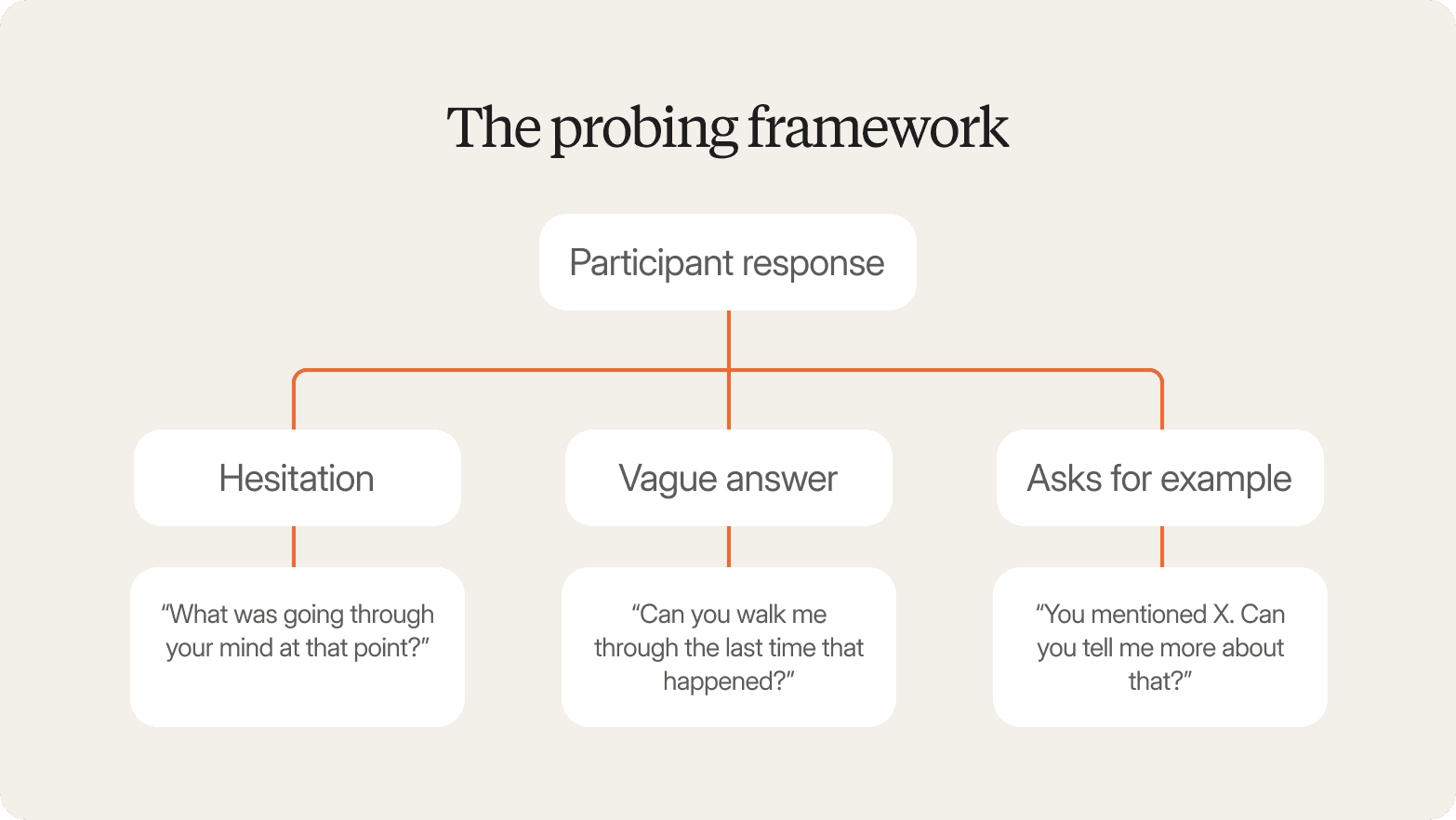
If an interviewer moves on too quickly before fully exploring an answer, the output can feel surface-level. Adaptive probing is the skill that helps turn a basic response into something more useful.
What you ask next depends on how the participant responds:
When they hesitate, explore emotion. Hesitation can signal uncertainty, discomfort, or something they are not fully saying. Ask: “How did that make you feel?” or “What was going through your mind?”
When their answer is vague, ask for a specific example. General comments like “it’s not very intuitive” are hard to act on. Ask: “Can you give a specific example?” or “Can you walk me through the last time that happened?”
When they say something unexpected, follow up before moving on. These moments often contain the most useful insight. Ask: “You mentioned X. Can you tell me more about that?”
It also helps to understand how different types of questions affect the answers you receive. The wrong question can influence a participant's response, while the right one can uncover deeper insights.
| Question type | What it does | Example |
|---|---|---|
| Leading | Suggests the answer you expect | “Don't you think the new feature makes things easier?” |
| Neutral | Encourages an unbiased response | “How did you find that feature?” |
| Deepening | Explores a point in more detail | “You mentioned it felt clunky. What exactly felt that way?” |
As a rule, start with neutral questions and use deepening questions to explore interesting responses. Avoid leading questions whenever possible.
Conducting Qualitative Interviews: Best Practices
The quality of what participants share depends partly on the questions you ask and on the conditions you create before and during the session. Keep these three elements in mind:
Consent and recording setup. Participants should know they're being recorded and how the recording will be used. Get this in writing before the session starts.
Environment. A quiet space, stable connection, and camera at eye level are the baseline for a usable recording. Poor audio and shaky video affect the participant experience and make analysis and clip sharing harder.
Handling silence. The instinct to fill silence is one of the hardest habits to break. Silence usually means they're processing something, and what comes after the pause is often more considered than what came before it. Jumping in to rephrase the question or offer an answer option cuts that off.
Remote and Asynchronous Qualitative Interviewing
Not every qualitative interview needs to happen live. In async interviews, participants record their answers at their convenience. This works well for some types of research but is less effective for others.
| Works well for | Less suitable for |
|---|---|
| Concept testing | Complex topics that need clarification during the conversation |
| Diary studies | Research where trust and rapport are important |
| Participants in different locations | Interviews that require immediate follow-up questions |
| Large studies across multiple time zones | Topics where the next question depends on the previous answer |
The biggest challenge with async interviews is that participants may misunderstand a question or give an answer that needs follow-up. You can't step in and clarify in real time, but there are a few ways to reduce this risk:
Write clear instructions so participants understand exactly what you're asking.
Include an example response to show the level of detail you're looking for.
Use follow-up questions that adapt based on a participant's answer.
Handling Multimodal Signals in Recorded Sessions
One concern with conducting interviews asynchronously is losing the ability to observe participants in real time. However, recorded video responses still capture important nonverbal cues like tone of voice, facial expressions, pauses, and hesitation.
The challenge is finding these moments across dozens or hundreds of recordings. Modern market research platforms can automatically identify and surface relevant clips, making it much faster to review recordings and spot meaningful patterns.
Async Interview Setup Checklist (Downloadable)
Make sure your async interviews go off without a hitch with our free async interview setup checklist.
Quality and Credibility Guardrails
Qualitative research findings only get acted on if stakeholders trust them. That trust comes down to three things:
Traceability. Every theme should link to the quotes and clips that support it, so stakeholders can check the interpretation directly.
Documentation. A clear record of who you interviewed, why you selected them, what you asked, and how you analyzed the responses gives anyone reviewing the findings the context to assess them properly.
Output structure. Lead with themes, support each one with quotes and clips, and format the document so it stands alone. Stakeholders should be able to review the evidence without needing a researcher to walk them through it.
The more interviews a team runs, the harder it is to maintain all three without a system that handles traceability and documentation by default. See how teams use Conveo for continuous discovery. Book a demo to see adaptive probing in action.
Common Interviewing Mistakes and How to Avoid Them
Even experienced qualitative researchers fall into patterns that limit what participants share. These are the most common mistakes and how to fix them.
| Mistake | What it is | Why it matters | Example | How to fix |
|---|---|---|---|---|
| Leading questions | Framing a question in a way that signals the expected answer | Participants follow the cue rather than sharing what they think, so findings reflect your assumptions back at you | "Don't you think this feature is useful?" | Ask open-ended questions that don't contain the answer: "How would you use this feature?" |
| Yes/no questions | Questions with a binary answer that close down exploration | Participants give the shortest possible answer and stop there, leaving no room for explanation or nuance | "Did you find the onboarding easy?" | Open the question up: "What was your experience of the onboarding?" |
| Double-barreled questions | Asking two questions in one | Participants answer the easier part and skip the other, so you don't know which question their answer addresses | "How did you find the setup process, and did it change how you felt about the product overall?" | Split into two separate questions and ask them one at a time |
| Asking "why" too early | Jumping to motivation before establishing what actually happened | Participants haven't described the behavior yet, so "why" prompts shallow rationalization rather than genuine reflection | "Why did you decide to cancel?" was the opening question | Start with "walk me through" to establish what happened first, then probe the reasoning |
| Assumption framing | Building an assumption into the question that the participant hasn't confirmed | Participants may go along with the premise rather than correct it, giving you data based on a false starting point | "Why do you find the onboarding confusing?" | Ask about the actual experience first: "How did you find the onboarding process?" |
| Confirmation bias | Probing answers that support your hypothesis and moving quickly past ones that don't | You end up with evidence for what you already believed and miss the responses most likely to change your direction | A participant says the feature is confusing, and the interviewer moves on. The same interviewer asks five follow-up questions when someone says they love it. | Probe disconfirming responses harder than confirming ones. When a participant hesitates or pushes back, treat it as a signal to go deeper. |
| Poor probing | Accepting vague answers without asking for specifics | General responses don't give you anything actionable. The detail that drives decisions lives in concrete examples | Participant: "It's not very intuitive." Interviewer: "Got it, thanks." | Follow vague answers with a specific prompt: "Can you walk me through the last time you felt that way?" |
A platform with built-in AI moderation removes these problems by design, so you can ensure your research process produces in-depth information every time.
How Conveo Transforms Qualitative Interviewing
Conveo is a video-first AI research platform built for teams running qualitative interviews at scale. Here's how it works in practice.
AI Moderation That Adapts In Real Time
Every participant gets an interview that responds to what they say. Conveo's AI moderator probes hesitation, follows unexpected threads, and adjusts direction in real time. 83% of participants report being as open or more open with Conveo's AI moderator than with a human one, and responses run 3 to 4x longer than static survey answers.
See it in action: how AI-moderated interviews work →
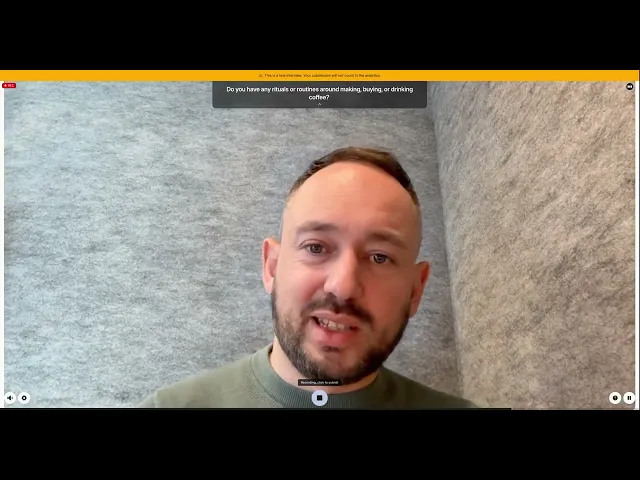
Async Interviewing At Scale
Teams can run hundreds of conversations in parallel across time zones, with each participant getting a personalized interview experience. Studies that would take a traditional agency six or more weeks can be completed in as little as three days.
"Within days, we had insights that would've taken a traditional agency a month."
Head of Customer Insights, JDE Peet's
Compounding Knowledge Library
Teams build on previous findings rather than starting from scratch each cycle. Every interview feeds a searchable library that links insights across studies.
Compliance Built In
Customer research teams can move fast without compliance risk. Conveo is SOC 2-certified and GDPR-compliant, and customers choose where their data is hosted.
Frequently Asked Questions
What are qualitative interview questions?
Qualitative interview questions are open-ended questions designed to draw out detailed, exploratory answers rather than yes/no responses or numerical ratings. They invite participants to explain their reasoning and describe their experiences in ways that closed-ended questions can't capture. Common formats include "walk me through..." prompts, "why" and "how" questions, with follow-up questions to dig deeper into specific responses.
What is a qualitative interview example?
Say a product team wants to understand why free-trial users don't convert to paid plans. Rather than sending a survey, they conduct qualitative study interviews with 15 users who didn't convert, asking open-ended questions about what stopped them from signing up and where they got stuck. The interviews reveal that most users had trouble connecting their CRM and couldn’t find help resources, so they gave up.
What is a semi-structured qualitative interview?
A semi-structured qualitative research interview follows a prepared set of questions but gives the interviewer freedom to ask follow-up questions and adapt based on what each participant says.
What are qualitative interview analysis methods?
The most common qualitative interview data analysis approaches are thematic analysis, in which researchers look for recurring ideas and themes across responses, and content analysis, which groups responses into categories and counts how often they appear. In grounded theory, rather than starting with a hypothesis, researchers develop explanations based on what they find in the data. For example, if you interview users about why they cancel a subscription, you don’t start with a fixed idea like “price is the main reason”; you look at the responses first.
What is a qualitative interview PDF?
A qualitative interview PDF is a downloadable guide that walks researchers through conducting qualitative research interviews. Teams use them most often when they're building an interview process for the first time and need an interview guide for qualitative research, such as structuring questions and analyzing responses. Most are a single document covering everything from interview setup to findings.
What are the types of interviews in qualitative research?
There are three types of interviews in qualitative research: Structured interviews use the same predetermined questions in the same order for every participant Semi-structured interviews follow a core set of questions but allow the interviewer to adapt based on what each participant says Unstructured interviews are open conversations with minimal predetermined questions. The right format depends on how much consistency your research requires versus how much flexibility you want to give the conversation.

About the author
Anna Sharp
Client Growth Manager
Anna got into market research by asking the CEO of one of the largest agencies in the world out for a juice. Eight years on she is an ethnographer who backs methods she believes in. She runs studies with media and consumer clients, including the one that went from a Friday-morning brief to a finished project by Saturday.
Meet Anna on film →Qualitative insights at the speed of your business.
Conveo runs AI-moderated video interviews and structures everything they say.