In this article
TL;DR
Best for: Enterprise research teams running multi-source recruitment who need survey fraud detection built into the study design from the start.
Fraudulent respondents contaminate data before analysis starts, eroding stakeholder confidence and triggering costly re-fielding.
Recruiting across panels and social ads creates a deduplication gap: each source checks only against its own records, leaving cross-source duplicate respondents undetected.
Survey-only fraud checks miss the authenticity signals that video surfaces: tone, hesitation, and facial expression that are hard for fraudsters to simulate consistently.
Video-first participation with unified participant records enables cross-source deduplication and ties every reported theme to a timestamped clip, providing stakeholders with a direct audit trail to protect data quality.
The real cost of participant fraud is decision lag. A finding built partly on people who were never real is presented; the concept moves forward on its strength; and the flaw surfaces months later when the launch underperforms. By then the decision is closed, and the correction has nowhere to land.
Survey fraud detection is the control that prevents survey fraud from shaping a study's conclusions. It belongs at the front of the workflow, because contamination caught after analysis has already shaped thematic clusters and the stakeholder narrative built on them.
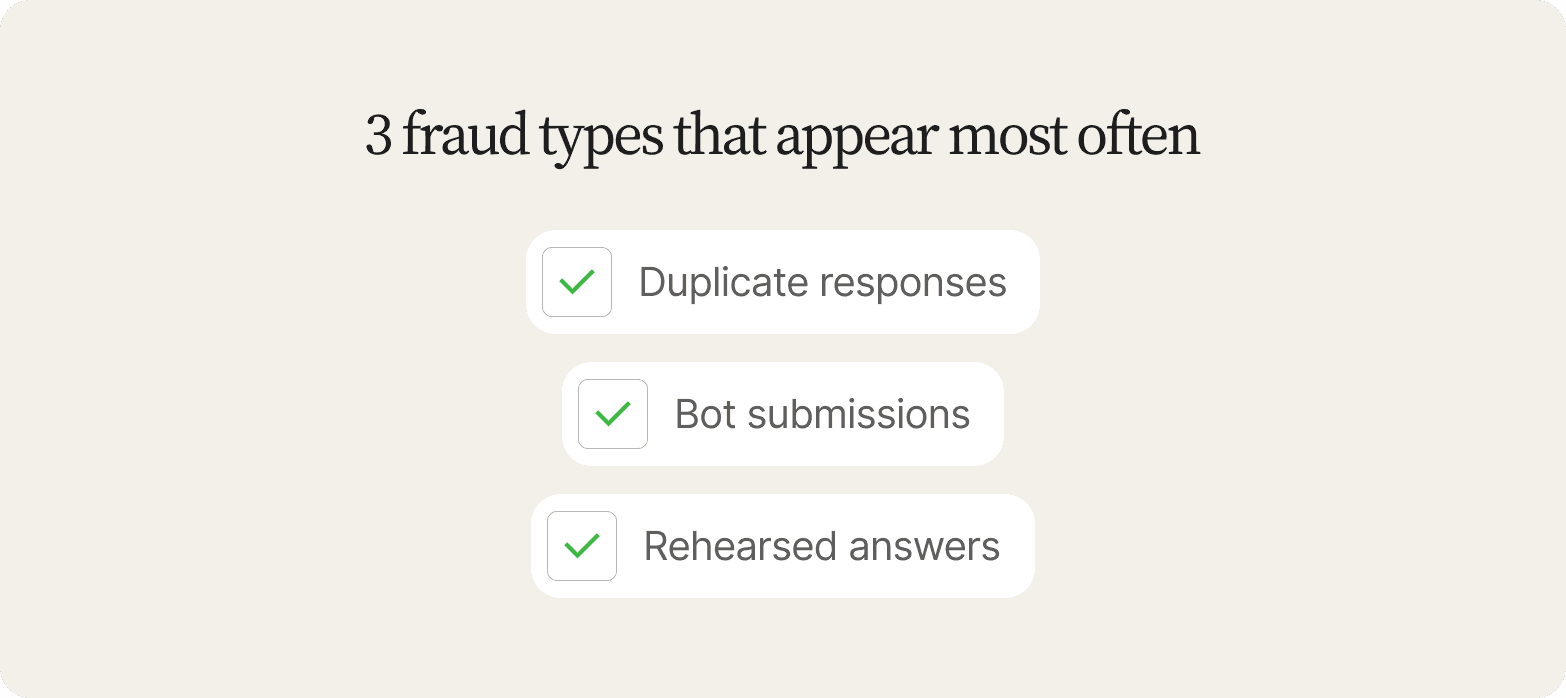
Three fraud types appear most often, each requiring a different detection technique:
Duplicate responses across email, IP, and device fingerprints
Bot submissions with impossible completion times
Rehearsed answers from professional respondents calibrated to pass screeners
For most projects, the highest costs of a bad sample are the re-fielding and the credibility repair that follows, both of which dwarf the incentive payouts themselves.
The challenge intensifies when recruitment spans multiple sources simultaneously. Panels, social ads, QR codes, and CRM lists each check for duplicate respondents only within their own records, so a participant entering through two channels passes both screeners cleanly. This piece covers the detection methods available at each stage of the research workflow and what video-first participation surfaces that text-only techniques cannot structurally capture.
What is survey fraud and why it matters to data quality
Participant fraud covers any situation in which respondents are not who they claim to be or are not engaging honestly. It takes several forms:
Professional survey takers cycling through panels for incentives
Bots mimicking human behavior at scale
Participants misrepresenting demographics to qualify
Disengaged participants clicking through without reading
Each introduces a different kind of contamination, but the result is the same: the data reaching analysis is bad data.
The business impact is measurable. Fraudulent responses in online research drive substantial revenue losses and reputational damage for the organizations relying on that data, and a significant share of research professionals report a rise in poor business decisions traced back to low-quality samples. [NEEDS: named, linked source for fraud prevalence rate and the decision-quality finding, or cut both claims]
This is why the researchers who built Conveo treat sample quality as a study-design question rather than a data-cleaning question: what the screener lets through determines what the analysis has to untangle later. An insights team whose findings are later revealed to rest on fraudulent responses loses far more than a single study. It loses the organizational trust that makes future research worth commissioning, which is exactly why protecting data quality must occur upstream of analysis.
The 3 categories of bad actors in participant fraud
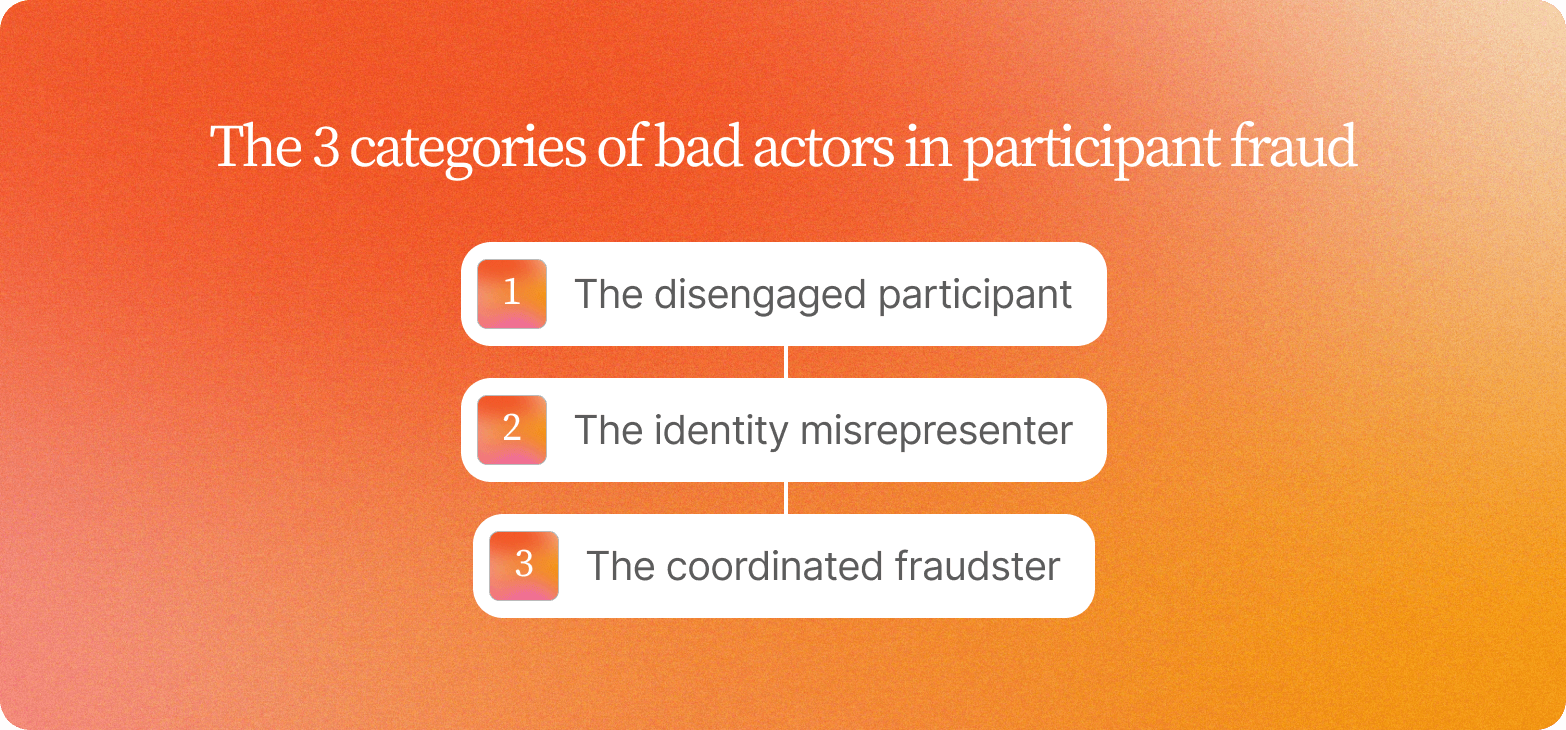
Not every bad actor looks the same, and detection works best when market researchers know which type they are dealing with.
The disengaged participant
This respondent is real and legitimately qualifies, but puts in minimal effort to collect the incentive. Detection signals include short, generic open-ended answers and a session duration well below average. Thematic analysis that weights response depth quickly surfaces these participants.
The identity misrepresenter
This participant manipulates screener responses to qualify for a study they would otherwise be ineligible for. Detection signals include inconsistencies between screener answers and interview responses, hesitation when probed about claimed experience, and answers lacking specificity. Behavioral screening that asks for situational detail rather than yes/no qualification is the most helpful countermeasure, testing human behavior under mild pressure instead of relying on self-reported claims.
The coordinated fraudster: multiple submissions at scale
This is the fastest-growing category. Coordinated fraud involves multiple fake identities, often run by the same person or network, entering a study to collect incentives at scale. Detection signals include duplicate IPs and device type matches, similar email patterns arriving in rapid succession, and multiple submissions from apparently separate respondents. This requires technical infrastructure rather than moderator judgment, because the signals are invisible in isolation.
5 common online survey fraud detection methods (and where they fall short)
Most survey tools layer bot detection, duplicate prevention, and behavior-based flags. Each layer catches something real. What remains unresolved, individually or together, is confirming that the person behind the screen is who they say they are and that their answers reflect what actual humans actually think.
| Detection method | What it catches | What it misses |
|---|---|---|
| Duplicate prevention (email, IP, device fingerprinting) | Repeat submissions from the same device, IP, or email within a single study | Cross-source duplicate responses when recruitment runs across multiple panels |
| IP geolocation and VPN detection | Proxies or VPNs misrepresenting location | Legitimate VPN use, creating false positives |
| Speeding and attention checks | Completions faster than median reading speed, failed attention questions | Professional survey-takers who pace responses and recognize check patterns |
| Consistency checks | Contradictory answers to the same question asked two ways | Rehearsed answers from over-surveyed participants who stay internally consistent |
| Post-hoc data cleaning | Straight-lining, repetitive answers, uniform distributions after the fact | Fraud caught after analysis cannot be removed without re-fielding |
Each gap compounds the one before it:
Duplicate prevention misses respondents who enter through two panel partners because each panel checks only against its own records. Closing that requires unified participant records across all channels.
VPN detection introduces its own bias, flagging legitimate respondents based on IP or device type.
Attention and consistency checks have a longer erosion problem: experienced fraudsters have seen enough standard formats to navigate them without triggering flags.
Post-hoc cleaning arrives too late by design, since a dataset that has already shaped findings cannot be surgically corrected.
The structural gap across all five methods is the same: they rely on metadata and behavioral flags that describe how someone completed a form, while leaving open the question of whether their expressions, tone, and reasoning align with what they typed. Video-based participation changes that, because the evidence is visible, timestamped, and traceable back to a real individual.
Why basic fraud detection checks create false positives
Every fraud check operates on a single signal, and single-signal checks force a blunt tradeoff: tighten the threshold and legitimate participants get removed, loosen it and bad actors slip through. Aggressive IP filters cost usable data in markets where shared networks are common, while the same filters miss coordinated fraud that rotates IPs and device type.
The more consequential gap is structural: each source sees only what enters through its own platform. A respondent who completed your panel survey last week and now enters through a social invite is invisible to that platform's check. The result is a sample that passes every individual quality gate but still contains duplicate respondents, because the duplication occurred across sources rather than within a single source.
A multi-layered framework to protect data quality
No single control catches every bad actor. The most effective teams treat survey fraud detection as a stack, with corroboration across multiple signals rather than reliance on any single indicator:
Front-door controls stop obvious fraud before it enters: VPN and proxy detection, plus device fingerprinting paired with device type checks that assign a persistent identifier to each session. These are high-volume and low-cost but carry a false-positive risk for legitimate respondents on corporate VPNs or shared devices, so treat flags as a reason to scrutinize rather than automatically exclude.
Behavioral signals are collected during the session and include speeding (the gap between the median and the actual completion time), open-ended answer scoring for coherence and relevance, and embedded attention checks.
Post-completion checks close the loop through deduplication across channels, as unified participant records prevent duplicate respondents from inflating incentive costs and draining the fieldwork budget.
| Signal type | Detection strength | False-positive cost |
|---|---|---|
| VPN / proxy detection | High for location fraud | Medium: corporate VPN users flagged |
| Device fingerprinting and device type | High for repeat attempts | Low: persistent ID is reliable |
| Speeding (completion time) | Medium: misses deliberate pacers | Low: easy to verify manually |
| Open-ended answer scoring | High for low-effort responses | Medium: brief legitimate answers may score low |
| Attention checks | Medium: sophisticated fraudsters pass | Very low: genuine respondents rarely fail |
| Video and multimodal analysis | Highest: hardest to fake | Very low: flagged cases only need review |
Video is the highest-signal authenticity check available because it is hardest to fake at scale. Multimodal analysis on the Conveo platform runs as recordings arrive, powered by real-time machine learning that flags unusual patterns in real time, so analyst time goes to flagged cases rather than a full manual review queue. The output is cleaner, high-quality data: a timestamped video record that research ops teams can produce when a stakeholder questions whether the findings reflect actual humans.
How fraud prevention changes across online research modes
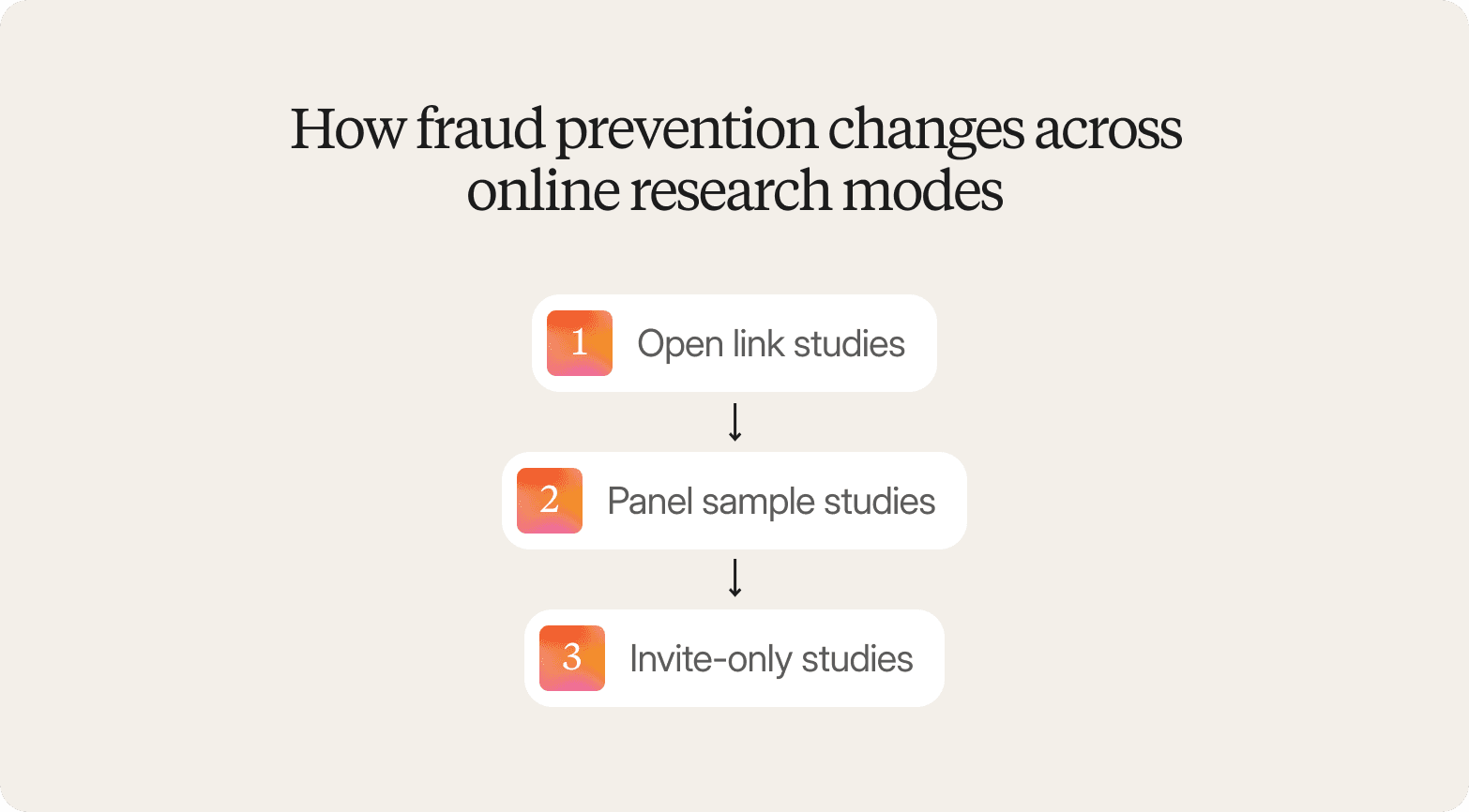
Open link studies
Open link studies carry the highest exposure, since a shareable URL is accessible to anyone who forwards it. Prevention means designing the link itself as a control: expiration windows, response caps per device, and a behavioral screener specific enough that an outsider cannot bluff through it.
Panel sample studies
Panel sample studies shift the risk from link exposure to profile misrepresentation. The upstream lever is screener design: questions requiring specific, verifiable knowledge rather than self-reported attitudes. Behavioral screening at recruitment is designed for exactly this: filtering based on demonstrated human behavior rather than stated identity before a single interview begins.
Invite-only studies
Invite-only studies carry the lowest risk of fraud by design. Unique, expiring tokens prevent forwarding, though invite-only lists can produce self-selection bias toward highly engaged or dissatisfied respondents, a design problem screener weighting can partially address.
Why video-first participation changes fraud detection
Text-based responses can be scripted or generated in seconds, and there is no way to verify that the person who typed the answer is the respondent who screened in. Video-based participation changes the calculus because it requires real-time human presence that is difficult to simulate at scale.
"Super valuable... quite a special way to analyze this data"
Matt Harris, Research & Insights Lead, EMEA, Canva
Tone and affect
Hesitation, audible confusion, or a shift in energy signal genuine cognitive processing that a rehearsed response cannot replicate. AI fraud detection in research is increasingly oriented toward these paralinguistic cues because they are hardest for fraudsters to replicate convincingly throughout a full interview.
Facial expression
Micro-expressions and sustained engagement cues are not something a bot can simulate. A brow furrow at a price point, or a smile that does not reach the eyes, tells a trained researcher whether the verbal response reflects what the respondent actually thinks.
Contextual detail
Real participants reference their environment and specific past experiences. Fabricated responses tend toward the generic, because the person constructing them has no real experience to draw on.
The audit path this creates matters as much as the fraud prevention itself: when a theme links to a timestamped clip and verbatim quote, stakeholders can watch the moment it was said instead of asking whether it's credible. This also serves qual-native quant, where a preference ranking and the reasoning behind it come from the same session, applying the same authenticity signals to both.
Cross-source deduplication: Closing the panel recruitment gap
Recruiting across multiple channels simultaneously creates a gap that no individual panel can close, since each source validates only against its own membership records. A respondent who signed up through two panels, or clicks a social ad after already screening in through a panel link, passes every individual check cleanly.
Duplicate responses skew thematic distributions, collect incentives more than once, distort cost-per-complete, and drain money from the fieldwork budget. A thematic cluster that traces back to one person completing three times, via different entry paths, is noise presented as insight.
The fix is a unified participant database spanning every channel. Three requirements make this work in practice:
Unique, expiring participation links, so a shared or bookmarked link produces no second record.
Deduplication at screener completion, run before fieldwork proceeds rather than as a post-fieldwork cleaning pass.
A documented flag record, noting which respondents were flagged, the signal, and the action taken.
Platforms that integrate with multiple panel partners but maintain separate participant records for each source cannot close this gap. Treating every respondent as a record in a single shared database, regardless of entry channel, is the most effective step a team can take to protect data quality across the recruitment stack.
Decision framework: When to remove, quarantine, or keep a case
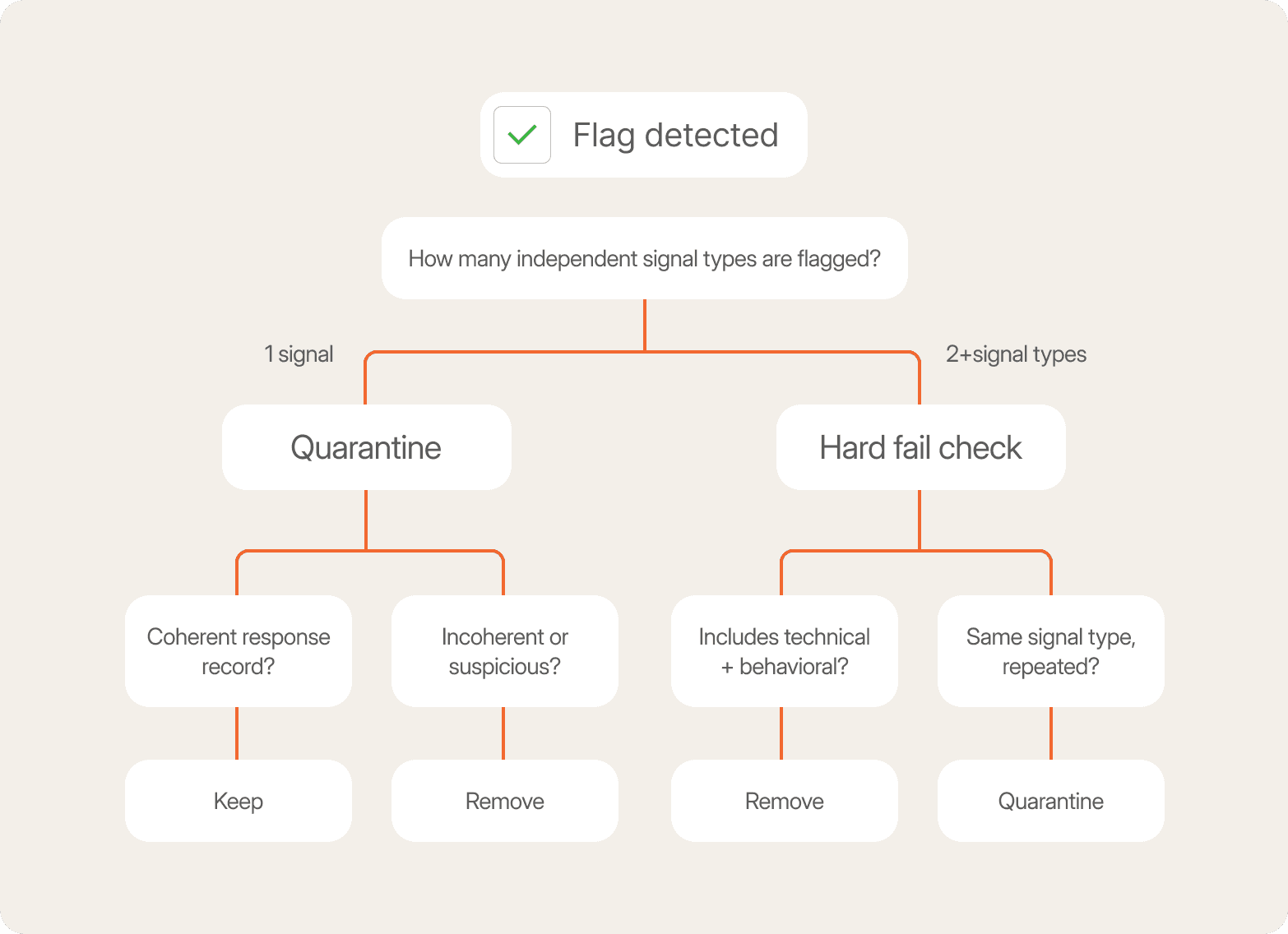
Survey fraud detection without a removal protocol is just a list of suspicions. The clearest approach separates signals by severity and requires corroboration across multiple indicators before acting:
Hard fails, remove immediately: combinations like a VPN-masked IP, a device fingerprint matching other sessions, and bottom-5% completion time leave no reasonable alternative interpretation.
Review signals, quarantine pending human behavior review: a single flag, such as a fast completion time or one failed attention check, should trigger quarantine while a researcher runs a focused review. Many quarantined cases turn out to reflect survey fatigue or low literacy rather than fraud.
Keep, no action required: a flagged item that doesn't meet review thresholds but has a coherent, broader response record stays in.
Every removal and quarantine decision needs a dated log entry recording the signals, the reviewer, and the threshold rule applied, retained for compliance and GDPR-related audit requirements.
Decision tree
| Signals flagged | Response record | Action | Log requirement |
|---|---|---|---|
| 1 signal | Coherent | Keep | Flag noted, no action taken |
| 1 signal | Incoherent or suspicious | Remove | Signal, reviewer, and date |
| 2+ independent signal types (technical + behavioral) | Any | Remove | Combination rule triggered, signals listed |
| 2+ flags of the same signal type, repeated | Any | Quarantine | Escalate to senior researcher |
Enterprise operating model for fraud monitoring
Detection methods are one part of the answer. The four standards below are what a Research Operations Manager can write down and apply consistently across studies:
Role clarity: the Research Operations Manager owns the monitoring framework and thresholds, the study lead owns live fieldwork monitoring, and a senior researcher or research director makes final removal decisions. Without this structure, decisions get made inconsistently and cannot be audited later.
Monitoring cadence: check behavioral screener outputs within the first 24 hours of fieldwork, run a mid-field review at the 50% mark, and a final pre-analysis check before data enters synthesis. Waiting until analysis is complete means contamination is already in the findings.
Escalation protocols: a documented decision tree covering flag for review, remove and replace, and halt fieldwork, written down before fieldwork starts rather than invented when a problem surfaces.
Documentation standards: every fraud-related decision should be logged in the study record, with the rationale noted, protecting findings when stakeholders ask questions later and building institutional knowledge that carries forward through a searchable insight library.
Participant authenticity in qualitative market research
Most anti-fraud investment has concentrated on survey pipelines, with far less attention paid to qualitative workflows. That gap matters: a fraudulent survey response skews a distribution, but a fraudulent qualitative respondent corrupts the meaning behind every theme built from the session.
In documented cases, participants have declined to use their cameras and failed to provide meaningful responses, prompting session cancellation. A camera decline on its own proves nothing, since connection problems and privacy concerns are ordinary reasons to stay audio-only. What justifies cancellation is the combination of a decline, thin, generic answers, and screener claims that the respondent cannot expand on when probed.
The practical protocol: set the camera expectation in the invitation, treat a decline as a prompt for closer probing, and require a second independent signal before canceling a session. Then log the decision the same way as any removal.
Considerations, trade-offs, and the limits of data cleaning
Every control here has a cost:
Aggressive IP and VPN filters remove legitimate respondents, particularly on shared networks, and strict device-type fingerprinting can exclude valid participants.
Single-signal checks force a blunt tradeoff between catching more fraud and losing more real people, which is why corroboration across multiple signals is the only way out.
Quarantine review takes researcher time, since many quarantined cases reflect survey fatigue rather than fraud.
Invite-only recruitment trades fraud risk for self-selection bias.
Post-hoc cleaning cannot recover a contaminated study: by the time patterned responses surface, the options are re-fielding or disclosure.
How Conveo helps prevent survey fraud
Fraud detection is worth investing in for one reason: the decision closes before the contamination surfaces. Conveo is Consumer Understanding Infrastructure, built by researchers, so the controls in this article are built into the study rather than in a cleaning pass that runs after findings have already been presented.
Behavioral screening at recruitment filters on demonstrated human behavior rather than stated identity, the countermeasure for the identity misrepresenter. Video-based participation surfaces the tone, expression, and contextual details that text-only checks cannot structurally reach, using artificial intelligence and machine learning to flag what a manual review would miss.
See it in action: How AI-Moderated Video Interviews Actually Work
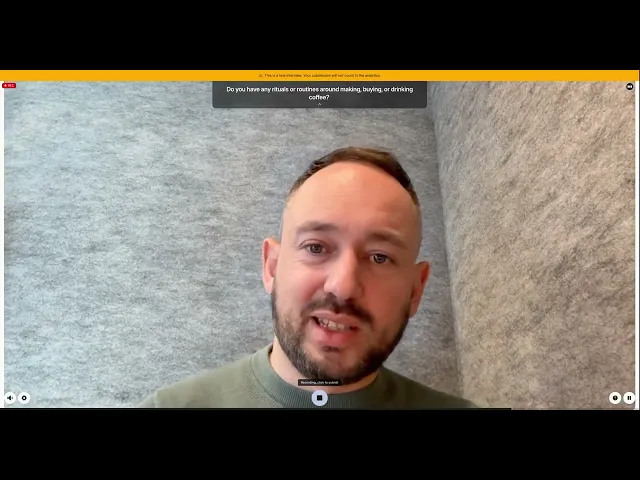
Unified cross-source participant records close the deduplication gap no individual panel can see across, whether teams recruit through Conveo's integrated panel network, their own lists, QR codes, or social links. Because every reported theme traces back to a timestamped session record and the respondent who said it, removal and retention decisions have something concrete to point at. Thresholds, flag patterns, and screener language also carry over into a searchable insight library, so each wave starts from what the previous one learned.
Frequently Asked Questions
What is survey fraud in research?
Survey fraud encompasses any situation in which respondents are not who they claim to be or do not answer the questions honestly. It includes professional survey takers, bots, participants misrepresenting their demographics, and disengaged participants who click through without reading.
What are the three main categories of participant fraud?
The disengaged participant, who qualifies legitimately and puts in minimal effort. The identity misrepresenter, who manipulates screener answers to qualify. And the coordinated fraudster, who runs multiple fake identities to collect incentives at scale.
Why do standard fraud checks miss cross-source duplicates?
Each recruitment source validates only against its own records. A respondent entering through two panels, or a panel and then a social ad, passes both checks cleanly because neither source can see the other. Closing that gap requires unified participant records across all channels.
Does tightening fraud checks create false positives?
Yes. Single-signal checks force a tradeoff: tighten the threshold and legitimate respondents get removed, loosen it and bad actors get through. Corroboration across multiple signals before acting is the way out.
What can video-based participation detect that a text survey cannot?
Three signals text cannot convey: tone and affect, including hesitation and shifts in energy; facial expression, including micro-expressions that a bot cannot simulate; and contextual detail, the specific references that a fabricated answer lacks.
When should a flagged case be removed rather than quarantined?
Remove when two or more independent signal types flag together, spanning behavior, technical metadata, and content. Quarantine when a single flag appears, then review the full response record before deciding.

About the author
Ivayana Abdi
Research Impact Lead
Ivayana has worked in market research since 2017, most recently as group manager of research operations and logistics at Culturati, and trained at RIVA and the Burke Institute. She joined Conveo for the hybrid researcher model: agile with new methods, fluent in the traditional ones, and able to combine the two for clients who want to try new things.
Meet Ivayana on film →Qualitative insights at the speed of your business.
Conveo runs AI-moderated video interviews and structures everything they say.