
TL;DR
AI survey tools analyze open-text responses fast, but they miss the signals that explain why someone answered the way they did.
Video-first platforms like Conveo capture facial expressions, tone, and pauses that text analysis can't see.
Enterprise buyers should weigh workflow coverage, evidence traceability, and compliance infrastructure before they commit to an AI survey tool
Conveo is built for recurring qualitative research, not one-off surveys.
AI survey tools automate much of the work that comes after collecting responses. They can generate surveys, analyze open-ended answers, identify themes, and summarize results in minutes instead of hours. For teams collecting large volumes of customer feedback, that makes surveys much faster to run and review. The challenge is choosing the right tool, because platforms vary widely in their AI capabilities, pricing, and research focus.
That variety comes down to the job the AI survey software is designed to do. Some tools are built to summarize what people typed, which suits quant-style feedback on closed-ended questions. Others are built to understand why people responded that way, which requires a real conversation rather than a text response. This guide compares 15 AI-based survey tools and AI-moderated research platforms across both jobs, so you can tell which one fits the research you're running.
When AI Survey Tools Work, and When They Fall Short
An AI survey analysis tool reads thousands of open-ended answers, spots patterns, and returns a summary in minutes. They’re a good fit for high-volume feedback tasks where you need to quickly understand trends, such as:
Understand feedback from a Net Promoter Score (NPS) survey
Group bug reports
Review feature requests
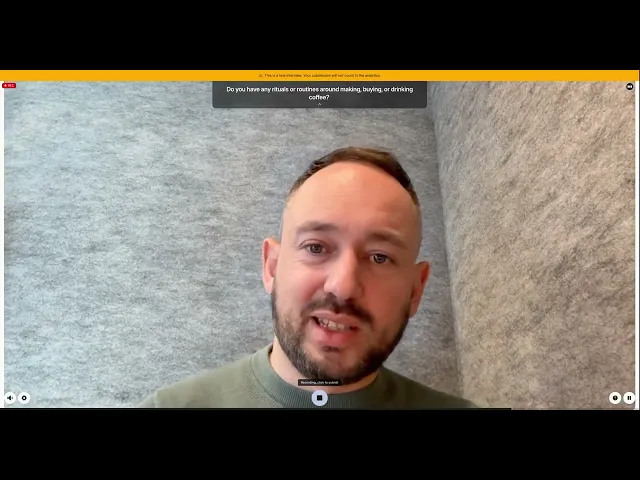
In this type of research, the goal is to identify recurring themes, not to investigate every response in depth. But when you need to understand the reasons behind a response, text analysis has limits. Take concept testing: a participant says "I like it," and the AI tags the response as positive. If you watched the participant respond, however, you might notice the pause before they answered, suggesting hesitation that the transcript misses.
Use an AI survey analysis tool when you need directional feedback at scale, such as identifying trends in closed-ended questions and summarizing themes from open-ended responses. Use AI-moderated interviews when you need to explore the context behind those responses.
See it in action: How AI-Moderated Interviews Work →
Choosing the wrong survey research method can leave teams with data that looks clear at first but raises more questions when stakeholders need to understand the reasons behind customer behavior.
Comparison Table: AI Survey Tools vs. Video-First AI Research Platforms
The table below contrasts text-only AI survey platforms with video-first AI research platforms such as Conveo.
What to compare | AI survey analysis tools | Video-first AI research platforms |
How they collect feedback | They analyze written survey responses. | They collect voice and video responses from participants. |
How they ask follow-up questions | They use fixed survey questions and can’t adapt to responses. | They ask follow-up questions based on what participants say in real time. |
How you verify insights | They provide summaries of responses. | They let you review video clips and direct quotes from participants. |
What part of research they support | They focus mainly on analyzing feedback after it is collected. | They support the full research process, from recruiting participants to analyzing results. |
Data security and compliance | Security and compliance standards depend on the provider. | Many platforms offer SOC 2 and GDPR compliance, as well as regional data hosting. |
AI survey analysis tools still have a place when you need quick feedback from a large group using simple closed-ended questions. For more complex research questions, the ability to connect findings back to real customer evidence becomes just as important as speed.
15 AI Survey Tools Compared
Platforms in this space serve different purposes, from building and fielding surveys to running a full qualitative research workflow end-to-end. Here's how 15 tools compare within each.
AI Survey Generator Tools
Reach for AI-generated survey tools when you need to create surveys faster and handle light thematic analysis once responses come in.
1. SurveyMonkey
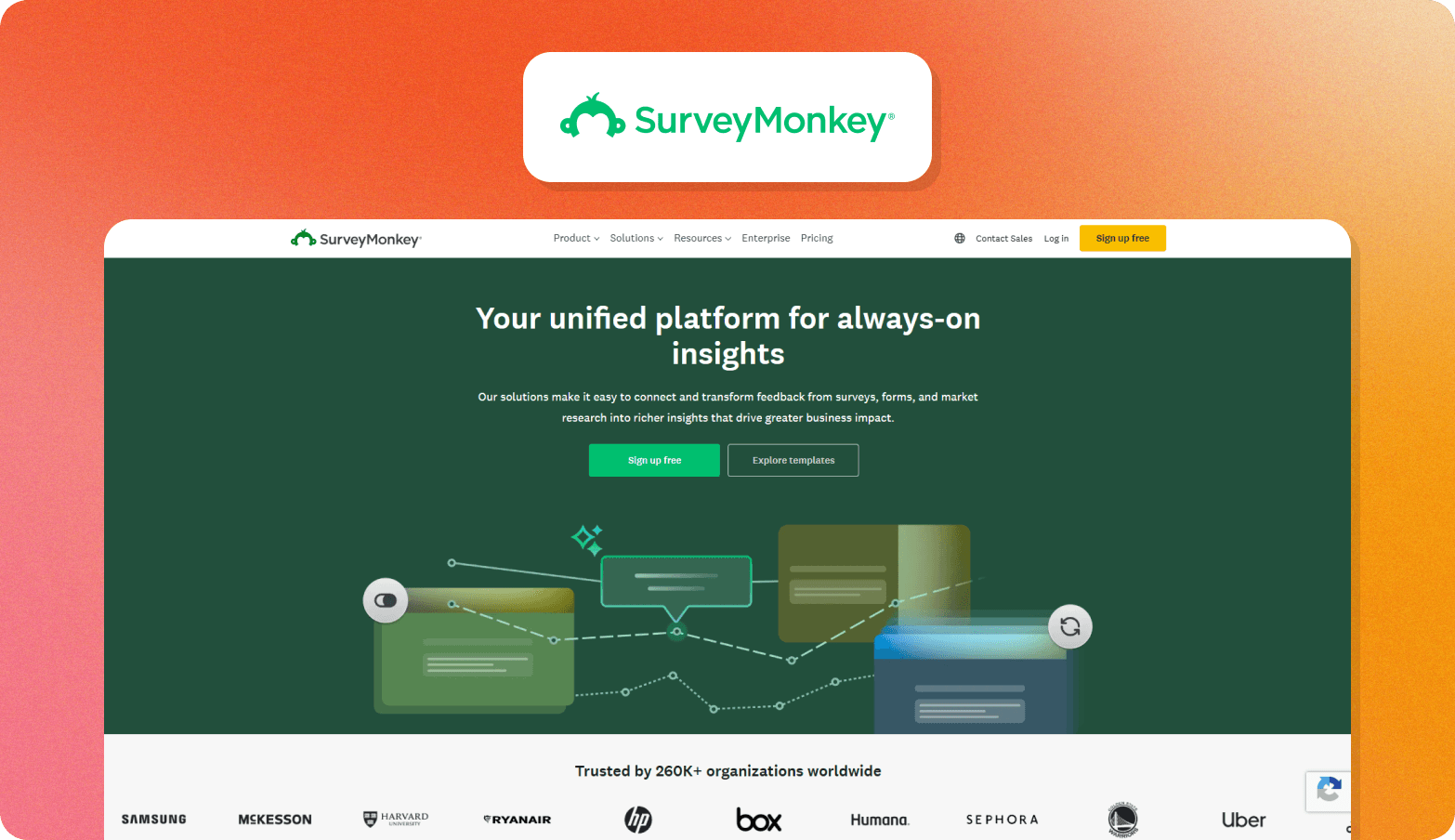
SurveyMonkey is a survey platform with AI-assisted question writing and a global panel.
Best for: Teams that want fast survey creation and built-in research methods without a steep learning curve.
Core strength: It offers a panel of 335 million-plus people across 130-plus countries for quick fielding.
Limitation: It only collects text-based responses and has no way to capture video or audio responses.
Pricing: Team plans start at $30 per user per month, billed annually.
2. Jotform
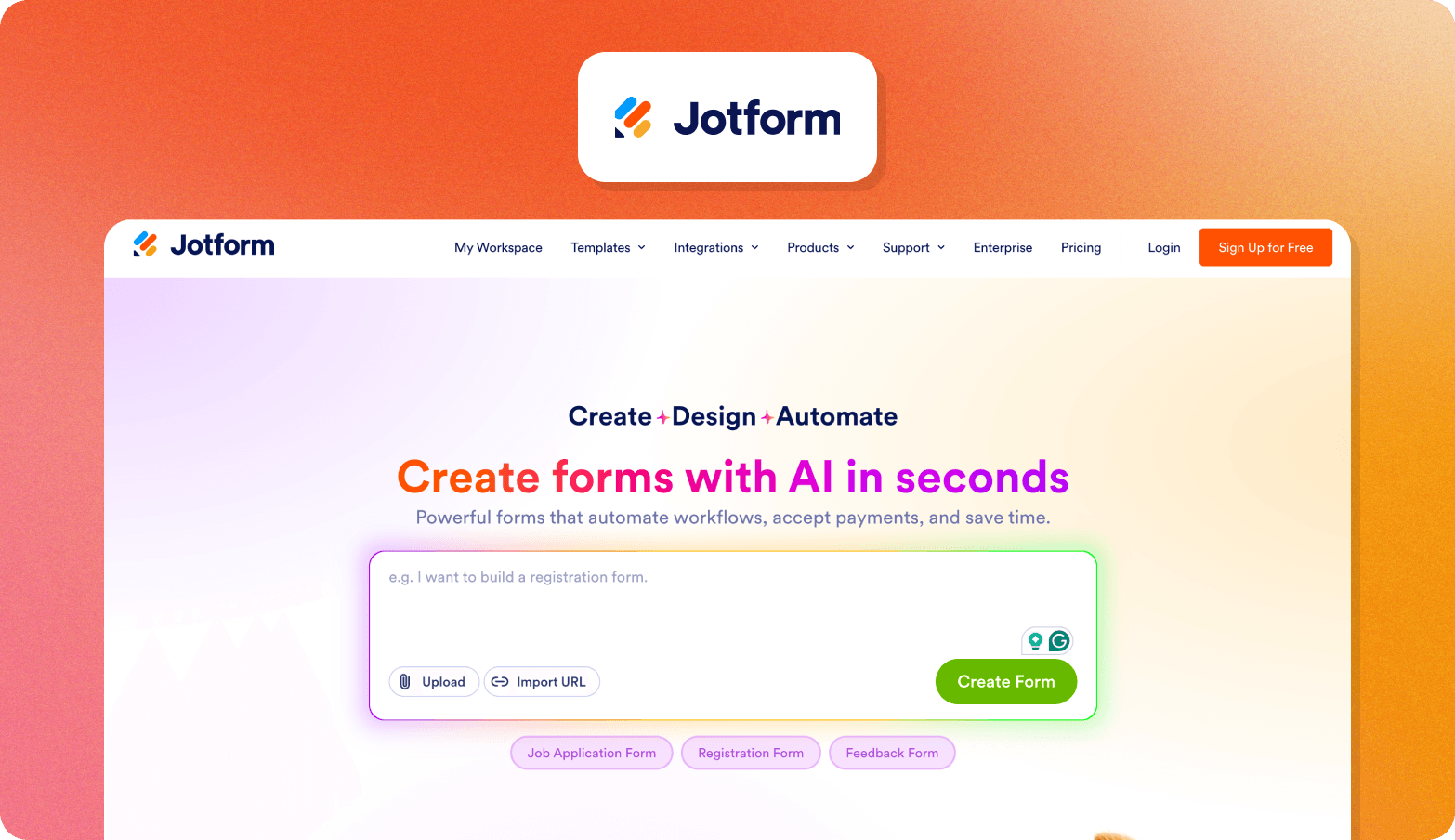
Jotform is an AI form builder with a drag-and-drop interface that turns a prompt into a working survey.
Best for: Teams that want to spin up a survey quickly using an existing template instead of building one from scratch.
Core strength: A large template library covering most common survey and form use cases.
Limitation: The artificial intelligence output often requires manual cleanup, and there's no interview layer to explain the "why" behind the answers.
Pricing: A free plan is available. Paid plans start at $34 a month, billed annually.
3. Typeform
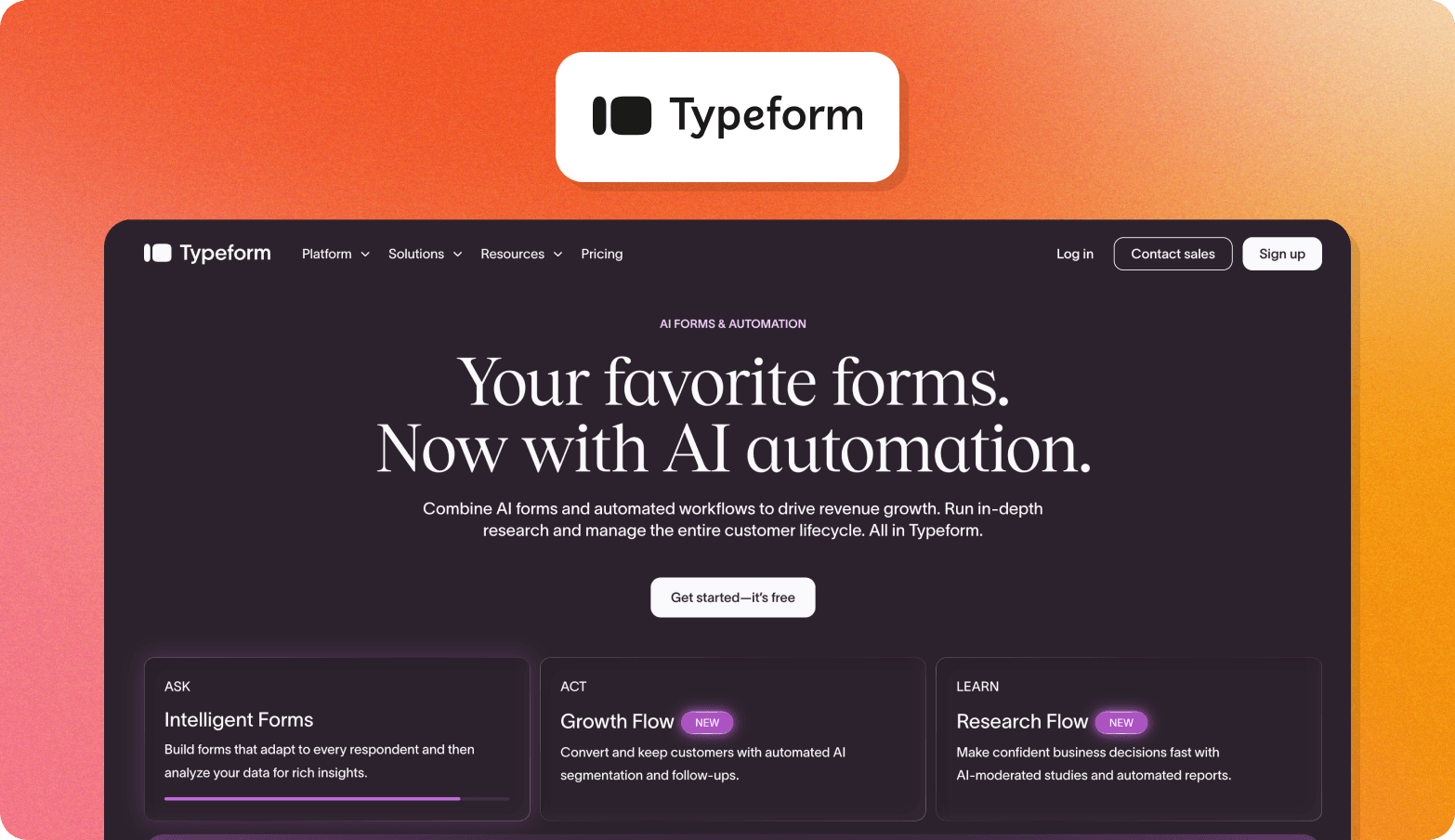
Typeform is a survey builder with a full-screen, animated question format designed to feel more like a conversation.
Best for: UX and marketing teams that want a conversational format to lift completion rates.
Core strength: Its Research Flow feature adds AI-moderated video interviews and recruitment.
Limitation: Research Flow is billed in addition to the standard plan.
Pricing: Plans start at $28 a month, billed annually.
4. Zoho Survey
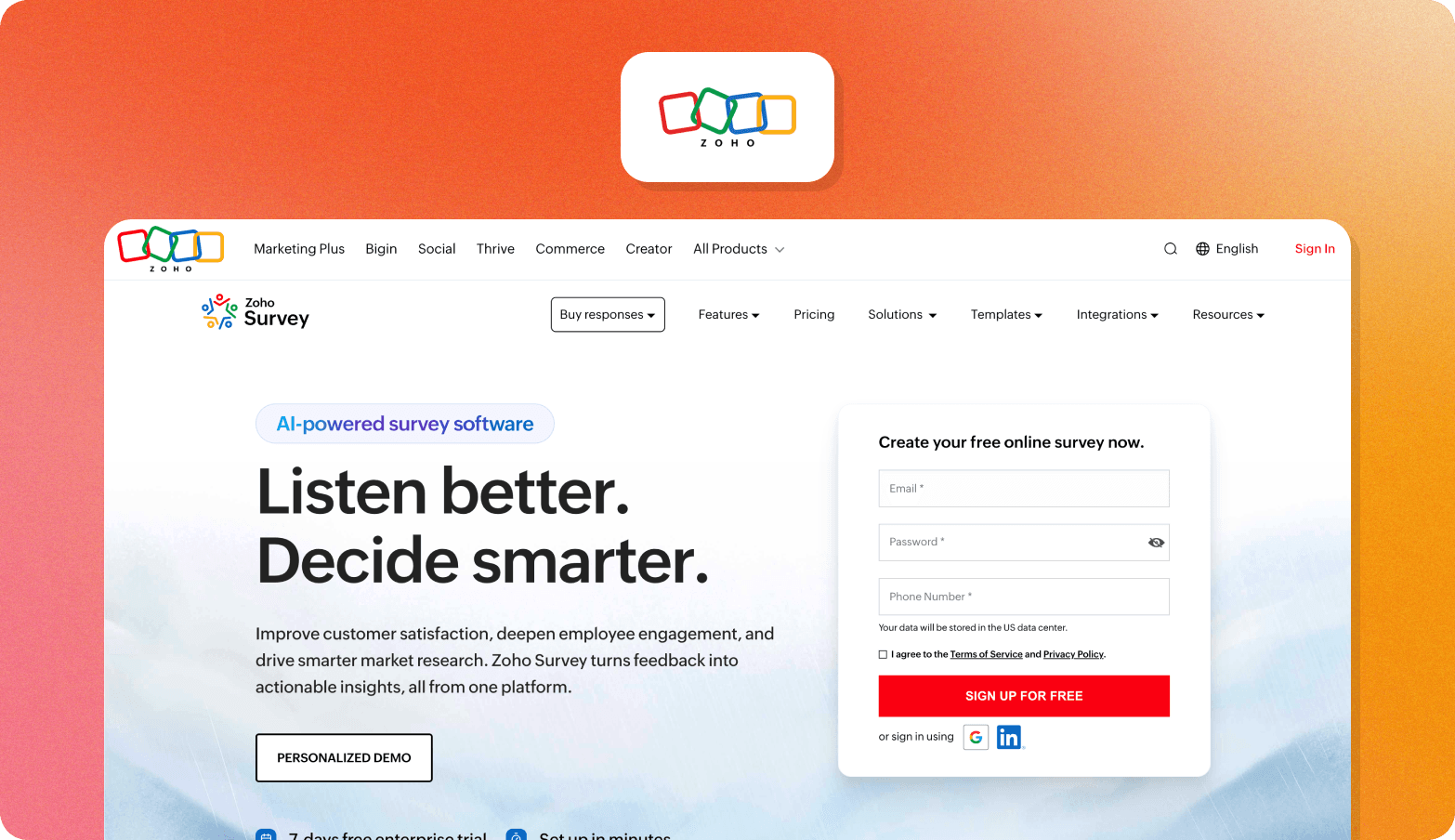
Zoho Survey is a survey tool built to integrate directly with the rest of the Zoho business suite.
Best for: Teams already running Zoho CRM or Analytics who want survey data to flow straight into existing dashboards.
Core strength: It offers adaptive logic branching and native Zoho integrations that skip manual exports.
Limitation: Sentiment tagging covers the basics, but there's no way to see or hear the respondent behind an answer.
Pricing: Not publicly available.
5. Google Forms
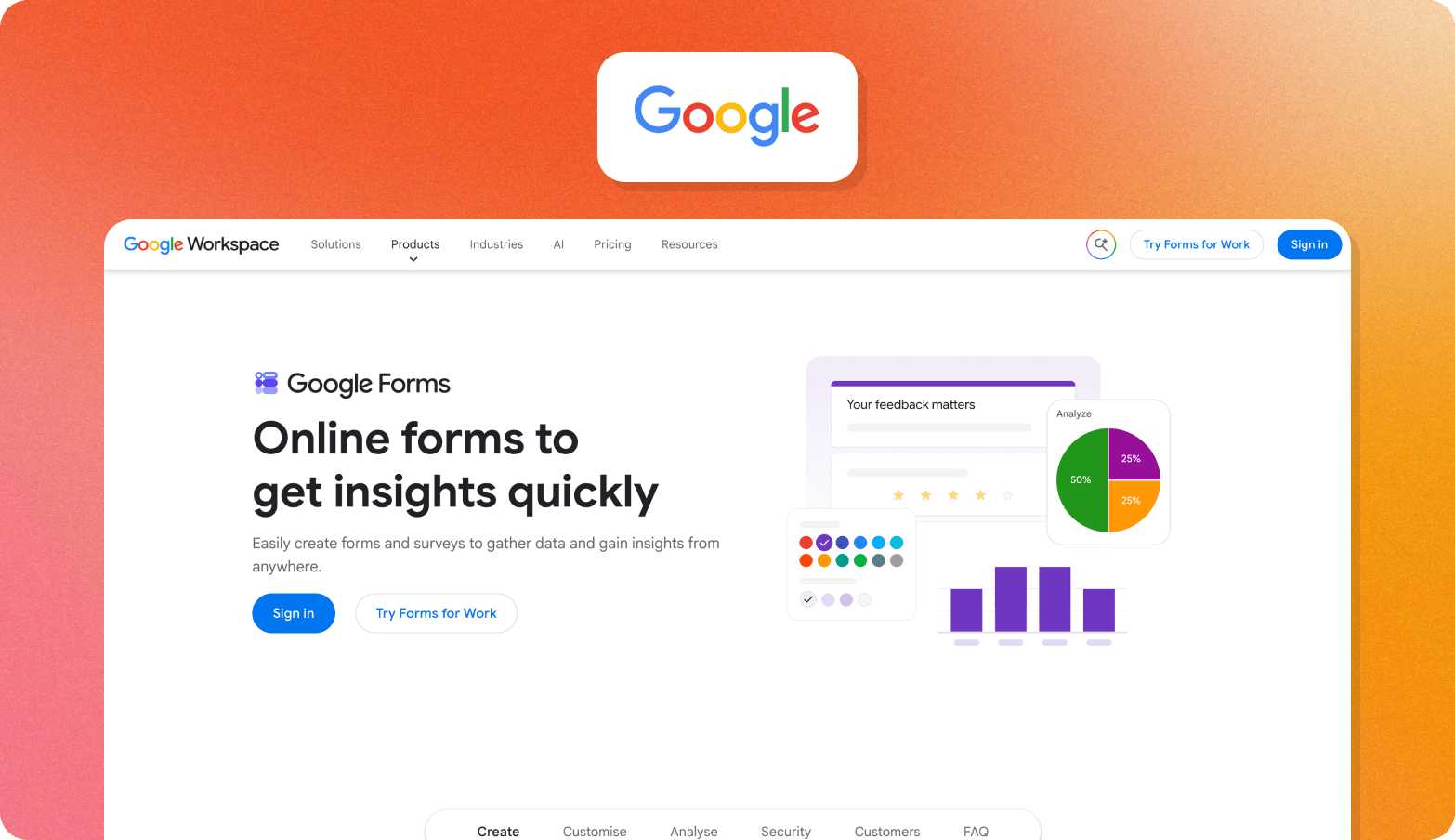
Google Forms is a free form builder included with Google Workspace.
Best for: Teams that need a free, no-setup option for lightweight screeners and internal surveys.
Core strength: It instantly collects responses in Google Sheets for anyone already using Google Workspace.
Limitation: Gemini-powered features, like form generation and response summarization, require a paid Workspace tier.
Pricing: Free with a Google account. Paid plans start at $7 per user per month.
Multi-Purpose Survey Platforms
Reach for these when a basic survey builder isn't enough. Some platforms in this group add sentiment analysis and thematic analysis on open-ended responses. Others help you reach a specific target audience or run survey analysis built for large datasets.
6. Qualtrics
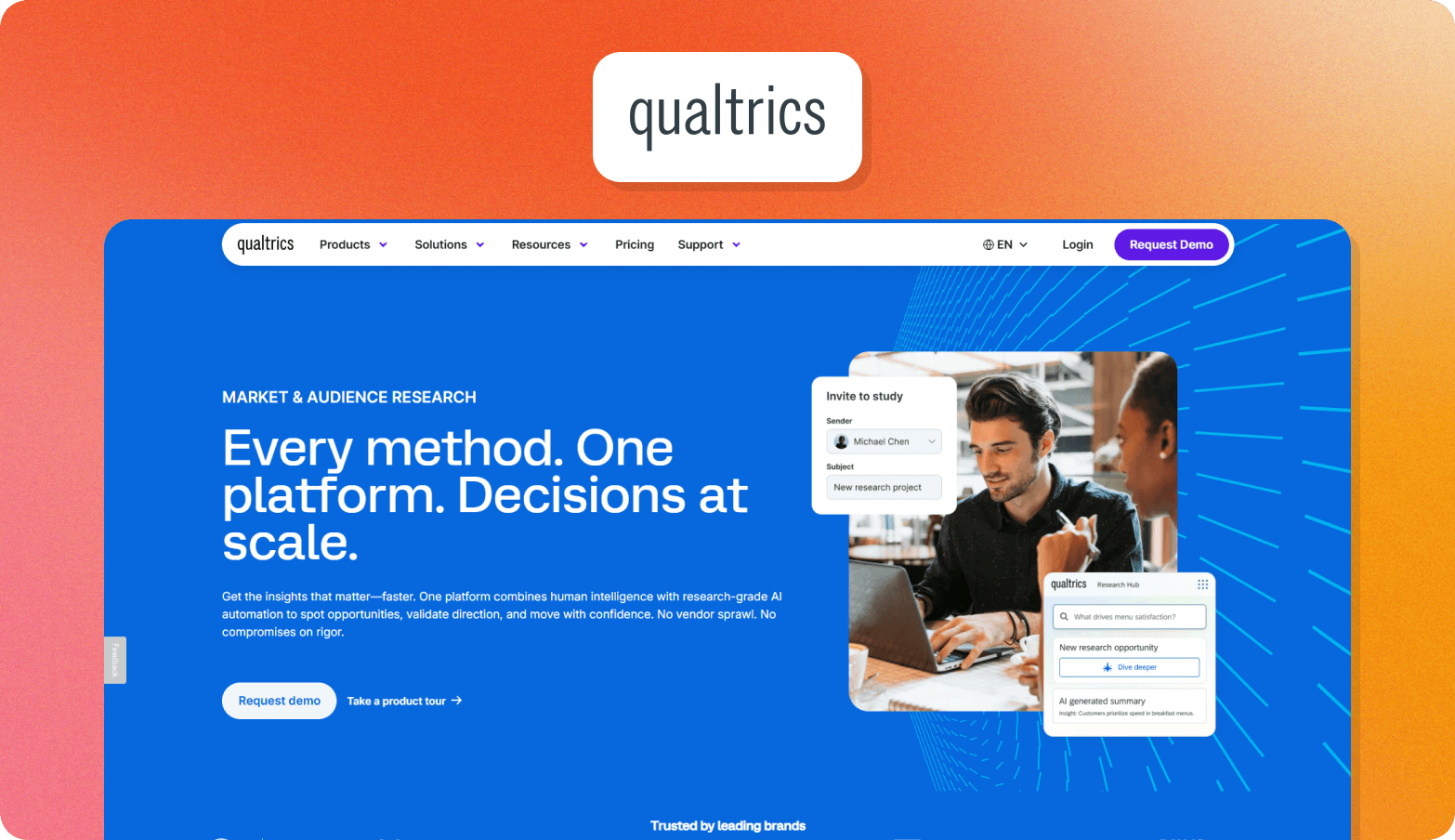
Qualtrics Strategy & Research is an enterprise research platform inside the broader Qualtrics XM suite.
Best for: Large enterprises already invested in the Qualtrics XM ecosystem who want research folded into a broader experience management program.
Core strength: It includes a cross-study Research Hub for querying findings across surveys.
Limitation: As part of a much larger suite, it takes more setup and admin overhead to get running than a standalone research tool.
Pricing: Available on request.
7. Pollfish
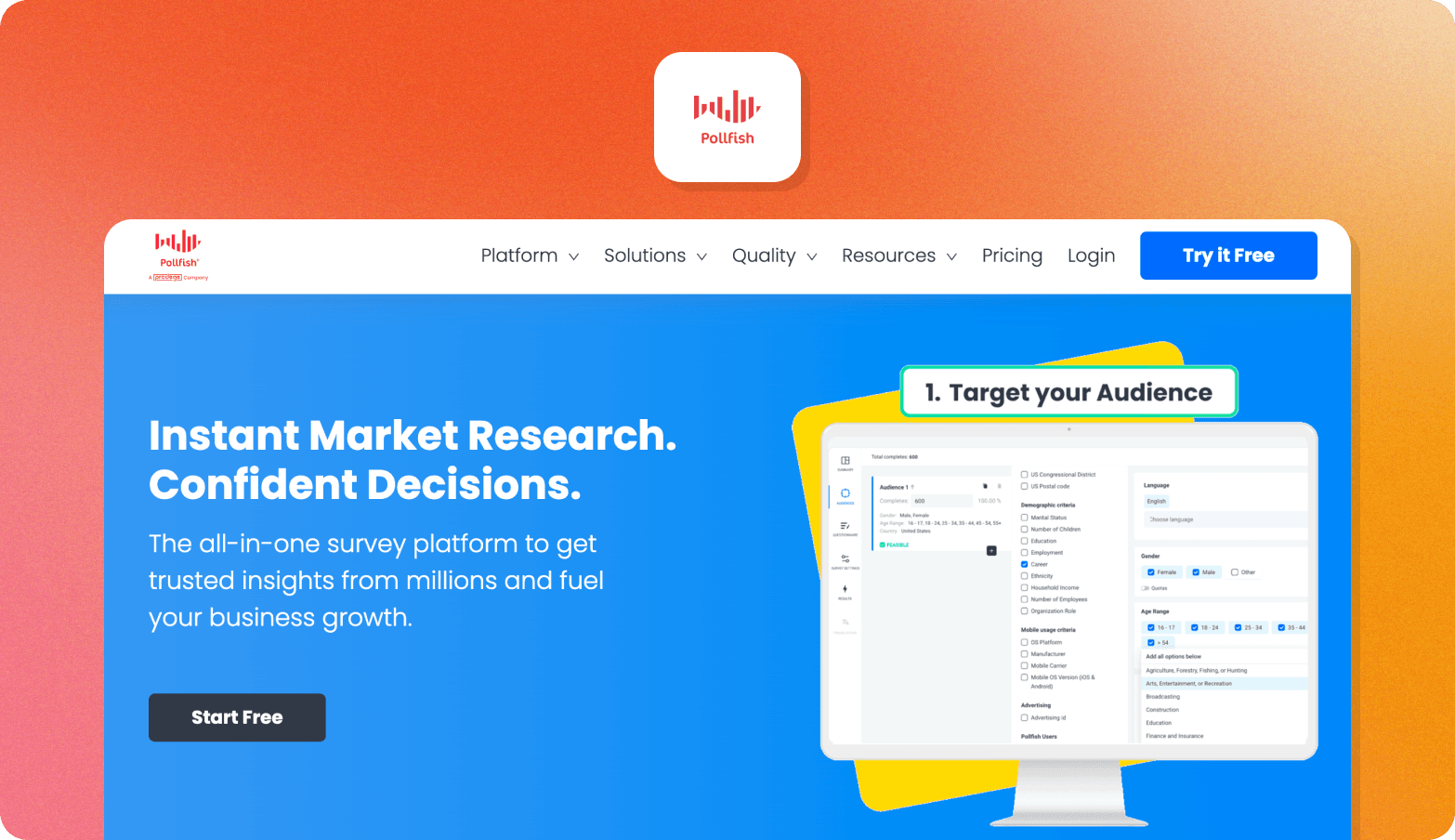
Pollfish is a self-serve survey platform built for fast-turn B2C research.
Best for: Marketers and researchers who need precise targeting more than deep qualitative data.
Core strength: It can filter respondents using more than 7,000 verified behavioral attributes, including specific brand purchases, website visits, and physical store visits, on top of standard demographic filters.
Limitation: Language selection changes only the interface text, so researchers still translate questionnaires by hand.
Pricing: Pricing starts from $0.95 per survey response.
8. Forsta
Forsta is an enterprise feedback platform for teams running studies that combine online surveys, phone interviews, and in-person interviews.
Best for: Large research and customer experience teams who need the scale and support of a full-service research agency.
Core strength: AI helps write survey questions and logic and summarize survey results with open-ended answers.
Limitation: Follow-up questions still run within a fixed survey script rather than a free-flowing, AI-moderated conversation.
Pricing: Available on request.
9. Alchemer
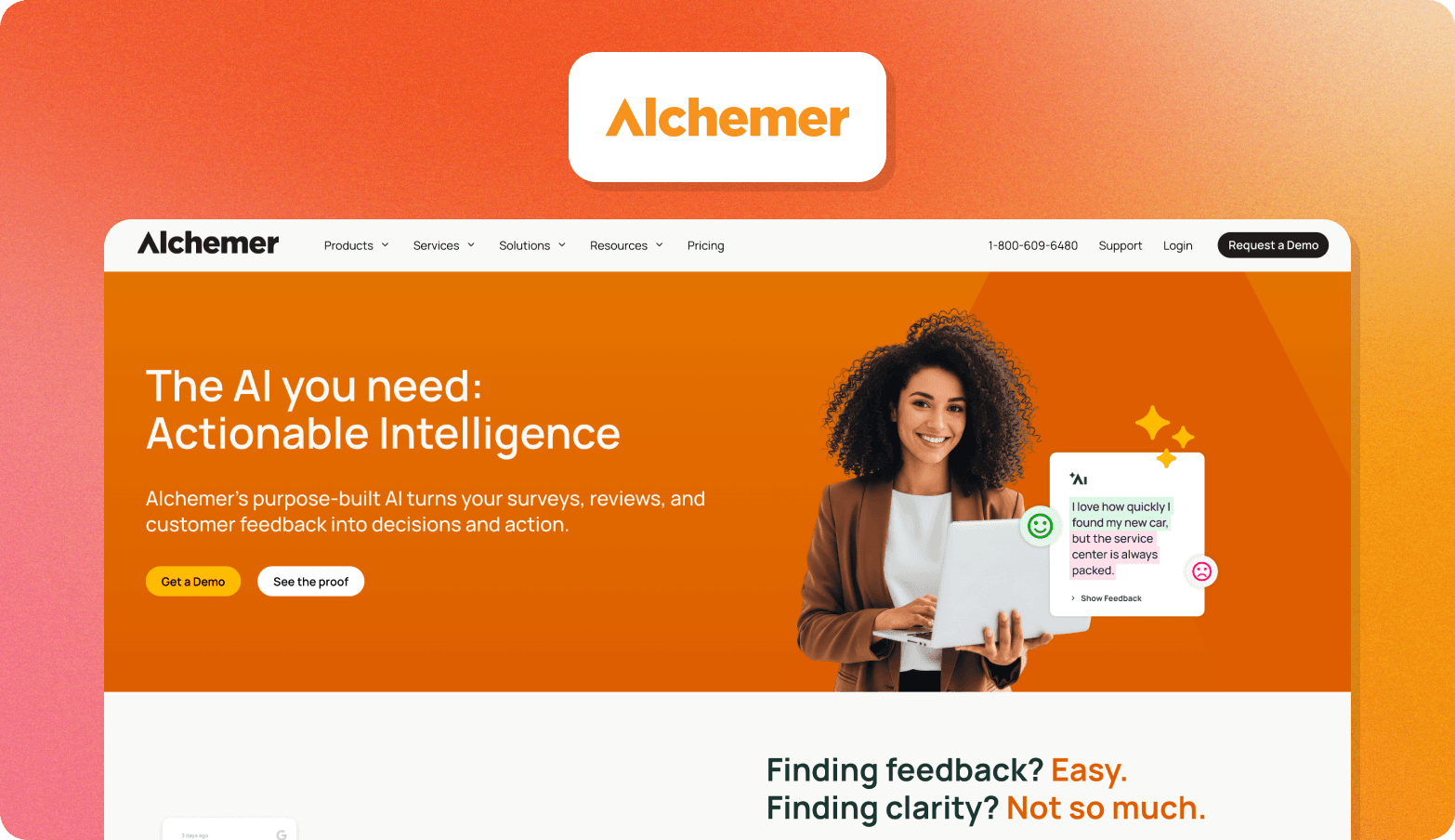
Alchemer is a feedback platform that combines survey tools with AI-powered analysis of open-text responses.
Best for: Teams that have outgrown basic survey tools but don't need a full enterprise platform.
Core strength: Alchemer Pulse generates insights into sentiment and themes from open-ended feedback in plain language.
Limitation: Everything is text-based, so there's no way to capture tone or behavior.
Pricing: Plans start at $55 per user per month.
10. SurveySparrow
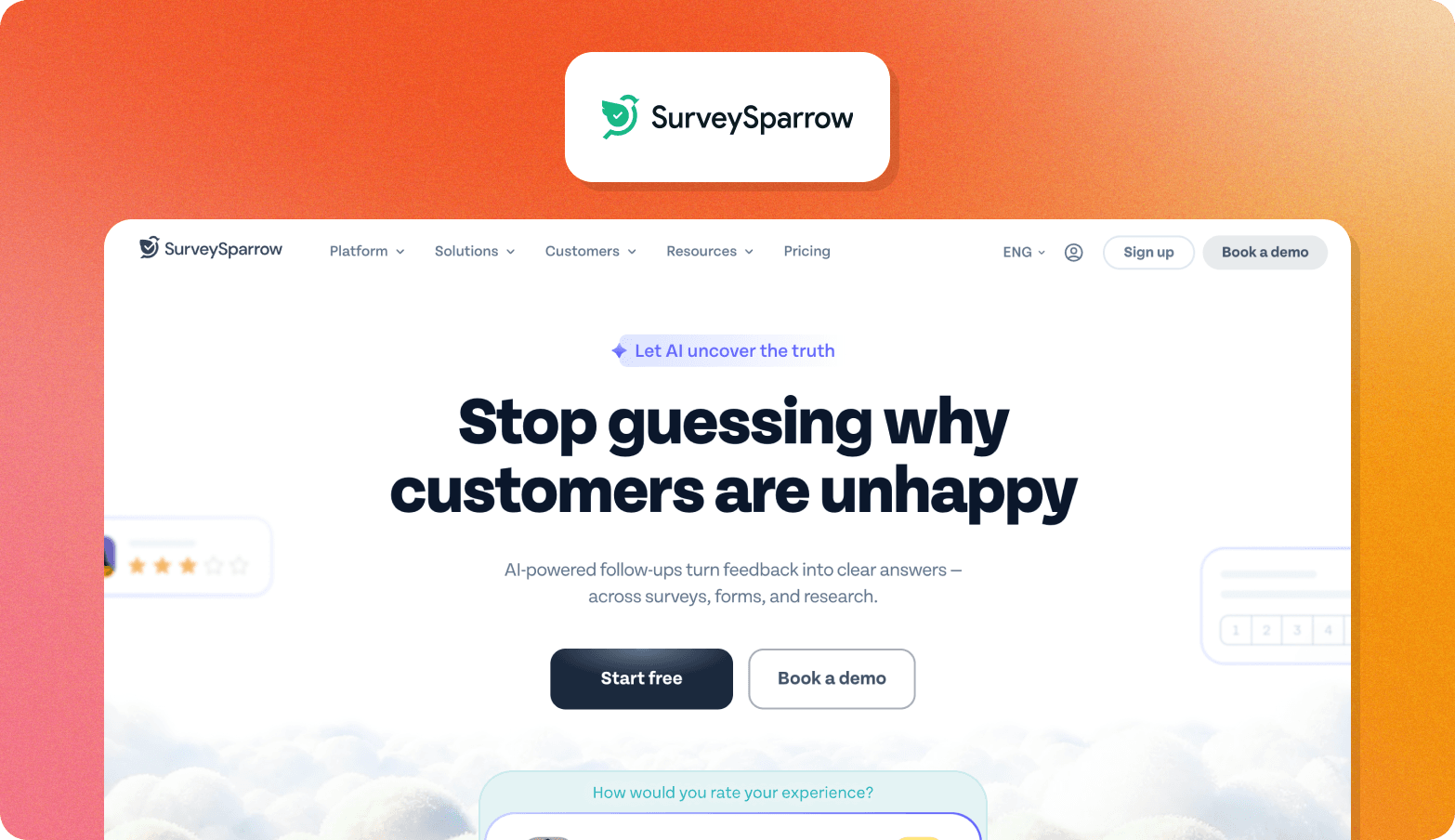
SurveySparrow is a chat-style survey platform built for CX teams.
Best for: Teams that want higher completion rates through a conversational format.
Core strength: CogniVue scans open-text responses for sentiment and themes, while SmartReach AI optimizes send timing across channels including email and SMS.
Limitation: Analysis stops at sentiment tagging, so the findings still lack a face or a voice.
Pricing: Pricing is gated; you’ll need to provide an email address and phone number to find out the cost.
End-to-End AI Research Platforms
Reach for these tools when the study needs to run as one connected program, from recruitment through reporting.
11. Conveo
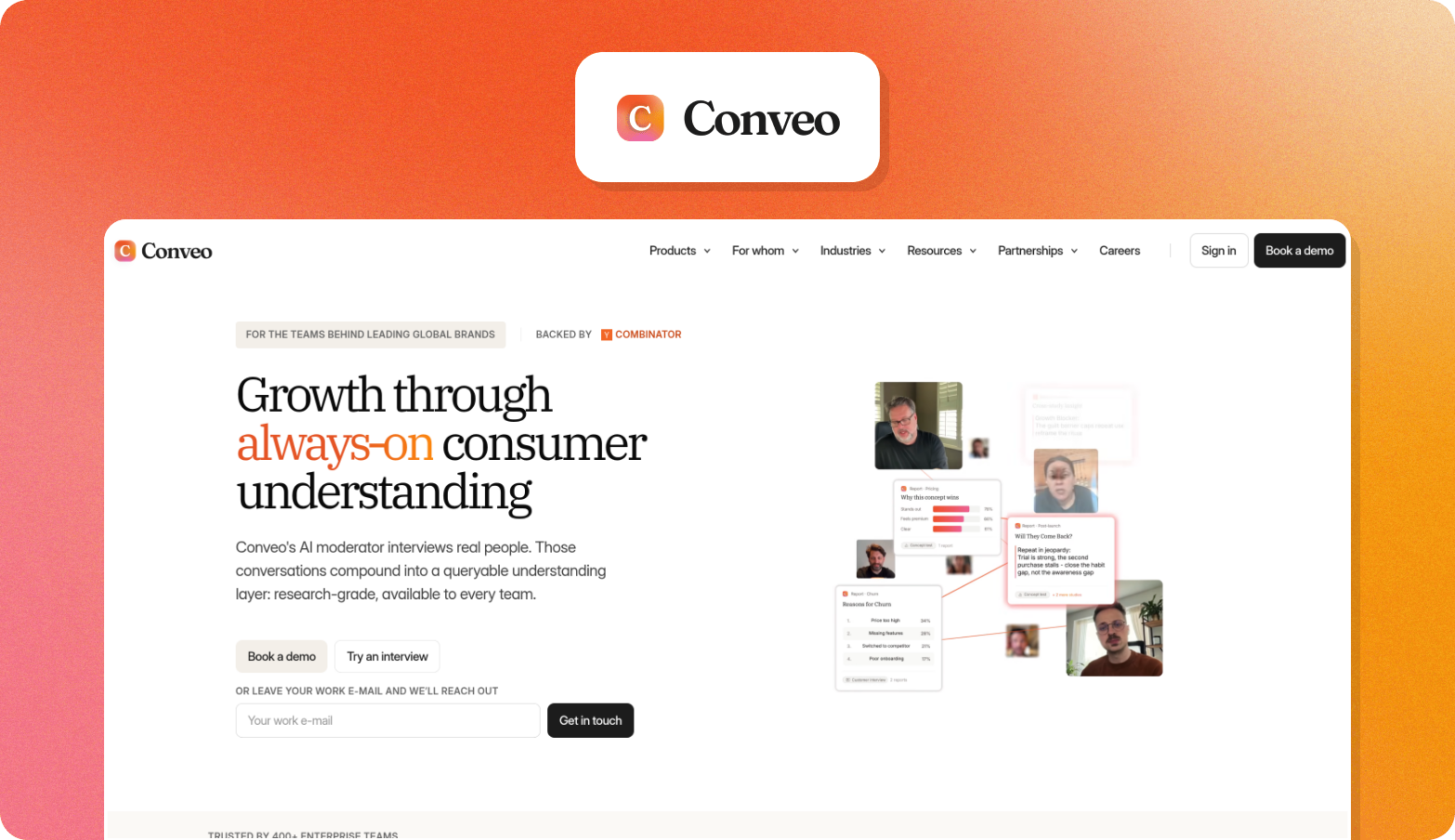
Conveo is a video-first AI research platform that runs the whole qualitative research workflow in one place.
Best for: Teams running recurring qualitative research who need stakeholder-ready outputs backed by evidence.
Core strength: It runs an end-to-end workflow covering study design, recruitment, AI-moderated voice and video interviews, automated analysis and reporting. Every insight links to a timestamped video clip and quote, so stakeholders can check the source directly. Real participants across 50+ languages replace the static text response, and a compounding knowledge library means each new study builds on everything the team has already learned.
Limitation: It isn't built for purely quantitative survey programs or one-off studies.
Pricing: Enterprise plans are priced on request.
"Every team I've introduced Conveo to wants to use it again immediately."
- Head of Customer Insights, JDE Peet's
12. Listen Labs
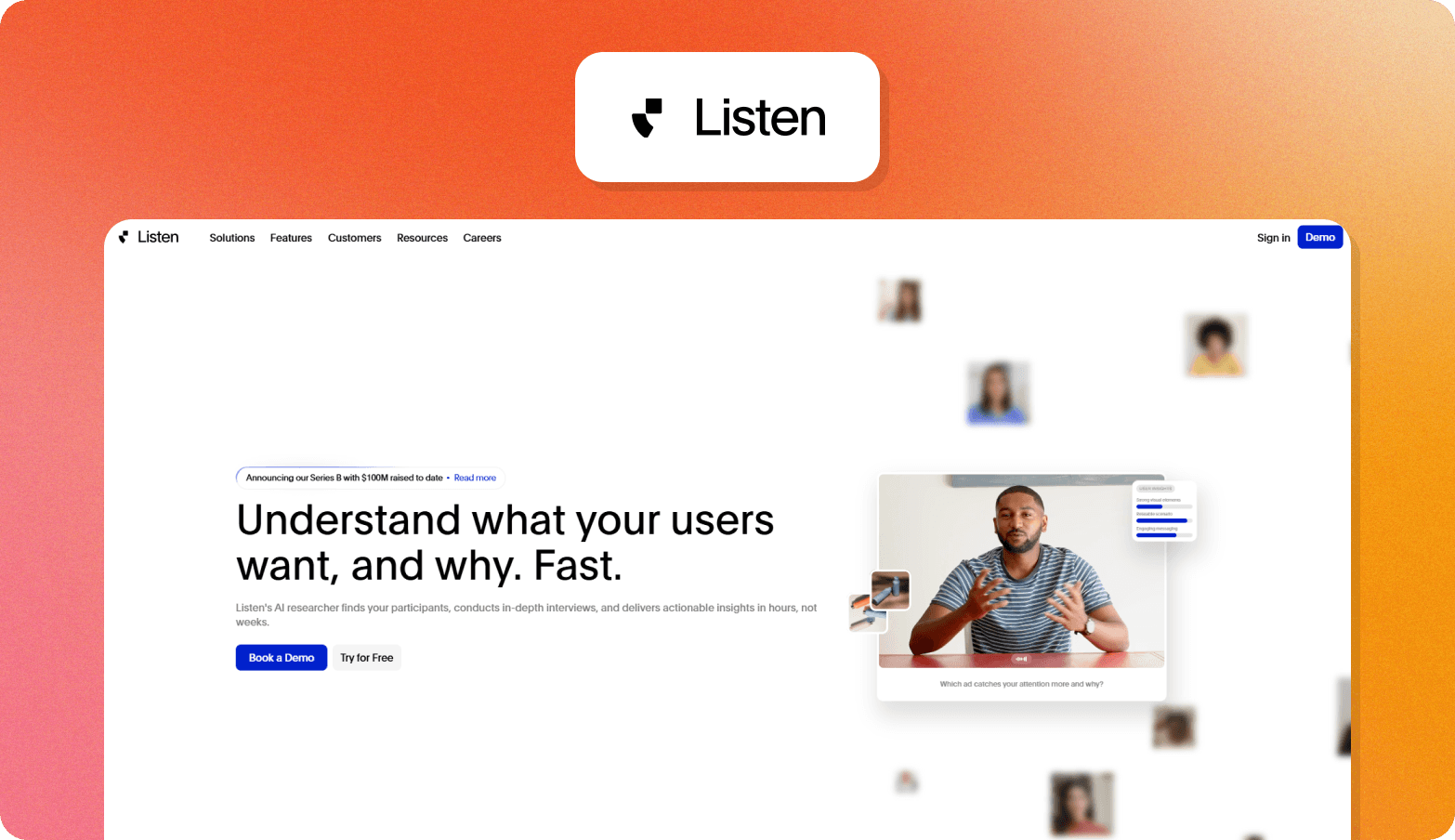
Listen Labs is an AI-moderated consumer research platform for high-volume qualitative feedback.
Best for: Consumer insights teams that need fast, high-volume qualitative research without building out research ops.
Core strength: Quality Guard screens every session in real time for rushed responses and scripted language.
Limitation: EU data hosting isn't publicly confirmed, which can complicate procurement for European enterprise buyers.
Pricing: Available on request.
13. Outset
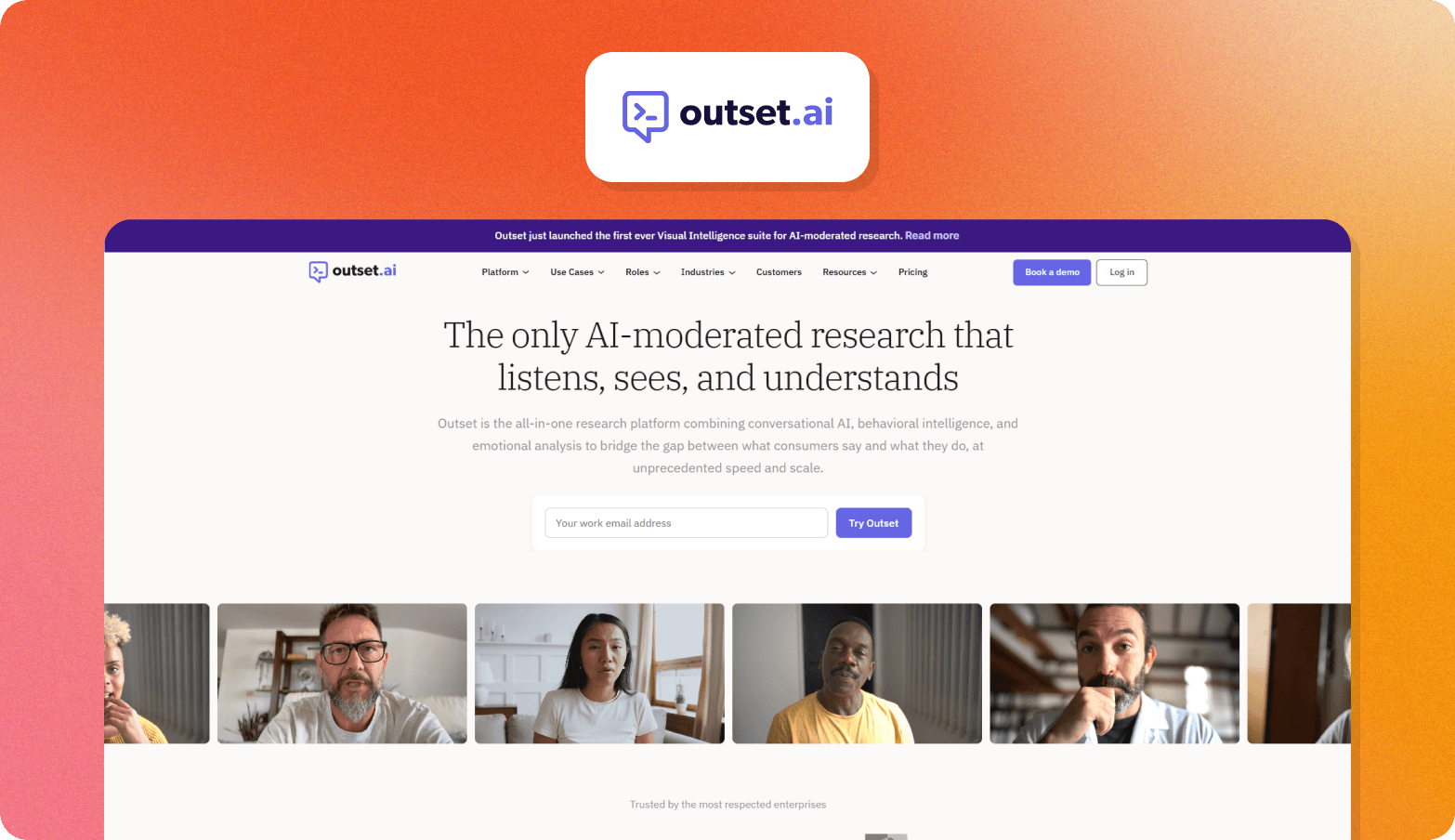
Outset is an AI-moderated research platform that runs async interviews, with participants responding by video, voice, or text.
Best for: Product and UX teams running high-volume async discovery interviews across distributed groups.
Core strength: It uses an AI interviewer that asks adaptive follow-up questions based on each participant's responses.
Limitation: It has no built-in cross-study library, so teams need a separate Dovetail integration to search past findings.
Pricing: Pricing is custom, based on research and support needs.
14. UserTesting
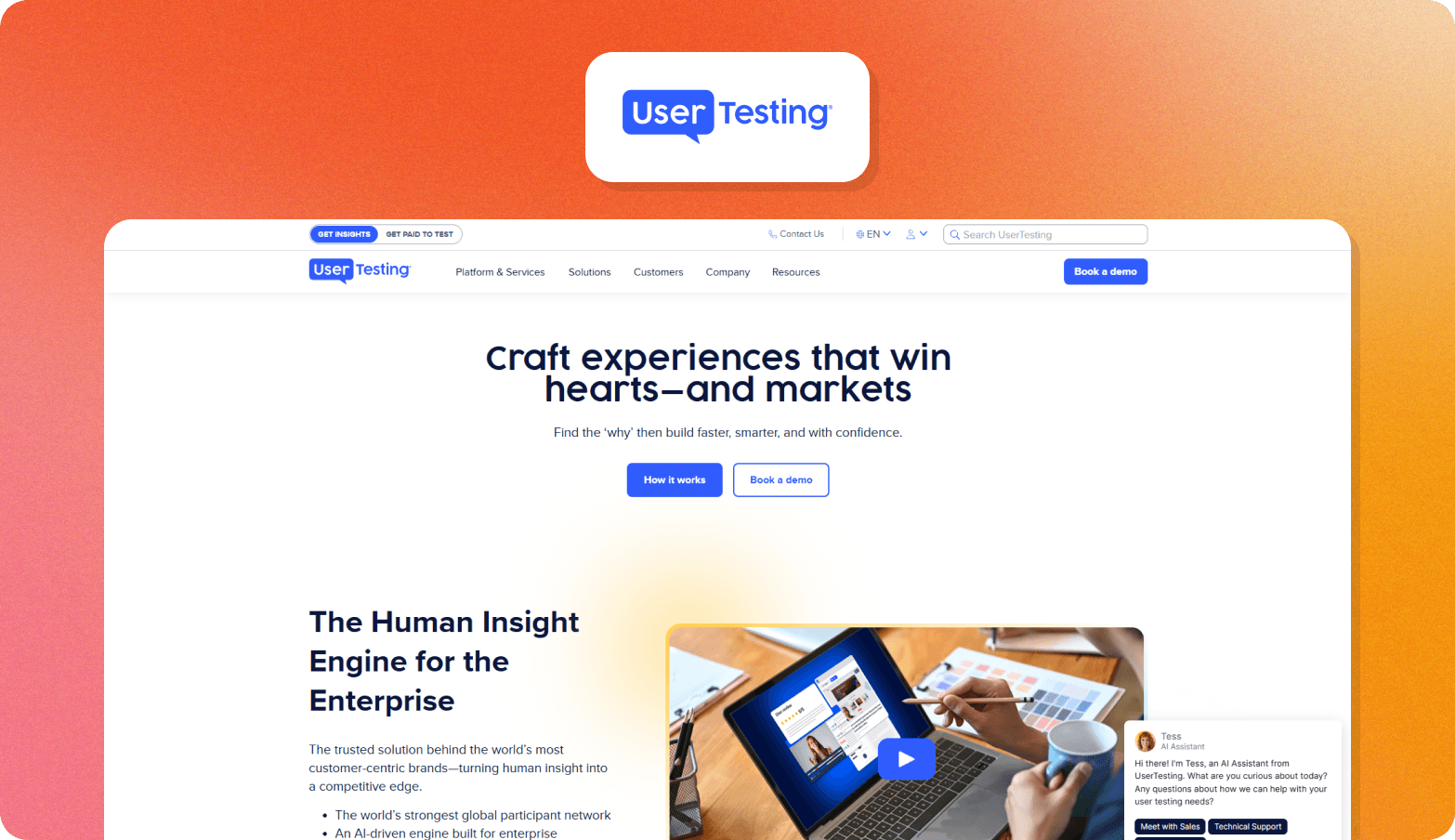
UserTesting is an enterprise human insights platform for unmoderated usability testing.
Best for: Teams running high volumes of unmoderated usability testing who need reliable panel access.
Core strength: More than 80% of requested sessions come back completed within a few hours
Limitation: Only 22 study languages are supported, and there is no automated translation.
Pricing: Available on request.
15. Maze
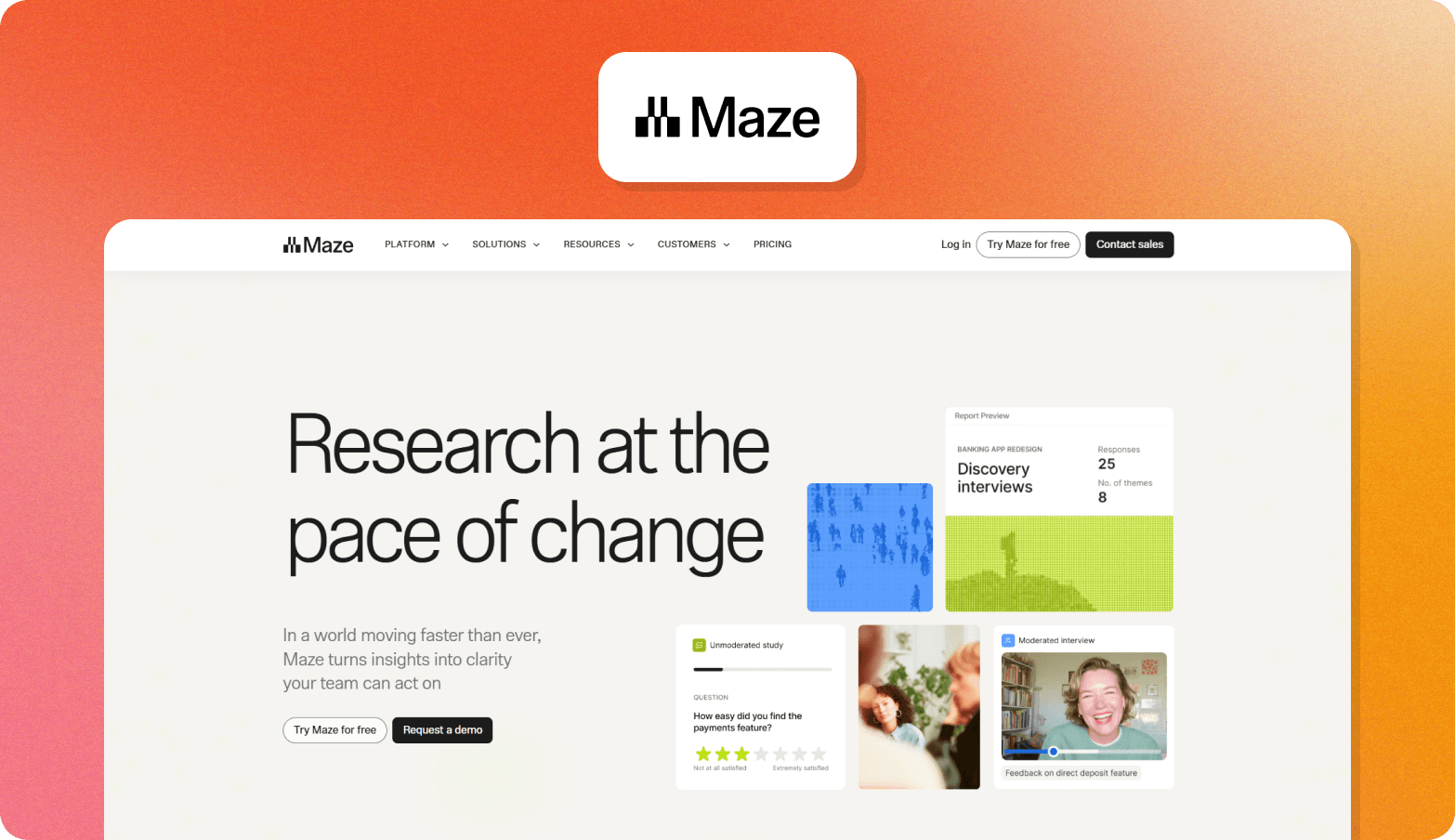
Maze is a product research platform combining usability testing with AI-moderated interviews and built-in recruiting.
Best for: Product and UX research teams running frequent usability testing and lightweight discovery tied to release cycles.
Core strength: You can create shareable highlight reels from any session.
Limitation: The AI moderator is an Enterprise add-on, not included in standard plans.
Pricing: Pricing isn’t publicly listed, and recruitment is credits-based.
What to Check Before Choosing an AI Survey Tool
Once you’ve narrowed down your options, the next step is checking whether a platform meets your organization’s security and governance requirements. For enterprise teams, these details can determine whether a tool moves through procurement or stops there.
Before you buy, ask the vendor these questions:
What to check | Why it matters for enterprise teams |
Does the platform have SOC 2 certification? | It shows that the provider has established controls to manage security and protect customer data. |
Is it GDPR-compliant with regional data hosting? | It helps teams meet data protection requirements and internal policies around where information is stored. |
Can findings be traced back to the original evidence? | Stakeholders can verify insights by reviewing the source material, such as video clips and verbatim quotes. |
Does it support SSO and role-based access controls? | Teams can manage who has access and align the platform with existing security processes. |
Conveo is SOC 2-certified and GDPR-compliant, with EU regional data hosting, and every insight is tied to a video clip and quote for full traceability.
What Makes AI Research Insights Trustworthy
Once you’ve checked a platform’s security and governance, the next step is evaluating the quality of the insights it produces. Look for tools that show how findings were created and make the supporting evidence easy to review.
What to check | Why it matters |
Can you view the original customer response behind each insight? | Teams can verify findings rather than relying solely on AI-generated summaries. |
Are themes linked to supporting evidence? | Stakeholders can see how a conclusion was reached. |
Can you share customer clips or quotes with decision-makers? | Findings are easier to trust and act on when teams can see the evidence directly. |
This matters most in research like concept or ad testing, where a seemingly positive comment may not tell the full story. A participant might say, "I like the messaging," while their facial expression suggests uncertainty.
AI tools for survey data analysis, or generative AI for survey analysis, can help identify patterns quickly, but the strongest insights are those teams can trace back to the original conversation. Conveo combines automated analysis with video clips and quotes to create findings that stakeholders can verify.
How to Evaluate the Cost and ROI of an AI Research Platform
Basic AI survey tools may offer free or low-cost text analysis, while enterprise platforms with broader research capabilities are priced for larger teams and more complex workflows. But when comparing costs, you should look beyond the subscription price to determine a platform’s true value.
Consider what sits outside the tool: if it only analyzes survey responses, you may still need separate providers for recruiting participants or for creating a research repository, which add to your total costs.
To understand the ROI, calculate what the platform allows your team to do that was previously too slow, expensive, or resource-intensive:
Can it bring more research in-house?
Reduce reliance on external agencies?
Help teams run studies that would otherwise be delayed or skipped?
If so, you make more studies possible using the same resources and free up time for your team, turning the platform from an added expense into a cost-saving investment. For example, teams using Conveo have reported up to 75% lower research spend compared to traditional methods.
Why Teams Choose Conveo for Recurring Qualitative Research
Survey tools summarize what people wrote. Understanding why they responded that way takes a different kind of platform, and that's the job Conveo is built for.
A drop in satisfaction appears the same way on every dashboard: as a number. What explains it, like a pricing change or a feature nobody asked for, only surfaces in a conversation, and "why did this happen" is usually the first thing a stakeholder asks.
Study design, recruitment, AI-moderated interviews, analysis, and reporting are handled through a single workflow.
SOC 2 certification, GDPR compliance, and regional data hosting come standard.
Interviews are always with real participants, never synthetic respondents.
Findings carry over from one project to the next through a shared knowledge library, so nothing starts from scratch.
"Conveo's video-first approach is a real differentiating methodological advantage. The ability to distill insights from reactions and not just hear answers adds context you simply can't get from transcript-only tools, or any other tool in the market for that matter."
- Senior Marketing Research & Insights Manager, Google
Conveo isn’t the right fit for teams running purely quantitative survey programs or one-off ad hoc studies. It’s built for organizations with recurring qualitative research needs who want to own their research capability in-house.
Frequently Asked Questions
What Are AI Survey Tools?
Are There Free AI Survey Tools?
What Is the Best AI Survey Tool?
How Do AI Survey Analysis Tools Work?
Can AI Replace Human Moderators in Qualitative Research?
What Compliance Certifications Should I Look for in AI Survey Tools?