


TL;DR
Healthcare UX research is constrained by IRB timelines, clinician scheduling, and patient consent, not by a lack of good methods
One-on-one depth interviews are the gold standard for sensitive topics, but synchronous scheduling with patients and clinicians is the bottleneck
Asynchronous AI-moderated interviews remove that bottleneck, letting participants respond on their own time while preserving depth
Compliance is a procurement gatekeeper: confirm SOC 2, GDPR, and data hosting before fieldwork, especially in high-stakes environments involving healthcare providers and medical staff
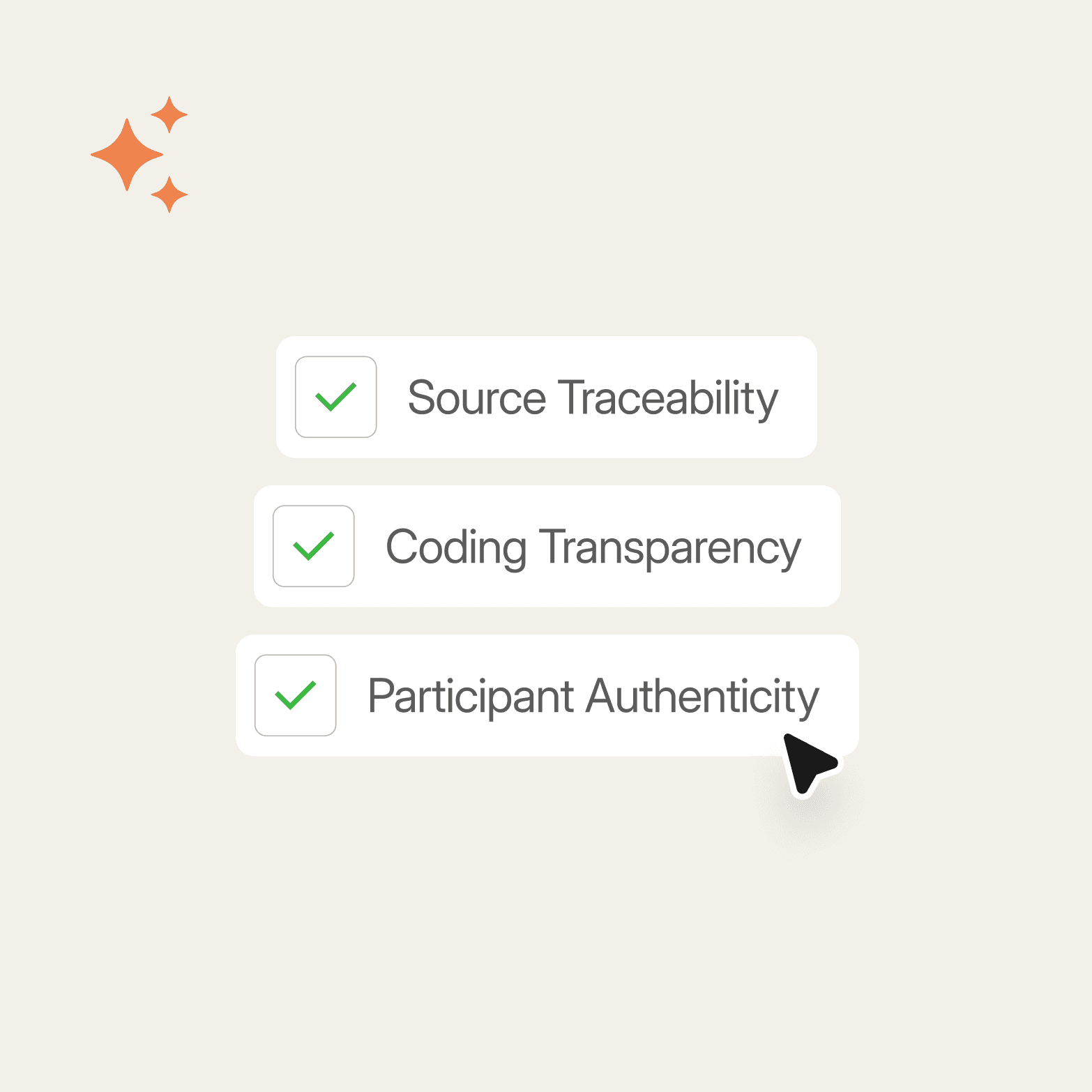
Every finding should trace to a timestamped clip and verbatim quote, because healthcare stakeholders challenge research without a clear evidence trail
Healthcare UX research is the practice of studying how patients, caregivers, and clinicians interact with healthcare products and systems, using methods such as depth interviews, usability testing, and journey mapping, while adapting to HIPAA, GDPR, and IRB requirements that don't apply to general UX work. Qualitative research in healthcare produces the insights that drive product decisions: why a patient stopped following a care plan, the workaround a clinician invented when the EHR failed, the hesitation that signals a usability problem no survey can catch.
What's changed is speed. Video captured at scale, AI moderation, and findings that compound in a searchable library mean healthcare UX research no longer has to trade rigor for pace.
The gap between that possibility and current practice is still wide. IRB review can add weeks before recruitment starts. Synchronous scheduling with patients and clinical staff compounds the delay. And healthcare's complex systems, patient portals, EHR platforms, and connected medical devices demand the same human factors rigor as physical products, plus traceable evidence stakeholders across the healthcare system can actually scrutinize.
This guide covers the methods, compliance requirements, and workflow patterns healthcare UX researchers use to close that gap in 2026.
Why Healthcare UX Research Is Different
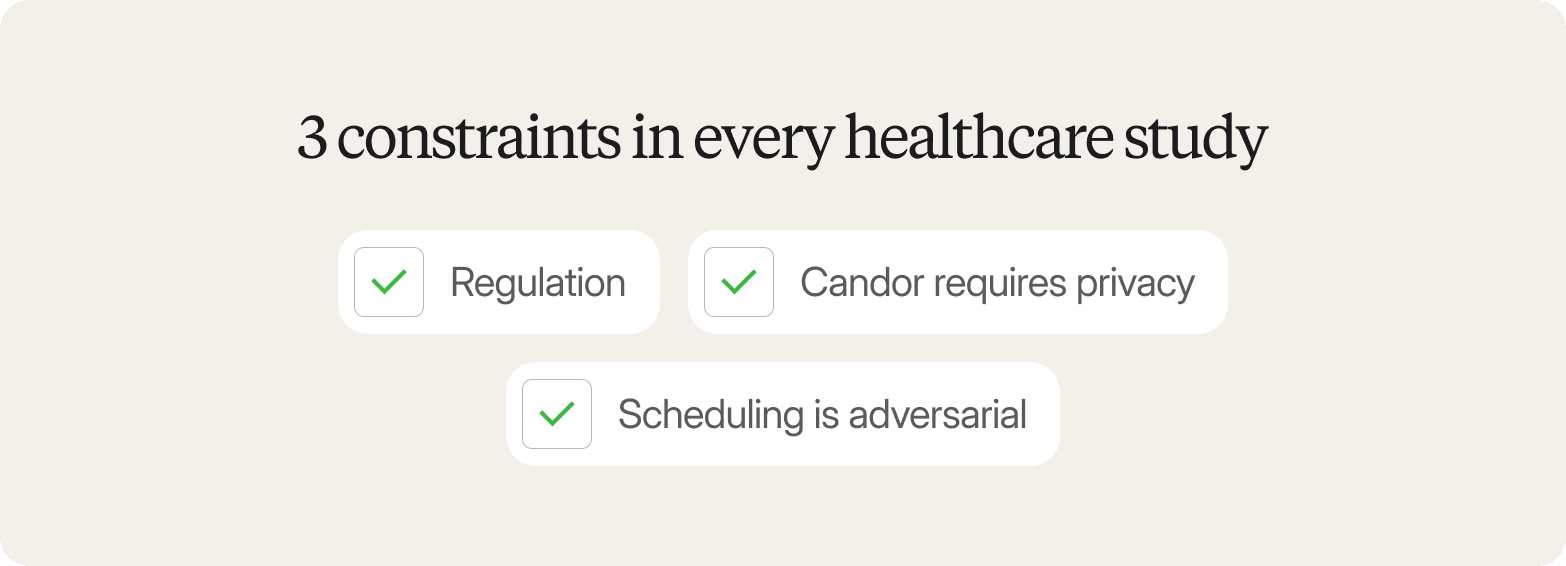
Three constraints shape every healthcare study:
Regulation. HIPAA, GDPR, patient consent protocols, and IRB review govern data collection before a session even begins. This is one of the most highly regulated domains in research, and it shapes screener design, consent flows, and the handling of recordings.
Candor requires privacy. Patients discussing chronic illness or end-of-life decisions, and clinicians describing workarounds, rarely speak candidly in group settings. One-on-one depth interviews are often the only format that elicits honest disclosure from vulnerable people who share personal experiences.
Scheduling is adversarial. Recruiting healthcare providers means competing with clinical rotations and on-call demands. Recruiting patients means working around treatment schedules and caregiver availability. No-shows and reschedules are common enough that researchers who work closely with clinical staff learn to design around these constraints rather than against them.
Traceability compounds the pressure: legal, procurement, and clinical leadership want every claim tied to a real participant, a real conversation, and documented consent.
6 Core UX Research Methods for Healthcare
Method | Best for | Healthcare-specific constraint |
| Sensitive topics: diagnosis, treatment adherence, end-of-life care | Clinician scheduling windows; patient cancellations during active treatment |
| Task completion on healthcare software and digital products (portals, prior auth, lab results) | PHI-compliant screen recording and restricted access to session footage |
| Identifying where care experiences and pain points occur across touchpoints | Requires patients, caregivers, and clinicians simultaneously, often with conflicting views |
| Shared norms across user groups (clinical teams, patient communities) | Hierarchy (attendings vs. residents) can suppress honest disagreement |
| Behaviors participants don't self-report accurately (documentation habits, med management at home) | Time-intensive; introduces incidental-disclosure compliance risk |
| Conditions unfolding over weeks or months (recovery, behavioral health) | Drop-off increases with duration; data governance scales with volume |
The discipline underlying all six draws on human factors engineering: understanding how real users interact with systems built for high-stakes environments, where a usability issue can affect user satisfaction and, in some cases, patient safety.
Where each method needs the most care
One-on-one interviews build the strong relationship needed for candor. Asynchronous AI-moderated formats directly address the scheduling constraint, allowing participants to respond on their own time without a live moderator per session.
Usability testing should account for target users with limited access to assistive technology, including accessibility features such as high-contrast modes and larger tap targets for older adults. This is error prevention, not a nice-to-have: it directly reduces errors that could put patients at risk. Good ux design here means identifying friction points before they reach production.
Journey mapping works only when synthesis doesn't flatten one group's patient experiences in favor of another's. Design systems teams use it to identify friction points across the full healthcare experience.
Asynchronous AI-Moderated Interviews: A New Approach for Healthcare UX
Scheduling a depth interview with a clinician means working around rounds and shift handoffs. Recruiting a patient means finding a window that doesn't conflict with treatment or caregiving. This scheduling coordination problem- aligning clinician shifts, patient treatment windows, and caregiver availability- is why healthcare studies take months and why teams often settle for fewer participants than the design requires.
Asynchronous AI-moderated interviews remove the constraint. Participants respond when it works for them: a nurse between shifts, a caregiver after an appointment, and sessions run in parallel instead of sequentially. A study that would take six weeks of calendar coordination can field across patient, caregiver, and clinician segments in days, helping teams save time without cutting rigor.
This approach still captures what a survey can't: the pause before a question about adherence, the workaround a clinician demonstrates unprompted. These signals carry diagnostic weight and produce deep insights that generic survey data misses.
"The AI doesn't just summarize, it surfaces patterns I wouldn't have spotted reading transcripts"
— CMI Lead, Edgard & Cooper
See it in action: How AI-Moderated Interviews Actually Work →
Two things make asynchronous AI-moderated research output usable at the organizational level:
Traceability. Timestamped clips and verbatim quotes give product, legal, and procurement teams something to inspect directly, not a summary to trust.
Scale across markets. AI moderation in 50+ languages removes the localization overhead that typically adds weeks to multi-country fieldwork.
Governance is a procurement gatekeeper, not a footnote. Conveo, a video-first AI research platform, runs this workflow on SOC 2-certified, GDPR-compliant infrastructure with EU regional data hosting.
How to Choose the Right Method
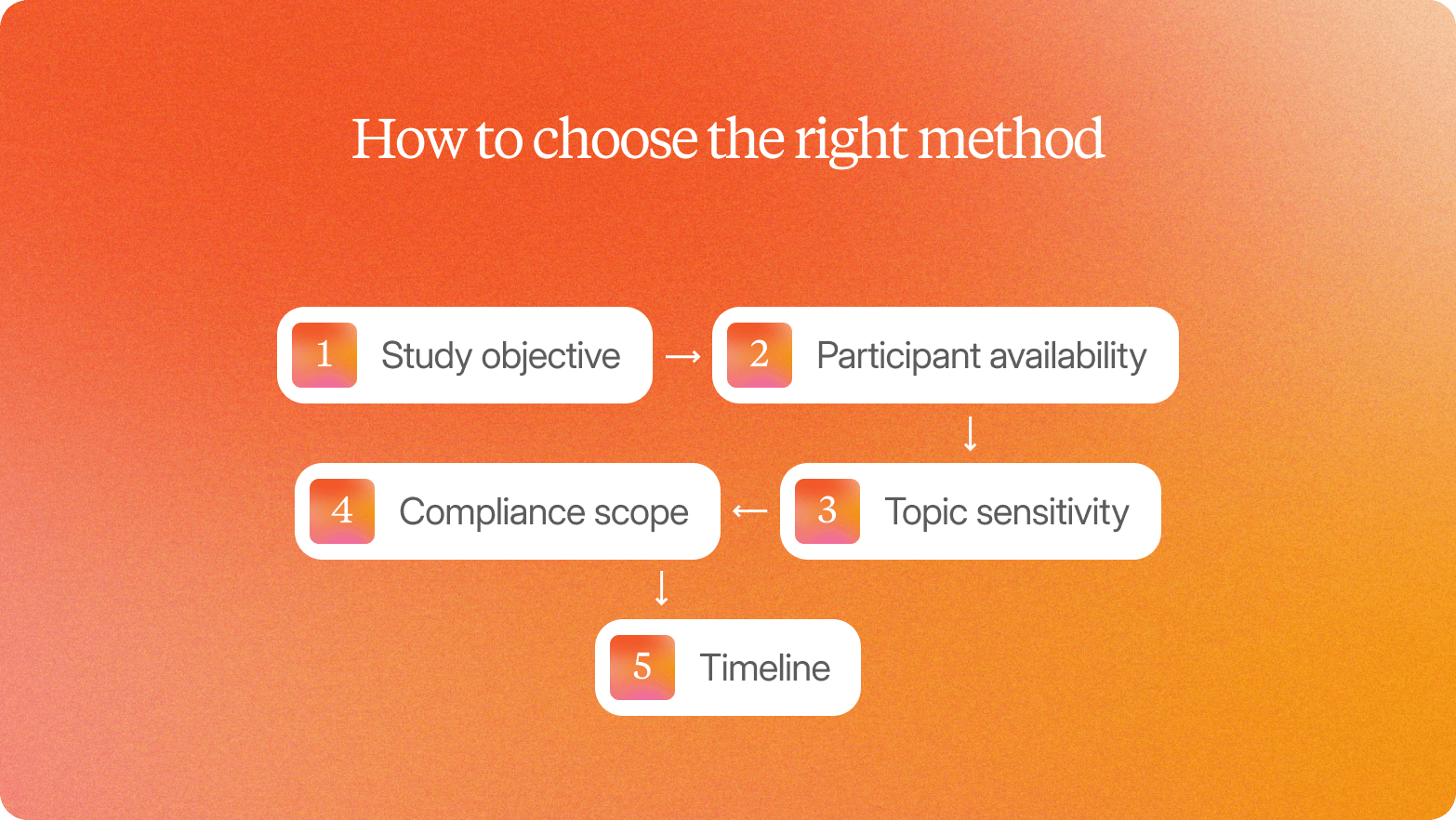
Work through these in order; this is an essential part of building user-centered solutions rather than defaulting to whatever the team ran last time:
Study objective. Concept validation needs exploratory interviews. Interface evaluation needs task-based testing. Patient journey understanding needs longitudinal methods.
Participant availability. Limited windows (patients, caregivers, clinical staff mid-shift) favor asynchronous methods. Real-time probing favors synchronous.
Topic sensitivity. Diagnosis, treatment adherence, mental health, and financial stress call for one-on-one interviews, not groups.
Compliance scope. Any study involving PHI needs a data-handling plan that meets the regulatory standards your organization and health services partners require before fieldwork, not after. Confirm IRB applicability and consent flows first; let compliance scope the method, not the reverse.
Timeline. Sprint teams need days. Strategic roadmap research can absorb longer cycles.
Compliance and Governance Checklist
Work through this before a single participant joins a session:
Data residency: Does the platform support regional hosting to comply with GDPR requirements?
Certification: Is it SOC 2 certified, and does it meet relevant regulatory standards for a highly regulated domain?
Consent management: Are consent records retrievable and auditable, not just collected and filed away? Strong consent management also supports patient engagement, as participants who understand how their data will be used are more willing to return for future studies.
PHI/PII handling: What controls are in place to anonymize or de-identify data before it enters analysis?
Auditability: Can every finding trace back to a specific participant response, session, and consent record?
Conveo's SOC 2 certification and EU regional data hosting are built to clear these checkpoints before fieldwork begins.
5 Common Pitfalls
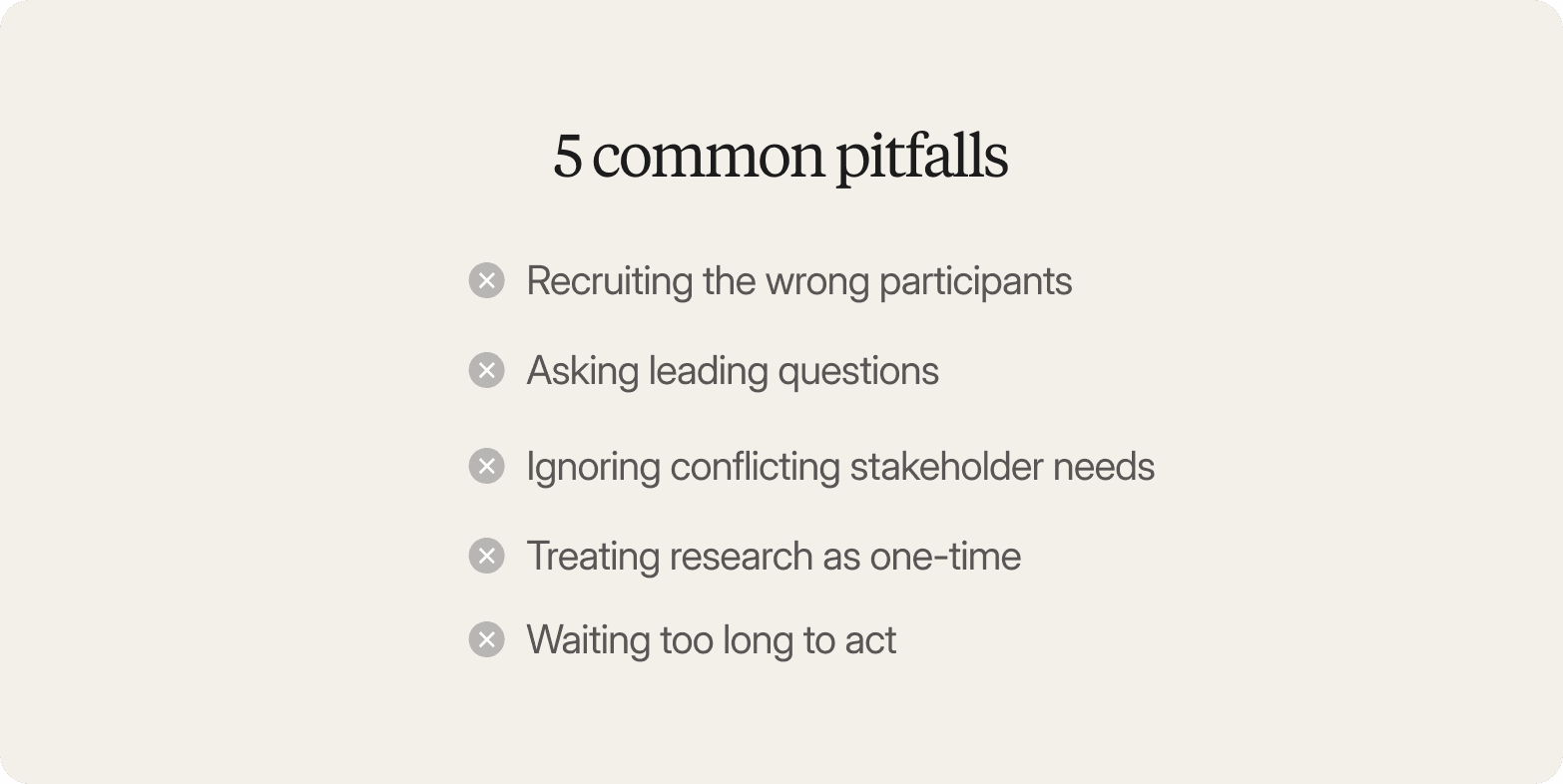
Recruiting the wrong participants. A newly diagnosed patient and someone managing a chronic condition across multiple care teams have almost nothing in common. Define inclusion criteria by care pathway stage and diagnosis timeline to identify friction points specific to each segment.
Asking leading questions. Social desirability bias runs high in healthcare. Ask what someone did last time, not whether a system feels straightforward.
Ignoring conflicting stakeholder needs. Patients want reassurance; clinicians want efficiency. Capture both patient and clinician input and synthesize it with explicit trade-offs so product teams aim for a win-win rather than favoring one side.
Treating research as one-time. Store findings in a searchable, tagged repository so past research keeps paying off on the next study.
Waiting too long to act. Traditional cycles take weeks; roadmap meetings don't wait. Asynchronous methods compress this from months to days.
How Conveo Supports Healthcare UX Research
Conveo is a video-first AI research platform built for this environment, used by 400+ enterprise teams, including Google and Unilever. Its AI moderator conducts in-depth interviews asynchronously, so patients, caregivers, and clinicians participate on their own schedules, giving healthcare designers the deep insights they need without weeks of coordination.
The platform captures video-based nonverbal cues and verbatim language, with timestamped clips linking every finding to its source- the evidence trail that clears stakeholder review in regulated, high-stakes environments.
Compliance is built in: SOC 2 certification, GDPR compliance, and EU regional data hosting let procurement and legal approve the platform before a single session runs. AI moderation in 50+ languages supports multi-country studies without separate regional teams, and every study feeds a searchable knowledge library so findings compound over time.
Frequently Asked Questions
What is UX research in healthcare?
What are the most common methods?
How long does healthcare UX research typically take?
What compliance requirements apply?
How is this different from market research?
How do you recruit participants?