In this article
TL;DR
Qualitative user research answers the "why" behind user behavior that analytics and surveys cannot reach
The right method depends on your research goals: in-depth interviews for individual motivations, usability testing for friction points, diary studies for behavior over time, asynchronous video interviews for speed and scale
Qualitative research takes six weeks or more in traditional workflows, primarily because of operational overhead, not methodology
AI-moderated platforms compress that timeline to days by handling recruitment, moderation, transcription, and first-pass synthesis in parallel
The strongest research programs combine qualitative depth with quantitative scale, sequencing qualitative and quantitative methods deliberately rather than treating them as alternatives
Qualitative user research answers the questions analytics dashboards and surveys cannot: not what users did, but why they did it, what confused them, and what they were actually trying to accomplish. Qualitative data surfaces the reasoning behind user behavior: the motivations, friction points, and emotional drivers that no click-through rate can explain.
The methodology was never the bottleneck. Recruiting, scheduling, moderation, transcription, and data collection turned each study into a six-week project, forcing teams to ration qual to only the highest-stakes decisions. AI-moderated platforms have changed that. Teams can now run qualitative UX research on a sprint cadence, delivering valuable insights in days rather than months.
This guide covers the full range of qualitative and quantitative user research methods, when to use them, the end-to-end process, and how modern platforms are compressing timelines without trading away depth.
What Is Qualitative User Research?
Qualitative user research is the practice of developing a deep understanding of why users behave as they do through open-ended conversations and direct observation, rather than numerical measurement. Where quantitative research answers “how many” and “how much,” qualitative research answers “why” and “how.”
Qual earns its place when the problem is still taking shape, when a product team sees a drop in activation but doesn’t know what’s driving it, when emotional or attitudinal drivers are at play, or when you need the exact words users reach for when describing a problem. Qualitative data helps teams surface motivations, friction points, and the contextual nuances that surveys miss.
It’s the wrong choice when the question requires statistical significance, representative measurement across a broader audience, or reliable metric tracking over time.
Most rigorous research programs use both qual to explore and generate hypotheses, and quant to validate and measure at scale.
When to Use Qualitative User Research: 6 Examples
The most common failure mode in research planning is mismatching the method to the question. Use qualitative research when:
A key metric moved, and you don’t know why
Checkout abandonment spiked. Feature adoption stalled post-launch. Quantitative data shows where the problem is, not what’s driving it. Conversations with real users surface qualitative insights that data alone can’t provide.
You’re entering unfamiliar territory
Designing for a new target audience or market where your assumptions may not hold. Qual is the right starting point because you need to understand the problem space before forming hypotheses worth testing.
You need to validate messaging, concepts, or prototypes
Qualitative sessions reveal how users interpret what you’ve built, not just whether they click through. This is particularly valuable early in the design process, before significant resources are committed.
You’re investigating emotional or attitudinal drivers
Surveys can measure satisfaction scores. They rarely explain what’s behind them. When trust, anxiety, or brand perception is involved, you need a real conversation to surface what’s actually driving behavior.
You need verbatim language
Personas, journey maps, and stakeholder presentations are stronger when grounded in real user language, more persuasive than synthesized summaries.
You’re adding context to quantitative findings
Survey data shows dissatisfaction in a particular segment. Qualitative interviews explain the underlying causes.
Reach for a different approach when you need statistically significant results to measure prevalence across a population, when you’re tracking a metric over time, or when stakeholders require representative data to justify a resource decision.
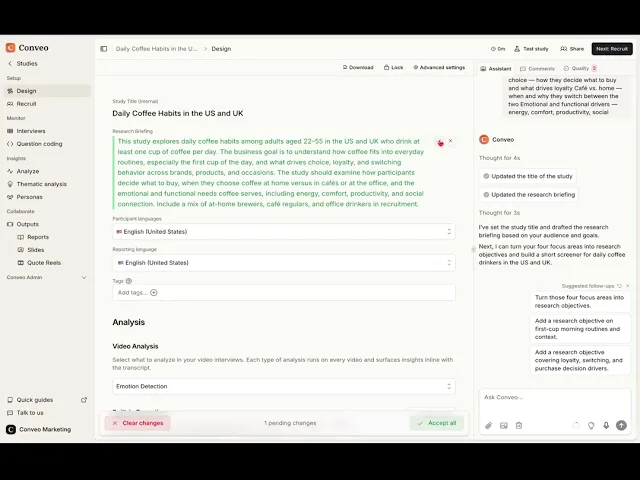
Discover how to build and launch a study in Conveo
7 Core Qualitative User Research Methods
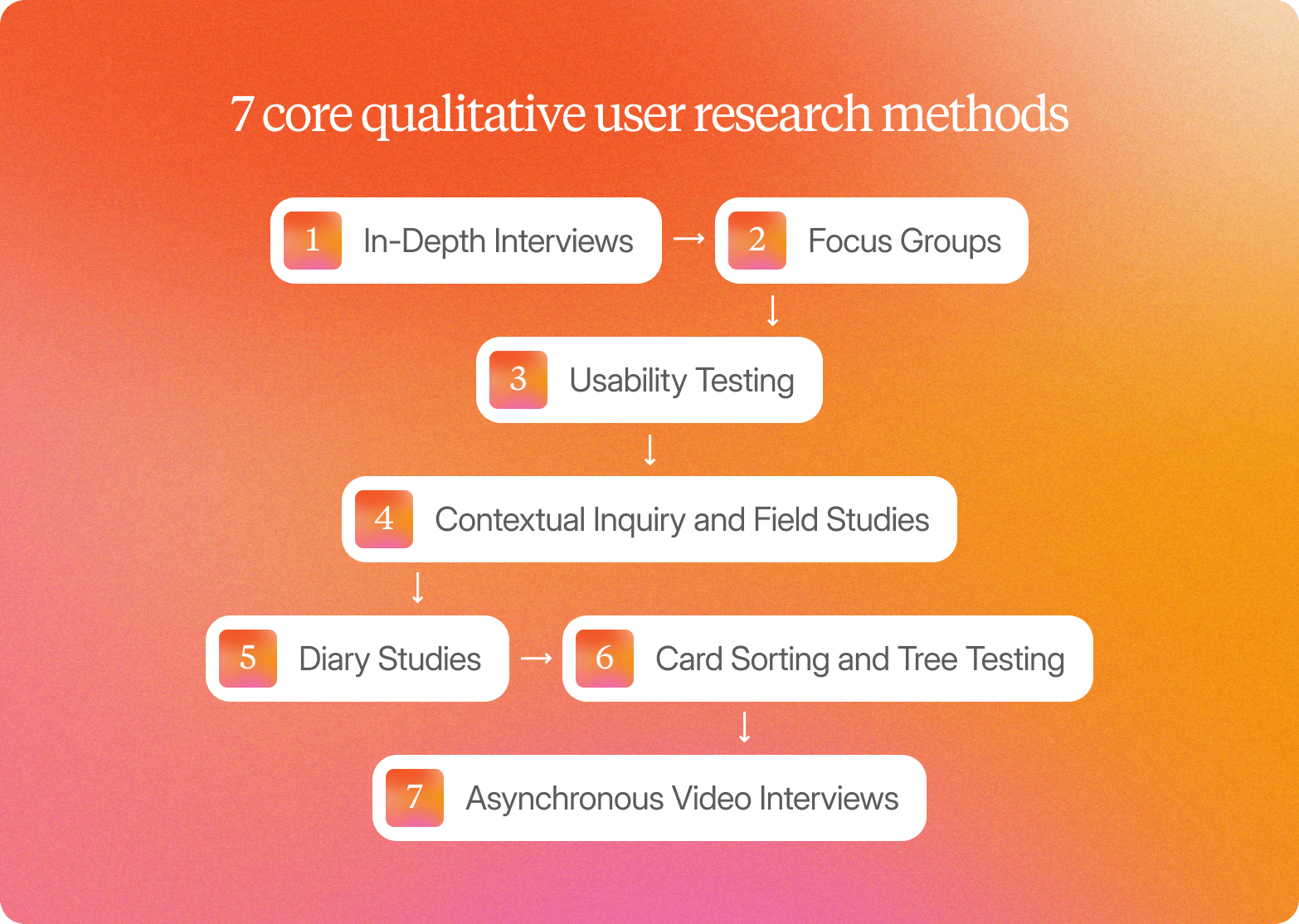
1. In-Depth Interviews (IDIs)
One-on-one user interviews guided by a semi-structured discussion guide. IDIs give researchers the flexibility to follow unexpected threads while maintaining enough structure to compare findings across research participants. Best for individual motivations, sensitive topics, or complex decision-making where group dynamics would distort responses. Business question: Why do enterprise buyers choose one SaaS platform over another, and what objections nearly derailed the purchase?
2. Focus Groups
Moderated discussions with 6 to 10 participants exploring shared attitudes, reactions, or ideas. Useful for understanding how a target audience discusses a topic and for observing how opinions form socially. Core tradeoff: groupthink and dominant voices can pull toward a consensus that doesn’t reflect individual experience. Best for concept exploration and language development, not for validating whether a specific design will land. Business question: How do target consumers react to three brand messaging concepts, and which language feels most credible?
3. Usability Testing
Participants interact with a product, prototype, or live user interface while thinking aloud. Usability studies reveal where users hesitate, misinterpret, or abandon tasks, giving teams the usability metrics they need before a product ships. Unlike quant usability testing, which measures success rates across large samples, qualitative usability sessions reveal the reasoning behind task failures. Both the design process and the broader product development process benefit early from this method. Business question: Where do users drop off during the new checkout flow, and what causes the confusion?
4. Contextual Inquiry and Field Studies
Researchers observe users in their natural environment performing real tasks. Rooted in ethnographic research traditions, contextual inquiry captures the environmental constraints, interruptions, and workarounds users have normalized: behaviors they’d never mention in an interview. The defining characteristic is direct observation in context rather than recall in a lab. Business question: How do nurses actually use medical software during a hospital shift, and where does the interface create dangerous workarounds?
5. Diary Studies
Participants collect data on their own experiences over days or weeks using structured prompts. The right choice when behavior is longitudinal, infrequent, or tied to a life context that a single session can’t capture. AI-powered synthesis makes diary study analysis faster: automated transcription and thematic coding can process data collected across weeks of entries as it arrives, rather than in a batch at the end. Business question: How do new parents use a baby monitoring app across the first month, and when does initial enthusiasm drop off?
6. Card Sorting and Tree Testing
Participants organize information into groups (card sorting) or navigate a structure to find specific content (tree testing). These are core UX research methods purpose-built for validating information architecture and taxonomy decisions before committing to a redesign. Both methods are especially effective when the design process has surfaced competing structural hypotheses. Business question: Does the proposed navigation structure match how users expect to find product information?
7. Asynchronous Video Interviews
Participants respond to prompts via video on their own schedule, without a live moderator. Instead of scheduling 50 interviews across three weeks, teams collect data from distributed audiences in parallel within 48 hours. AI-moderated async interviews adapt follow-up questions based on each participant’s responses, preserving conversational depth at scale. A UX researcher or insights manager can review structured findings (transcripts, themes, video clips) without having been present for a single session. Business question: How do users across five markets describe their onboarding experience, and where does the flow break down by region?
The Qualitative User Research Process
1. Define the research question and goals
Vague questions produce vague findings. Before any study design work begins, name the specific decision the research will inform and clarify the research goals it needs to serve. “Why do users abandon checkout?” is a research question. “Understand the checkout experience” is a topic.
2. Choose the method and sample
Method must match the question. Sample size depends on depth vs. breadth: five to eight user interviews surface most recurring themes when the participant profile is tightly defined. Larger research studies (segmentation work, multi-market programs) may require 20 to 30 research participants across distinct groups. A poorly recruited sample invalidates an otherwise solid study.
3. Design the discussion guide
A semi-structured guide with probing beats a fully scripted questionnaire. Four practices that consistently improve guide quality:
Open with broad, context-setting questions before narrowing
Probe for concrete examples when participants give general answers
Avoid leading language that signals the answer you expect
Leave deliberate space for unexpected directions
4. Recruit and incentivize participants
Screeners should qualify research participants on behavior and context: have they done the thing you’re studying, recently enough to remember it clearly? Incentives should reflect participant effort and opportunity cost. Under-incentivizing reduces completion rates and introduces self-selection bias.
5. Conduct the interviews
Good moderators listen more than they talk, probe when answers are vague, and adapt based on what participants reveal. AI-moderated async interviews remove scheduling overhead entirely: 30 conversations can run in parallel over a weekend rather than being scheduled one per hour across three weeks.
6. Analyze and synthesize findings
Qualitative analysis involves thematic analysis of transcripts, identifying patterns across research participants, and tracing every claim back to verbatim quotes. Qualitative insights should emerge from the data, not be imposed on it. Stakeholders trust findings more when every claim links to a specific quote or video clip rather than a summary with no visible source.
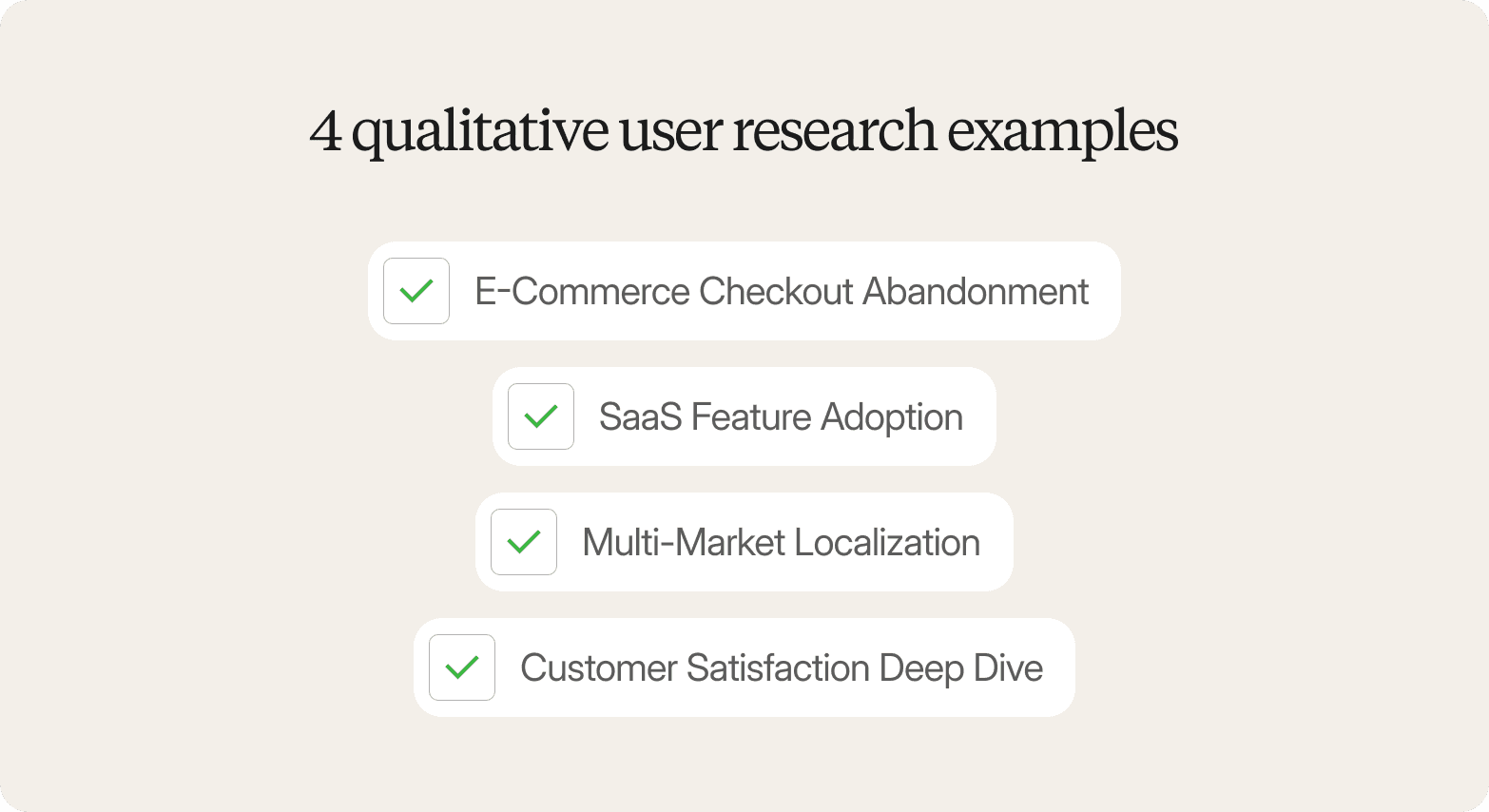
4 Qualitative User Research Examples
E-Commerce Checkout Abandonment
A retailer saw a 15% spike in checkout abandonment after a redesign. In-depth user interviews with recent shoppers revealed that a new “save payment info” prompt felt untrustworthy on first visits. The team removed the prompt and added trust badges at the payment step; abandonment dropped 12%.
SaaS Feature Adoption
A B2B company launched a collaboration feature and watched adoption stall below 10% despite positive pre-launch testing. Usability studies showed users couldn’t find the feature in the existing navigation. Moved to the main menu with onboarding tooltips, adoption reached 35% within a month.
Multi-Market Localization
A global SaaS company assumed its core product would translate well into three new markets with minimal translation work. Async video interviews with 60 users across the target markets told a different story: terminology and workflows that felt natural in the home market created confusion abroad. The team adapted before launch; trial-to-paid conversion improved 25%.
Customer Satisfaction Deep Dive
A subscription service saw NPS decline by 10 points over six months, with no clear cause visible in support tickets or usage data. Diary studies with current subscribers revealed a consistent pattern: users felt the product had become cluttered with features they couldn’t easily ignore. The team introduced a simplified “essentials” plan. NPS stabilized, and churn dropped 8%.
Each of these research studies started with a number that raised a question. The answer required a conversation.
Qualitative vs. Quantitative User Research
Understanding the key differences between these approaches is foundational to good research planning. Qualitative research answers “why” and “how” through in-depth conversations with small, purposive samples. Quantitative research answers “how many users” experience something, using statistical analysis of numerical data to measure user behavior across a broader audience or even an entire population.
Popular quantitative research methods include surveys, A/B tests, and web analytics tools like Google Analytics. Where a qualitative study reveals why users hesitate at a step, a quantitative study measures how many abandon it, and whether the difference is statistically significant. Quantitative UX research adds usability metrics (task completion rates, success rates, error rates) that user testing alone can’t produce at scale. Quantitative UX research methods like benchmark testing and heat-mapping help teams measure metrics at the population level in ways a qualitative study cannot.
A mixed methods approach (combining qualitative and quantitative research) is more powerful than either method alone. Quantitative user research scales measurement; qualitative and quantitative UX research together produce the full picture. The goal isn’t to choose: it’s to sequence deliberately.
| Combination | How it works |
|---|---|
| Generate, then validate | A qualitative study surfaces a pain point in detail. Quantitative research methods measure how common it is across a broader audience. |
| Identify, then explain | Web analytics reveal a drop-off. User interviews uncover the actual cause – something no dashboard could have named. |
| Validate, then deepen | A quantitative study shows declining satisfaction scores. Together, qualitative and quantitative methods reveal what’s driving the change and how widespread it is. |
| Segment, then size | Interviews identify distinct user archetypes. Quantitative user research methods quantify each segment’s behavioral patterns. |
Qualitative and quantitative UX work best together. When platforms like Conveo compress the qualitative timeline from weeks to days, both qualitative user research methods for exploration and quantitative methods for validation fit within a single sprint.
7 Common Qualitative User Research Mistakes
Mismatching the method to the question
Teams default to the method they know best rather than the one that fits their research goals. Define what the finding needs to look like first, then choose the method that produces it.
Poor recruitment and screening
Recruiting the wrong target audience doesn’t just weaken findings: it invalidates them. Use experience-based screening criteria and set incentives that attract genuine research participants.
Leading questions in the discussion guide.
“Why do you find this feature useful?” assumes the participant does. Use neutral prompts that invite description rather than confirmation.
Over-reliance on self-reported behavior
What participants say they do and what they actually do are often different. Combine qualitative data with observation or behavioral analytics to triangulate what’s actually happening.
Ignoring negative or contradictory findings
Cherry-picking quotes that confirm a preferred direction is one of the most common ways research loses credibility. Report all themes, including the ones that complicate the narrative.
Delivering findings without traceability
A summary slide that says “users find onboarding confusing” is easy to dismiss. The same finding, backed by verbatim quotes and video clips, is not.
Letting insights die in decks
Research that lives in a presentation file doesn’t compound. A searchable insight library changes that: findings become reusable, contradictions surface across research studies, and the organization builds a deep understanding of its customers over time.
How Modern Platforms Compress Qualitative Research Timelines
Traditional qualitative research takes longer because of everything surrounding the conversations, not the conversations themselves. Recruiting alone takes two to three weeks. Scheduling, transcription, and manual data collection and coding add another four to six weeks from brief to final report.
AI-moderated platforms restructure how time is spent. Recruitment, screening, moderation, transcription, and first-pass thematic analysis run in parallel. What previously took weeks of coordination collapses into days of actual work, without changing the qualitative research methods themselves.
The mechanism: a researcher defines the participant profile and uploads a brief. The platform sources research participants, runs AI-moderated video interviews as they qualify, and begins transcription and synthesis as sessions conclude. By the time the researcher reviews findings, the mechanical work is done.
Conveo was built around this model. Teams report going from study launch to structured findings in days, not weeks, not by shortcutting the research, but by removing overhead unrelated to research quality.
"Within days, we had insights that would've taken a traditional agency a month."
Head of Customer Insights, JDE Peet’s
The AI moderator probes adaptively based on participants’ responses, preserving the depth of a well-moderated interview without requiring a human moderator in every session.
The most effective model: AI handles the first 80% of mechanical work, so researchers can invest their expertise in the 20% that determines whether findings actually change anything.
How Conveo Accelerates Qualitative User Research
Conveo is a video-first AI research platform used by hundreds of enterprise teams, including Google, Bosch, Reddit, and FOX. Its AI moderator conducts adaptive user interviews in 50+ languages, probing based on each participant’s responses rather than following a static script. Recruitment runs through integrated panel partners or a team’s own lists, with behavioral screeners that qualify on experience rather than demographics alone. Transcription, translation, and thematic analysis happen automatically as sessions complete, surfacing valuable insights without the manual overhead.
Every interview, transcript, and discovery phase finding feeds into a compounding knowledge library: qualitative insights become searchable and reusable across the organization rather than sitting in individual decks. Conveo is SOC 2-certified with GDPR-compliant EU hosting, meeting compliance requirements that many AI research vendors leave unaddressed.
Frequently Asked Questions
What is qualitative user research?
Qualitative user research is the practice of understanding why users behave as they do through open-ended conversations, direct observation, and user interviews, rather than through numerical measurement. It surfaces motivations, emotional drivers, and contextual factors: the qualitative data that quantitative data alone cannot capture.
How many participants do I need for a qualitative study?
For most qualitative studies with a tightly defined participant profile, five to eight user interviews capture most recurring themes. Segmentation work, edge-case identification, or multi-market research studies may require 20 to 30 research participants from distinct groups. The quality of recruitment matters more than the raw sample size.
How long does qualitative user research take?
Traditional qualitative research takes six weeks or more from brief to final deliverable. AI-moderated platforms compress that to as few as three days by running recruitment, interviews, and synthesis in parallel.
What is the difference between qualitative and quantitative user research?
Qualitative research answers "why" and "how" through depth with small, purposive samples. Quantitative research answers "how many" and "how much" through breadth with large, representative samples. The strongest research programs use a mixed method approach: qualitative and quantitative research working together, qual to explore, quant to validate at scale.
When should I not use qualitative research?
Qualitative methods are not the right choice when the question requires statistical significance, representative measurement across a population, or reliable metric tracking over time. If the goal is to measure prevalence, compare performance across segments, or justify a resource decision with statistically significant data, reach for quantitative research methods instead.

About the author
Florian Hendrickx
Head of Growth
Florian is Conveo’s Chief Growth Officer, leading growth strategy and go-to-market execution as the company scales. He’s held growth leadership roles at companies like Deliverect, Robovision, and Aikido Security, and brings hands-on experience across marketing, sales, and product.
More by Florian →Qualitative insights at the speed of your business.
Conveo runs AI-moderated video interviews and structures everything they say.