In this article
TL;DR
The core tension: Evidence that arrives after the decision closes stays unused. Food and beverage teams work to a multi-week qualitative research timeline while product decisions, from flavor selection to packaging lock and claims approval, close in a fraction of that time.
Why the traditional process breaks down: Sequential research workflows- recruit, schedule, moderate, transcribe, analyze, report- add a handoff at every stage. Each handoff stretches a short question into a long project, so the debrief deck lands after the shelf window has already closed.
What changes with always-on consumer understanding: Teams can field AI-moderated video interviews across hundreds of participants at once, with analysis completing as conversations close. Findings come back while the decision is still open, so teams can make informed decisions before the window closes.
Best for: Insights and CMI teams at food, beverage, and CPG companies validating flavor profiles, packaging concepts, and product claims while the decision is still open.
Not the right fit for: Teams running purely quantitative tracking, or one-off research buyers who won't see the value of findings that compound across studies.
Picture a food innovation team with three flavor concepts, a Q2 shelf window, and a retailer commitment deadline sitting six weeks out. On paper, the picture looks fine: historical data from the prior launch is solid, SKU velocity is holding, category share is steady, sales trends point in the right direction, and the top-line survey scores show a clear winner among the three concepts. So the team commits to production on concept two, the one that scored highest on purchase intent.
Six months later, concept two is underperforming at shelf. A recontact study and some intercepted shopper conversations reveal what the survey never surfaced: consumers read the health claim as a dietary product, whereas the team intended it as a functional snack. The flavor descriptor confused shoppers who expected something closer to the adjacent SKU on the shelf two over. The packaging cue that tested well on screen read differently under fluorescent store lighting. All of that stayed invisible in the scores. The scores identified patterns in stated preferences and stopped there, leaving the consumer behavior driving them and the information that would have changed the decision unexplained.
That gap is the real cost of decision-lag: the evidence that would have changed the call arrived six months too late to matter. A consumer who rates a concept 7 out of 10 for purchase intent gives you a number and keeps the reason to themselves. The price point that felt inconsistent with the packaging, the flavor name that recalled something they had tried and disliked, the health claim that felt like a stretch: all of it stays behind the score. Those objections are the ones that kill products at shelf, and turning them into actionable insights and informed decisions takes a different kind of evidence.
Sales dashboards, shelf-share reports, and promotional lift data tell you what happened after the decision was made and the product was already on shelf, tracking sales revenue, market share, and operational efficiency after the fact. They stop short of why shoppers chose or rejected a product, and of what would need to change for them to pick it up next time. Always-on consumer understanding is the missing layer: evidence that arrives while the concept, the claim, or the price is still an open question.
This piece covers seven use cases in which qualitative evidence resolves a business intelligence signal before the decision window closes, so that insights teams get evidence back while the decision is still open.
What business intelligence in the food industry actually means (and what it misses)
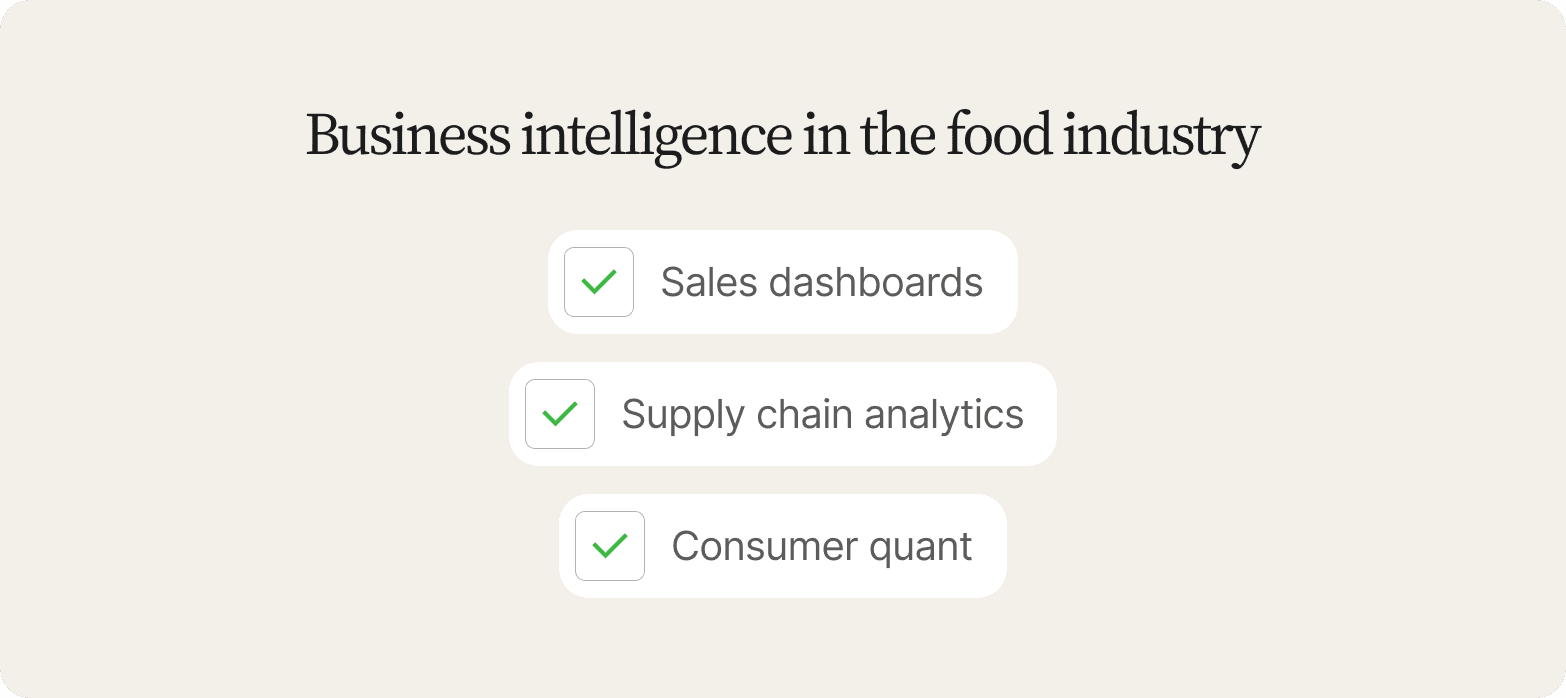
Business intelligence in the food industry refers to the procedural and technical infrastructure that turns operational data, spanning sales, inventory, food production, and shelf share, into commercial decisions. For most food and beverage companies, that infrastructure runs on three core categories of business intelligence tools, each doing a specific job well:
Sales dashboards are largely descriptive analytics: they track SKU velocity, channel performance, and regional market trends, most often built on business intelligence BI tools like Microsoft Power BI. They tell you which products moved, where they moved, and whether sales revenue shifted between periods, drawing on historical data to identify trends and build sales forecasts for the quarter ahead.
Supply chain analytics support supply chain management by covering inventory management, inventory levels, waste rates, and production efficiency, surfacing where raw materials cost leaks, where food waste eats into margins, and where production processes could better minimize waste, feeding supply chain optimization and optimizing resource allocation decisions across production planning.
Consumer quant rounds out the picture: brand trackers, purchase-intent scores, and preference-ranking studies show how many shoppers favor option A over option B, how market share shifts, and how brand health metrics trend over quarters.
Each of these does exactly what it promises. Food manufacturers and food processors lean on this stack daily to monitor food manufacturing, day-to-day operations, and operational efficiency, running data analysis on the data generated across the business. The limitation shared across all three is the same, and it matters: all of them describe what happened and stop at the threshold of why. Why did a new health claim test well in a preference study but underperform at shelf? Why did a reformulated product lose repeat buyers who initially trialed it? The data produced by these systems registers the outcome and leaves the reasoning to be inferred.
This is where qualitative consumer understanding functions as the missing layer, and it works best as a sequential input: run qual first to understand the causal mechanism, then size the finding with surveys. A video interview that captures tone, hesitation, and the specific language a shopper uses when evaluating packaging, product quality, or a protein claim gives you a better understanding of the why behind the number.
The practical split is this: quant answers "how many prefer it," and qual answers "why they chose or rejected it." When a business intelligence signal surfaces an anomaly, whether a velocity dip, a regional performance gap, or a claim that is underconverting, the next question is almost always causal. That is the question qualitative research exists to resolve, providing insights that inform management decisions.
Conveo is built by researchers, which is why the probing underneath every use case below is method: the artificial intelligence and machine learning behind the moderator follow up on a hesitation the moment it shows up, the same way a skilled human interviewer would, at a scale that runs well beyond what a single moderator could cover.
The operational problem: Why traditional qual misses the shelf window
Traditional qualitative research runs on a dependency chain that was built for a slower cycle than production operations timelines across the food and beverage industry allow. Add it up and a standard qual study can easily run from brief to an actionable finding over a period measured in months:
Recruitment (1–2 weeks): assumes panel availability aligns with your project timeline.
Scheduling and moderation (adds more time): participants across time zones need to be coordinated into interview slots that fit both their calendars and your moderator's.
Transcription and process analysis: follow once fieldwork closes.
Report writing and internal stakeholder review: the final step before findings reach a decision-maker.
The problem is that most food product decisions move faster than that. Concept go/no-go gates, packaging reviews, flavor prioritization calls, and retailer pitch preparation tend to close within 2 to 4 weeks. The research timeline and the decision timeline are structurally misaligned, and that misalignment has a name: the shelf window closes before the evidence arrives.
Teams have access to sales data, category trends, and distribution metrics in near real time, with real-time insights on everything from inventory levels to sales revenue. The qualitative understanding that explains why a concept lands, or why a flavor variant underperforms against the benchmark, still takes weeks to surface in a traditional process. The result is that consumer understanding becomes a post-launch diagnostic rather than a pre-launch input. The research arrives with the answer to a question the team already answered without it, and the findings get filed, even as all the data a BI stack produces sits ready and waiting.
The dependency chain compounds because each step waits for the one before it:
Moderation starts once recruitment closes.
Analysis starts once transcripts are complete.
Reporting starts once analysis is done.
Stakeholder review adds another cycle on top.
Every handoff is a waiting room, and the product decision moves on regardless of shifting consumer demands.
Asynchronous video interviews remove the scheduling constraint entirely. Participants complete sessions via a link on their own schedule, which means fieldwork runs in parallel across time zones. A team can test three flavor variants across four consumer segments simultaneously, rather than choosing which segment to study first and waiting for the results before commissioning the next wave. Teams report fielding hundreds of consumer interviews within days and receiving stakeholder-ready findings while the product decision window is still open, a meaningful competitive edge for teams trying to optimize operations and enhance efficiency across the whole innovation pipeline. The research arrives in time to shape the decision.
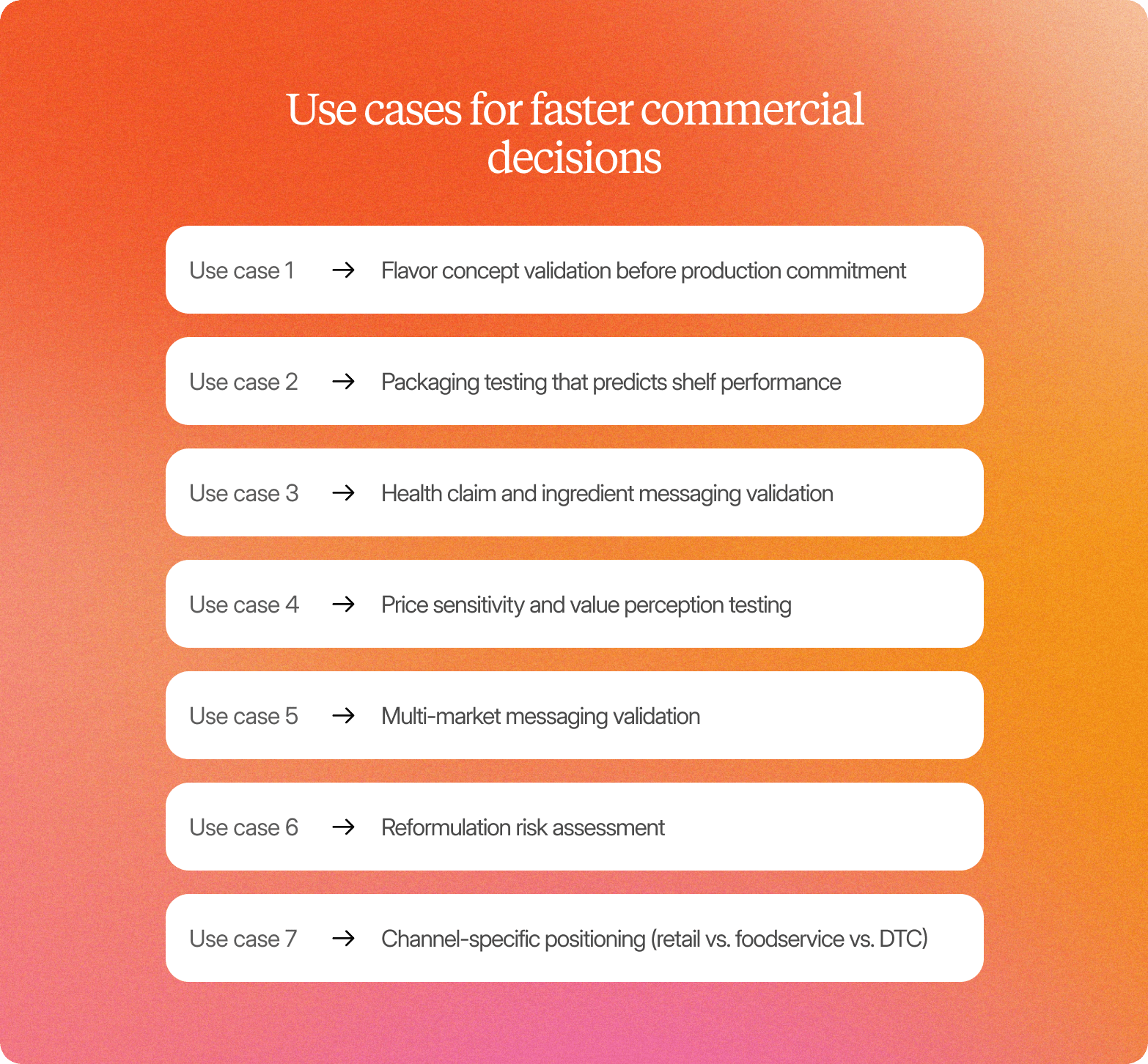
Use case 1: Flavor concept validation before production commitment
The decision point is concrete: three flavor concepts, a production commitment in four weeks, and a team that needs to know which one consumers will actually buy before the tooling spend is locked.
Survey scores can rank the options, but they consistently miss the reasoning underneath the number:
"Spicy" might score highest on purchase intent, while the same participants mentally file it as "too hot for kids," which eliminates the family snack occasion entirely.
"Savory" might perform respectably, while the word quietly triggers "salty junk food" associations that will kill repeat purchases.
"Tangy" may score well on uniqueness but activate "artificial flavor" concerns the moment a consumer reads the ingredient list.
Survey data captures the preference rank. The objection that blocks the shelf pick-up stays out of reach.
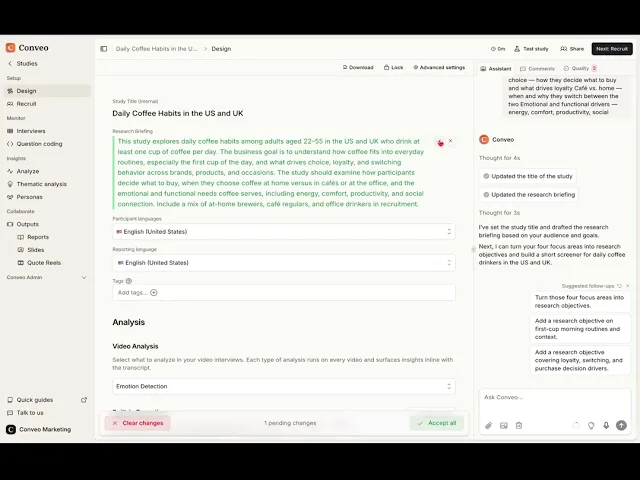
Qualitative validation changes what gets asked and how. In AI-moderated video interviews, participants taste the product or engage with the concept through description and packaging visuals, then explain their reaction in their own words. Conveo's AI moderator flags hesitation language: "interesting," "I guess," and "maybe" carry weight. They are signals that something has landed wrong, and the moderator follows up in the moment, asking what feels uncertain while the reaction is still fresh.
Facial reactions when participants read flavor descriptors are captured through multimodal analysis, so a furrowed brow at "bold" or a shift in expression at "plant-based" becomes part of the record rather than disappearing between a moderator's notes.
In a representative scenario, a CPG team ran 200 consumer interviews across five days to eliminate weak flavor concepts before committing production spend. One concept had performed well in quantitative screening but surfaced a consistent "diet food" association in qualitative probing, a framing that would have undermined shelf performance in the mainstream grocery channel where the team was planning to launch. That finding appeared when participants described the concept in their own words, and the AI moderator asked them to say more.
"We ran a concept test for a new product line, in one night we had 200 interviews analyzed"
CMI Manager, Edgard & Cooper
The output from each session connects findings to timestamped video clips and verbatim quotes. When the product team and the brand team disagree about which concept to move forward with, the conversation shifts from competing opinions to competing evidence. A stakeholder who believes "tangy" will resonate can be shown the exact moment three participants described it as artificial. That is a different kind of meeting.
Validation completes while the production decision is still open. The commitment is backed by consumer evidence.
Watch the walkthrough: How to Run Concept and Messaging Tests Using AI-Moderated Video Interviews
Use case 2: Packaging testing that predicts shelf performance
Sales data and shelf performance reporting arrive after the fact. By the time a packaging redesign appears in velocity reports or distribution metrics, the print run is already long-committed, and the relaunch budget is already spent. The failure mode is specific and consistent: a package tests well in quantitative screening because shoppers say they prefer it, then underperforms at shelf because the three-second scan that governs real purchase decisions works nothing like a survey screen.
Static testing shows one package in isolation. It strips out the competitive visual noise that defines an actual shelf set: the adjacent SKUs competing for the same flavor cue, the price signals from the brand to the left, the trust markers from the category leader directly above. In that stripped-down context, shoppers can give a design a high preference score while completely missing that the flavor descriptor is visually subordinate to a sustainability badge, or that "natural" reads as "unregulated" rather than "clean." Those misreadings surface when a shopper stands in an aisle and puts the product back, well past the point a five-point rating scale could have caught them.
The qualitative approach that catches these failures before print commitment puts participants in front of a simulated shelf, shown alongside actual competitor SKUs, and asks them to narrate their decision process out loud. The conversation is structured around the three-second scan: what did they notice first, what did they read next, what made them reach or hesitate.
Video captures what a survey rating leaves behind. Researchers can observe which element a participant reads first, where attention stalls, and the specific moment a design loses them. Hesitation when interpreting a claim is visible before a participant can articulate it: a pause before answering, a hedging qualifier like "I think it means..." or "it sort of looks like..." These are the signals that indicate a communication failure at the visual hierarchy level.
Conveo's AI moderator follows up on exactly those signals in real time. When a participant says "interesting" after viewing the front panel and then moves on, the probe comes immediately: "You paused there. What made you stop?" That follow-up is what converts a behavioral signal into an actionable finding. Human moderators do this well one-on-one; the constraint has always been scale, running enough interviews to cover multiple shelf configurations before a print deadline.
In one representative scenario, a CPG team discovered through this approach that their "sustainable" claim was being read as "diluted product." The sustainability badge was visually dominant relative to the flavor descriptor, and participants interpreted its prominence as a signal that the brand had traded down on the core product to meet an environmental target. That confusion appeared in the language participants used when narrating their hesitation, where a preference score would have registered nothing.
The output from this kind of study is video clips of real shopper reactions, timestamped to the exact moment a design element creates confusion or confidence, with verbatim quotes explaining why. A creative team can watch a participant misread a claim hierarchy and understand the fix in a way no bar chart makes possible, a comprehensive analysis that protects business performance long before a single unit ships. That evidence allows a packaging decision to be made with confidence before the print commitment.
Use case 3: Health claim and ingredient messaging validation
Regulatory approval and consumer trust are two different tests, and the distance between them is where product launches quietly fail. A health claim can clear every legal hurdle and still land wrong at shelf. "Supports immune health" may satisfy the regulatory standard, but the moment a shopper reads it on a carton, it can trigger "sounds like a drug" or "too good to be true" skepticism that compliant language alone will not resolve. Legal defensibility is the floor. Commercial persuasion sits above it, and so does food safety credibility, since a claim that reads as evasive about ingredients can undercut trust in the product's safety as much as its efficacy.
Most BI systems track claim performance after launch, through sales velocity, category share, and post-purchase surveys. Those systems register the misread only once it has already cost a sale. By the time a retailer flags that a SKU is underperforming against its segment, the packaging has already shipped, the claim has already confused or alienated, and the window to adjust has closed.
The qualitative validation approach addresses this before the decision is locked in. Participants receive packaging in context, read the claim as they would in a store environment, and speak aloud what it means to them, what evidence they would need to believe it, and whether it changes their likelihood to buy. It is an open-ended interview in which the participant's own words reveal the interpretation gap.
Video captures the moment before the answer. When a participant reads "clinically proven" and their tone flattens, or they pause before answering, that hesitation is visible and audible before they say anything. Specific words trigger specific reactions:
"Clinically proven" reads as "tested on sick people" to some shoppers.
"Natural" reads as "unregulated" to others.
The trust signals that resolve hesitation vary by audience: one participant needs third-party certification, another needs a named ingredient with a visible source, another needs the brand's existing reputation to carry the weight of the claim.
Conveo's AI moderator surfaces the misread in the moment. When a participant says "I guess it's probably fine," the follow-up is precise: "You said 'I guess' when you read that claim. What would make you more confident it's true?" That probe, applied consistently across every participant, generates a body of evidence about where the language breaks down and what would fix it, evidence marketing campaigns can build on with more confidence than a compliance sign-off alone provides.
In a representative scenario, a team validating a protein supplement line discovered that "plant-based protein" carried entirely different connotations across two regional markets. In one, participants interpreted it as a signal of poor taste and texture; "cardboard" was the word that surfaced repeatedly. In the other, it read as a premium health-food marker, which triggered a different objection about price and accessibility. The same three words required two different messaging frames to address the specific doubt each audience brought to the shelf.
The output from this kind of study is a structured map of which claims land as intended, which trigger skepticism and why, and what evidence or framing would close the trust gap for each audience segment. Teams leave with clear direction on which claims to advance, which to reframe, and which to retire before they create a compliance and credibility problem.
Use case 4: Price sensitivity and value perception testing
Food and beverage teams face a pricing dilemma that post-launch BI resolves only in hindsight: it tracks price elasticity once a product is on shelf, measuring volume decline as prices rise, while what shoppers are actually thinking when they first see a price tag stays out of frame.
Standard quantitative price testing methods fill part of that gap. Van Westendorp and Gabor-Granger studies map the acceptable price range and demand curve using fixed price points and purchase-intent scoring. Both stop short of why shoppers hesitate at the high end, and of what value signal would make a higher price feel justified. The range is visible; the reasoning stays hidden.
Qualitative video interviews close that gap by presenting the product and the price to a participant simultaneously, then asking them to think aloud. Participants explain whether the price feels fair, expensive, or suspiciously cheap, and what would need to change for a higher price to feel worth it. Because the session is recorded on video, the hesitation is visible before the participant can articulate it: a brow furrow when the price appears, a pause before answering. These signals sit outside what transcripts and quant methods can capture.
The comparison anchors shoppers use are equally revealing. In video interviews, participants routinely name the competitors they are mentally benchmarking against: "that's more than I pay for [a mass-market brand]," or "I'd pay that for organic, but not for a regular version." Those anchors tell a product team exactly which competitive set shoppers are placing them in, which is often a different set from the one the brand intended, and getting that positioning right is a real competitive advantage that can quietly determine market share long before a single price change reaches shelf.
Conveo's AI moderator probes the moment a comparison appears: "You mentioned that price feels high compared to what you normally buy. What would this product need to offer to feel like a different category?" That follow-up surfaces the specific value signal- a larger pack size, a premium ingredient, a sustainability claim- that would resolve the objection.
In a representative scenario, a team running a premium snack launch discovered through video interviews that participants were consistently benchmarking their product against mass-market snack brands rather than the premium health-food alternatives the team had positioned against. The price felt inflated because the packaging and messaging left the product sitting in the wrong competitive tier.
The output from this kind of qualitative price validation is specific and actionable: the exact value signal missing from current packaging or messaging, the comparison anchor shoppers default to, and the price threshold where stated intent drops, along with the reason it drops. Teams can adjust positioning, revise pack copy, or reconsider pack size before committing to a launch price, while the post-launch volume data that would have flagged the same problem is still months away.
Use case 5: Multi-market messaging validation
A positioning claim that works in one market can quietly fail in another:
"Natural" signals positive health in the US. In Germany, the same word can trigger skepticism about regulatory oversight.
"Gut health" resonates with US consumers primed by years of probiotic marketing. In the UK, teams report the same framing lands closer to a medical claim, producing distance rather than appetite.
BI systems can tell you that sales underperformed in a given market, while the question of whether the problem was the claim, the framing, the trust signal, or the specific language used stays open. That is a qualitative question, and it requires qualitative answers from real people in each market.
The risk of skipping regional validation is concrete. Launching with a single global message reduces localization costs at the front end, while a misread message in a high-value European market can cost far more in underperformance, repositioning spend, and delayed market entry. Saving a few weeks of research up front often creates a much longer recovery problem later.
The qualitative approach that addresses this runs AI-moderated video interviews across markets in parallel. Instead of sequencing fieldwork country by country, teams can conduct the same study across multiple markets simultaneously. In a representative scenario, a CPG team ran 90 video interviews across the US, UK, and Germany in seven days, with participants in each market evaluating the same messaging stimulus and explaining, in their own words, what it meant to them. Every market ran at once, in the same language, with findings landing together. This is the same always-on pattern behind Conveo StoryLines: continuous, parallel research.
Video is what makes regional interpretation visible in ways that go beyond what a transcript alone records. A participant in Germany pausing before responding to a "natural" claim, then hedging their answer, tells you something a closed-ended survey leaves on the table. Tone shifts when a health claim feels overstated. Facial cues when a flavor descriptor lands wrong. These signals, captured across 90 sessions, show not just what participants said but how they said it, and the contrast across markets is where the strategic insight lives.
Conveo's AI moderator supports 50+ languages, removing localization delays that add time to traditional multi-market qual. Conventional agency-led research adds weeks recruiting bilingual moderators and sequencing fieldwork market by market; running in parallel with native-language AI moderation compresses that considerably.
In one illustrative scenario, a food and beverage team discovered mid-study that their "gut health" positioning was performing well with US participants but generating a consistent "sounds like a medicine" reaction in the UK. The fix was a single-word change: shifting to "digestive comfort" in UK-facing materials preserved the functional benefit while removing the clinical register that was creating distance. That finding reached the team while packaging decisions were still open.
The output of multi-market messaging validation is a market-by-market map. It shows where messaging works as-is, where it needs regional adaptation, and what specific trust or safety framing each market requires. Teams enter localization with evidence.
Use case 6: Reformulation risk assessment
Reformulation decisions rarely start as brand decisions. They start as supply chain ones: an ingredient becomes scarce, a cost line blows out, a regulatory change forces a formula swap. BI can track exactly when a sales drop follows a recipe change, and that data arrives after the damage is done. By the time the post-launch numbers signal trouble, loyal buyers have already formed their verdict and moved on.
The validation gap sits between technical approval and consumer acceptance. Internal sensory panels can confirm the new formula is within an acceptable range. A quant preference test can show that a statistically adequate proportion of participants prefer or accept the reformulated version. What both leave untouched is the emotional reaction that drives repurchase: the quiet recognition that something is different, the suspicion that the brand cut a corner on raw materials or product quality, the moment a loyal buyer decides the product they trusted is no longer the one they knew. That reaction shows up on a face, where a rating scale has nothing to record.
Qualitative video interviews, run with participants tasting both versions either blind or branded, create the conditions for that reaction to surface and be named. Participants describe what they notice, whether it registers as meaningful, and whether it changes how they feel about buying the product again. Those are behavioral questions, and they predict repurchase, whereas a preference score predicts a ranking.
What video captures is specific in a way that sits beyond quant's reach:
A participant who says "it's a bit thinner" is giving the R&D team a texture signal.
A participant who says "it tastes like they swapped something out" is giving the brand team a trust signal.
Those are two different problems requiring two different responses, and both stay hidden in aggregate preference data. Multimodal analysis across speech, tone, and facial cues adds another layer: hesitation before answering, a slight grimace at the aftertaste, a flattening of tone when describing the new version compared to the old one.
Conveo's AI moderator is built to follow these moments exactly. When a participant says the new version tastes "different," the moderator follows up: "You said it tastes different. Does that make you more or less likely to buy it again?" That single probe is often where the real finding lives, because "different" stays neutral until the participant tells you which direction it points.
In a representative scenario, a CPG team running this kind of study on a reformulated snack product found that participants consistently described the new version as "healthier but less indulgent." In a video interview, the implication was clear. Existing buyers, who had chosen the product for its indulgence, were at risk. New buyers who had avoided it for health reasons might now consider it. The team was looking at a segmentation problem. They adjusted their messaging and kept the recipe, framing the change as "same great taste, better ingredients," which held existing buyers while opening the door for a new audience.
The output of this kind of study answers three questions that quant leaves open: will the reformulation hold existing buyers, attract new ones, or require messaging to prevent rejection before it reaches the shelf? Each answer points to a different decision, and getting to that answer before launch costs a fraction of what recovering from a loyalty drop after launch costs.
Use case 7: Channel-specific positioning (retail vs. foodservice vs. DTC)
Most CPG and FMCG brands sell the same product through at least two or three channels simultaneously. Grocery retail, foodservice, and DTC subscription each represent a distinct commercial environment, and the positioning that wins in one will often misfire in another. Teams have a brand story. The problem is applying one version of it across channels where the shopper's mindset, decision context, and tolerance for different kinds of claims are fundamentally different.
The gap shows up most clearly with functional or health-forward products. The same claim needs a different job in each channel:
Grocery: a claim like "supports immunity" can work on shelf, where a shopper scanning the wellness aisle is actively comparing product benefits and has a few seconds to weigh up the functional angle. The decision triggers here are comparison and trial.
Foodservice: that same claim lands awkwardly, where restaurant operations shape an experience the guest is there to enjoy and set the pace of the visit. The person ordering a drink or a meal is there for an experience, so leaning on the health credential can feel out of place, even slightly preachy. The triggers are occasion fit and sensory appeal.
DTC: the subscriber has already opted in and expects the brand to know them, so a generic mass-market wellness claim reads as inattention. The triggers are relationship, ritual, and the sense that the brand understands the individual.
These mismatches show up in performance. Teams report that marketing strategies developed for one channel and carried over to another without channel-specific consumer input consistently underperform compared with brands that have done the work channel by channel. Each channel requires a different emphasis and, in some cases, an entirely different lead claim.
What makes this hard to solve with conventional research methods is the sample problem. Running separate qualitative studies for each channel is expensive and slow, and by the time findings return from a third-party agency, the positioning decision has often already been made. Teams end up defaulting to their strongest channel's messaging, or blending channel contexts into one study whose findings are too averaged to act on.
Teams can restructure the problem to run parallel AI-moderated interviews with grocery shoppers, foodservice visitors, and DTC subscribers in the same research cycle, with the discussion guide adapted to each channel's context. The AI moderator probes based on what each participant actually says, so a grocery shopper who mentions a comparison decision gets follow-up questions about what drove that comparison, while a DTC subscriber who mentions routine gets probed on what would disrupt it. The result is channel-specific consumer language, surfaced from real people, with full coverage of every channel.
Those findings connect in Conveo's searchable insight library, where findings from every study stay linked, so a channel-specific finding from this study is still there the next time a related question comes up, ready to reuse instead of re-research. That cross-channel view is what makes positioning decisions defensible.
Considerations before you start
Qualitative validation earns its place in the decision-making process, and it works best alongside the quantitative data a team already collects. A few things worth deciding upfront: which decision gate the findings need to land before (production commitment, print commitment, launch pricing), how many segments or markets genuinely need separate treatment, and who on the team needs to see the video evidence firsthand rather than a summary. Teams that skip that last step often find that a slide recapping a finding lands with less conviction than the seven-second clip it was drawn from.
How Conveo keeps the decision window open
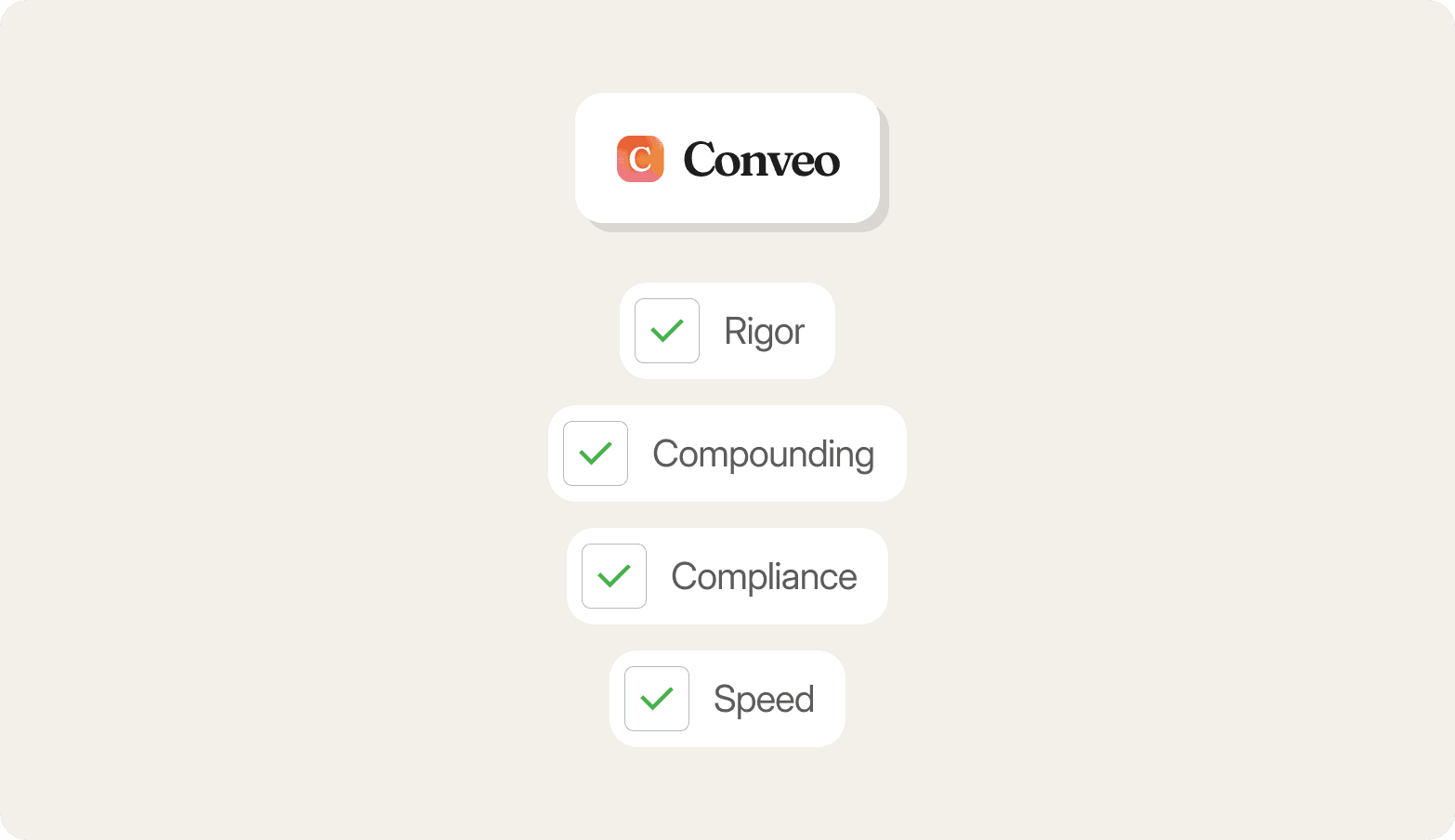
Every use case above depends on the same underlying capability: evidence that arrives while a decision is still open, from real participants, with the reasoning attached to the number.
Rigor. Conveo is built by researchers, so the probing behind each interview follows the same discipline a skilled human moderator would apply, at a scale no single moderator can cover. Every finding traces back to a real participant, a timestamped clip, and a verbatim quote.
Compounding. Findings from every study connect within Conveo's searchable insight library, so a claim tested for a US launch remains available when a European team asks a related question next quarter. For teams running continuous validation across markets or channels, Conveo StoryLines delivers it as an ongoing, wave-based program.
Compliance. For procurement and compliance review, Conveo is SOC 2 Type II certified, GDPR compliant, and EU hosting (Belgium).
Speed. Because studies run in parallel, teams get findings back while the decision; the flavor call, the packaging lock, the claim, the price- is still open.
That is research shaping the decision while it is still a decision, and over time it is what helps a team improve profitability launch after launch.
Frequently Asked Questions
What is qualitative validation, and how is it different from a consumer survey?
Qualitative validation is an open-ended, video-recorded conversation with real consumers, in which participants explain their reasoning in their own words. A survey tells you how many people prefer an option; qualitative validation tells you why, including the specific objection that would block a purchase.
How many interviews does a typical validation study need?
It depends on the decision. Flavor or claim validation studies in the use cases above ran into the hundreds of interviews over several days; narrower questions, such as confirming a single packaging misread, may require far fewer. The right number is determined by how many segments or markets require separate coverage.
Can this replace quantitative testing entirely?
They do different jobs. Quant answers "how many," qual answers "why." The two work best when run together, with qualitative findings explaining the mechanism behind a quantitative signal, or run first to shape what the quantitative study should even measure.
How does AI-moderated video interviewing work in practice?
Participants complete a video interview through a link, on their own schedule. Conveo's AI moderator asks the discussion guide's core questions, then follows up in the moment when a participant hesitates, hedges, or uses language that signals something unresolved, the same way a skilled human moderator would.
Is this only useful for new product launches?
It applies just as well to reformulation risk, channel-specific positioning, multi-market messaging, and pricing decisions for products already on shelf. Any decision where the reasoning behind a number matters is a candidate.

About the author
Kelsey Allen-Niesen
Research Impact Lead
Kelsey spent three years in insights and strategy at Kelton Global, then led innovation consumer insights at Pharmavite, before a Kellogg MBA with a summer at Bain. She joined Conveo in October 2026 and spent her first week at the product hackathon, helping ship a routing improvement on day one.
Meet Kelsey on film →Qualitative insights at the speed of your business.
Conveo runs AI-moderated video interviews and structures everything they say.