
TL;DR
CPG insights teams lose influence not because their research lacks rigor, but because traditional qual runs 6 to 12 weeks, closing the decision window and slowing sales growth.
The bottleneck is structural: recruit, moderate, transcribe, code, synthesize, and report occur in sequence, delaying the actionable insights that sales and brand teams need to make informed decisions.
Conveo, a video-first AI research platform, runs those steps in parallel, compressing the cycle from weeks to days and turning consumer data into data-driven insights while the decision window is still open.
Every finding traces to a real participant's verbatim quote and timestamped video clip, giving stakeholders a complete view of real behavior rather than a summary to trust on faith.
Conveo is built on real participants, SOC 2-certified compliance, and an insight library that aggregates every study, helping leading CPG brands make smarter decisions and launch with confidence.
CPG consumer insights teams know the problem intimately: the research that should inform a packaging redesign or campaign positioning arrives after the brief has been locked, the creative approved, and the print run scheduled. The gap between when a business question surfaces and when qual findings land has always been the central tension in CPG consumer insights, and it shows up directly in market share, sales, and brand health.
The reason is structural, not motivational. Traditional qualitative research is sequential: recruiting, scheduled moderation, transcription, manual coding, analyst-led synthesis, and stakeholder reporting, each step waiting for the one before it. The result is a 6- to 12-week timeline built for a world where business decisions and consumer demand itself moved at the same pace. That world no longer exists in 2026, when packaging, media, and launch decisions move in days, not months.
By the time a shopper behavior study concludes, the innovation pipeline has moved on. By the time packaging research is synthesized, the design is in production. Insights teams are not slow because they lack rigor; the infrastructure underneath their work was built for periodic research, not continuous learning about consumer preferences and emerging trends.
What has changed is the infrastructure itself. Conveo, a video-first AI research platform, compresses the qual cycle from weeks to days by running asynchronous AI-moderated video interviews in parallel across hundreds of participants. Moderation, transcription, translation, and thematic coding happen as sessions land, not after the last one closes, so traceable, data-driven shopper insights arrive before the decision window closes.
This article covers how CPG consumer insights teams capture consumer behavior at scale, where traditional methods create friction, and what infrastructure makes continuous consumer learning viable for small teams serving an entire enterprise, sales teams included.
Why CPG consumer insights teams can't wait weeks for qual research
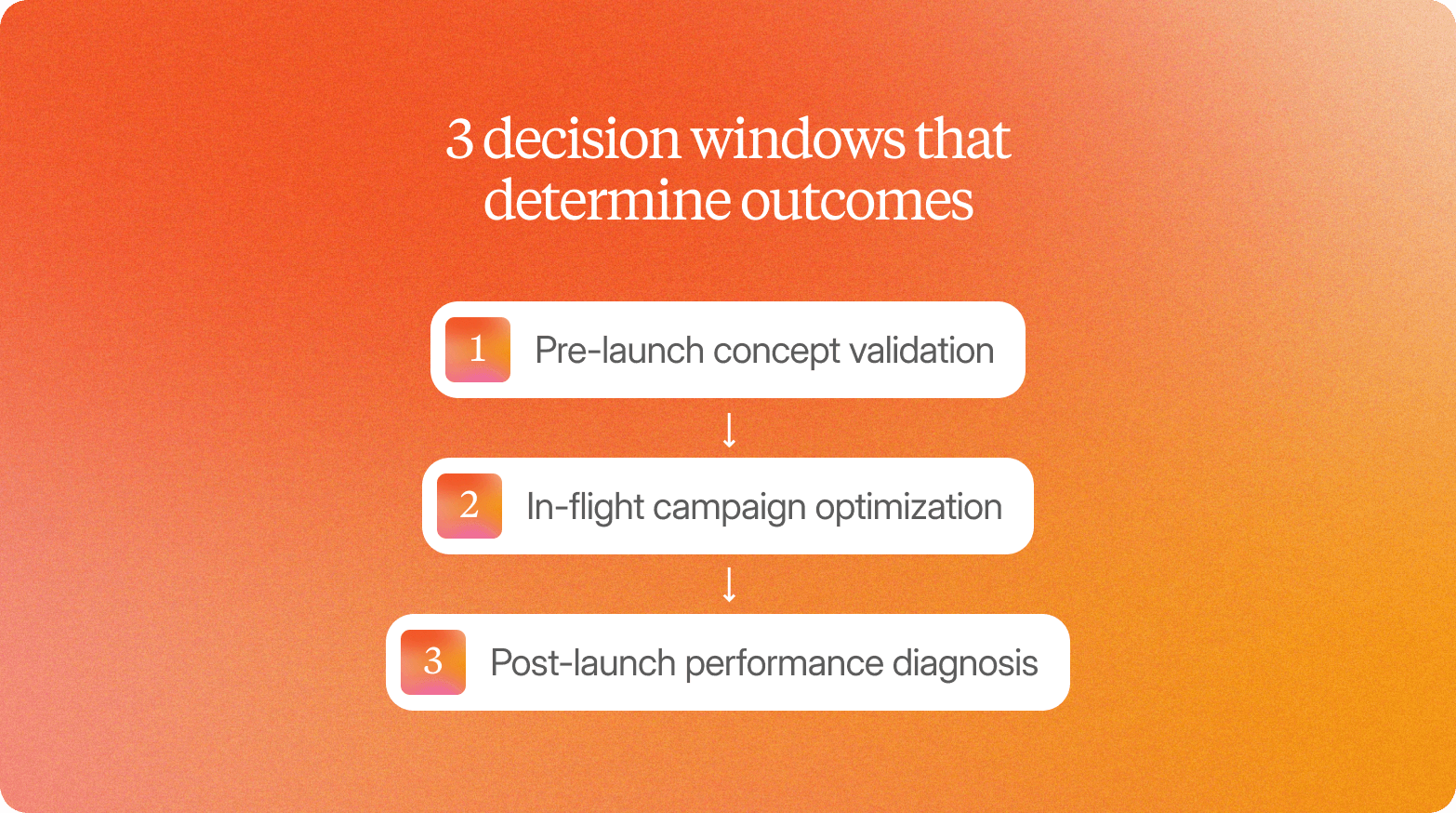
Three decision windows determine whether consumer insights CPG teams influence outcomes, drive sales growth, and protect gross margin, or simply document what already happened:
Pre-launch concept validation: before packaging goes to print and production commitments are made.
In-flight campaign optimization: the two- to three-week period after launch when marketing spend and promotional investment are still adjustable.
Post-launch performance diagnosis: when syndicated data show declining velocity but cannot explain why.
Pre-launch matters most: a finding that reframes the lead claim, repositions the product against a different competitor set, or flags a credibility gap in the hero benefit can change the entire launch trajectory and its downstream sell-through. Traditional qual timelines close all three windows, since an agency study typically runs 6 to 12 weeks from brief to debrief, so findings arrive as a post-mortem, and CPG leaders end up reacting to trends instead of shaping them.
Syndicated data from Nielsen, Circana, or Numerator tell stakeholders what happened at retail: which SKUs gained or lost market share and which price points held. What it cannot tell them is why a shopper picked up the product and put it back, or what a new positioning claim actually communicated in the moment of decision. That answer requires a conversation, and it's the piece of consumer data most retail execution decisions are still missing.
The structural bottleneck is the mechanics of traditional one-on-one moderation. Each interview requires individual scheduling, a human moderator, manual transcription, and analyst-led coding before any pattern can surface. Running 30 interviews sequentially takes weeks, and as stakeholder demand increases and headcount stays flat, the research cycle stretches further behind the decisions it was meant to inform. This is the bottleneck asynchronous AI moderation is designed to remove.
Focus groups and in-depth interviews
Moderated focus groups and in-depth interviews (IDIs) remain a gold standard for understanding the shopper's inner world. A skilled moderator listens: when a participant hesitates before answering a question about a price point, the moderator notices and follows up. That adaptive probing produces CPG consumer insights data that explains real behavior rather than just recording it. For packaging research or exploring why a product loses shoppers at the fixture, there is still no substitute for a real conversation with a real person.
The operational reality is that human moderation is sequential: one moderator runs one session at a time, so fieldwork stretches across days or weeks before analysis begins. The cost structure compounds this: agencies charge $15,000 to $50,000 or more per study because human moderation, transcription, and analysis cannot be parallelized. In practice, CPG insights teams commission qual periodically rather than continuously, which makes recurring shopper learning impractical for teams with flat budgets and growing demand. Async AI moderation keeps the adaptive probing while removing the one-session-at-a-time ceiling, which matters across every CPG category, whether the study spans one product line or several CPG categories at once.
Surveys and quantitative panels
Surveys are the workhorse of CPG research for good reason: they return quantitative data in days, scale to thousands of participants without proportional cost increases, and produce statistically confident directional claims brand teams can act on quickly.
The tradeoff lives in the question format. Rating scales and multiple-choice questions are designed to measure, not to probe. They can tell you a shopper gave a new flavor variant a 6 out of 10, but not whether that score reflects the packaging, the price point, or a faint memory of a disappointing purchase two years ago. The mechanism that drove the response and the unmet consumer needs behind it remain invisible.
Surveys also ask shoppers to reconstruct behavior from memory. But consumer behavior in CPG is a real-time response to the retail environment, shaped by competitive set visibility, shelf placement, price anchoring, and claim credibility, none of which carry over into survey responses. This is why consumer insights retail CPG teams report the same frustration: the data comes back clean, and the room is still debating what the numbers mean for brand strategy. Video-first AI moderation closes that depth gap without sacrificing speed, pairing quantitative data with the why behind it.
What shopper behavior actually requires from CPG consumer insights
Capturing what CPG customers actually do is a three-layer problem:
Behavioral: what did this shopper do during their last real purchase?
Motivational: why did they make that choice?
Conditional: what would have to change for them to choose differently?
Teams that treat these as a single question get findings that look clean in a deck but fall apart in the market, and that leave unmet needs unmet.
Behavioral questions grounded in a shopper's most recent actual purchase are the most reliable starting point for understanding actual behavior. When someone describes what they did last Tuesday at the shelf, they are recounting a real event, not a hypothetical preference. Anchoring questions to a specific, recent purchase draws on memory rather than imagination, which is why stated preferences and actual brand choices so often diverge.
But behavioral recall alone does not explain the why. That requires adaptive probing: following what a shopper just said rather than advancing to the next scripted question. The follow-up that matters is not "how important is price to you generally?" It is "what made you pause there specifically?" That distinction is how consumer packaged goods insights teams surface switching triggers, brand loyalty risk, and the friction points positioning data rarely captures.
Laddering and projective techniques add the third layer, moving from product attributes to the underlying consequences and values that drive preference. A shopper who chooses a competitor because it "feels cleaner" is expressing something about identity, trust, or routine that a rating scale rounds off into a satisfaction score, often the clearest signal of unmet consumer needs a brand can act on.
Across all three layers, there is a traceability requirement teams cannot ignore. Stakeholders who were not in the room distrust findings they cannot inspect and hesitate to make confident choices, which slows decision-making exactly when speed matters most. Video-first interviews address this directly: they capture tone, facial reactions, and the moment a shopper holds up a package and frowns at the ingredient list. A shopper who says "yeah, it looks fine" while their expression registers skepticism is giving two different answers, and text responses capture only one.
How AI-moderated video interviews change CPG consumer insights operations
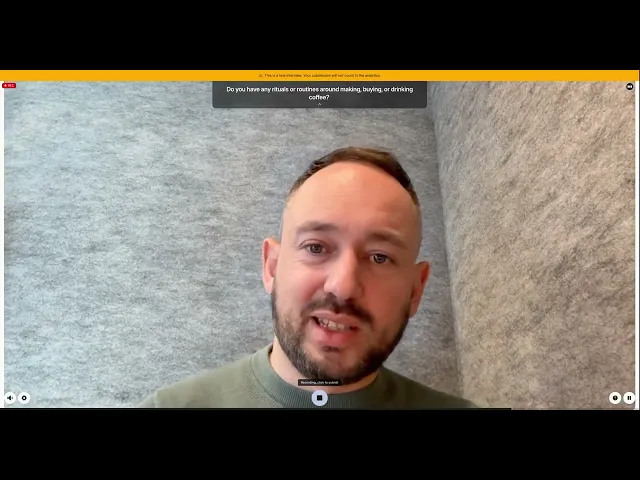
Traditional CPG qual follows a sequential path: recruit, schedule, moderate, transcribe, analyze, report. Conveo runs those steps in parallel: participants receive a link, open it on their own schedule, and complete a video interview with an AI moderator that adapts to what they actually say. Because sessions run asynchronously, hundreds of conversations can run in parallel, so a team with three researchers can field a 200-person study in the window it once took to schedule a single focus group facility.
That scale changes what CPG consumer insights programs look like. A team that previously ran 4 to 6 agency-supported studies a year could run 20 to 30 studies internally on the same budget using AI-moderated video research. The constraint was never an appetite for insight; it was the operational overhead attached to every study and the customer feedback loop it kept shut.
"With Conveo, we can run 100 interviews at once; speed is everything in FMCG"
— CMO & Founder, Edgar & Cooper
The adaptive probing mechanism is where the depth holds. When a shopper says "I almost bought the competitor brand," Conveo's AI moderator follows the thread: what made you hesitate, what did the competitor offer, what brought you back. That logic is built on what the participant just said, not a predetermined guide, surfacing the real purchase drivers and brand differentiation opportunities in language a brand team can use.
Multi-market research follows the same logic. Conveo runs AI-moderated interviews in 50+ languages with automated transcription and translation, so a team testing packaging across the US, Germany, and Brazil no longer has to coordinate three separate agency engagements, aligning teams around one consistent read on consumer preferences.
The trust barrier deserves a direct response. Stakeholders have encountered AI research outputs that feel fabricated: summaries without sources, themes without quotes. Every Conveo finding links to verbatim quotes and video clips from real human participants, with no synthetic respondents, changing review meetings from "do we trust this?" to "here's what consumers actually said," and turning customer feedback into evidence rather than anecdote.
For enterprise procurement, Conveo offers SOC 2 certification, GDPR compliance, and EU regional hosting, clearing the governance requirements that often stall AI research adoption. The outcome is a shift across the product lifecycle: instead of a post-launch autopsy weeks after a product ships, insights teams run pre-launch validation that influences decisions while they are still open, where innovation success is actually won or lost.
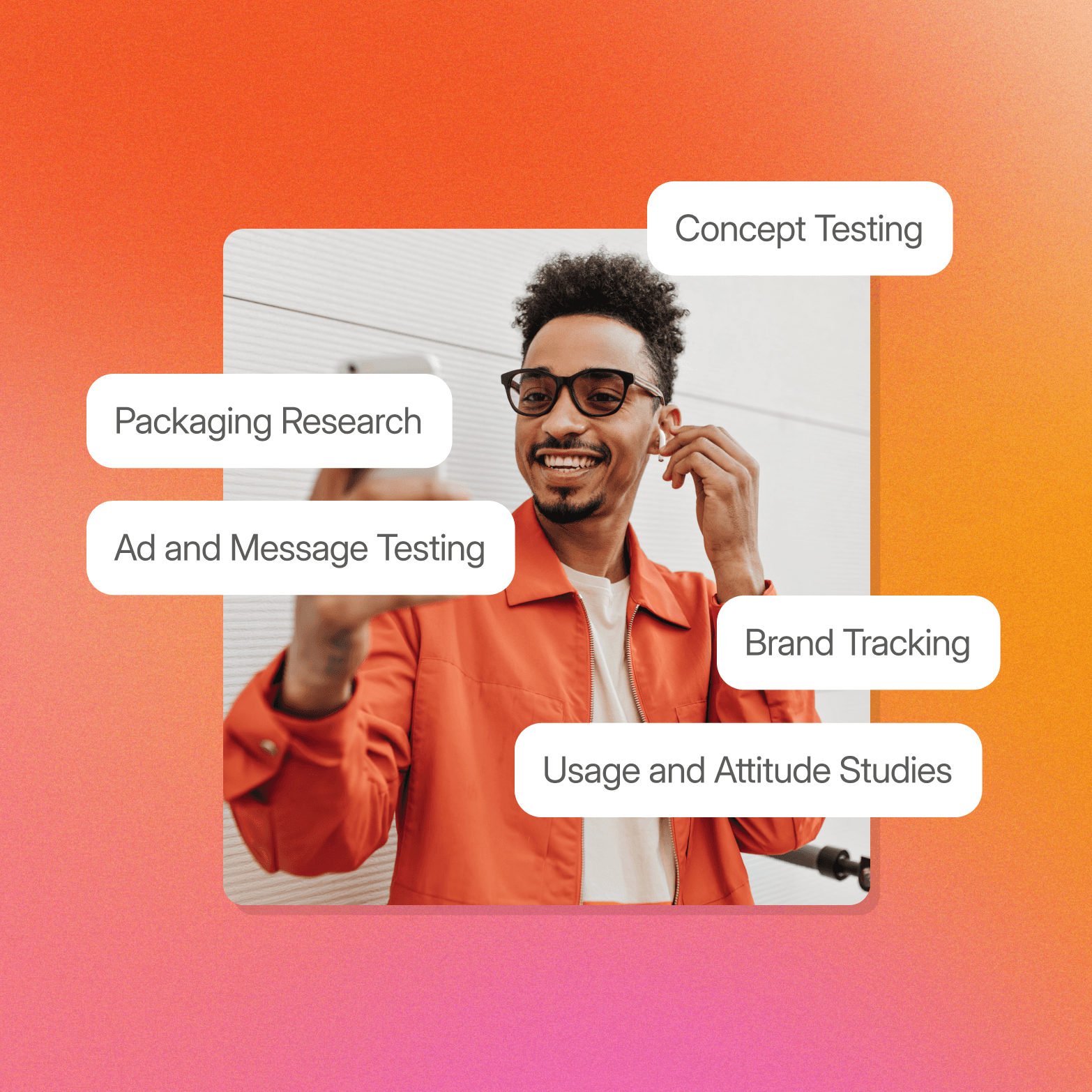
Concept testing and messaging validation
A rating scale can tell you 62% of shoppers prefer Design A over Design B. It cannot tell you why the other 38% paused or what they silently assumed, and for decisions that will hold for two or three years and shape brand health, that missing context is where launches fail.
Conveo's AI moderator changes what can be recovered from a concept test. When a shopper pauses, the moderator senses the hesitation and probes: "What made you stop there?" When a participant says a benefit "sounds too good to be true," it follows that thread, surfacing the language and doubt that drives or kills purchase intent and, ultimately, brand loyalty.
Consider a case study from a CPG brand testing two packaging designs for a new cleaning product. Both score similarly on a survey likeability scale, but video interviews reveal shoppers consistently misread the sustainability claim on one design as meaning the formula is diluted. That finding does not appear in any quantitative data; it appears when a shopper furrows their brow and asks whether it actually cleans.
Watch the walkthrough: How to Run Concept and Messaging Tests Using AI-Moderated Video Interviews →
Conveo's concept test output is built for stakeholder communication: clip reels show the exact moments when shoppers react to packaging or claims, and thematic outputs map to individual video timestamps, so a brand director can inspect the evidence and make an informed decision rather than accept a summary conclusion.
Packaging and shelf decisions
Packaging decisions carry more risk than most teams account for. A design that performs well in an isolated concept test can disappear on a competitive shelf, where color contrast, font legibility, and claim hierarchy fight for attention against 30 adjacent SKUs. Consumer insights: retail CPG teams need to understand what happened in the three seconds before a shopper picked something up or put it back, because that moment is when shelf placement and sell-through are actually won.
Video interviews capture the reaction before the rationalization. A participant might say a pack "looked kind of muddy" or "I couldn't read the flavor at a glance," language that points directly to a color contrast or font size problem; no closed-ended option would surface. Retail context shapes behavior in ways isolated testing cannot replicate: a claim that reads as differentiated in isolation can feel generic when every competitor on the same shelf makes a similar promise, exactly the brand differentiation gap most retail execution plans fail to catch before launch.
Operationally, Conveo lets teams run three to five packaging variations in parallel across real shopper segments, with findings in days rather than the two to three weeks a traditional agency requires, keeping research relevant to retailer sell-in timelines and promotional timing.
Competitive differentiation
CPG consumer insights teams typically choose between three approaches when shopper questions surface: a traditional agency, a survey, or a generic AI platform. Each breaks at a predictable point.
Approach | Speed | Depth (the "why") | Compliance & traceability |
Traditional agency | 6 to 12 weeks, brief to findings | High: skilled human moderation probes adaptively | Not the differentiator; cost and timeline are |
Survey platform | Days | Low: closed-ended questions capture what, not why | Not the differentiator |
Generic AI platform | Fast: speed and synthesis | Unclear: outputs can't be traced to real conversations | Lacks compliance infrastructure CPG procurement requires |
Conveo | Days: parallel async video fieldwork | High: adaptive AI probing reaches the why | SOC 2, GDPR, EU hosting; every finding traces to a real participant |
Conveo's video-first AI moderation addresses all three gaps without forcing teams to choose between speed, depth, and credibility:
Parallel async fieldwork: AI-moderated video interviews run in parallel across integrated panels, compressing timelines from weeks to days.
Adaptive probing: when a participant says they almost switched brands but didn't, Conveo follows that thread in the language they just used, rather than a rigid script.
Compliance infrastructure: SOC 2 certification, GDPR compliance, and EU data hosting clear procurement before any platform can run, often the first filter applied for organizations working across multiple markets.
Traditional agencies still have a legitimate role for complex ethnographic studies, in-store shelf observation, or highly sensitive topics where human judgment is non-negotiable. Conveo is not a replacement for all qualitative research; it is the infrastructure that makes shopper research viable at the pace CPG businesses move, producing traceable, stakeholder-ready evidence without the multi-week wait, and giving CPG leaders a complete view of the customer they're building for.
How CPG insights teams use Conveo in practice
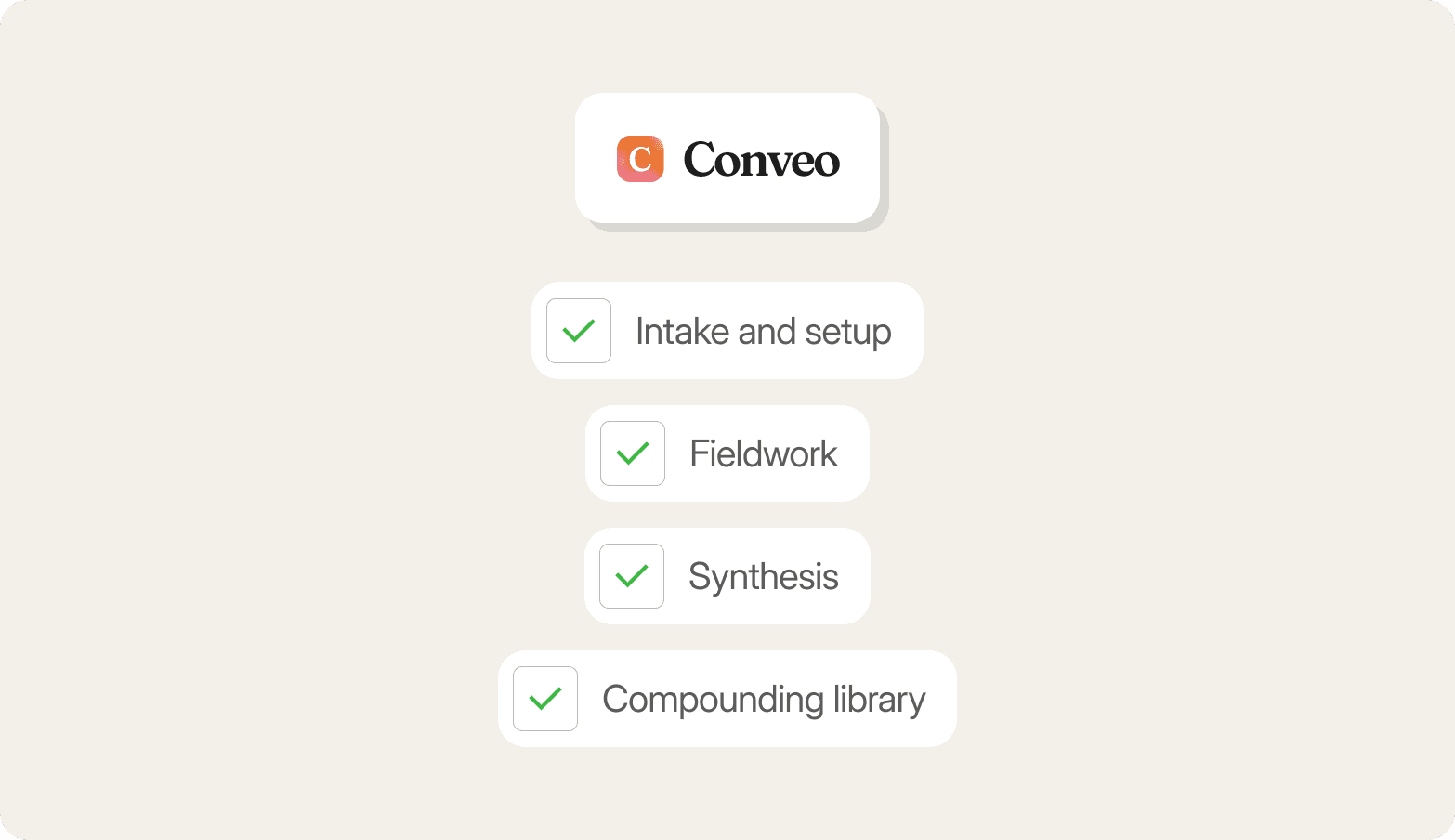
The workflow follows a consistent sequence:
Intake and setup. A research intake request typically comes in from a brand, innovation, or marketing stakeholder who needs consumer input before making a decision. The insights team opens Conveo and begins study setup: uploading stimuli, adapting the discussion guide, and defining participant criteria based on demographics, purchase behavior, and category usage. Teams report setup takes around 30 minutes rather than the multi-day briefing cycle an agency requires, helping align teams across brand, innovation, and sales earlier.
Fieldwork. Conveo recruits through its integrated panel network, or from your own list, and runs asynchronous video interviews in parallel, with no scheduling bottlenecks and no geographic ceiling.
Synthesis. As recordings come in, synthesis begins automatically. AI-assisted thematic analysis surfaces patterns across interviews, with every theme traceable to verbatim quotes and video clips, so a researcher can review a theme cluster and verify the finding, and the actionable insights behind it, in seconds.
Compounding library. Every study, clip, and coded theme flows into a searchable repository, so prior findings from a packaging test or brand equity study do not die in a deck. A researcher can search the library in plain language and surface relevant customer feedback from months ago, without commissioning a new study to answer a question already answered, building a complete view of consumer demand.
Consider the rhythm this creates: a team receives a concept test brief Monday morning; the study is live that afternoon; themed outputs are ready by Wednesday; and the team presents to the innovation team by Friday, with the decision window still open and the group aligned on the same data-driven insights.
Frequently Asked Questions
What is CPG consumer insights?
How do CPG brands collect consumer insights?
How is AI-moderated research different from AI-generated or synthetic research?
How fast can CPG qual research realistically be?
Is AI-moderated qual reliable enough for packaging and launch decisions?