In this article
TL;DR
Teams look for Dscout alternatives when niche or B2B audiences are hard to reach, pre-launch reviews slow studies down, analysis takes too long, or custom pricing makes costs hard to plan.
Start from the Dscout research methods your team uses most, then compare tools on recruitment, AI analysis, pricing, and security.
Indeemo and EthOS are the closest swaps for mobile diary studies, while Discuss.io and UserTesting cover live and usability research.
Conveo suits consumer insights teams that want AI follow-up questions in interviews and diary studies, with every theme traced to the video behind it.
Dscout still fits one-off diary studies, but questions that keep coming back call for continuous research.
Dscout covers a wide range of qualitative research methods from one account, with its own participant panel and some AI analysis built in. That range makes alternatives hard to compare. Some run research end to end, while others specialize in one method or one step, such as recruitment or analysis, so their feature lists rarely line up neatly with Dscout’s.
Comparing Dscout alternatives gets easier when you start from the methods your team uses most and the problems that made you look elsewhere. This guide looks at 10 alternatives on the methods they cover, AI analysis, recruitment and pricing, with a profile of how each one stacks up against Dscout. By the end, you’ll know which tools fit your research and have a shortlist ready for vendor demos.
What Dscout does well, and why teams look elsewhere
Dscout is a remote research platform that runs diary studies, interviews, usability tests, surveys, and website intercepts from one account.
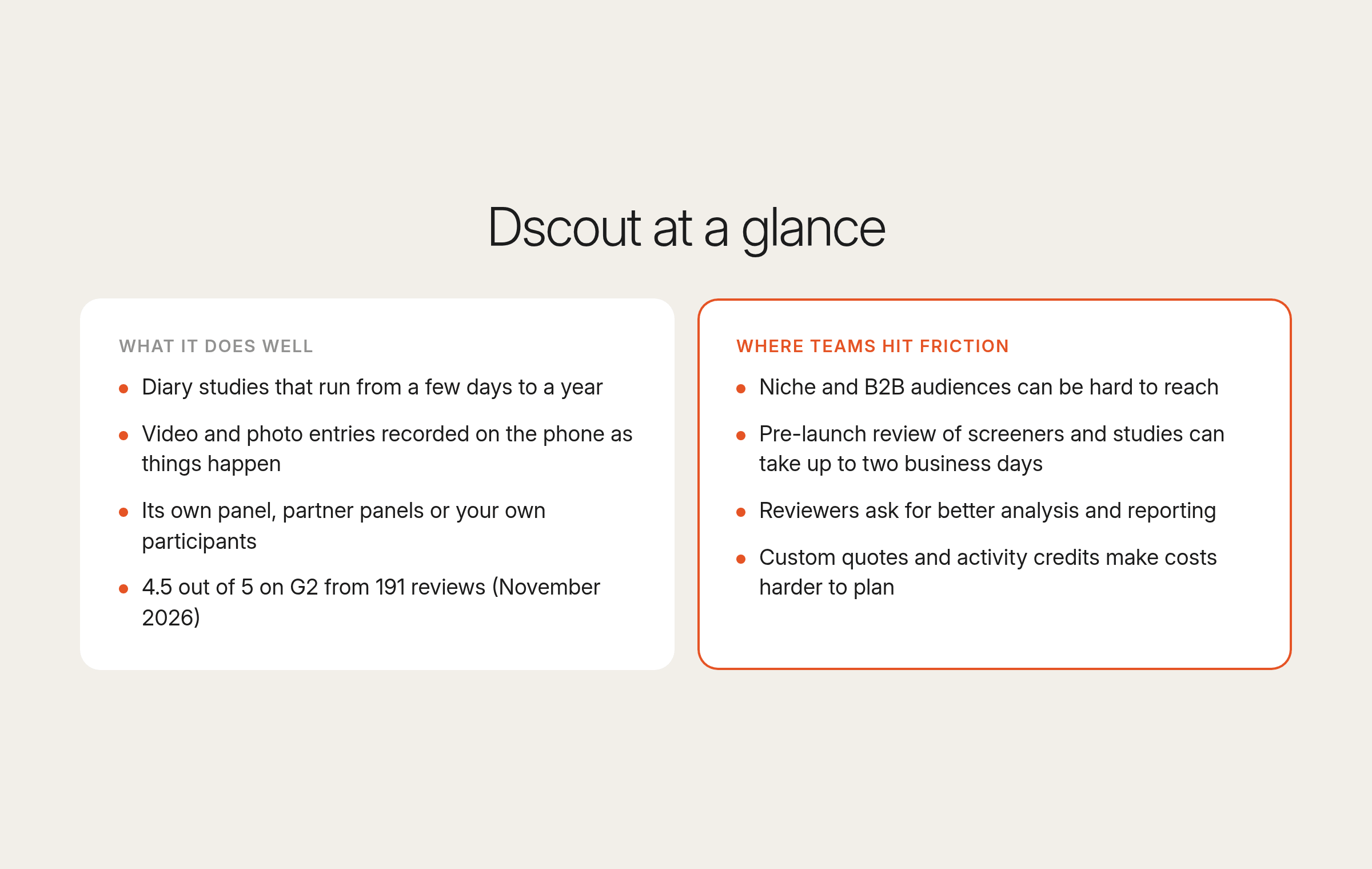
Diary studies are one of Dscout’s flagship testing methods and one it’s most well known for. A single study can run anywhere from a few days to a year, split into activities that each have their own questions and deadlines. Participants record video and photos on their phone as things happen, and automatic reminders help keep them on schedule. Teams recruit from Dscout’s own panel, partner panels or bring their own.
As of November 2026, Dscout holds a 4.5 out of 5 rating on G2 from 191 reviews. Reviewers most often praise how easy it is to use and the quality of the support team. However, if you’re looking into Dscout competitors, you may have run into one of the following issues:
Niche and B2B audiences can be hard to reach through the panel, and some reviewers see the same participants come back for similar studies.
Dscout’s pre-launch review of screeners and studies can take up to two business days, and some reviewers say their accounts can’t skip it, which makes quick-turnaround work harder to plan.
Reviewers have asked for better analysis and reporting, and one wanted the AI to show which participant and which minute of a session each point comes from. Dscout’s new AI-moderated studies add AI analysis that traces findings back to participants’ responses, but they run as a separate study type from diary studies.
Every plan is priced by custom quote, and studies use activity credits from the team’s subscription, so costs take some planning ahead.
As Dscout started with diary studies, some reviewers find the other methods to be more limited.
How to evaluate Dscout alternatives
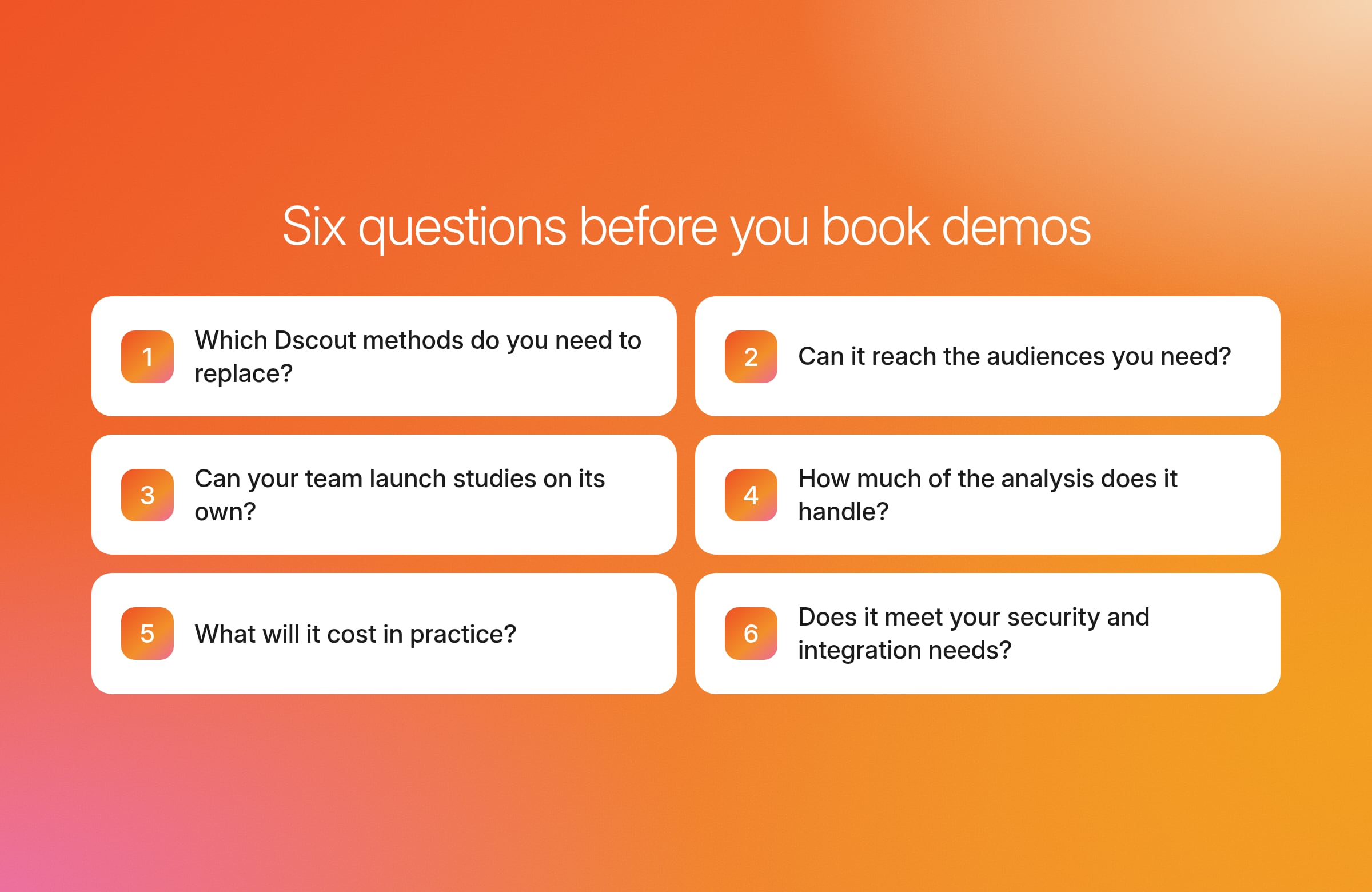
Before booking demos or signing up for trials, narrow your shortlist by checking how well each platform addresses the problems you’re having with Dscout. These questions help you rule out qualitative research platforms that look like a good match on paper but don’t cover your needs.
| Question | What to check | Watch out for |
|---|---|---|
| Which Dscout methods do you need to replace? | Check that it supports the methods your team uses most, such as diary studies, interviews, usability tests, or surveys. | Diary tools work in different ways. Some capture moments on a phone as they happen, while others run each entry as a conversation with follow-up questions, so check which one your studies need. |
| Can it reach the audiences you need? | Check whether its panel access covers B2B and specialist audiences in the countries you need. If you recruit elsewhere, make sure you can bring your own participants, such as existing customers, or connect your panel provider. | A large panel can still miss niche consumer groups or B2B participants. |
| Can your team launch studies on its own? | Check whether researchers can set up screeners and launch studies without waiting for vendor approval. | Approval steps make quick-turnaround studies harder to plan. |
| How much of the analysis does it handle? | Check whether the AI can surface patterns across responses and link each theme back to the clips and quotes it came from. | A platform advertising AI analysis doesn’t always show where each finding came from, which makes results harder to check. |
| What will it cost in practice? | Check whether pricing is published or quoted, and whether recruitment and incentives are included. Confirm which plans include AI-moderated sessions and AI analysis. | Add-ons and plan limits can mean keeping additional research tools you hoped to consolidate. |
| Does it meet your security and integration needs? | Check for SOC 2 Type II certification and GDPR compliance, and confirm where participant data is hosted. Make sure it connects to the tools your team already uses. | Some platforms host all data in the US, which can be a problem for research in Europe. |
This should give you enough information to remove unsuitable options and take a smaller shortlist into vendor demos.
The best Dscout alternatives compared
These alternatives each focus on different research needs, so compare their key features against the methods your team uses most. Pricing and security details are as of November 2026 and come from each vendor’s own website.
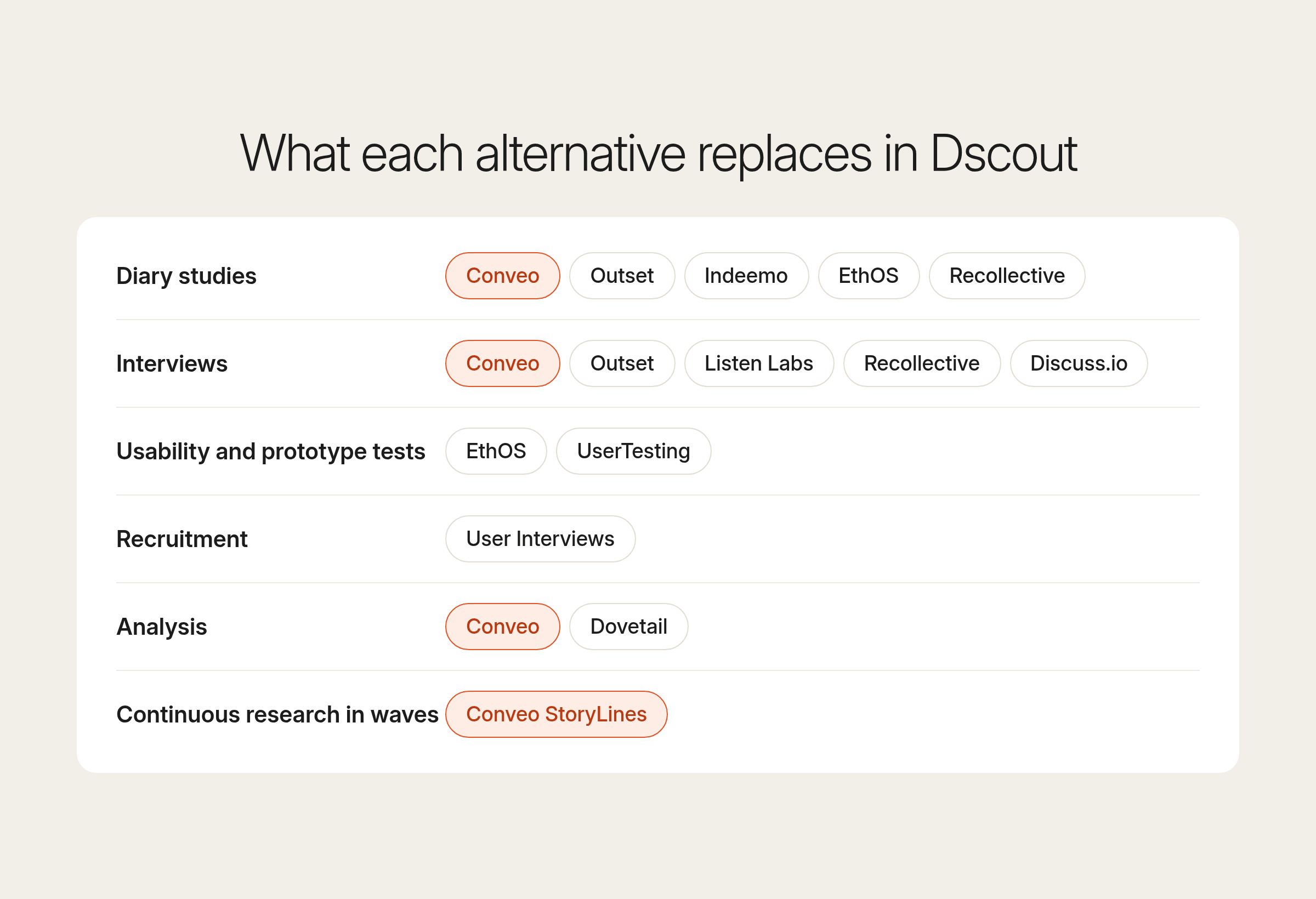
| Platform | What it replaces in Dscout | Diary study functionality | AI follow-ups and analysis | Recruitment | Pricing | Security and hosting |
|---|---|---|---|---|---|---|
| Conveo | Interviews, diary studies and analysis, plus continuous research with StoryLines | Each entry is a conversation with the AI research assistant, which follows up on the person’s earlier entries; studies run over days | AI research assistant follows up in video and voice interviews; themes link to clips and quotes; searchable findings and recurring themes across studies | Eight panel providers or your own contact lists | Start for free, or book a demo for enterprise pricing | SOC 2 Type II and ISO 27001:2022, GDPR; EU hosting in Belgium |
| Outset | Diary studies and interviews | Each entry is a conversation with the AI moderator, which asks follow-up questions | AI follow-ups; summary per session; themes from the first round; search across studies | Built-in panel integrations, or bring your own | Custom quote | SOC 2 Type II, GDPR; hosting region not stated |
| Listen Labs | Interviews | Not specified, but its Pulse feature repeats a study at set intervals | AI follow-ups in text, voice, and video; Research Library searches every past study | Own panel, or your own contacts | Not published | SOC 2 Type II; hosting region not stated |
| Indeemo | Diary studies | Phone app with video, photo and screen recording | Themes linked to the source clip; follow-ups sent by the researcher | Panel through Respondent, or invite your own | Not published | SOC 2 (type not stated), GDPR-aligned; EU or US data residency |
| EthOS | Diary studies, usability tests and video surveys | Diary and mobile ethnography studies lasting weeks to months | Generative AI analysis and AI Moderation from the Enhanced plan | Own panel covering B2B and B2C | Custom quote | SOC 2 not publicly listed; runs on Google Cloud |
| Recollective | Long-running diary studies and live interviews | Journals inside communities that run for months or years | Summaries and themes; AI conversation task; Ask AI across projects with source verbatims | Your own lists or panel provider integrations | From $475 a month | SOC 2 Type 2, GDPR; AWS with regional options |
| Discuss.io | Live interviews and focus groups | Video diaries through self-paced activities; follow-up questions are written into each task in advance | AI-moderated interviews; takeaways link to quotes and clips; Discuss Intelligence searches every study | Own panel, or bring your own | Custom quote | SOC 2 (type not stated), GDPR; US hosting |
| UserTesting | Usability and prototype testing | Run as a series of tests sent to the same contributors; UserTesting suggests involving its services team | AI insight summaries; AI follow-ups in limited early access; Insights Hub across studies | Own panel | Custom quote | SOC 2 (type not stated), GDPR; hosting region not stated |
| User Interviews | Dscout’s panel | Doesn’t collect research. | AI analysis for moderated sessions run through Zoom, Google Meet or Teams | Own panel in 34 core markets, plus Research Hub for your own participants | From $36 per session | SOC 2 Type II; US hosting |
| Dovetail | Analysis | Doesn’t collect research. | Chat across all your research with cited sources; transcript lines link to the moment they were said | None | From $4,800 a year | SOC 2 Type II, GDPR; US, EU or Australia hosting |
For a more comprehensive look at how each platform compares to Dscout, read the full profiles below.
1. Conveo: know why consumers behave the way they do, with evidence stakeholders can watch
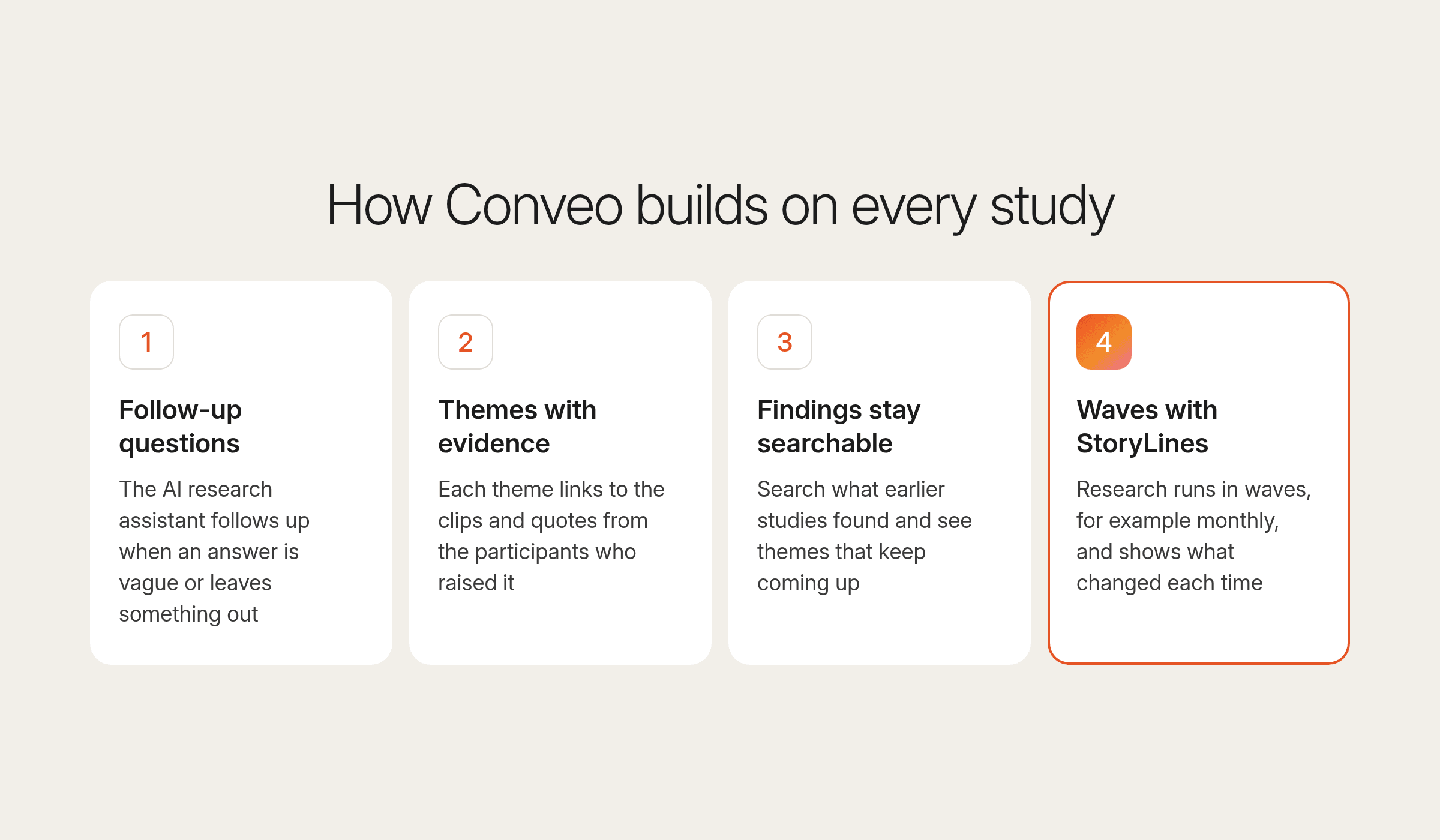
Conveo takes over the AI-moderated interview and diary work teams run in Dscout. Its AI research assistant follows up on vague answers in every interview, and in a diary study with Memory turned on, it picks up what each person said in their earlier entries. Dscout's AI moderator treats each session as self-contained, working only from that study's objectives and what the participant says in the session. To bring in earlier research, you write it into the study setup yourself.
See it in action: an AI-moderated interview that follows up on vague answers.
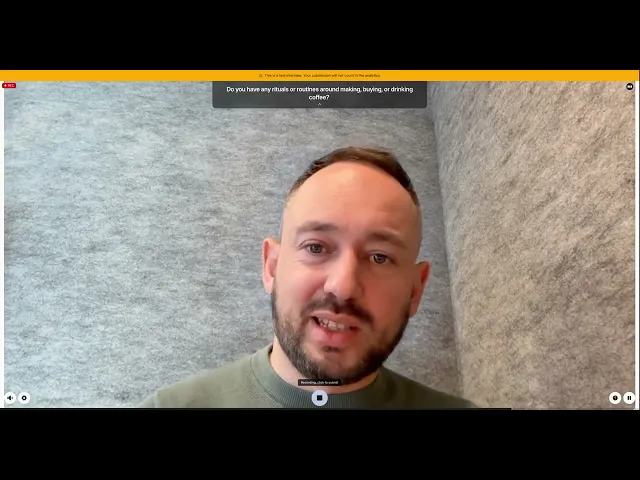
That depth carries through to the analysis, which G2 reviewers say they sometimes have to do manually in Dscout. Conveo groups responses into themes and links each one to the clips and quotes behind it. The analysis picks up tone of voice and facial expression as well as words, and stakeholders can watch the moment a finding came from.
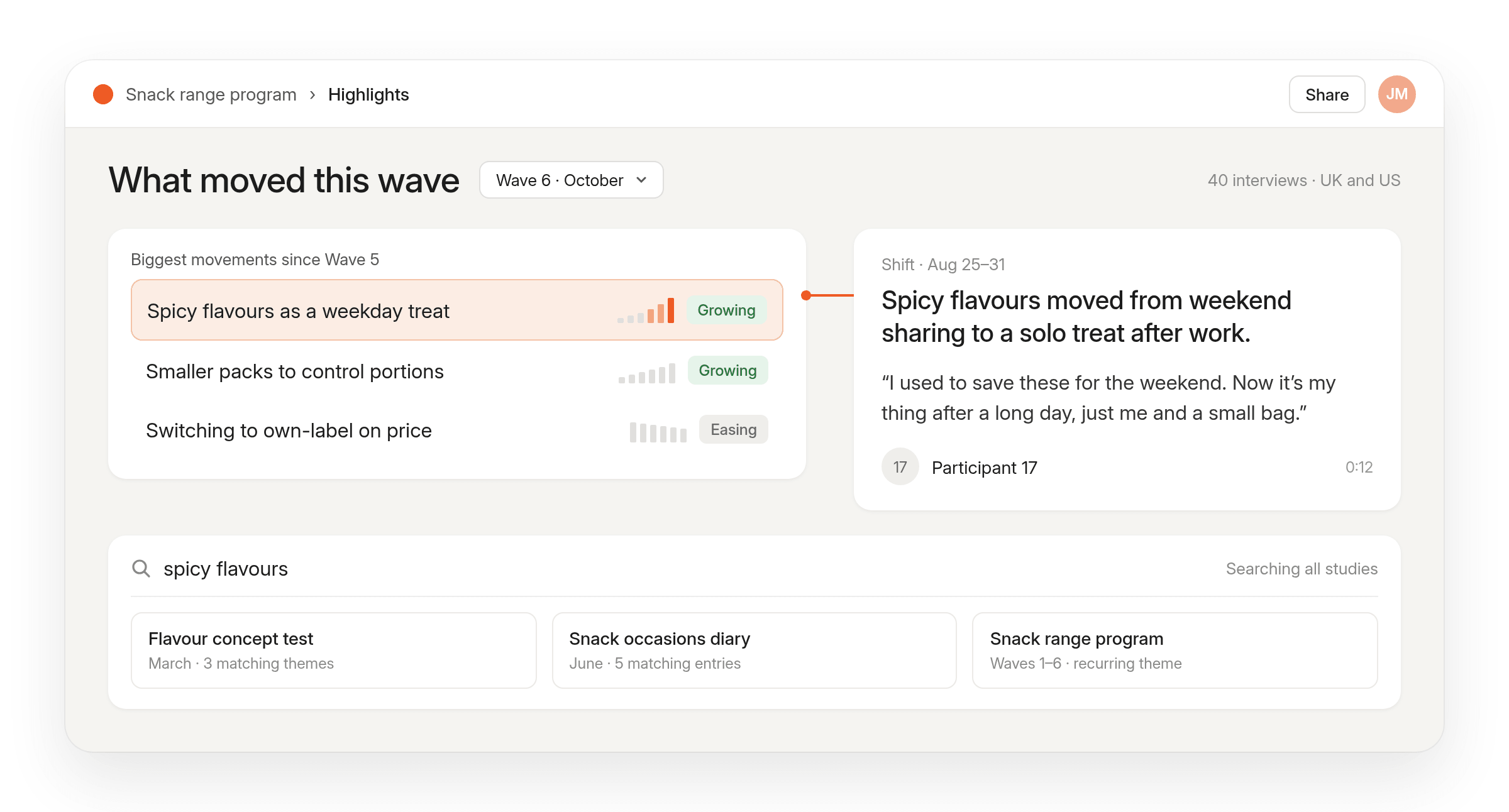
Findings also stay useful after a study closes. Conveo recognizes recurring themes across studies and keeps earlier findings searchable. For questions that come back every quarter, Conveo StoryLines runs interviews in waves, for example, monthly, and flags what’s shifted once each wave closes. Participants come from eight panel providers or your own contact lists, and every finding is based on real people, never synthetic ones.
Want to see how Conveo would handle your next diary study or interview program? Book a demo.
2. Outset: turn each diary entry into a conversation
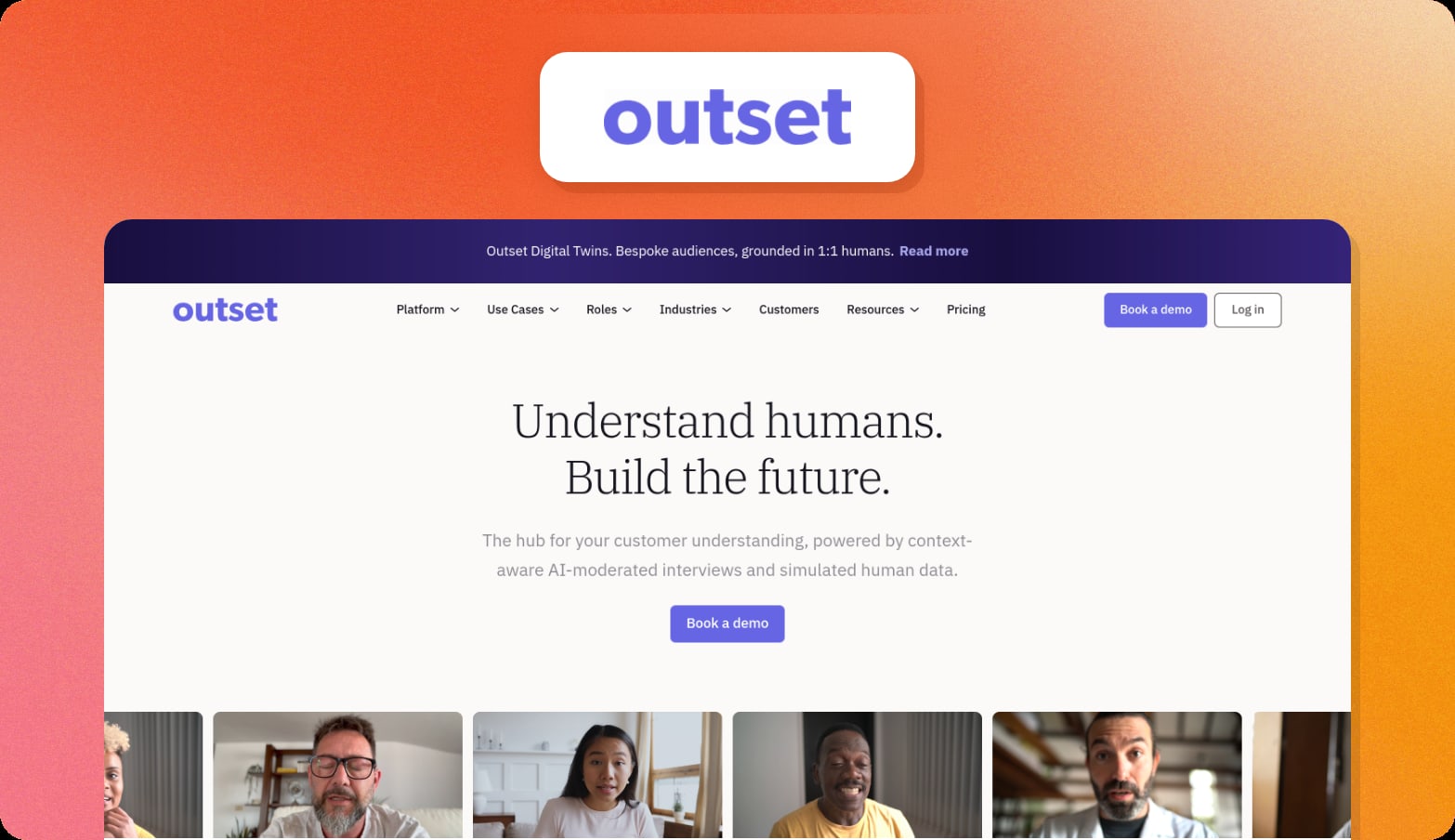
Outset brings AI follow-up questions into diary studies, which is one place Dscout’s AI Moderator doesn’t reach. Each round of an Outset diary study can be a full conversation with its AI moderator, so participants explain what they did as well as recording it. Every session ends with an AI summary, and themes are ready from the first round, which means analysis starts while the study is still running. Outset can also search across studies from inside the tool, while Dscout’s cross-study search runs through its MCP connection with AI tools like Claude.
Recruitment works through built-in panel integrations, or you can bring your own participants, so teams leaving Dscout’s panel can still recruit inside the tool. Outset only added diary studies in August 2026, though, and its announcement doesn’t say whether the AI refers back to a participant’s earlier rounds. If that matters for your study, it’s worth asking in a demo.
3. Listen Labs: ask the same questions again and see how answers change
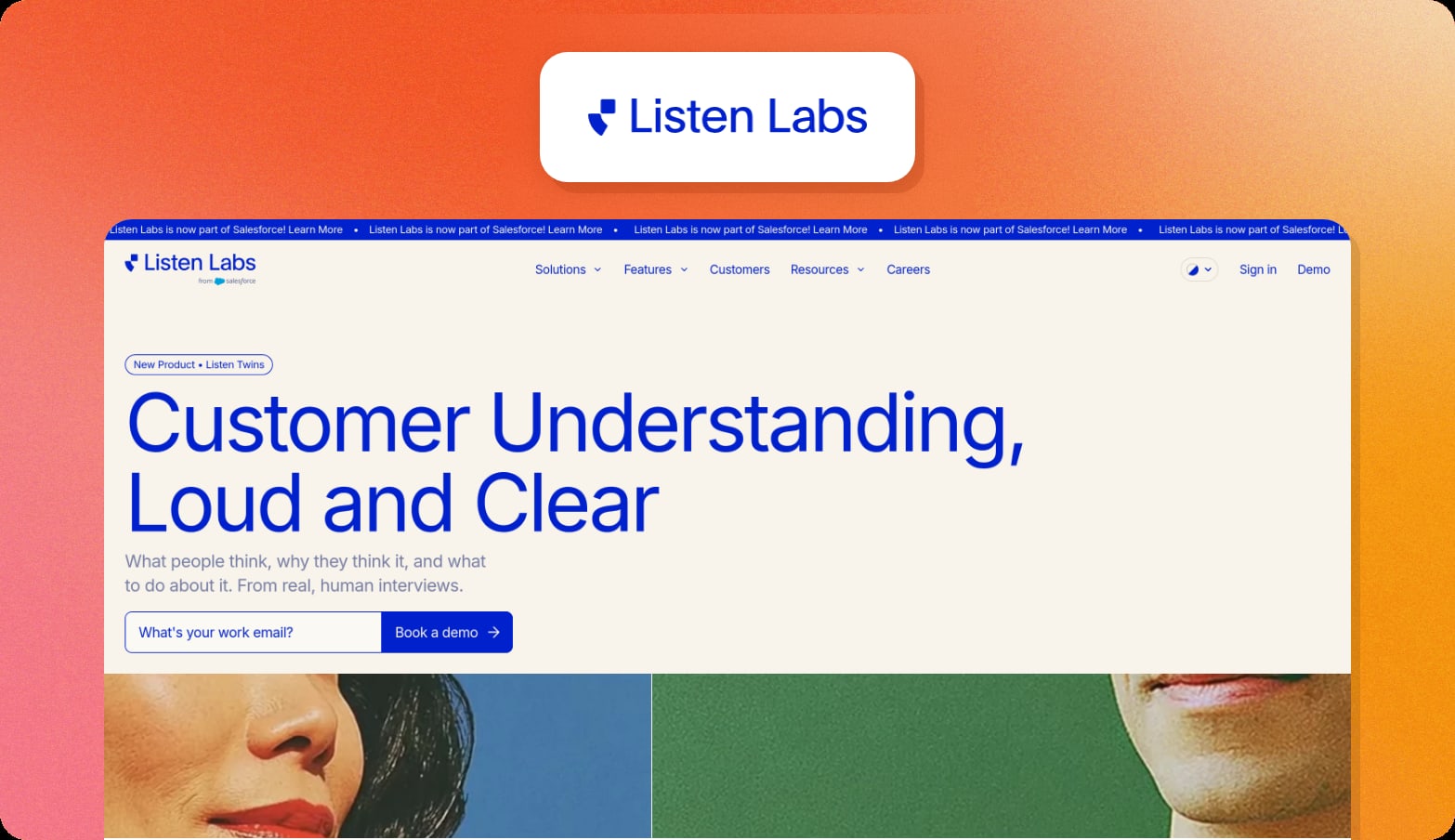
Listen Labs suits teams whose Dscout work is mostly interviews. Its AI moderator runs interviews with follow-up questions, and its Pulse feature re-runs the same study at an interval you choose, keeping the design and audience the same so answers can be compared over time. Results are coded into themes you can trend, and the Research Library lets you ask a question across every study you’ve run.
Listen Labs doesn’t list diary studies as a research method, so it won’t replace Dscout for in-the-moment entries from a participant’s phone. It’s now part of Salesforce, and its site doesn’t yet say how the product will be sold going forward. It’s a good fit for teams without dedicated insights staff that want quick, repeatable interviews.
4. Indeemo: see consumers’ everyday lives as they happen, wherever they are
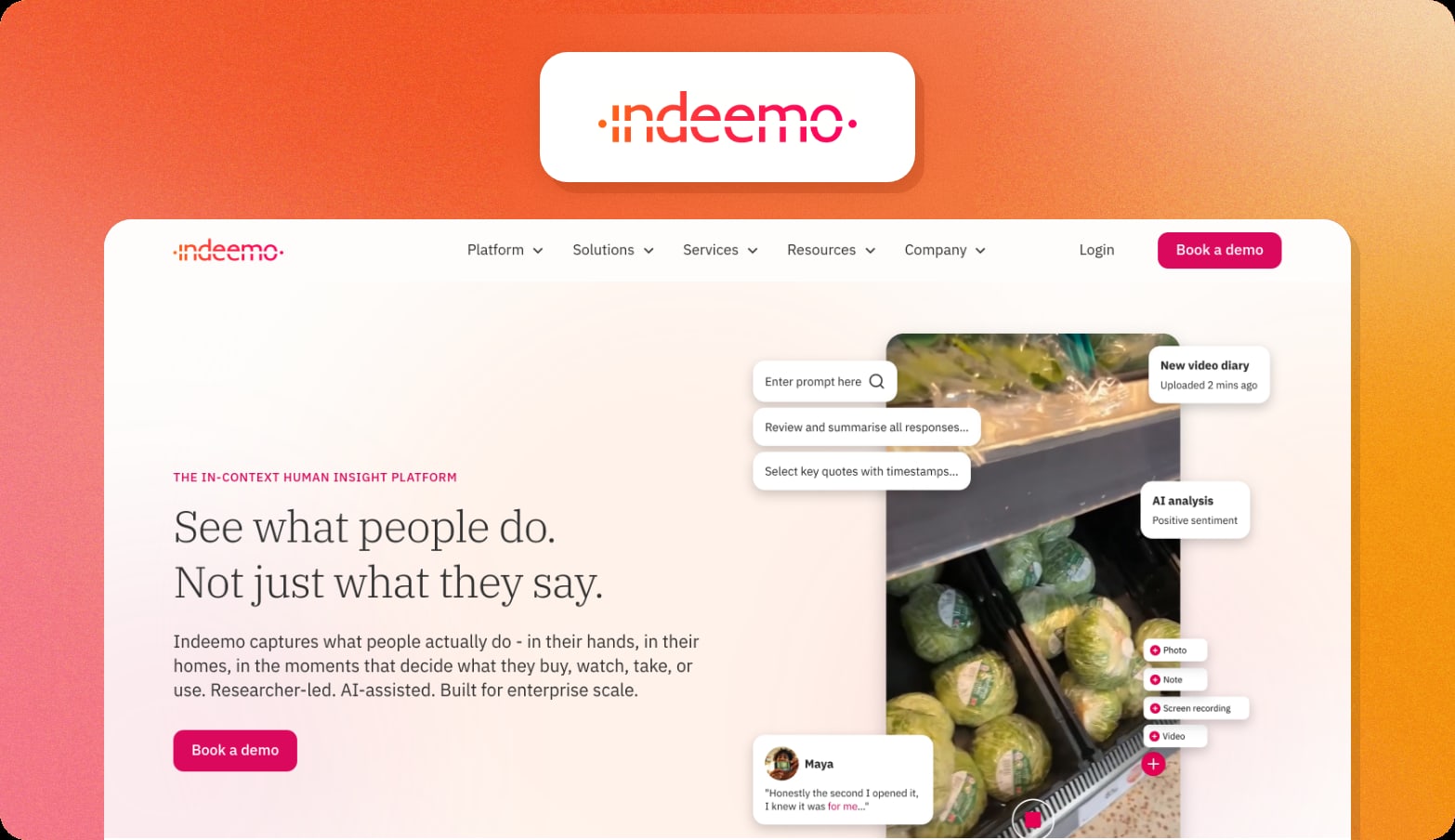
Indeemo is a mobile ethnography platform and one of the closest matches for Dscout’s diary studies. Participants use a phone app to capture behavior on video and in photos as it happens, and push reminders keep entries coming in over the course of the study. Where it can help Dscout users most is recruitment. Its panel partner reaches participants worldwide, and you can also invite your own users with a link or with a QR code placed where they already are. Once entries arrive, its AI suggests themes and links each one back to the source clip.
The tradeoff is range. Indeemo’s site focuses on diary and ethnography studies, so teams that also run usability tests or surveys in Dscout may need a second tool for those. Follow-up questions are sent by the researcher, and there’s no AI-moderated option.
5. EthOS: run diary and usability studies with business audiences too
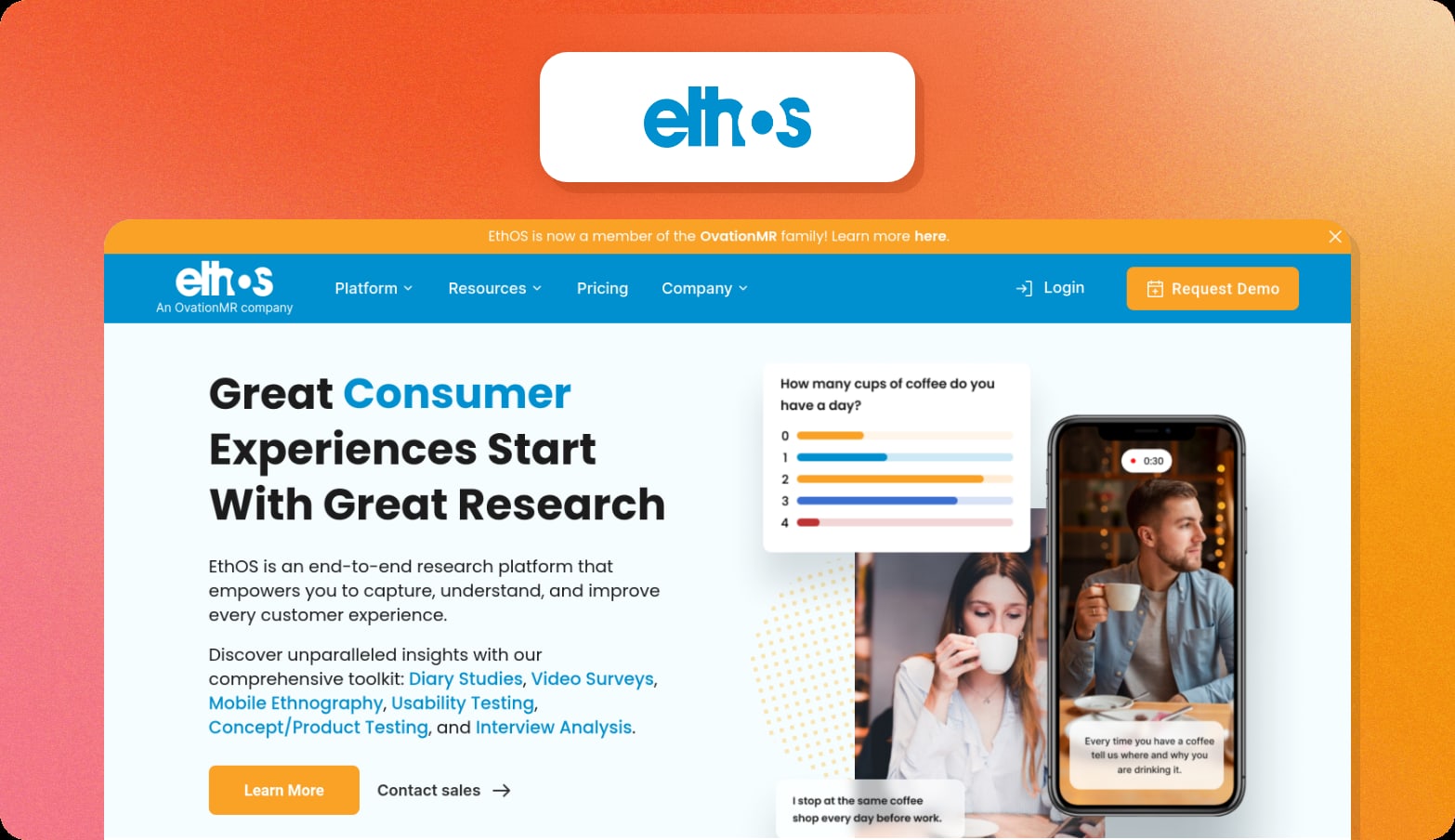
EthOS covers much of the same ground as Dscout, with diary and mobile ethnography studies that can run for weeks or months alongside video surveys and usability tests. Participants can record their screens on mobile or desktop, so the same tool handles in-context diaries and digital tasks. Its panel targets B2B as well as B2C audiences, which could help with the niche recruiting G2 reviewers find hard on Dscout.
The plan you choose matters more here than with some tools. AI Moderation and generative AI analysis start from EthOS’s Enhanced plan, so the entry plan works mainly for collecting responses. Its security page also points to Google Cloud’s certifications without listing a SOC 2 report for EthOS itself, which enterprise security teams will want to raise before moving away from Dscout.
6. Recollective: keep the same group of consumers engaged for months
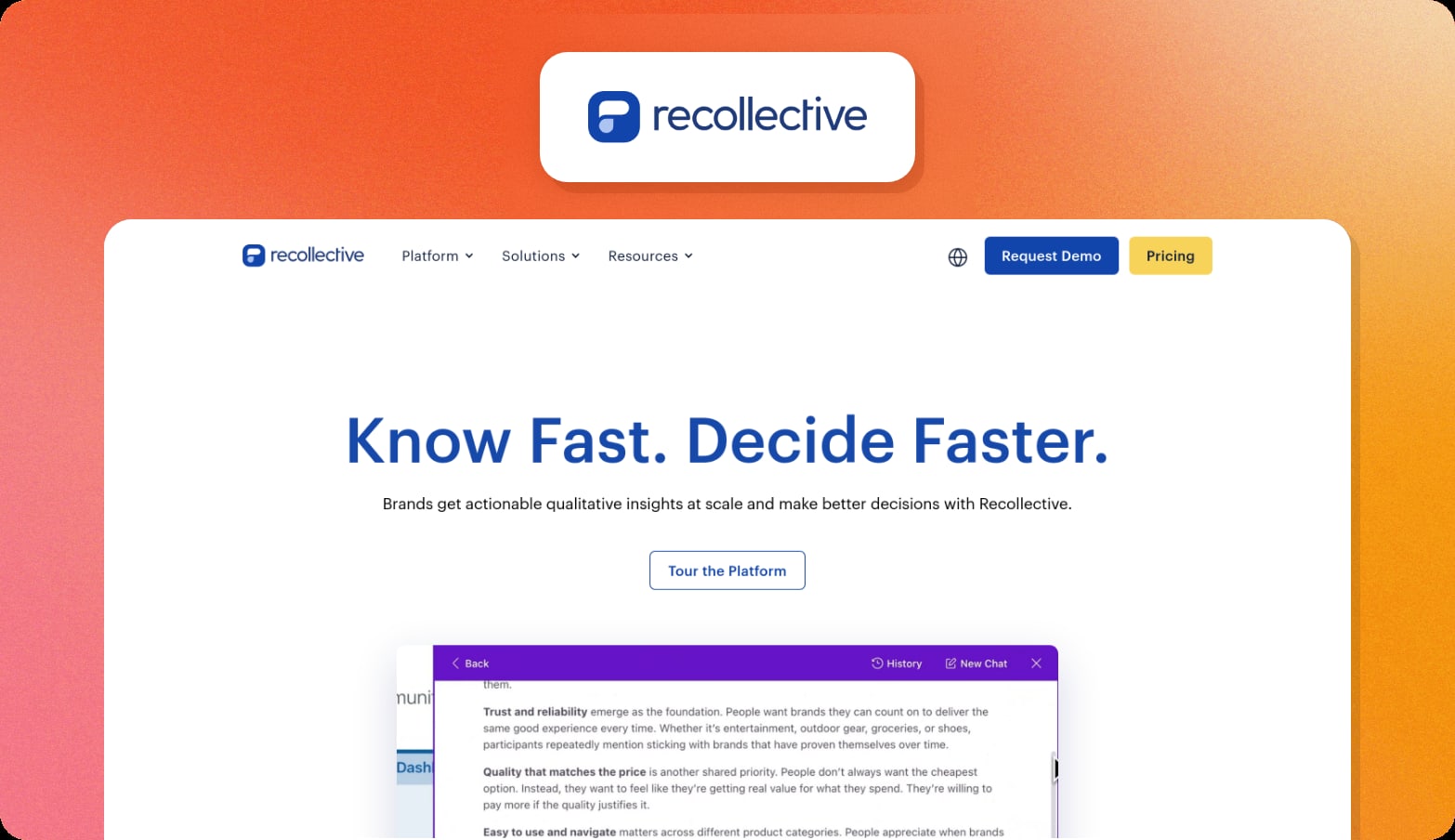
Recollective runs research as an online community, where the same consumers keep journals and join discussions over months or years. Researchers can add live video interviews and focus groups within the community, so a topic raised in a journal can be explored in conversation later. Its Ask AI answers questions across several projects and links to the source verbatims, and unlike Dscout, Recollective publishes starting prices.
A community does need someone to run it. Recollective offers full-service moderation as a paid option, and teams managing it themselves should plan time to post activities and keep members engaged. It also doesn’t list its own participant panel, so recruitment comes through panel providers or your own lists, where Dscout has one built in.
7. Discuss.io: let stakeholders watch live sessions together
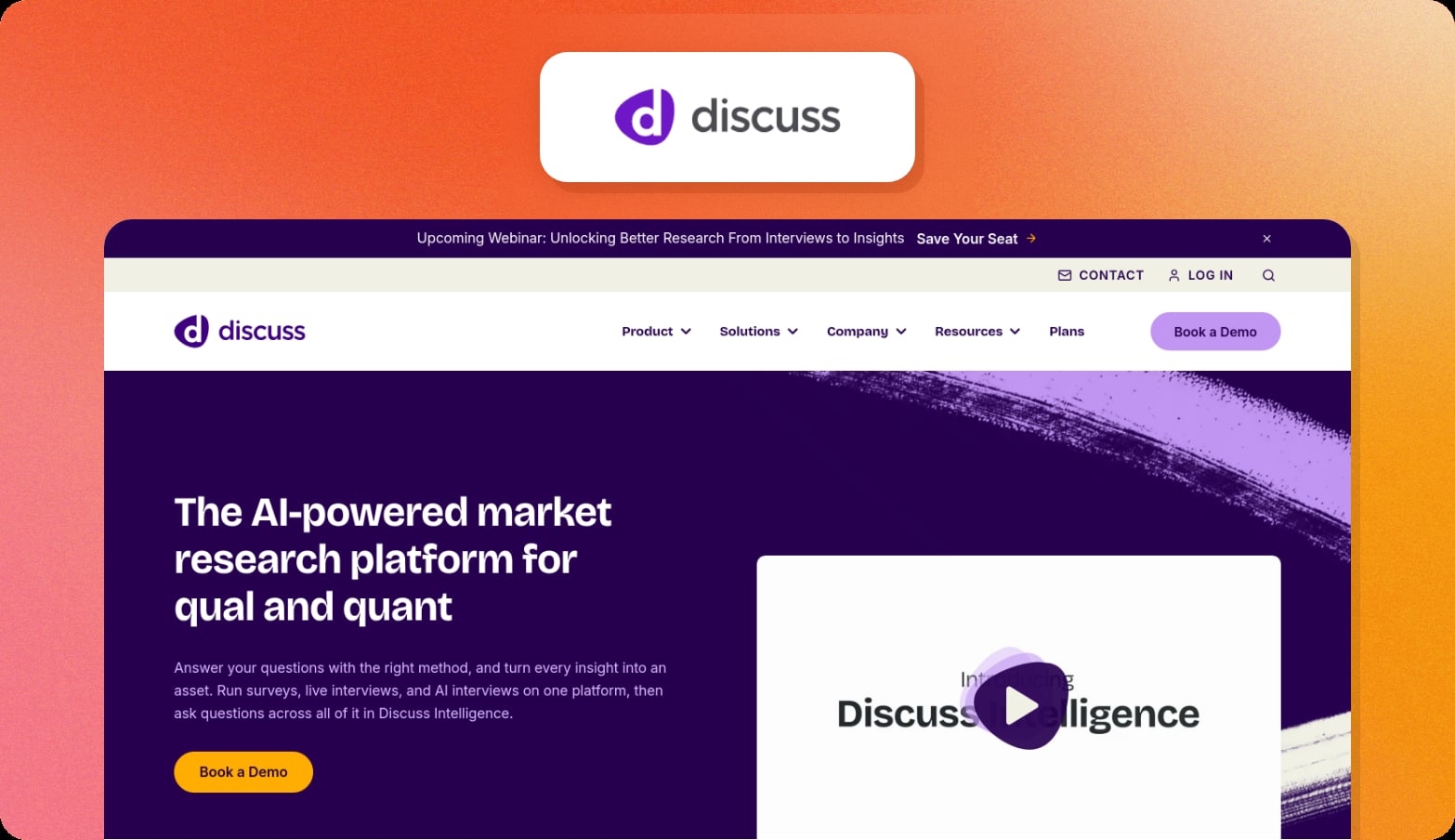
Discuss.io is built for live interviews and focus groups, which one G2 reviewer says Dscout handles less well. Observers follow along from a private backroom with live translation into English, and clips are ready as soon as the session ends, so stakeholders can see what consumers said straight away. It also runs AI-moderated interviews, and Discuss Intelligence lets teams ask questions across every study the company has run.
Discuss.io can run video diaries through its Self-Paced Activities, but those tasks don’t include AI follow-up questions, so every probe has to be written in advance. Its data is hosted in the US, which is worth checking if your research falls under EU data requirements.
8. UserTesting: get quick feedback on prototypes before launch
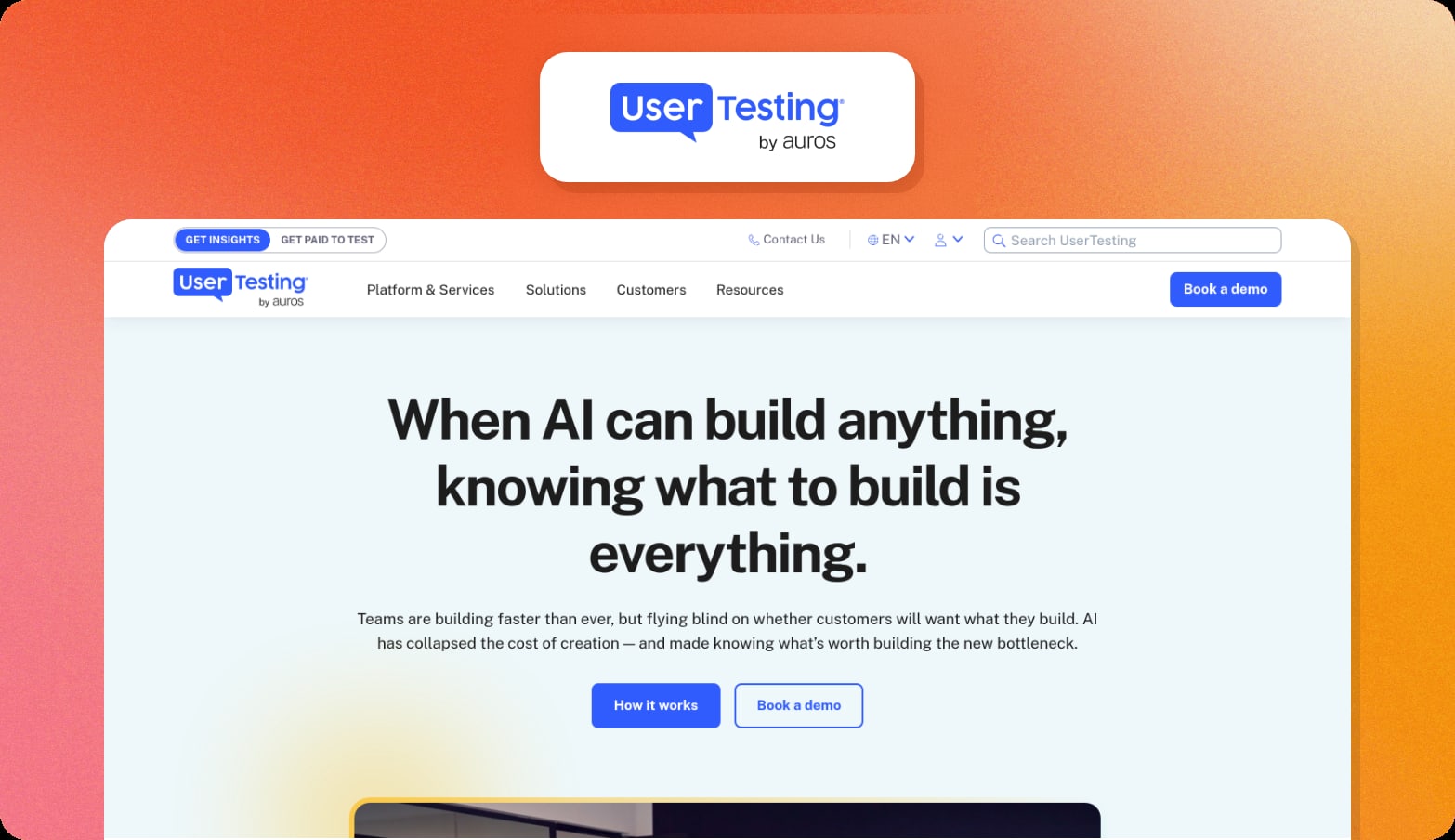
UserTesting focuses on the usability side of Dscout. Its plans cover moderated live conversations, unmoderated think-aloud tests, and prototype testing, with card sorting and tree testing on higher tiers, so product teams can test designs at several stages. UserTesting also owns User Interviews, which brings recruitment and testing under one company.
UserTesting can run diary studies as a series of tests sent to the same contributors, though it suggests involving its Professional Services team, so they take more setup than in a dedicated diary tool. Its AI follow-up questions are in limited early access and only work in think-aloud tasks. It’s the stronger fit when most of your Dscout use is product and prototype testing.
9. User Interviews: find the participants Dscout’s panel can’t reach
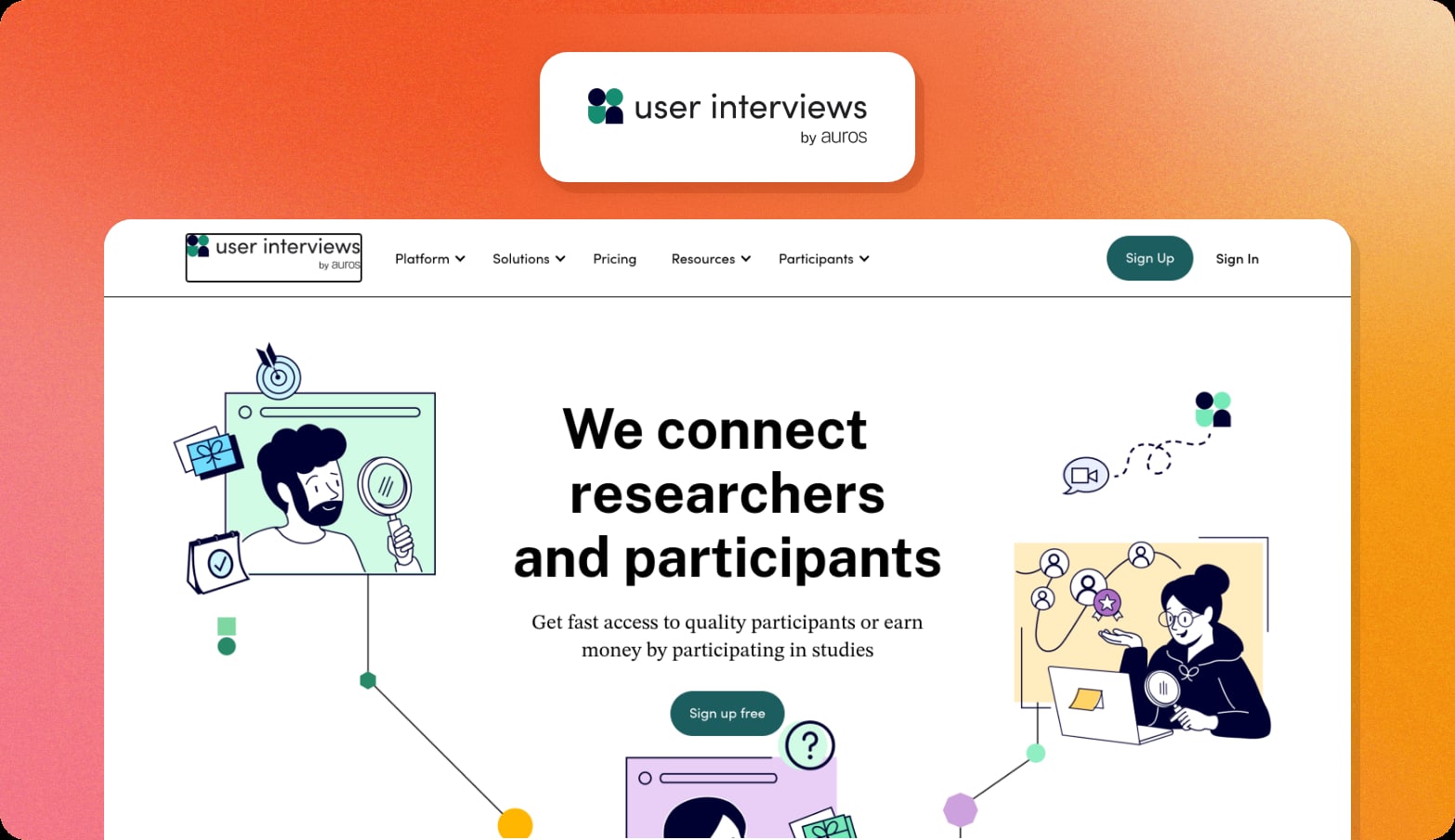
User Interviews handles recruitment and leaves the research itself to the tool of your choice. It recruits from its own panel, with advanced targeting for B2B audiences, and its Research Hub lets you manage your own participants alongside it. Unlike Dscout, it publishes per-session prices, so you know what recruitment will cost before you start.
Because it doesn’t run studies, you’ll need a separate tool for diary studies or interviews. Dscout and Indeemo aren’t among its listed integrations, so moving participants into a diary tool may take a few extra steps. It works best for teams whose main problem with Dscout is finding the right people.
10. Dovetail: search everything your team has learned, whichever tool it came from
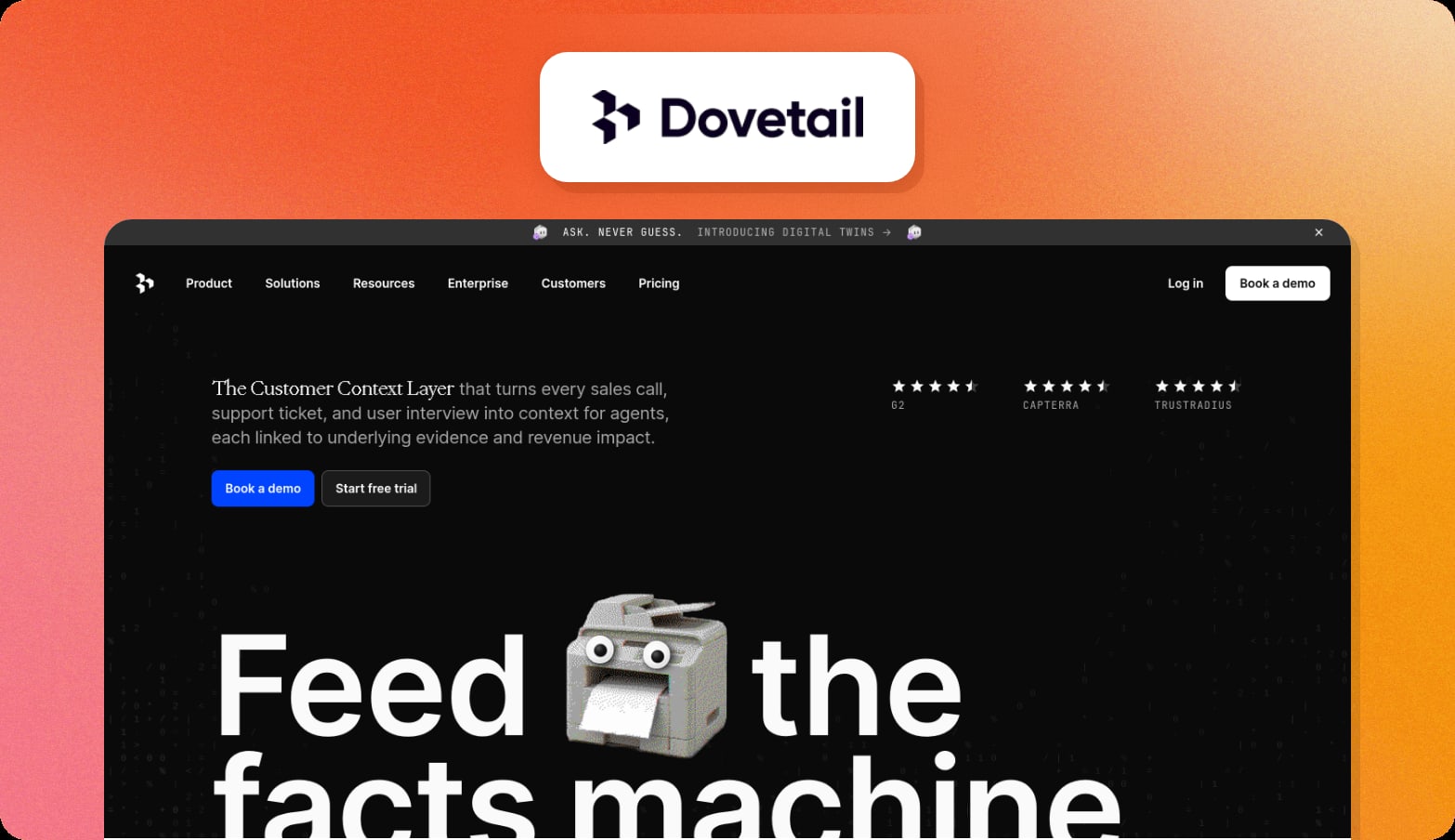
Dovetail sits on top of the research you already run and gives your team one place to analyze it. It brings in interviews and other feedback from connected tools and links each line of a transcript to the moment it was said. You can then ask questions across all of it and get answers with citations back to the source, whichever tool the research came from.
Dovetail doesn’t collect research, and it retired its recruitment tool in 2025, so you’d still run studies in Dscout or another platform. Dscout isn’t among its listed integrations, so check how you’d bring Dscout data in before committing.
Diary study or continuous research: which do you need?
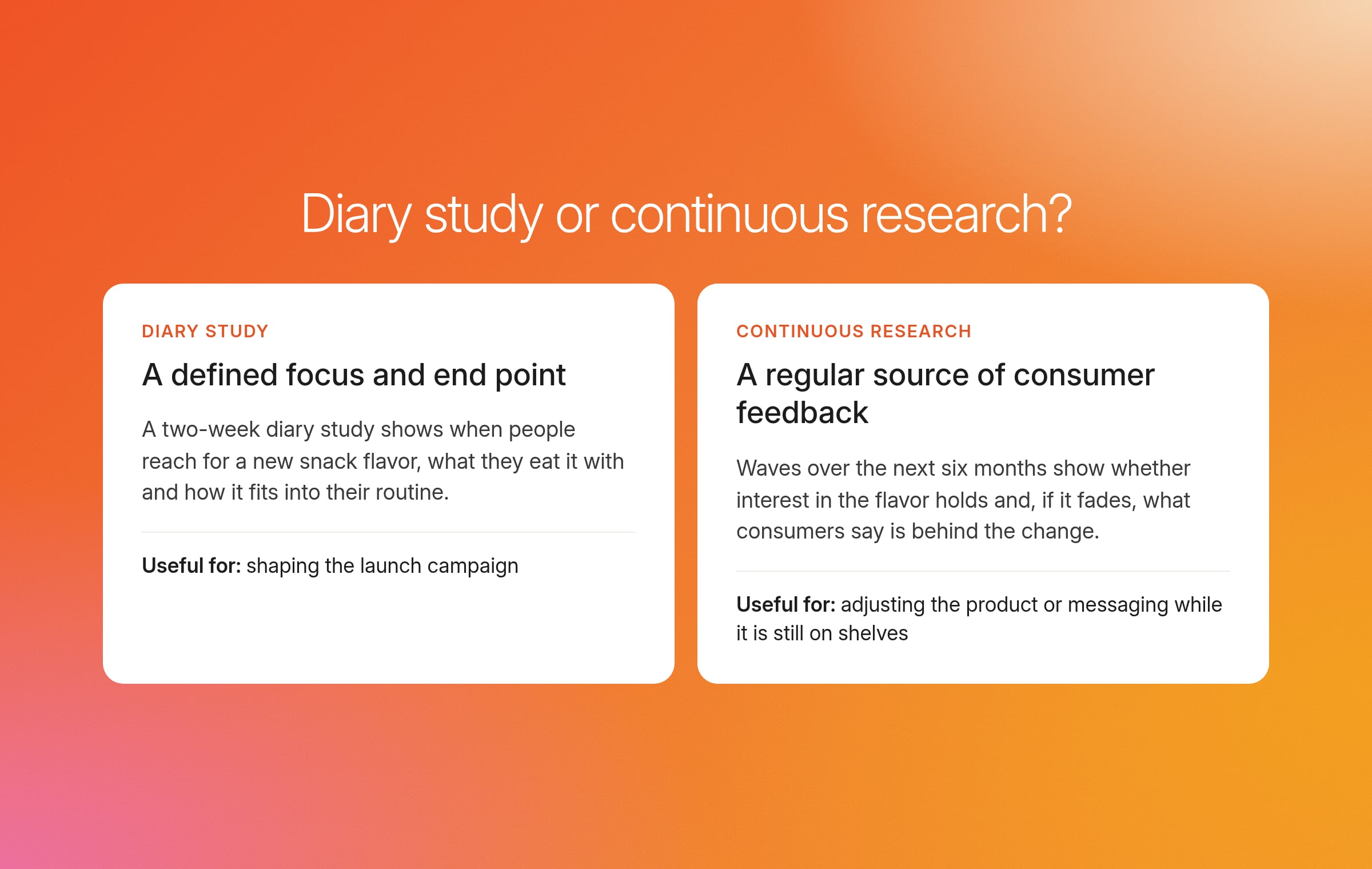
Dscout customers tend to gravitate towards it for its diary studies, as it’s what the platform started with. Diary study tools are a go-to when you want to understand a particular experience over time. The study has a defined focus and end point, and gives you a detailed picture of what participants experience during that period.
However, if your team regularly needs to understand what consumers think about your brand or category, running separate diary studies won’t give you the same ongoing picture. Continuous research gives you a regular source of consumer feedback, so you can track how attitudes and preferences change and dig into new questions as they come up, without starting an entirely new research project each time.
Example: Take a snack brand launching a new flavor. A longitudinal, two-week diary study would show when people reach for it, what they eat it with, and how it fits into their routine. That’s useful for shaping the launch campaign. A continuous research program would show whether that interest holds over the next six months, and if it fades, what consumers say is behind the change. That gives the team time to adjust the product or the messaging while the flavor is still on shelves.
Conveo StoryLines runs AI-moderated video conversations on your core questions every wave and opens on what moved since the last one, with the reasons in participants' own words.
Why insights teams choose Conveo as their Dscout alternative
If you’re looking for a Dscout alternative because analysis takes too long or answers stop short of the reason behind a behavior, Conveo gives enterprise teams deeper answers from every participant and findings stakeholders can check for themselves. Here’s how:
Get the reason behind every answer. When a participant’s answer is vague or leaves something out, the AI research assistant asks a follow-up on the spot, in interviews and diary entries alike.
Show stakeholders the evidence. Findings come with their proof attached: open any theme to see the clips and quotes from the participants who raised it.
Build on what you already know. Before a new study starts, your team can search what earlier studies found, and Conveo points out themes that keep coming up.
Stay on top of questions that keep cropping up. For topics you check on regularly, Conveo StoryLines runs research in waves, for example, monthly, and highlights what’s changed each time a wave closes.
Trust what you present. Your researchers stay in charge of each study's design and can check every finding against the clips behind it, and every theme comes from real participants, never synthetic ones.
Pass security review with confidence. Conveo is SOC 2 Type II and ISO 27001:2022 certified, GDPR compliant, with EU hosting in Belgium.
"The pace, responsiveness, and research expertise of the Conveo team, on top of the top AI-moderated qual platform, have been invaluable to us in scaling brand advertising internationally."
Matt Harris, Research & Insights Lead, EMEA, Canva
Frequently asked questions
Does Dscout publish its pricing?
No. As of November 2026, Dscout lists three paid plans on its pricing page, Core, Select, and Enterprise, but doesn’t show a price for any of them or list a free plan. Each plan is set up as a custom quote, so you’ll need to talk to sales to get a number. Studies also use activity credits that come with your subscription, which means the final cost depends on how many studies you run and how many participants take part in each one.
What’s the closest alternative to Dscout for diary studies?
Indeemo is the closest like-for-like swap. It’s a mobile ethnography app where participants record video entries and photos on their phone as things happen, with push reminders that keep diary entries coming in. You can recruit participants through its panel partner or invite your own users with a link or QR code. If you’d rather run each diary entry as a conversation, Conveo’s AI research assistant follows up on each person’s earlier entries, so you capture the reason behind a behavior as well as the moment itself.
How do AI-moderated diary studies handle follow-up questions and traceability?
In an AI-moderated diary study, each entry becomes a short conversation. The AI interviewer asks a follow-up question when an answer is vague or leaves a gap, much as a human moderator would in a live interview, so you get the reason behind the behavior while it’s still fresh. For traceability, check that every theme and summary links back to the participant and the exact moment in the video it came from. That way you can check the context yourself before a finding goes into a report.
How does diary study software keep participants engaged?
Diary platforms keep participants engaged by making each entry quick and easy to remember. Automated reminders prompt people at the time of day the behavior usually happens, and short tasks on a phone take a few minutes to finish. Splitting a longitudinal diary study into activities with their own deadlines helps too, because participants always know what’s due next. Paying incentives after each completed activity also gives people a reason to keep going through to the final entry.
Can teams run Dscout and another research platform together?
Yes. One setup keeps Dscout for mobile diary studies and unmoderated usability testing and adds a separate tool for other work, such as AI-moderated interviews or a research repository that stores findings across studies. Running separate tools means paying for two contracts and keeping research data in two places, so agree on shared tags and theme names from the start. That way, findings from both tools can be compared side by side, and switching tools later doesn’t mean redoing your analysis.
Which security and compliance credentials should a diary study platform have?
Diary data often includes video of people at home, so look for enterprise-grade security. At a minimum, that means SOC 2 Type II certification and GDPR compliance. If you run research in Europe, check where the platform hosts its data, since some store everything in the US. Teams in healthcare should also ask about HIPAA. It’s worth requesting the vendor’s subprocessor list, which shows every other company that handles your data.

About the author
Alex de Hemptinne
Business Impact Lead
Alex is a Business Impact Lead at Conveo, partnering with enterprise teams to embed AI-led research into their workflows. From the first study to full-scale rollout, she helps customers shift from project-based research to continuous customer intelligence.
Meet Alex on film →