
In this article
TL;DR
A diary study is a longitudinal qualitative data collection method: research participants log entries describing their experiences as they happen, over days or weeks, useful when sequence matters as much as endpoint sentiment.
Diary studies fail in three predictable ways: participant dropout, inconsistent entry quality, and a synthesis burden that eats weeks, and AI-moderated longitudinal interviews address each one structurally: real-time probing, asynchronous scheduling, and synthesis organized as sessions close.
Traditional diary studies remain the right call when in-the-moment behavioral capture over several weeks is the core requirement, and the team can sustain active monitoring for the full field period.
Conveo StoryLines runs continuous, wave-based AI-moderated research so longitudinal understanding stays current without every wave restarting from scratch.
By the time a diary study's findings reach a stakeholder deck, the decision they were meant to inform has often already closed. The brand team has committed to the packaging concept; the product team has shipped the roadmap. Diary studies are one of the few qualitative tools designed to capture how opinions and emotions shift in real time across sessions rather than within a single session, but the timeline the method requires often works against that strength.
A consumer's relationship with a skincare routine, a patient managing a chronic condition, a shopper's path to purchase: these stories only make sense told across days and weeks, at a length that exceeds any single 60-minute session. That temporal dimension is genuinely difficult to replicate in one sitting, and it's exactly what makes diary studies valuable when the research question is sequence-dependent.
The operational reality of running them at enterprise scale is harder to talk around. When recruiting participants for two or three weeks of daily entries, dropout often starts by day four. Entry quality degrades as novelty fades, and missing data from participants who quietly stop logging skews a cohort that was never uniform to begin with; synthesizing 40 participants across 14 days of entries can take longer than the fieldwork itself. What decides whether a finding still matters when it arrives is the velocity of understanding what changed and why, beyond what participants reported at the end.
This piece examines when it makes sense to conduct a diary study, where they tend to collapse operationally, and when AI-moderated asynchronous interviews, sessions where Conveo's AI moderator conducts and probes a structured conversation without a human interviewer present, can deliver comparable longitudinal depth without the dropout and synthesis burden that make traditional diary designs so difficult to finish on time.
What is a diary study?
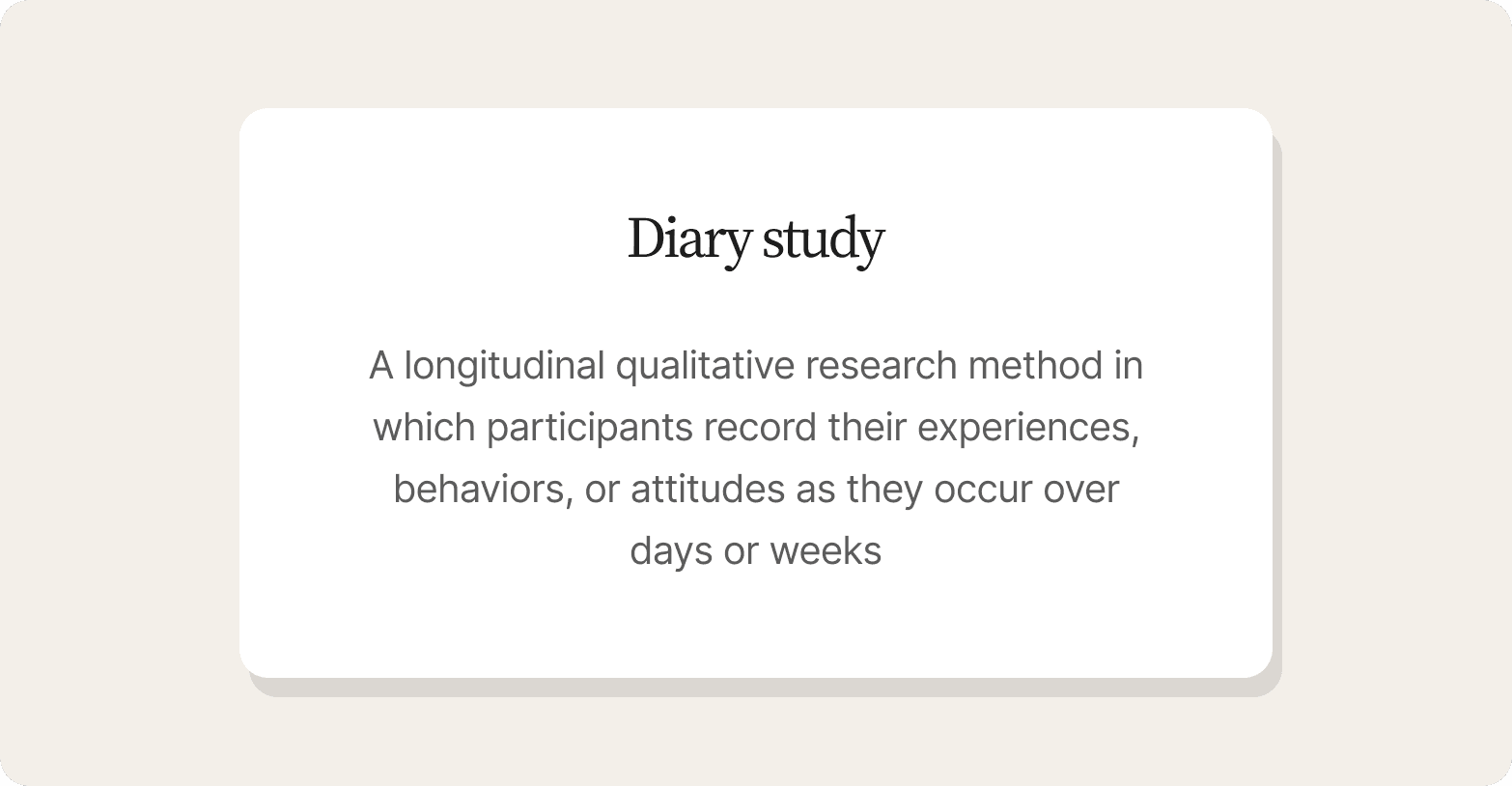
A diary study is a longitudinal qualitative research method in which participants record their experiences, behaviors, or attitudes as they occur over days or weeks, rather than recalling them after the fact. The method's core advantage is temporal: instead of reconstructing a four-week onboarding experience in a 45-minute interview, you capture what they felt at the moment a pain point appeared, and what triggered the decision to escalate to support.
Three characteristics define the diary study research method:
Longitudinal (data collection unfolds over time): the study deliberately spans time, allowing researchers to observe how attitudes shift and where they land.
Contextual: participants report from their actual environments, part of day-to-day life, rather than a moderated session that approximates those conditions, a form of in situ logging a lab can't replicate.
Self-reported: participants generate self-reported data in their own words, preserving nuance a moderator's paraphrase would flatten.
The experience sampling method, with roots in academic research, is a related technique that typically follows a signal-contingent protocol: prompts are delivered at random or scheduled intervals rather than as part of structured diary entries. Both approaches share the same underlying logic: real-time data is more accurate than reconstructed data, and the gap widens the longer the interval between experience and recall.
In a representative scenario, a team runs a 14-day diary study on a new product trial. Participants submit a short video or voice note each day describing what they used, what confused them, and what they almost gave up on. By day five, a pattern emerges: a specific setup step consistently elicits frustration, but participants who push through it report greater satisfaction by day ten. A one-time post-study interview at the end of the trial would likely surface only the endpoint emotion, leaving out the friction that nearly determined the outcome, exactly the kind of finding that has to arrive before the roadmap decision closes.
That distinction, between knowing what a customer thinks and knowing when that thinking changed, is what makes diary studies a different category of evidence entirely. As a generative research method, diary studies surface the unknown unknowns rather than confirm a hypothesis, and it's why always-on understanding keeps pace with how often that thinking changes.
When to use a diary study (and when not to)
The decision to conduct a diary study comes down to one question: does sequence matter to your research objectives? If what you need to understand changes between day two and day ten, a single interview cannot capture it. A diary study is the right method in any user research program where the question is fundamentally longitudinal.
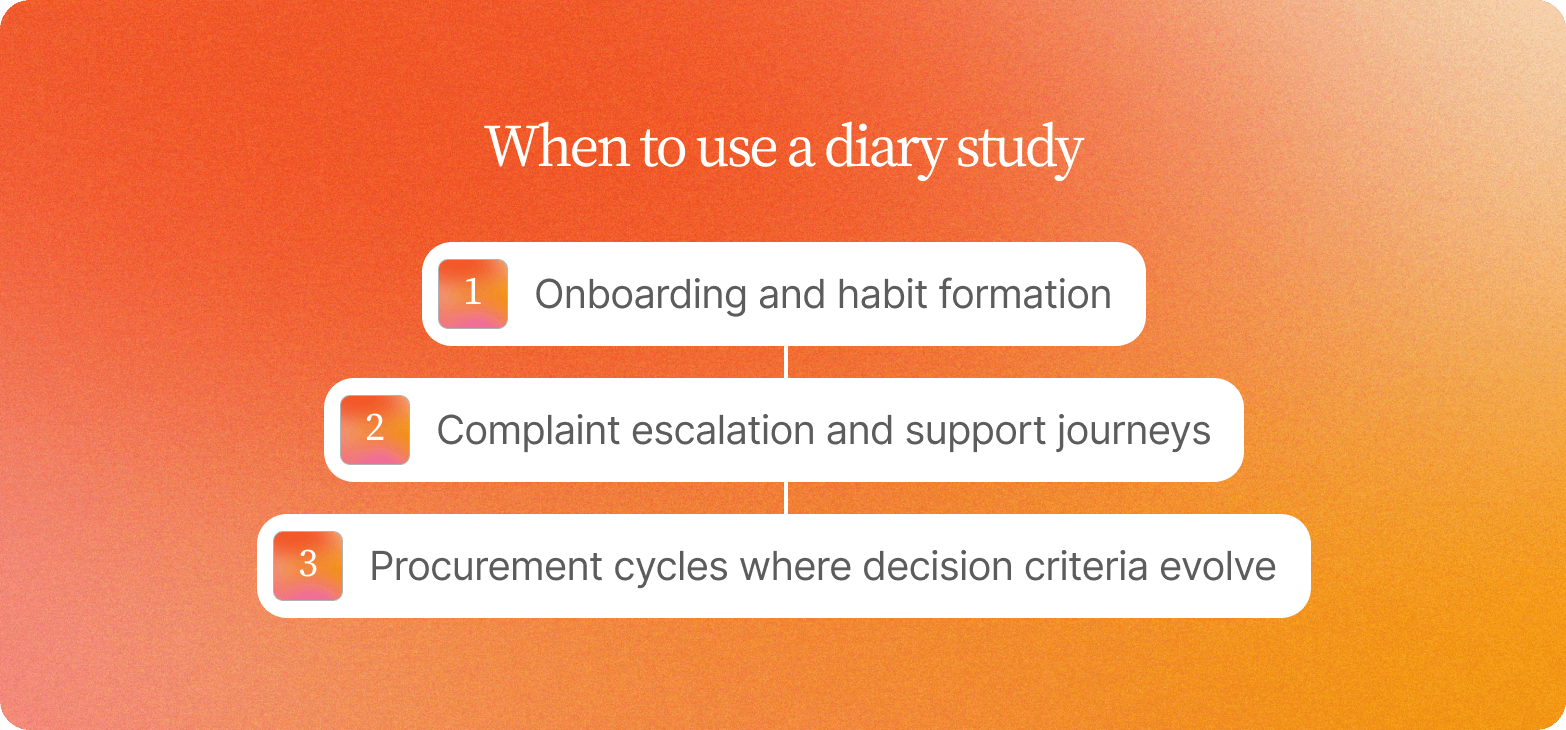
3 scenarios where diary studies are the right call
Onboarding and habit formation
As a UX research method, a diary study suits product onboarding well, where the goal is to understand how new user behavior forms, stalls, or is abandoned in the first days of use, capturing how users interact with a product before habits settle into everyday life. Participants log experience in the moment, reporting the friction, confusion, and small moments of confidence before narrative instinct tidies them up.
Complaint escalation and support journeys
When customers move through a support experience across multiple channels, a single interview captures only the final impression. Diary entries capture how frustration builds, where it peaks, and how participants interact at each touchpoint, helping a service team identify the moment that actually broke the relationship.
Procurement cycles where decision criteria evolve
A B2B buying journey that runs across several weeks involves shifting priorities and changing risk tolerances. A diary study maps how the decision frame evolves, tracing the temporal dynamics of how different events reshape stakeholder priorities, which no end-of-process interview can reconstruct.
When a diary study is not the right choice
The method has real costs, and choosing it when the question doesn't require it is a waste of resources. If a well-designed, hour-long round of user interviews can answer the question, run the interview. The diary study vs. interview tradeoff turns on one question: whether the phenomenon you are studying unfolds over time or can be surfaced in a single conversation.
Diaries are also the wrong choice when you need quantitative data on prevalence, or when business timelines cannot accommodate weeks of calendar time.
The harder constraint is operational. A diary study involving 30 to 50 research participants entails collecting daily diary entries, which requires constant monitoring and active probing when responses thin out. Most research teams staffed for project-based work find it difficult to sustain that level of active management across the full duration of a study.
Templates and quality checkpoints
Most diary studies run between 7 and 21 days, depending on the behavior being studied: a weekly grocery decision cycle needs at least two full loops, while a post-purchase experience may resolve in as little as a few days and rarely needs more than 7 to 10 days of logging. Studies that extend beyond three weeks see meaningful dropout, and the participants who remain tend to be atypical, skewing the data.
Entry cadence typically follows daily logging or one of three contingent protocols:
Daily logging suits habitual behaviors where frequency matters.
An event-contingent protocol captures moments as they happen, tracking how different events unfold in low-frequency decisions, such as a financial product comparison.
Interval-contingent protocol: prompts sent every two or three days, reducing participant fatigue.
Signal-contingent protocol: prompts are triggered at random; works best when the goal is to catch behavior as it happens.
Diary study templates fall into two broad categories, and the diary structure a study uses, how much structure it builds in from the start, affects dropout rates as much as data texture. Structured prompts ask specific questions at set intervals, "What did you eat for breakfast and why did you choose it?", and work because clear and detailed instructions tell participants exactly what's expected; ambiguity is the primary driver of mid-study dropout, and detailed instructions at every checkpoint remove it. Open-ended logging ("Tell us anything notable about your morning routine today") gives participants more latitude and surfaces language the research team didn't anticipate asking about, which is valuable in early discovery phases, though looser prompts can bias participants toward whatever they assume the study wants to hear.
Entry formats extend the template further: text, photo, video, or audio, matched to the behavior, whether captured through electronic diaries and digital tools, a physical diary, or paper diaries kept by hand. A meal diary benefits from photos; a financial decision diary often yields more through audio or video, where tone and hesitation carry meaning that text flattens.
Most studies also need a consistent three-phase protocol to hold up across a team and across waves:
A pre-study brief that gives participants initial guidance on what to log and how.
An active logging period.
A follow-up interview, sometimes conducted as a post-study interview, that probes the patterns revealed by the logs.
The debrief is where diary data earns its value; without it, teams have a record of what happened, while the grounded explanation of why remains out of reach.
Calibration and monitoring standards across a fielding period
Completion rates and entry quality need active monitoring from day one. When drop-off starts accumulating mid-study, the problem is usually that the entry burden is too high, the prompts are too abstract, or the diary study incentives aren't landing. Catching that pattern in week one gives time to adjust; catching it during synthesis means the skew is already baked in.
Vague entries compound: individually they look like noise, but at scale they become the dataset. When a participant submits one-sentence responses for five consecutive days, that incomplete data affects every theme those entries touch.
Real-time probing addresses this before it accumulates. When an entry reads as low-effort, the ability to remind participants and prompt them to expand while the moment is still fresh keeps the quality floor consistent across the study, rather than discovering the gap only when it's too late to recover. This is one of the clearest places an AI-moderated session and a traditional diary diverge: a diary entry sits in a database until a researcher reads it, while an AI-moderated session responds immediately.
Synthesis and reporting standards
Diary study qualitative research generates a volume of raw data no single interview produces, no single conversation gathers that much data at once, dozens of entries per participant spanning days or weeks. Synthesis means working across that entire body of evidence to build coherent journey narratives, finding where moments cluster, where sentiment shifts, and where a decision point appears across multiple participants at roughly the same stage.
That process only holds up if findings trace back to source; stakeholders will dismiss thematic conclusions as interpretation the moment they can't see the underlying evidence. Traceability earns credibility: every theme needs a verbatim entry, a quote, or a timestamped clip that any stakeholder can examine. A conclusion without that anchor is an opinion.
Conveo's searchable insight library, where findings connect across projects and nothing gets researched twice, keeps every clip and quote linked to the study it came from, so a researcher can surface the source in seconds rather than hunting through transcripts.
The 3 operational failure modes of traditional diary studies
Diary studies carry a structural tension most research briefs don't acknowledge: the method asks participants to do real work, repeatedly, over an extended period, and the quality of everything downstream depends on whether they actually do it.
Participant dropout
Daily or near-daily logging over two to four weeks drives meaningful dropout, particularly when recruiting participants who are only mildly engaged to begin with, and the attrition follows a pattern. Highly engaged participants tend to drop out faster when the logging burden feels repetitive. What remains by week three is a self-selected group: compliant, available, and less time-pressured.
That distortion compounds across waves: by the third or fourth wave, the sample may no longer resemble the population it was designed to represent. Participant burden is the biggest operational risk in diary research, and it rarely appears in the project plan no matter how many participants the study recruits.
Inconsistent entry quality
When a participant submits a vague or incomplete entry, there's no mechanism to probe in the moment; the researcher sees it hours or days later, after the behavioral context has passed, producing uneven qualitative data across the cohort. Entries like "bought the usual brand, nothing different" tell you almost nothing, and entries that contradict earlier ones create interpretation problems no follow-up conversation may resolve.
The result is a data-quality monitoring overhead that most research teams cannot properly staff. Low-effort entries don't stay isolated; they compound into synthesis problems because a thematic analysis built on uneven, missing, and incomplete raw material produces conclusions that are harder to defend in a stakeholder presentation.
Synthesis burden
Combining hundreds of individual entries into coherent journey narratives takes weeks regardless of how much data any single participant contributes, even with experienced analysts. Stakeholder-ready reporting requires tying each claim back to a real participant entry or clip, so a brand director asking "where does this come from?" gets an answer traceable to source, and that traceability work adds time most timelines don't budget for.
The typical diary study timeline runs for six weeks from recruitment to the final report, assuming no major dropouts and a synthesis phase that doesn't slip. In practice, those assumptions fail on most studies, which is the decision-lag problem: findings arrive as confirmation of a choice that's no longer open.
When AI-moderated interviews outperform diary studies
Diary studies fail in three predictable ways:
Participants stop logging consistently after the first few days.
Vague entries arrive with no mechanism to probe them.
Synthesis takes weeks because hundreds of fragmented responses must be coded before any pattern becomes visible.
AI-moderated interviews address each of these structurally, gathering feedback continuously rather than only at the end of a fixed field period, and closing that gap is what always-on understanding is built to solve.
Real-time probing catches incomplete responses the moment they happen, before vague answers compound into a dataset full of gaps. Sessions run asynchronously, so participants engage on their own schedule rather than a researcher's calendar, preserving longitudinal depth without the compliance drop-off that typically sets in by week two.
See it in action: How AI-Moderated Video Interviews Actually Work
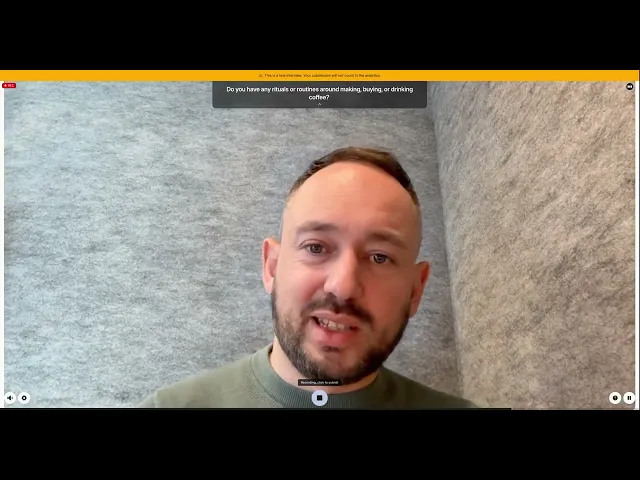
Because each session is structured around decision-relevant themes from the start, synthesis is organized rather than open-ended: findings arrive ready for stakeholders, having already cleared the analysis step.
The mechanism that makes this work in longitudinal studies is session-to-session continuity: programs run multiple sessions over days or weeks, with each session probing based on what a participant said in the prior one. This is the same logic behind Conveo StoryLines, which carries context forward across waves so that understanding compounds rather than resets.
The difference in traceability matters just as much for enterprise teams. Diary entries are often paraphrased before they reach a stakeholder deck; AI-moderated interviews produce verbatim quotes and timestamped video clips, so findings trace back to a specific person, the standard that makes them credible enough to base a decision on.
Where diary studies struggle to scale, teams running research through Conveo can run AI-moderated conversations in parallel across 50+ languages, so a longitudinal program that would otherwise require months of recruitment and synthesis- the work of conducting diary studies at scale- moves at a different pace: teams have completed 100 interviews in 3 days. Teams report moving from a diary study's typical multi-week timeline to decision-ready findings within days.
"The pace, responsiveness, and research expertise of the Conveo team, on top of the top AI-moderated qual platform, has been invaluable to us in scaling brand advertising internationally."
Matt Harris, Research & Insights Lead, EMEA, Canva
The result fits business timelines: the attitudinal-shift tracking diary studies promise, backed by the traceability enterprise decisions actually need.
Comparison: Diary study UX research vs. AI-moderated longitudinal interviews
The table below covers diary study UX research and product onboarding scenarios, alongside broader longitudinal programs, and contrasts traditional diary studies with AI-moderated longitudinal interviews across the six dimensions that most directly affect research operations decisions.
| Dimension | Traditional diary studies | AI-moderated longitudinal interviews |
|---|---|---|
| Participant dropout risk | High. Daily logging over 14 to 21 days creates fatigue; a longer timeline raises the chance of dropout (Nielsen Norman Group), and teams routinely over-recruit to compensate | Lower. Structured sessions replace continuous self-logging, removing the daily burden that drives attrition |
| Entry quality control | Manual and reactive. Vague or incomplete entries surface only during synthesis, when it is too late to probe; researchers must monitor submissions throughout and chase participants for clarification | Real-time. Conveo's AI moderator catches incomplete responses immediately and follows up within the same session, so thin entries do not compound into thin data |
| Synthesis timeline | Weeks. Combining hundreds of entries into coherent themes is labor-intensive; a two-week diary with 50 participants generates 1,200+ entries needing review | Faster. Sessions are organized around decision-ready themes as they close, with synthesis running in parallel |
| Traceability to source | Medium. Traceability depends entirely on how much detail a participant chose to write; vague entries leave interpretive gaps that cannot be closed after the fact | High. Every finding links back to verbatim quotes and timestamped video clips, so stakeholders can verify the source of any claim |
| Calendar time required | 14 to 21 days, plus synthesis | Typically weeks to days, depending on program design; teams report shorter timelines meaningfully |
| Researcher hours required | High. Constant monitoring, entry review, and manual thematic coding across a large corpus | Lower. Conveo's AI moderator handles probing and organization; researcher time concentrates on interpretation and reporting |
The operational contrast describes a tradeoff between two valid methods. Traditional diary study UX research remains right when the question requires in-the-moment behavioral capture across weeks. When the research team can't sustain active monitoring across a multi-week field period, AI-moderated longitudinal interviews cover the same ground with lower dropout risk.
The question to ask before committing to a method is whether the team has the calendar time and researcher hours the chosen method actually requires.
Mixed-method designs: Combining diaries with interviews or surveys
Diary studies generate rich longitudinal evidence, but become significantly more defensible when triangulated with other sources. A single method leaves stakeholders room to question whether reported experience reflects behavior at scale. Hybrid designs close that gap by pairing qualitative depth with quantitative sizing.
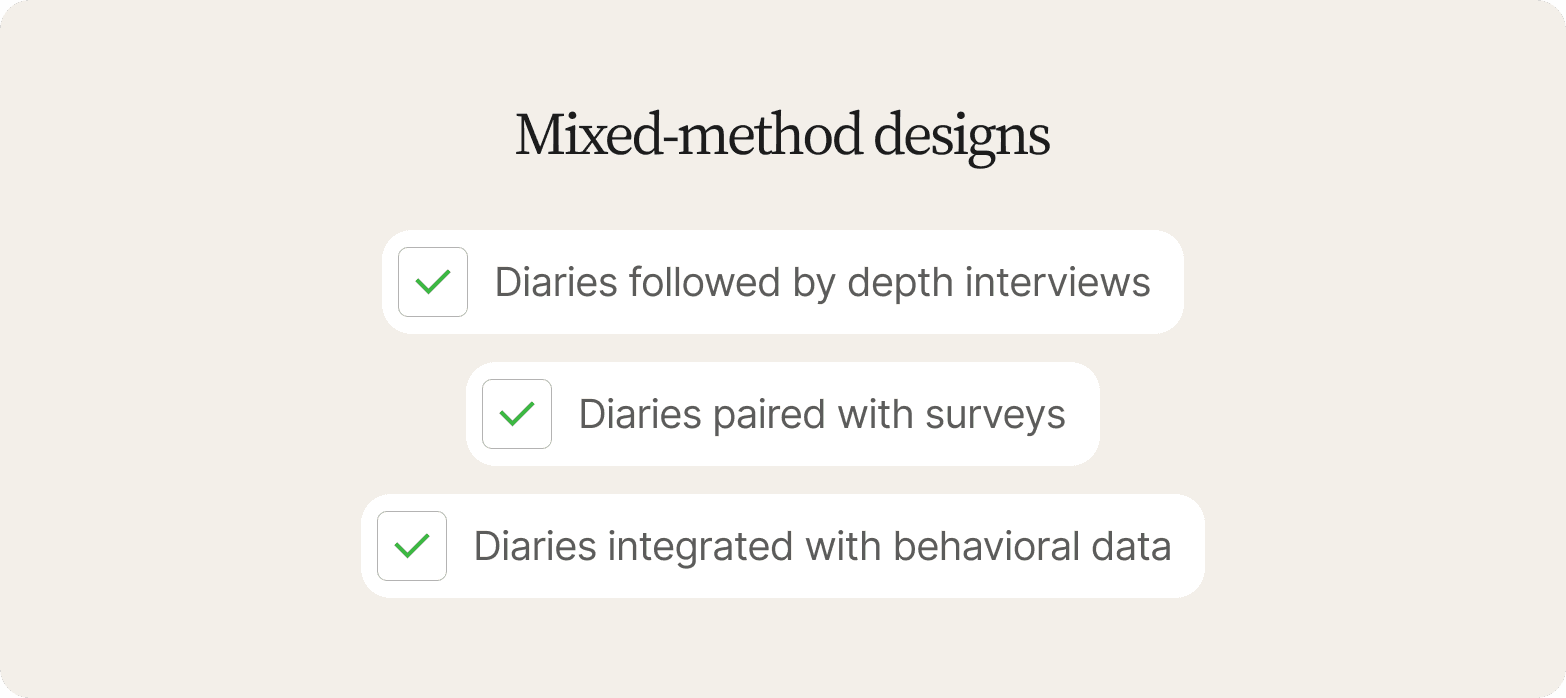
Three designs work consistently well in practice.
Diaries followed by depth interviews
Diary entries surface the participants whose experiences are most instructive: someone who described a workaround in precise detail, or whose frustration escalated across entries. Teams use diary data to identify these high-value participants and probe their entries directly, so the conversation starts with evidence already on the table. When that follow-up layer is AI-moderated, it runs without adding researcher hours: Conveo's AI moderator asks about specific moments the participant described, producing more grounded conversations because their own prior account anchors the discussion.
Diaries paired with surveys
Diaries tell you what the experience feels like from the inside; surveys tell you how many people share it. Running a survey after a diary phase, built from themes that emerged in the entries, lets teams move from "several participants described this friction" to, for example, "a majority of users in this segment report the same." That combination is what converts an insight from interesting to actionable, and stakeholders who would push back on qualitative evidence alone tend to accept findings when prevalence data sits alongside the verbatims.
Diaries integrated with behavioral data
When diary entries can be cross-referenced with usage logs, CRM notes, or support tickets, the triangulation becomes structural rather than additive. A participant who reports feeling confident but whose usage log shows they abandoned the workflow three times that week raises a discrepancy worth investigating.
Consent and re-contact standards
Diary studies create governance challenges single-session interviews do not. Entries frequently include screenshots, photos, or video clips that may contain unintended PII: a name on a package, a face in the background, a location tag in metadata. That exposure compounds with every submission across waves.
Consent frameworks for diary studies need to cover more ground than a standard pre-interview disclosure:
The full study duration.
How the study will collect and store data.
What happens to the data after the program closes.
Consent obtained at enrollment does not automatically extend to a follow-up wave commissioned six months later; each new wave requires a fresh consent trigger.
Re-contact intervals matter too: multi-week programs that contact participants too frequently generate dropout and, in some jurisdictions, raise questions about undue pressure.
PII risk in video and screenshots
Video diaries create a PII-exposure category that static surveys do not capture. When participants record themselves at home, the frame can capture:
An email address on a laptop screen.
A name on a phone notification.
Mail on the counter.
None of it is intentional; all of it enters the research record as data collected without the participant's full awareness. Screenshots compound the risk, often catching a username or billing address without the participant realizing it. Governance can't treat video and image files like transcript text: PII detection needs to run across both before any session is shared with stakeholders.
Data retention and audit standards
Longitudinal diary studies create a specific retention problem that point-in-time research does not. Each entry in a multi-week study is a discrete data event: it needs a timestamp, a record of who accessed it, and a clear chain of custody from raw participant response through to any theme or finding it informed. Without that chain, a compliance audit cannot confirm whether a finding traces back to a real, consented participant or to an analyst's interpretation of one.
Data residency adds another layer: where entries are stored becomes a procurement requirement, and EU-based participants require their data to stay within defined regional boundaries. Traceability matters just as much: the underlying video and transcript must be retrievable on demand. Conveo is SOC 2 Type II certified, GDPR compliant, with EU hosting (Belgium), and builds consent, PII detection, and audit-ready traceability into the research workflow, so the record stays intact regardless of staff turnover.
Where a diary study still beats Conveo, and where AI-moderated interviews aren't the right fit
Neither method wins every case. A traditional diary study is still right when the research genuinely requires unprompted, self-initiated logging no structured session can substitute for, or when a client's governance model requires a client-owned, manual chain of custody over raw entries. AI-moderated interviews aren't the right fit when the question is purely about incidence or prevalence, or when a team needs data captured with zero prompting. In those cases, a well-run diary study or a quantitative survey is the more honest research tool for the job.
Operational economics: What a diary study actually costs
The case for changing method rests more on capacity than cost: longitudinal research becomes something a Research Ops team can run at the cadence the business needs, rather than staying on the planning list.
Diary studies carry a cost structure that surprises teams the first time they run one. Unlike a one-time interview, the work does not end at recruitment: someone has to monitor incoming entries, follow up on vague responses while collecting data, and track who has dropped off for the full duration of the study, and that load compounds across every participant and every day.
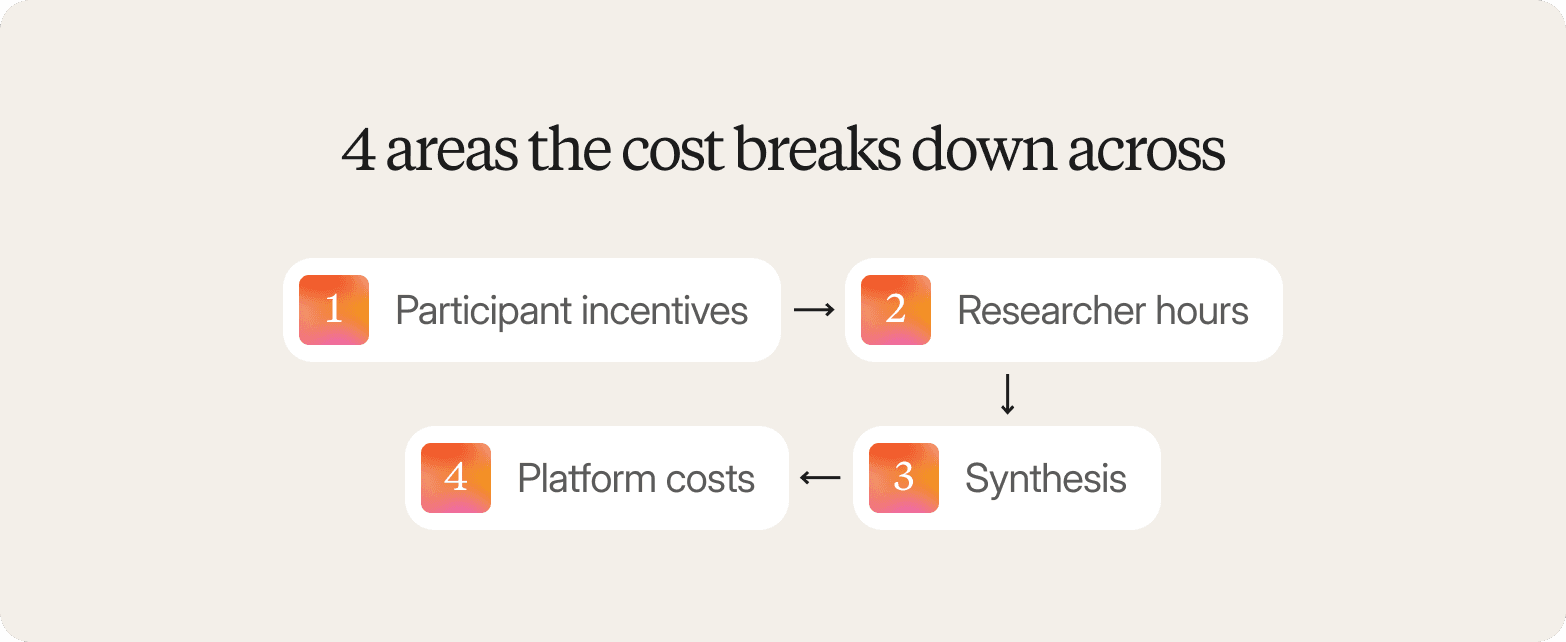
The cost breaks down across four areas:
Participant incentives, the diary study incentives needed to sustain engagement over days or weeks, run higher than for a single-session interview because meaningful compensation is required to maintain completion rates.
Researcher hours, covering monitoring, probing, and dropout management, in a 14-day study with 30 participants, typically 40 to 60 hours of active researcher time before study design and reporting are even counted.
Synthesis, its own cost center: combining hundreds of entries into narratives that hold up in a stakeholder presentation requires structured data analysis rather than a quick read-through.
Platform costs, whether that's a diary study tool built for the purpose, one of the growing number of specialized diary study tools on the market, or a patchwork of forms and spreadsheets held together by researcher effort.
A team that could run four concept tests in a quarter may have capacity for only one diary study, and only if nothing else breaks. The real constraint is frequency: longitudinal research is currently impractical to run as often as most Research Ops functions actually need.
Running that same work through Conveo makes research that was previously off the roadmap actually runnable, and lowers the bill along the way. Conveo's AI moderator handles real-time probing as each participant responds, and every finding traces back to a real participant, with verbatim quotes and video as the evidence layer.
For a Research Ops Manager evaluating platform consolidation, the hours a diary study consumes across monitoring and synthesis can be redirected toward interpretation and the next study, with governance built into the workflow. Cost relief is real, and it arrives as a byproduct of that shift.
Frequently Asked Questions
What is a diary study in qualitative research?
A diary study is a longitudinal qualitative research method where participants record their own experiences, behaviors, or attitudes over days or weeks as they occur, rather than reconstructing them afterward. Three characteristics define it: longitudinal (data collection unfolds over time), contextual (entries happen in the participant's real environment), and self-reported (the participant controls what they log and when). This makes diary studies well suited to habitual behavior, gradual attitude shifts, or experiences that vary across days.
When should I use a diary study instead of an interview?
The decision comes down to whether time and sequence are part of the question. Diary studies are well-suited when you need to capture experiences as they happen, tracking how a product is used on day two versus day ten. A one-time interview is the right call when a single, focused session can fully answer the question, or when the behavior is infrequent enough that a diary would yield too little signal.
What is an example of a diary study?
In a representative scenario, a product team tracking onboarding friction over 14 days asked participants to log every moment they encountered confusion or abandoned a task. The study revealed the exact sequence of pain points, showing how initial optimism shifted to frustration by day five as participants repeatedly hit the same configuration step. A one-time interview at the end would likely have surfaced only a general sense of difficulty; the diary format captured when attitudes turned and which steps triggered abandonment, telling the team precisely where and when to intervene.
What is a diary study template?
A diary study template defines how participants record experiences over time: prompt cadence, entry format, and quality checkpoints. Cadence can be fixed, event-triggered, or run at variable intervals. Entry format shapes what participants can realistically submit. Template design balances participant burden against data depth: the more demanding the protocol, the higher the risk of dropout.
How do I reduce dropout in a diary study?
Participant burden is the single biggest operational risk in diary research. Structured prompts reduce friction by giving participants a clear, bounded task. Shorter durations help too: a 7- to 10 day program typically maintains engagement better than a 21-day program. Real-time probing addresses a related problem by catching vague or incomplete entries while the experience is still fresh. Design the daily interaction to take under five minutes, and treat anything longer as a design problem to solve on your side.
How long does it take to synthesize diary study data?
Synthesizing a 14-day diary study with 30 participants typically takes two to four weeks after fieldwork closes, largely because each participant generates multiple entries per day. AI-moderated interviews compress this considerably because analysis runs as each session closes rather than after all fieldwork is complete. Teams report moving from weeks of post-fieldwork synthesis to just days.

About the author
Alex de Hemptinne
Business Impact Lead
Alex is a Business Impact Lead at Conveo, partnering with enterprise teams to embed AI-led research into their workflows. From the first study to full-scale rollout, she helps customers shift from project-based research to continuous customer intelligence.
Meet Alex on film →Qualitative insights at the speed of your business.
Conveo runs AI-moderated video interviews and structures everything they say.