In this article
TL;DR
The ethical use of AI in research is an infrastructure problem, not a philosophical one: real participants, traceable data lineage, documented consent, and verified compliance are the operational requirements
Stakeholder trust breaks down when AI-generated findings cannot be traced back to time-stamped participant video and verbatim quotes; no amount of AI technology resolves that gap without proper data lineage
Synthetic and avatar-based research removes the foundation of qualitative credibility: real human responses collected under transparent conditions
Consent must be specific, informed, and explicit before every AI-moderated session, covering AI moderator identity, recording, data retention, and model training exclusion
Video-first platforms maintain an auditable evidence chain from insight to source participant, converting ethical risk into stakeholder confidence
Enterprise procurement teams now treat SOC 2 certification, GDPR compliance, EU data hosting, and source traceability as baseline ethical standards for any AI tools entering their stack
Qualitative research is entering a new era. Real-time, multi-market voice and video studies that once required six weeks of agency coordination can now run in days. Artificial intelligence has made it possible to capture richer, more candid participant responses at a scale not possible even two years ago, and generative AI tools are accelerating that shift, enabling adaptive moderation, real-time thematic analysis, and multilingual synthesis at enterprise scale. The capability exists. The challenge teams are now navigating is how to run it credibly.
Research teams running AI-moderated studies are hitting a specific wall: they can produce findings in days, but they cannot always explain to a skeptical CMO or procurement lead how a theme traced back to a real participant. That gap between what the AI surfaced and what a human actually said is where ethical use of AI in research breaks down in practice. It is not a theoretical concern. It is the moment a senior stakeholder asks, "Show me the source," and the answer is a summary without a timestamp.
Those ethical concerns are structural. When findings arrive without visible provenance, stakeholders cannot distinguish between insights grounded in real conversations and AI-generated content drawn from synthetic or hallucinated data, and most insights teams lack the operational infrastructure to close that gap. No standardized consent process, no clear framework for data provenance, no multimodal capture that lets stakeholders verify participant authenticity. Those are solvable problems, not abstract ethics questions.
This article covers practical strategies for responsible AI adoption: operational frameworks for ethical AI use, consent and data governance standards, vendor evaluation criteria, and the provenance requirements that separate credible AI research from outputs stakeholders cannot trust.
Why ethical AI research adoption stalls
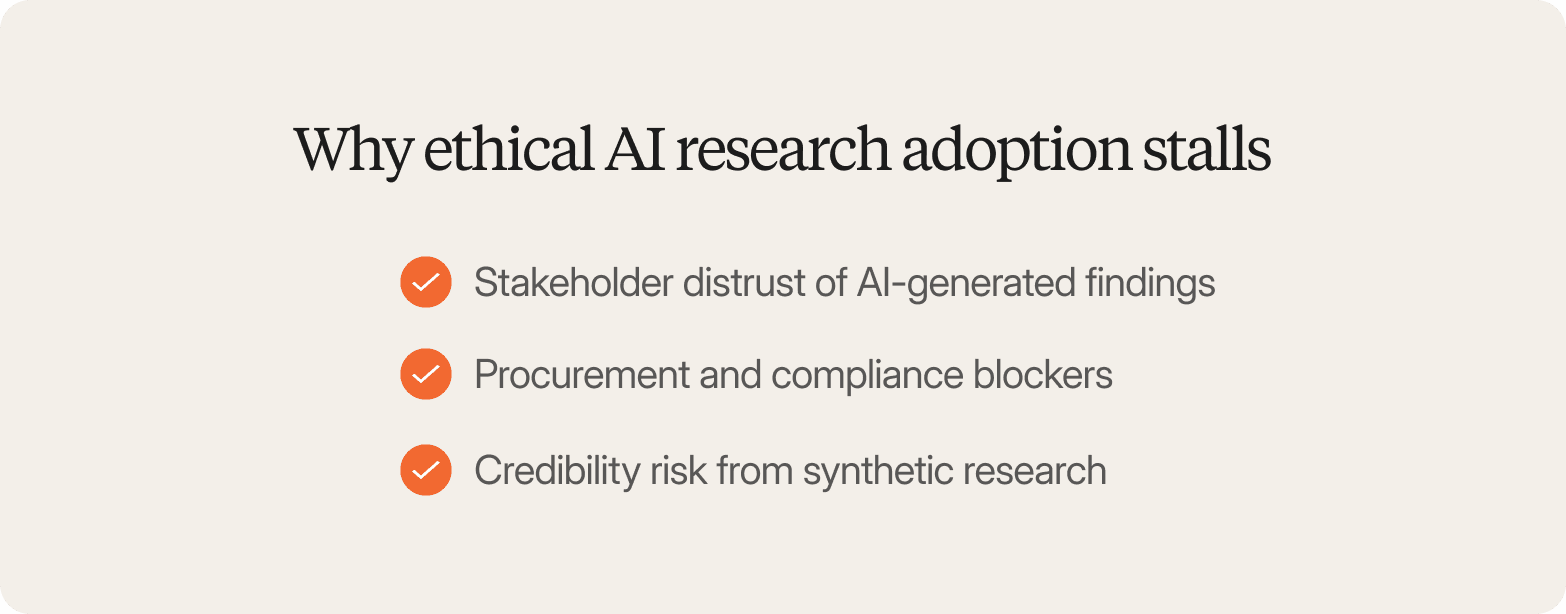
Most enterprise teams hit the same wall before they ever run a study. They cannot clearly explain to stakeholders, procurement teams, or legal what participant data is collected, how consent is captured, or where it is stored. That ambiguity alone is enough to pause or kill adoption.
Three friction points account for most of the stalling:
1. Stakeholder distrust of AI-generated findings
When a research team presents thematic outputs from an AI-moderated study, the first question is predictable: "Can I see the conversations that produced this?" If the platform cannot link a theme directly to a specific participant's voice, video, or transcript, the finding has no credibility floor and lacks research integrity. Teams report that leadership routinely rejects AI-generated insights, not because the themes are wrong, but because there is no way to verify them.
2. Procurement and compliance blockers
The ethics of using AI in research are increasingly operationalized through security requirements and ethical standards. Procurement teams want documented answers: Is this platform SOC 2 certified? Is participant data stored in the EU? Does it support GDPR-compliant consent flows? Many AI tools cannot answer those questions from documentation alone. That ends evaluations before a contract is ever drafted.
3. Credibility risk from synthetic research
Some platforms generate "participant" responses from AI models rather than real people. When enterprise companies discover that a study used synthetic participants, the harm extends beyond that single project; it raises questions about every prior study and makes the entire research function harder to defend in multi-stakeholder environments.
The mechanism connecting all three is data lineage. Ethical guardrails against hallucination are not primarily a model problem. They are an infrastructure problem. Every AI-generated summary and theme must link back to the raw transcript text and time-stamped video, establishing proper attribution from insight to source. Without that chain of evidence, there is no way to audit, verify, or defend the output.
The credibility gap: Synthetic vs. real participant research
A growing category of AI research platforms generates AI-generated content without recruiting a single real participant. Avatar-based interviews, simulated personas, and AI-only focus group platforms produce findings by having models respond to models: no real consumers, no real conversations, no verifiable human signal.
The appeal is obvious: studies run in minutes, with no recruitment timelines or scheduling friction. But the output is not research. It is a prediction of what research might find, generated by generative AI systems that are asked to study the people they simulate. This creates a critical methodological problem that no amount of AI sophistication can resolve.
This is the core problem with synthetic research. Methodological integrity in qualitative research rests on one foundation: real human responses, collected under conditions that allow people to speak honestly. Synthetic platforms remove that foundation entirely. This is why the ethical use of AI in research, and the broader field of AI ethics as applied to research practice, requires drawing a clear line between AI that facilitates real conversations and AI that replaces them.
Beyond academia, where academic integrity standards are well-established, enterprise research teams are increasingly holding their own work to comparable scrutiny, asking the same questions about data provenance and participant authenticity that institutional review boards have always required.
Video-first platforms hold a fundamentally different position. Every insight traces back to a time-stamped participant video. A claim about how a consumer reacted to a new packaging concept links directly to the moment that reaction occurred: the expression, the pause, the exact words used. That traceability is the difference between a finding a stakeholder can trust and one they have to take on faith.
"Conveo's video-first approach is a real differentiating methodological advantage. The ability to distill insights from reactions and not just hear answers adds context you simply can't get from transcript-only tools, or any other tool in the market for that matter"
Senior Marketing Research & Insights Manager, Google
The depth advantage compounds this gap. Participants report being as open as, or more open than, with an AI moderator than with a human one (83% describe this level of candor), and, in practice, share responses 3-4x longer than in static surveys. The absence of social judgment, combined with flexible scheduling, removes the performance dynamic that suppresses genuine disclosure in traditional moderation.
Synthetic platforms cannot provide auditability. Their outputs are plausible, but not provable. In enterprise procurement environments where governance teams now ask for source traceability as a baseline requirement, that distinction determines whether research clears internal review or doesn't.
Operational framework for ethical AI research
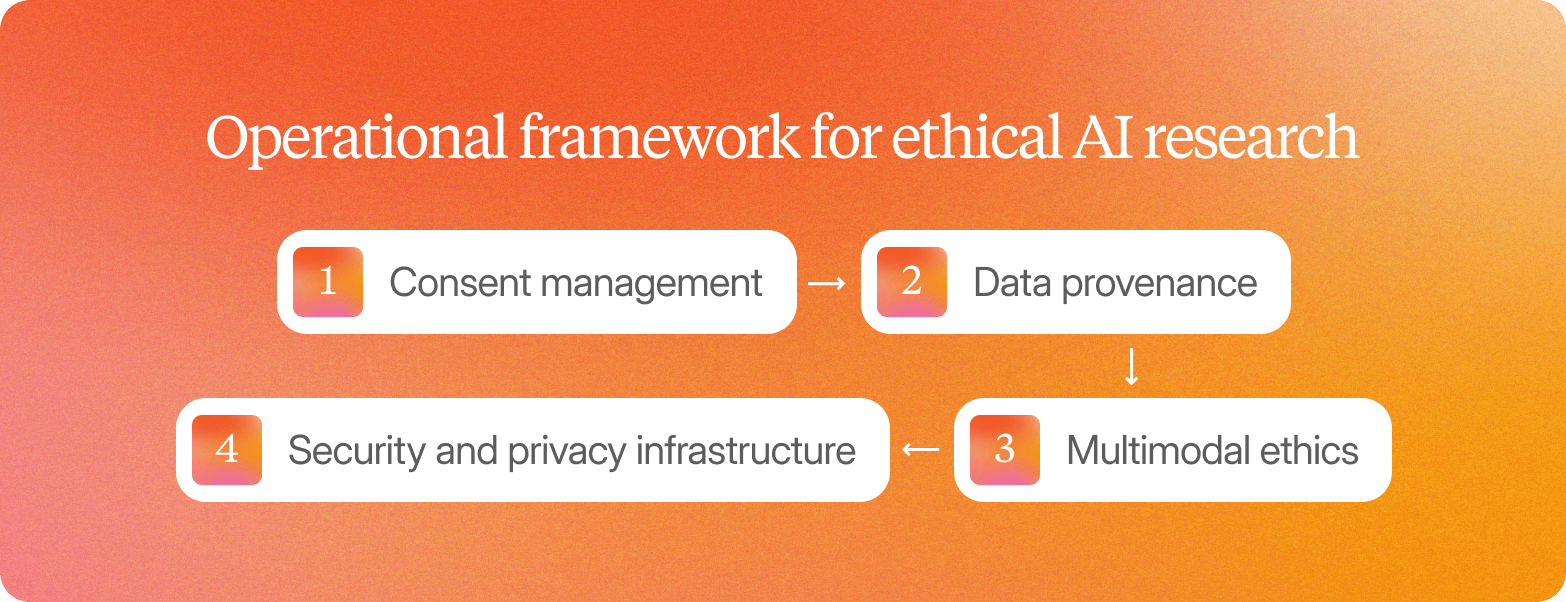
Adopting the ethical use of AI in research has four distinct operational components: the practical strategies that determine whether AI research builds or erodes stakeholder confidence.
1. Consent management
Participants must know before a session begins that they are speaking with an AI moderator, that their responses will be recorded and stored, and exactly how long the data will be retained and who can access it.
In practice, this means a pre-session disclosure screen that:
Names the AI moderator explicitly
Describes recording and storage conditions in plain language
Confirms whether responses will be used for AI model training data
Gives participants the ability to withdraw consent at any point
Transparent disclosure does not reduce the quality of participation. 83% of participants report being as open or more open with an AI moderator than with a human one; knowing they are not being judged by a person tends to increase openness rather than suppress it.
2. Data provenance
AI-generated themes are only as credible as the evidence behind them. Think of data provenance as the proper attribution standard for qualitative research: every finding must cite its source, and that source must be verifiable. Stakeholders should be able to click through from a finding to the verbatim quote, hear the original audio, and see the time-stamped video clip that generated it.
The practical standard: every thematic output should link directly to its source material. Verbatim clips, transcript excerpts, and time-coded video references are the auditability layer. If a vendor cannot show you the source behind a finding, that finding cannot be trusted in a boardroom. Always double-check that traceability works end-to-end before presenting findings to senior stakeholders.
3. Multimodal ethics
Voice and video capture tone, emotion, hesitation, and nonverbal cues: signals that carry meaning beyond words. Richer data requires stricter consent. Participants consenting to a voice interview have not automatically consented to emotion analysis. These ethical considerations must be addressed explicitly: if the platform analyzes facial cues or tone shifts, participants need to know that before the session begins.
Apply data minimization: use only the modalities necessary for the research objective. If emotional signals appear in stakeholder reports, those reports must clearly explain how the signals were captured and interpreted.
4. Security and privacy infrastructure
SOC 2 certification, GDPR compliance, EU regional data hosting, and SSO support are not features to mention at the end of a vendor demo. For enterprise procurement teams, they are the first questions on the security questionnaire. Any AI technology that cannot provide documented evidence of these credentials is not operationally ready for enterprise deployment.
Vendor evaluation checklist: Security, privacy, and auditability
Enterprise ethical requirements map directly to documented security standards, privacy regulations, and auditability requirements that legal, IT, and compliance teams will check before any contract is signed. Adaptive governance frameworks increasingly require that AI tools used in research meet these standards, and the guidance below reflects the baseline requirements now expected by enterprise procurement teams. Use it as your evaluation filter for the ethical use of AI in research.
Security
| Criterion | Why it matters |
|---|---|
| SOC 2 certification confirmed? | Baseline enterprise security credential that verifies an independent audit of data security, availability, and confidentiality controls |
| ISO 27001 certification? | Internationally recognized governance evidence for multi-jurisdiction procurement |
| Penetration testing cadence documented? | Platforms that cannot answer clearly haven't made security assurance a structural priority |
Privacy
| Criterion | Why it matters |
|---|---|
| GDPR-compliant, with DPAs available? | Non-negotiable for any team operating in or collecting data from the EU |
| EU regional data hosting available? | Some procurement paths require participant data to never leave EU infrastructure |
| Data retention policies documented? | Research data needs defined retention limits and deletion protocols |
Auditability
| Criterion | Why it matters |
|---|---|
| Every insight traceable to a time-stamped participant video? | Stakeholder trust depends on the ability to verify findings; untraceable outputs cannot be defended in a business review |
| Verbatim clips exportable in standard formats? | Insights that live only inside a platform cannot be shared, challenged, or archived |
| Raw transcripts accessible to stakeholders? | Platforms that summarize without surfacing source material create a trust gap that undermines every output |
Participant authenticity
| Criterion | Why it matters |
|---|---|
| Real participants or synthetic/avatar-based? | Synthetic research is a methodological and credibility risk for enterprise decisions |
| Are bot fraud prevention measures in place? | Bot fraud is a documented risk in online panel research; confirm screening protocols and post-collection detection |
Model training policies
| Criterion | Why it matters |
|---|---|
| Participant data used to train AI models? | Participants consent to research, not to improving a commercial AI product; responsible AI use requires these to stay separate |
| Is the customer opt-out documented and accessible? | Opt-out controls should not be buried in terms of service |
Any platform that cannot provide clear, documented answers here is not ready for enterprise deployment.
Anti-hallucination standards: Data lineage and traceability
AI-generated summaries and themes can fabricate findings that don't exist in the source data: attributed sentiments that no participant expressed, patterns constructed from inference rather than evidence. As generative AI tools become more capable, this risk grows rather than diminishes: more sophisticated outputs are more convincingly wrong. For enterprise teams basing product and commercial decisions on this AI-generated content, that is a governance problem.
The mechanism that prevents it is data lineage: a traceable chain from every AI-generated insight back to the raw participant data that produced it. Not a general reference to the study; a direct link to the specific video clip, timestamp, and verbatim quote from the specific participant whose response generated that finding. When stakeholders can double-check a finding against source evidence, the integrity of the output is no longer a matter of trust; it is a matter of record.
Operationally, this changes how stakeholders interact with findings. A CMI director can click a theme cluster and immediately see the participant video clips behind it, complete with timestamps and exact language. This is where critical thinking can be applied to AI outputs: not blindly accepting what the model surfaced, but exploring whether the evidence actually supports the interpretation. The AI's role is to identify and cluster; the correct interpretation still requires human judgment.
Watch: How build a study in Conveo from scratch →
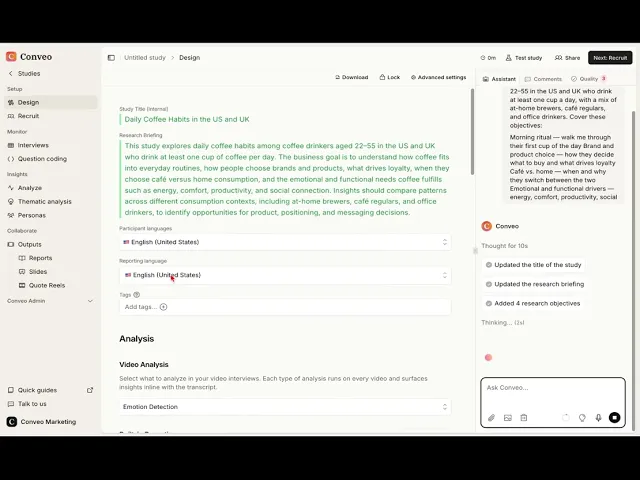
Text-only platforms and generic large language models cannot provide this level of traceability. When analysis runs on transcripts alone, the chain of evidence stops at the written record: no behavioral layer, no tone, no hesitation captured on screen. Procurement teams at large organizations increasingly require video evidence and source traceability as baseline requirements before approving AI tools for research programs.
Human oversight: What AI automates and what humans must own
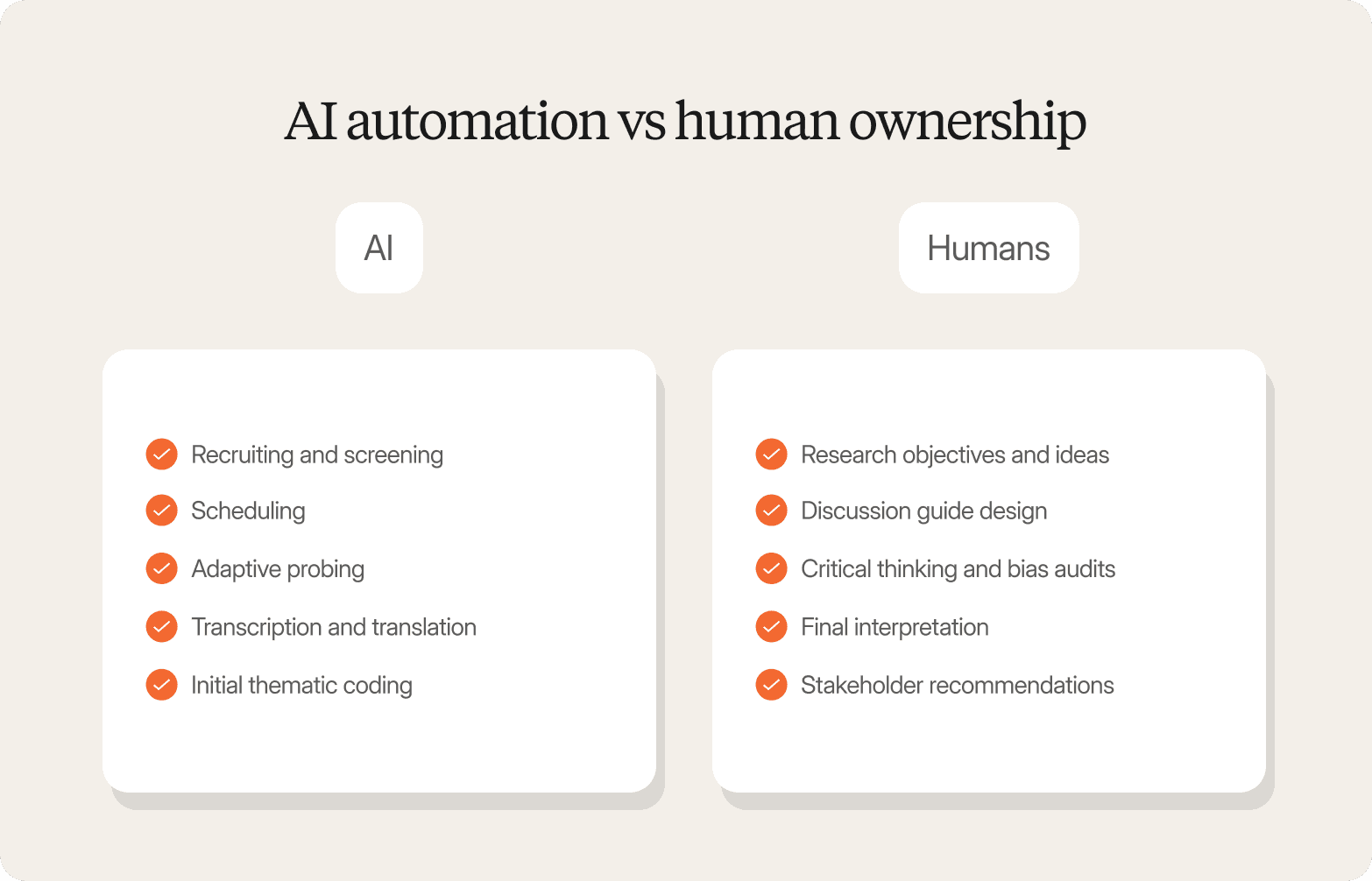
Manual coding and synthesis routinely consume 40-60 hours of senior researchers' time per project. AI removes that bottleneck. The question of what AI should handle and what humans must retain is an accountability question, not a technical one.
What AI should automate
Recruiting and screening participants against a defined profile
Scheduling and participant communications across time zones
Adaptive probing: following up on what a participant actually said, rather than advancing to the next scripted question
Transcription and translation across languages
Initial thematic coding: identifying patterns, clustering responses, flagging sentiment shifts
These tasks create the bottlenecks that push research timelines from days into weeks. Done by AI, they run in parallel, at scale, without fatigue.
What do humans own?
Research objectives and ideas: setting the aim of a study requires understanding what decision is actually being made and what the organization needs to know to make it well
Discussion guide design: methodological judgment about what questions surface genuine insight vs. socially acceptable answers
Critical thinking and bias audits: checking whether screener criteria inadvertently exclude relevant voices, or whether question framing is leading participants toward expected responses
Final interpretation: AI can surface that a theme appeared in 68% of responses; it cannot determine whether that theme should drive a product decision or needs more evidence before reaching the C-suite
Stakeholder recommendations: requires organizational and political context that AI does not have: which findings will land, which need more evidence, and how to frame insight for a specific audience
This division of labor reflects the true importance of human oversight in responsible AI use. Research integrity, whether in academia or enterprise, has always required that humans remain accountable for the conclusions drawn from data. When AI handles the mechanical work, and humans retain interpretive control, the human contribution is concentrated where it matters most.
Global research ethics: Multilingual consent and data residency
Running qualitative research across multiple markets creates two simultaneous problems: coordinating participants across time zones and languages, and ensuring every participant genuinely understands what they are consenting to. As AI technology rapidly enters global research programs, the gap between what platforms can technically do and what they can do responsibly across jurisdictions is widening, and most programs paper over it with workarounds that leave consent ethically thin at the edges.
GDPR requires that personal data collected from European participants be stored within EU-approved infrastructure. For multi-market studies, that means participant recordings, transcripts, and identifying information must remain within compliant regional hosting environments. This is crucial for any global companies running research in the EU, not just those headquartered there.
Multilingual consent means more than on-request translation. Consent forms, interview instructions, and participant-facing communications must be available in the participant's native language. This is both a legal standard and a methodological one; participants who do not fully understand what they are consenting to produce less reliable data. Guidance on what constitutes valid consent must be applied consistently across every market, not adapted for convenience in harder-to-reach regions.
Conveo, the video-first AI research platform, supports AI moderation in 50+ languages and recruitment across 50+ markets through integrated panel partners, with automatic transcription and translation built into the workflow. Because sessions run asynchronously, hundreds of conversations can run in parallel across markets: no time zone dependencies, no moderator availability constraints, no scheduling failures in one market delaying synthesis for the rest. For teams exploring global research at scale, this removes the logistical barriers that have historically made multi-market qual impractical.
ROI and ethical adoption: Speed without sacrificing rigor
The most expensive research decision most teams make is the one they don't make in time. A concept test that takes ten weeks doesn't inform a campaign that launched in week four, and with AI technology moving quickly, the cost of slow research is only growing.
Video-first platforms preserve the evidence trail stakeholders require while removing the overhead unrelated to insight quality: recruiting coordination, live scheduling, transcript cleanup, and manual coding.
In a representative first-project scenario:
~$15,000 avoided in traditional vendor and moderation costs
~50 hours of researcher time saved across design, coordination, and synthesis
~$7,500 in time savings at a $150/hour fully-loaded rate
~$22,500 combined first-project return, before accounting for faster downstream decisions
For study sizing: 15-50 participants per segment gives sufficient thematic saturation for most concept, messaging, and CX applications. When the research questions scale, the platform scales with it; hundreds of interviews can run overnight without adding moderation capacity.
Ethical adoption is not a compliance overhead. It is an operational advantage. Companies that aim to run AI-moderated research responsibly build stakeholder trust faster than teams relying on unverifiable AI-generated summaries. When a CMO asks, "How do we know this is real?" the answer is a timestamped video clip.
How Conveo addresses ethical AI research requirements
Conveo is built specifically to close those gaps, purpose-built around genuine AI ethics principles, not checkbox compliance, and unlike generic generative AI tools applied to research data:
| Requirement | How Conveo addresses it |
|---|---|
| Real participants | Every study uses real, recruited participants: no avatars, no synthetic personas, no AI-generated "respondents" |
| Full data lineage | Every AI-generated theme links back to the specific time-stamped video and verbatim transcript that produced it; stakeholders can click a finding and see the evidence |
| Consent workflows | Transparent pre-session disclosure naming the AI moderator, explaining what's recorded, stating retention windows, and confirming opt-in before data collection begins |
| Enterprise compliance | SOC 2 certified, GDPR-compliant, EU regional data hosting, SSO support, built into the architecture, not added as optional configuration |
| Multilingual moderation | AI moderation in 50+ languages, recruitment across 50+ markets through integrated panel partners |
| Compounding knowledge library | Every study adds to a searchable institutional intelligence layer, turning isolated projects into compounding strategic advantage |
Over 400 enterprises trust Conveo, including Google, Bosch, Reddit, and FOX.
Frequently Asked Questions
What is the ethical use of AI in research?
The ethical use of AI in research means using AI to facilitate genuine conversations with real participants while maintaining a traceable data lineage, transparent consent, and a verifiable compliance infrastructure. The principles overlap with academic integrity standards that have governed research for decades: proper attribution of findings, participant rights, and the requirement that conclusions are grounded in real evidence. Ethical AI research requires operational infrastructure, not just principles.
How do you ensure AI-generated insights are not hallucinated?
Data lineage is the mechanism: the proper attribution standard for AI-generated content in research. Every theme, summary, or sentiment cluster must link directly back to time-stamped participant video and verbatim transcripts so stakeholders can double-check any finding against its source. Platforms that analyze transcripts alone stop the chain of evidence at the written record.
What consent is required for AI-moderated research?
Before every session, participants must be told: (1) they are speaking with an AI moderator, not a human; (2) their voice and video will be recorded and transcribed; (3) how long data will be retained and for what specific purpose; (4) whether their responses will be used for AI model training data. Consent must be freely given, specific, informed, and unambiguous, and participants must be able to withdraw at any point. 83% of participants report being as open or more open with an AI moderator than with a human one.
What compliance certifications should an AI research platform have?
At minimum: SOC 2 certification, GDPR compliance, EU regional data hosting capability, and SSO support. These ethical standards are procurement baseline requirements at most enterprise organizations, not optional features. EU data hosting is a specific requirement for European buyers; SOC 2 is a hard gate at most companies, regardless of analytical capabilities.
Why is synthetic participant research a credibility risk?
Synthetic platforms generate AI-generated content by training models to predict what participants would say, without collecting real human responses. The discovery of the use of synthetic data seriously harms the credibility of the research function, raising questions about every prior study. The critical distinction is whether the data was produced by real people or simulated by AI.
What should humans own vs. what should AI handle in research?
AI tools handle the high-volume tasks: recruiting, scheduling, adaptive probing, transcription, translation, and initial thematic coding. Humans own the judgment-intensive work: research objectives and ideas, discussion guide design, critical thinking and bias audits, final interpretation, and stakeholder recommendations. The aim is not to limit AI; it is to ensure human responsibility remains clearly assigned.

About the author
Kahini Achrekar
Research Impact Lead
Kahini grew up in Canada, studied cognitive and behavioural science, and ran AI-moderated research client side before joining Conveo, where it let her team go deeper across more markets. She now brings that experience to clients and to the product, where what researchers ask for gets built.
Meet Kahini on film →Qualitative insights at the speed of your business.
Conveo runs AI-moderated video interviews and structures everything they say.