In this article
TL;DR
Ethnographic market research observes consumer behavior in real-world environments to capture what consumers actually do
Traditional ethnographic research delivers behavioral depth but takes weeks, often after the decision it was meant to inform has already closed
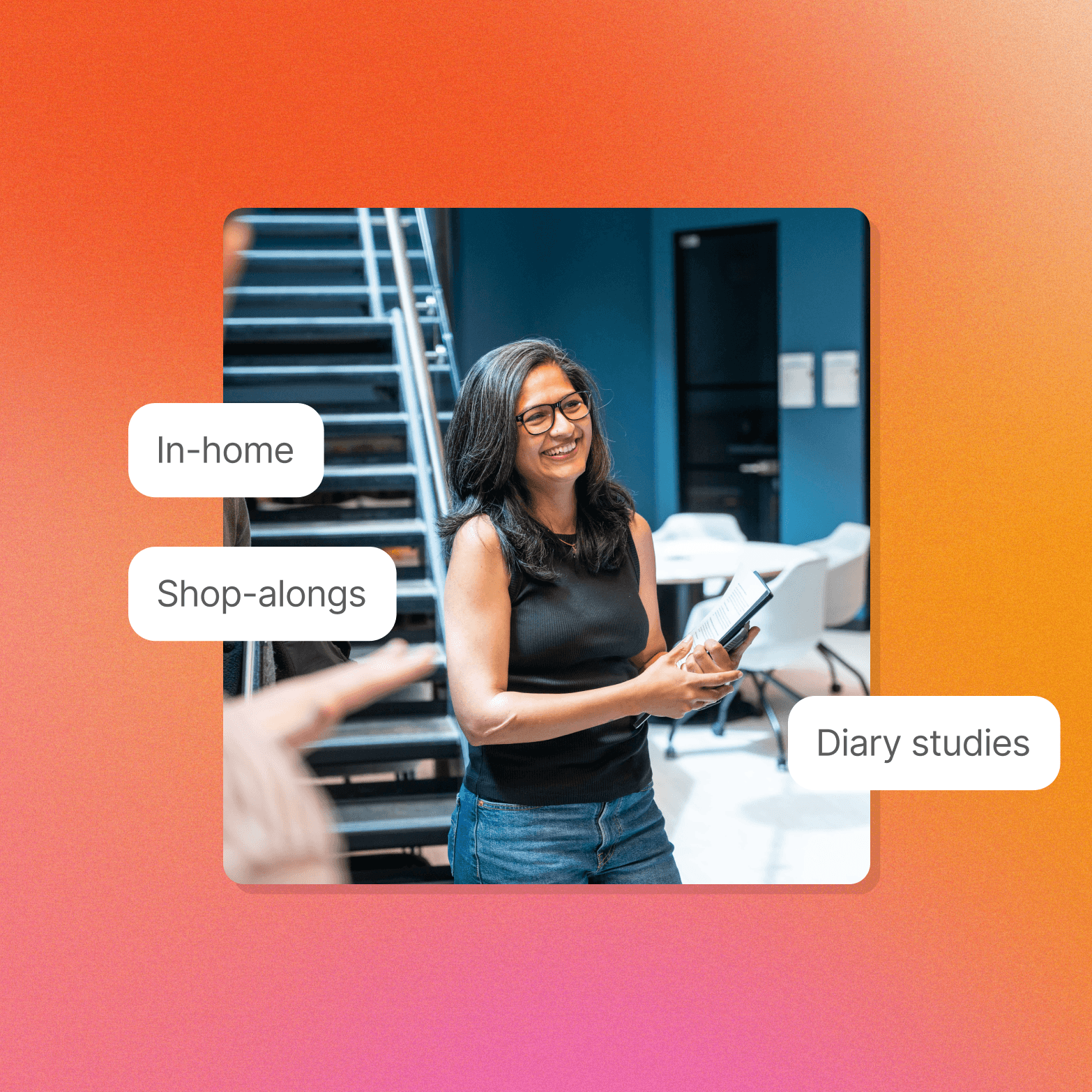
Three core methods carry most ethnographic work: in-home observation, shop-alongs, and digital ethnography (mobile ethnography and video walkthroughs)
Asynchronous video interviews preserve ethnographic insights while running across markets in parallel, delivering deeper insights while decisions are still open
When findings flow into a persistent insight library, valuable insight compounds across studies instead of disappearing into one-off decks
The insight that arrives after a decision has already closed might as well never have existed. Traditional ethnographic research and observational research deliver behavioral depth surveys cannot match, but multi-week recruiting and fieldwork cycles routinely land findings after marketing campaigns have locked and roadmaps have shipped.
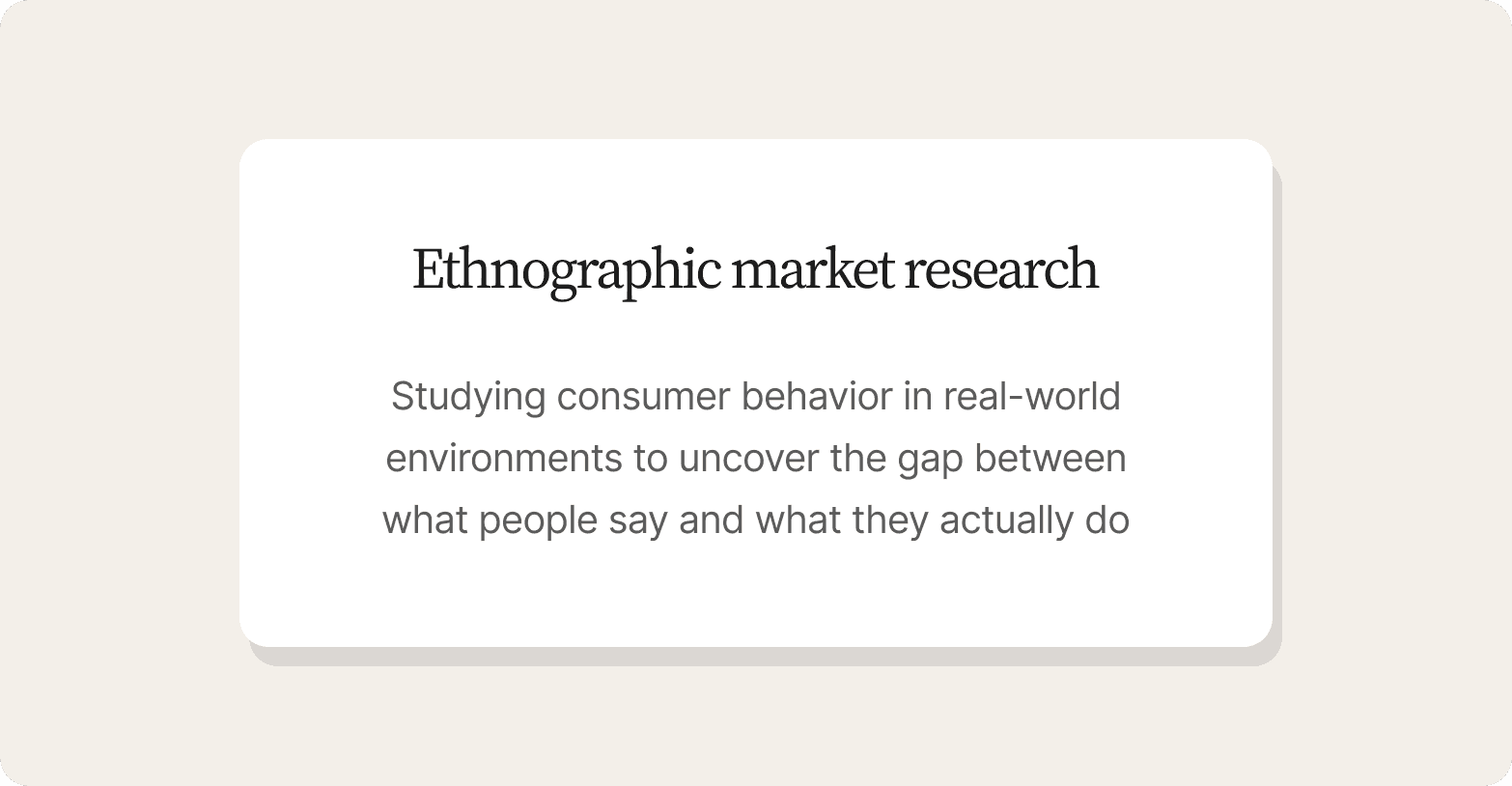
Ethnographic market research (also called ethnography market research or ethnography research) studies consumer behavior in real-world environments to uncover the gap between what people say and what they actually do. Market researchers use the term for observation in a natural setting: watching how someone navigates a grocery aisle or troubleshoots a product at home, rather than asking them to reconstruct that behavior in a focus group or survey.
Surveys capture stated preferences. Ethnographic market research captures hesitation, contradiction, workarounds, and the exact language people reach for when no one is prompting them with answer choices, the emotional drivers behind a purchase that skilled researchers are trained to notice.
Three methods carry out most ethnographic work: in-home observation and participant observation; shop-alongs, which follow decisions at the point of purchase; and digital ethnography, including mobile ethnography and self-recorded video walkthroughs that capture behavior over days or weeks, often via online platforms that participants already use. The operational constraint is that traditional market research methods require in-person access, participant recruitment, and coordinated scheduling, so teams typically wait weeks for findings.
Why teams use ethnographic market research
The gap between what people say and what they do is where product and campaign decisions break down. When a positioning hypothesis is being tested, or a localization investment is being evaluated, stated consumer preferences are rarely sufficient. Ethnographic consumer research exists for these moments: when a team needs to influence consumer behavior with more confidence than a survey can provide.
Four use cases drive most of this work: habitual usage patterns that contradict survey responses and help product developers identify gaps in the roadmap; unspoken category workarounds that expose unmet needs and consumer values; cross-cultural messaging validation, a question of cultural context and cultural sensitivity as much as language; and product-market fit testing before a localization spend.
Surveys strip out tone, hesitation, and the social influences shaping a behavior. Skip that layer, and marketing campaigns ship with messaging that misreads cultural nuance, roadmaps prioritize features nobody uses, and market-entry bets rest on assumptions that real customer behavior would have challenged. The actionable insights from ethnographic work tend to hold up better than survey data when teams revisit the same pain points later.
3 ethnographic market research methods
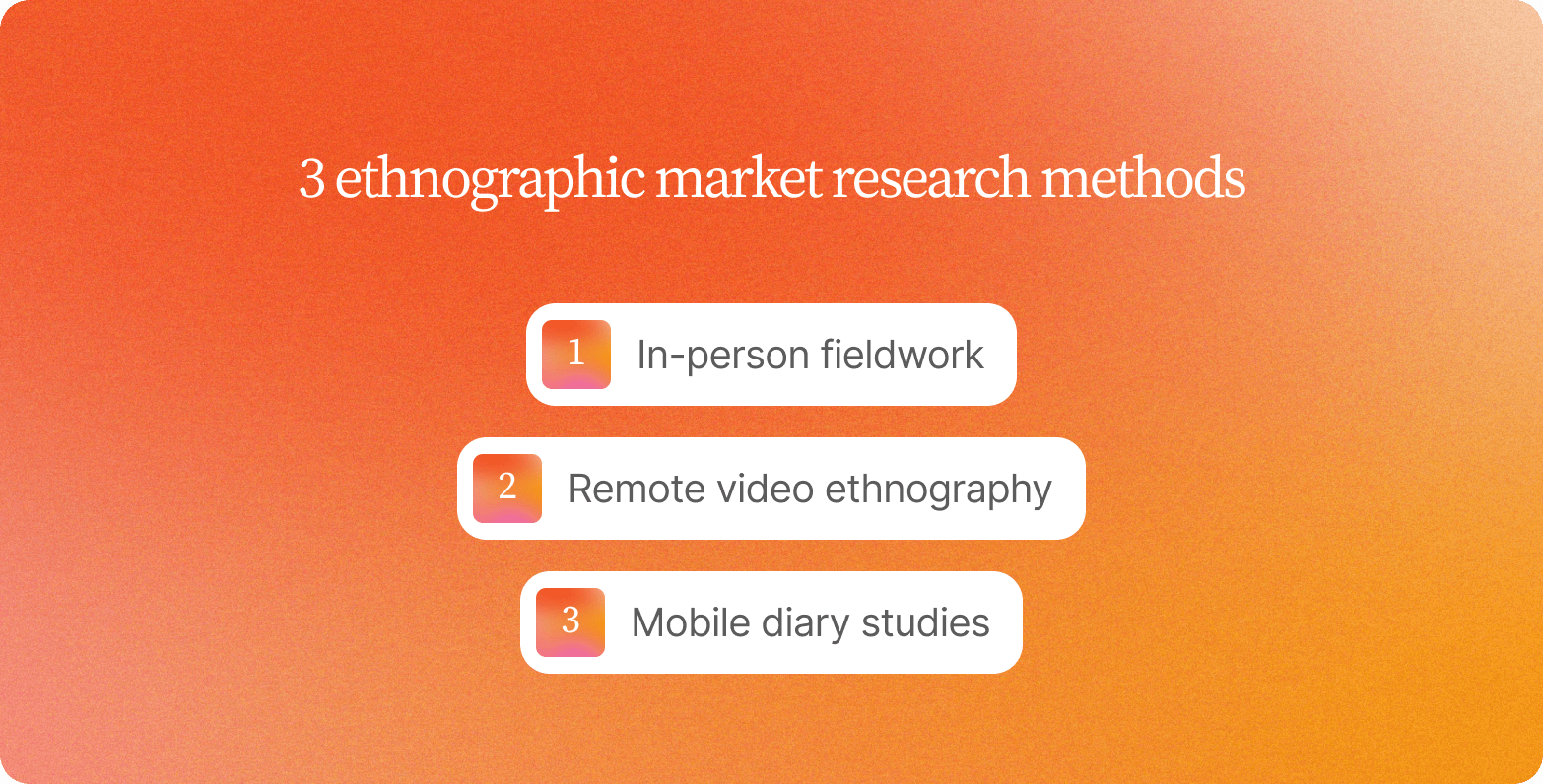
Ethnographic methodologies fall into three categories, each defined by how data collection happens: in-person fieldwork, remote video ethnography, and mobile diary studies.
In-person fieldwork
places the researcher inside the participant's home, store, or workplace. The value is in what can't be articulated: the refrigerator that reveals real eating habits, the hesitation at a price point no survey would catch. The cost is travel, scheduling, and recruiting cycles that run weeks before a session begins.
Remote video ethnography
Preserves much of that behavioral detail without the travel. Participants record themselves via asynchronous video, on their own schedule. Studies that once required coordinating fieldwork across three cities now run simultaneously across time zones, giving teams a comprehensive understanding of a market without the sequencing traditional research demands.
Mobile ethnography (diary studies)
Extends the observation window over days or weeks, capturing patterns that no single session reveals: how a routine shifts over a working week, how purchase intent builds or collapses before checkout.
The synthesis challenge is consistent across all three methods: each generates hours of unstructured video, photo, and audio evidence that resists quick analysis. Manual coding typically adds weeks to the post-fieldwork process, however many skilled researchers are assigned to code it, and that's where most ethnographic projects lose their influence over in-flight decisions. Conveo's asynchronous video interviews close that gap by running transcription and translation as sessions close, so synthesis begins while fieldwork is still running.
Ethnographic market research examples
Ethnographic examples matter most when behavioral evidence contradicts what people say or when cross-market nuance determines whether a campaign lands.
Messaging development
A CPG brand needed to know whether a "confidence" claim read as empowering or arrogant across five markets, a brand perception question a survey scale can't answer. The team ran 100 parallel video sessions simultaneously, capturing facial expressions and tone as participants reacted to the tagline. Findings arrived in days instead of the usual multi-week agency timeline, revealing the same word carried pride in two markets and condescension in three, a real brand strategy risk no survey would have surfaced.
Product positioning
An enterprise software company used asynchronous video walkthroughs to observe how buyers actually evaluate competing platforms, watching where users interact with a demo rather than just describing it afterward. Stated priorities diverged sharply from real decision criteria: implementation risk and vendor trust dominated, along with onboarding pain points that never surfaced in sales calls. Timestamped clips made the findings auditable before a shift in positioning.
Market entry
A retailer entering three new markets used mobile diary studies to capture shopping routines in real time, surfacing category workarounds and the social factors behind them that a scripted survey question missed. The findings reshaped shelf strategy before launch.
All three needed behavioral evidence surveys couldn't deliver. Traditional in-person ethnography would have taken a multi-week cycle for any one of them.
How to run ethnographic market research in the field: 5 Steps
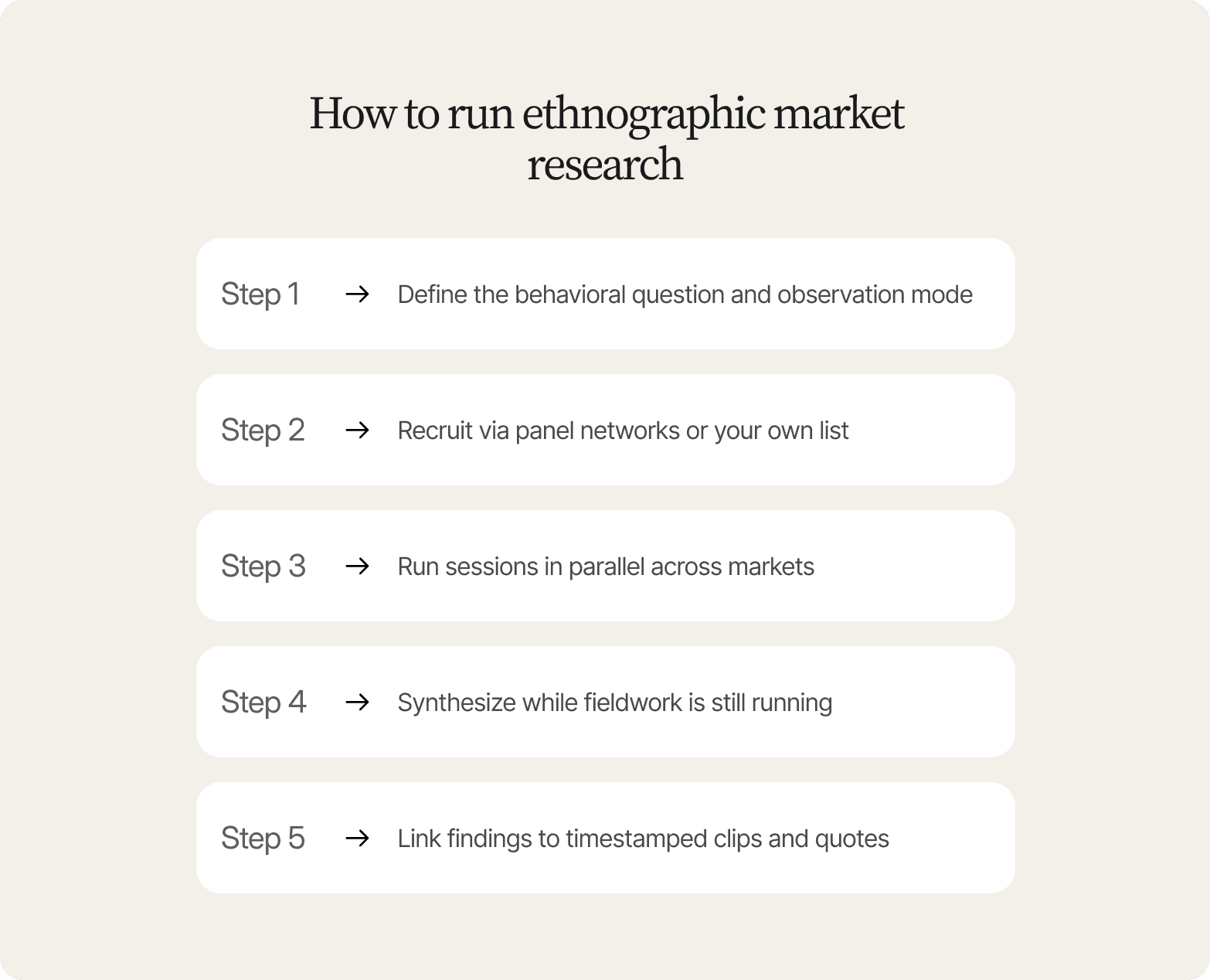
Traditional ethnography in the field means weeks of recruiter outreach and travel before a single insight lands. Asynchronous video interviews deliver the same depth without the fieldwork constraint.
Design
Define the behavioral question, then pick the observation mode: in-home video walkthrough, task-based recording, or mobile diary.
Recruit
Source participants through integrated panel networks or upload your own list. Asynchronous sessions remove the coordination bottleneck that adds weeks to traditional recruiting.
Run fieldwork
Sessions run in parallel across markets. Conveo's AI moderator adapts follow-up probes to what each participant actually says, rather than stopping at scripted answers.
Synthesize
Transcription and translation run during sessions, so synthesis starts while fieldwork is still underway, cutting the research process short.
Report
Link every finding to a timestamped clip and a verbatim quote so stakeholders can verify the evidence directly rather than debating what participants meant.
Teams report moving from weeks to days for stakeholder-ready outputs, freeing time for the next market research project instead of still synthesizing the last one.
Ethnographic market research vs. other qualitative methods
When ethnographic research feels too slow, teams reach for three alternatives: focus groups, in-depth interviews, or surveys. Each qualitative research method trades something away.
Focus groups surface group dynamics and reveal how a target audience influences each other's opinions, but ambivalent reactions often go unvoiced.
In-depth interviews isolate individual perspectives but still rely on self-reported behavior; a shopper describing their routine is narrating a cleaned-up version of it.
Surveys scale efficiently but strip out hesitation, contradictions, and the precise language people use, producing surface-level data rather than a broader context for the decision. Surveys still earn their place for numerical data and statistical analysis at scale, but they're a poor substitute for observed behavior when the question is "why," not "how many."
What ethnographic methods retain is multimodal evidence, facial expression, tone, the moment a participant loses confidence in their own answer, along with deeper insights that only show up on video. Conveo's AI-moderated asynchronous video interviews approximate ethnographic depth at a scale traditional methods can't reach, running across 50+ markets simultaneously.
Choosing an ethnographic market research approach
Start with the behavioral question, then check the decision window and what your operations can support.
In-home observation is appropriate when environmental cues are load-bearing, such as how a product is stored or what workarounds consumers build into their routines. It's the human-centered approach in its purest form, but it requires travel and multi-week recruiting.
Remote video ethnography is well-suited when behavioral detail matters but physical fieldwork isn't viable: cross-market studies, tight timelines, and distributed participants across a dynamic target market.
Mobile ethnography and diary studies fit when the pattern matters more than any single moment, such as habitual routines or longitudinal behavior around a launch.
Teams running ethnographic studies across multiple markets can use Conveo to capture behavioral depth in days rather than the multi-week timeline traditional research typically requires.
Key Points
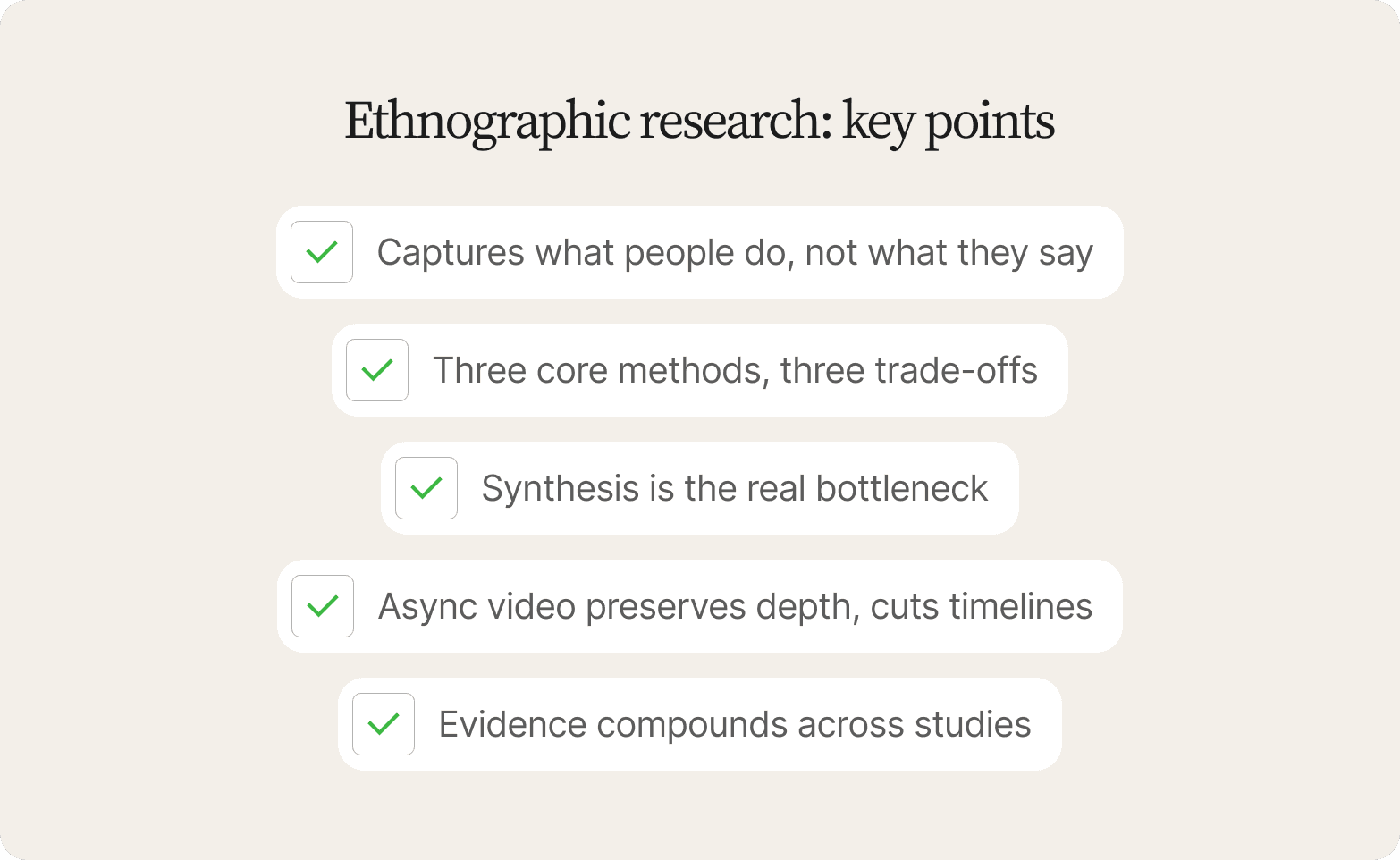
Ethnographic market research captures actual customer behavior- what people do versus what they say- that surveys and scripted interviews miss.
Three core methods dominate: in-home observation, remote video ethnography, and mobile diary studies, each trading environmental richness for operational complexity.
Most projects lose their influence over live decisions in the synthesis bottleneck.
Asynchronous video interviews preserve ethnographic insights while compressing timelines, enabling faster translation of findings into actionable strategies.
Compounding behavioral evidence turns ethnographic research from a periodic luxury into continuous infrastructure that supports business growth over time.
Why teams choose Conveo for ethnographic-depth research
The core problem with traditional research is timing. Evidence that arrives after a decision closes can't influence it. Evidence that arrives after a decision closes can't influence it.
Always-on behavioral evidence
Asynchronous video interviews run in parallel across 50+ markets, so teams can commission research on the same timeline as the decisions it informs.
Research rigor built in
Conveo is built by researchers. The AI moderator adapts follow-up probes to what each participant actually says, surfacing the reasoning behind behavior rather than stopping at scripted answers. Every finding links to a timestamped video clip and a verbatim quote, so stakeholders can verify evidence directly, a competitive advantage over agency-mediated research.
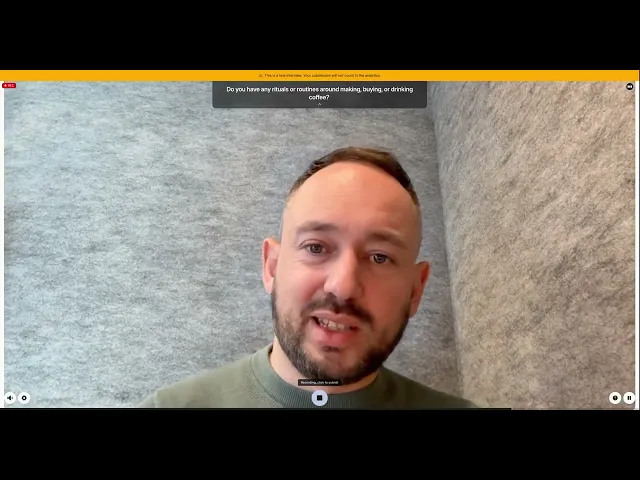
See it in action: How AI-Moderated Video Interviews Actually Work
Compounding knowledge
Every study flows into Conveo's Knowledge Layer, a searchable library of insights connecting behavioral evidence across projects, turning one-off market research projects into a compounding source of ethnographic insights.
Enterprise compliance
SOC 2-compliant, GDPR-compliant, European hosting with primary infrastructure in Belgium.
Speed as supporting proof
Teams report moving from weeks to days for stakeholder-ready outputs.
"Fast exec summary was perfect, job done"
Matt Harris, Research & Insigths Lead, Canva
With Conveo StoryLines, continuous behavioral research becomes part of how your team operates, and observing customers is no longer a one-time project.
Frequently Asked Questions
What are common ethnographic market research topics?
Ethnographic market research topics cover consumer behavior in real-world environments, where what people do diverges from what they say: habitual usage, category workarounds, cross-cultural messaging validation, product-market fit before localization, and purchase journeys. Asynchronous video interviews remove scheduling bottlenecks across time zones.
What are ethnographic research marketing examples?
Three common situations: messaging development, where parallel video sessions reveal how the same claim lands differently by region before a campaign ships; product positioning, where walkthroughs of real usage show stated priorities diverge from actual decision criteria; and market entry, where diary sessions surface category workarounds surveys miss entirely. The multimodal record- tone, facial expression, visible pauses- is preserved in timestamped clips rather than stripped out of a text transcript.
Is ethnographic market research qualitative or quantitative?
It's inherently qualitative research, capturing behavioral context and motivation rather than measuring frequency. The evidence- video, field notes, participant reflections- requires thematic analysis, not numerical aggregation. Teams often pair ethnographic fieldwork with quantitative methods and statistical analysis to validate patterns at scale.
How long does ethnographic market research take?
Traditional ethnography runs weeks: fieldwork can't start until participants are recruited, and synthesis can't start until fieldwork closes. Asynchronous video interviews let synthesis begin while fieldwork is underway, removing the post-fieldwork gap. Teams report moving from weeks to days, and a large multi-market wave completes in the time it would traditionally take to schedule a single focus group.
What are ethnographic market research companies?
Agencies or platforms specializing in observing consumer behavior in real-world environments through in-home visits, shop-alongs, and diary studies. Traditional agencies deliver this depth over weeks at high per-project cost. Conveo produces the same depth through asynchronous video interviews that run in parallel across markets, and is SOC 2- and GDPR-compliant, hosted in Europe with primary infrastructure in Belgium.
Can ethnographic research scale across markets?
Traditional ethnography doesn't scale efficiently because in-field observation requires sequential travel to each market. Asynchronous AI-moderated interviews run in parallel, with moderation in 50+ languages and transcription that runs as sessions close, compressing what agencies typically complete in weeks into days and giving market researchers broader context on regional differences without a proportional increase in cost.

About the author
Alex de Hemptinne
Business Impact Lead
Alex is a Business Impact Lead at Conveo, partnering with enterprise teams to embed AI-led research into their workflows. From the first study to full-scale rollout, she helps customers shift from project-based research to continuous customer intelligence.
Meet Alex on film →Qualitative insights at the speed of your business.
Conveo runs AI-moderated video interviews and structures everything they say.