In this article
TL;DR
Generative research, also called discovery research or exploratory research, defines the problem worth solving; evaluative research tests whether a specific solution works. In user research, the two are complementary, not interchangeable.
The costly mistake is running evaluative research first: you get precise quantitative data on a product that may solve the wrong problem.
The real barrier to conducting generative research is throughput, not methodology; live-moderated user interviews cap at five to eight sessions per moderator per week.
Asynchronous AI-moderated video interviews remove the five-to-eight-session cap, letting discovery run at sprint pace and in parallel with evaluation research.
Findings only turn into actionable insights when they are traceable to a source clip or quote and quick to revisit in a searchable library.
Many UX teams run usability tests every sprint and skip user interviews for months. The work feels rigorous: tasks are timed, completion rates are tracked, and designs are iterated. But generative vs evaluative research isn't only a methodological distinction; it determines whether a team is optimizing the right solution or refining the wrong one. Running evaluative research without first conducting generative discovery produces precise measurements of a product no one actually needs.
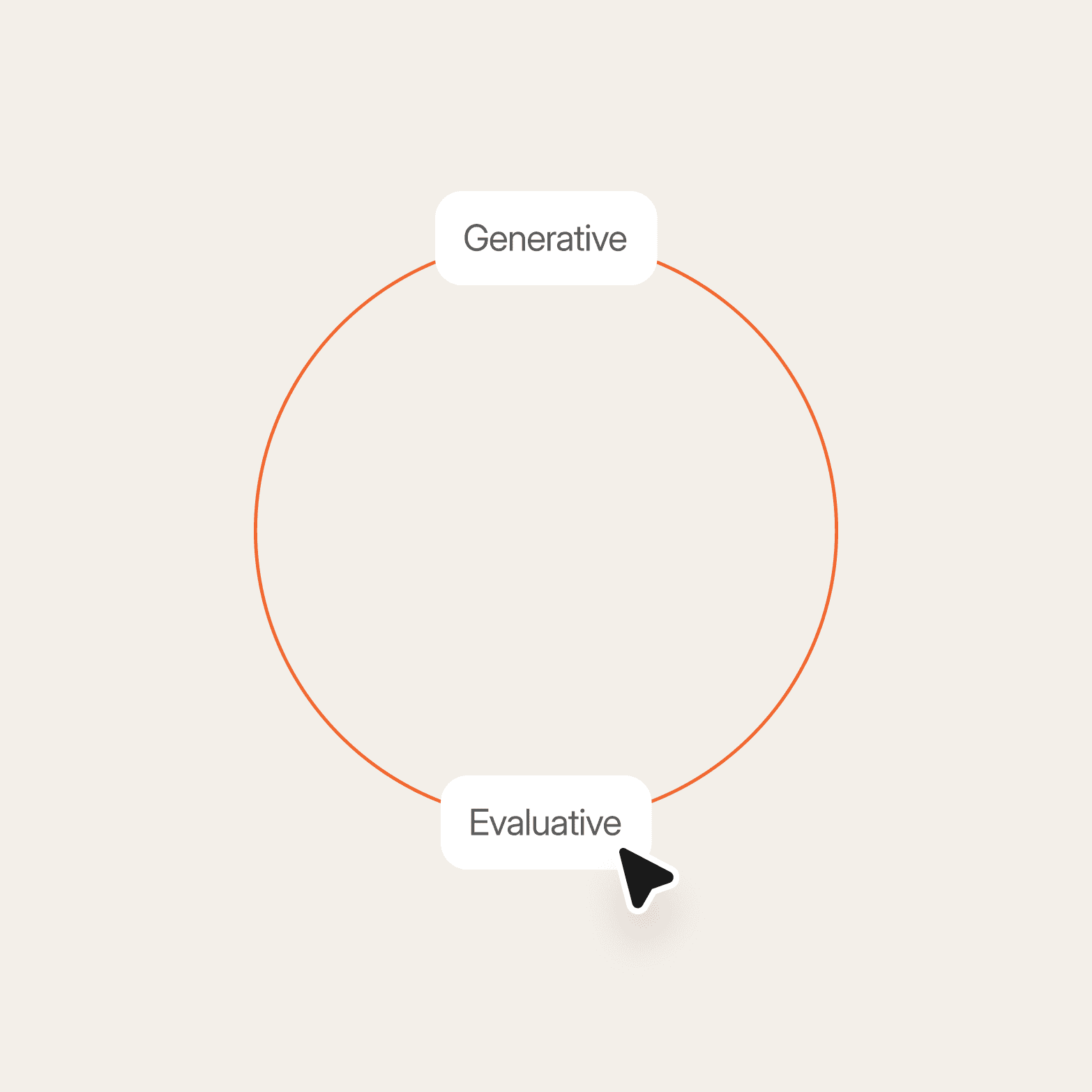
Generative research defines the problem space: it surfaces user needs, user motivations, and the context that shapes user behavior before any solution exists. Evaluative research tests a specific concept, design, or prototype against defined criteria. Both are rigorous forms of user research. Both are necessary. The failure mode is treating one as a substitute for the other.
The confusion is common because both methods involve talking to users. What differs is the question being asked, the sample recruited, and the output delivered to the team, and those operational differences matter more than the format.
This article covers when each approach applies, how they differ in practice, and how UX researchers can run generative and evaluative methods without breaking sprint cadence.
Generative vs Evaluative Research: Quick Comparison
Generative and evaluative research differ across the dimensions that matter most to product teams: purpose, timing in the design and development process, and output. One produces qualitative data; the other produces quantitative data, and most mature user research programs need both.
| Dimension | Generative Research | Evaluative Research |
|---|---|---|
| Purpose | Discover user needs, user motivations, and context | Test and validate a defined solution or design |
| Timing in Product Development Process | Early stages: before concepts or features are defined | Later: once a prototype, feature, or design exists |
| Common Methods | User interviews, focus groups, diary studies, contextual inquiry | Usability testing, A/B testing, tree testing |
| Output Type | Qualitative data: open-ended themes, workarounds, pain points, context | Quantitative data: error rates, user satisfaction scores, task completion |
| Typical Duration | Two to three weeks or longer due to recruiting, scheduling, and manual synthesis | Days to produce metrics like task completion rates |
| Stakeholder Question Answered | "What problem should we solve?" | "Does our solution work?" |
Asynchronous AI-moderated interviews compress generative timelines to match sprint cadences, enabling parallel discovery research and evaluation research.
"Conveo gives us quant-level robustness and qual-style depth"
CMI Lead, Edgard & Cooper
What Is Generative Research?
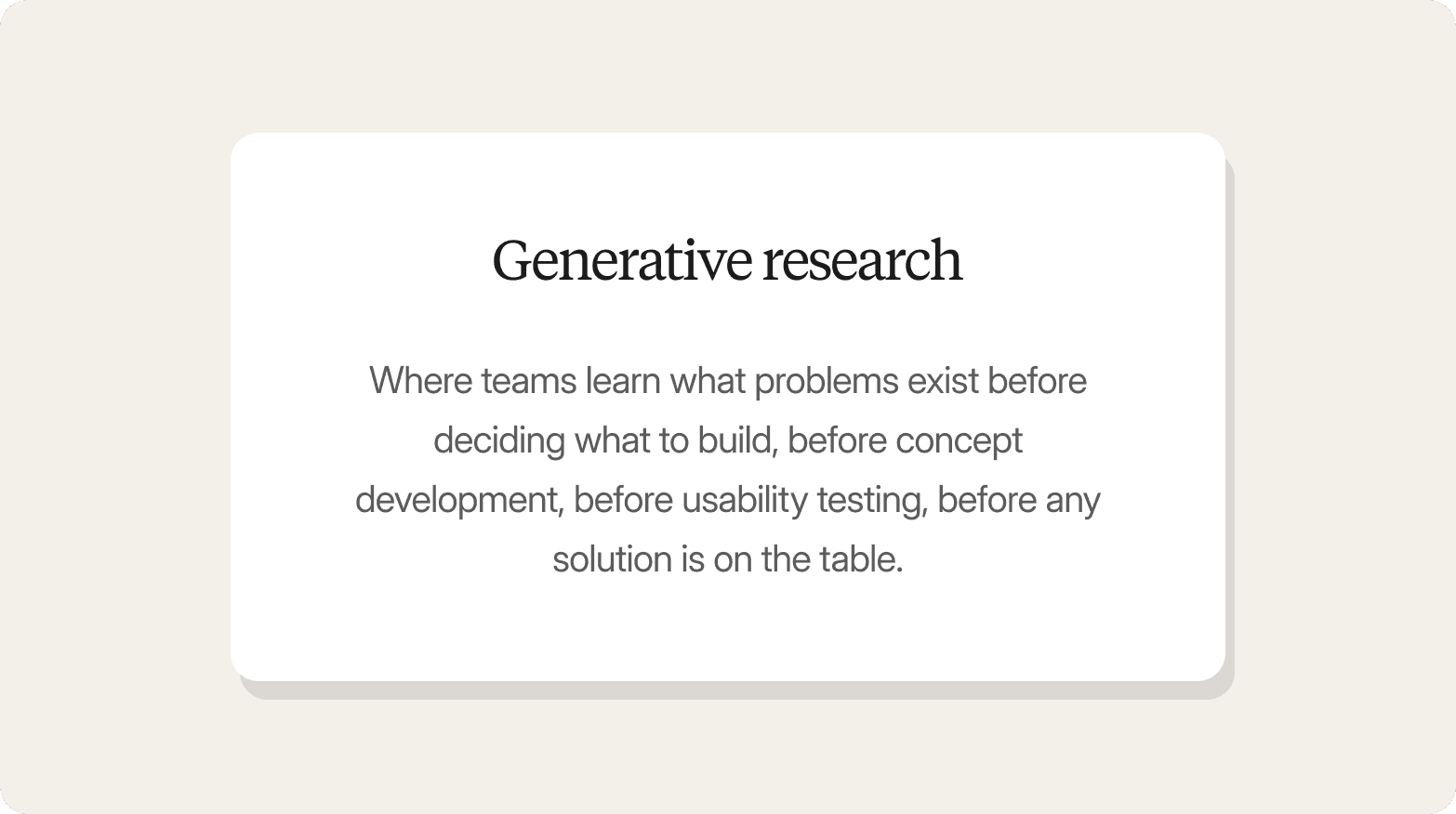
Generative research, sometimes called exploratory or discovery research, is the phase of a user research program where teams learn what problems exist before deciding what to build, before concept development, before usability testing, before any solution is on the table. As a form of qualitative research, generative research aims to build a deeper understanding of user needs and user behavior: what people are trying to accomplish, where their current approach breaks down, and what they've already tried to compensate for the gap.
The mechanism is open-ended conversation and observation. A researcher asks a participant to walk through a recent experience in their own words, then follows the threads that matter: the workarounds, the hesitations, the moments where the person quietly adapted their behavior because nothing worked as expected. Surveys cannot capture this qualitative data; a five-point scale cannot tell you that users have been copy-pasting data between two systems for six months because no one built the integration they needed.
Without generative research, teams optimize against the wrong frame: refining navigation for a feature users never trusted, or improving onboarding for a workflow users have already abandoned. The UI gets cleaner; the adoption problem stays exactly where it was. That's what makes generative research important early in the product development process, before resources are committed to the wrong direction.
Common generative UX research methods include user interviews, focus groups, contextual inquiry, diary studies, and ethnographic studies. Each surfaces a different layer of context:
User interviews reveal user motivations and mental models
Contextual inquiry captures behavioral data in a natural environment
Diary studies capture how needs shift over time
Ethnographic studies expose the gap between what people say and what they do, surfacing cultural insights along the way
The operational constraint is significant. Live-moderated depth interviews typically bottleneck at five to eight sessions per moderator per week, stretching a standard generative study across two to three weeks at minimum. Product decisions get made on the evidence available, not the evidence still being collected, which is why many teams skip generative research and default to evaluative testing alone. Conducting generative research early and often keeps a team's roadmap grounded in real user needs rather than assumptions.
What Is Evaluative Research?
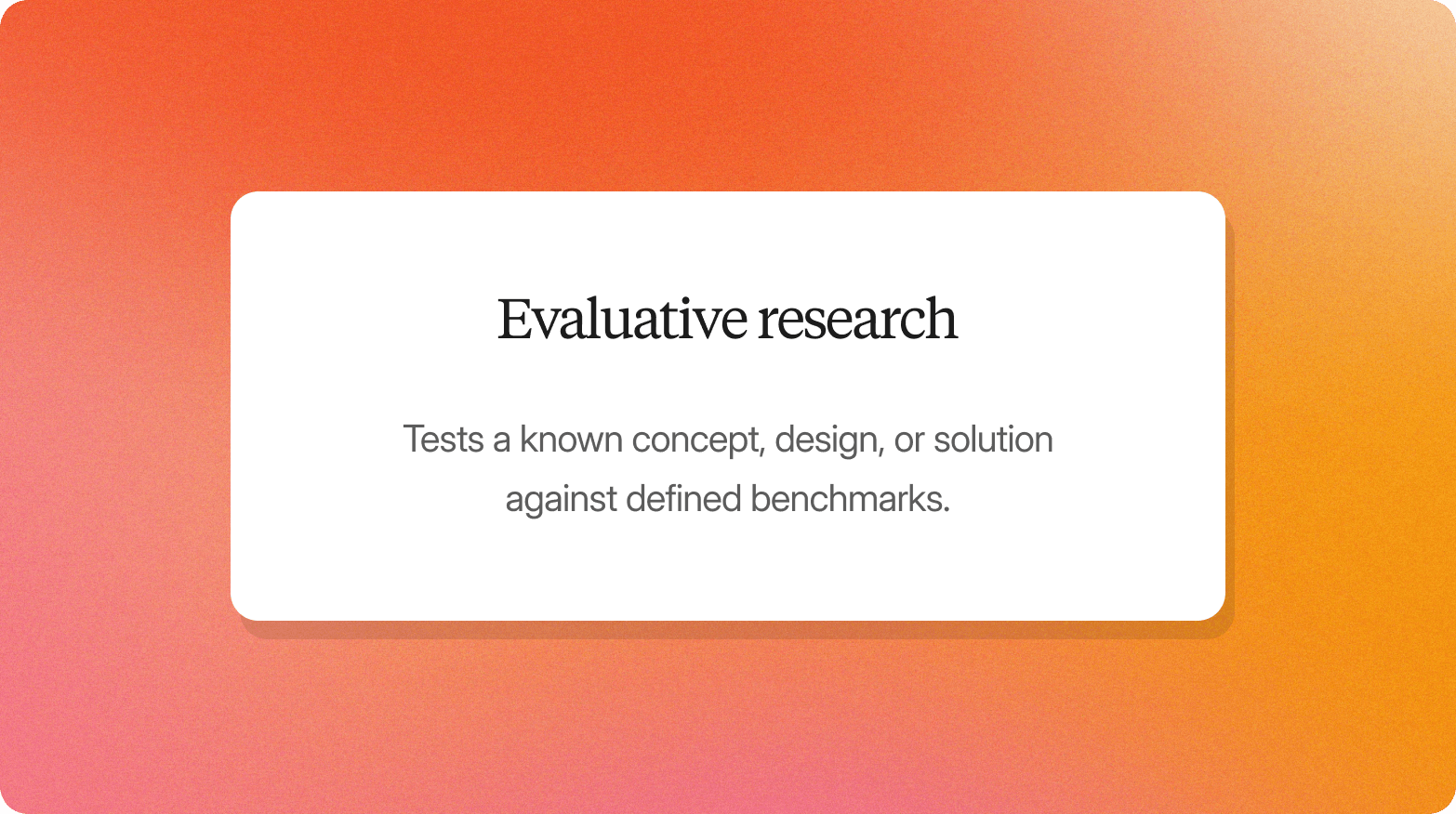
Evaluative research, also called evaluation research or assessment research, tests a known concept, design, or solution against defined benchmarks. Unlike generative research, evaluative research assumes the problem is already understood. Where generative research dives into open questions, evaluative research asks a closed one: does this design work? Do users complete tasks efficiently?
That clarity is an operational advantage. Evaluative research measures outcomes as quantitative data, including task completion rates, error frequencies, user satisfaction scores, and time on task. These metrics require less interpretive work than open-ended discovery, making evaluative research faster to scope, run, and report.
Common evaluation research methods include:
Usability testing: Participants attempt specific tasks while researchers observe where friction or failure occurs
A/B testing: Two variants run simultaneously against a measurable outcome, typically conversion or completion
Tree testing: Participants navigate a stripped-down site structure to test whether a proposed information architecture supports task completion
Concept testing: Structured stimulus evaluation measuring comprehension, appeal, and purchase intent
Heuristic evaluation: Expert review of a design against established usability principles, producing a prioritized issue list without recruitment
The limitation is structural: evaluative research centers on validating a solution someone has already proposed, and the solution direction is assumed correct. It tells you whether the thing you built works, not whether you built the right thing.
This is where teams get into trouble. Evaluative research is faster and easier to justify in sprint cycles, so it gets prioritized while generative research gets deferred. Over time, teams accumulate quantitative insights showing that solutions perform well on tasks that are never grounded in real user needs. The challenge isn't choosing between generative and evaluative methods; it's running both at the pace decisions actually move.
When to Use Generative vs Evaluative Research
Use generative research when the problem space is ambiguous, contested, or not yet well understood. Use evaluative research when the direction is clear, and you need to validate execution. The difference isn't about rigor; both methods require it; it's about what question you're actually trying to answer.
Use Generative Research When:
Entering a new market or segment where your team has limited direct exposure
Redesigning a core workflow and existing assumptions about user preferences need to be challenged
Stakeholders disagree on what the problem is and need shared grounding
Customer complaints are vague ("it's confusing," "it doesn't work for me")
Users are working around your product in ways you didn't design for, a signal worth surfacing before concept development begins
Use Evaluative Research When:
Testing two design variations to see which performs better on a task
Validating a concept before committing to a build cycle
Benchmarking usability against a competitor or a prior product version
Measuring whether a redesign improved completion, comprehension, or user satisfaction
Confirming a proposed solution is understood and trusted by your target audience before launch
The sequencing mistake most teams make is running evaluative research first: it's faster, more structured, and easier to present to stakeholders. But quantitative data without context produces false confidence, and a design can test well while still solving the wrong problem.
The correct sequence is: generative research aims to define which problem is worth solving; evaluative research aims to confirm whether the solution works. Skipping the first step doesn't save time; it shifts the cost downstream into roadmap decisions built on incomplete understanding.
Traditional generative research takes weeks of recruiting, scheduling, moderating, and manual synthesis. Teams skip it not because they disagree with the methodology, but because the process can't keep pace with the decisions being made. The bottleneck is not methodology. It's throughput. Conducting generative research early and treating it as a habit rather than a phase is what separates teams that identify opportunities from those that only react to them.
How Teams Get Generative vs Evaluative Research Wrong
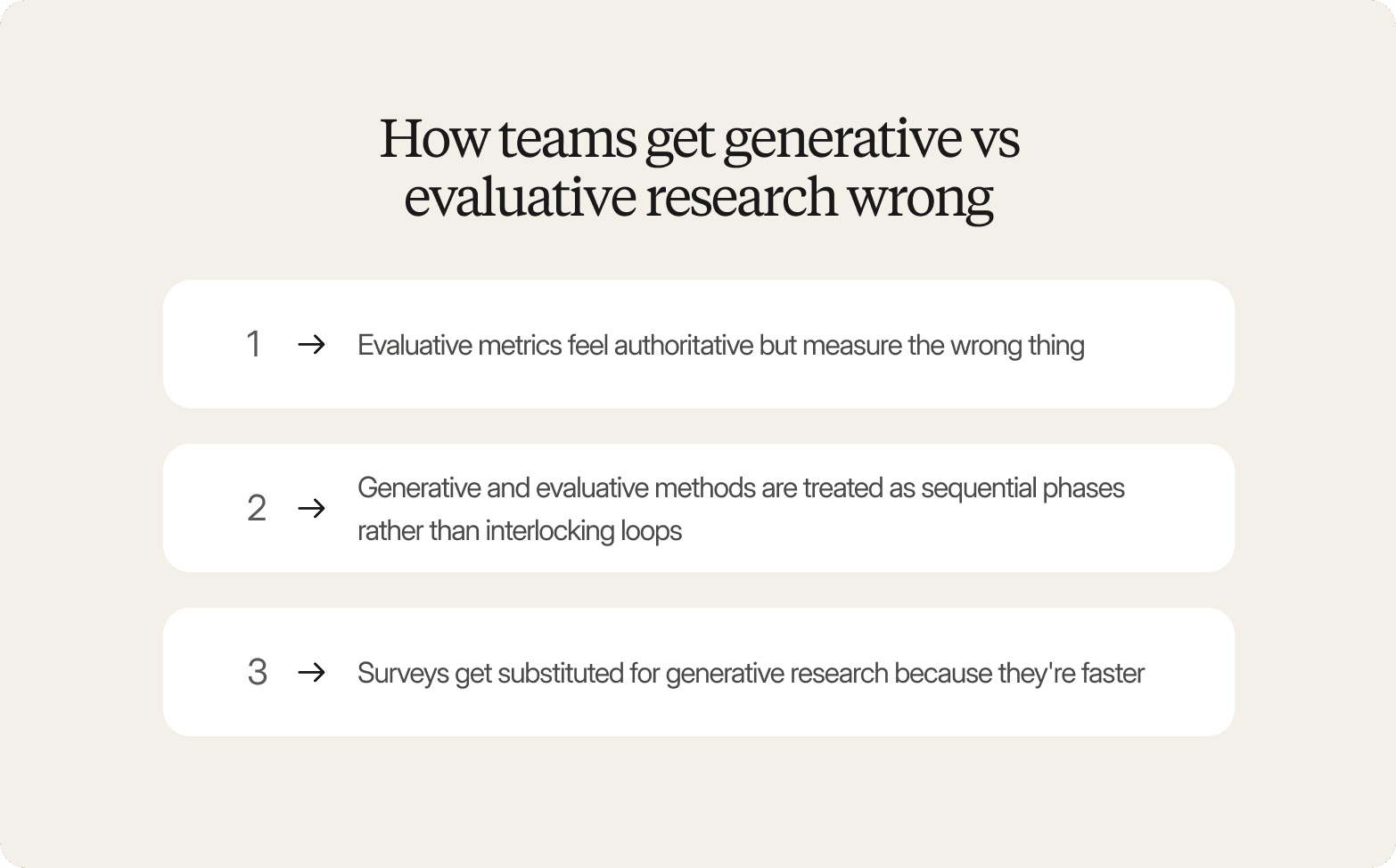
The most common mistake teams make is not choosing the wrong method; it's defaulting to one while neglecting the other. Usability tests happen every sprint because the cadence fits and the outputs feel objective, while user interviews get deprioritized until a planning cycle forces the question.
Failure mode 1: Evaluative metrics feel authoritative but measure the wrong thing
They only show how well users navigate the experience you built. If the underlying problem is misunderstood, the metrics measure the wrong thing entirely. A team can spend three sprints optimizing checkout completion rates and hit their targets, while users still abandon the product because checkout doesn't support their actual workflow. The flow works; the product doesn't fit user needs.
Failure mode 2: Generative and evaluative methods are treated as sequential phases rather than interlocking loops
Teams complete a discovery research sprint, hand off findings, then spend six weeks building before returning to users, by which time the decisions the research was meant to inform are already made.
Failure mode 3: Surveys get substituted for generative research because they're faster
Surveys show what percentage of users hit a pain point, not why it exists. Generative research requires conversation; surveys produce distributions, not the deeper understanding that comes from watching someone describe a problem in their own words.
The common thread is operational, not intellectual. Teams don't neglect generative research because they doubt it; they neglect it because it's too slow to keep up. Removing that friction, rather than choosing one approach over the other, is what lets both run at sprint pace, the specific gap asynchronous AI moderation is built to close.
Running Generative UX Research Methods at Sprint Pace
The gap between generative and evaluative UX research methods isn't only methodological; it's operational. Live-moderated depth interviews bottleneck at roughly five to eight sessions per moderator per week. When sprint timelines compress faster than recruiting calendars, that ceiling forces teams to choose between depth and speed. Most choose speed, and the generative work gets cut.
Three constraints have historically capped generative research at sprint pace. Asynchronous AI-moderated interviews remove each one:
The scheduling bottleneck. Live-moderated interviews depend on calendars. Asynchronous, AI-moderated video interviews swap that for an always-on model: participants complete sessions when it suits them, research runs continuously in the background, and hundreds of conversations happen in parallel, letting generative discovery match the cadence of agile development instead of lagging two or three sprints behind it. That shift is what makes conducting generative research early in the design process realistic rather than aspirational.
The depth bottleneck. Higher volume only matters if depth holds. Conveo's AI moderator detects thin or surface-level responses and probes further in the moment, the same way a skilled human moderator would, preserving generative quality while lifting throughput well beyond the five-to-eight-a-week ceiling of live moderation.
The synthesis bottleneck. Manual analysis after a large generative study can take days or weeks, long enough to miss the decision window. AI-assisted synthesis with human review compresses that cycle to hours, so meaningful insights reach product and design teams while the sprint is still live.
See it in action: How AI-Moderated Video Interviews Actually Work

Video-first interviews add evidence written concept tests cannot provide: tone shifts, hesitation, and visible reactions carry the "why" behind evaluative scores, visible only on video. Teams using Conveo report running generative research in as little as 3 to 5 days, down from the traditional 6 to 10 weeks, so input arrives before the decision window closes and can still shape the design process.
Choosing the Right Methods for Each Approach
The tables below map generative and evaluative methods, qualitative and quantitative methods, to the questions they answer and the operational trade-offs teams should weigh.
Generative Methods
| Method | Best For | Key Tradeoff |
|---|---|---|
| User interviews | Uncovering user motivations, mental models, and decision context | Traditionally hard to scale; async AI-moderated interviews remove that constraint |
| Focus groups | Generating early-stage ideas and surfacing shared language around a problem | Group dynamics can suppress individual user preferences; better for idea generation than deep diagnosis |
| Contextual inquiry | Behavioral data in a natural environment as the primary source | Requires live observation; doesn't scale across geographies |
| Diary studies | Longitudinal patterns across days or weeks of behavior | High dropout and slow synthesis; best reserved for time-dependent questions |
| Ethnographic studies | Deep contextual and cultural insights into product use | Time-intensive and expensive; hard to run across markets at once |
Evaluative Methods
| Method | Best For | Key Tradeoff |
|---|---|---|
| Usability testing | Task-based validation of specific flows or interfaces | Works best with a defined prototype; findings are narrow by design |
| A/B testing | Quantitative comparison of two variants at scale | Tells you which version wins, not why users respond differently |
| Tree testing | Validating information architecture before visual design begins | Isolates navigation logic only; doesn't test visual or interaction design |
| Concept testing | Validating ideas before committing to build | Requires clear stimulus materials; quality of input shapes quality of output |
| Heuristic evaluation | Expert review against established usability principles | Fast and low-cost, but lacks real user feedback |
Multilingual studies raise the stakes for generative research specifically. Running user interviews or contextual inquiry across markets traditionally requires local recruiters, bilingual moderators, and separate synthesis per language. AI-moderated interviewing supporting 50+ languages, with automated transcription and translation, compresses global generative research into something teams can run in parallel across markets.
Deliverables and Success Criteria
The outputs that matter from generative and evaluative research aren't the same, and conflating them is a fast way to lose stakeholder confidence.
For generative research, "good" looks like:
Themes mapped to specific opportunities, helping teams identify opportunities before committing resources, not merely a list of observations
Pain points and workarounds surfaced in the qualitative data (what users do instead of what the product intended)
Verbatim quotes and clips with enough context to be credible and to provide evidence-based insights stakeholders can act on
Understanding user context this way is what turns a transcript into valuable insights rather than a pile of notes.
For evaluative research, "good" looks like:
Completion rates broken out by user segment
Error frequency logged by severity
User satisfaction scores measured against a prior benchmark
These are quantitative insights rather than open-ended themes. Evaluative research helps teams confirm a design decision instead of guessing, but without benchmarks, you're reporting a number with no reference point.
Both types share one credibility requirement: stakeholders distrust findings they can't trace. Each insight should link back to a timestamped clip or verbatim quote, the difference between meaningful insights that get acted on and findings that get questioned in the readout.
The compounding advantage comes when clips and quotes flow into a searchable insight library rather than a one-off deck, so recurring questions get answered in minutes, and teams can make informed decisions faster. For agency teams under margin pressure, this directly expands capacity: when moderation and synthesis no longer become the bottleneck, more studies ship per researcher per quarter.
Running Generative and Evaluative Research with Conveo
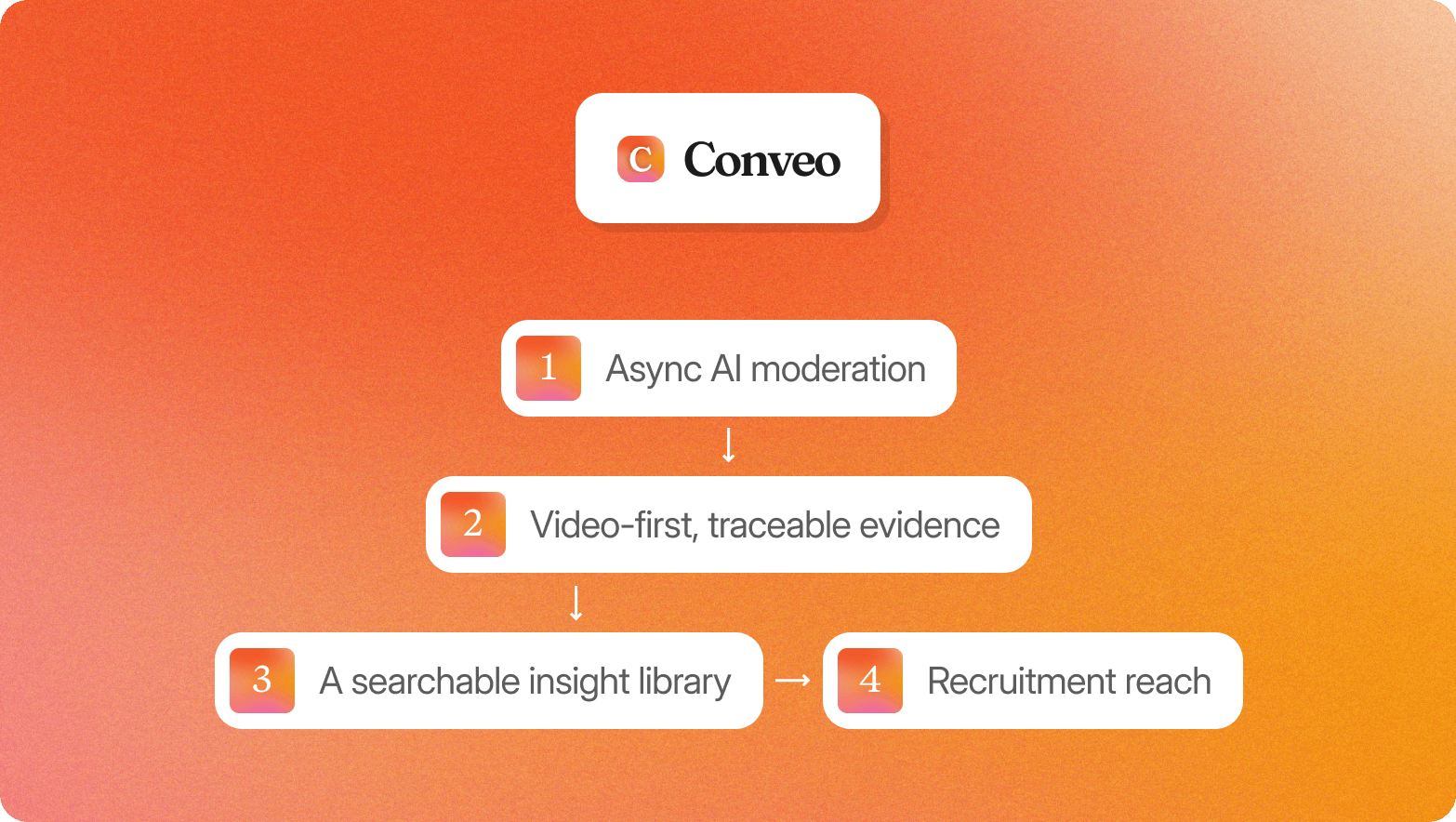
Most teams don't neglect discovery research because they undervalue it; they neglect it because the operational cost of recruiting, scheduling, moderating, and synthesizing is too high to sustain at sprint speed. Conveo, a video-first AI research platform, closes that gap so generative and evaluative methods can run side by side and feed directly into the product development process.
Async AI moderation runs hundreds of conversations in parallel, probing thin responses in real time so depth holds as volume rises, whether you're generating insights for a new concept or gathering user feedback on a live product.
Video-first, traceable evidence links every insight back to its source clip, ensuring findings withstand scrutiny in the readout. 68% of participants said they were more open with Conveo's AI moderator than with a human interviewer.
A searchable insight library turns each study into compounding knowledge, so recurring questions are answered by prior research rather than a new project, and teams build a deeper understanding of their target audience over time.
Recruitment reach through Conveo's panel network, plus your own lists, covers the markets a global study requires without a separate pipeline for each language.
The result is generative research that arrives before the decision window closes, and evaluative research that runs against a confirmed problem, driving product development innovation instead of just polish.
Frequently Asked Questions
What is continuous discovery in UX research?
Continuous discovery means maintaining regular touchpoints with users throughout the product development process rather than treating research as a milestone activity. Teams run small, targeted studies alongside every sprint, concept development, usability checks, and user interviews to keep decisions grounded in real evidence, not just at launch. The challenge is to make that cadence sustainable without consuming a researcher's entire week on logistics.
What's the biggest barrier to running continuous discovery?
Operational overhead, consistently. Recruiting, scheduling, consent flows, transcription, and manual synthesis of qualitative data can consume more time than the research yields in value. For a team of one or two UX researchers serving multiple squads, studies occur at best quarterly. The constraint isn't research appetite; it's that every study feels like starting from scratch.
How is AI-moderated interviewing different from a survey?
Surveys collect responses to fixed questions. AI-moderated interviews follow the participant: when someone hesitates or mentions something unexpected, the AI moderator probes further, the way a skilled human moderator would. A survey tells you what percentage prefers option A; an AI-moderated interview tells you why option B almost won and which language the participant used to describe the trade-off.
How does a research library help UX teams over time?
A persistent, searchable library turns individual studies into compounding organizational knowledge instead of decks nobody revisits. When a new question surfaces, teams check what prior studies already know before commissioning fresh research. Over time, the library also surfaces contradictions among studies and makes it faster to brief stakeholders with evidence-backed sources.
What is the difference between generative and evaluative research?
Generative research defines the problem space through open-ended conversations that surface user motivations, context, and user needs. Evaluative research tests solutions against the problem, producing quantitative data such as task completion rates and error frequencies. Running evaluative research before generative work is a common and costly mistake: teams end up optimizing a solution to a problem that was never clearly defined.
When should you use generative research vs evaluative research?
It comes down to how well you understand the problem. Use generative research when the space is ambiguous: entering a new market, redesigning a workflow, or investigating churn the data can't explain. Use evaluative research when the direction is set, and you need to validate execution: testing design variations, benchmarking usability, or confirming a concept before it ships. Teams often skip conducting generative research because traditional methods take too long to influence in-flight decisions.

About the author
Abby Euyang
Research Impact Lead
Abby studied psychology, fell for research there, and spent four years on the UX research team at PayPal. She compared the AI-moderated platforms before choosing Conveo for the researchers it had gathered, and now sits in the sessions where researcher feedback becomes product changes the same day.
Meet Abby on film →Qualitative insights at the speed of your business.
Conveo runs AI-moderated video interviews and structures everything they say.