In this article
TL;DR
Knowing how to conduct qualitative analysis means you can turn interview and survey responses into findings that stakeholders trust and act on.
Analysis can break down when you lose the link between a finding and the evidence behind it, so keep every conclusion traceable to the original response.
As research scales across more studies and researchers, findings stay comparable only when everyone codes against the same shared framework.
Conveo connects findings across studies automatically, so each new analysis builds on what you've already learned.
Qualitative research is only useful if you can turn what participants said into verifiable, concrete findings. The challenge is doing that without losing important context or losing track of the evidence behind your conclusions. The more studies you run, the harder it becomes.
This guide gives you a repeatable way to analyze qualitative research so teams can move from raw interviews to findings they can use to inform decisions and build on over time.
What Qualitative Analysis Is (and What It’s Not)
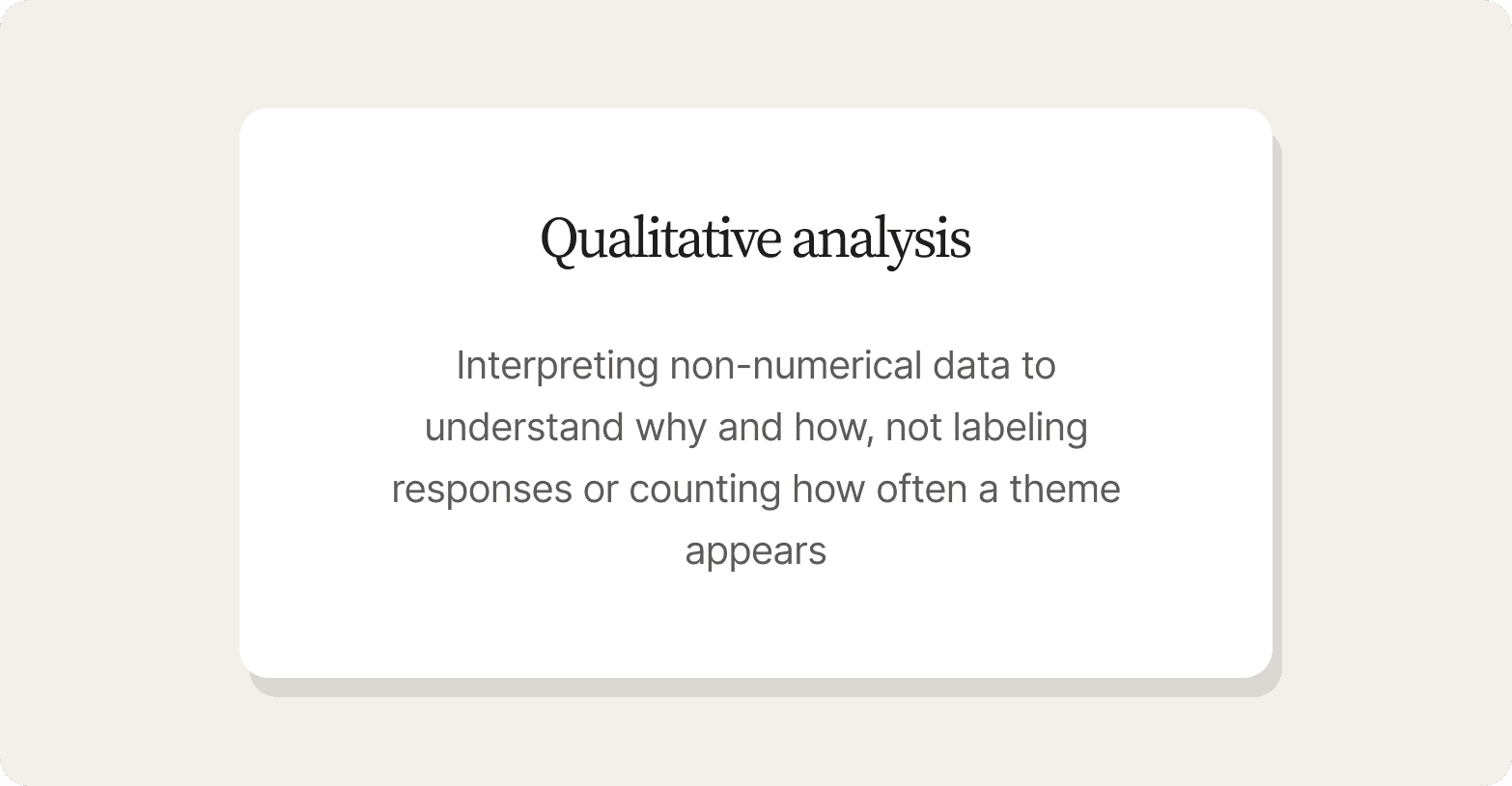
Qualitative analysis is the process of organizing and interpreting non-numerical data, including interview transcripts and open-ended survey responses. Qualitative data analysis goes beyond labeling responses or counting how often a theme appears. The goal is to interpret what people said, identify patterns, and understand what those patterns reveal about the research question.
For example, say 15 interview participants mention "pricing" when asked about a product. Counting that as a theme tells you pricing came up 15 times. Qualitative analysis goes further and asks why: maybe eight people were comparing the price to a specific competitor, four felt the value wasn't clear from the homepage, and three brought it up only after describing a separate frustration with onboarding. That distinction changes what you'd recommend to the product team.
How to Prepare Qualitative Data for Analysis: 5 Steps
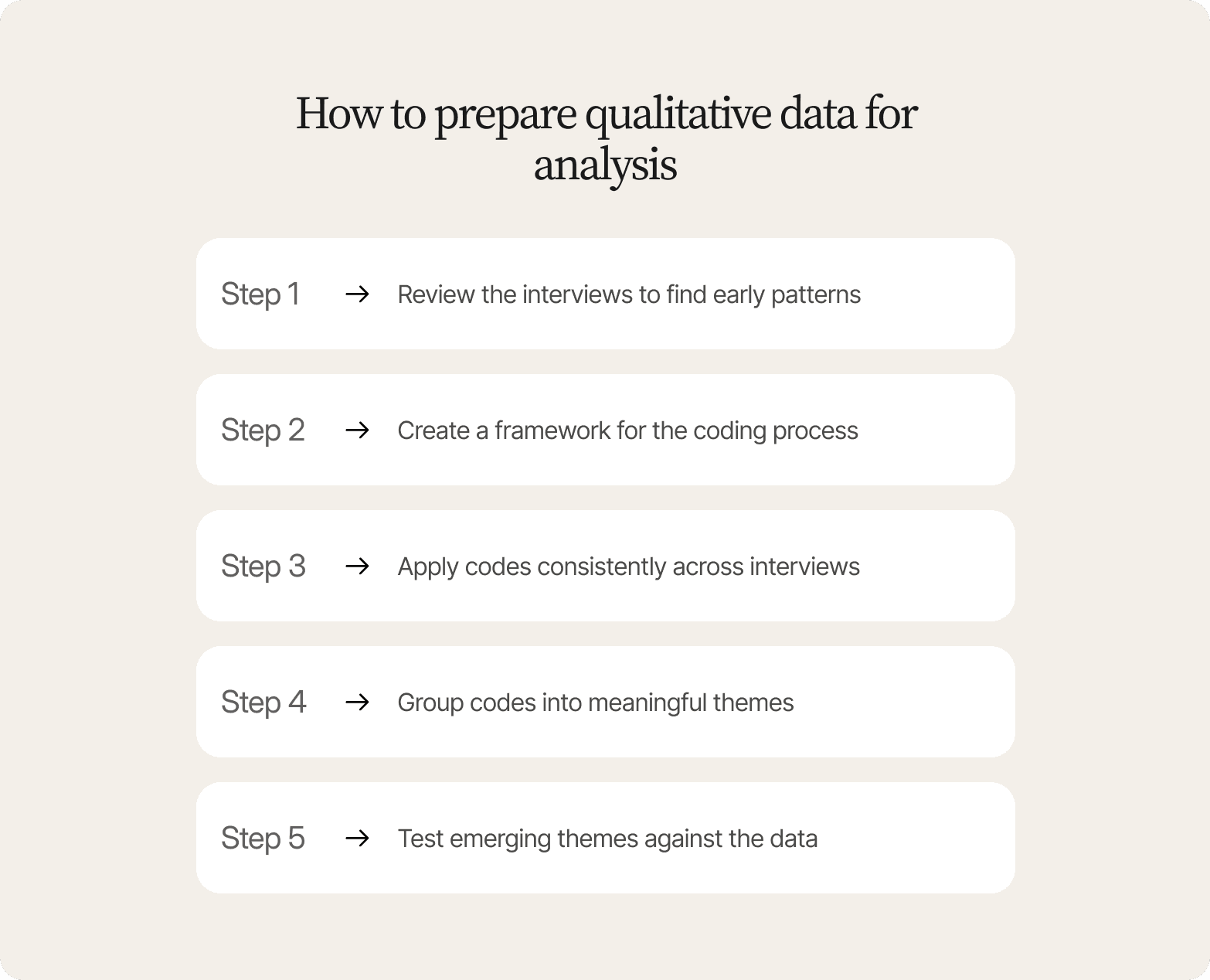
Preparing qualitative data before analysis helps you catch any errors that could skew your results and helps ensure accuracy in your findings. Follow these 5 steps during the research process to make your data easier to analyze.
Step 1: Review the Interviews to Find Early Patterns
Reviewing a sample of full interviews before creating a coding framework gives you an idea of genuine themes and stops you unintentionally forcing the data to fit pre-existing expectations.
8 to 12 interviews are a good place to start, as they give you enough depth to inform your framework without creating too much work. When reviewing video interviews, you can also consider tone and reactions alongside what participants said, giving you a fuller picture of their responses.
Step 2: Create a Framework for the Coding Process
Once you've reviewed the interviews, create a set of codes to label responses that are relevant to your research questions. A code is simply a label for a specific idea or type of response from your data collection. For example, if you're researching onboarding friction, responses such as “I didn't know what I was supposed to do next” and “There weren't any instructions telling me what to do” could both receive the code “unclear next steps.”
Some codes can come from your research objectives or existing knowledge, while others may emerge as you review the interviews in Step 1. Define each code clearly so qualitative researchers know when to use it and when not to, helping them apply the same labels consistently across the data.
Step 3: Apply Codes Consistently Across Interviews
With your coding framework in place, apply the relevant codes across all interviews. As you work through the full dataset, you may find responses that don't fit neatly into your existing categories. Rather than forcing them into the closest code, use these cases to check whether your framework needs to change.
For example, you might initially code both “I didn't know what to do next” and “I couldn't find the instructions” as “unclear next steps.” If you find enough responses like these, you may decide they represent different issues and split the code into “unclear next steps” and “hard to find information.” This keeps the coding closer to what participants said and makes the patterns you identify more meaningful.
Step 4: Group Codes Into Meaningful Themes
Once you've coded the interviews, look for connections between related codes and group them into broader themes. The aim to explain what those responses reveal about your research question.
For example, codes such as “unclear next steps,” “missing instructions,” and “hard to find help” could coalesce into a theme of poor guidance during onboarding. This gives stakeholders a clearer understanding of the underlying issue and what they may need to address.
Step 5: Test Emerging Themes Against the Data
Before treating a theme as a finding, check that the evidence supports it across the interviews. Look for responses that both challenge the theme and support it. For example, if your analysis suggests that poor guidance is the main cause of onboarding problems, look for participants who had a smooth onboarding experience or who struggled for a different reason. This helps you avoid presenting a single pattern as a universal finding when the data show a more complex picture.
For larger research teams, having two researchers code the same excerpts can also help identify differences in interpretation. Where they apply different codes, discussing those differences can clarify the coding rules and make the final analysis more consistent.
How to Analyze Video-Based Qualitative Data
Using video gives you additional context that you don’t get with text-only or quantitative data types. That context can change how you interpret what a participant says. Look for signals like hesitation, facial expressions, or tone to help you understand a response in the context of how it was given.
For example, a long pause before answering a question about a product may prompt you to look more closely at the response and the surrounding discussion. These signals can add context to what a participant says, but you shouldn’t treat them as proof of how they feel or what they mean. A pause could reflect uncertainty, but it could also simply mean they are thinking about their answer.
When a finding depends on something visible or audible in the video, link it to the relevant timestamp so researchers can check the original response and its context. This keeps findings grounded in real participant responses and makes the evidence behind each finding easy to trace.
"The pace, responsiveness, and research expertise of the Conveo team, on top of the top AI-moderated qual platform, have been invaluable to us in scaling brand advertising internationally."
Matt Harris, Research & Insights Lead at Canva
Content Analysis vs Thematic Analysis: When to Use Each
Qualitative content analysis differs from thematic analysis, though they both help researchers make sense of data:
Use content analysis when you want to categorize and count what appears in the raw data. For an example of how to do a qualitative content analysis, you might code customer interviews for mentions of price and support, then count how often each category appears. This works well when you have a clear set of categories and want to compare their frequency.
Use thematic analysis when you want to understand what those responses mean and why they matter. An example of how to conduct a thematic analysis of qualitative data might be examining how responses about price or support relate to a broader issue, such as customers struggling to see sufficient value in the product to justify the cost.
Even though they answer different questions, you can use the two approaches on the same data. You could count how often a particular issue appears, then use thematic analysis to understand what those responses reveal about the broader experience.
How to Run Qualitative Analysis at Scale, Reliably
As you increase the number of studies you conduct or the number of markets or researchers involved, it becomes harder to maintain consistent analysis. Keep these guidelines in mind to make sure your findings stay comparable:
Use a shared, systematic coding framework. Give researchers a common set of codes and clear definitions so that similar responses are categorized consistently across studies.
Calibrate across researchers. Have researchers compare how they have coded the same responses and resolve differences before analyzing the full dataset. This helps keep individual interpretation from affecting the results.
Document changes. If you change a code or add a new one during a study, record what changed and why. This makes it easier to understand differences between research waves or markets.
Keep findings connected. Link findings back to the studies and participant responses that support them. This makes it easier to compare new research with previous findings and build on what you already know.
Build on existing research. Conveo automatically connects findings across projects, surfacing relevant patterns from past research so teams don't end up asking the same question twice.
Consistent analysis makes findings easier to compare across studies. Keeping those findings linked to the original evidence makes them easier to verify.
Watch the walkthrough: How to build and launch a study in Conveo
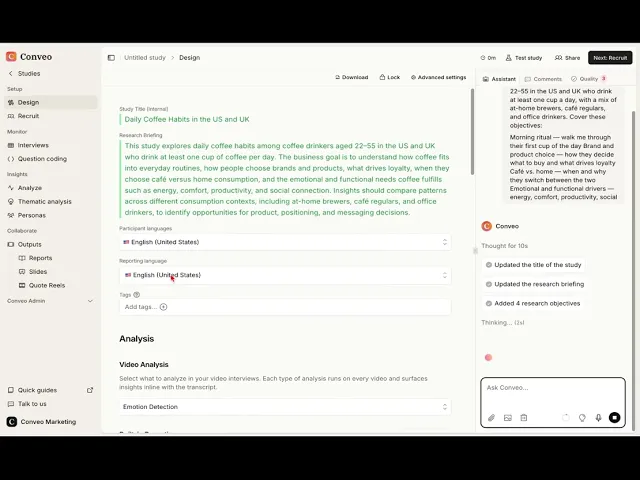
Showing the Evidence Behind Your Qualitative Findings
Stakeholders can’t be sure that a finding is high-quality and trustworthy if they don’t know where it came from. An audit trail connects the original response to the final finding, so reviewers can check the evidence behind it and understand your evaluation method.
For a qualitative research method like video interviews, this might connect a participant's quote to the relevant video timestamp, the code applied to that response, and the broader theme it supports. You can maintain these links manually in a spreadsheet or research document, but that becomes harder to manage as the number of interviews and findings grows.
Qualitative data analysis software can keep the source evidence and analysis connected in one place, but it’s not something every platform offers. Make sure to ask how findings are linked back to the original response when you compare qualitative research tools.
How to Evaluate Qualitative Data Analysis Software
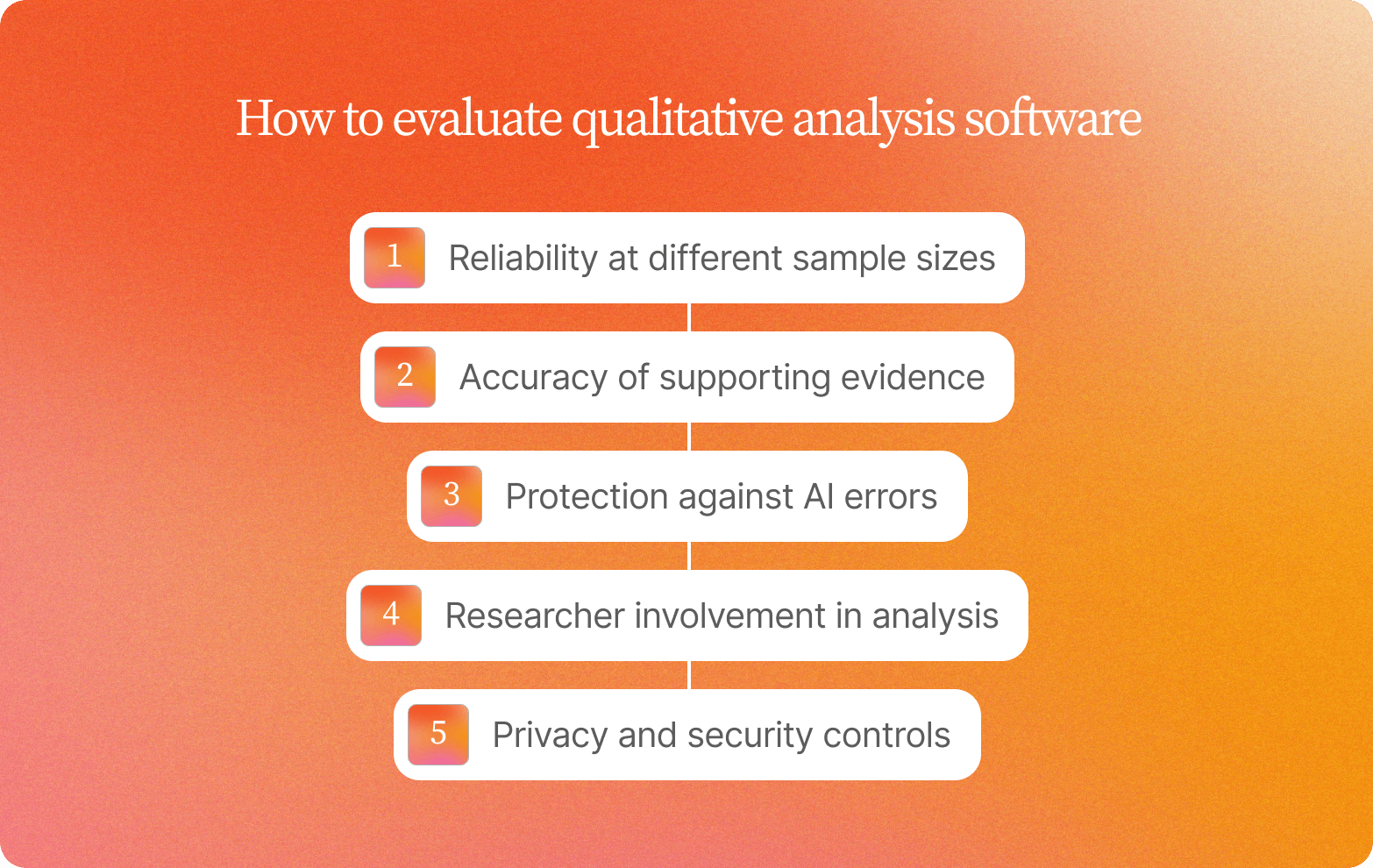
Qualitative analysis platforms can produce polished summaries and convincing-looking findings, but that alone tells you very little about the quality of the analysis behind them. When comparing platforms, look beyond the output and consider how well you can apply the findings in practice.
| What to evaluate | What to ask or check | Why it matters |
|---|---|---|
| Reliability at different sample sizes | Ask to see how the platform analyzes 10, 50, and 100 interviews. Do the findings change as more interviews are added, and can the platform show why? | You need to know whether the analysis reflects the additional data or produces inconsistent findings as the sample grows. |
| Accuracy of supporting evidence | Pick a finding and trace it back to the quotes and original interview that support it. | This helps you verify that conclusions are based on what participants actually said. |
| Protection against AI errors | Ask how the platform handles hallucinated quotes and unsupported conclusions. | AI-generated analysis can sound convincing even when the evidence doesn't support it. |
| Researcher involvement in the analysis | Ask where researchers can review the platform's output. | Human judgment is still needed to interpret context and decide whether a finding is meaningful. |
| Privacy and security controls | Check for SOC 2 compliance, GDPR compliance, regional data hosting, and SSO. | Research data can contain sensitive information, so the platform needs to meet your company’s requirements for handling it. |
If possible, run a small pilot with your own research data before committing to a platform. This lets you see how the analysis or research tool handles the kinds of interviews your team conducts and compare its analysis with your own interpretations.
3 Common Pitfalls for Analyzing Qualitative Data (and How to Avoid Them)
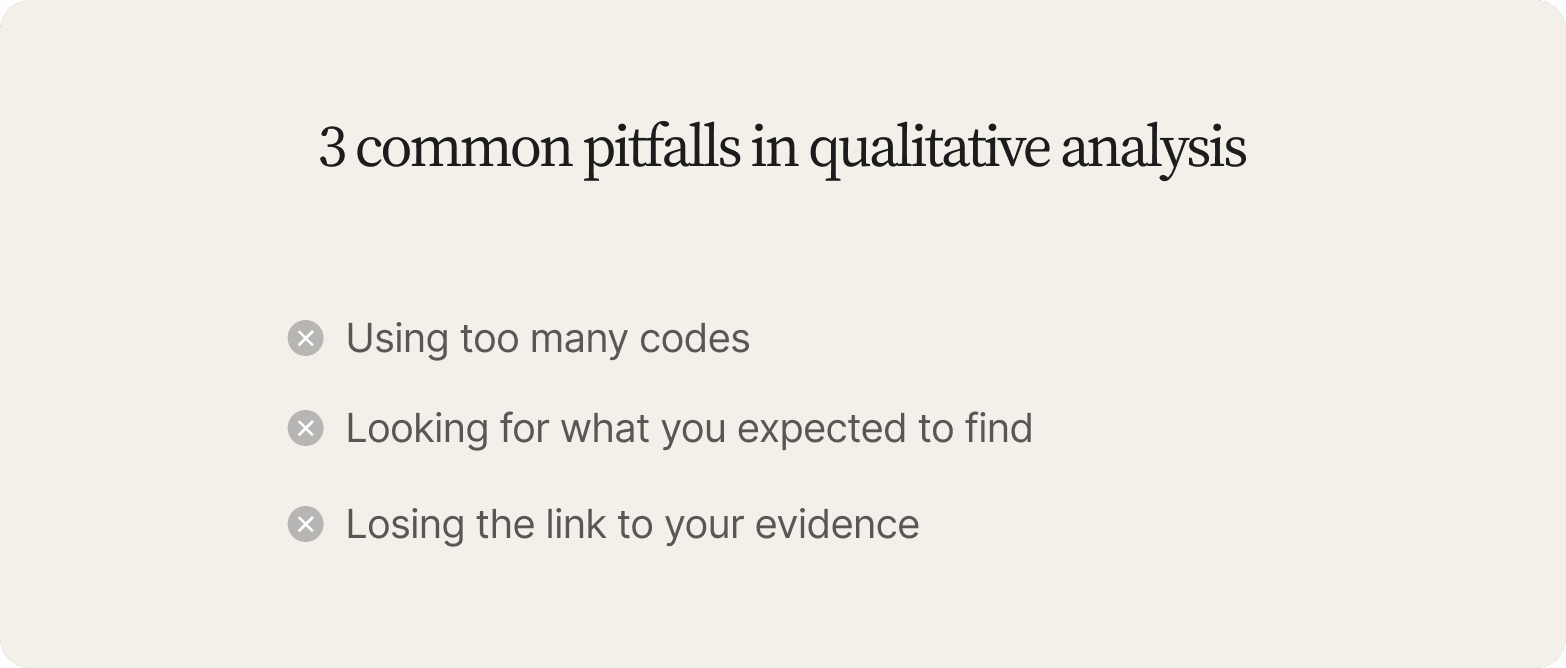
Qualitative analysis involves a lot of judgment, which means small decisions made along the way can affect the conclusions you reach. Being aware of common mistakes makes it easier to catch them before they shape your findings.
1. Using Too Many Codes
It's tempting to create a new code every time a response says something slightly different, especially early in a study when everything feels distinct. The problem shows up later when, instead of one clear theme like "pricing confusion," you end up with six near-identical codes like "unclear pricing," "hidden fees," and "pricing not visible," each with only a handful of responses attached.
None of the themes look significant on their own, so you miss meaningful insights. Keep codes tied to the underlying idea, not the exact wording, and merge codes once you notice two of them are really describing the same thing.
2. Looking for What You Expected to Find
If you go into analysis with a hypothesis, like assuming price is the main barrier to purchase, it's easy to code every response that mentions price and skim past responses that don't fit that story.
This isn't usually deliberate. It happens because the responses that confirm what you expected feel more relevant while you're reading, so they get more attention and more detailed qualitative coding. The fix is to review the data, specifically looking for anything that contradicts your hypothesis, and to have a second researcher independently code a sample before comparing notes.
3. Losing the Link to Your Evidence
A theme like "shoppers feel overwhelmed by choice" is easy to write down and hard to defend if a stakeholder asks which participants said that and in what words.
Without a link back to the original response, you're left describing your own interpretation rather than the evidence behind it. It becomes difficult to catch cases where you've overstated how many people genuinely raised the issue. Keep every finding connected to the specific participant responses and where it came from, so anyone reviewing the analysis can check how you got there.
Keep Your Qualitative Research Moving Forward with Conveo
A repeatable qualitative analysis process helps you turn individual interviews into reliable findings. But as you run more research, the challenge is also keeping those key insights connected so each study can build on what came before.
Conveo gives research teams a platform to manage that process, from analyzing individual interviews to ongoing research. Here’s how:
StoryLines: Run qualitative research on a continuous cadence rather than treating every new research question as a separate project. This helps teams keep analyzing how consumer needs and opinions change over time.
Traceable findings: Every finding can be traced back to a real participant and the evidence behind it, making it easier for researchers and stakeholders to review how conclusions were reached.
Research library: Connect findings across projects so previous research remains available when new questions arise. Instead of starting each analysis from scratch, teams can build on what they already know.
Enterprise security and compliance: Conveo is SOC 2 compliant and GDPR compliant with European hosting.
Faster analysis: Automating parts of the qualitative analysis process helps teams spend less time working through raw interviews and more time reviewing and interpreting the findings.
Frequently Asked Questions
What does a qualitative analysis example look like?
Say you run 15 customer interviews to understand onboarding friction. Start by reviewing the interviews to get a sense of the issues participants raise, then create codes to label similar responses. For example, comments about not knowing what to do next could be coded as “unclear next steps.” Once you've coded all 15 interviews, look for connections between the codes and group them into broader themes. Finally, check those themes against the original interviews and link them back to the quotes that support them.
What's an example of data analysis in qualitative research?
A company might analyze customer interviews to understand why people drop off during onboarding. The analyzed data could reveal that unclear instructions are a common reason, helping the company decide what to improve.
How to do a qualitative analysis in research?
Start by defining your research question, since it shapes how you collect data and what methods you use to get it, for example, focus groups, interviews, or surveys for textual or visual data. Once your data is collected, review it to understand what participants are saying. Then create a set of codes or labels to group similar responses. Look for broader themes across those coded responses and link meaningful findings back to the original evidence in a qualitative report.
Is qualitative analysis in chemistry the same as qualitative analysis in research?
No. This guide covers qualitative analysis in social science research, in which researchers examine interviews and observations to understand behavior or attitudes. Qualitative analysis in chemistry identifies which substances are in a sample, often alongside quantitative analysis to measure how much is present. For that, you'll want a chemistry-specific resource instead.
Can you do a full qualitative analysis in a PDF?
PDFs work for the final report, since that's meant for reading rather than editing. Analyzing and coding qualitative data needs a format that lets you tag and search responses, so you can search across studies and pull up the original source later. A flattened PDF can't do that, so it can’t give you deeper insights into your data.
How to do a content analysis in qualitative research?
Content analysis is a method for categorizing qualitative data and examining how often different categories appear. Start by defining the broader categories you want to look for, then code relevant responses into those categories and review the patterns across your data.

About the author
Ella Savill
Research Lead
Ella works with enterprise research teams from the first study onwards and is happiest when a client describes the platform as a candy shop. She cares about the part most vendors skip: putting researchers and engineers in front of customers so the feedback loop is a conversation, not a form.
Meet Ella on film →Qualitative insights at the speed of your business.
Conveo runs AI-moderated video interviews and structures everything they say.