In this article
TL;DR
A consumer research platform helps businesses understand how customers think and behave, so they can base strategic decisions on evidence instead of guesswork.
These platforms fall into three types: qualitative research, surveys, and social listening.
The right platform depends on the research you need to run. Once you've chosen the right type, compare how each platform collects its data and whether you can verify the evidence behind its findings.
Conveo is the top choice for enterprise teams that need ongoing qualitative research. It runs AI-moderated video interviews, links every finding to the original participant evidence, and keeps past research in a searchable library.
Consumer research platforms all promise to help you understand your customers, but the evidence behind their insights can look very different. Some interview real customers and let you review their responses. Others rely on aggregated panel data or public online conversations.
When those findings influence strategic decision-making, being able to see where they came from makes them easier to trust and defend. A platform that gives you access to the original evidence also makes it easier to judge whether its conclusions hold up.
This guide compares seven consumer research platforms to help you find the right approach for your research needs. You'll see how each platform produces its findings and how much of the underlying evidence you can review, so you can build a shortlist with confidence and grow your business intelligence.
What Is a Consumer Research Platform?
A consumer research platform allows businesses to run qualitative or quantitative research to understand how their customers think and behave. You can then use those consumer insights to shape decisions across the company, from validating new product ideas to creating new pricing tiers.
The term “consumer research platform” includes different types of tools, including:
Qualitative research platforms that let you interview real participants through video, voice, or text.
Survey platforms that collect structured responses from large groups, often through a consumer research panel of pre-recruited participants who match your target audience.
Social listening platforms that analyze public online conversations.
Companies get the most value from using consumer research platforms for continuous research rather than one-off studies, because findings remain current as customers and products evolve.
Traditional research methods like focus groups, that used to take more time and resources than most budgets allowed. AI-moderated interviews and automated analysis have now made continuous research affordable for smaller teams as well, allowing you to run more studies without increasing headcount.
How to Choose a Consumer Research Platform
To choose the right type of platform, start with your research objectives. Picking a market research tool before you're clear on the objective usually means ending up with a tool that's technically capable but doesn't answer the question you actually needed answered.
| Platform type | Best for | Example research objective | Typical timeline |
|---|---|---|---|
| Qualitative research platforms | Understanding why customers think and behave the way they do | Why are customers abandoning their shopping carts? | Days |
| Survey platforms | Measuring opinions, preferences, and trends across large groups | How satisfied are customers with our latest product update? | Days to weeks |
| Social listening platforms | Understanding public conversations and consumer sentiment tracking | How are people reacting to our latest product launch online? | Real time |
Once you've identified the right research method, look at how each platform produces its findings. Understanding where the data came from and how the platform reached its conclusions will help you judge how much confidence to place in the results.
Can you see the original evidence? Depending on the research method, that might be a video interview, survey responses, or the public posts behind key trends. The easier it is to review the original source, the easier it is to understand and explain the findings.
Is it clear how the results were produced? A good platform should show how it collects and analyzes customer intelligence, so you can understand how it reaches its conclusions rather than simply accepting them.
Can you explain the findings to other people? Whether you're presenting to C-level or working with product teams, you should be able to show how the platform arrived at its recommendations.
With that framework in mind, here's how seven platforms across those three categories compare.
Best Consumer Research Platforms for Enterprise Insights Teams
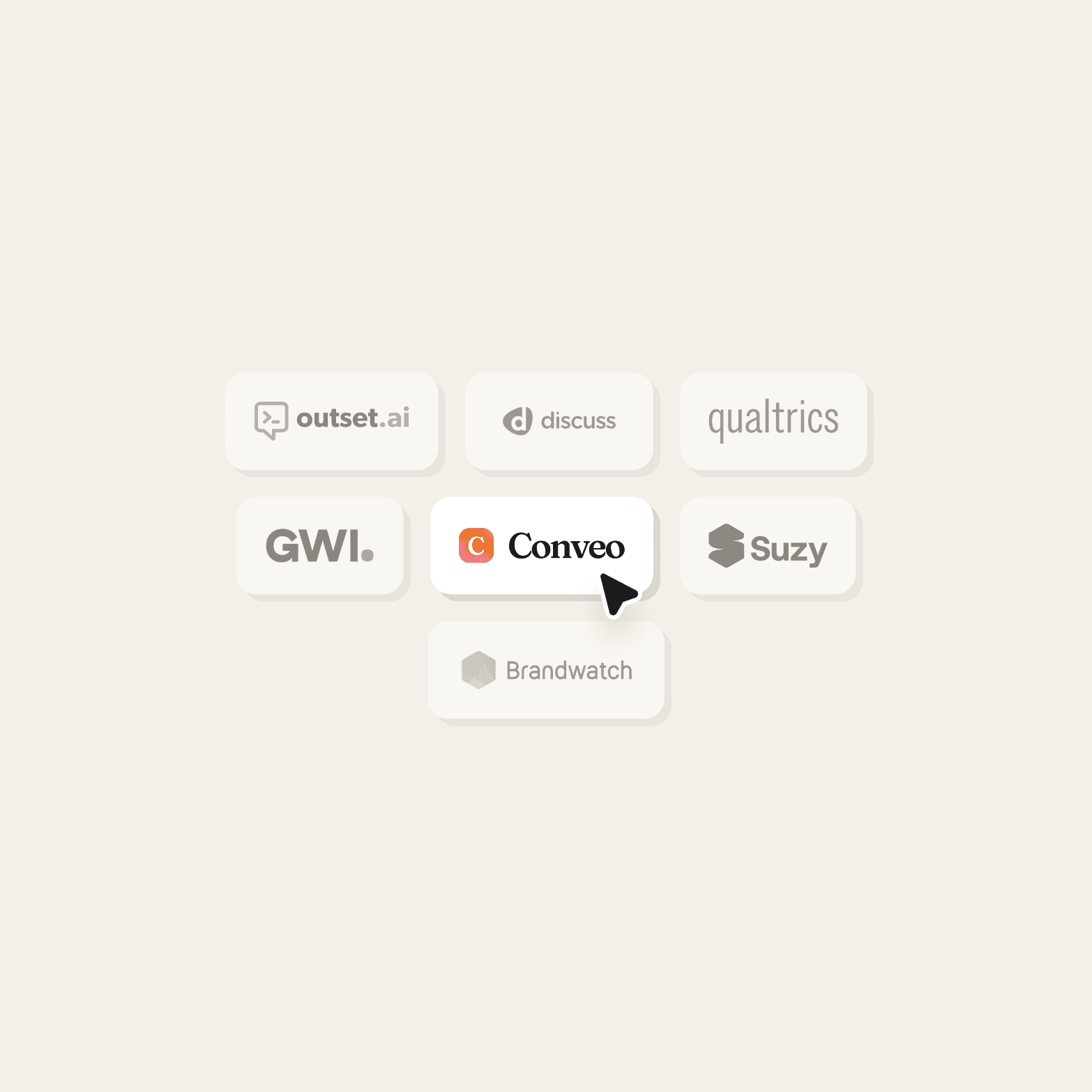
Use this table for a quick overview of the customer intelligence tools before exploring the complete profiles below.
| Platform | Evidence type | Can you check the evidence behind a finding? | Compliance | Best for |
|---|---|---|---|---|
| Conveo | Qualitative research platform (AI-moderated video) | Yes. Findings link to timestamped video clips and exact quotes | SOC 2 certified, GDPR compliant, EU regional hosting | Teams that need fast qualitative research with findings they can verify |
| Outset | Qualitative research platform (AI-moderated video, voice, text) | Yes. Findings link to participant clips and quotes | SOC 2 Type II, GDPR compliant; EU hosting not publicly confirmed | Product and UX teams running high-volume async discovery |
| Discuss.io | Qualitative research platform (human- and AI-moderated) | Yes. Findings link to timestamped video synced to the transcript | GDPR compliant, SOC 2 not publicly confirmed, hosted in the US | Enterprise teams that want to choose AI or human moderation per session |
| Qualtrics | Survey platform (with video feedback tools) | Yes within a study. AI summaries can link back to the source video; findings are aggregated across the Research Hub | SOC 2 Type II, GDPR compliant, EU hosting confirmed | Large enterprises already invested in the Qualtrics XM suite |
| GWI | Survey platform (aggregated panel data) | Limited. Results come from aggregated panel responses; it is unclear whether Agent Spark links AI answers to the specific responses behind them | Not publicly confirmed | Agency, and brand teams that need broad audience data across many markets |
| Suzy | Survey platform plus AI-moderated voice | Yes. Evidence includes exact responses, recordings, and transcripts | SOC 2 certified, GDPR compliant, hosted in the US | CPG, FMCG, and retail teams that also want real-time trend signals |
| Brandwatch | Social listening platform | Limited. You can see the original public posts, but the people behind them are not verified research participants | Not publicly disclosed | Brand and communications teams tracking sentiment and emerging market trends |
The platforms below are grouped by research methodologies, so you can compare tools that solve similar needs before looking at where each one differs.
AI-Moderated Interview Platforms
These platforms all interview real participants with AI moderation, but they take different approaches to running studies and managing the evidence those studies produce.
1. Conveo
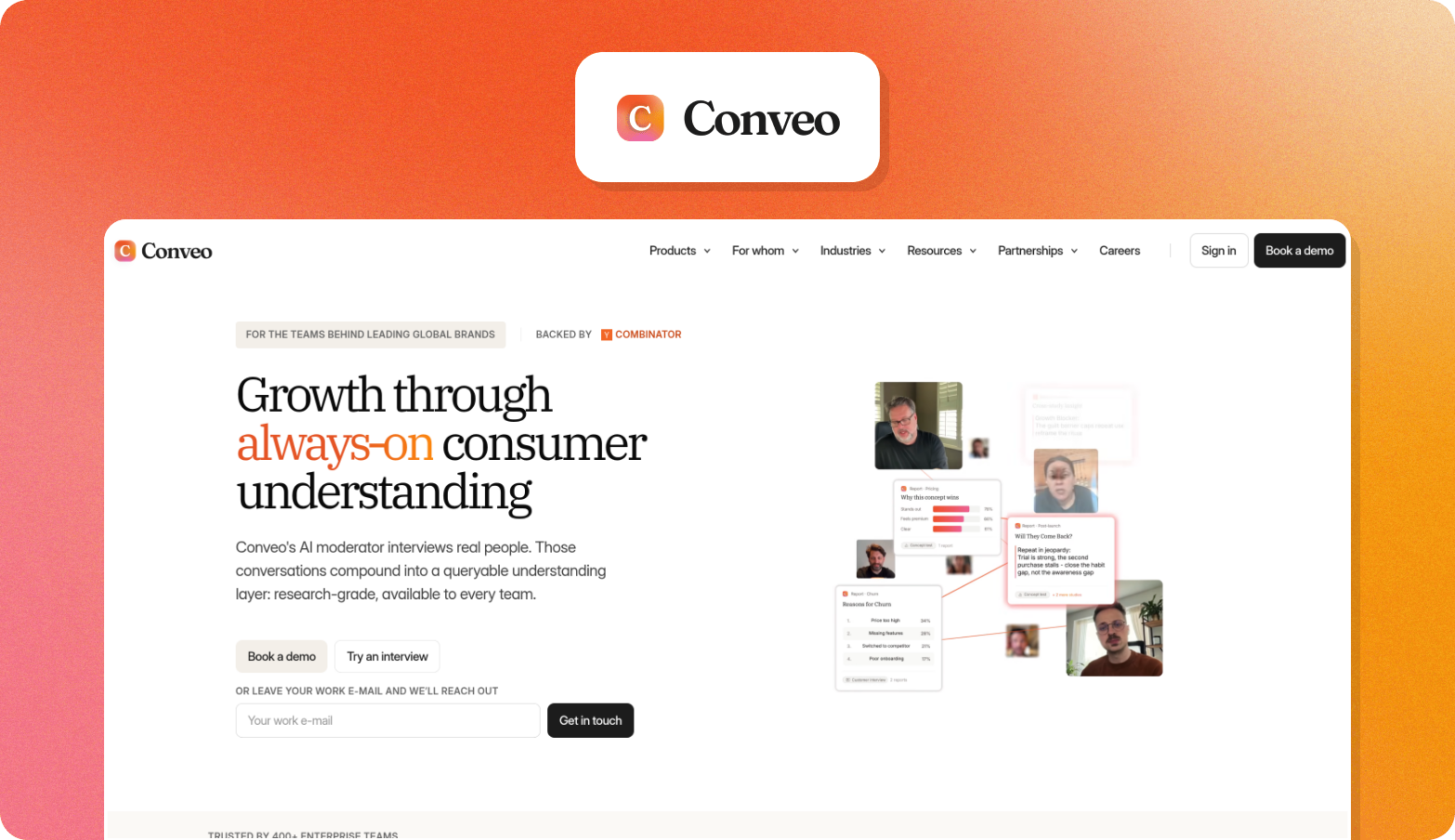
Conveo is a consumer insights platform built for always-on customer understanding, used by insights teams at companies including Google and Canva. Every finding on the platform traces back to a real participant.
Conveo runs asynchronous AI-moderated interviews in 50+ languages. The AI moderator asks follow-up questions based on what a participant says, rather than working through a fixed script, so a session can go deeper on an unexpected answer instead of moving past it. Every finding is traceable to a real participant, with a timestamped video clip and a quote, and past studies feed a searchable insight library. Findings remain accessible across projects rather than sitting in a folder that someone has to track down.
For questions you need answered continuously rather than once, Conveo StoryLines runs research as an ongoing program in waves. Each wave codes the new interviews, runs statistical tests across the time series to detect meaningful shifts, and combines these signals into insights that are automatically delivered as reports, quote reels, and slides. Rather than a snapshot that ages, teams get a living read on how consumer thinking is moving, with each wave building on the last.
Compliance: Conveo is SOC 2 Type II certified, GDPR compliant, and offers regional data hosting, which addresses the three requirements enterprise procurement asks about most. Qualitative work that traditionally took six weeks now takes about three days on Conveo.
Best for: Teams that need traceable, primary qualitative depth, delivered quickly enough to inform a decision before it's made.
Not for: Teams whose only need is large-scale online survey tracking, with no qualitative research.
2. Outset
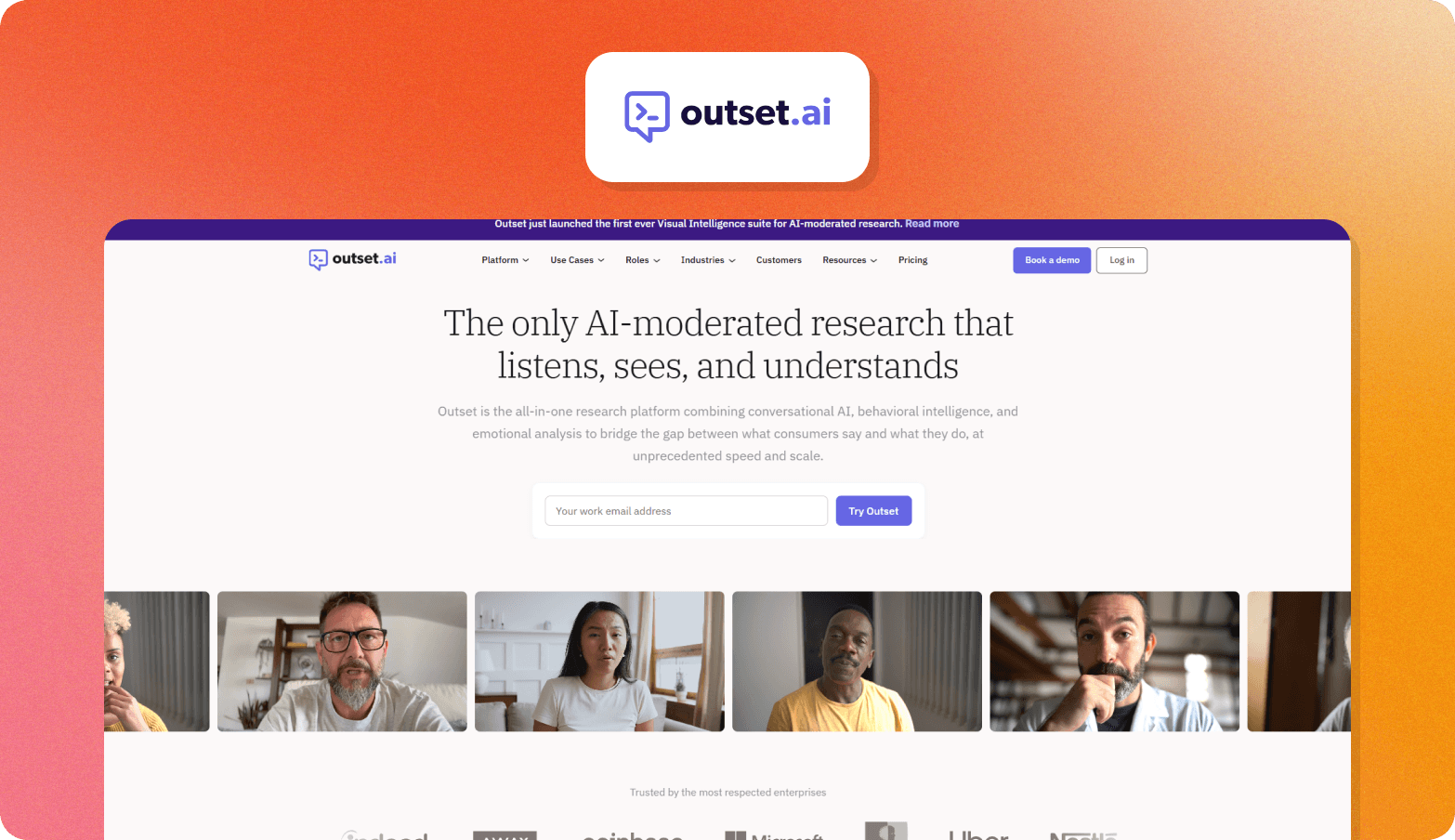
Outset is an AI research platform for running asynchronous interviews with real participants across video, voice, and text. Its AI interviewer asks follow-up questions based on each participant's answers, allowing teams to run hundreds of interviews in parallel across different markets and time zones.
Every finding links back to participant quotes and video clips, and the platform supports 40+ languages with automatic transcript translation.
Compliance: Outset is SOC 2 Type II certified and GDPR compliant, although it doesn't publicly confirm EU data hosting.
Best for: Product and UX teams running high-volume asynchronous discovery interviews that don't need native recruitment or a built-in insight library.
Limitation: Outset has no built-in cross-study library. Teams that want to connect findings across projects need a separate Dovetail integration, so those not already using Dovetail end up managing two tools instead of one.
3. Discuss.io
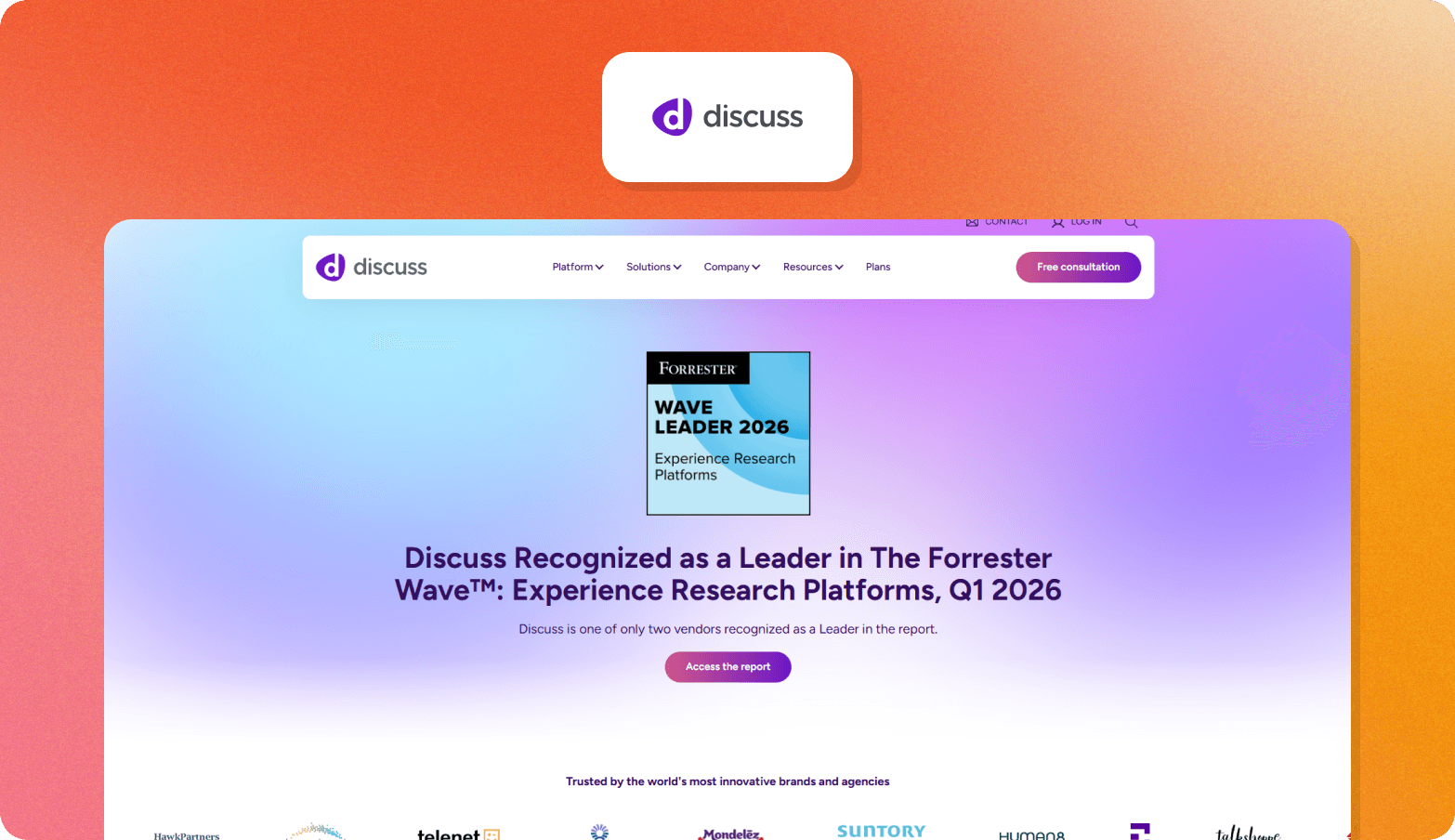
Discuss.io gives research teams the flexibility to run either AI-moderated or human-moderated interviews from the same platform. That makes it well suited to organizations running different types of qualitative studies across multiple markets and audiences.
Transcripts are synchronized with recorded video, and researchers can turn any highlighted quote into a timestamped video clip.
Compliance: The platform is GDPR compliant, but it doesn't publicly confirm SOC 2 certification and hosts customer data in Virginia, USA.
Best for: Enterprise market insights, CX, and UX teams that want the flexibility to choose between AI- and human-moderated interviews for each study.
Limitation: Organizations that require EU data hosting or bidirectional multilingual translation may find the platform less suitable.
Panel and Survey Platforms
Survey platforms let you collect structured responses at scale, either from your own audience or a built-in panel. They're useful for measuring broad patterns, but offer less insight into the reasoning behind each response.
4. Qualtrics
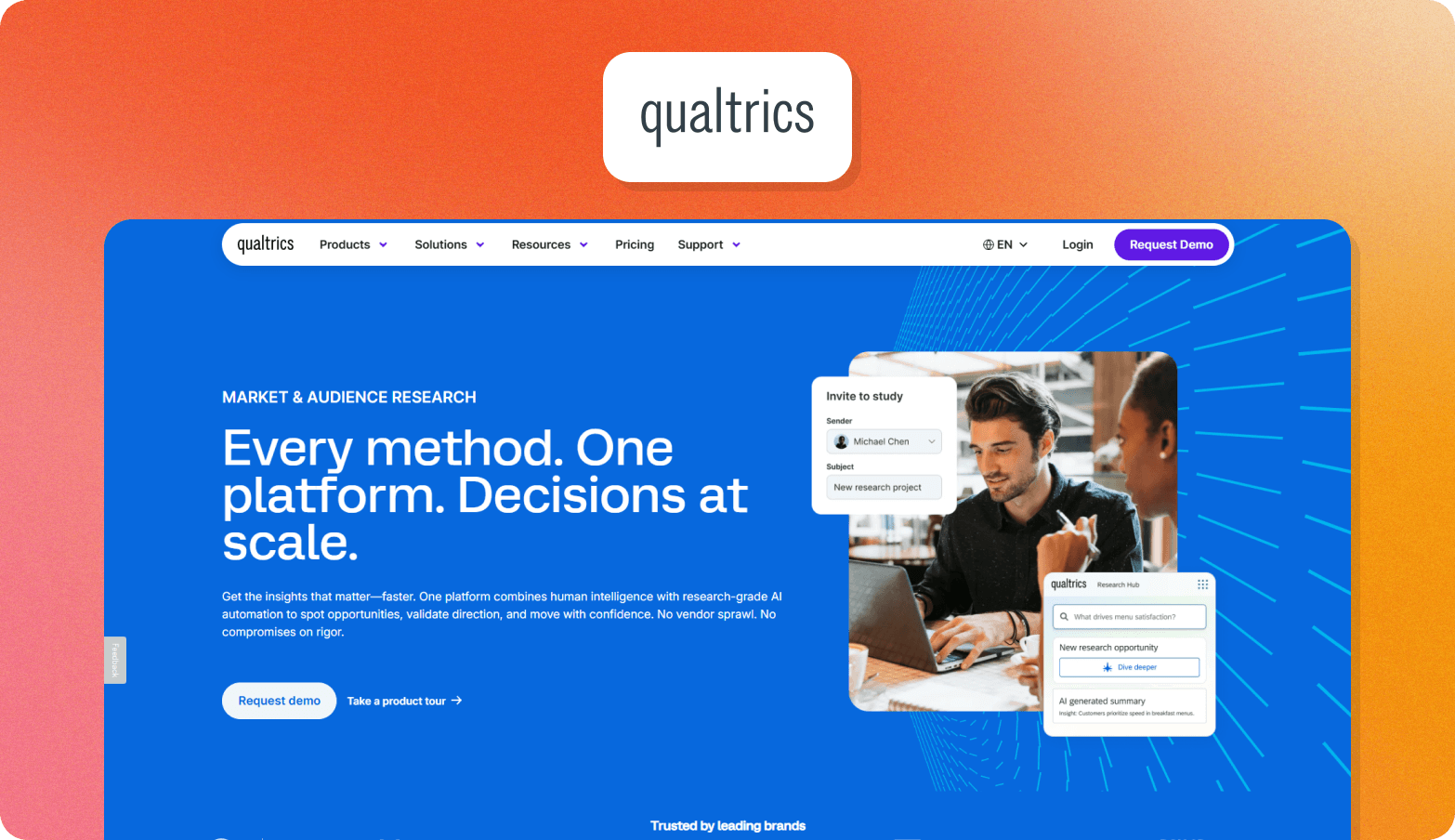
Qualtrics Strategy & Research is an enterprise survey platform for running large-scale consumer research. Teams can build and field their own studies, use research panels to recruit participants, and analyze results within the wider Qualtrics platform.
Qualtrics also supports video feedback and qualitative analysis. Teams can collect video responses, review transcripts and supporting quotes, and store research in a searchable Research Hub. Its AI can help design and analyze studies, but it doesn't conduct AI-moderated interviews that ask participants follow-up questions.
Compliance: Qualtrics is SOC 2 Type II certified, GDPR compliant, and offers EU data hosting.
Best for: Enterprise research teams running large-scale survey programs that want surveys integrated with a broader experience management platform.
Limitation: While Qualtrics supports qualitative research, it's built around surveys rather than AI-moderated interviews, so teams looking for conversational qualitative research may need a dedicated platform.
5. GWI
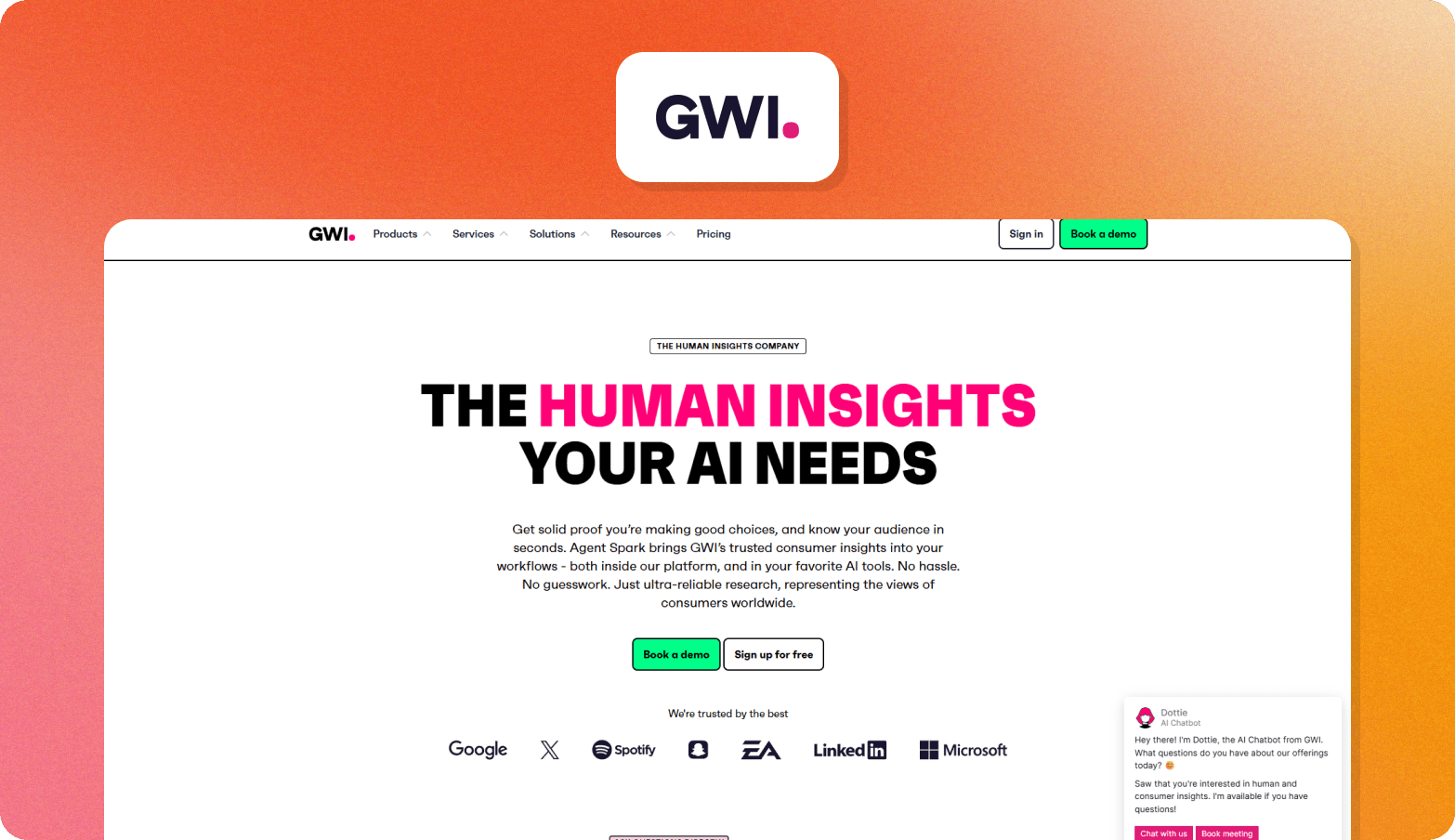
GWI gives teams access to a large global dataset built from its own consumer panel, covering more than 50 markets. Instead of running a new survey every time a question comes up, researchers can explore existing data on consumer demographics, attitudes, interests, and buying behavior through interactive dashboards and reports.
For questions not covered by its existing dataset, GWI also offers custom research and an AI assistant to help users explore survey data. Findings are based on aggregated survey responses rather than individual participant interviews, so they can't be traced back to a specific response.
Compliance: GWI doesn't publicly confirm SOC 2 certification or GDPR compliance.
Best for: Agencies, media companies, and brand teams that need fast access to consumer and market data across multiple countries.
Limitation: GWI is designed to answer questions using its existing panel data. If you need to interview your own customers or explore a new research question in depth, you'll need a platform that collects primary research.
6. Suzy
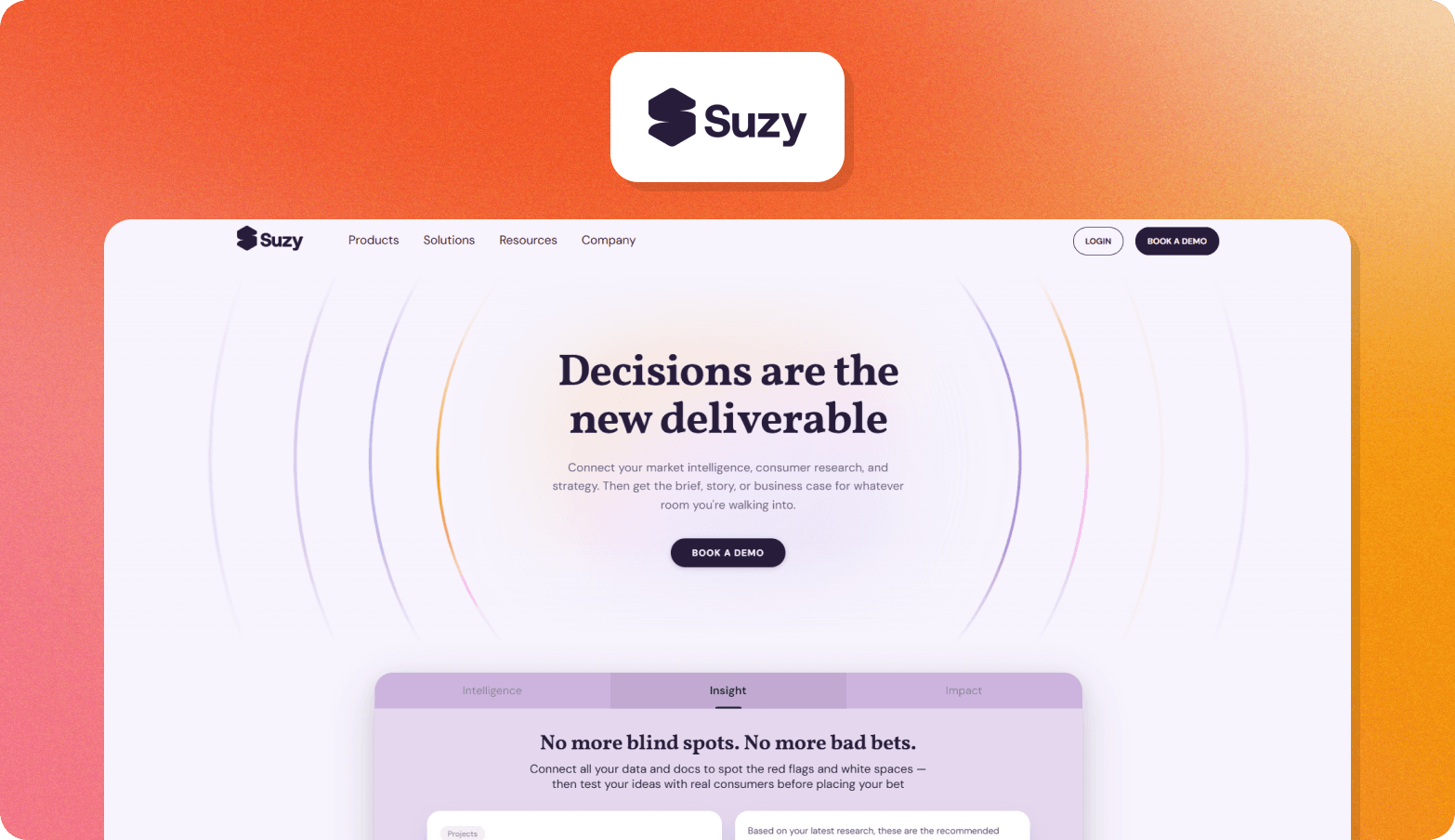
Suzy combines a built-in consumer panel with self-serve surveys, so teams can quickly get feedback from specific groups without recruiting participants separately. It also supports live interviews and AI-moderated voice interviews, giving teams a way to explore the reasons behind their survey results when they need more depth.
Interview findings link back to the original recording and transcript, while Suzy Insight makes past research searchable across studies. Suzy also monitors online consumer trends, giving brand teams another way to track shifting attitudes beyond their own research.
Compliance: Suzy is SOC 2-certified and GDPR-compliant, although data is processed and stored in the US rather than the EU.
Best for: Brand and insights teams in consumer industries that want survey research and access to a built-in panel, with qualitative research available when they need to dig deeper.
Limitation: Suzy doesn't offer EU data hosting, which may rule it out for organizations that require research data to remain in Europe.
Social Listening Platforms
Social listening platforms give teams a broader view of consumer sentiment and emerging trends, rather than answers to specific research questions.
7. Brandwatch
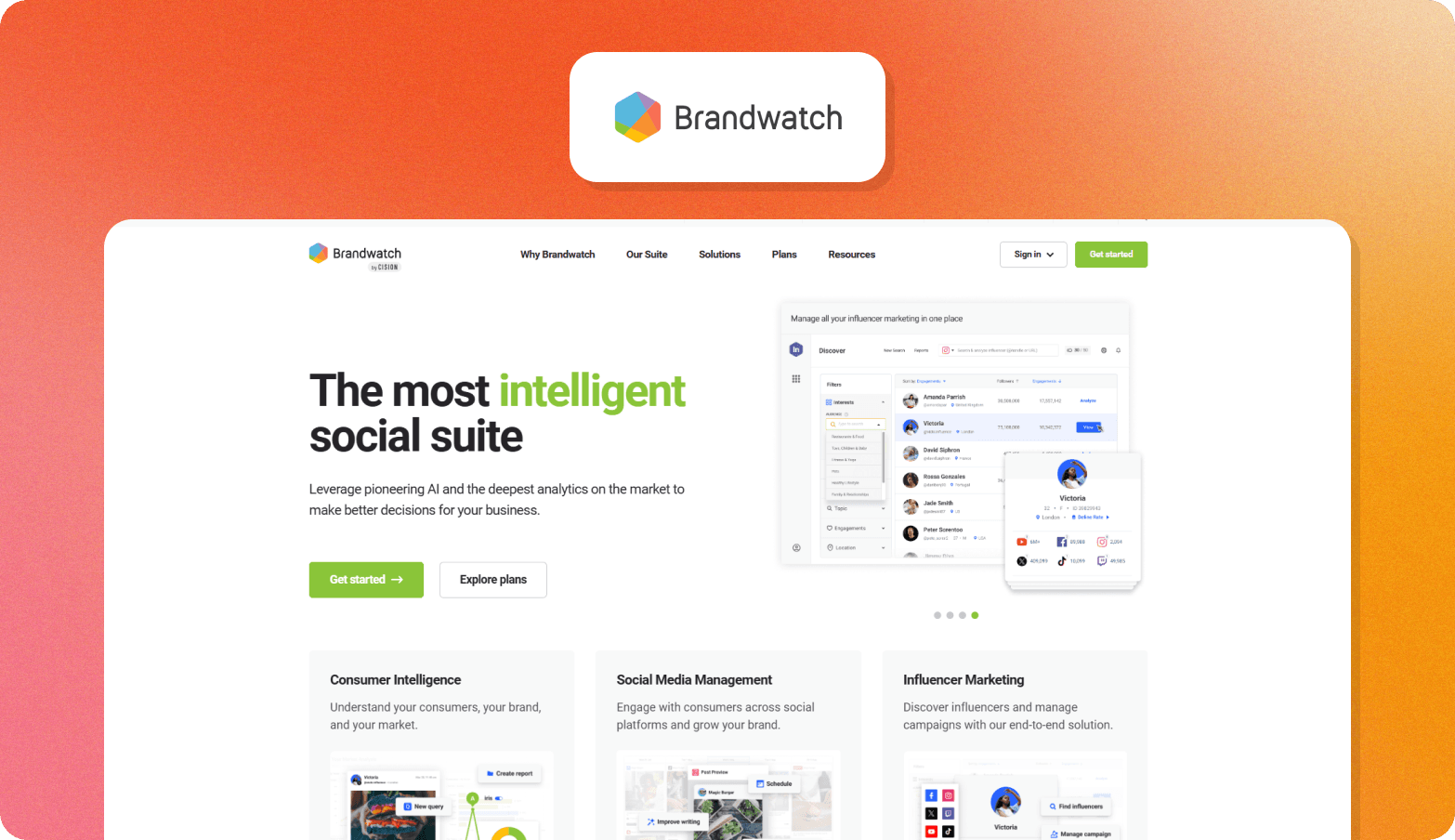
Brandwatch helps teams monitor what people say about their brand online, including on social media and review sites. It tracks mentions and sentiment in real time, making it easy to identify emerging trends or changes in public opinion as they happen.
Unlike consumer research platforms, Brandwatch analyzes conversations that are already happening rather than collecting feedback from recruited participants. That makes it useful for understanding public discussion, but not for answering questions that require direct customer research.
Compliance: Brandwatch doesn't publicly confirm SOC 2 certification, GDPR compliance, or its data hosting location.
Best for: Brand and communications teams that need real-time insights into public conversations and brand sentiment.
Limitation: Brandwatch can give you broad competitive intelligence, but it can't tell you whether online conversations reflect your target market or explain why people hold those views. For that, you'll need a platform that collects feedback directly from participants.
Compliance Questions to Ask Before You Shortlist a Platform
Once you've narrowed your shortlist, check whether each platform meets your company's compliance requirements:
Where is participant data stored? If your organization has data residency requirements, hosting in the wrong region may rule out the platform.
Is the platform SOC 2 Type II certified? Many enterprise organizations require this before approving a new vendor.
Is it GDPR compliant? If you collect personal data from participants, you need to know the platform handles it appropriately.
Does it support single sign-on (SSO)? SSO can be a requirement for secure access and user management in larger organizations.
How can participant data be deleted? You should be able to remove personal data when participants request it.
Which third parties process the data? Sub-processors affect where participant data goes and who can access it.
Is participant data used to train AI models? Some organizations won't allow research data to be used for model training, so it's important to understand the vendor's policy.
Asking these questions early can save weeks of back-and-forth later, especially if a platform turns out to be a poor fit for your organization's policies.
How to Move from One-Off Studies to Continuous Consumer Research
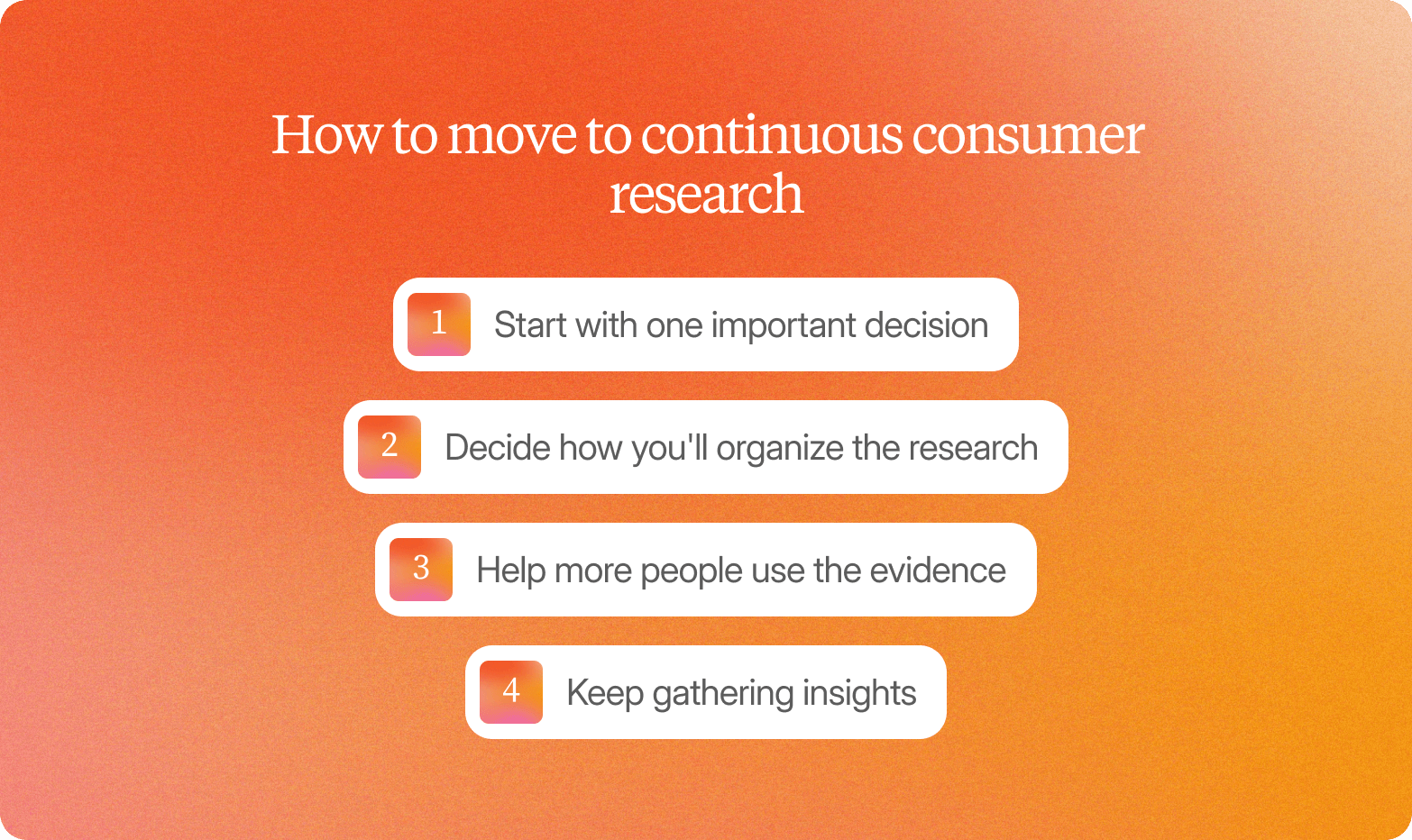
Most research teams don't switch from occasional projects to continuous brand research overnight. The easiest approach is to start with one important decision, build a repeatable process, and expand from there.
1. Start With One Important Decision
Choose a decision where your team needs to understand what customers think or why they behave a certain way, but doesn't have enough evidence to answer confidently. You might be deciding which product problem to prioritize, for example, or trying to understand why customers are leaving.
Start by using continuous research to support that one decision. Once the process is working, you can apply it to other questions across the business.
2. Decide How You'll Organize The Research
If you're running research continuously, each new study should add to what your team already knows. Decide where interviews and findings will live, and agree on simple naming and tagging rules so people can find relevant evidence later, rather than starting from scratch.
Conveo does this through a searchable research library. Every completed study is added automatically, so teams can search across past interviews and findings as the evidence base grows.
3. Help More People Use The Evidence
As you run more research, your research team shouldn't become the bottleneck between the evidence and the people making decisions. Give stakeholders access to the research and show them how to check the participant evidence behind a finding for themselves.
This makes it easier for teams to use new findings as they become available, without waiting for a researcher to turn every study into a presentation or answer every follow-up question.
4. Keep Gathering Insights
Once the process is working, keep interviews running regularly rather than treating each question as a separate research project. This gives your team a steady flow of current customer evidence and lets you explore new questions as priorities change.
Because AI-moderated interviews can run continuously and at scale, you can build this ongoing research capacity without needing your research team to moderate every conversation themselves.
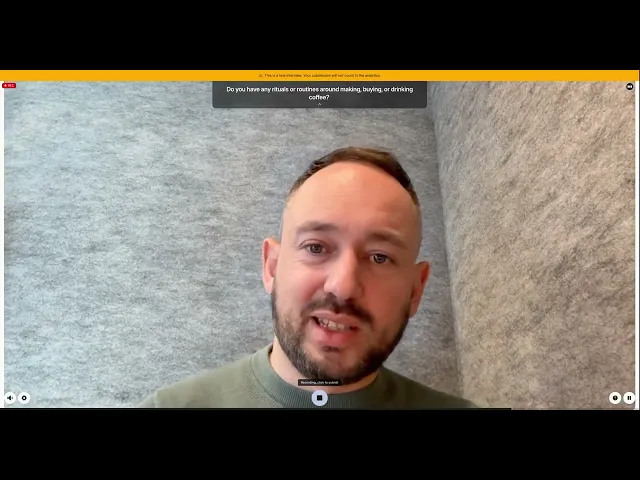
See the difference: How AI-Moderated Interviews Actually Work
When Conveo Isn’t the Right Fit
Conveo is designed for teams that need to understand why customers think and behave the way they do. If that's not the problem you're trying to solve, another type of platform may be a better fit.
You Mainly Run Large-Scale Surveys
If your research primarily involves tracking scores or measuring trends across thousands of people, a traditional survey or consumer panel platform is likely a better choice. Those platforms are built for high-volume quantitative research, while Conveo focuses on qualitative interviews.
You Need To Monitor Public Conversations Online
Conveo only analyzes research you run with your own participants. If your goal is to monitor public discussions about your brand or your brand reputation, look for consumer sentiment research platforms or social listening platforms instead.
A Quick Answer Is Good Enough
Conveo is built for decisions where you need to understand the reasoning behind customer feedback and trace every research finding back to the original participant. If you're only looking for a quick directional answer and don't need that level of evidence or consumer intelligence, a simpler tool may be a faster, more cost-effective solution for your market research needs.
For teams that do need qualitative research backed by evidence they can trust, those same differences are what make Conveo stand out.
"The pace, responsiveness, and research expertise of the Conveo team, on top of the top AI-moderated qual platform, have been invaluable to us in scaling brand advertising internationally."
Matt Harris, Research & Insights Lead at Canva
Why Teams Choose Conveo For Continuous Consumer Insights
Conveo is designed to solve some of the biggest challenges in consumer research, from slow turnaround times to findings that are difficult to verify or reuse. Here’s why over 400 enterprises trust Conveo:
Research that arrives in time. Research is only useful if it reaches the people making the decision before they've moved on. Conveo helps teams complete studies in days, providing valuable insights that shape the outcome rather than explain it afterward.
Evidence you can trust. Conveo is built and run by senior researchers, and every finding links back to a real participant through a timestamped video clip and quote. When someone asks, "Where did this finding come from?", the answer is the original interview, not an AI-generated summary.
A research library that grows over time. Every completed study becomes part of a searchable insight library. Over time, it becomes a record of what customers have already told you, giving every new project a stronger starting point.
Built for enterprise buying. Conveo is SOC 2-certified, GDPR-compliant, and offers regional data hosting. Those are common requirements for enterprise procurement, helping security and compliance reviews move more smoothly.
Fast enough to keep up with the business. Traditional agency research can take around six weeks. Conveo reduces that to about three days, making it practical to bring customer evidence into decisions while there's still time to act on it.
Frequently Asked Questions
What is a consumer research platform?
A consumer research platform helps businesses understand consumer behavior, opinions, and needs. Depending on the platform, it might collect qualitative data through interviews, run surveys or panel research, or track consumer trends through social listening.
What are the best consumer research platforms?
The best market research tools depend on your research needs. Conveo is a strong choice for qualitative research, while Qualtrics focuses on surveys. GWI and Suzy support panel research, while Brandwatch specializes in social listening and sentiment analysis.
Are there free consumer research platforms?
Some survey platforms offer free plans with basic data collection and analysis features. Most enterprise market research platforms don't, because pricing often depends on research volume, participant recruitment, and the features included.
What is the difference between consumer research software and consumer research tools?
In most cases, there isn't one. The terms are often used interchangeably to describe software that supports the consumer research process, from data collection through to analysis.
How do AI platforms for consumer research ensure reliable results?
The strongest AI-powered platforms connect their findings to the original consumer feedback, such as a video clip or transcript. Researchers can check the evidence behind an insight instead of relying on an AI-generated summary alone.
Can we trust AI analysis for business decisions?
AI analysis is most useful when the research outcomes are backed by evidence you can review. Platforms that connect findings to participant responses make it easier to verify conclusions and share reliable, actionable insights with stakeholders.

About the author
Alex de Hemptinne
Business Impact Lead
Alex is a Business Impact Lead at Conveo, partnering with enterprise teams to embed AI-led research into their workflows. From the first study to full-scale rollout, she helps customers shift from project-based research to continuous customer intelligence.
Meet Alex on film →Qualitative insights at the speed of your business.
Conveo runs AI-moderated video interviews and structures everything they say.